

AI and prior knowledge
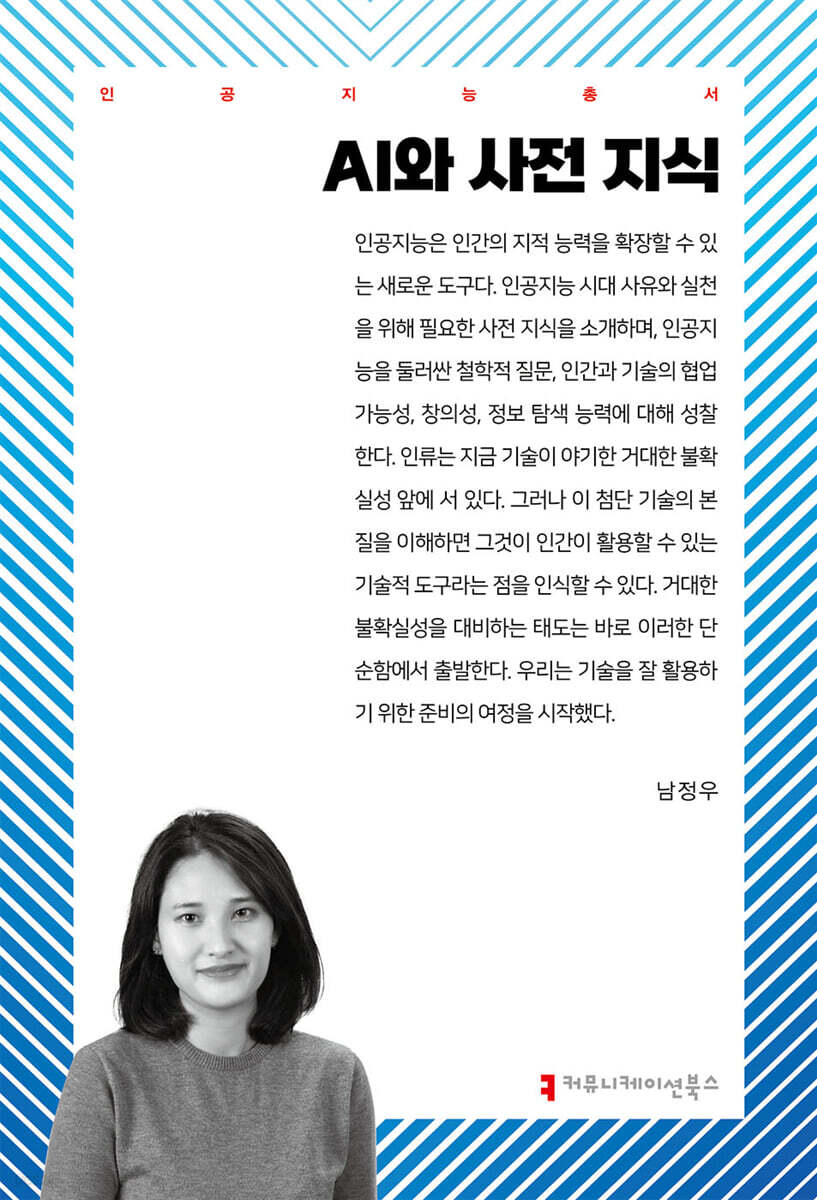 |
Description
Book Introduction
Humans call themselves 'Homo Faber' and consider tools to be the core of their essence.
To effectively utilize artificial intelligence technology as a tool, prior knowledge is essential above all else.
It philosophically explores the foundation of awareness and understanding that users must have in advance.
To effectively utilize artificial intelligence technology as a tool, prior knowledge is essential above all else.
It philosophically explores the foundation of awareness and understanding that users must have in advance.
- You can preview some of the book's contents.
Preview
index
New tools
01 Background knowledge of artificial intelligence
02 Human prior knowledge
03 Technical Knowledge
04 Technical Ability
05 Expertise
06 Collaboration and Prior Knowledge
07 Creativity and Prior Knowledge
08 Ask a question
09 Judging
10 Apply
01 Background knowledge of artificial intelligence
02 Human prior knowledge
03 Technical Knowledge
04 Technical Ability
05 Expertise
06 Collaboration and Prior Knowledge
07 Creativity and Prior Knowledge
08 Ask a question
09 Judging
10 Apply
Into the book
Seeing that the language understanding and generation abilities we have been performing without thinking are only just being replicated with billions of parameters and high-performance computing gives us a new perspective on human cognitive abilities.
This is where the paradox of understanding humans again through artificial intelligence begins.
I hope this chapter will leave you amazed at the intricacies of artificial intelligence and awed by the sophistication of human functioning.
--- From "01_Background Knowledge of Artificial Intelligence"
Prior knowledge refers to the experiences and cognitive structures that a person already has, and the ability to understand and apply new information through these.
And the composition is not limited to the simple act of 'putting in' knowledge.
The construction of prior knowledge is a process that includes the ability to ‘utilize’ knowledge.
Human prior knowledge is not simply an accumulation of information, but a cognitive foundation that can interpret information and apply it to new situations.
--- From "02_Human Prior Knowledge"
As a concrete example, let's assume a situation where a chef uses a tool called a knife. The chef will use the knife to prepare the ingredients for cooking.
But just because a chef knows how to use a knife doesn't mean he knows all the alloy components or manufacturing processes of the knife.
Likewise, we can leverage AI without needing to know all the details of its internal implementation.
However, just as learning how to use a sword well requires understanding the basic principles, philosophy, and flow of technology to use AI well.
--- From "03_Technical Knowledge"
Expertise is knowledge that can be refined and built over a long period of time, and can be acquired by investing time and renewing oneself through repeated, deliberate practice.
This is where we find the distinction between AI and humans. While AI improves through developer updates, humans improve their performance by evolving themselves.
The ability to build expertise beyond prior knowledge is a human strength.
And it is expected that the specialized knowledge accumulated in this way can become a unique domain of humans.
This is where the paradox of understanding humans again through artificial intelligence begins.
I hope this chapter will leave you amazed at the intricacies of artificial intelligence and awed by the sophistication of human functioning.
--- From "01_Background Knowledge of Artificial Intelligence"
Prior knowledge refers to the experiences and cognitive structures that a person already has, and the ability to understand and apply new information through these.
And the composition is not limited to the simple act of 'putting in' knowledge.
The construction of prior knowledge is a process that includes the ability to ‘utilize’ knowledge.
Human prior knowledge is not simply an accumulation of information, but a cognitive foundation that can interpret information and apply it to new situations.
--- From "02_Human Prior Knowledge"
As a concrete example, let's assume a situation where a chef uses a tool called a knife. The chef will use the knife to prepare the ingredients for cooking.
But just because a chef knows how to use a knife doesn't mean he knows all the alloy components or manufacturing processes of the knife.
Likewise, we can leverage AI without needing to know all the details of its internal implementation.
However, just as learning how to use a sword well requires understanding the basic principles, philosophy, and flow of technology to use AI well.
--- From "03_Technical Knowledge"
Expertise is knowledge that can be refined and built over a long period of time, and can be acquired by investing time and renewing oneself through repeated, deliberate practice.
This is where we find the distinction between AI and humans. While AI improves through developer updates, humans improve their performance by evolving themselves.
The ability to build expertise beyond prior knowledge is a human strength.
And it is expected that the specialized knowledge accumulated in this way can become a unique domain of humans.
--- From "05_Professional Knowledge"
Publisher's Review
Prior knowledge holds the key to leveraging AI.
Humans have liberated themselves from the physical constraints of nature through tools.
Unlike existing tools that enabled physical extensions of humanity, how should we handle AI, which enables cognitive extensions? AI is now positioned as a multipurpose tool that interprets and judges human language, even producing creative output.
However, to properly utilize this powerful tool, the user's 'prior knowledge' is essential.
"AI and Prior Knowledge" views artificial intelligence as a "tool" rather than a technology in itself, and examines the prerequisites we must know in advance to effectively use it.
When AI functions not simply as a machine that executes commands, but as a being that interacts with human thought and produces results, what kind of knowledge and understanding must humans possess? This book closely explores the conditions for tool use, crossing the perspectives of philosophy, technology, and user experience.
In the age of artificial intelligence, what we need to prepare first to use tools effectively is human cognition, rather than the tools themselves.
Humans have liberated themselves from the physical constraints of nature through tools.
Unlike existing tools that enabled physical extensions of humanity, how should we handle AI, which enables cognitive extensions? AI is now positioned as a multipurpose tool that interprets and judges human language, even producing creative output.
However, to properly utilize this powerful tool, the user's 'prior knowledge' is essential.
"AI and Prior Knowledge" views artificial intelligence as a "tool" rather than a technology in itself, and examines the prerequisites we must know in advance to effectively use it.
When AI functions not simply as a machine that executes commands, but as a being that interacts with human thought and produces results, what kind of knowledge and understanding must humans possess? This book closely explores the conditions for tool use, crossing the perspectives of philosophy, technology, and user experience.
In the age of artificial intelligence, what we need to prepare first to use tools effectively is human cognition, rather than the tools themselves.
GOODS SPECIFICS
- Date of issue: July 11, 2025
- Page count, weight, size: 114 pages | 128*188*7mm
- ISBN13: 9791143005328
You may also like
카테고리
korean


korean

![ELLE 엘르 A형 (여성월간) : 1월 [2026]](http://librairie.coreenne.fr/cdn/shop/files/3b70e1cf77cf67d6da56e0eb041901e8.jpg?v=1767265322&width=3840)


