

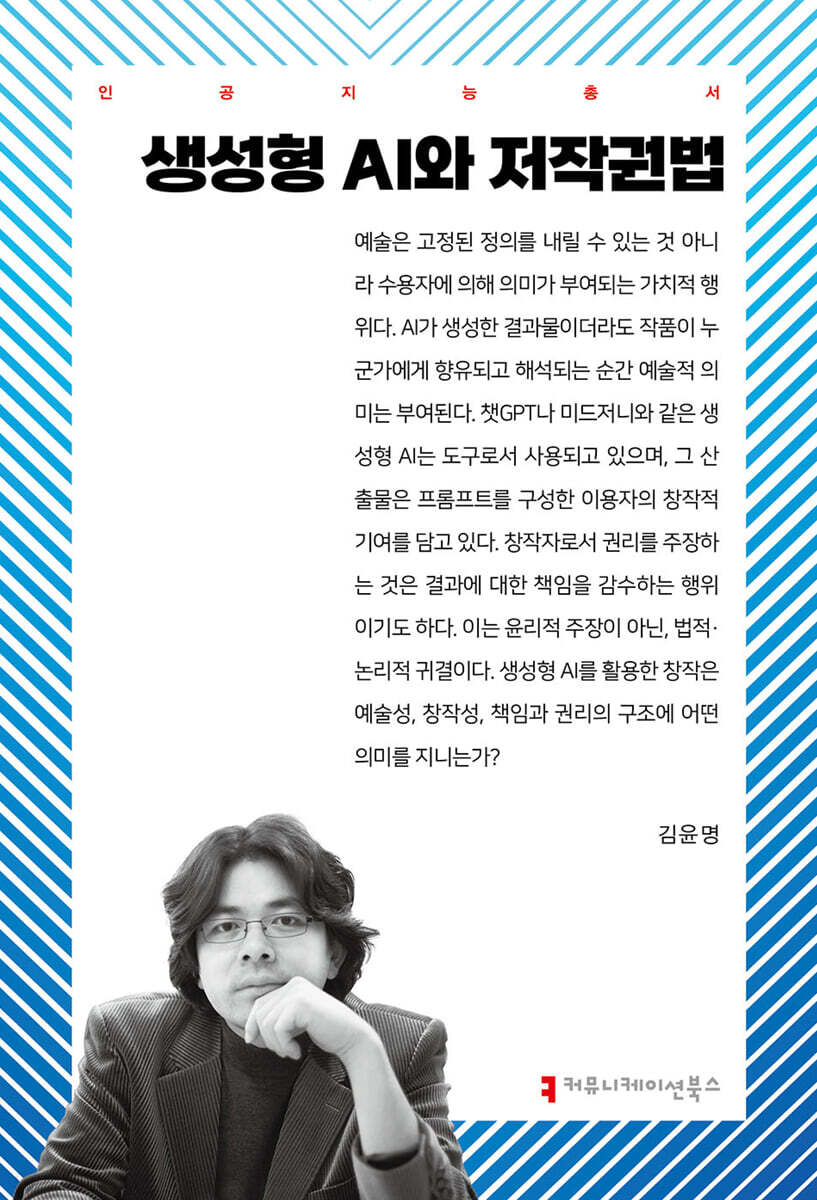
Generative AI and Copyright Law
 |
Description
Book Introduction
Who owns the copyright to AI-generated content? From prompt input to the rights to the resulting output, this in-depth exploration explores how law and ethics should respond in this new era of creation.
Artificial Intelligence Encyclopedia.
You can find the artificial intelligence knowledge you need at aiseries.oopy.io.
Artificial Intelligence Encyclopedia.
You can find the artificial intelligence knowledge you need at aiseries.oopy.io.
- You can preview some of the book's contents.
Preview
index
Why generative AI and copyright law?
01 Generative AI
02 Training data
03 Machine Learning
04 Prompt Creation: Creative Contribution
05 Legal nature of the product
06 Generative AI Creation and Authorship
07 Copyright Infringement
08 Copyright and Ethics: Watermarks and Markings
09 Service Provider Responsibilities
10 Implications
01 Generative AI
02 Training data
03 Machine Learning
04 Prompt Creation: Creative Contribution
05 Legal nature of the product
06 Generative AI Creation and Authorship
07 Copyright Infringement
08 Copyright and Ethics: Watermarks and Markings
09 Service Provider Responsibilities
10 Implications
Into the book
A Foundation Model, also known as a large language model (LLM), is an AI model that is pre-trained based on a large data set.
With the recent advancement of deep learning technology, pre-trained models using large amounts of data have been created, which are called foundation models.
The foundation model is utilized in various fields and shows excellent performance in various fields such as natural language processing, image recognition, and speech recognition.
For example, GPT-3 is one of the foundation models that shows world-class performance in the field of natural language generation.
Because it is trained using a large data set, it can learn various data distributions and patterns.
This allows it to generalize to new tasks, and through a fine-tuning process, it often achieves high performance even with small data sets.
Recently, it has been made easy to use by utilizing public codes or models, so it can be utilized in various fields.
--- From "01_Generative AI"
Machine learning is the way AI analyzes and learns data on its own.
The data used for learning can be autonomously selected by AI or specified by developers or service providers.
If the data used for learning is a copyrighted work, this constitutes an act of using the copyrighted work.
During this process, various data are stored in system memory, etc., and replication activities, including temporary replication, occur.
Temporary reproduction is generally exempt from liability under certain conditions, but in principle, it can become an issue of infringement of reproduction rights.
--- From "03_Machine Learning"
Since the Supreme Court and academic doctrines consistently limit the definition of a work to “human” effort, results created by AI, not humans, are denied copyrightability.
However, if the meaning of 'human' can be interpreted not only as something directly created by humans but also as something directly or indirectly related to humans, there is no reason why the results produced by AI cannot be seen as expressions of human thoughts and emotions, as they are also created or produced by AI by humans.
Therefore, depending on how the term ‘human’ is interpreted, there is room for AI products to be recognized as copyrightable works.
It is technically a product of human involvement, as it is software coded by humans and data-based machine learning is also performed by humans.
Additionally, it is difficult to view learning data as not being an expression of human thoughts and emotions, as it is information containing human thoughts and emotions.
--- From "06_Generative AI Creation and Authors"
Recognizing service providers as CPs should be avoided.
This is because the act of creating something through a prompt should be viewed as a factual act by the user, not as a creation by the service provider.
From the perspective of an online service provider, if a generative AI service creates or provides new content based on data provided by users, the service can be considered an online service provider that provides hosting or relay functions for content uploaded by users.
The Digital Millennium Copyright Act limits the liability of online service providers, and the DMCA's liability limitation provisions may shield online service providers from liability for copyright infringement in content uploaded by users.
With the recent advancement of deep learning technology, pre-trained models using large amounts of data have been created, which are called foundation models.
The foundation model is utilized in various fields and shows excellent performance in various fields such as natural language processing, image recognition, and speech recognition.
For example, GPT-3 is one of the foundation models that shows world-class performance in the field of natural language generation.
Because it is trained using a large data set, it can learn various data distributions and patterns.
This allows it to generalize to new tasks, and through a fine-tuning process, it often achieves high performance even with small data sets.
Recently, it has been made easy to use by utilizing public codes or models, so it can be utilized in various fields.
--- From "01_Generative AI"
Machine learning is the way AI analyzes and learns data on its own.
The data used for learning can be autonomously selected by AI or specified by developers or service providers.
If the data used for learning is a copyrighted work, this constitutes an act of using the copyrighted work.
During this process, various data are stored in system memory, etc., and replication activities, including temporary replication, occur.
Temporary reproduction is generally exempt from liability under certain conditions, but in principle, it can become an issue of infringement of reproduction rights.
--- From "03_Machine Learning"
Since the Supreme Court and academic doctrines consistently limit the definition of a work to “human” effort, results created by AI, not humans, are denied copyrightability.
However, if the meaning of 'human' can be interpreted not only as something directly created by humans but also as something directly or indirectly related to humans, there is no reason why the results produced by AI cannot be seen as expressions of human thoughts and emotions, as they are also created or produced by AI by humans.
Therefore, depending on how the term ‘human’ is interpreted, there is room for AI products to be recognized as copyrightable works.
It is technically a product of human involvement, as it is software coded by humans and data-based machine learning is also performed by humans.
Additionally, it is difficult to view learning data as not being an expression of human thoughts and emotions, as it is information containing human thoughts and emotions.
--- From "06_Generative AI Creation and Authors"
Recognizing service providers as CPs should be avoided.
This is because the act of creating something through a prompt should be viewed as a factual act by the user, not as a creation by the service provider.
From the perspective of an online service provider, if a generative AI service creates or provides new content based on data provided by users, the service can be considered an online service provider that provides hosting or relay functions for content uploaded by users.
The Digital Millennium Copyright Act limits the liability of online service providers, and the DMCA's liability limitation provisions may shield online service providers from liability for copyright infringement in content uploaded by users.
--- From "09_Service Provider Responsibilities"
Publisher's Review
In the AI era, questioning the boundaries between creativity and law.
Who holds legal rights to text and images created by generative AI? In an era where generative AI is deeply involved in the creative process, this question directly asks how the nature and standards of copyright should change.
Is the output produced by AI based on human input truly creative? Who owns the rights to AI's training data?
This book addresses the black-box limitations of AI, starting from human-centered values and the principles of legal responsibility and closely analyzing issues such as prompt creation, algorithm disclosure, and protection period limitations.
Through ten chapters, it carefully examines the technical structure of generative AI, the scope of copyright law, and the potential for social consensus, and proposes how law and ethics can be harmoniously designed in the future.
It contains insights that artists, developers, and lawyers alike need.
Who holds legal rights to text and images created by generative AI? In an era where generative AI is deeply involved in the creative process, this question directly asks how the nature and standards of copyright should change.
Is the output produced by AI based on human input truly creative? Who owns the rights to AI's training data?
This book addresses the black-box limitations of AI, starting from human-centered values and the principles of legal responsibility and closely analyzing issues such as prompt creation, algorithm disclosure, and protection period limitations.
Through ten chapters, it carefully examines the technical structure of generative AI, the scope of copyright law, and the potential for social consensus, and proposes how law and ethics can be harmoniously designed in the future.
It contains insights that artists, developers, and lawyers alike need.
GOODS SPECIFICS
- Date of issue: July 11, 2025
- Page count, weight, size: 125 pages | 128*188*8mm
- ISBN13: 9791143005236
You may also like
카테고리
korean


korean

![GQ KOREA Mark (Monthly): December [2025]](http://librairie.coreenne.fr/cdn/shop/files/8ef265dbbfbf186523ed75ba7319009d.jpg?v=1765340328&width=3840)


