

Songline
 |
Description
Book Introduction
"Songline" is a travelogue written by Chatwin while walking along the "Songline," an invisible path considered a "dream trail" by the Australian Aboriginal people. It is his second travelogue and the last work published in his life.
In terms of content, this book is largely divided into two parts.
Up until the middle of the story, he meets many people and visits many places with the help of Arkady, a Russian man with close ties to the Australian Aboriginal people, and learns about the song maps called 'Songlines', a unique way for the Aboriginal people to perceive the land.
From the middle part onwards, Chatwin's notes, quotations, and short travel sketches he had written while contemplating a 'book about nomads' appear alternately with his records of his trip to Australia.
The value of the 'nomad' lifestyle that he consistently advocated during his lifetime, which he passed away at the young age of 48, reaches its peak in his last book, 'Songline'.
Chatwin believed that the Aboriginal creation myth contained the ultimate beauty that a 'nomad' lifestyle could dream of and enjoy.
And while traveling through Australia's 'Songline', he continues his journey of re-experiencing and confirming his reflections on 'nomad', which he has long been obsessed with.
In terms of content, this book is largely divided into two parts.
Up until the middle of the story, he meets many people and visits many places with the help of Arkady, a Russian man with close ties to the Australian Aboriginal people, and learns about the song maps called 'Songlines', a unique way for the Aboriginal people to perceive the land.
From the middle part onwards, Chatwin's notes, quotations, and short travel sketches he had written while contemplating a 'book about nomads' appear alternately with his records of his trip to Australia.
The value of the 'nomad' lifestyle that he consistently advocated during his lifetime, which he passed away at the young age of 48, reaches its peak in his last book, 'Songline'.
Chatwin believed that the Aboriginal creation myth contained the ultimate beauty that a 'nomad' lifestyle could dream of and enjoy.
And while traveling through Australia's 'Songline', he continues his journey of re-experiencing and confirming his reflections on 'nomad', which he has long been obsessed with.
- You can preview some of the book's contents.
Preview
Publisher's Review
Travel literature is divided into before and after Bruce Chatwin!─The Guardian
Patagonia: A Travelogue of Patagonia, the End of the World and Land of Exiles
The Origin of Nomadism: A Travelogue of Australia, a Sanctuary for Wanderers, "Songline"
Finally, we meet Bruce Chatwin, the legendary wanderer who ushered in a new era in travel literature.
"At the end of the world, a museum documenting the beginning of the world." - Hong Eun-taek
"Fluent sentences, novel-like structure, a textbook travelogue." ─ Lee Sang-yeop
"It sweeps the gaze and the heart as deeply as a stunning black-and-white photo album." ─ Lee Byeong-ryul
“The writer who captured the world on a few sheets of paper”—John Updike
"I found myself filling the book with exclamation marks and highlighting." ─ Luis Sepúlveda
"A powerful snapshot, a powerful allure"—Colin Serron
“Writing about wandering was Chatwin’s eternal task and vocation.” —Salman Rushdie
■ Bruce Chatwin: Why He Was a "New Era in Travel Literature"
British author Bruce Chatwin wrote two travelogues (in addition to his novels) during his lifetime.
『In Patagonia』 published in 1977 and 『Songlines』 published in 1987.
Chatwin was evaluated as a 'new era in travel literature' not later, but right from the time he published his first book, 'Patagonia'.
The editor who had obtained the manuscript from the author's publishing agent and was considering publishing it in the US wrote this after reading the manuscript for the first time:
“[Encountering this manuscript] was one of the ten most thrilling ‘events’ I’ve experienced in my publishing career.
“This was completely different from any other author’s manuscript I’ve reviewed so far.”
As soon as 『Patagonia』 was published, it was in the book reviews every day.
However, the reviews that should have accurately identified the core and character of the book were full of 'confusion'.
Controversy arose over questions such as, 'Are these contents true, slightly fictional, or completely fictional?' and 'What genre should we call this book?'
Some bookstores even create new shelves just for this book.
And that bookshelf was named 'New Nonfiction Corner'.
Amidst these controversies, Chatwin explained:
“I once did an experiment in Patagonia where I counted each and every one of the things that were considered lies.
The results weren't too bad.
“It hasn’t been that long,” he said in another interview.
“Everything in this book is based on real events.
Of course, the order is a bit different.” And Nicholas Shakespeare, who wrote the biography of Bruce Chatwin, Bruce Chatwin, tried to put an end to the controversy by defending Chatwin with the following words:
“Generally speaking, he did not tell half-truths, but added half-truths to the truth.
His true achievement lies not in describing Patagonia as it is, but in creating a new way of exploring, a new aspect of the world, along with the landscape that is Patagonia.
And in the process, he transformed himself.”
These are the very phenomena that occurred when Chatwin's Patagonia was published.
Despite a series of setbacks, interest in Chatwin's unusual travelogue remained undiminished.
The book, which also received enthusiastic responses from critics, won the Hawthornden Medal, the most prestigious literary award in Britain, and the E.
He soon won the 'M. Poster Award'.
And finally, The Guardian wrote:
“Travel literature is divided into before and after Bruce Chatwin.”
Chatwin is undoubtedly one of the most creative travel writers of all time.
This is because he “did not simply see, hear, and feel the places he traveled to, but created every space he arrived at as a land imbued with travel.”
That's not just rhetoric.
For example, the village of Gaiman in Patagonia, which was nothing more than a "dreary village of faded red brick houses" and not even clearly marked on maps in the 1970s when Chatwin first visited it, is said to now even have a cruise ship operating to pick up travelers who come to visit after reading Chatwin's book.
The locals say this:
“For the gringos (slang for white people of Anglo-American descent) who come here carrying ‘Patagonia’, that book should be called the ‘Bible.’” Patagonia, which used to be just a barren and rough land, is now called ‘the end of the world’ thanks to Chatwin, and has become a mythical land that travelers want to visit at least once in their lifetime.
This is the power and legacy of Chatwin's literature.
■ A wanderer who has dedicated his life to exploring 'nomads' and searching for 'miracles'
Bruce Chatwin's debut as a writer was dramatic.
Chatwin previously worked as an appraiser specializing in Impressionist paintings at the art auction house Sotheby's.
I didn't start out at Sotheby's as an art expert.
He joined Sotheby's as a security guard at the age of 18, but soon gained recognition for his artistic discernment beyond that of a professional, and was promoted to appraiser.
Then, within a few years, he became a key figure leading the reputation of Sotheby's.
Chatwin was the one who discovered the value of Impressionist painting and introduced its true value to the global art world.
It was Chatwin who led the major project to uncover Picasso forgeries.
Thanks to such achievements, he was a cometary figure who rose to the position of director of Sotheby's at a young age.
Then, when he started having vision problems, he quit his job and went on a trip to East Africa. While traveling in Sudan in particular, he came across the subject of 'nomad', which he would dedicate his life to exploring.
And then, nine years later, in 1974, he sent a telegram to his workplace and suddenly left for Patagonia.
The telegram read, “Leaving for Patagonia for six months.”
Chatwin thus decided that the task of the rest of his life would be to explore the 'nomad', and planned his own life as the epitome of a nomad.
And the first achievement of Chatwin's planned life as a nomad was undoubtedly his trip to Patagonia and his work, Patagonia.
From this work onwards, Chatwin reflects on the idea that the human way of life is essentially suited to nomadism rather than residential life.
For him, nomadic humans, or nomads, are always weaving stories.
He believed that human life was about following one's own story, and that relationships were the intersection of stories.
The lifestyle of living in a nomadic environment was nothing less than a hindrance to the birth of stories.
It erases the miracles from life.
Chatwin's passionate dream was, of course, the exact opposite.
Because he says this.
“What I have been searching for all my life is a ‘miracle.’”
Chatwin died of AIDS at the age of 48.
So, his period of production was only 10 years after the publication of Patagonia.
The value of the 'nomad' lifestyle that he consistently advocated for during that brief period reaches its climax in the ending of his last published work, 'Songline'.
To convey the feeling of the ending, borrowing the translator's words, "Chatwin paints a moving scene in which the 'first verse of the Song of the World', uttered by the first human being, a 'migratory species' on the African savannah, the cradle of civilization, spreads out as a 'songline' that spans all continents and all times.
This beautiful illusion is one of those afterimages that lingers before your eyes even after you close the book.”
One more thing to add.
Hyunamsa published 『Patagonia』 and 『Songline』 as a series called ‘The Walker’s Notebook.’
The purpose of this book is to inform readers of the fact that the journeys unfolding in these two books are, above all, 'journeys with a purpose', and are travelogues that have been carefully thought out and meticulously recorded.
Chatwin is truly a traveler who, rather than simply taking in information without interpretation or simply absorbing sensory excitement, never stops to think about the experience of travel, and even about 'travel itself.'
I hope that through your encounter with this series, you will feel as if you have received a notebook filled with precious stories left behind by the charming "walker" named Chatwin.
■ About the Dream Footsteps, 『Songline』
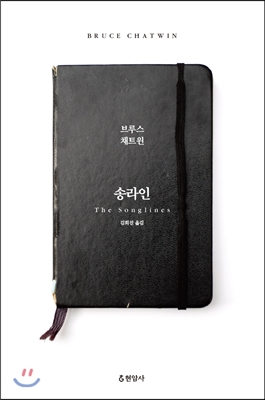
On the cover of 『Songline』 there is a worn notebook.
This notebook is none other than the 'Moleskine', which Chatwin expressed his affection for with words bordering on worship.
The most striking aspect of this book is that it is a "philosophical journey" that plans the next inquiry from one inquiry, just as today's work determines tomorrow's plans. During this journey, Chatwin never put down his notebook.
"Songline" is a travelogue written by Chatwin as he walked along the "Songline," an invisible path considered a "dream trail" by the Australian Aborigines. It is his second travelogue and the last work he published.
In terms of content, this book is largely divided into two parts.
Up until the middle of the story, he meets many people and visits many places with the help of Arkady, a Russian man with close ties to the Australian Aboriginal people, and learns about the song maps called 'Songlines', a unique way for the Aboriginal people to perceive the land.
From the middle of the book onwards, Chatwin's notes, quotations, and short travel sketches, which he had been writing while contemplating a 'book about nomads', appear alternately with his records of his trip to Australia.
It may be necessary to explain what a 'songline' is, which may be unfamiliar to us, but simply put, it is a key 'concept' that forms the core of the Aboriginal creation myth.
Aboriginal people believed that there were ancestors who created the world, and that these ancestors roamed the Australian continent, singing the names of everything they encountered along the way (totemic beings such as birds, animals, plants, rocks, and waterholes), thereby bringing the world into existence.
And the path our ancestors walked while creating the world is called 'The Songlines' and it is believed that the path is 'the footsteps of dreams'.
That is, the Aboriginal people believed that the world was created through song.
And he considered it his life's mission to sacredly preserve the 'Songline', the trace of it.
Chatwin believed that this beautiful creation myth contained the pinnacle of beauty that a 'nomad' lifestyle could dream of and enjoy.
And while traveling through the Australian 'Songline', he continues his journey of re-experiencing and confirming the reflections on 'nomad' that he has long been obsessed with.
The text quoted below clearly shows that Chatwin was as preoccupied with finding some kind of 'miracle' on this trip as he was on his Patagonia trip.
And the moment of 'miracle' that he discovers and conveys is enough to captivate our hearts.
No Aborigine could conceive of the idea that the created world was in any way imperfect.
Their religious life has only one goal.
Maintaining the land in its original and requisite state.
Those who leave Walkerbout are on a conscious journey.
He walks in the footsteps of his ancestors.
Sing the verses of your ancestors without changing a single word or sound.
Thus, creation is recreated.
“Sometimes I [Arkady] would take our ‘old men’ out into the desert, and when we came across a peak or a sand dune, they would suddenly start singing.
When I ask them, 'What song are you singing?' they answer like this.
“I sing to the land, to make the land come into being more quickly.”
The Aborigines did not believe that the land existed until they saw it and sang about it for themselves.
Just as the land came into existence only when our ancestors sang in the Dream Age.
"So, the land must first exist as a concept in our minds? Then it must be sung? Only then can it truly be said to exist?"
"that's right."
(…) Aborigines believe that all ‘living things’ were created secretly beneath the earth’s crust.
The same goes for all the white man's gadgets, including airplanes, guns, and Toyota Land Cruisers, and all inventions that will be invented in the future.
They lie dormant beneath the surface of the earth, waiting for their turn to be called.
■ Bruce Chatwin Chronology
Born May 13, 1940 in Sheffield, England
Graduated from Marlborough College, a prestigious private university in England, in 1958
Joined Sotheby's as a security guard in 1958.
However, his outstanding appreciation of art was recognized and he was promoted to the position of expert appraiser specializing in impressionist paintings, including in the antiques department.
He rose to the position of director at the young age of 20, making a unique contribution to identifying Picasso's forgeries and promoting the true value of Impressionist paintings.
In 1964, he developed vision problems.
On August 26, 1965, he married Elizabeth Chanler, who was working as a secretary at Sotheby's.
Around this time, I traveled around East Africa.
He took pictures of the desert and recorded the lives of nomadic people.
He became particularly interested in nomadic peoples while traveling in Sudan.
My interest and passion for the nomadic life continues throughout my life.
He returned from his travels in 1966 and resigned from Sotheby's.
Studied Archaeology at the University of Edinburgh.
He receives the Wardrop Prize for outstanding papers, but becomes disillusioned with university education and drops out, giving up on his degree.
In 1972, he joined the Sunday Times as an arts and architecture reporter.
You will have the opportunity to travel around the world to report.
He also arranged interviews with celebrities such as André Malraux and Indira Gandhi.
While interviewing 93-year-old architect and designer Eileen Gray, we discussed a large map of Patagonia she had drawn, and she asked if I could go to Patagonia on her behalf, given her advanced age.
In 1974, he sent a telegram to the Sunday Times saying, “I’m off to Patagonia for six months,” and set off on his journey.
Traveled through the Patagonia region of South America for four months.
1977: 『Patagonia In Patagonia』 published.
He soon gained fame as a travel writer.
Along with the book's enthusiastic response, it has also been met with criticism that all of its contents are fiction and contain no facts whatsoever.
Critically acclaimed, it won the Hawthornden Award, the E.
It has won prestigious literary awards, including the M. Foster Award and the New York Times Book Review Best Book Award.
Published in 1980 as 『The Viceroy of Ouidah』.
This novel, written by Chatwin during his long stay in Benin, West Africa, depicts the life of a Brazilian slave trader.
I am currently infected with HIV.
This fact is hidden from those around him.
Published 『On the Black Hill』 in 1982.
This novel, which depicts the lives of twin brothers who live isolated from the social changes of the 20th century on a remote farm in Wales for nearly 80 years, won the James Tait Black Memorial Award.
Published 『The Songlines』 in 1987.
This travelogue, published 10 years after 'Patagonia', contains reflections on the origins and history of nomads, nomads, and an exploration of the creation myths of the Australian Aboriginal people.
In this year, 『The Viceroy of Ouidah』 was made into a film by director Werner Herzog.
Published in 1988 as 『Utz』.
This novel, based on his experiences working in the art world and his interest in Soviet Eastern Europe, tells the story of a collector fascinated by Meissen porcelain.
It is nominated for the Booker Prize (now the Man Booker Prize).
Died on January 18, 1989 in Nice, France.
AIDS is known to be the cause of death.
A few months after his death, a collection of essays, What Am I Doing Here?, was published.
Published 『Photographs and Notebooks』, a collection of photographs and notes, in 1993.
Published the prose collection 『Anatomy of Restlessness』 in 1997.
1998: Published photo book 『Winding Paths』.
Contains photos taken by Chatwin during his writing trips.
In 2010, a collection of Chatwin's letters, "Under The Sun," was published.
It was edited by his wife Elizabeth and Nicholas Shakespeare, the journalist and Chatwin biographer.
Patagonia: A Travelogue of Patagonia, the End of the World and Land of Exiles
The Origin of Nomadism: A Travelogue of Australia, a Sanctuary for Wanderers, "Songline"
Finally, we meet Bruce Chatwin, the legendary wanderer who ushered in a new era in travel literature.
"At the end of the world, a museum documenting the beginning of the world." - Hong Eun-taek
"Fluent sentences, novel-like structure, a textbook travelogue." ─ Lee Sang-yeop
"It sweeps the gaze and the heart as deeply as a stunning black-and-white photo album." ─ Lee Byeong-ryul
“The writer who captured the world on a few sheets of paper”—John Updike
"I found myself filling the book with exclamation marks and highlighting." ─ Luis Sepúlveda
"A powerful snapshot, a powerful allure"—Colin Serron
“Writing about wandering was Chatwin’s eternal task and vocation.” —Salman Rushdie
■ Bruce Chatwin: Why He Was a "New Era in Travel Literature"
British author Bruce Chatwin wrote two travelogues (in addition to his novels) during his lifetime.
『In Patagonia』 published in 1977 and 『Songlines』 published in 1987.
Chatwin was evaluated as a 'new era in travel literature' not later, but right from the time he published his first book, 'Patagonia'.
The editor who had obtained the manuscript from the author's publishing agent and was considering publishing it in the US wrote this after reading the manuscript for the first time:
“[Encountering this manuscript] was one of the ten most thrilling ‘events’ I’ve experienced in my publishing career.
“This was completely different from any other author’s manuscript I’ve reviewed so far.”
As soon as 『Patagonia』 was published, it was in the book reviews every day.
However, the reviews that should have accurately identified the core and character of the book were full of 'confusion'.
Controversy arose over questions such as, 'Are these contents true, slightly fictional, or completely fictional?' and 'What genre should we call this book?'
Some bookstores even create new shelves just for this book.
And that bookshelf was named 'New Nonfiction Corner'.
Amidst these controversies, Chatwin explained:
“I once did an experiment in Patagonia where I counted each and every one of the things that were considered lies.
The results weren't too bad.
“It hasn’t been that long,” he said in another interview.
“Everything in this book is based on real events.
Of course, the order is a bit different.” And Nicholas Shakespeare, who wrote the biography of Bruce Chatwin, Bruce Chatwin, tried to put an end to the controversy by defending Chatwin with the following words:
“Generally speaking, he did not tell half-truths, but added half-truths to the truth.
His true achievement lies not in describing Patagonia as it is, but in creating a new way of exploring, a new aspect of the world, along with the landscape that is Patagonia.
And in the process, he transformed himself.”
These are the very phenomena that occurred when Chatwin's Patagonia was published.
Despite a series of setbacks, interest in Chatwin's unusual travelogue remained undiminished.
The book, which also received enthusiastic responses from critics, won the Hawthornden Medal, the most prestigious literary award in Britain, and the E.
He soon won the 'M. Poster Award'.
And finally, The Guardian wrote:
“Travel literature is divided into before and after Bruce Chatwin.”
Chatwin is undoubtedly one of the most creative travel writers of all time.
This is because he “did not simply see, hear, and feel the places he traveled to, but created every space he arrived at as a land imbued with travel.”
That's not just rhetoric.
For example, the village of Gaiman in Patagonia, which was nothing more than a "dreary village of faded red brick houses" and not even clearly marked on maps in the 1970s when Chatwin first visited it, is said to now even have a cruise ship operating to pick up travelers who come to visit after reading Chatwin's book.
The locals say this:
“For the gringos (slang for white people of Anglo-American descent) who come here carrying ‘Patagonia’, that book should be called the ‘Bible.’” Patagonia, which used to be just a barren and rough land, is now called ‘the end of the world’ thanks to Chatwin, and has become a mythical land that travelers want to visit at least once in their lifetime.
This is the power and legacy of Chatwin's literature.
■ A wanderer who has dedicated his life to exploring 'nomads' and searching for 'miracles'
Bruce Chatwin's debut as a writer was dramatic.
Chatwin previously worked as an appraiser specializing in Impressionist paintings at the art auction house Sotheby's.
I didn't start out at Sotheby's as an art expert.
He joined Sotheby's as a security guard at the age of 18, but soon gained recognition for his artistic discernment beyond that of a professional, and was promoted to appraiser.
Then, within a few years, he became a key figure leading the reputation of Sotheby's.
Chatwin was the one who discovered the value of Impressionist painting and introduced its true value to the global art world.
It was Chatwin who led the major project to uncover Picasso forgeries.
Thanks to such achievements, he was a cometary figure who rose to the position of director of Sotheby's at a young age.
Then, when he started having vision problems, he quit his job and went on a trip to East Africa. While traveling in Sudan in particular, he came across the subject of 'nomad', which he would dedicate his life to exploring.
And then, nine years later, in 1974, he sent a telegram to his workplace and suddenly left for Patagonia.
The telegram read, “Leaving for Patagonia for six months.”
Chatwin thus decided that the task of the rest of his life would be to explore the 'nomad', and planned his own life as the epitome of a nomad.
And the first achievement of Chatwin's planned life as a nomad was undoubtedly his trip to Patagonia and his work, Patagonia.
From this work onwards, Chatwin reflects on the idea that the human way of life is essentially suited to nomadism rather than residential life.
For him, nomadic humans, or nomads, are always weaving stories.
He believed that human life was about following one's own story, and that relationships were the intersection of stories.
The lifestyle of living in a nomadic environment was nothing less than a hindrance to the birth of stories.
It erases the miracles from life.
Chatwin's passionate dream was, of course, the exact opposite.
Because he says this.
“What I have been searching for all my life is a ‘miracle.’”
Chatwin died of AIDS at the age of 48.
So, his period of production was only 10 years after the publication of Patagonia.
The value of the 'nomad' lifestyle that he consistently advocated for during that brief period reaches its climax in the ending of his last published work, 'Songline'.
To convey the feeling of the ending, borrowing the translator's words, "Chatwin paints a moving scene in which the 'first verse of the Song of the World', uttered by the first human being, a 'migratory species' on the African savannah, the cradle of civilization, spreads out as a 'songline' that spans all continents and all times.
This beautiful illusion is one of those afterimages that lingers before your eyes even after you close the book.”
One more thing to add.
Hyunamsa published 『Patagonia』 and 『Songline』 as a series called ‘The Walker’s Notebook.’
The purpose of this book is to inform readers of the fact that the journeys unfolding in these two books are, above all, 'journeys with a purpose', and are travelogues that have been carefully thought out and meticulously recorded.
Chatwin is truly a traveler who, rather than simply taking in information without interpretation or simply absorbing sensory excitement, never stops to think about the experience of travel, and even about 'travel itself.'
I hope that through your encounter with this series, you will feel as if you have received a notebook filled with precious stories left behind by the charming "walker" named Chatwin.
■ About the Dream Footsteps, 『Songline』
On the cover of 『Songline』 there is a worn notebook.
This notebook is none other than the 'Moleskine', which Chatwin expressed his affection for with words bordering on worship.
The most striking aspect of this book is that it is a "philosophical journey" that plans the next inquiry from one inquiry, just as today's work determines tomorrow's plans. During this journey, Chatwin never put down his notebook.
"Songline" is a travelogue written by Chatwin as he walked along the "Songline," an invisible path considered a "dream trail" by the Australian Aborigines. It is his second travelogue and the last work he published.
In terms of content, this book is largely divided into two parts.
Up until the middle of the story, he meets many people and visits many places with the help of Arkady, a Russian man with close ties to the Australian Aboriginal people, and learns about the song maps called 'Songlines', a unique way for the Aboriginal people to perceive the land.
From the middle of the book onwards, Chatwin's notes, quotations, and short travel sketches, which he had been writing while contemplating a 'book about nomads', appear alternately with his records of his trip to Australia.
It may be necessary to explain what a 'songline' is, which may be unfamiliar to us, but simply put, it is a key 'concept' that forms the core of the Aboriginal creation myth.
Aboriginal people believed that there were ancestors who created the world, and that these ancestors roamed the Australian continent, singing the names of everything they encountered along the way (totemic beings such as birds, animals, plants, rocks, and waterholes), thereby bringing the world into existence.
And the path our ancestors walked while creating the world is called 'The Songlines' and it is believed that the path is 'the footsteps of dreams'.
That is, the Aboriginal people believed that the world was created through song.
And he considered it his life's mission to sacredly preserve the 'Songline', the trace of it.
Chatwin believed that this beautiful creation myth contained the pinnacle of beauty that a 'nomad' lifestyle could dream of and enjoy.
And while traveling through the Australian 'Songline', he continues his journey of re-experiencing and confirming the reflections on 'nomad' that he has long been obsessed with.
The text quoted below clearly shows that Chatwin was as preoccupied with finding some kind of 'miracle' on this trip as he was on his Patagonia trip.
And the moment of 'miracle' that he discovers and conveys is enough to captivate our hearts.
No Aborigine could conceive of the idea that the created world was in any way imperfect.
Their religious life has only one goal.
Maintaining the land in its original and requisite state.
Those who leave Walkerbout are on a conscious journey.
He walks in the footsteps of his ancestors.
Sing the verses of your ancestors without changing a single word or sound.
Thus, creation is recreated.
“Sometimes I [Arkady] would take our ‘old men’ out into the desert, and when we came across a peak or a sand dune, they would suddenly start singing.
When I ask them, 'What song are you singing?' they answer like this.
“I sing to the land, to make the land come into being more quickly.”
The Aborigines did not believe that the land existed until they saw it and sang about it for themselves.
Just as the land came into existence only when our ancestors sang in the Dream Age.
"So, the land must first exist as a concept in our minds? Then it must be sung? Only then can it truly be said to exist?"
"that's right."
(…) Aborigines believe that all ‘living things’ were created secretly beneath the earth’s crust.
The same goes for all the white man's gadgets, including airplanes, guns, and Toyota Land Cruisers, and all inventions that will be invented in the future.
They lie dormant beneath the surface of the earth, waiting for their turn to be called.
■ Bruce Chatwin Chronology
Born May 13, 1940 in Sheffield, England
Graduated from Marlborough College, a prestigious private university in England, in 1958
Joined Sotheby's as a security guard in 1958.
However, his outstanding appreciation of art was recognized and he was promoted to the position of expert appraiser specializing in impressionist paintings, including in the antiques department.
He rose to the position of director at the young age of 20, making a unique contribution to identifying Picasso's forgeries and promoting the true value of Impressionist paintings.
In 1964, he developed vision problems.
On August 26, 1965, he married Elizabeth Chanler, who was working as a secretary at Sotheby's.
Around this time, I traveled around East Africa.
He took pictures of the desert and recorded the lives of nomadic people.
He became particularly interested in nomadic peoples while traveling in Sudan.
My interest and passion for the nomadic life continues throughout my life.
He returned from his travels in 1966 and resigned from Sotheby's.
Studied Archaeology at the University of Edinburgh.
He receives the Wardrop Prize for outstanding papers, but becomes disillusioned with university education and drops out, giving up on his degree.
In 1972, he joined the Sunday Times as an arts and architecture reporter.
You will have the opportunity to travel around the world to report.
He also arranged interviews with celebrities such as André Malraux and Indira Gandhi.
While interviewing 93-year-old architect and designer Eileen Gray, we discussed a large map of Patagonia she had drawn, and she asked if I could go to Patagonia on her behalf, given her advanced age.
In 1974, he sent a telegram to the Sunday Times saying, “I’m off to Patagonia for six months,” and set off on his journey.
Traveled through the Patagonia region of South America for four months.
1977: 『Patagonia In Patagonia』 published.
He soon gained fame as a travel writer.
Along with the book's enthusiastic response, it has also been met with criticism that all of its contents are fiction and contain no facts whatsoever.
Critically acclaimed, it won the Hawthornden Award, the E.
It has won prestigious literary awards, including the M. Foster Award and the New York Times Book Review Best Book Award.
Published in 1980 as 『The Viceroy of Ouidah』.
This novel, written by Chatwin during his long stay in Benin, West Africa, depicts the life of a Brazilian slave trader.
I am currently infected with HIV.
This fact is hidden from those around him.
Published 『On the Black Hill』 in 1982.
This novel, which depicts the lives of twin brothers who live isolated from the social changes of the 20th century on a remote farm in Wales for nearly 80 years, won the James Tait Black Memorial Award.
Published 『The Songlines』 in 1987.
This travelogue, published 10 years after 'Patagonia', contains reflections on the origins and history of nomads, nomads, and an exploration of the creation myths of the Australian Aboriginal people.
In this year, 『The Viceroy of Ouidah』 was made into a film by director Werner Herzog.
Published in 1988 as 『Utz』.
This novel, based on his experiences working in the art world and his interest in Soviet Eastern Europe, tells the story of a collector fascinated by Meissen porcelain.
It is nominated for the Booker Prize (now the Man Booker Prize).
Died on January 18, 1989 in Nice, France.
AIDS is known to be the cause of death.
A few months after his death, a collection of essays, What Am I Doing Here?, was published.
Published 『Photographs and Notebooks』, a collection of photographs and notes, in 1993.
Published the prose collection 『Anatomy of Restlessness』 in 1997.
1998: Published photo book 『Winding Paths』.
Contains photos taken by Chatwin during his writing trips.
In 2010, a collection of Chatwin's letters, "Under The Sun," was published.
It was edited by his wife Elizabeth and Nicholas Shakespeare, the journalist and Chatwin biographer.
GOODS SPECIFICS
- Date of publication: September 14, 2012
- Page count, weight, size: 464 pages | 686g | 145*220*30mm
- ISBN13: 9788932316321
- ISBN10: 8932316325
You may also like
카테고리
korean


korean

![GQ KOREA Mark (Monthly): December [2025]](http://librairie.coreenne.fr/cdn/shop/files/8ef265dbbfbf186523ed75ba7319009d.jpg?v=1765340328&width=3840)


