

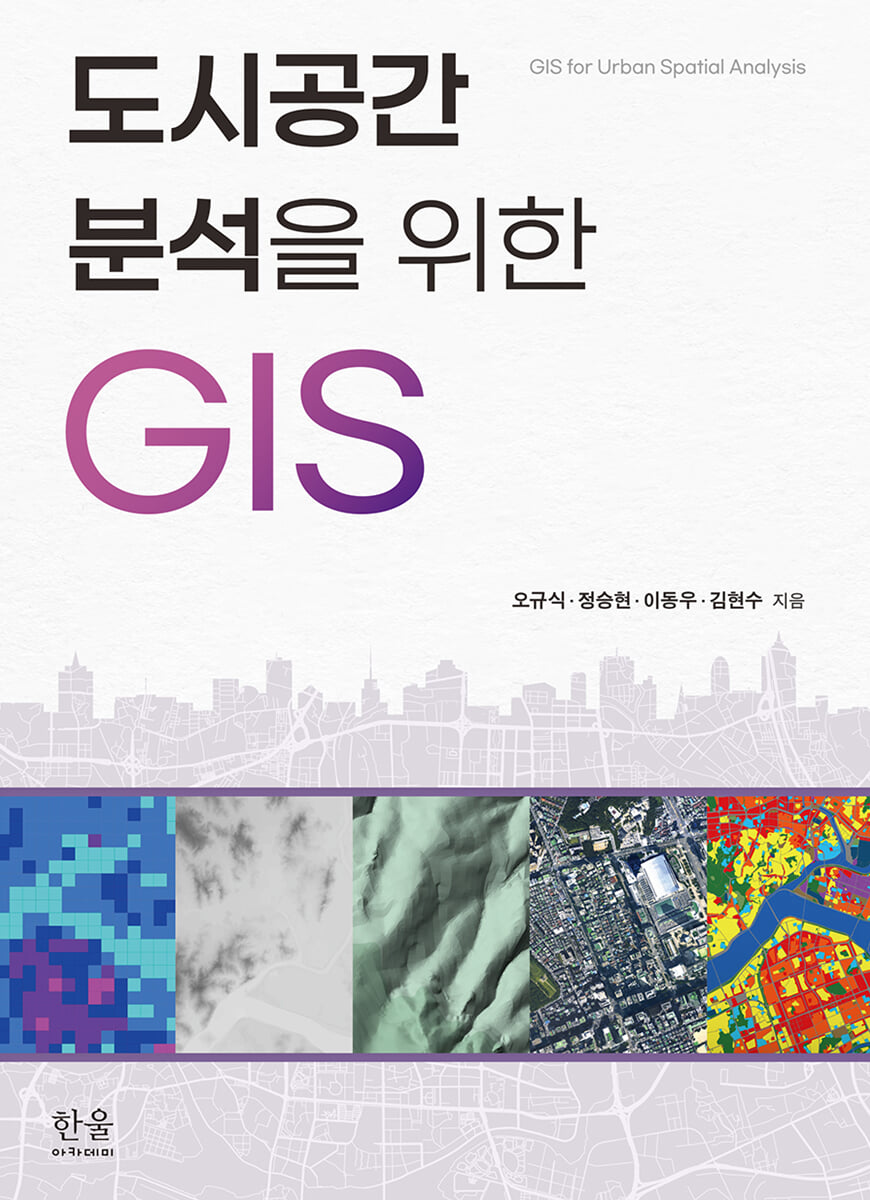
GIS for urban spatial analysis
 |
Description
Book Introduction
What the data doesn't tell you,
The true value of the city hidden within it
GIS is not just a technology.
Identify the city's problems,
It is a special tool that contains insight that penetrates the essence.
This book explains the key role of GIS in scientifically elucidating the complex and diverse phenomena of cities and supporting policymaking and decision-making for the future.
In the midst of convergence with cutting-edge technologies such as artificial intelligence (AI) and big data, it is emphasized that GIS is not simply an automated tool, but a "tool of thought" that produces meaningful results through the analyst's deliberation and judgment.
This book helps us understand the value of urban space and concretize a desirable future.
Part 1 covers the basic theories of GIS, including its background, history, concepts, and data structures, while Part 2 provides hands-on training utilizing the latest GIS tools, such as ArcGIS.
The core of this book is contained in Parts 3 and 4.
From basic terrain analysis and site analysis to advanced spatial analysis functions such as network analysis, satellite imagery utilization, and 3D simulation, the course demonstrates how the analyst's intervention and value judgment at each stage advances raw data from 'facts' to 'judgments' and from 'explanations' to 'prescriptions.'
The true value of the city hidden within it
GIS is not just a technology.
Identify the city's problems,
It is a special tool that contains insight that penetrates the essence.
This book explains the key role of GIS in scientifically elucidating the complex and diverse phenomena of cities and supporting policymaking and decision-making for the future.
In the midst of convergence with cutting-edge technologies such as artificial intelligence (AI) and big data, it is emphasized that GIS is not simply an automated tool, but a "tool of thought" that produces meaningful results through the analyst's deliberation and judgment.
This book helps us understand the value of urban space and concretize a desirable future.
Part 1 covers the basic theories of GIS, including its background, history, concepts, and data structures, while Part 2 provides hands-on training utilizing the latest GIS tools, such as ArcGIS.
The core of this book is contained in Parts 3 and 4.
From basic terrain analysis and site analysis to advanced spatial analysis functions such as network analysis, satellite imagery utilization, and 3D simulation, the course demonstrates how the analyst's intervention and value judgment at each stage advances raw data from 'facts' to 'judgments' and from 'explanations' to 'prescriptions.'
index
Part 1: Basic GIS Theory
Chapter 1: Background and History of GIS
Chapter 2: Concept and Definition of GIS
Chapter 3 GIS and Maps
Chapter 4 GIS Data Structure
Chapter 5 Spatial Analysis Using GIS
Part 2: Understanding GIS Tools
Chapter 6: Introduction to ArcGIS Pro
Chapter 7: Building Data
Chapter 8: Editing Data
Chapter 9: Exploring Data
Chapter 10: Presentation of Data
Chapter 11: Map Design
Chapter 12: Hands-on Project: Building and Presenting Data
Part 3: Utilizing Urban Spatial Analysis I
Chapter 13: Terrain-Based Analysis
Chapter 14: Land Analysis
Chapter 15 Model Builder
Part 4: Utilizing Urban Spatial Analysis II
Chapter 16: Adjacency Analysis
Chapter 17 Network Analysis
Chapter 18: Use of Satellite Imagery
Chapter 1: Background and History of GIS
Chapter 2: Concept and Definition of GIS
Chapter 3 GIS and Maps
Chapter 4 GIS Data Structure
Chapter 5 Spatial Analysis Using GIS
Part 2: Understanding GIS Tools
Chapter 6: Introduction to ArcGIS Pro
Chapter 7: Building Data
Chapter 8: Editing Data
Chapter 9: Exploring Data
Chapter 10: Presentation of Data
Chapter 11: Map Design
Chapter 12: Hands-on Project: Building and Presenting Data
Part 3: Utilizing Urban Spatial Analysis I
Chapter 13: Terrain-Based Analysis
Chapter 14: Land Analysis
Chapter 15 Model Builder
Part 4: Utilizing Urban Spatial Analysis II
Chapter 16: Adjacency Analysis
Chapter 17 Network Analysis
Chapter 18: Use of Satellite Imagery
Publisher's Review
Expanding the Eyes of the City with GIS
An academic and practical guide to understanding urban space and designing the future.
We live in an era where artificial intelligence and big data analyze urban problems.
In this day and age, GIS (Spatial Information Science) is no longer just a map-making tool.
For those seeking a fresh perspective on urban phenomena, this book will serve as a guide in itself.
A map is not just a tool to show us the way; it is a medium for reflection that allows us to reflect on where we stand and seek a direction to move forward.
This book leads readers to reconsider the relationship between cities, humans, and technology at that very point.
Main structure of the book
Part 1: History, Concepts, Data Structures, Maps, and Spatial Analysis of GIS
Part 2: ArcGIS-Based Practice: Data Construction, Editing, Exploration, Presentation, and Drawing
Part 3: Basic Analysis: Terrain-Based Analysis, Site Analysis
Part 4: Advanced Analytics: Network Analysis, Satellite Imagery, and 3D Simulation
This book begins with the history and fundamental concepts of GIS and moves on to ArcGIS-based practice, gradually expanding from basic techniques like terrain analysis and site analysis to advanced analyses like network analysis, satellite imagery utilization, and 3D simulation.
Not only has the practical course been significantly enhanced to match the latest software versions, but it has also improved technical accuracy and refined expressions to aid reader understanding.
It provides a systematic learning environment for undergraduate and graduate students majoring in relevant fields of study, as well as researchers interested in urban issues.
At the same time, it does not miss the critical perspective necessary to explore the various values and perspectives surrounding urban space issues.
Where this book shines is that it goes beyond being a simple technical manual.
The authors emphasize that even in this cutting-edge technological age, obsessed with automation and efficiency, the deliberation and value judgment of GIS analysts determine the entire analysis process.
Only through the intervention of the analyst can the raw data leap from fact to judgment, from explanation to prescription.
Ultimately, urban spatial analysis reminds us that it is an intellectual journey from which human subjective thinking cannot be excluded.
This book provides a framework for solving urban problems in an era where diverse values coexist alongside technological advancements.
I hope this book will serve as a reliable companion in creatively exploring the value of urban space through GIS and in mapping out a better future for cities.
※ Please scan the QR code on page 4 of the text to download the practice file. You can download the file after registering as a member of Hanul M Plus (www.hanulmplus.kr). Scan the QR code, and then click "Related Materials" in the link to the book introduction.
An academic and practical guide to understanding urban space and designing the future.
We live in an era where artificial intelligence and big data analyze urban problems.
In this day and age, GIS (Spatial Information Science) is no longer just a map-making tool.
For those seeking a fresh perspective on urban phenomena, this book will serve as a guide in itself.
A map is not just a tool to show us the way; it is a medium for reflection that allows us to reflect on where we stand and seek a direction to move forward.
This book leads readers to reconsider the relationship between cities, humans, and technology at that very point.
Main structure of the book
Part 1: History, Concepts, Data Structures, Maps, and Spatial Analysis of GIS
Part 2: ArcGIS-Based Practice: Data Construction, Editing, Exploration, Presentation, and Drawing
Part 3: Basic Analysis: Terrain-Based Analysis, Site Analysis
Part 4: Advanced Analytics: Network Analysis, Satellite Imagery, and 3D Simulation
This book begins with the history and fundamental concepts of GIS and moves on to ArcGIS-based practice, gradually expanding from basic techniques like terrain analysis and site analysis to advanced analyses like network analysis, satellite imagery utilization, and 3D simulation.
Not only has the practical course been significantly enhanced to match the latest software versions, but it has also improved technical accuracy and refined expressions to aid reader understanding.
It provides a systematic learning environment for undergraduate and graduate students majoring in relevant fields of study, as well as researchers interested in urban issues.
At the same time, it does not miss the critical perspective necessary to explore the various values and perspectives surrounding urban space issues.
Where this book shines is that it goes beyond being a simple technical manual.
The authors emphasize that even in this cutting-edge technological age, obsessed with automation and efficiency, the deliberation and value judgment of GIS analysts determine the entire analysis process.
Only through the intervention of the analyst can the raw data leap from fact to judgment, from explanation to prescription.
Ultimately, urban spatial analysis reminds us that it is an intellectual journey from which human subjective thinking cannot be excluded.
This book provides a framework for solving urban problems in an era where diverse values coexist alongside technological advancements.
I hope this book will serve as a reliable companion in creatively exploring the value of urban space through GIS and in mapping out a better future for cities.
※ Please scan the QR code on page 4 of the text to download the practice file. You can download the file after registering as a member of Hanul M Plus (www.hanulmplus.kr). Scan the QR code, and then click "Related Materials" in the link to the book introduction.
GOODS SPECIFICS
- Date of issue: September 19, 2025
- Format: Hardcover book binding method guide
- Page count, weight, size: 344 pages | 173*242*30mm
- ISBN13: 9788946076099
- ISBN10: 8946076097
You may also like
카테고리
korean


korean

![GQ KOREA Mark (Monthly): December [2025]](http://librairie.coreenne.fr/cdn/shop/files/8ef265dbbfbf186523ed75ba7319009d.jpg?v=1765340328&width=3840)


