

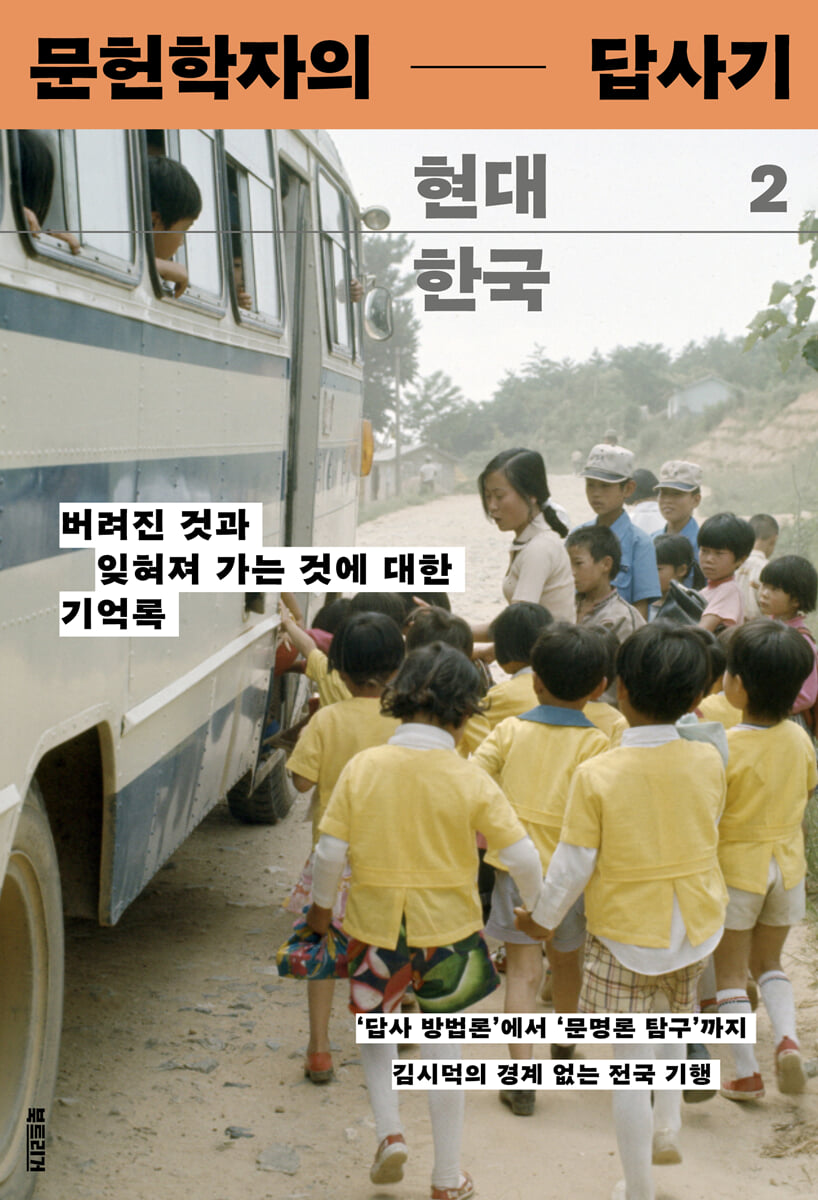
A Philologist's Travels through Modern Korea Part 2
 |
Description
Book Introduction
“Teacher, what do you pay attention to when you do a field trip?”
? “I see everything.”
『A Philologist's Modern Korean Field Trip 1·2』 is a book that contains the field trip methodology and stories of the nationwide field trips of Kim Si-deok, a philologist who began his "city field trips" in the summer of 2017.
Kim Si-deok's field trip, which began with an interest in the urban areas of Seoul and Gyeonggi-do, soon extended to cities all over the country as well as rural, mountainous, and fishing villages, and took on the character of a kind of 'exploration of civilization theory.'
Kim Si-deok vividly captures the rapidly changing landscape of Korea in the early 21st century and the colorful lives of the citizens who have lived here to this day.
Without a driver's license, walking on foot alone.
? “I see everything.”
『A Philologist's Modern Korean Field Trip 1·2』 is a book that contains the field trip methodology and stories of the nationwide field trips of Kim Si-deok, a philologist who began his "city field trips" in the summer of 2017.
Kim Si-deok's field trip, which began with an interest in the urban areas of Seoul and Gyeonggi-do, soon extended to cities all over the country as well as rural, mountainous, and fishing villages, and took on the character of a kind of 'exploration of civilization theory.'
Kim Si-deok vividly captures the rapidly changing landscape of Korea in the early 21st century and the colorful lives of the citizens who have lived here to this day.
Without a driver's license, walking on foot alone.
- You can preview some of the book's contents.
Preview
index
Entering: Beyond the borders of Greater Seoul into Korea
Part 1: Tracing the Birth of Modern Korea
01 East and West of Daejeon Station: Hot Places and Public Housing Districts
02 Hebangchon and Hopechon: Visiting the Korean War Refugee Camps
03 The Path of General Walton Walker: Traces of a War Hero
04 Jaeban-ro, Haeundae-gu, Busan: The Path of Two Refugees
05 Three Fires, Four Monuments: The Great Busan Fire of 1953-1954
06 Gwangju, the Production City: About the Now-Disappeared IBRD Loan Complex
07 Yeongju Modern History and Culture Street: Yeongju hidden behind Buseoksa Temple and Sosu Seowon
08 How Suncheon Became What It Is Today: The Jeolla Line and the 1962 Flood
Part 2: What Happens at the Edge of the City
01 Perspectives on Remembering the Original Pattern: Unions, Apartments, and the War Veterans' Village
02 Bangbae Jungang-ro, Seocho-gu, Seoul: 'Slaughter' in the city
03 Pyeongchon New Town and Anyang Beolmal: Where is My Friend's House?
04 Busan Munhyeon-dong Mural Village: A Place Where Retro Feelings and Brushstrokes Passed
05 New Religion: A Scene from a 'Jeondogwan' on the Outskirts of Seoul
06 Hansen's Disease in Modern Korea: Victims of the Democratic Republic
07 Yeongwol Mining Village: Industrial Transition and the People Left Behind
08 US Military Comfort Women Camp Village: A Field Trip Following the Footsteps of Ms. Kim Jeong-ja
09 Hwaseong Hyangnam-eup: Korea, a multi-ethnic and multicultural nation
Coming out: so that the records will not disappear any more
Part 1: Tracing the Birth of Modern Korea
01 East and West of Daejeon Station: Hot Places and Public Housing Districts
02 Hebangchon and Hopechon: Visiting the Korean War Refugee Camps
03 The Path of General Walton Walker: Traces of a War Hero
04 Jaeban-ro, Haeundae-gu, Busan: The Path of Two Refugees
05 Three Fires, Four Monuments: The Great Busan Fire of 1953-1954
06 Gwangju, the Production City: About the Now-Disappeared IBRD Loan Complex
07 Yeongju Modern History and Culture Street: Yeongju hidden behind Buseoksa Temple and Sosu Seowon
08 How Suncheon Became What It Is Today: The Jeolla Line and the 1962 Flood
Part 2: What Happens at the Edge of the City
01 Perspectives on Remembering the Original Pattern: Unions, Apartments, and the War Veterans' Village
02 Bangbae Jungang-ro, Seocho-gu, Seoul: 'Slaughter' in the city
03 Pyeongchon New Town and Anyang Beolmal: Where is My Friend's House?
04 Busan Munhyeon-dong Mural Village: A Place Where Retro Feelings and Brushstrokes Passed
05 New Religion: A Scene from a 'Jeondogwan' on the Outskirts of Seoul
06 Hansen's Disease in Modern Korea: Victims of the Democratic Republic
07 Yeongwol Mining Village: Industrial Transition and the People Left Behind
08 US Military Comfort Women Camp Village: A Field Trip Following the Footsteps of Ms. Kim Jeong-ja
09 Hwaseong Hyangnam-eup: Korea, a multi-ethnic and multicultural nation
Coming out: so that the records will not disappear any more
Detailed image
Into the book
When I came across a store called 'Saebusan Iyongwon' in an alley in the Janglim-dong policy relocation area, I was reminded of the now-disappeared settlement of the displaced people in Geoyeo-dong, Songpa-gu, Seoul.
As the nearby military base was relocated to the southeastern part of Gyeonggi Province and the construction of Wirye New Town began, the demolition of the Geoyeo-dong evicted residents' settlement that had formed next to the military base also began in 2017.
As I was walking through the Geoyeo-dong demolition village to record the end of an era, I came across a closed shop called ‘Sae Seoul Barber Shop.’
The owner of the store, who wanted to remain a citizen of Seoul even after being driven out of the center of Seoul to the outskirts in 1967-1971 and named it “New Seoul,” probably never achieved that dream and was demolished again.
I sincerely hope that Sae Busan Hair Salon in Janglim-dong, Busan will have a happy ending, different from Sae Seoul Hair Salon in Geoyeo-dong, Seoul.
--- p.59~60, from “Jaeban-ro, Haeundae-gu, Busan”
It is said that the union members who were staging a sit-in at the Wonpung imitation factory sang the “National Anthem” every time they were chased by riot police and detectives.
In this case, the detectives stopped chasing the union members and “put their hands on their hearts and waited for the song to end.”
--- p.133~134, from “A Perspective on Remembering the Original Style”
As the name suggests, Pyeongchon-dong and its surrounding areas, where villages dotted the plains, were located on the border between Anyang and Uiwang, which were densely populated with special facilities, contrary to the image of a quiet rural area given by the name.
Even now, this area is home to a number of "special facilities," including the Ottogi Anyang Factory, a combined heat and power plant, a substation, a resource recovery facility, the Anyang Agricultural and Marine Products Market, Anyang Prison, the St. Lazarus Village, a settlement facility for people with Hansen's disease, a reserve force training center at the foot of Mt. Morak, and the Metropolitan Area's First Ring Expressway.
--- p.166~168, from “Pyeongchon New Town and Anyang Beolmal”
After walking up the steep mountain path for about 15 minutes, the ridge connecting Jeonpo Dolsan Park and Hwangnyeongsan Mountain appeared.
We have reached the highest point of the so-called 'Munhyeon-dong Andongne Mural Village', where Jinnam-ro 283beongil in Busanjin-gu and Dolsan-gil in Nam-gu meet.
The deep valley extending south contained a mix of almost every type of building in modern Korea, from single-family homes to high-rise apartments.
In the middle of the road, there was a signboard for the mural village that was erected in 2008.
However, the coating on the signboard was so bad that it was almost unrecognizable, as if someone had torn it off.
Several of the 'retro-feeling' shops that used to be on this street have long since closed.
At the entrance of Dolsan 3-gil, which leads down from the mountain ridge to the Munhyeon-dong Mural Village, there is a painting indicating the beginning of the mural street, and the 'Dolsan Village Survival Rights Struggle Council / End Struggle Office' is located next to it.
Dolsan 3-gil is so overgrown with bushes that it is questionable whether it still functions as a road.
However, if you go down a little, you will see a path, and at the entrance there is a notice regarding the spread of COVID-19 written in the name of the mayor of Nam-gu, Busan Metropolitan City on February 26, 2020.
This is evidence that this village and this road were still functioning as of early 2020.
--- p.182~183, from “Busan Munhyeon-dong Mural Village”
When exploring outside of major cities, check the level of multi-ethnicity and multiculturalism by looking at the number of stores such as 'World Mart' and 'Halal Mart'.
There are countless of these stores in the old downtown area of Hyangnam-eup.
A walk along Hyangnam's old Shinjak-ro reveals how disconnected from reality the debate among some citizens of large cities about whether Korea should become a multiracial and multicultural nation is.
As the nearby military base was relocated to the southeastern part of Gyeonggi Province and the construction of Wirye New Town began, the demolition of the Geoyeo-dong evicted residents' settlement that had formed next to the military base also began in 2017.
As I was walking through the Geoyeo-dong demolition village to record the end of an era, I came across a closed shop called ‘Sae Seoul Barber Shop.’
The owner of the store, who wanted to remain a citizen of Seoul even after being driven out of the center of Seoul to the outskirts in 1967-1971 and named it “New Seoul,” probably never achieved that dream and was demolished again.
I sincerely hope that Sae Busan Hair Salon in Janglim-dong, Busan will have a happy ending, different from Sae Seoul Hair Salon in Geoyeo-dong, Seoul.
--- p.59~60, from “Jaeban-ro, Haeundae-gu, Busan”
It is said that the union members who were staging a sit-in at the Wonpung imitation factory sang the “National Anthem” every time they were chased by riot police and detectives.
In this case, the detectives stopped chasing the union members and “put their hands on their hearts and waited for the song to end.”
--- p.133~134, from “A Perspective on Remembering the Original Style”
As the name suggests, Pyeongchon-dong and its surrounding areas, where villages dotted the plains, were located on the border between Anyang and Uiwang, which were densely populated with special facilities, contrary to the image of a quiet rural area given by the name.
Even now, this area is home to a number of "special facilities," including the Ottogi Anyang Factory, a combined heat and power plant, a substation, a resource recovery facility, the Anyang Agricultural and Marine Products Market, Anyang Prison, the St. Lazarus Village, a settlement facility for people with Hansen's disease, a reserve force training center at the foot of Mt. Morak, and the Metropolitan Area's First Ring Expressway.
--- p.166~168, from “Pyeongchon New Town and Anyang Beolmal”
After walking up the steep mountain path for about 15 minutes, the ridge connecting Jeonpo Dolsan Park and Hwangnyeongsan Mountain appeared.
We have reached the highest point of the so-called 'Munhyeon-dong Andongne Mural Village', where Jinnam-ro 283beongil in Busanjin-gu and Dolsan-gil in Nam-gu meet.
The deep valley extending south contained a mix of almost every type of building in modern Korea, from single-family homes to high-rise apartments.
In the middle of the road, there was a signboard for the mural village that was erected in 2008.
However, the coating on the signboard was so bad that it was almost unrecognizable, as if someone had torn it off.
Several of the 'retro-feeling' shops that used to be on this street have long since closed.
At the entrance of Dolsan 3-gil, which leads down from the mountain ridge to the Munhyeon-dong Mural Village, there is a painting indicating the beginning of the mural street, and the 'Dolsan Village Survival Rights Struggle Council / End Struggle Office' is located next to it.
Dolsan 3-gil is so overgrown with bushes that it is questionable whether it still functions as a road.
However, if you go down a little, you will see a path, and at the entrance there is a notice regarding the spread of COVID-19 written in the name of the mayor of Nam-gu, Busan Metropolitan City on February 26, 2020.
This is evidence that this village and this road were still functioning as of early 2020.
--- p.182~183, from “Busan Munhyeon-dong Mural Village”
When exploring outside of major cities, check the level of multi-ethnicity and multiculturalism by looking at the number of stores such as 'World Mart' and 'Halal Mart'.
There are countless of these stores in the old downtown area of Hyangnam-eup.
A walk along Hyangnam's old Shinjak-ro reveals how disconnected from reality the debate among some citizens of large cities about whether Korea should become a multiracial and multicultural nation is.
--- p.250, from “Hwaseong Hyangnam-eup”
Publisher's Review
From 'Survey Methodology' to 'Exploration of Civilization'
Kim Si-deok's Borderless National Journey
Author Kim Si-deok applies the methodology of philology to examine the 'present history' of modern Korea.
Just as we unearth traces of history from a pile of rarely-seen ancient documents, we walk through alleys across the country and reveal to the world the stories of citizens hidden in houses and tombstones.
What does a scholar of urban literature see as modern Korea? People and buildings are being displaced even today, after being ravaged by war and natural disaster.
Stories from forgotten and abandoned frontiers.
『A Literature Scholar's Travelogue of Modern Korea 2』 looks back at those who have lived before us, calls out those who will live after us, and illuminates the place where we stand now.
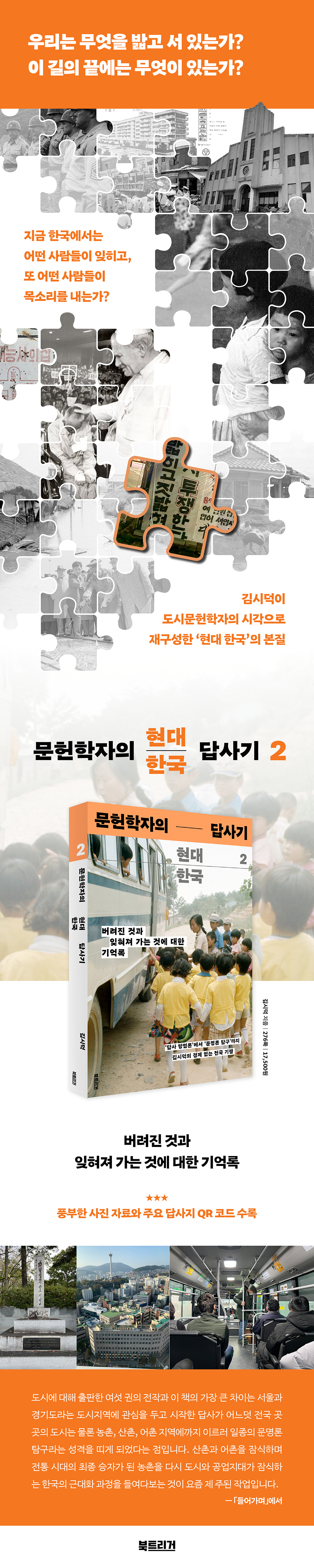
『A Literature Scholar's Travelogue of Modern Korea 2』 is a book that stands out for its abundant photographic materials taken by the author himself while traveling around the country.
At the beginning of each chapter, QR codes are placed that link to the main tour sites on Google Maps, allowing you to walk through each one, starting from the closest location.
Why not take this book and explore the neighborhood? It's great alone, but even better with a group.
And if, like the author, you can record the stories of your region with photos and words, it would be the icing on the cake.
For the readers of 'Future Korea' who will come next time.
What are we standing on?
What lies at the end of this road?
The city 'expands'.
From the center to the outskirts, along the railways and roads.
Cities are 'built'.
Cutting down trees, evicting people, and building factories, office buildings, and apartments.
So the village is 'demolished'.
Redevelopment, reconstruction, and land development.
People 'turn their backs' on their hometowns.
Flooding due to war and dam construction, natural disasters and isolation, forced migration in the name of new city development… .
Where do we "live" now? Whose footsteps are we "stepping on"?
The Republic of Korea is a country that was founded on land with a long history.
People have lived in various places since very long ago.
Therefore, there is hardly any land here without indigenous peoples and their history.
But we forget the traces of them that are barely left behind.
Maybe erase it.
I hope that the place where I live will grow and develop day by day, but I also hope that my hometown will remain the same as it was in the past.
The author, who looks at various parts of the city through the eyes of a philologist, emphasizes that we must 'have a relative perception.'
In this book, he brings back memories of places and records of people we have abandoned and forgotten.
This is a record written while reading the village chief's merit monument at the entrance to a rural village, walking on the embankment of reclaimed land, searching for traces of slash-and-burn farmers while navigating mountain paths, and being chased by 'tiger mosquitoes' in a mountain village.
In Korea today, some people are forgotten,
Who else is speaking out?
In Part 1, “Tracing the Birth of Modern Korea,” the author recalls memories of the places that gave birth to the Republic of Korea today.
Comparing the east and west sides of Daejeon Station, we examine the hot spots surrounding the station and the development of public housing districts, and trace the traces of the Korean War refugee camp and the path of General Walton Walker.
Also, while walking along Jaeban-ro in Haeundae-gu, Busan, I reflect on the lives of the Sampaltaraji ‘Vietnam Min’ and the Vietnam War refugees ‘Vietnam Min’.
We will highlight the history of Busan, Yeongju, and Suncheon, which rebuilt their cities after enduring fires and floods, and also examine Gwangju's endless struggle to become a productive city.
Following the places filled with memories, in Part 2, "What Happens at the End of the City," the author meticulously collects people's records.
Through the records of the Wonpungmobang labor union members, we convey the memories of Greater Seoul, including unions, apartments, and the village of disabled veterans, and we confirm the raw conflict triggered by redevelopment and reconstruction projects by walking along Bangbae Jungang-ro in Seocho-gu, Seoul.
Meanwhile, the memories of Anyang Beolmal, who goes to find 'my friend's house', and the story of Busan's Munhyeon-dong, which exposes the reality of plunder swept by the 'mural project', clearly show where the author's gaze starts and who he directs it towards.
In the section focusing on the 'Jeondogwan' building and the legacy that the new religion left to the Korean people, interviews with the person involved were added to make the contemporary situation more vivid.
Furthermore, following the testimonies of those with Hansen's disease and the women who were forced to work as comfort women for the US military, the path we walk brings to life the lives of the survivors we have turned a blind eye to.
Finally, in Yeongwol's mining village and Hyangnam-eup in Hwaseong, we focus on the people left behind after the industrial transition, and on Korea as a multi-ethnic and multicultural nation.
Kim Si-deok's Borderless National Journey
Author Kim Si-deok applies the methodology of philology to examine the 'present history' of modern Korea.
Just as we unearth traces of history from a pile of rarely-seen ancient documents, we walk through alleys across the country and reveal to the world the stories of citizens hidden in houses and tombstones.
What does a scholar of urban literature see as modern Korea? People and buildings are being displaced even today, after being ravaged by war and natural disaster.
Stories from forgotten and abandoned frontiers.
『A Literature Scholar's Travelogue of Modern Korea 2』 looks back at those who have lived before us, calls out those who will live after us, and illuminates the place where we stand now.
『A Literature Scholar's Travelogue of Modern Korea 2』 is a book that stands out for its abundant photographic materials taken by the author himself while traveling around the country.
At the beginning of each chapter, QR codes are placed that link to the main tour sites on Google Maps, allowing you to walk through each one, starting from the closest location.
Why not take this book and explore the neighborhood? It's great alone, but even better with a group.
And if, like the author, you can record the stories of your region with photos and words, it would be the icing on the cake.
For the readers of 'Future Korea' who will come next time.
What are we standing on?
What lies at the end of this road?
The city 'expands'.
From the center to the outskirts, along the railways and roads.
Cities are 'built'.
Cutting down trees, evicting people, and building factories, office buildings, and apartments.
So the village is 'demolished'.
Redevelopment, reconstruction, and land development.
People 'turn their backs' on their hometowns.
Flooding due to war and dam construction, natural disasters and isolation, forced migration in the name of new city development… .
Where do we "live" now? Whose footsteps are we "stepping on"?
The Republic of Korea is a country that was founded on land with a long history.
People have lived in various places since very long ago.
Therefore, there is hardly any land here without indigenous peoples and their history.
But we forget the traces of them that are barely left behind.
Maybe erase it.
I hope that the place where I live will grow and develop day by day, but I also hope that my hometown will remain the same as it was in the past.
The author, who looks at various parts of the city through the eyes of a philologist, emphasizes that we must 'have a relative perception.'
In this book, he brings back memories of places and records of people we have abandoned and forgotten.
This is a record written while reading the village chief's merit monument at the entrance to a rural village, walking on the embankment of reclaimed land, searching for traces of slash-and-burn farmers while navigating mountain paths, and being chased by 'tiger mosquitoes' in a mountain village.
In Korea today, some people are forgotten,
Who else is speaking out?
In Part 1, “Tracing the Birth of Modern Korea,” the author recalls memories of the places that gave birth to the Republic of Korea today.
Comparing the east and west sides of Daejeon Station, we examine the hot spots surrounding the station and the development of public housing districts, and trace the traces of the Korean War refugee camp and the path of General Walton Walker.
Also, while walking along Jaeban-ro in Haeundae-gu, Busan, I reflect on the lives of the Sampaltaraji ‘Vietnam Min’ and the Vietnam War refugees ‘Vietnam Min’.
We will highlight the history of Busan, Yeongju, and Suncheon, which rebuilt their cities after enduring fires and floods, and also examine Gwangju's endless struggle to become a productive city.
Following the places filled with memories, in Part 2, "What Happens at the End of the City," the author meticulously collects people's records.
Through the records of the Wonpungmobang labor union members, we convey the memories of Greater Seoul, including unions, apartments, and the village of disabled veterans, and we confirm the raw conflict triggered by redevelopment and reconstruction projects by walking along Bangbae Jungang-ro in Seocho-gu, Seoul.
Meanwhile, the memories of Anyang Beolmal, who goes to find 'my friend's house', and the story of Busan's Munhyeon-dong, which exposes the reality of plunder swept by the 'mural project', clearly show where the author's gaze starts and who he directs it towards.
In the section focusing on the 'Jeondogwan' building and the legacy that the new religion left to the Korean people, interviews with the person involved were added to make the contemporary situation more vivid.
Furthermore, following the testimonies of those with Hansen's disease and the women who were forced to work as comfort women for the US military, the path we walk brings to life the lives of the survivors we have turned a blind eye to.
Finally, in Yeongwol's mining village and Hyangnam-eup in Hwaseong, we focus on the people left behind after the industrial transition, and on Korea as a multi-ethnic and multicultural nation.
GOODS SPECIFICS
- Date of issue: September 25, 2023
- Page count, weight, size: 276 pages | 492g | 150*220*17mm
- ISBN13: 9791193378021
- ISBN10: 1193378028
You may also like
카테고리
korean


korean

![GQ KOREA Mark (Monthly): December [2025]](http://librairie.coreenne.fr/cdn/shop/files/8ef265dbbfbf186523ed75ba7319009d.jpg?v=1765340328&width=3840)


