

A Philologist's Travels through Modern Korea Part 1
 |
Description
Book Introduction
“The first thing I saw when I went there was
“It’s often the last we see of it.”
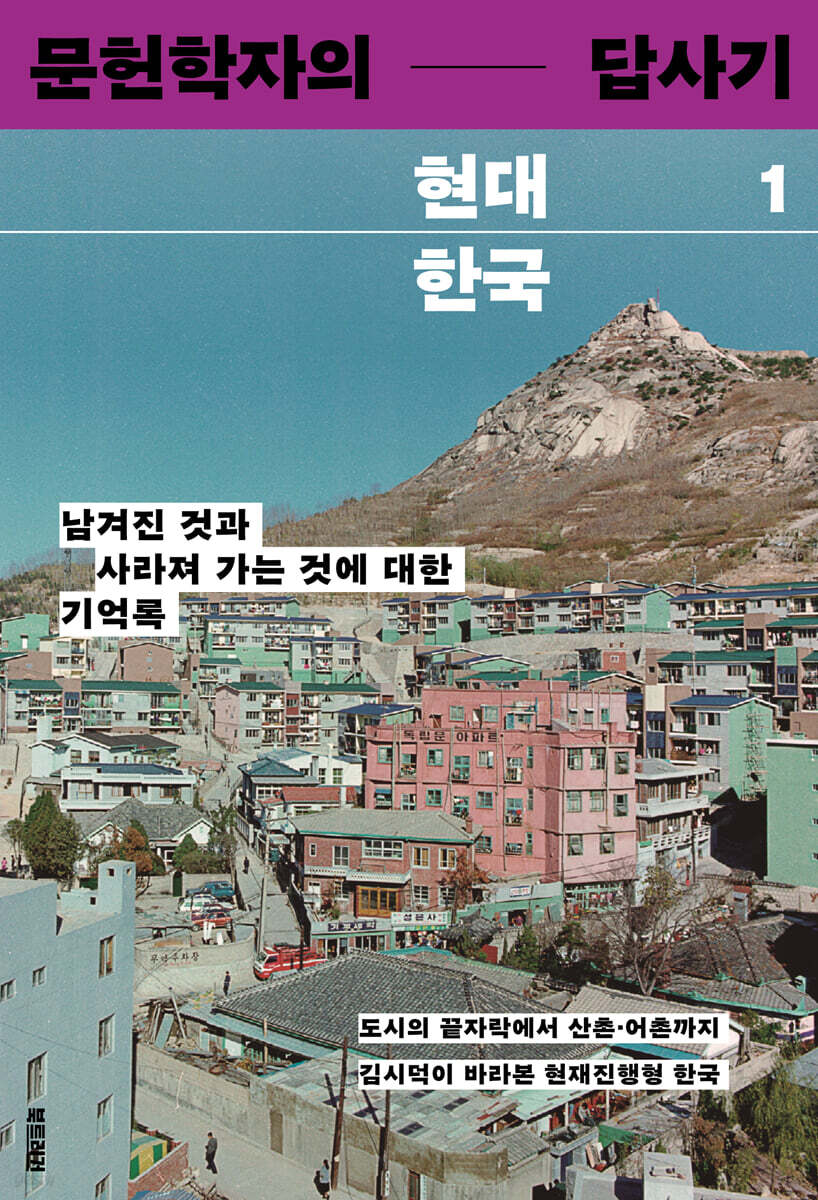
『A Philologist's Modern Korean Field Trip 1·2』 is a book that contains the field trip methodology and stories of the nationwide field trips of Kim Si-deok, a philologist who began his "city field trips" in the summer of 2017.
Kim Si-deok's field trip, which began with an interest in the urban areas of Seoul and Gyeonggi-do, soon extended to cities all over the country as well as rural, mountainous, and fishing villages, and took on the character of a kind of 'exploration of civilization theory.'
Kim Si-deok vividly captures the rapidly changing landscape of Korea in the early 21st century and the colorful lives of the citizens who have lived here to this day.
Without a driver's license, walking on foot alone.
“It’s often the last we see of it.”
『A Philologist's Modern Korean Field Trip 1·2』 is a book that contains the field trip methodology and stories of the nationwide field trips of Kim Si-deok, a philologist who began his "city field trips" in the summer of 2017.
Kim Si-deok's field trip, which began with an interest in the urban areas of Seoul and Gyeonggi-do, soon extended to cities all over the country as well as rural, mountainous, and fishing villages, and took on the character of a kind of 'exploration of civilization theory.'
Kim Si-deok vividly captures the rapidly changing landscape of Korea in the early 21st century and the colorful lives of the citizens who have lived here to this day.
Without a driver's license, walking on foot alone.
- You can preview some of the book's contents.
Preview
index
Entering: Beyond the borders of Greater Seoul into Korea
Part 1: Discovering Modern Korea on a Walk
01 Signboard: Reading the City in Everyday Life
02 Cultural Housing: From the Center to the Periphery, A Century of Style
03 Civic Art: A proactive attitude toward creating a beautiful life
04 Flower Pots and Jars: In Search of the Unyielding Spirit of the Garden
05 Cold Noodles, Cheongyo-ri, and Nuruk: The Past, Present, and Future of Korean Cuisine
06 Folk Houses: The Diverse World of Housing on the Korean Peninsula
07 Improved Tile-Roofed House: The Contradictions Surrounding Hanok
08 Apartment: Living together in a loose manner
Apartment 09: Build, Build, and Remember
10 Commercial and Public Facilities: Cultural Heritage Near Us
11. Railway: From Seoul to Jeju Island
12 Bus Stops: Names Attached, Names Remaining
Part 2: The Clash of Civilizations in Modern Korea
01 Farmers and Fishermen: Building Rice Fields in the Sea
02 Slash-and-burn farmers and farmers: The back of the dense forest
03 Rural areas absorbed by cities and factories: erased roads, torn villages
04 The Birth of Ulsan, an Industrial City: Walking Along the Monument to Longing
05 Jeju Tapdong-ro: Jeju Island's Past, Present, and Future
06 Jochiwon: The Identity of Sejong, a Urban-Rural Complex City
07 Bucheon Yeokgok-dong Old House: Albakgi or 'We must protect this place!'
08 Yeongnam-daero: Reconnecting the Disappearing Road with Footsteps
Coming Out: The Shattered Places and Covered Memories
Part 1: Discovering Modern Korea on a Walk
01 Signboard: Reading the City in Everyday Life
02 Cultural Housing: From the Center to the Periphery, A Century of Style
03 Civic Art: A proactive attitude toward creating a beautiful life
04 Flower Pots and Jars: In Search of the Unyielding Spirit of the Garden
05 Cold Noodles, Cheongyo-ri, and Nuruk: The Past, Present, and Future of Korean Cuisine
06 Folk Houses: The Diverse World of Housing on the Korean Peninsula
07 Improved Tile-Roofed House: The Contradictions Surrounding Hanok
08 Apartment: Living together in a loose manner
Apartment 09: Build, Build, and Remember
10 Commercial and Public Facilities: Cultural Heritage Near Us
11. Railway: From Seoul to Jeju Island
12 Bus Stops: Names Attached, Names Remaining
Part 2: The Clash of Civilizations in Modern Korea
01 Farmers and Fishermen: Building Rice Fields in the Sea
02 Slash-and-burn farmers and farmers: The back of the dense forest
03 Rural areas absorbed by cities and factories: erased roads, torn villages
04 The Birth of Ulsan, an Industrial City: Walking Along the Monument to Longing
05 Jeju Tapdong-ro: Jeju Island's Past, Present, and Future
06 Jochiwon: The Identity of Sejong, a Urban-Rural Complex City
07 Bucheon Yeokgok-dong Old House: Albakgi or 'We must protect this place!'
08 Yeongnam-daero: Reconnecting the Disappearing Road with Footsteps
Coming Out: The Shattered Places and Covered Memories
Detailed image
Into the book
Cultural housing, which was widely popular in the early to mid-20th century, began to decline in the late 1970s.
According to the results of a survey conducted in 1977 by the Korea Housing Bank (today KB Kookmin Bank) on 2,000 people who had purchased housing in Seoul, Incheon, Suwon-si, Gyeonggi-do, Cheongju-si, Chungcheongbuk-do, Masan-si, Gyeongsangnam-do (today Masanhappo-gu and Masanhoewon-gu, Changwon-si), and Jeju-si, Jeju-do, 96.3% of the respondents answered that they wanted to live in “a modern cultural house with 40-60 pyeong (of land) and 4-5 rooms, a standing kitchen, and a flush toilet” (Maeil Business Newspaper, July 26, 1977, “96% Want a Single-Family House”).
Looking at that point, we can see that the demand for cultural housing was healthy nationwide until then.
However, starting with the Hangang Mansion in Ichon-dong, Yongsan-gu, Seoul in 1971 and the Model Apartment in Yeouido-dong, Yeongdeungpo-gu, strong competitors in cultural housing began to appear one after another, with the construction of Banpo Public Housing in Banpo-dong, Seocho-gu (then Dongjak-dong, Gwanak-gu) in 1974, Jamsil Public Housing in Jamsil-dong, Songpa-gu (then Gangnam-gu) in 1978, and Hyundai Apartments in Apgujeong-dong, Gangnam-gu in 1982.
At that time, middle-class citizens in northern Seoul were agonizing over whether to buy a cultural home or move into an apartment complex, and we now know that their choice at that moment determined their economic situation for decades to come.
--- p.40~41, from “Cultural Housing”
Recently, a movement to appreciate windows aesthetically has emerged in places like Taiwan and Japan.
In Taiwan in particular, there is a movement to understand the bars that decorate windows as 'iron flower windows' (鐵花窓), that is, iron flowers blooming on windows.
In Korea, although not as many as in Taiwan, a wide variety of window designs can still be seen.
It is possible that each and every bar in a window was chosen and installed with aesthetic sensibility in mind, and this can be especially evident if multiple windows in a single wall have different bars.
You can also see cases where the window frames are made to protrude on all sides, a style that is common in modern Japanese buildings.
Even after Korea was liberated from Japanese rule on August 15, 1945, home builders throughout Korea continued to build buildings as they had learned during the colonial period.
Given these circumstances, Japanese-style houses can be found widely throughout the country, including in Chungju, North Chungcheong Province and Jinhae, South Gyeongsang Province.
--- p.60~63, from “Citizen Art”
Especially when touring the city in July and August, you will often see grapes growing above the front doors of single-family homes.
The sight of green grape vines growing on the beautifully decorated main gate and bunches of grapes hanging in clusters wrapped in white paper makes for a unique and captivating sight on a summer city tour.
So far, I've seen examples of vineyards being planted above the front gates of single-family homes in Seoul, Incheon, and Cheonan, South Chungcheong Province. I'm not sure about the southern regions, but it's a common practice at least in the central region.
--- p.79~80, from “Flowerpots and Jars”
One of the most frustrating moments while exploring a city is when you come across a beautiful building, but the photos don't turn out well because of the cars parked in front of it.
Every time this happens, I feel like lifting the car in front of the building with a crane and moving it somewhere.
But even if you don't go this extreme, if you find a nice building, I recommend going there several times to find a time when there are no cars around.
The neat building of the Oriental Medicine Clinic in Baedari Village, Dong-gu, Incheon, was something I was able to photograph by chance one night after visiting the area for several years.
As it happened, there were no cars parked in front of the building.
The most important virtue of fieldwork is persistence.
--- p.189~191, from “Commercial and Public Facilities”
People believe that the essence of culture remains in the geographical center, but in reality, it is in the outskirts that the most ancient culture remains.
It is for this reason that the ancient documents of the Tang Dynasty and the Neo-Confucianism of the Song Dynasty remain not in present-day Beijing, but in Dunhuang on the western border and the Korean Peninsula on the eastern border.
The most numerous and best preserved 20th-century Seoul tile-roofed houses are in Seongbuk-gu and Yeongdeungpo-gu, not in Bukchon or Seochon.
However, just as the movement to preserve Seochon's renovated tile-roofed houses was met with fierce opposition just over a decade ago, blocks of renovated tile-roofed houses in Seongbuk-gu and Yeongdeungpo-gu are being demolished in 2023 amid public indifference.
Recently, a block of triangular tile-roofed houses near Exit 7 of Gireum Station on Seoul Subway Line 4 in Gireum-dong, Seongbuk-gu was demolished for reconstruction.
According to the results of a survey conducted in 1977 by the Korea Housing Bank (today KB Kookmin Bank) on 2,000 people who had purchased housing in Seoul, Incheon, Suwon-si, Gyeonggi-do, Cheongju-si, Chungcheongbuk-do, Masan-si, Gyeongsangnam-do (today Masanhappo-gu and Masanhoewon-gu, Changwon-si), and Jeju-si, Jeju-do, 96.3% of the respondents answered that they wanted to live in “a modern cultural house with 40-60 pyeong (of land) and 4-5 rooms, a standing kitchen, and a flush toilet” (Maeil Business Newspaper, July 26, 1977, “96% Want a Single-Family House”).
Looking at that point, we can see that the demand for cultural housing was healthy nationwide until then.
However, starting with the Hangang Mansion in Ichon-dong, Yongsan-gu, Seoul in 1971 and the Model Apartment in Yeouido-dong, Yeongdeungpo-gu, strong competitors in cultural housing began to appear one after another, with the construction of Banpo Public Housing in Banpo-dong, Seocho-gu (then Dongjak-dong, Gwanak-gu) in 1974, Jamsil Public Housing in Jamsil-dong, Songpa-gu (then Gangnam-gu) in 1978, and Hyundai Apartments in Apgujeong-dong, Gangnam-gu in 1982.
At that time, middle-class citizens in northern Seoul were agonizing over whether to buy a cultural home or move into an apartment complex, and we now know that their choice at that moment determined their economic situation for decades to come.
--- p.40~41, from “Cultural Housing”
Recently, a movement to appreciate windows aesthetically has emerged in places like Taiwan and Japan.
In Taiwan in particular, there is a movement to understand the bars that decorate windows as 'iron flower windows' (鐵花窓), that is, iron flowers blooming on windows.
In Korea, although not as many as in Taiwan, a wide variety of window designs can still be seen.
It is possible that each and every bar in a window was chosen and installed with aesthetic sensibility in mind, and this can be especially evident if multiple windows in a single wall have different bars.
You can also see cases where the window frames are made to protrude on all sides, a style that is common in modern Japanese buildings.
Even after Korea was liberated from Japanese rule on August 15, 1945, home builders throughout Korea continued to build buildings as they had learned during the colonial period.
Given these circumstances, Japanese-style houses can be found widely throughout the country, including in Chungju, North Chungcheong Province and Jinhae, South Gyeongsang Province.
--- p.60~63, from “Citizen Art”
Especially when touring the city in July and August, you will often see grapes growing above the front doors of single-family homes.
The sight of green grape vines growing on the beautifully decorated main gate and bunches of grapes hanging in clusters wrapped in white paper makes for a unique and captivating sight on a summer city tour.
So far, I've seen examples of vineyards being planted above the front gates of single-family homes in Seoul, Incheon, and Cheonan, South Chungcheong Province. I'm not sure about the southern regions, but it's a common practice at least in the central region.
--- p.79~80, from “Flowerpots and Jars”
One of the most frustrating moments while exploring a city is when you come across a beautiful building, but the photos don't turn out well because of the cars parked in front of it.
Every time this happens, I feel like lifting the car in front of the building with a crane and moving it somewhere.
But even if you don't go this extreme, if you find a nice building, I recommend going there several times to find a time when there are no cars around.
The neat building of the Oriental Medicine Clinic in Baedari Village, Dong-gu, Incheon, was something I was able to photograph by chance one night after visiting the area for several years.
As it happened, there were no cars parked in front of the building.
The most important virtue of fieldwork is persistence.
--- p.189~191, from “Commercial and Public Facilities”
People believe that the essence of culture remains in the geographical center, but in reality, it is in the outskirts that the most ancient culture remains.
It is for this reason that the ancient documents of the Tang Dynasty and the Neo-Confucianism of the Song Dynasty remain not in present-day Beijing, but in Dunhuang on the western border and the Korean Peninsula on the eastern border.
The most numerous and best preserved 20th-century Seoul tile-roofed houses are in Seongbuk-gu and Yeongdeungpo-gu, not in Bukchon or Seochon.
However, just as the movement to preserve Seochon's renovated tile-roofed houses was met with fierce opposition just over a decade ago, blocks of renovated tile-roofed houses in Seongbuk-gu and Yeongdeungpo-gu are being demolished in 2023 amid public indifference.
Recently, a block of triangular tile-roofed houses near Exit 7 of Gireum Station on Seoul Subway Line 4 in Gireum-dong, Seongbuk-gu was demolished for reconstruction.
--- p.140~143, from “Improved Tile-Roofed House”
Publisher's Review
From the edge of the city to the mountain and fishing villages
Kim Si-deok's view of Korea in the present
Author Kim Si-deok applies the methodology of philology to examine the 'present history' of modern Korea.
Just as we unearth traces of history from a pile of rarely-seen ancient documents, we walk through alleys across the country and reveal to the world the stories of citizens hidden in houses and tombstones.
What does a scholar of urban literature see as modern Korea? The neighborhoods here and there are marked by a determination to live a beautiful life, despite poverty, not a life lived in squalor.
A story of what was left behind and what was lost as civilizations clashed everywhere.
『A Literature Scholar's Travelogue of Modern Korea 1』 looks back at those who have lived before us, calls out those who will live after us, and illuminates the place where we stand now.
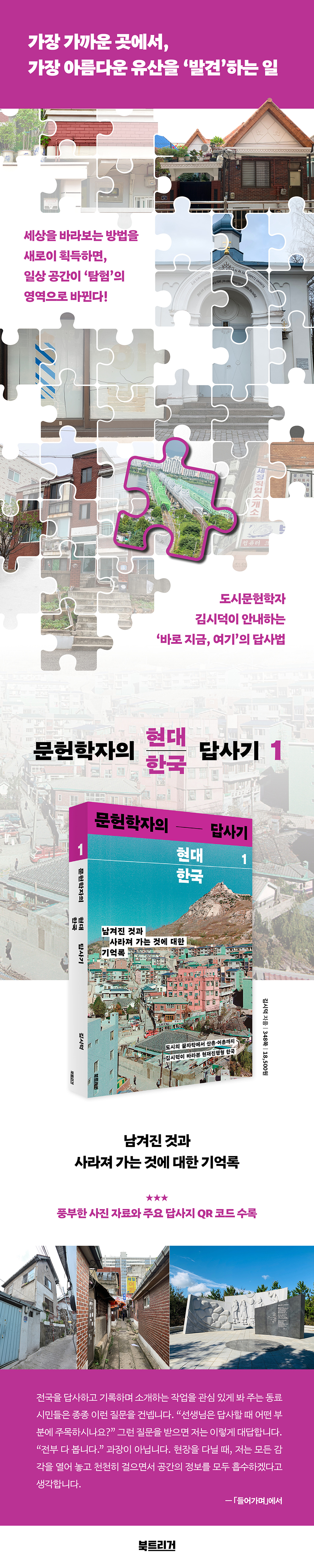
『A Literature Scholar's Travelogue of Modern Korea 1』 is a book that stands out for its abundant photographic materials taken by the author himself while traveling around the country.
At the beginning of each chapter, QR codes are placed that link to the main tour sites on Google Maps, allowing you to walk through each one, starting from the closest location.
Why not take this book and explore the neighborhood? It's great alone, but even better with a group.
And if, like the author, you can record the stories of your region with photos and words, it would be the icing on the cake.
For the readers of 'Future Korea' who will come next time.
When you acquire a new way of looking at the world,
Everyday spaces are transformed into areas of ‘exploration’!
Seoul, Busan, Incheon, Daegu, Daejeon, Gwangju, Suwon, Ulsan, Yongin, Goyang… .
Where do you live? Ulleung, Yeongyang, Jangsu, Yanggu, Jinan, Muju, Gurye, Cheongsong, Hwacheon, Yangyang…
Have you been to these places? The former are the top 10 most populous cities among South Korea's local governments above the county level, while the latter are the bottom 10 (based on population as of November 2022).
No matter where we live or where we go, our daily lives in modern Korea may not be all that different.
Because, amidst the hardships of commuting to and from work, school, earning money, and managing the household, we often rush towards our ‘destination’ day after day without even having time to look away.
So, where is your destination? A comfortable haven, symbolized by an apartment? Or a dream vacation spot that's sure to impress your Instagram followers?
You don't have to take the time to travel far away or spend a lot of money to find joy.
The author, who looks at various parts of the city through the eyes of a philologist, suggests that 'field trips' are one of the things we enjoy.
In this book, he reveals the secrets of exploration that will change your daily life.
If you imagine a field trip as a trip where you go to a historic site, read the signs, take a commemorative photo, find a good restaurant nearby, fill your hungry stomach, and then turn back on the congested road, you are mistaken.
The world's most precious relics are right next to me, in my neighborhood.
At the nearest place,
'Discovering' the most beautiful heritage
In Part 1, “Discovering Modern Korea through Strolls,” the author presents 12 major points for exploration.
Signboards, cultural housing, civic art, flower pots and kimchi storage containers, cold noodles, green dishes, and yeast, private houses, improved tile-roofed houses, multi-family housing, apartments, commercial and public facilities, railways, and bus stops.
These are the things we encounter every time we walk down the street, yet we simply consider them as passing scenery.
But let's slow down for a moment and take a look.
Objects and neighborhoods across the country that seem completely unremarkable will speak to you.
If you've had your fill of exploring the hidden gems within the city, it's time to venture beyond its boundaries.
In Part 2, "The Clash of Civilizations in Modern Korea," the author examines the two groups or forces that clashed fiercely in this land: farmers versus fishermen and slash-and-burn farmers, and urban versus rural areas.
Through stories from inside and outside the city, such as the memorial stones of the industrial city of Ulsan, the island of Jeju where trains once ran, the identity issues of the local residents surrounding Sejong City, land development and traditional villages, and walking along the traces of old roads, we realize how important it is to record the memories of the places where we live.
Kim Si-deok's view of Korea in the present
Author Kim Si-deok applies the methodology of philology to examine the 'present history' of modern Korea.
Just as we unearth traces of history from a pile of rarely-seen ancient documents, we walk through alleys across the country and reveal to the world the stories of citizens hidden in houses and tombstones.
What does a scholar of urban literature see as modern Korea? The neighborhoods here and there are marked by a determination to live a beautiful life, despite poverty, not a life lived in squalor.
A story of what was left behind and what was lost as civilizations clashed everywhere.
『A Literature Scholar's Travelogue of Modern Korea 1』 looks back at those who have lived before us, calls out those who will live after us, and illuminates the place where we stand now.
『A Literature Scholar's Travelogue of Modern Korea 1』 is a book that stands out for its abundant photographic materials taken by the author himself while traveling around the country.
At the beginning of each chapter, QR codes are placed that link to the main tour sites on Google Maps, allowing you to walk through each one, starting from the closest location.
Why not take this book and explore the neighborhood? It's great alone, but even better with a group.
And if, like the author, you can record the stories of your region with photos and words, it would be the icing on the cake.
For the readers of 'Future Korea' who will come next time.
When you acquire a new way of looking at the world,
Everyday spaces are transformed into areas of ‘exploration’!
Seoul, Busan, Incheon, Daegu, Daejeon, Gwangju, Suwon, Ulsan, Yongin, Goyang… .
Where do you live? Ulleung, Yeongyang, Jangsu, Yanggu, Jinan, Muju, Gurye, Cheongsong, Hwacheon, Yangyang…
Have you been to these places? The former are the top 10 most populous cities among South Korea's local governments above the county level, while the latter are the bottom 10 (based on population as of November 2022).
No matter where we live or where we go, our daily lives in modern Korea may not be all that different.
Because, amidst the hardships of commuting to and from work, school, earning money, and managing the household, we often rush towards our ‘destination’ day after day without even having time to look away.
So, where is your destination? A comfortable haven, symbolized by an apartment? Or a dream vacation spot that's sure to impress your Instagram followers?
You don't have to take the time to travel far away or spend a lot of money to find joy.
The author, who looks at various parts of the city through the eyes of a philologist, suggests that 'field trips' are one of the things we enjoy.
In this book, he reveals the secrets of exploration that will change your daily life.
If you imagine a field trip as a trip where you go to a historic site, read the signs, take a commemorative photo, find a good restaurant nearby, fill your hungry stomach, and then turn back on the congested road, you are mistaken.
The world's most precious relics are right next to me, in my neighborhood.
At the nearest place,
'Discovering' the most beautiful heritage
In Part 1, “Discovering Modern Korea through Strolls,” the author presents 12 major points for exploration.
Signboards, cultural housing, civic art, flower pots and kimchi storage containers, cold noodles, green dishes, and yeast, private houses, improved tile-roofed houses, multi-family housing, apartments, commercial and public facilities, railways, and bus stops.
These are the things we encounter every time we walk down the street, yet we simply consider them as passing scenery.
But let's slow down for a moment and take a look.
Objects and neighborhoods across the country that seem completely unremarkable will speak to you.
If you've had your fill of exploring the hidden gems within the city, it's time to venture beyond its boundaries.
In Part 2, "The Clash of Civilizations in Modern Korea," the author examines the two groups or forces that clashed fiercely in this land: farmers versus fishermen and slash-and-burn farmers, and urban versus rural areas.
Through stories from inside and outside the city, such as the memorial stones of the industrial city of Ulsan, the island of Jeju where trains once ran, the identity issues of the local residents surrounding Sejong City, land development and traditional villages, and walking along the traces of old roads, we realize how important it is to record the memories of the places where we live.
GOODS SPECIFICS
- Date of issue: September 25, 2023
- Page count, weight, size: 348 pages | 612g | 150*220*23mm
- ISBN13: 9791193378014
- ISBN10: 119337801X
You may also like
카테고리
korean


korean

![GQ KOREA Mark (Monthly): December [2025]](http://librairie.coreenne.fr/cdn/shop/files/8ef265dbbfbf186523ed75ba7319009d.jpg?v=1765340328&width=3840)


