

Such an elegant zero-waste journey
 |
Description
Book Introduction
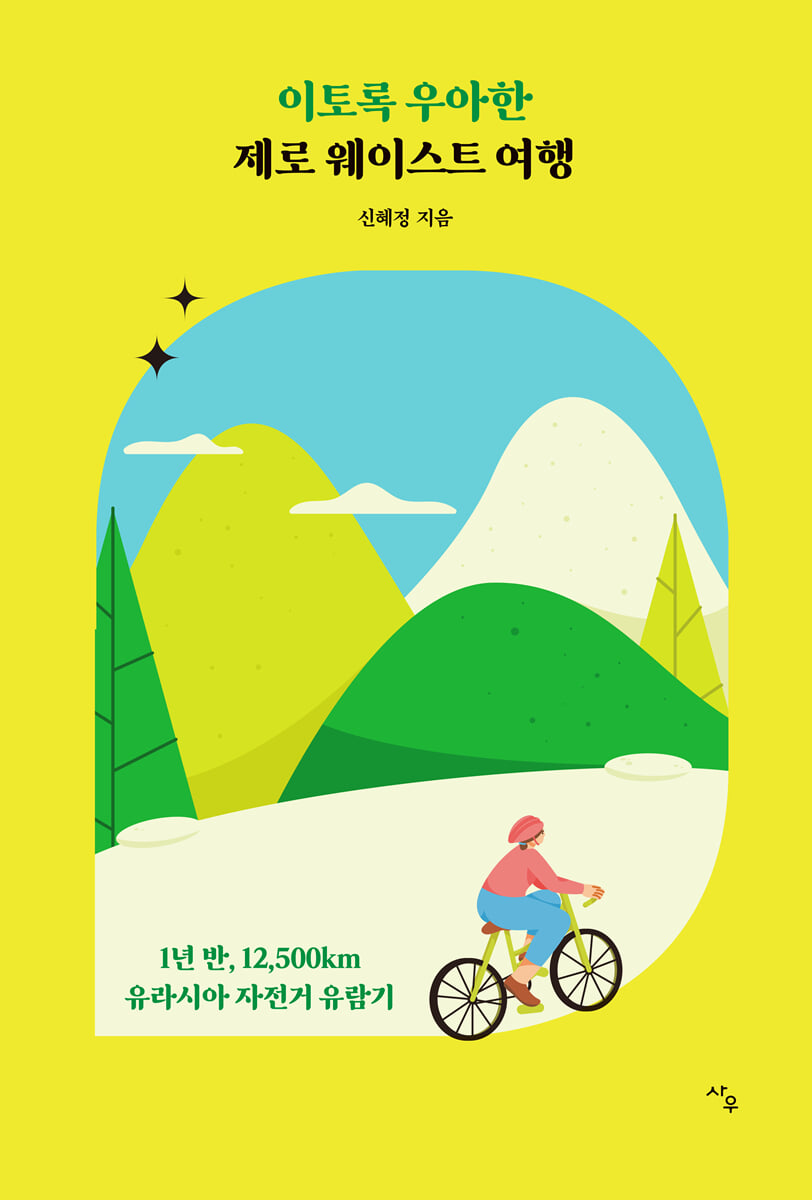
A woman in her 30s with poor physical condition cycled 12,500 km across Eurasia alone in a year and a half. The elegant, melancholic, funny, and poignant tale of a zero-waste traveler. At thirty-three, a woman living a life of sprinting as a workaholic decides to stop. After quitting my job, I boarded a ship to China with my bicycle to start over and figure out how to live again. I ran 12,500 kilometers to Turkey in a year and a half. This book is a moving collection of essays about the people I met along the way, the trash I found, and the things I realized along the way. I went on a zero-waste trip without using any daily necessities. Cycling solo wasn't easy, but the challenges faced by zero-waste travelers, unable to afford bottled drinks or plastic-wrapped snacks in the heat and hunger, were equally challenging. But I was also able to enjoy just as much joy and emotion. The funny and heartbreaking stories of the journey to zero waste are both entertaining and powerful in their environmental education. During my journey, I visited garbage dumps and recycling centers all over Eurasia. The things we discarded were ultimately connected to us. I felt that the various 'wandering thoughts' of using things for a long time, saving them, and not using them at all could be, in other words, the 'elegance' of respecting myself, other beings, and our land. Another main character in this book is the countless people I met on the road. They offered unconditional hospitality to the weary cyclist. They would not hesitate to invite travelers they met by chance into their homes and provide them with a place to sleep and plenty of food. Although they had different nationalities, religions, and skin colors, they were all people. The story of people who gave unconditional generosity to a stranger on a bicycle is more interesting and touching than any drama. |
- You can preview some of the book's contents.
Preview
index
A rather long prologue_ Back on the road
Part 1: The Slowpoke Who Arrived Like a Comet in the Cycling World: Wouldn't Walking Be Better? (China)
·The start of the trip was easy until the afternoon.
·The navigator tells me to cross the river.
·The secret to greatness
·Climb Hwangsan Mountain to drink Hwangju
·The biggest climb of my cycling life
There is no exit in this sauna.
·16-year-old garbage collector's cart
A person with a mysteriously large heart
·I went to the world's largest garbage dump in the past.
·A different world in one restaurant
It's incredibly difficult to enjoy a luxurious stay in Guangzhou.
Two sentences from a bicycle traveler
·Accept it like that
Why am I not happy after my second trip? (Vietnam, Laos, Thailand)
·Walked from China to Vietnam across a bridge
·A motorcycle came and crashed into the clear sky.
·What did I do to deserve this?
·Over the mountains and across the river to Laos
I hate riding a bike so much
·Riding a bike was the easiest
·Back again, on a trip
Part 3: People Save Me (Thailand, Myanmar)
·The community saved me.
·Dreams come true, working at a recycling plant
·Meet a companion
·There are two mountains on the way to Myanmar (they repeat that they are dead)
·Mingalaba Myanmar, beautiful in many ways!
·Even on the unpaved hell road, people are beautiful
·Where are you going to sleep tonight?
Bagan then, Bagan now
·The Bicycle Rebellion and the Outstretched Hands of Salvation
Part 4.
Dynamic Western Regions put me to the test (India, Pakistan)
·A scrap jeep stopped by, offering to give me a ride.
Three Nights of Manipur
·India's plastic-free revolution
·India, the mecca of leveling up
A day in Bihar, a state known for its thieves
New Delhi Blues
·There was no need to come all the way to this remote village in Ladakh.
A letter from a place close to heaven
·Hitchhiking on a garbage truck
Where is Hotel Stein?
· Had a meal at a Sikh temple with a Sikh companion
·There are too many people who put me to the test.
·Picked cucumbers at the sacred Golden Temple in Amritsar
·He jumped into Pakistan during Ramadan.
·Take a Chinese visa and travel 30,000 miles
·Why are there Greek ruins in Pakistan?
Part 5: I told you not to go to high places (Xinjiang, China, Kyrgyzstan, Tajikistan)
·The story of riding in a police car for two days in a row
·Please put it in a tumbler
·Fold my hands
·I'm all grown up, I'm going to Pamir alone
The greatest headwind of my life in the Pamirs
·Imagination in the Pamir Plateau, a world traveler's dream
Part 6: I Can't Come to My senses About Islam's Hospitality
(Tajikistan, Uzbekistan, Turkmenistan, Iran)
·Camping with nature people on the first full moon of Chuseok
·A bicycle craftsman I met in Turkmenistan
Iran, a land of twists and turns
·The Light of Humanity
·I couldn't get the sandwich in a cloth bag.
Part 7: My Eldorado is Someone's Boring Daily Life (Turkey)
Heaven and Hell on a Truck
·Leonardo DiCaprio of Turkey
·The boredom of going up and down and the sun setting all day long
·I came to Istanbul
Epilogue: A Forest of Barley Trees
Part 1: The Slowpoke Who Arrived Like a Comet in the Cycling World: Wouldn't Walking Be Better? (China)
·The start of the trip was easy until the afternoon.
·The navigator tells me to cross the river.
·The secret to greatness
·Climb Hwangsan Mountain to drink Hwangju
·The biggest climb of my cycling life
There is no exit in this sauna.
·16-year-old garbage collector's cart
A person with a mysteriously large heart
·I went to the world's largest garbage dump in the past.
·A different world in one restaurant
It's incredibly difficult to enjoy a luxurious stay in Guangzhou.
Two sentences from a bicycle traveler
·Accept it like that
Why am I not happy after my second trip? (Vietnam, Laos, Thailand)
·Walked from China to Vietnam across a bridge
·A motorcycle came and crashed into the clear sky.
·What did I do to deserve this?
·Over the mountains and across the river to Laos
I hate riding a bike so much
·Riding a bike was the easiest
·Back again, on a trip
Part 3: People Save Me (Thailand, Myanmar)
·The community saved me.
·Dreams come true, working at a recycling plant
·Meet a companion
·There are two mountains on the way to Myanmar (they repeat that they are dead)
·Mingalaba Myanmar, beautiful in many ways!
·Even on the unpaved hell road, people are beautiful
·Where are you going to sleep tonight?
Bagan then, Bagan now
·The Bicycle Rebellion and the Outstretched Hands of Salvation
Part 4.
Dynamic Western Regions put me to the test (India, Pakistan)
·A scrap jeep stopped by, offering to give me a ride.
Three Nights of Manipur
·India's plastic-free revolution
·India, the mecca of leveling up
A day in Bihar, a state known for its thieves
New Delhi Blues
·There was no need to come all the way to this remote village in Ladakh.
A letter from a place close to heaven
·Hitchhiking on a garbage truck
Where is Hotel Stein?
· Had a meal at a Sikh temple with a Sikh companion
·There are too many people who put me to the test.
·Picked cucumbers at the sacred Golden Temple in Amritsar
·He jumped into Pakistan during Ramadan.
·Take a Chinese visa and travel 30,000 miles
·Why are there Greek ruins in Pakistan?
Part 5: I told you not to go to high places (Xinjiang, China, Kyrgyzstan, Tajikistan)
·The story of riding in a police car for two days in a row
·Please put it in a tumbler
·Fold my hands
·I'm all grown up, I'm going to Pamir alone
The greatest headwind of my life in the Pamirs
·Imagination in the Pamir Plateau, a world traveler's dream
Part 6: I Can't Come to My senses About Islam's Hospitality
(Tajikistan, Uzbekistan, Turkmenistan, Iran)
·Camping with nature people on the first full moon of Chuseok
·A bicycle craftsman I met in Turkmenistan
Iran, a land of twists and turns
·The Light of Humanity
·I couldn't get the sandwich in a cloth bag.
Part 7: My Eldorado is Someone's Boring Daily Life (Turkey)
Heaven and Hell on a Truck
·Leonardo DiCaprio of Turkey
·The boredom of going up and down and the sun setting all day long
·I came to Istanbul
Epilogue: A Forest of Barley Trees
Detailed image

Into the book
When people think of traveling Eurasia by bike, they think of muscular professional cyclists in tights, but I'm just a reckless, low-skilled office worker who chose to ride a bike because I didn't know how hard it would be.
The idea for this trip was naively conceived: "I want to travel Eurasia at my own pace, but walking seems too slow. Maybe a bicycle would be better."
I haven't ridden a bike since elementary school.
A month before this trip, I took a test trip around the country and climbed a hill on my bike for the first time in my 30-year life.
That was the first time I realized that climbing a hill by bike was harder than climbing a hill on foot.
It was obvious.
The bicycle was not alone, but was carrying a load weighing at least 20 kilograms.
Even on a slight climb, the wind made a hissing sound in my throat.
Every climb is a Golgotha hill.
With this stamina, would I be able to go on a bicycle trip?
--- From "The Story of Drinking Hwangju in Hwangsan"
Hien puts an egg roll on my rice and tells me to eat a lot.
“Don't be hungry.
Don't be hungry (Eat until you're full.
“Eat a lot.”
I'm touched by Hien's poor English.
I am grateful that I am alive today because of the heart of the person I met for the first time today, who told me not to be hungry.
Because on this big Earth, it seems like we can live thanks to one person, a tiny speck of dust, a tiny speck of dust.
I gulped down the scrambled eggs.
--- From "Even if I am like dust"
There were a few vendors selling food that got on the bus when the bus stopped here and there, but they were all wrapped in plastic so I didn't eat anything.
When a vendor pulled up with a pomelo (a grapefruit-like fruit I love) neatly wrapped in Styrofoam and plastic wrap and corn double-wrapped in plastic bags (I was dazzled), I asked myself, "What is plastic?" and "What am I?"
Until then, it was bearable.
Maybe because I had expended energy riding my bike in the morning, but even though I was sitting still on the bus, my blood sugar level started to drop around 3 o'clock.
This is what happens to your body when you get really hungry while riding a bike.
A feeling of stiffness in the body due to poor blood circulation.
I thought I was meditating for a while and did a simulation of circulating energy in my body, and I felt better.
It's okay.
For now, he gaslighted my body, saying that it seemed okay.
--- From "Riding a bike was the easiest"
A small community where we can see each other's faces and the people around us.
A community where I can feel connected to other beings.
A community where you can feel like you can do something to help the community run.
Sisa Asok was previously featured in the Korean media as an example of a global alternative community village.
I finally got to go to the place I had been holding in my heart since then.
A banner with the philosophy of the Asok community, “Our Loss is Our Gain,” fluttered among the vibrant festival scene.
There was another society.
Someone was living in a society with a different logic than the one I knew, a society where common sense was different from the common sense I knew, a society I had only dreamed of.
--- From "The Community Saved Me"
Yesterday's plan was definitely to leave this morning.
But after waking up in the morning and naturally watching the dyeing, I went sightseeing in the neighborhood with the kids, got Dalbam's hair cut at the neighborhood barber shop, and in the afternoon, I followed the old man and the neighbor to see a traditional brewery and had some drinks, and it was natural that I would not leave for today, when the old man asked me.
“How about going the day after tomorrow instead of tomorrow?”
That's how it goes for three nights.
The lady covered me with a blanket carefully today too.
--- From "Three Nights of Manipur"
Traveling by bus for long stretches of Pakistan's Karakoram Highway for safety reasons was both rewarding and disappointing.
The section where I took the bus will always remain an unknown space to me, just a high barrier.
If I try to fit in, I'll have to give up more and more things as time goes on, but I don't want to keep giving up and just be jealous.
Doing what was thought impossible, venturing into unknown territory - these are challenges I want to take on at least once in my life.
I want to experience that hardship, that loneliness, that fear of breaking down in the midst of that hardship.
--- From "I'm all grown up, I'm going to Pamir alone"
Uncle Reza's house had a large yard.
The uncle and Nasser bought tomatoes and chicken, seasoned the chicken in the yard, made kebabs, built a fire, and fanned it while roasting the tomatoes and chicken, and in the kitchen, the uncle's wife boiled rice, poured it over potatoes, mixed it with cooking oil, and steamed it.
After three long hours of cooking inside and out, lunch is ready around 3 o'clock.
As we were eating and playing deliciously, the sun was setting and we were slowly getting ready to go out when Uncle Reza spoke politely again.
Go to sleep.
I shut my mouth again in my mind.
Mr. Reza, who gives generously.
--- From "Iran, a country of reversals and reversals"
We need to dispel the dangerous atmosphere.
There are situations where being scared can make the other person a truly scary person.
The knight asked if I had noticed that I was slowly avoiding him after our physical contact when I got out of the truck.
“Why are you afraid of me?”
“No? I’m not scared.
I know you are a good person.
We can be good friends!”
He keeps raising the corners of his mouth and repeats his response like a parrot.
As we approached the Black Sea, the sun set and darkness fell.
There are still no cars or people on the road, but the driver suddenly stops the car.
“There is a lot of traffic on the Trabzon side right now.
“Let’s wait and go.”
The knight locks the car door.
He turns towards me and sits close to me.
My heart is trembling, and my hands are shaking for the first time in a long time.
I had already opened the can of pepper spray and put it in my pocket, but it seemed useless with the car doors locked.
--- From "Heaven and Hell Met on a Truck"
A dog is an occasional variable in a quiet ride.
If we were to discuss the national character of dogs, or rather, the national character of dogs, the most aggressive dog breeds would be the Thai and Turkish dogs.
The dogs here were on average larger than the Thai dogs.
The barking was also loud.
But now I'm not as scared of dogs as I was in Thailand.
After being bitten by a dog in Ladakh, India, I redefine my relationship with dogs by rubbing soap into the wound every day.
In the great outdoors, the dog and I had to face off against each other.
After that, in the Pamir backlash, when only evil remained in tatters, I was surprised to find myself yelling at a dog that was running towards me barking.
So, after a year of traveling, I grew into a well-rounded dog chaser.
The idea for this trip was naively conceived: "I want to travel Eurasia at my own pace, but walking seems too slow. Maybe a bicycle would be better."
I haven't ridden a bike since elementary school.
A month before this trip, I took a test trip around the country and climbed a hill on my bike for the first time in my 30-year life.
That was the first time I realized that climbing a hill by bike was harder than climbing a hill on foot.
It was obvious.
The bicycle was not alone, but was carrying a load weighing at least 20 kilograms.
Even on a slight climb, the wind made a hissing sound in my throat.
Every climb is a Golgotha hill.
With this stamina, would I be able to go on a bicycle trip?
--- From "The Story of Drinking Hwangju in Hwangsan"
Hien puts an egg roll on my rice and tells me to eat a lot.
“Don't be hungry.
Don't be hungry (Eat until you're full.
“Eat a lot.”
I'm touched by Hien's poor English.
I am grateful that I am alive today because of the heart of the person I met for the first time today, who told me not to be hungry.
Because on this big Earth, it seems like we can live thanks to one person, a tiny speck of dust, a tiny speck of dust.
I gulped down the scrambled eggs.
--- From "Even if I am like dust"
There were a few vendors selling food that got on the bus when the bus stopped here and there, but they were all wrapped in plastic so I didn't eat anything.
When a vendor pulled up with a pomelo (a grapefruit-like fruit I love) neatly wrapped in Styrofoam and plastic wrap and corn double-wrapped in plastic bags (I was dazzled), I asked myself, "What is plastic?" and "What am I?"
Until then, it was bearable.
Maybe because I had expended energy riding my bike in the morning, but even though I was sitting still on the bus, my blood sugar level started to drop around 3 o'clock.
This is what happens to your body when you get really hungry while riding a bike.
A feeling of stiffness in the body due to poor blood circulation.
I thought I was meditating for a while and did a simulation of circulating energy in my body, and I felt better.
It's okay.
For now, he gaslighted my body, saying that it seemed okay.
--- From "Riding a bike was the easiest"
A small community where we can see each other's faces and the people around us.
A community where I can feel connected to other beings.
A community where you can feel like you can do something to help the community run.
Sisa Asok was previously featured in the Korean media as an example of a global alternative community village.
I finally got to go to the place I had been holding in my heart since then.
A banner with the philosophy of the Asok community, “Our Loss is Our Gain,” fluttered among the vibrant festival scene.
There was another society.
Someone was living in a society with a different logic than the one I knew, a society where common sense was different from the common sense I knew, a society I had only dreamed of.
--- From "The Community Saved Me"
Yesterday's plan was definitely to leave this morning.
But after waking up in the morning and naturally watching the dyeing, I went sightseeing in the neighborhood with the kids, got Dalbam's hair cut at the neighborhood barber shop, and in the afternoon, I followed the old man and the neighbor to see a traditional brewery and had some drinks, and it was natural that I would not leave for today, when the old man asked me.
“How about going the day after tomorrow instead of tomorrow?”
That's how it goes for three nights.
The lady covered me with a blanket carefully today too.
--- From "Three Nights of Manipur"
Traveling by bus for long stretches of Pakistan's Karakoram Highway for safety reasons was both rewarding and disappointing.
The section where I took the bus will always remain an unknown space to me, just a high barrier.
If I try to fit in, I'll have to give up more and more things as time goes on, but I don't want to keep giving up and just be jealous.
Doing what was thought impossible, venturing into unknown territory - these are challenges I want to take on at least once in my life.
I want to experience that hardship, that loneliness, that fear of breaking down in the midst of that hardship.
--- From "I'm all grown up, I'm going to Pamir alone"
Uncle Reza's house had a large yard.
The uncle and Nasser bought tomatoes and chicken, seasoned the chicken in the yard, made kebabs, built a fire, and fanned it while roasting the tomatoes and chicken, and in the kitchen, the uncle's wife boiled rice, poured it over potatoes, mixed it with cooking oil, and steamed it.
After three long hours of cooking inside and out, lunch is ready around 3 o'clock.
As we were eating and playing deliciously, the sun was setting and we were slowly getting ready to go out when Uncle Reza spoke politely again.
Go to sleep.
I shut my mouth again in my mind.
Mr. Reza, who gives generously.
--- From "Iran, a country of reversals and reversals"
We need to dispel the dangerous atmosphere.
There are situations where being scared can make the other person a truly scary person.
The knight asked if I had noticed that I was slowly avoiding him after our physical contact when I got out of the truck.
“Why are you afraid of me?”
“No? I’m not scared.
I know you are a good person.
We can be good friends!”
He keeps raising the corners of his mouth and repeats his response like a parrot.
As we approached the Black Sea, the sun set and darkness fell.
There are still no cars or people on the road, but the driver suddenly stops the car.
“There is a lot of traffic on the Trabzon side right now.
“Let’s wait and go.”
The knight locks the car door.
He turns towards me and sits close to me.
My heart is trembling, and my hands are shaking for the first time in a long time.
I had already opened the can of pepper spray and put it in my pocket, but it seemed useless with the car doors locked.
--- From "Heaven and Hell Met on a Truck"
A dog is an occasional variable in a quiet ride.
If we were to discuss the national character of dogs, or rather, the national character of dogs, the most aggressive dog breeds would be the Thai and Turkish dogs.
The dogs here were on average larger than the Thai dogs.
The barking was also loud.
But now I'm not as scared of dogs as I was in Thailand.
After being bitten by a dog in Ladakh, India, I redefine my relationship with dogs by rubbing soap into the wound every day.
In the great outdoors, the dog and I had to face off against each other.
After that, in the Pamir backlash, when only evil remained in tatters, I was surprised to find myself yelling at a dog that was running towards me barking.
So, after a year of traveling, I grew into a well-rounded dog chaser.
--- From "The Boredom of Going Up and Down and the Sun Setting"
Publisher's Review
What I learned from cycling 12,500km across Eurasia alone for a year and a half.
At thirty-three, a workaholic woman living a fast-paced life decides to get off the moving train.
She was working as a senior at a climate crisis response NGO.
The work was familiar and the coworkers were nice.
But at some point, I started to feel skeptical about the things I loved and cared about so much.
"Is this the right path?" he asked, still sitting in his familiar seat.
Then one day, the death of a close friend prompted me to stop and ask myself what it means to live well and how I should live.
Her next move is to cycle across Eurasia along the Silk Road.
A poorly-built office worker who hasn't ridden a bike since elementary school plans a bike trip for the simple reason that a bike is faster than walking.
Additionally, I decided to go on a zero-waste trip without using disposable products.
While solo cycling for women is challenging, the challenges faced by zero-waste travelers, unable to afford bottled drinks and plastic-wrapped snacks in the heat and hunger, are equally challenging.
But I was also able to enjoy just as much joy and emotion.
The author ran 15,000 km for one year and six months, repeatedly asking himself and answering questions about a worthwhile life.
The Earth is getting hotter, and the oceans and atmosphere are being polluted with trash and fine dust. What can I do?
The Earth is so vast and big, but is there anything I, a being smaller than a speck of dust, can do?
This question kept coming back to me throughout the trip, “like a magpie that returns without dying.”
The author answers this question by visiting dumps and working in recycling workshops around the world.
There were things I had only known through books and the internet that I could truly appreciate after seeing them with my own eyes.
People I met along the way offered unconditional hospitality to the weary cyclist.
On the uphill slopes of Myanmar, during Ramadan in Pakistan, in the Pamir Plateau, people willingly reached out.
In particular, people in Islamic countries, who “do not turn away guests who come today even if it means starving tomorrow,” invite travelers they meet by chance into their homes without hesitation and provide them with a place to sleep and plenty of food.
Although they had different nationalities, religions, and skin colors, they were all people.
The story of people who gave unconditional generosity to a stranger on a bicycle is more interesting and touching than any drama.
This book tells the story of the author's realization of the meaning and precious values of life and work during his long journey.
The author vividly describes the countless people he met and their stories, allowing readers to enjoy the thrill of traveling with him on a bicycle.
An elegant, poignant, funny, and poignant zero-waste travel story.
A powerful environmental education book that teaches you while laughing!
The author has challenged himself several times to not use disposable plastic for a week while working.
It failed every time.
I need to prepare in advance to avoid using plastic, but I don't have the concentration to do that while working.
Now that I'm a traveler who can focus on my daily life rather than work, I decide to try again.
“Plastic is light, cheap, and convenient.
The problem is using it too much.
The Earth's surface is covered in plastic because it is difficult to recycle and does not decompose easily.
There are even predictions that by 2050 there will be more plastic than fish in the ocean.
Over time, plastic breaks down into microplastics that float around.
“Fish will eat those microplastics, seabirds will eat them, and people will eat them.”
So, I've been traveling without disposable plastic for a year and a half.
Even while traveling, I was able to use cotton sanitary pads.
If you wash it and hang it on the back of your bike, it will be completely dry in half a day.
“A daily life without disposable plastics is easier than you think.
A tumbler, a shopping basket, a lunch box, and a spoon are the basic set of LessWaste.
It's important to be 'prepared' because you never know when you'll need something.
When I unpack at my accommodation and go out, I pack a basic set in my bag.
If you didn't bring the basic set, you won't buy anything that looks good, so you'll end up carrying the basic set like it's your body.
Prepare water and snacks for each day the day before.
It's a good idea to prepare snacks the day before, as it can be difficult to find unpackaged food while running.
Ask for unpackaged food from a bakery, fruit shop, or street vendor near your accommodation.
I have free time in my daily life, so this kind of thing doesn't bother me.
“Rather, there is fun in taking care of life.”
Often times, crises came.
There were times when I skipped a meal because I couldn't find a restaurant while running on a mountain road.
No matter how hungry I was, I couldn't buy plastic-wrapped bread and cookies, let alone steamed corn wrapped in plastic or fruit wrapped in plastic wrap in a Styrofoam container.
Even in the sweltering heat of 43 degrees, I had to sigh as I looked at the cool drink in the plastic bottle.
It is full of truly funny and sad stories.
Hearing stories of people enduring hunger and thirst to avoid using even a single piece of plastic wrap during a grueling bicycle trip makes us reflect on our convenient daily lives with a heavy heart.
In that sense, this book can be the most effective motivation for those who want to practice reducing waste.
“During my last trip, when I committed to not using single-use plastic, I became more adept at asking and refusing, and a little more shameless.
I gestured for someone to put the cola in a tumbler.
I asked for the shake, which was supposed to be consumed with a straw, to be put in a lunch box so I could eat it with a spoon.
Even highly developed sensors that shout "I don't need it" before a merchant takes out a plastic bag or straw are available.
People either understood my actions or didn't.
Especially in China, where plastic waste was not a national issue, my employees looked at me with a puzzled expression.
To the staff who didn't know English, I just seemed like a guy who really liked his cup, and that didn't matter.
“Whether I am understood or misunderstood, I just have to go my own way.”
The author visits landfills whenever he can to find out how the waste we throw away is actually processed.
We visit a dump in China, where 70 percent of the world's e-waste is collected, and witness mountains of plastic piled high in a village near Hanoi, Vietnam, where every household makes a living by recycling plastic.
In a community village in Thailand, you get to experience the task of sorting and collecting waste yourself and realize that 'recycling' is different from what you vaguely think of.
Just because we separate our waste well, it doesn't mean it's being reused.
More than 80 percent is simply discarded, buried in the ground, incinerated, or flows into the sea.
“Actually, there is no need for this much garbage to be produced.
If you put something in the trash can, it becomes trash.
If there is more than necessary, it becomes trash.
“Rather than a culture that uses and throws away easily, wouldn’t a culture that respects and cherishes even the smallest things be a more dignified and elegant culture?”
“It is discovering that all things that seemed different and unrelated are connected.
“It was an absolute pleasure.”
In Korea, a divided island in the far east of the Eurasian continent, crossing the border requires taking a plane or a boat.
The author says that cycling across borders from China to Laos, Thailand, Myanmar, India, and Pakistan gave him a new perspective on borders.
“The border is less than 100 years old and is not perfect.
If you look at a world map, the lines dividing the continents are solid lines (borders), but sometimes you can also see dotted lines (temporary borders).
In the disputed Kashmir region between India and Pakistan, there are areas where there are no solid or dotted lines.
There are more Lao people in Thailand than in present-day Laos.
There are 3-4 million Lao people in Laos, but 20 million live in Thailand.
There are 6 million Tajiks in Tajikistan, while 8 million live in Afghanistan.
I was actually living in this world.
“Everything is open, flowing, and sometimes divided, but in fact, everything is intertwined and connected.”
China, Japan, Vietnam, and Korea share many cultures.
I gave a bookmark with a traditional pattern that I had brought as a gift to a man who washed my bicycle in China, and he pointed to the Chinese characters written on it and explained them to me one by one.
In this way, the author witnesses several scenes that make him question whether there is something uniquely Korean.
In Pakistan, I saw coins with Aphrodite statues and Greek figures on them.
So, this region was part of the Indus civilization, then under Persian rule, and then under the rule of Alexander the Great of Greece, so the statue of Aphrodite and Greek coins are traces of this place's diverse identities.
“In the place where I stand now, in the past, Gandharas, Persians, Greeks, Bactrians, Kushans, Guptas, Huns, and even Monk Hyecho would have come and gone.
People have lived their lives going back and forth, and the world today is similar.
For most people, foreign countries were not 'overseas' but the neighborhood next door.
If we perceive time and space broadly, Pakistan is not just Pakistan, China is not just China, and Korea is not just Korea.
“I realized this when I saw a Buddha statue that looked like a Greek god at one point along the Silk Road: we are connected and have come to this point through giving and receiving, inseparable from the boundaries of nations, ethnicities, and religions.”
Not only countries, but also religions are like that.
The religious conflict between Islam and Christianity, which can lead to war, has its roots in Islam, Christianity, and Judaism.
Both were born in the Middle East and serve 'God'.
Judaism, Zoroastrianism, Buddhism, and Hinduism developed while influencing each other.
The author says that the joy of discovering that things that were thought to be completely different were actually connected was indescribable.
“The journey of discovering that every nook and cranny of the world is connected has been ecstatic.
I learned that people are shaped by their environment and society, that people who appear different because they speak different languages and look different are actually not that different, that even in a world ruled by survival of the fittest and the law of the jungle, there are people who protect their own well and even water others' throats, and that one person can become another person's world.”
At thirty-three, a workaholic woman living a fast-paced life decides to get off the moving train.
She was working as a senior at a climate crisis response NGO.
The work was familiar and the coworkers were nice.
But at some point, I started to feel skeptical about the things I loved and cared about so much.
"Is this the right path?" he asked, still sitting in his familiar seat.
Then one day, the death of a close friend prompted me to stop and ask myself what it means to live well and how I should live.
Her next move is to cycle across Eurasia along the Silk Road.
A poorly-built office worker who hasn't ridden a bike since elementary school plans a bike trip for the simple reason that a bike is faster than walking.
Additionally, I decided to go on a zero-waste trip without using disposable products.
While solo cycling for women is challenging, the challenges faced by zero-waste travelers, unable to afford bottled drinks and plastic-wrapped snacks in the heat and hunger, are equally challenging.
But I was also able to enjoy just as much joy and emotion.
The author ran 15,000 km for one year and six months, repeatedly asking himself and answering questions about a worthwhile life.
The Earth is getting hotter, and the oceans and atmosphere are being polluted with trash and fine dust. What can I do?
The Earth is so vast and big, but is there anything I, a being smaller than a speck of dust, can do?
This question kept coming back to me throughout the trip, “like a magpie that returns without dying.”
The author answers this question by visiting dumps and working in recycling workshops around the world.
There were things I had only known through books and the internet that I could truly appreciate after seeing them with my own eyes.
People I met along the way offered unconditional hospitality to the weary cyclist.
On the uphill slopes of Myanmar, during Ramadan in Pakistan, in the Pamir Plateau, people willingly reached out.
In particular, people in Islamic countries, who “do not turn away guests who come today even if it means starving tomorrow,” invite travelers they meet by chance into their homes without hesitation and provide them with a place to sleep and plenty of food.
Although they had different nationalities, religions, and skin colors, they were all people.
The story of people who gave unconditional generosity to a stranger on a bicycle is more interesting and touching than any drama.
This book tells the story of the author's realization of the meaning and precious values of life and work during his long journey.
The author vividly describes the countless people he met and their stories, allowing readers to enjoy the thrill of traveling with him on a bicycle.
An elegant, poignant, funny, and poignant zero-waste travel story.
A powerful environmental education book that teaches you while laughing!
The author has challenged himself several times to not use disposable plastic for a week while working.
It failed every time.
I need to prepare in advance to avoid using plastic, but I don't have the concentration to do that while working.
Now that I'm a traveler who can focus on my daily life rather than work, I decide to try again.
“Plastic is light, cheap, and convenient.
The problem is using it too much.
The Earth's surface is covered in plastic because it is difficult to recycle and does not decompose easily.
There are even predictions that by 2050 there will be more plastic than fish in the ocean.
Over time, plastic breaks down into microplastics that float around.
“Fish will eat those microplastics, seabirds will eat them, and people will eat them.”
So, I've been traveling without disposable plastic for a year and a half.
Even while traveling, I was able to use cotton sanitary pads.
If you wash it and hang it on the back of your bike, it will be completely dry in half a day.
“A daily life without disposable plastics is easier than you think.
A tumbler, a shopping basket, a lunch box, and a spoon are the basic set of LessWaste.
It's important to be 'prepared' because you never know when you'll need something.
When I unpack at my accommodation and go out, I pack a basic set in my bag.
If you didn't bring the basic set, you won't buy anything that looks good, so you'll end up carrying the basic set like it's your body.
Prepare water and snacks for each day the day before.
It's a good idea to prepare snacks the day before, as it can be difficult to find unpackaged food while running.
Ask for unpackaged food from a bakery, fruit shop, or street vendor near your accommodation.
I have free time in my daily life, so this kind of thing doesn't bother me.
“Rather, there is fun in taking care of life.”
Often times, crises came.
There were times when I skipped a meal because I couldn't find a restaurant while running on a mountain road.
No matter how hungry I was, I couldn't buy plastic-wrapped bread and cookies, let alone steamed corn wrapped in plastic or fruit wrapped in plastic wrap in a Styrofoam container.
Even in the sweltering heat of 43 degrees, I had to sigh as I looked at the cool drink in the plastic bottle.
It is full of truly funny and sad stories.
Hearing stories of people enduring hunger and thirst to avoid using even a single piece of plastic wrap during a grueling bicycle trip makes us reflect on our convenient daily lives with a heavy heart.
In that sense, this book can be the most effective motivation for those who want to practice reducing waste.
“During my last trip, when I committed to not using single-use plastic, I became more adept at asking and refusing, and a little more shameless.
I gestured for someone to put the cola in a tumbler.
I asked for the shake, which was supposed to be consumed with a straw, to be put in a lunch box so I could eat it with a spoon.
Even highly developed sensors that shout "I don't need it" before a merchant takes out a plastic bag or straw are available.
People either understood my actions or didn't.
Especially in China, where plastic waste was not a national issue, my employees looked at me with a puzzled expression.
To the staff who didn't know English, I just seemed like a guy who really liked his cup, and that didn't matter.
“Whether I am understood or misunderstood, I just have to go my own way.”
The author visits landfills whenever he can to find out how the waste we throw away is actually processed.
We visit a dump in China, where 70 percent of the world's e-waste is collected, and witness mountains of plastic piled high in a village near Hanoi, Vietnam, where every household makes a living by recycling plastic.
In a community village in Thailand, you get to experience the task of sorting and collecting waste yourself and realize that 'recycling' is different from what you vaguely think of.
Just because we separate our waste well, it doesn't mean it's being reused.
More than 80 percent is simply discarded, buried in the ground, incinerated, or flows into the sea.
“Actually, there is no need for this much garbage to be produced.
If you put something in the trash can, it becomes trash.
If there is more than necessary, it becomes trash.
“Rather than a culture that uses and throws away easily, wouldn’t a culture that respects and cherishes even the smallest things be a more dignified and elegant culture?”
“It is discovering that all things that seemed different and unrelated are connected.
“It was an absolute pleasure.”
In Korea, a divided island in the far east of the Eurasian continent, crossing the border requires taking a plane or a boat.
The author says that cycling across borders from China to Laos, Thailand, Myanmar, India, and Pakistan gave him a new perspective on borders.
“The border is less than 100 years old and is not perfect.
If you look at a world map, the lines dividing the continents are solid lines (borders), but sometimes you can also see dotted lines (temporary borders).
In the disputed Kashmir region between India and Pakistan, there are areas where there are no solid or dotted lines.
There are more Lao people in Thailand than in present-day Laos.
There are 3-4 million Lao people in Laos, but 20 million live in Thailand.
There are 6 million Tajiks in Tajikistan, while 8 million live in Afghanistan.
I was actually living in this world.
“Everything is open, flowing, and sometimes divided, but in fact, everything is intertwined and connected.”
China, Japan, Vietnam, and Korea share many cultures.
I gave a bookmark with a traditional pattern that I had brought as a gift to a man who washed my bicycle in China, and he pointed to the Chinese characters written on it and explained them to me one by one.
In this way, the author witnesses several scenes that make him question whether there is something uniquely Korean.
In Pakistan, I saw coins with Aphrodite statues and Greek figures on them.
So, this region was part of the Indus civilization, then under Persian rule, and then under the rule of Alexander the Great of Greece, so the statue of Aphrodite and Greek coins are traces of this place's diverse identities.
“In the place where I stand now, in the past, Gandharas, Persians, Greeks, Bactrians, Kushans, Guptas, Huns, and even Monk Hyecho would have come and gone.
People have lived their lives going back and forth, and the world today is similar.
For most people, foreign countries were not 'overseas' but the neighborhood next door.
If we perceive time and space broadly, Pakistan is not just Pakistan, China is not just China, and Korea is not just Korea.
“I realized this when I saw a Buddha statue that looked like a Greek god at one point along the Silk Road: we are connected and have come to this point through giving and receiving, inseparable from the boundaries of nations, ethnicities, and religions.”
Not only countries, but also religions are like that.
The religious conflict between Islam and Christianity, which can lead to war, has its roots in Islam, Christianity, and Judaism.
Both were born in the Middle East and serve 'God'.
Judaism, Zoroastrianism, Buddhism, and Hinduism developed while influencing each other.
The author says that the joy of discovering that things that were thought to be completely different were actually connected was indescribable.
“The journey of discovering that every nook and cranny of the world is connected has been ecstatic.
I learned that people are shaped by their environment and society, that people who appear different because they speak different languages and look different are actually not that different, that even in a world ruled by survival of the fittest and the law of the jungle, there are people who protect their own well and even water others' throats, and that one person can become another person's world.”
GOODS SPECIFICS
- Date of issue: September 5, 2023
- Page count, weight, size: 368 pages | 546g | 152*224*24mm
- ISBN13: 9791187332893
- ISBN10: 1187332895
You may also like
카테고리
korean


korean

![GQ KOREA Mark (Monthly): December [2025]](http://librairie.coreenne.fr/cdn/shop/files/8ef265dbbfbf186523ed75ba7319009d.jpg?v=1765340328&width=3840)


