

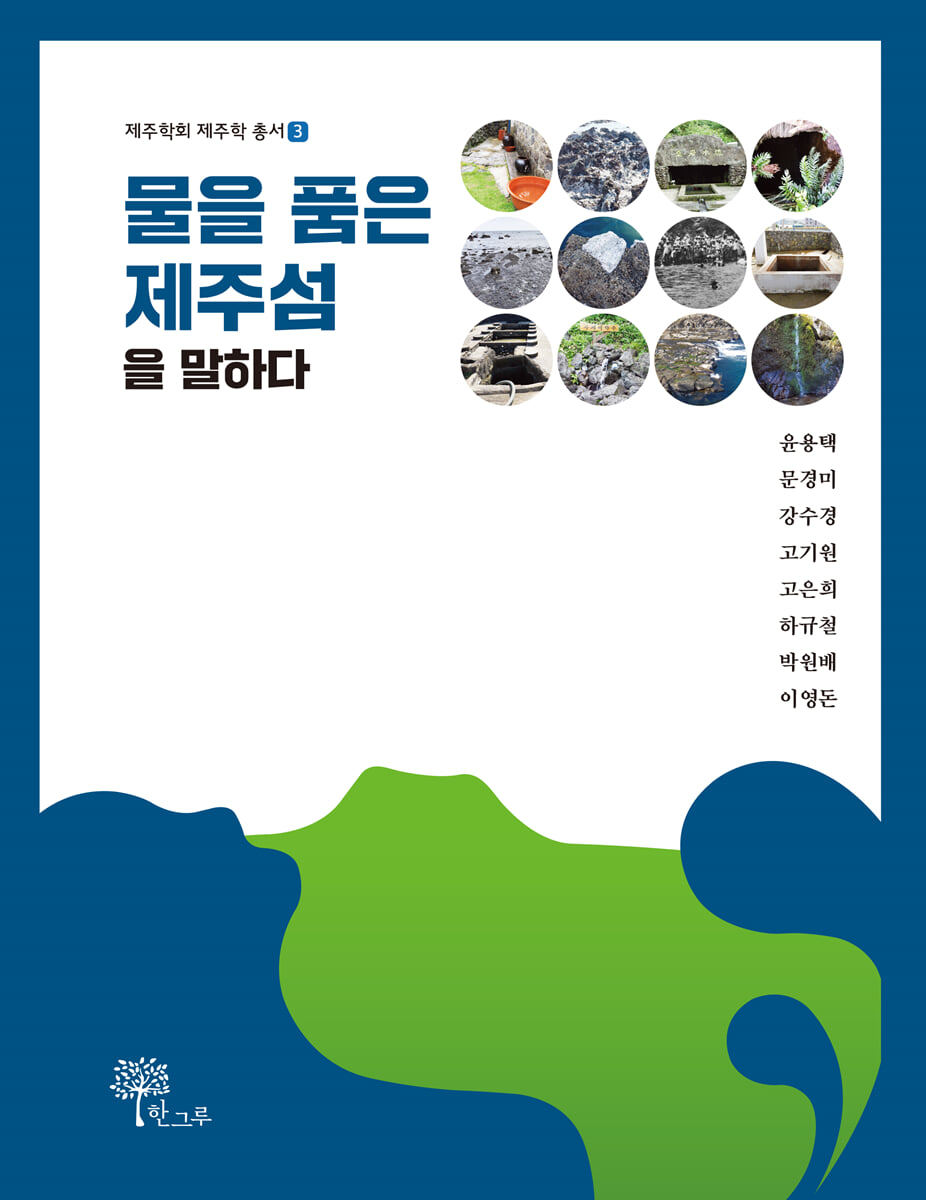
Speaking of Jeju Island, filled with water
 |
Description
Book Introduction
Integrated research to preserve Jeju's precious water
This is the third volume of the "Jeju Studies Series" of the Jeju Society, which was established to promote academic exchange and cooperation among researchers in the humanities, social sciences, and natural sciences, focusing on the Jeju region, and to promote research in academic fields related to Jeju Island.
While the academic journal 『Jeju Island Studies』, published semiannually by the Jeju Society, is a forum for presentations centered on specialized research results, the 『Jeju Studies Series』 aims to be a more popular academic textbook centered on one of the academic fields related to Jeju Studies.
This issue covers Jeju's water resources, including groundwater.
Jeju's water shows a wide variety of forms, including rainwater collected in springs, underground water seeping into the ground, spring water, flowing streams, and lava seawater (saltwater) that is constant and clean.
To properly understand such a variety of waters, we need to examine not only natural sciences such as environmental science, geology, hydrology, and oceanography, but also humanities and social sciences such as philosophy, history, folklore, and culture.
Therefore, this series seeks to provide a multifaceted understanding of Jeju's water resources through the research of eight researchers in the humanities, social sciences, and natural sciences who have taken an interest in Jeju Island's water.
The Jeju Society plans to continue organizing the basic topics and core contents of Jeju studies by academic field or major topic through the publication of the “Jeju Studies Series.”
This is the third volume of the "Jeju Studies Series" of the Jeju Society, which was established to promote academic exchange and cooperation among researchers in the humanities, social sciences, and natural sciences, focusing on the Jeju region, and to promote research in academic fields related to Jeju Island.
While the academic journal 『Jeju Island Studies』, published semiannually by the Jeju Society, is a forum for presentations centered on specialized research results, the 『Jeju Studies Series』 aims to be a more popular academic textbook centered on one of the academic fields related to Jeju Studies.
This issue covers Jeju's water resources, including groundwater.
Jeju's water shows a wide variety of forms, including rainwater collected in springs, underground water seeping into the ground, spring water, flowing streams, and lava seawater (saltwater) that is constant and clean.
To properly understand such a variety of waters, we need to examine not only natural sciences such as environmental science, geology, hydrology, and oceanography, but also humanities and social sciences such as philosophy, history, folklore, and culture.
Therefore, this series seeks to provide a multifaceted understanding of Jeju's water resources through the research of eight researchers in the humanities, social sciences, and natural sciences who have taken an interest in Jeju Island's water.
The Jeju Society plans to continue organizing the basic topics and core contents of Jeju studies by academic field or major topic through the publication of the “Jeju Studies Series.”
- You can preview some of the book's contents.
Preview
index
5 while publishing a book
Water Culture in Ilgangjeong, the Water Village (Yoon Yong-taek) 8
Jeju Island's Water Names, Myths, and Legends (Moon Kyung-mi) 52
Jeju Water Utilization Patterns and Folk Perceptions (Kang Su-kyung) 81
Hydrogeology and Groundwater Resources of Jeju Island (Pagogiwon) 107
Jeju Island Groundwater Quality and Circulation System (Eunhee Ko) 174
Water Balance and Groundwater Recharge (Ha Gyu-cheol) 208
Jeju's Yongcheonsu (Park Won-bae) 296
Jeju Lava Seawater (Lee Young-don) 322
Water Culture in Ilgangjeong, the Water Village (Yoon Yong-taek) 8
Jeju Island's Water Names, Myths, and Legends (Moon Kyung-mi) 52
Jeju Water Utilization Patterns and Folk Perceptions (Kang Su-kyung) 81
Hydrogeology and Groundwater Resources of Jeju Island (Pagogiwon) 107
Jeju Island Groundwater Quality and Circulation System (Eunhee Ko) 174
Water Balance and Groundwater Recharge (Ha Gyu-cheol) 208
Jeju's Yongcheonsu (Park Won-bae) 296
Jeju Lava Seawater (Lee Young-don) 322
Into the book
The reason why water has such important value in the humanities and social sciences is because humans have formed villages and social communities around water.
In other words, water is not just a physical condition for sustaining life, but a social condition that creates a network of relationships that form bonds within a community.
In particular, Jeju Island, a volcanic island, has a natural environment different from that of the mainland, creating a unique water lifestyle.
The purpose of focusing on the names of the waters in this article is to remind you of the names of the disappearing water containers.
As the number of residents who call the place by its name gradually decreases, the memory of the place also disappears, and along with it, the name.
It is clear that the names of water that still naturally come out from the village elders will gradually disappear forever.
The disappearance of a name means the disappearance of a specific part of our culture, just as it means the disappearance of an object of cultural heritage.
Because names serve as substitutes for memories.
--- p.54
Looking at the way Yongcheon water is used, facilities have been installed to use limited water in a rational and economical way.
And there were certain rules to follow when using Yongcheon water.
The facilities for spring water used for drinking water were usually divided into two or three sections.
This has a primary purpose of ensuring that drinking water is always available.
Also, dividing the space into sections according to the direction of water flow is a way to naturally reuse flowing water.
This would have served as a system that could increase the satisfaction of village residents with water use.
In comparison, Yongcheonsu, which was mainly used as a space for men to wash their bodies, was made up of a single tub.
That is, in terms of utility, the form and structure have been simplified.
--- p.98
Since the successful development of groundwater using the irrigation method in Jeju Island in 1961, as of 2021, 4,566 irrigation wells are being used for drinking water (water supply), agriculture, and industrial purposes.
As of 2021, the total permitted groundwater withdrawal volume is 1,650,000㎥ per day, but the average daily usage volume is 657,000㎥.
Despite the active use of groundwater, information on the composition of aquifers, including their developmental structure and types, is very limited.
Additionally, it is common knowledge that all groundwater in Jeju is produced from volcanic rock aquifers.
Through analysis of the development status of public wells (812 wells) and geological column data, the characteristics of groundwater development and vertical aquifer development structure by region were identified.
--- p.166
The main source of groundwater recharge is rainfall, and groundwater recharge occurs when rainfall that falls on the surface passes through the soil layer and unsaturated zone and reaches the groundwater level.
The mineral components of the soil and rocks dissolve into the groundwater due to the water-rock reaction that occurs during the groundwater recharge process.
Along with the supply of these natural groundwater components, in areas where various land developments have taken place, artificial pollutants such as chemical fertilizers, livestock manure, wastewater, and landfill leachate flow into the groundwater aquifer with rainfall, causing groundwater pollution.
Jeju Island, blessed with a naturally rich environment, is a volcanic island formed by dozens of lava eruptions and boasts clean groundwater quality. However, due to increasing human activities such as land development, groundwater pollution is also occurring.
--- p.174
Water balance assessment is the most basic and essential process for the development, use, and management of water resources.
When precipitation falls to the ground, surface runoff and evapotranspiration occur, and the water that infiltrates the ground seeps deeper into the ground and becomes groundwater.
This series of processes is repeated continuously to form the water cycle (hydrologic cycle).
In order to prevent excessive groundwater level decline and depletion and to develop, utilize, and manage groundwater rationally and systematically, the amount of groundwater available for sustainable use must be evaluated.
In particular, Jeju Island has geological features with high permeability, so a large amount of rainfall is recharged into groundwater, and most of its water resources depend on this groundwater.
Groundwater recharge is the basic data for sustainable use, and the water balance analysis method is a representative method used to evaluate groundwater recharge.
However, each element of the hydrological cycle, such as precipitation, evapotranspiration, direct runoff, and groundwater recharge, still has uncertainty and needs to be improved and developed.
--- p.208
Freshwater groundwater and saline groundwater (groundwater, lava seawater) exist underground in Jeju Island.
Freshwater groundwater is water that is created underground when snow and rain that fall on Mt. Halla seep into the ground.
On the other hand, Jeju lava seawater is a water resource that was formed after seawater seeped through the cracks in the strata after Jeju Island was formed, and is mostly found in the eastern region where the basalt layer is developed.
The amount of freshwater groundwater depends on the amount of rainfall and snowfall, but Jeju lava seawater is created through the physical interaction between the geology of the coastal area and seawater, so its creation mechanism is different.
Saline groundwater is distributed in many places on Earth, but its reserve form and composition vary depending on geological characteristics (Van Weert et al., 2009).
Jeju lava seawater (water temperature 16-18℃, pH 7.4, salinity 34‰) is a water resource with stability and purity, and has been used as aquaculture water for flatfish farms in Jeju since the mid-1980s.
In 1991, the production of flatfish fertilized eggs throughout the year was successfully achieved using the characteristics of the lava seawater temperature (16-18℃) and the photoperiod, and the current flatfish production in Jeju has reached 25,000 tons/year.
And recently, lava seawater has been used for the cultivation of red sea bream, Java bream, and rockfish (Lee, 2015; Lee, 2020).
In other words, water is not just a physical condition for sustaining life, but a social condition that creates a network of relationships that form bonds within a community.
In particular, Jeju Island, a volcanic island, has a natural environment different from that of the mainland, creating a unique water lifestyle.
The purpose of focusing on the names of the waters in this article is to remind you of the names of the disappearing water containers.
As the number of residents who call the place by its name gradually decreases, the memory of the place also disappears, and along with it, the name.
It is clear that the names of water that still naturally come out from the village elders will gradually disappear forever.
The disappearance of a name means the disappearance of a specific part of our culture, just as it means the disappearance of an object of cultural heritage.
Because names serve as substitutes for memories.
--- p.54
Looking at the way Yongcheon water is used, facilities have been installed to use limited water in a rational and economical way.
And there were certain rules to follow when using Yongcheon water.
The facilities for spring water used for drinking water were usually divided into two or three sections.
This has a primary purpose of ensuring that drinking water is always available.
Also, dividing the space into sections according to the direction of water flow is a way to naturally reuse flowing water.
This would have served as a system that could increase the satisfaction of village residents with water use.
In comparison, Yongcheonsu, which was mainly used as a space for men to wash their bodies, was made up of a single tub.
That is, in terms of utility, the form and structure have been simplified.
--- p.98
Since the successful development of groundwater using the irrigation method in Jeju Island in 1961, as of 2021, 4,566 irrigation wells are being used for drinking water (water supply), agriculture, and industrial purposes.
As of 2021, the total permitted groundwater withdrawal volume is 1,650,000㎥ per day, but the average daily usage volume is 657,000㎥.
Despite the active use of groundwater, information on the composition of aquifers, including their developmental structure and types, is very limited.
Additionally, it is common knowledge that all groundwater in Jeju is produced from volcanic rock aquifers.
Through analysis of the development status of public wells (812 wells) and geological column data, the characteristics of groundwater development and vertical aquifer development structure by region were identified.
--- p.166
The main source of groundwater recharge is rainfall, and groundwater recharge occurs when rainfall that falls on the surface passes through the soil layer and unsaturated zone and reaches the groundwater level.
The mineral components of the soil and rocks dissolve into the groundwater due to the water-rock reaction that occurs during the groundwater recharge process.
Along with the supply of these natural groundwater components, in areas where various land developments have taken place, artificial pollutants such as chemical fertilizers, livestock manure, wastewater, and landfill leachate flow into the groundwater aquifer with rainfall, causing groundwater pollution.
Jeju Island, blessed with a naturally rich environment, is a volcanic island formed by dozens of lava eruptions and boasts clean groundwater quality. However, due to increasing human activities such as land development, groundwater pollution is also occurring.
--- p.174
Water balance assessment is the most basic and essential process for the development, use, and management of water resources.
When precipitation falls to the ground, surface runoff and evapotranspiration occur, and the water that infiltrates the ground seeps deeper into the ground and becomes groundwater.
This series of processes is repeated continuously to form the water cycle (hydrologic cycle).
In order to prevent excessive groundwater level decline and depletion and to develop, utilize, and manage groundwater rationally and systematically, the amount of groundwater available for sustainable use must be evaluated.
In particular, Jeju Island has geological features with high permeability, so a large amount of rainfall is recharged into groundwater, and most of its water resources depend on this groundwater.
Groundwater recharge is the basic data for sustainable use, and the water balance analysis method is a representative method used to evaluate groundwater recharge.
However, each element of the hydrological cycle, such as precipitation, evapotranspiration, direct runoff, and groundwater recharge, still has uncertainty and needs to be improved and developed.
--- p.208
Freshwater groundwater and saline groundwater (groundwater, lava seawater) exist underground in Jeju Island.
Freshwater groundwater is water that is created underground when snow and rain that fall on Mt. Halla seep into the ground.
On the other hand, Jeju lava seawater is a water resource that was formed after seawater seeped through the cracks in the strata after Jeju Island was formed, and is mostly found in the eastern region where the basalt layer is developed.
The amount of freshwater groundwater depends on the amount of rainfall and snowfall, but Jeju lava seawater is created through the physical interaction between the geology of the coastal area and seawater, so its creation mechanism is different.
Saline groundwater is distributed in many places on Earth, but its reserve form and composition vary depending on geological characteristics (Van Weert et al., 2009).
Jeju lava seawater (water temperature 16-18℃, pH 7.4, salinity 34‰) is a water resource with stability and purity, and has been used as aquaculture water for flatfish farms in Jeju since the mid-1980s.
In 1991, the production of flatfish fertilized eggs throughout the year was successfully achieved using the characteristics of the lava seawater temperature (16-18℃) and the photoperiod, and the current flatfish production in Jeju has reached 25,000 tons/year.
And recently, lava seawater has been used for the cultivation of red sea bream, Java bream, and rockfish (Lee, 2015; Lee, 2020).
--- p.322
Publisher's Review
The Jeju Society is publishing “Speaking of Jeju Island, Embracing Water” as its third volume of Jeju Studies.
In the fall of 2021, the Jeju Society held the 53rd National Academic Conference on the same topic, sharing with Jeju residents that water is a valuable resource on the island.
Because drinking water was scarce on Jeju Island, villages were formed around springs. In times when agricultural water was scarce, Jeju people called rice "Gon?" (fine rice) because it was difficult to farm.
However, now that groundwater has been developed and is available for our people and people around the world to drink, it is receiving attention as a global treasure.
To properly manage Jeju Island's precious water resources in a clean manner, we need to spread water culture and implement scientific policies.
The water of Jeju Island shows a wide variety of forms, including rainwater collected in springs, underground water seeping into the ground, spring water, flowing streams, and lava seawater (saltwater) that is constant and clean.
To properly understand such diverse waters, we need to examine not only natural sciences such as environmental science, geology, hydrology, and oceanography, but also humanities and social sciences such as philosophy, history, folklore, and culture.
Therefore, researchers from the humanities, social sciences, and natural sciences who have taken an interest in the water of Jeju Island are participating in the writing of this book.
In “Water Culture of Ilgangjeong, the Village of Water,” Yongtaek Yoon organizes memories of the river and spring water of Gangjeong Village, rice farming, and folk songs, and advocates for an eco-museum themed on water to preserve the water culture of Gangjeong.
In “Jeju Island’s Water Names, Myths, and Legends,” Moon Kyung-mi examines the Jeju people’s knowledge system related to water through various water names and traces the meanings related to water revealed in myths and legends.
In “Use of Jeju Water and Folk Perception,” Kang Su-kyung uses field cases and interview data to examine the consumption, production, and use of Jeju water, focusing on spring water, beacon water, rainwater collectors, and wells used in the pre-water supply era.
And in “Hydrogeology and Groundwater Reserve Characteristics of Jeju Island,” Gogiwon summarizes the history of research on the topography, hydrogeology, and groundwater reserves of Jeju Island and discusses various types of groundwater, such as upper groundwater, basal groundwater, saline groundwater, and bedrock groundwater, as well as vertical aquifer structures.
In “Jeju Island Groundwater Quality and Circulation System,” Eunhee Ko explains the various hydrogeochemical reactions that affect Jeju Island’s groundwater quality, along with the background water quality, water quality status, and the circulation system of potential pollutants distributed throughout the island.
In “Water Balance and Groundwater Recharge,” Ha Gyu-cheol estimates groundwater recharge through analysis of Jeju Island’s hydrological water balance, calculates the use of water resources and the sustainable amount of groundwater, and presents the fluctuation status of Jeju Island’s groundwater level.
In “Jeju’s Yongcheonsu,” Park Won-bae summarizes the current status, types, characteristics, and utilization of Yongcheonsu on Jeju Island based on local data, literature research, and Yongcheonsu field survey data, and suggests Yongcheonsu conservation and management plans.
In “Jeju Lava Seawater,” Lee Young-don described the background of the lava seawater business, the definition of lava seawater, the functionality of lava seawater minerals, and the current status and direction of lava seawater development based on the exploration of the effectiveness of Jeju lava seawater (salt groundwater), food and beverage development tasks, and the lava seawater industry direction of Jeju Technopark’s Lava Seawater Center.
I am grateful to the authors for their passion in revealing the ins and outs of Jeju Island's water in a three-dimensional way, despite their busy schedules.
This book will be of great help not only to experts formulating Jeju Island's water policy but also to ordinary residents in understanding the characteristics of Jeju Island's water resources.
And I hope that this book will become the seed for creating a blessed Jeju society today and in the future.
On behalf of the writing team, I would like to express my sincere gratitude to the Jeju Society and the Orion Foundation for their active support and cooperation in publishing this book.
In the fall of 2021, the Jeju Society held the 53rd National Academic Conference on the same topic, sharing with Jeju residents that water is a valuable resource on the island.
Because drinking water was scarce on Jeju Island, villages were formed around springs. In times when agricultural water was scarce, Jeju people called rice "Gon?" (fine rice) because it was difficult to farm.
However, now that groundwater has been developed and is available for our people and people around the world to drink, it is receiving attention as a global treasure.
To properly manage Jeju Island's precious water resources in a clean manner, we need to spread water culture and implement scientific policies.
The water of Jeju Island shows a wide variety of forms, including rainwater collected in springs, underground water seeping into the ground, spring water, flowing streams, and lava seawater (saltwater) that is constant and clean.
To properly understand such diverse waters, we need to examine not only natural sciences such as environmental science, geology, hydrology, and oceanography, but also humanities and social sciences such as philosophy, history, folklore, and culture.
Therefore, researchers from the humanities, social sciences, and natural sciences who have taken an interest in the water of Jeju Island are participating in the writing of this book.
In “Water Culture of Ilgangjeong, the Village of Water,” Yongtaek Yoon organizes memories of the river and spring water of Gangjeong Village, rice farming, and folk songs, and advocates for an eco-museum themed on water to preserve the water culture of Gangjeong.
In “Jeju Island’s Water Names, Myths, and Legends,” Moon Kyung-mi examines the Jeju people’s knowledge system related to water through various water names and traces the meanings related to water revealed in myths and legends.
In “Use of Jeju Water and Folk Perception,” Kang Su-kyung uses field cases and interview data to examine the consumption, production, and use of Jeju water, focusing on spring water, beacon water, rainwater collectors, and wells used in the pre-water supply era.
And in “Hydrogeology and Groundwater Reserve Characteristics of Jeju Island,” Gogiwon summarizes the history of research on the topography, hydrogeology, and groundwater reserves of Jeju Island and discusses various types of groundwater, such as upper groundwater, basal groundwater, saline groundwater, and bedrock groundwater, as well as vertical aquifer structures.
In “Jeju Island Groundwater Quality and Circulation System,” Eunhee Ko explains the various hydrogeochemical reactions that affect Jeju Island’s groundwater quality, along with the background water quality, water quality status, and the circulation system of potential pollutants distributed throughout the island.
In “Water Balance and Groundwater Recharge,” Ha Gyu-cheol estimates groundwater recharge through analysis of Jeju Island’s hydrological water balance, calculates the use of water resources and the sustainable amount of groundwater, and presents the fluctuation status of Jeju Island’s groundwater level.
In “Jeju’s Yongcheonsu,” Park Won-bae summarizes the current status, types, characteristics, and utilization of Yongcheonsu on Jeju Island based on local data, literature research, and Yongcheonsu field survey data, and suggests Yongcheonsu conservation and management plans.
In “Jeju Lava Seawater,” Lee Young-don described the background of the lava seawater business, the definition of lava seawater, the functionality of lava seawater minerals, and the current status and direction of lava seawater development based on the exploration of the effectiveness of Jeju lava seawater (salt groundwater), food and beverage development tasks, and the lava seawater industry direction of Jeju Technopark’s Lava Seawater Center.
I am grateful to the authors for their passion in revealing the ins and outs of Jeju Island's water in a three-dimensional way, despite their busy schedules.
This book will be of great help not only to experts formulating Jeju Island's water policy but also to ordinary residents in understanding the characteristics of Jeju Island's water resources.
And I hope that this book will become the seed for creating a blessed Jeju society today and in the future.
On behalf of the writing team, I would like to express my sincere gratitude to the Jeju Society and the Orion Foundation for their active support and cooperation in publishing this book.
GOODS SPECIFICS
- Publication date: December 30, 2022
- Page count, weight, size: 380 pages | 182*235*30mm
- ISBN13: 9791168670945
- ISBN10: 1168670942
You may also like
카테고리
korean


korean

![GQ KOREA Mark (Monthly): December [2025]](http://librairie.coreenne.fr/cdn/shop/files/8ef265dbbfbf186523ed75ba7319009d.jpg?v=1765340328&width=3840)


