

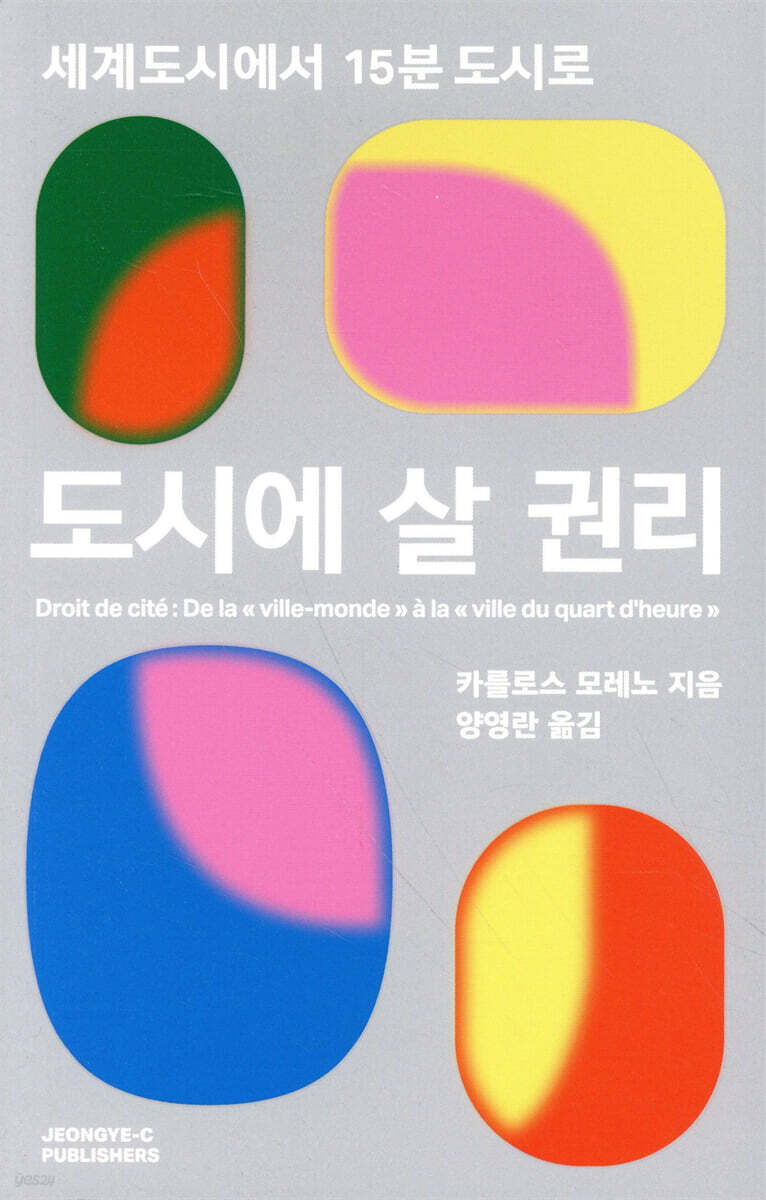
The right to live in the city
 |
Description
Book Introduction
Suggestions for a sustainable lifestyle and space
15-minute city, 30-minute territory
Housing, work, (living goods) supply, health/medical care within the living radius.
We imagine a multi-centric city that provides six social functions, including education and culture, where people can access amenities such as schools, workplaces, shops, parks, and health centers within 15 minutes on foot or by personal transportation (e.g. bicycles and scooters), no matter where they live.
15-minute city, 30-minute territory
Housing, work, (living goods) supply, health/medical care within the living radius.
We imagine a multi-centric city that provides six social functions, including education and culture, where people can access amenities such as schools, workplaces, shops, parks, and health centers within 15 minutes on foot or by personal transportation (e.g. bicycles and scooters), no matter where they live.
index
At the beginning of the book
-
Introduction | Citizenship, the Right to Exist in the City
1.
Living City
2.
climate crisis
3.
The complexity of the city
4.
City enjoyment rights
5.
Sustainable metropolis
6.
Proximity based on reality
7.
Great transformation
8.
Towards a ubiquitous city
Conclusion | Living Today with COVID-19
-
After reading
Acknowledgements
-
Introduction | Citizenship, the Right to Exist in the City
1.
Living City
2.
climate crisis
3.
The complexity of the city
4.
City enjoyment rights
5.
Sustainable metropolis
6.
Proximity based on reality
7.
Great transformation
8.
Towards a ubiquitous city
Conclusion | Living Today with COVID-19
-
After reading
Acknowledgements
Publisher's Review
Suggestions for a sustainable lifestyle and space
15-minute city, 30-minute territory
Housing, work, (living goods) supply, health/medical care within the living radius.
Imagine a multi-centric city (polycentric city) that provides six social functions, including education and culture, where you can access amenities such as schools, workplaces, stores, parks, and health centers within 15 minutes on foot or by personal transportation (bicycle, scooter, etc.) no matter where you live!
1) This book proposes the '15-minute city' as a solution to the ecological, economic, and social challenges facing modern cities, and contains the underlying philosophy and basic concepts.
2) The 15-minute city, which is the result of applying complex system mechanism research to urban problems and phenomena, raises fundamental questions about the relationship between space and time in which we have lived so far.
And modernist urban planning, that is, the space organized according to physical scale (distance), is said to be reorganized around temporality (time).
To achieve this, the 15-minute city emphasizes the revival of local communities, tolerance and openness toward others, and solidarity.
3) The core of the 15-minute city is time-centered urban planning (chronourbanism), free space-time dimension (chronotopia), and place attachment that drives participation (topophilia). It inherits Jane Jacobs' living city, Lewis Mumford's culturalist urban theory, the New Urbanism movement, the compressed city (compact city), and urban rhythm research, and questions the way the city is used.
4) Summarize the six basic social functions that enable us to live in a city.
Housing, work, (material) supply, health/medical care, education, culture, etc. are placed within walking distance using simple transportation, so that residents can continue to live in the city.
It is a practical solution that has been concretized as a continuation of Henri Lefebvre's 'right to the city (le droit a la ville)'.
The 15-minute city expanded to a national territory is called the '30-minute territory'.
15-minute city, 30-minute territory
Housing, work, (living goods) supply, health/medical care within the living radius.
Imagine a multi-centric city (polycentric city) that provides six social functions, including education and culture, where you can access amenities such as schools, workplaces, stores, parks, and health centers within 15 minutes on foot or by personal transportation (bicycle, scooter, etc.) no matter where you live!
1) This book proposes the '15-minute city' as a solution to the ecological, economic, and social challenges facing modern cities, and contains the underlying philosophy and basic concepts.
2) The 15-minute city, which is the result of applying complex system mechanism research to urban problems and phenomena, raises fundamental questions about the relationship between space and time in which we have lived so far.
And modernist urban planning, that is, the space organized according to physical scale (distance), is said to be reorganized around temporality (time).
To achieve this, the 15-minute city emphasizes the revival of local communities, tolerance and openness toward others, and solidarity.
3) The core of the 15-minute city is time-centered urban planning (chronourbanism), free space-time dimension (chronotopia), and place attachment that drives participation (topophilia). It inherits Jane Jacobs' living city, Lewis Mumford's culturalist urban theory, the New Urbanism movement, the compressed city (compact city), and urban rhythm research, and questions the way the city is used.
4) Summarize the six basic social functions that enable us to live in a city.
Housing, work, (material) supply, health/medical care, education, culture, etc. are placed within walking distance using simple transportation, so that residents can continue to live in the city.
It is a practical solution that has been concretized as a continuation of Henri Lefebvre's 'right to the city (le droit a la ville)'.
The 15-minute city expanded to a national territory is called the '30-minute territory'.
GOODS SPECIFICS
- Date of issue: February 10, 2023
- Page count, weight, size: 208 pages | 135*210*17mm
- ISBN13: 9791186058510
You may also like
카테고리
korean


korean

![GQ KOREA Mark (Monthly): December [2025]](http://librairie.coreenne.fr/cdn/shop/files/8ef265dbbfbf186523ed75ba7319009d.jpg?v=1765340328&width=3840)


