

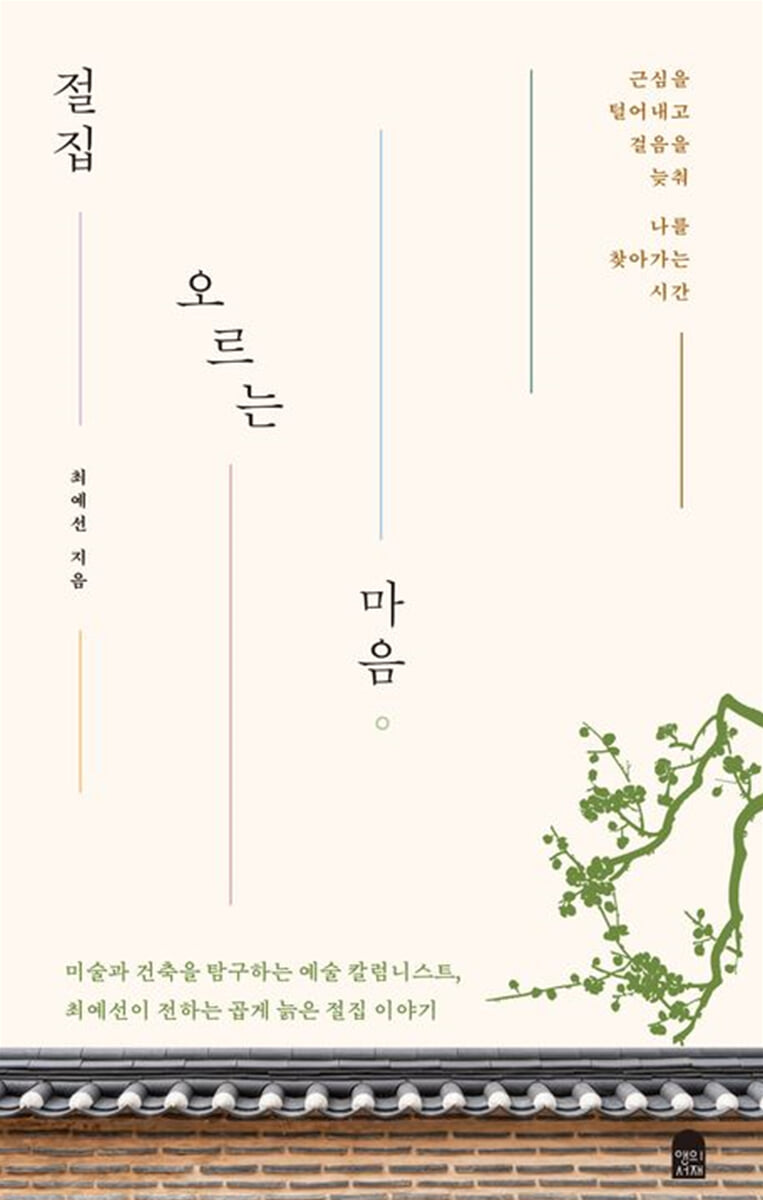
The heart that climbs a cliff
 |
Description
Book Introduction
The story of a gracefully aged temple, told by Choi Ye-seon, an art columnist who explores art and architecture.
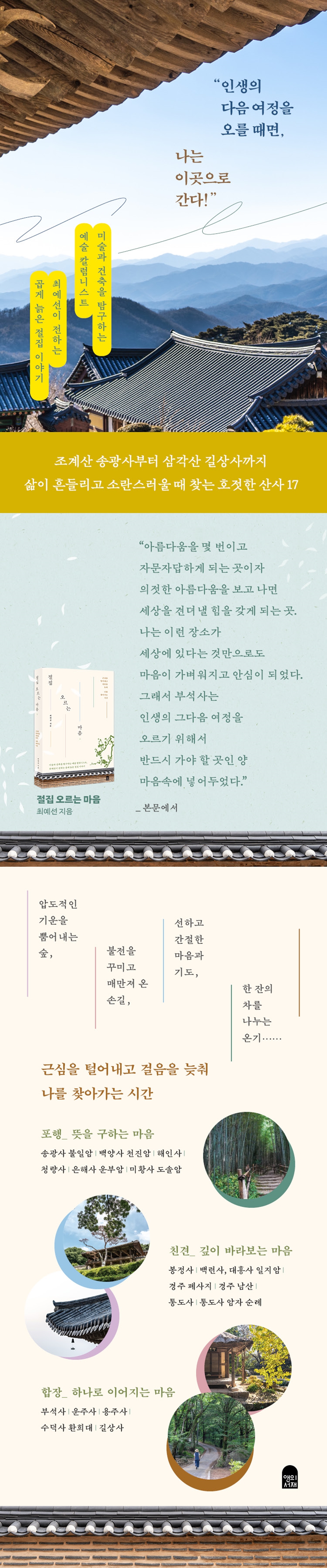
When I embark on my next journey in life, this is where I go!
From Songgwangsa Temple in Jogyesan Mountain to Gilsangsa Temple in Samgak Mountain???
17 Quiet Mountain Temples to Visit When Life Feels Chaotic and Noisy
Art columnist Choi Ye-seon, who has long explored the diverse landscapes of modern time and space and art, heads to a place known as a place that encompasses history, architecture, ancient art, and tea—all of it.
The author, who had climbed numerous temples, was moved by the refreshing forest, the sound of the wind, and the sound of water, and was amazed by the grandeur of the Buddhist scriptures and paintings that had stood there for a long time, capturing the lingering passage of time, and soon came to a realization.
The reason why the temple is so beautiful is not only because of the deep aesthetic sense and philosophy of the Buddhist world.
It is because of the earnest prayers and good hearts of those who have climbed this place for hundreds and thousands of years.
This book contains thoughtful stories discovered through a wide and deep pilgrimage to seventeen temples that have aged gracefully, embracing the passage of time and its stories.
The unique stories of the Buddha statues enshrined in the main hall, the unique meanings contained in the shape of the Buddha's hand, the stone pagoda that remains in place even after the temple has collapsed, allowing us to trace its long history, the Buddhist painting that embraces earnest prayers and leads us into a world of grandeur??? Above all, the beautiful hearts of those who climbed the temple, making it even more complete.
As you read the stories of an art columnist who has been writing about the layers of time that have continued from the past, seemingly trivial but deeply touching the heart the more you ponder them, you will find yourself slowing down and listening.
Before you know it, you will find yourself staring into your inner self.
In this way, you will shake off your worries and eventually find yourself examining and understanding your own heart.
When I embark on my next journey in life, this is where I go!
From Songgwangsa Temple in Jogyesan Mountain to Gilsangsa Temple in Samgak Mountain???
17 Quiet Mountain Temples to Visit When Life Feels Chaotic and Noisy
Art columnist Choi Ye-seon, who has long explored the diverse landscapes of modern time and space and art, heads to a place known as a place that encompasses history, architecture, ancient art, and tea—all of it.
The author, who had climbed numerous temples, was moved by the refreshing forest, the sound of the wind, and the sound of water, and was amazed by the grandeur of the Buddhist scriptures and paintings that had stood there for a long time, capturing the lingering passage of time, and soon came to a realization.
The reason why the temple is so beautiful is not only because of the deep aesthetic sense and philosophy of the Buddhist world.
It is because of the earnest prayers and good hearts of those who have climbed this place for hundreds and thousands of years.
This book contains thoughtful stories discovered through a wide and deep pilgrimage to seventeen temples that have aged gracefully, embracing the passage of time and its stories.
The unique stories of the Buddha statues enshrined in the main hall, the unique meanings contained in the shape of the Buddha's hand, the stone pagoda that remains in place even after the temple has collapsed, allowing us to trace its long history, the Buddhist painting that embraces earnest prayers and leads us into a world of grandeur??? Above all, the beautiful hearts of those who climbed the temple, making it even more complete.
As you read the stories of an art columnist who has been writing about the layers of time that have continued from the past, seemingly trivial but deeply touching the heart the more you ponder them, you will find yourself slowing down and listening.
Before you know it, you will find yourself staring into your inner self.
In this way, you will shake off your worries and eventually find yourself examining and understanding your own heart.
- You can preview some of the book's contents.
Preview
index
To begin writing.
Part 1.
Pohaeng - the mind that seeks meaning
Clothing.
Taking a short walk while sitting in meditation.
Walking should be done as if you were meditating.
Only when I leave am I there
_Bul-il-am, Songgwangsa Temple, Jogyesan Mountain
The mind that cultivates, prepares, offers, and cultivates
_Cheonjinam Hermitage, Baekyangsa Temple, Baekamsan Mountain
How did the Janggyeong woodblocks from Ganghwa Island end up at Haeinsa Temple?
_Haeinsa Temple in Gayasan Mountain
Is there a scene that comes to mind when you close your eyes?
_Cheongnyangsa Temple, Cheongnyangsan Mountain
On holding on to life with strength
_Palgongsan Mountain Eunhaesa Temple Unbuam
I looked at the western sky for a long time
_Dalmasan Mihwangsa Dosoram
Part 2.
A close look - a heart that looks deeply
See.
See for yourself and see for yourself.
If we look at it with all our heart, we cannot help but change.
Two magnificent worlds embraced by a gracefully aged temple
_Cheondeungsan Bongjeongsa Temple, Dosan Seowon
Come on, have a cup of tea.
_Baekryeon Temple on Mandeoksan Mountain, Iljiam Temple on Daeheungsa Temple on Durunsan Mountain
The city of endless wandering
_A walk around the Gyeongju temple ruins
The song sung by the old woman Buddha
_Pilgrimage to Namsan Mountain in Gyeongju
Climbing to the Jeokmyeolbogung Palace, where the Buddha's sarira is enshrined
_Yeongchuksan Tongdosa Temple
You'll go anywhere and meet anyone.
_Pilgrimage to Tongdosa Temple Hermitage
Part 3.
Hands clasped together - hearts united as one
Together.
Bringing the two palms together.
It shows piety and constancy of mind.
When you embark on the next journey of your life, let's go to the old temple.
_Bonghwangsan Buseoksa Temple
It feels like I've seen it somewhere, and I miss it even when I see it again
_Yeonguisan Unjusa Temple
King Jeongjo and Kim Hong-do build a temple
_Hwasan Yongjusa Temple
To you who is trying your best to find your own path
_Deoksungsan Sudeoksa Temple Hwanheedae
Still, living as a person who never stops
_Gilsangsa Temple on Samgaksan Mountain
supplement.
Things you encounter when you go to a temple
Part 1.
Pohaeng - the mind that seeks meaning
Clothing.
Taking a short walk while sitting in meditation.
Walking should be done as if you were meditating.
Only when I leave am I there
_Bul-il-am, Songgwangsa Temple, Jogyesan Mountain
The mind that cultivates, prepares, offers, and cultivates
_Cheonjinam Hermitage, Baekyangsa Temple, Baekamsan Mountain
How did the Janggyeong woodblocks from Ganghwa Island end up at Haeinsa Temple?
_Haeinsa Temple in Gayasan Mountain
Is there a scene that comes to mind when you close your eyes?
_Cheongnyangsa Temple, Cheongnyangsan Mountain
On holding on to life with strength
_Palgongsan Mountain Eunhaesa Temple Unbuam
I looked at the western sky for a long time
_Dalmasan Mihwangsa Dosoram
Part 2.
A close look - a heart that looks deeply
See.
See for yourself and see for yourself.
If we look at it with all our heart, we cannot help but change.
Two magnificent worlds embraced by a gracefully aged temple
_Cheondeungsan Bongjeongsa Temple, Dosan Seowon
Come on, have a cup of tea.
_Baekryeon Temple on Mandeoksan Mountain, Iljiam Temple on Daeheungsa Temple on Durunsan Mountain
The city of endless wandering
_A walk around the Gyeongju temple ruins
The song sung by the old woman Buddha
_Pilgrimage to Namsan Mountain in Gyeongju
Climbing to the Jeokmyeolbogung Palace, where the Buddha's sarira is enshrined
_Yeongchuksan Tongdosa Temple
You'll go anywhere and meet anyone.
_Pilgrimage to Tongdosa Temple Hermitage
Part 3.
Hands clasped together - hearts united as one
Together.
Bringing the two palms together.
It shows piety and constancy of mind.
When you embark on the next journey of your life, let's go to the old temple.
_Bonghwangsan Buseoksa Temple
It feels like I've seen it somewhere, and I miss it even when I see it again
_Yeonguisan Unjusa Temple
King Jeongjo and Kim Hong-do build a temple
_Hwasan Yongjusa Temple
To you who is trying your best to find your own path
_Deoksungsan Sudeoksa Temple Hwanheedae
Still, living as a person who never stops
_Gilsangsa Temple on Samgaksan Mountain
supplement.
Things you encounter when you go to a temple
Detailed image
Into the book
There were many people walking like me on the way up to the temple.
There were many people at Mihwangsa Temple to see the sunset, and many children at Haeinsa Temple to see the Tripitaka Koreana.
On the way to Unbuam, there were many young people enjoying the view, and there were many professional photographers who came out to take pictures of Gilsangsa Temple in Chopil.
And even in that gap, there were people who were careful about their conduct and walked around the temple and prayed.
The temple's inclusiveness and good energy came from the hearts of the people passing by.
The true beauty and stories of the temple began in its heart.
--- p.6
As Buddhism, which emphasizes Zen meditation, spread widely, temples moved from the city center to the mountains, and they had no choice but to move away from begging.
Sowing seeds, growing food, preparing food, and preparing a meal became not just a means of relieving hunger, but a part of one's practice.
Since a day's work and a day's offering were considered part of a practice, the bowl, which was a tool for making offerings, was also treated as a precious object that spoke of the practitioner's life.
When the master passed away, Balwoo was passed down to his disciples, which meant that they were carrying on the master's will.
--- pp.46~48
On the way down the stream, I saw a pagoda standing in front of the temple gate.
On the top it says 'What is this?'
It felt like the monk's stern scolding, and I felt a chill run down my spine.
'What is this?' is the question, 'What is this?' or 'Who am I?'
It is the ultimate question that all humans carry with them as they live.
Who am I, how should I live?
--- p.53
When I think of mountain temples, Haeinsa Temple comes to mind first, and the reason for that is also its architecture.
As you walk along the Garam structure, which has four spaces arranged on a slope with steps, you can feel your emotions being heightened as your body rises.
The overwhelming scale and simplicity of the Janggyeong Panjeon, perched atop the highest peak, possess an inexplicable power and beauty.
In a temple, the doors and stairs are as important as the Buddhist temple itself.
Doors and stairs are an architectural language that establishes the hierarchy of space.
Haeinsa Temple, situated on a high slope, has stairs and doors that further dramatically express this feeling.
As you climb the slope and pass through the door, you will reach the next level of the Buddhist temple.
--- p.58
We consider the stone pagodas of Silla, the stone Buddhas of Unified Silla, and the Buddhist statues and paintings of Goryeo to be the pinnacle of Buddhist art.
However, even during the Joseon Dynasty, when religious influence was poor, there was a flow of Buddhist art.
The Buddha of Joseon does not have a cold, rational face that looks far away toward an ideal world like the main Buddha of Seokguram Grotto, but rather a human face, a face full of affection.
The Buddha, who should have been sitting upright and showing an example of Zen meditation, had his back hunched over and developed a severe turtle neck.
If you sit in front of the Buddha altar, you will understand why the Buddha sits in a hunched posture.
This is so that when Buddhists look up, they can see the human face of the Buddha.
The Buddha of Joseon refuses to reach the world of enlightenment alone, but instead willingly sympathizes with and listens to the wishes and hopes of ordinary people.
--- p.116
When we realize how deeply the place where we stand embraces the past, the layers of time that have continued from the past become even more valuable.
The combination of the things accumulated by humans and the scenery of mountains and rivers that has not changed much since ancient times creates a temple, a space for practice and prayer.
At that time, beauty, love and peace are born together.
--- p.282
The word 'bhikkhu', which refers to a monk, means a beggar.
It is too humble a name for someone who is on the verge of reaching the end of his own practice.
But that too is the simplest directive to accept yourself.
The path to the highest being with the lowest name is the path of utter solitude.
But on that road, there are each people who are alone.
People who meet on the road and walk together toward the Way are called 'Doban (道伴)'.
Doban is a being that shares and adds, a being that goes all the way together.
There is a stepping stone so that we can walk without falling down.
We are each towers living our lives with the same questions.
There were many people at Mihwangsa Temple to see the sunset, and many children at Haeinsa Temple to see the Tripitaka Koreana.
On the way to Unbuam, there were many young people enjoying the view, and there were many professional photographers who came out to take pictures of Gilsangsa Temple in Chopil.
And even in that gap, there were people who were careful about their conduct and walked around the temple and prayed.
The temple's inclusiveness and good energy came from the hearts of the people passing by.
The true beauty and stories of the temple began in its heart.
--- p.6
As Buddhism, which emphasizes Zen meditation, spread widely, temples moved from the city center to the mountains, and they had no choice but to move away from begging.
Sowing seeds, growing food, preparing food, and preparing a meal became not just a means of relieving hunger, but a part of one's practice.
Since a day's work and a day's offering were considered part of a practice, the bowl, which was a tool for making offerings, was also treated as a precious object that spoke of the practitioner's life.
When the master passed away, Balwoo was passed down to his disciples, which meant that they were carrying on the master's will.
--- pp.46~48
On the way down the stream, I saw a pagoda standing in front of the temple gate.
On the top it says 'What is this?'
It felt like the monk's stern scolding, and I felt a chill run down my spine.
'What is this?' is the question, 'What is this?' or 'Who am I?'
It is the ultimate question that all humans carry with them as they live.
Who am I, how should I live?
--- p.53
When I think of mountain temples, Haeinsa Temple comes to mind first, and the reason for that is also its architecture.
As you walk along the Garam structure, which has four spaces arranged on a slope with steps, you can feel your emotions being heightened as your body rises.
The overwhelming scale and simplicity of the Janggyeong Panjeon, perched atop the highest peak, possess an inexplicable power and beauty.
In a temple, the doors and stairs are as important as the Buddhist temple itself.
Doors and stairs are an architectural language that establishes the hierarchy of space.
Haeinsa Temple, situated on a high slope, has stairs and doors that further dramatically express this feeling.
As you climb the slope and pass through the door, you will reach the next level of the Buddhist temple.
--- p.58
We consider the stone pagodas of Silla, the stone Buddhas of Unified Silla, and the Buddhist statues and paintings of Goryeo to be the pinnacle of Buddhist art.
However, even during the Joseon Dynasty, when religious influence was poor, there was a flow of Buddhist art.
The Buddha of Joseon does not have a cold, rational face that looks far away toward an ideal world like the main Buddha of Seokguram Grotto, but rather a human face, a face full of affection.
The Buddha, who should have been sitting upright and showing an example of Zen meditation, had his back hunched over and developed a severe turtle neck.
If you sit in front of the Buddha altar, you will understand why the Buddha sits in a hunched posture.
This is so that when Buddhists look up, they can see the human face of the Buddha.
The Buddha of Joseon refuses to reach the world of enlightenment alone, but instead willingly sympathizes with and listens to the wishes and hopes of ordinary people.
--- p.116
When we realize how deeply the place where we stand embraces the past, the layers of time that have continued from the past become even more valuable.
The combination of the things accumulated by humans and the scenery of mountains and rivers that has not changed much since ancient times creates a temple, a space for practice and prayer.
At that time, beauty, love and peace are born together.
--- p.282
The word 'bhikkhu', which refers to a monk, means a beggar.
It is too humble a name for someone who is on the verge of reaching the end of his own practice.
But that too is the simplest directive to accept yourself.
The path to the highest being with the lowest name is the path of utter solitude.
But on that road, there are each people who are alone.
People who meet on the road and walk together toward the Way are called 'Doban (道伴)'.
Doban is a being that shares and adds, a being that goes all the way together.
There is a stepping stone so that we can walk without falling down.
We are each towers living our lives with the same questions.
--- p.353
Publisher's Review
A forest that exudes overwhelming energy, earnest hearts and prayers, and the warmth of sharing a cup of tea???
The unique beauty of this temple discovered by an art columnist
It is a place where you can ask yourself about beauty over and over again.
A place where, after seeing its dignified beauty, you gain the strength to endure the world.
I felt relieved and relieved just knowing that a place like this existed in the world.
So, to climb the next journey of life,
I kept it in my heart as if it were a place I absolutely had to go.
_From the text
When you miss someone desperately, when you can't move forward because of worry and anxiety, when you're faced with the fundamental question of who you are and how you want to live??? Is there a place you turn to at such times?
‘Sansah’ is also a place where many people visit to ‘climb the next journey in life.’
Sudeoksa Temple where Monk Ilyeop stayed while searching for his own path with all his might; Buseoksa Temple where novelist Shin Kyung-sook said in her book, “Seeing the dignified beauty of ridge after ridge, ridge after ridge, gives me the strength to endure a season among people.”; Songgwangsa Temple and Gilsangsa Temple where traces of Monk Beopjeong, who practiced a life of non-possession, remain; and Yongjusa Temple, built by King Jeongjo of the Joseon Dynasty, for whom filial piety was a lifelong theme, to embody filial piety and filial piety in the Buddhist worldview.
A temple is a place where Buddhists learn, follow, and pray about the Buddha's teachings, and it is also a place where stories of people who have the will to never lose their good heart in any situation are piled high.
The author says that these feelings made the temple a more complete and sublime space.
This book is not simply a temple tour to gain a deeper understanding of Buddhist cultural heritage.
This book delves into the hidden stories behind the historical background of the temple, the hearts of the people who built, decorated, and maintained the temple, and ultimately makes us look at ourselves and reflect on how we should live.
To you, whose life is turbulent and chaotic, to you, who is preparing to embark on the next journey of life, 'this book' and 'this place' will be a warm and caring companion.
Above all, as you read this book, you will come to see the temples, which were previously thought of as old religious spaces located on famous mountains, as places that each have their own stories and characteristics, and that possess a beauty unique to each temple.
The story of the Tripitaka Koreana woodblocks that were moved to Haeinsa Temple long ago, the unique spatial aesthetics of Haeinsa Temple, the dramatic world of plants discovered through the Machilus thunbergii of Songgwangsa Temple, the mystery of Yongjusa Temple's "Samsebulhoedo" (painted by Kim Hong-do), the hidden story of Buseoksa Temple, a temple where a floating stone is the owner, and Baekryeonsa Temple, where traces of Dasan Jeong Yak-yong and a monk exchanging tea remain intact???.
As you follow the author's thoughtful gaze as he tells the stories of each temple, each with its own story and beauty, you will experience emotions that arise, become calm, and deepen, as if you were standing in the middle of a temple.
Furthermore, the author, an art columnist, reads about the temple's architecture, Buddhist paintings, and Buddhist statues, making the reading even more enjoyable by reminding us that the standards of beauty and the way Buddhism approached Buddhists differed in each era.
The unique beauty of this temple discovered by an art columnist
It is a place where you can ask yourself about beauty over and over again.
A place where, after seeing its dignified beauty, you gain the strength to endure the world.
I felt relieved and relieved just knowing that a place like this existed in the world.
So, to climb the next journey of life,
I kept it in my heart as if it were a place I absolutely had to go.
_From the text
When you miss someone desperately, when you can't move forward because of worry and anxiety, when you're faced with the fundamental question of who you are and how you want to live??? Is there a place you turn to at such times?
‘Sansah’ is also a place where many people visit to ‘climb the next journey in life.’
Sudeoksa Temple where Monk Ilyeop stayed while searching for his own path with all his might; Buseoksa Temple where novelist Shin Kyung-sook said in her book, “Seeing the dignified beauty of ridge after ridge, ridge after ridge, gives me the strength to endure a season among people.”; Songgwangsa Temple and Gilsangsa Temple where traces of Monk Beopjeong, who practiced a life of non-possession, remain; and Yongjusa Temple, built by King Jeongjo of the Joseon Dynasty, for whom filial piety was a lifelong theme, to embody filial piety and filial piety in the Buddhist worldview.
A temple is a place where Buddhists learn, follow, and pray about the Buddha's teachings, and it is also a place where stories of people who have the will to never lose their good heart in any situation are piled high.
The author says that these feelings made the temple a more complete and sublime space.
This book is not simply a temple tour to gain a deeper understanding of Buddhist cultural heritage.
This book delves into the hidden stories behind the historical background of the temple, the hearts of the people who built, decorated, and maintained the temple, and ultimately makes us look at ourselves and reflect on how we should live.
To you, whose life is turbulent and chaotic, to you, who is preparing to embark on the next journey of life, 'this book' and 'this place' will be a warm and caring companion.
Above all, as you read this book, you will come to see the temples, which were previously thought of as old religious spaces located on famous mountains, as places that each have their own stories and characteristics, and that possess a beauty unique to each temple.
The story of the Tripitaka Koreana woodblocks that were moved to Haeinsa Temple long ago, the unique spatial aesthetics of Haeinsa Temple, the dramatic world of plants discovered through the Machilus thunbergii of Songgwangsa Temple, the mystery of Yongjusa Temple's "Samsebulhoedo" (painted by Kim Hong-do), the hidden story of Buseoksa Temple, a temple where a floating stone is the owner, and Baekryeonsa Temple, where traces of Dasan Jeong Yak-yong and a monk exchanging tea remain intact???.
As you follow the author's thoughtful gaze as he tells the stories of each temple, each with its own story and beauty, you will experience emotions that arise, become calm, and deepen, as if you were standing in the middle of a temple.
Furthermore, the author, an art columnist, reads about the temple's architecture, Buddhist paintings, and Buddhist statues, making the reading even more enjoyable by reminding us that the standards of beauty and the way Buddhism approached Buddhists differed in each era.
GOODS SPECIFICS
- Publication date: November 1, 2022
- Page count, weight, size: 376 pages | 614g | 140*220*25mm
- ISBN13: 9791190710503
- ISBN10: 1190710501
You may also like
카테고리
korean


korean

![GQ KOREA Mark (Monthly): December [2025]](http://librairie.coreenne.fr/cdn/shop/files/8ef265dbbfbf186523ed75ba7319009d.jpg?v=1765340328&width=3840)


