

gwangju
 |
Description
Book Introduction
A life where abundance and equality coexist
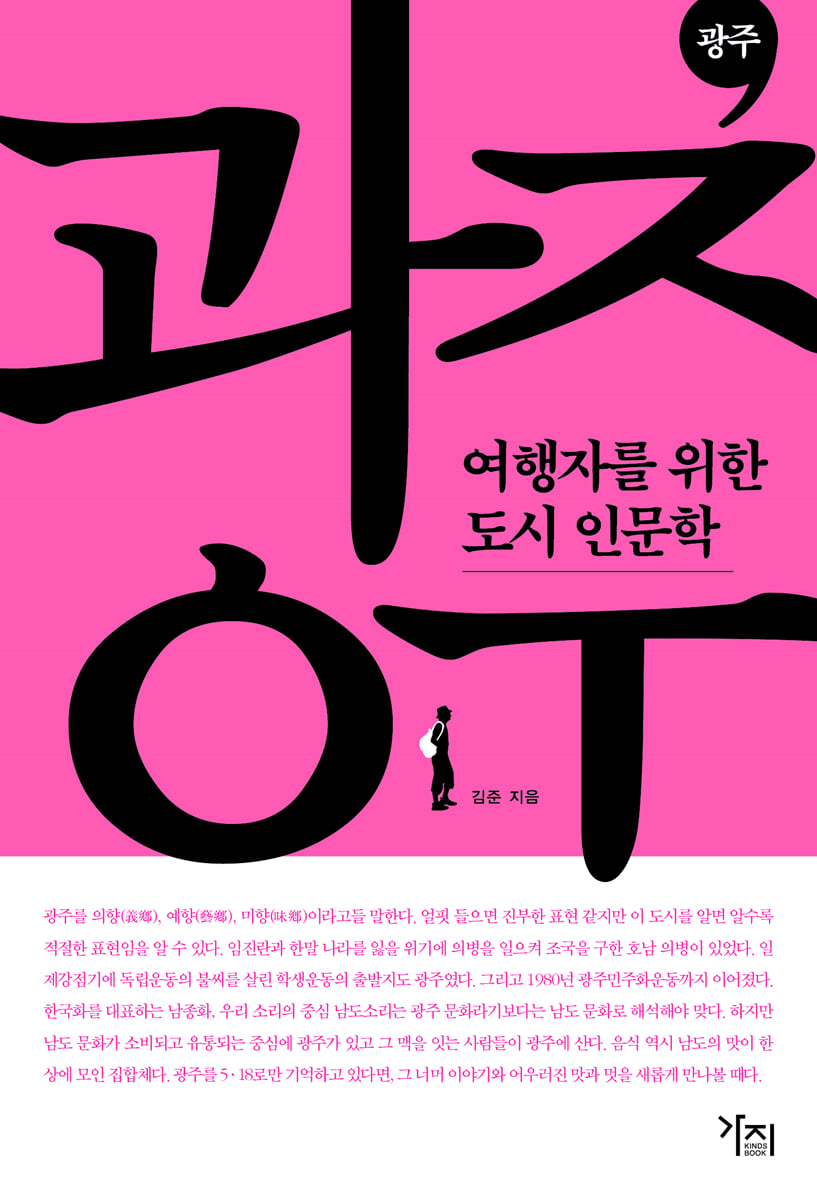
A User's Manual for "Gwangju Spirit," a Journey in Search of Taste and Style
A guide to Gwangju's cultural tourism for discerning city travelers.
The Gwangju Metropolitan City is a text that requires careful reading due to the psychological weight of the 'May 18 Democratization Movement.'
The author, who has lived in this city for a long time and studied its modern and contemporary history, interprets Gwangju as a classic but optimal identity of the “three villages”: a village of righteousness, a village of art, and a village of taste.
In Gwangju, there was the Honam Righteous Army that risked their lives to save the country from the Imjin War and the crisis of the late Joseon Dynasty, the Gwangju Student Movement that kept the flame of the independence movement alive during the Japanese colonial period, and the Gwangju Spirit of 1980.
Gwangju is the center of consumption and distribution of southern culture, including Namjonghwa, the representative Korean painting, and Namdo Sori, the soul of the nation. Gwangju is also a place where the rich flavors of the southern region are gathered together on one table, so you won't be disappointed no matter which restaurant you visit.
If you are curious about the life of Mudeung (無等) that unfolds beyond taste and style, it is time to walk that land with this instruction manual in hand.
A User's Manual for "Gwangju Spirit," a Journey in Search of Taste and Style
A guide to Gwangju's cultural tourism for discerning city travelers.
The Gwangju Metropolitan City is a text that requires careful reading due to the psychological weight of the 'May 18 Democratization Movement.'
The author, who has lived in this city for a long time and studied its modern and contemporary history, interprets Gwangju as a classic but optimal identity of the “three villages”: a village of righteousness, a village of art, and a village of taste.
In Gwangju, there was the Honam Righteous Army that risked their lives to save the country from the Imjin War and the crisis of the late Joseon Dynasty, the Gwangju Student Movement that kept the flame of the independence movement alive during the Japanese colonial period, and the Gwangju Spirit of 1980.
Gwangju is the center of consumption and distribution of southern culture, including Namjonghwa, the representative Korean painting, and Namdo Sori, the soul of the nation. Gwangju is also a place where the rich flavors of the southern region are gathered together on one table, so you won't be disappointed no matter which restaurant you visit.
If you are curious about the life of Mudeung (無等) that unfolds beyond taste and style, it is time to walk that land with this instruction manual in hand.
- You can preview some of the book's contents.
Preview
index
introduction
Gwangju Humanities Map
Part 1
The Gwangju spirit that flows powerfully
1.
The Candlelight of Korean Democracy: The May 18th Democratization Movement
2.
Follow the living, Mangwol Cemetery
3.
Why Student Day is on November 3rd
4.
The beginning of the independence movement, the Honam Righteous Army
5.
Dreaming of a New World: Unjusa and Jo Gwang-jo
6.
Do not let it become the property of one person, the last words of the Soswaewon
7.
The roots of the Gwangju community: Gwangju Hyangyak and Yanggwadong Dongyak
8.
Kim Dae-jung Convention Center, a symbol of the Gwangju spirit
Part 2
City History, City of History
1.
Where did the people of Gwangju live? Yeongsan River and Gwangjucheon
2.
The Growth of Gwangju, the Center of the Southern Province
3.
Humanities on the Road, Joseon Dynasty Nujeong
4.
The history of the railroad that became the gateway to Gwangju
5.
Yanglim-dong, the cradle of modern Gwangju
6.
Lost history and space: Gyeongyang Embankment and Gwangju Eupseong
7.
Gwangju Park, Gwangju's first urban park
8.
Seochang Village, the old Gwangju interchange
Part 3
City walk
1.
Walking along Mudeung, a lighthouse for the people of Gwangju
2.
Chungjang-ro, the heart of the old city center
3.
Songjeong Station Market, which shares a history with Gwangju Songjeong Station
4.
Traditional markets, the hottest places to live
5.
Chonnam National University, a mecca for the democratization movement
6.
Pureungil Park, a pioneer in urban regeneration
7.
Gyeongridan-gil and Dongmyeong-dong in Gwangju
8.
Youth and Residents Meet at Cheongchunbalsan Village
9.
Dreaming of an urban community, Munsan Village
10.
Gwangju Theater, the only single-screen theater in the country
Part 4
The taste and elegance of the southern region
1.
A collection of southern cuisine, Hanjeongsik
2.
Kimchi, the essence of Gwangju's flavor
3.
Lettuce fritters that challenge the 'Gwangju Omi'
4.
Songjeong tteokgalbi, my mother's favorite
5.
Must-eat meat in Gwangju: raw meat
6.
Gwangju is 'Omae', and Jeolla dialect is 'Geosigi'
7.
Pansori idol, bald Im Bang-ul
8.
From "Rock" to "March for the Beloved," Yukjabaegi Tori
9.
The Evolution of Village Guts: Chilseok-dong Gossaum
Part 5
A person to remember
1.
Gi Dae-seung, the mentor of the Joseon king
2.
The righteous family, Kim Deok-ryeong's family
3.
Choi Heung-jong, father of a leprosy patient and a tuberculosis patient
4.
The last great tree of Nam Jong-hwa, Heo Baek-ryeon
5.
Kim Pil-rye, founder of the Korean YWCA
6.
Gwangju's mother, Jo Ara
7.
I'm going too, Yong-ah's dream
8.
Without leaving behind love, honor, or name, the wildfire martyr
supplement
Recommended Courses for a Walking Tour of Gwangju
#1 The Path to Democracy and Human Rights
#2 Chonnam National University Campus Walk, Minju-gil
#3 Discovering Modern Gwangju: Yanglim Historical and Cultural Village
#4 A forest path in the city, a green path
#5 The Path to Lyric Literature
#6 Walking on Mt. Mudeung
#7 Safe and Beautiful Gwangjucheon Bike Path
#8 Riding a bicycle on the gorgeous mine road
#9 Gwangju's Perimeter Trail, Bitgoeulsan Mountain Trail
Search_Reading Gwangju by Keyword
Gwangju Humanities Map
Part 1
The Gwangju spirit that flows powerfully
1.
The Candlelight of Korean Democracy: The May 18th Democratization Movement
2.
Follow the living, Mangwol Cemetery
3.
Why Student Day is on November 3rd
4.
The beginning of the independence movement, the Honam Righteous Army
5.
Dreaming of a New World: Unjusa and Jo Gwang-jo
6.
Do not let it become the property of one person, the last words of the Soswaewon
7.
The roots of the Gwangju community: Gwangju Hyangyak and Yanggwadong Dongyak
8.
Kim Dae-jung Convention Center, a symbol of the Gwangju spirit
Part 2
City History, City of History
1.
Where did the people of Gwangju live? Yeongsan River and Gwangjucheon
2.
The Growth of Gwangju, the Center of the Southern Province
3.
Humanities on the Road, Joseon Dynasty Nujeong
4.
The history of the railroad that became the gateway to Gwangju
5.
Yanglim-dong, the cradle of modern Gwangju
6.
Lost history and space: Gyeongyang Embankment and Gwangju Eupseong
7.
Gwangju Park, Gwangju's first urban park
8.
Seochang Village, the old Gwangju interchange
Part 3
City walk
1.
Walking along Mudeung, a lighthouse for the people of Gwangju
2.
Chungjang-ro, the heart of the old city center
3.
Songjeong Station Market, which shares a history with Gwangju Songjeong Station
4.
Traditional markets, the hottest places to live
5.
Chonnam National University, a mecca for the democratization movement
6.
Pureungil Park, a pioneer in urban regeneration
7.
Gyeongridan-gil and Dongmyeong-dong in Gwangju
8.
Youth and Residents Meet at Cheongchunbalsan Village
9.
Dreaming of an urban community, Munsan Village
10.
Gwangju Theater, the only single-screen theater in the country
Part 4
The taste and elegance of the southern region
1.
A collection of southern cuisine, Hanjeongsik
2.
Kimchi, the essence of Gwangju's flavor
3.
Lettuce fritters that challenge the 'Gwangju Omi'
4.
Songjeong tteokgalbi, my mother's favorite
5.
Must-eat meat in Gwangju: raw meat
6.
Gwangju is 'Omae', and Jeolla dialect is 'Geosigi'
7.
Pansori idol, bald Im Bang-ul
8.
From "Rock" to "March for the Beloved," Yukjabaegi Tori
9.
The Evolution of Village Guts: Chilseok-dong Gossaum
Part 5
A person to remember
1.
Gi Dae-seung, the mentor of the Joseon king
2.
The righteous family, Kim Deok-ryeong's family
3.
Choi Heung-jong, father of a leprosy patient and a tuberculosis patient
4.
The last great tree of Nam Jong-hwa, Heo Baek-ryeon
5.
Kim Pil-rye, founder of the Korean YWCA
6.
Gwangju's mother, Jo Ara
7.
I'm going too, Yong-ah's dream
8.
Without leaving behind love, honor, or name, the wildfire martyr
supplement
Recommended Courses for a Walking Tour of Gwangju
#1 The Path to Democracy and Human Rights
#2 Chonnam National University Campus Walk, Minju-gil
#3 Discovering Modern Gwangju: Yanglim Historical and Cultural Village
#4 A forest path in the city, a green path
#5 The Path to Lyric Literature
#6 Walking on Mt. Mudeung
#7 Safe and Beautiful Gwangjucheon Bike Path
#8 Riding a bicycle on the gorgeous mine road
#9 Gwangju's Perimeter Trail, Bitgoeulsan Mountain Trail
Search_Reading Gwangju by Keyword
Detailed image

Into the book
Would the city of Gwangju have been possible without Mudeungsan Mountain and the Yeongsan River? It would have been impossible.
Traces of prehistoric people who stayed in Gwangju can be found along the Yeongsan River.
They sowed seeds, farmed, made tools, and built clothes and houses to live.
…The newly built Sangmu District, Suwan District, and Cheomdan District are also cities built on the upper reaches of the Yeongsan River.
The city also expanded into Mudeungsan Mountain.
An apartment building was built in a place where people were afraid of compatibility.
|--- p.12
Geumnam-ro, an eight-lane road that was once the widest road in Gwangju.
The roads in the metropolitan city, home to 1.45 million people, are not wide at present.
The place where banks, securities firms, department stores, media companies, and theaters were gathered is now called the 'UNESCO Democracy and Human Rights Road.'
The peak is the 'May 18 Democracy Square'.
This is the fountain square in front of the provincial government building where citizens gathered and held a rally during the May 18 Democratization Movement.
--- p.20
November 3, 1929 was Meiji-shu, a day when many people gathered to celebrate the Emperor's birthday.
The clashes at Gwangju Station were stopped by police and teachers, but street protests continued.
Japanese police officers threatened and suppressed the protesters with knives.
The leadership of the reading club gathered at Heunghak Hall and resolved to transform the students' protest from a simple brawl into a 'struggle for independence and anti-Japanese movement.'
--- p.34
Chungjang-ro, the central commercial district of Gwangju, is named after the nickname of Kim Deok-ryeong, a leader of the volunteer army in the late Joseon Dynasty.
Not only Chungjang-ro, but also Jebong-ro and Jukbong-ro are named after the nicknames of independence fighters.
Why are there so many roads in Gwangju named after independence fighters?
This is because the volunteer soldiers who rose up during the Imjin War of the Joseon Dynasty and when the country was in a desperate crisis at the end of the Joseon Dynasty were here.
--- p.37
Since 1980, young people in Gwangju have frequently visited Unjusa Temple and Jo Gwang-jo across the Neoritjae Pass in search of hope.
The first time I visited Unjusa Temple was in the early 1980s when I was a college student.
As I looked at the pagoda and Buddha statues in the middle of the field, and the Buddha statues lying in the stream and at the foot of the mountain, I felt my existing thoughts crumble.
The Buddhist statues, stone pagodas, and folk tales that cannot be seen anywhere else have been interpreted as the people's desire to overcome the existing order, including the standardized framework and system, and have become symbols of the people's movement in modern and contemporary Korean society.
--- p.43
Where did the prehistoric people of Gwangju live?
Did he live in Chungjang-ro, where Gwangju Eupseong Fortress is located, or did he live in Mudeungsan Mountain, where Mujin Goseong Fortress is located?
The key seems to be found in the lives of prehistoric people.
In order to change your lifestyle from a nomadic to a settled life, you need a place where you can solve your food, clothing and shelter needs.
Where in Gwangju today would be the most suitable place for this kind of life?
In 1992, during the expansion project of National Route 1, the keys were found pouring out in Sinchang-dong.
Sinchang-dong is a wetland along the river where the Yeongsan River flows.
--- p.62
Mokpo-bu experienced rapid growth with the opening of the port during the Japanese colonial period, but in the early 1940s, the administrative center was moved from Naju to Gwangju, and the expanded Gwangju-bu's wealth grew even larger.
After liberation, Gwangju became a metropolitan city in 1949, and a direct-controlled city in 1986. In 1988, Gwangsan County, which was part of South Jeolla Province, was incorporated into Gwangju.
In 1995, when it was transformed into a metropolitan city, its administration was separated from that of South Jeolla Province, and today's Gwangju was completed.
--- p.79
There was a similar humanities space during the Joseon Dynasty.
It is 'Nujeong'.
Nujeong is a shortened form of pavilion and pavilion.
There are an estimated 600 pavilions in Gwangju and Jeonnam.
If you count the ones that have disappeared, the number is said to be around 2,500, which is surprising.
It seems that every literati of the Joseon Dynasty had at least one pavilion.
--- p.83
Yanglim Mountain, which has the gravestones of missionaries such as Eugene Bell and Owen, is covered with a forest of old trees such as acacia trees, black walnut trees, Japanese maples, Japanese pine trees, and oak trees.
This tree was planted by missionaries during the Japanese colonial period.
The tiger thorn tree in front of 'Art Polygon', which was remodeled from the garage of a missionary's residence into an exhibition space, is an impressive 400-year-old tree with a majestic appearance, reaching a circumference of 1.2 meters and a height of 6 meters.
--- p.95
On the stairs leading up to the park, there is a sign that reads, "These are the stairs of Gwangju Shrine, a remnant of Japanese colonial rule."
As you walk along the history trail and enter the park, there are about 10 stone monuments erected on the right.
The rainwater collected from scattered throughout Gwangju City was moved to its current location in 1965.
What stands out is the monument commemorating General Kwon Yul, the commander of the Battle of Geumsan during the Imjin War.
--- p.107
The farmland around Munchon, where people crossed the river by boat from Seochang and farmed, was called Seochangdeul.
That is where the current Gwangju Airport is located.
The rich cultivated rice by digging waterways near the village, but the poor cultivated rice on sandy fields such as deltas and riparian lakes.
They were always worried about floods and had no choice but to farm while looking up at the sky.
--- p.111
Mudeungsan is the representative mountain of Gwangju and Jeollanam-do and the center of the Honam region.
Centered around Cheonwangbong Peak, which is 1,187 meters above sea level, the vertically jointed rocks such as Seoseokdae, Ipseokdae, and Gwangseokdae create a spectacular sight, as if they were forming a stone wall.
It is an incomparably high and large mountain, a noble and unequaled mountain that cannot be ranked.
--- p.116
The vibrant times in Chungjang-ro were the 1970s and 1980s.
At that time, 'going downtown' meant going to Chungjang-ro.
Other areas of Gwangju were not called downtown.
There were several reasons for going downtown.
The most common reason is promises.
The meeting place was in front of the Gwangju Post Office in Chungjang-ro 1-ga, commonly known as 'Udabang'.
--- p.125
Songjeong Station Market started as the ‘Daily Songjeong Station Exhibition Hall’ with the opening of Songjeong-ri Station in 1913.
He did business by selling noodles and other food to train passengers.
The market, which had been on the decline with the advent of large supermarkets, attempted a transformation in 2015 with the opening of the KTX, and reopened in April 2016 under the name '1913 Songjeong Station Market'.
…the year it was first created was added to the name to emphasize the 103-year tradition.
--- p.130
The representative product of Yangdong Market is the dried pollack pancake from the fish market.
It could be said that the fish market's existence is maintained thanks to fermented skate.
My mother-in-law, who sold fish in Yeonggwang, always went to Yangdong Market instead of the nearby Namgwangju Market to buy dried pollack.
Haepung Sangsa, a famous dried pollack restaurant in Yangdong Market, changed the way it was sold, from selling half a fish to packaging it in small packages, slicing it, and delivering it by courier.
--- p.134
There is a walking path called ‘Democracy Road’ on the campus of Chonnam National University.
This course, a circular route, connects 11 commemorative spaces, including the spirit, people, and locations of the campus democratization movement, into three routes: the "Road of Justice" (1.7 kilometers), the "Road of Human Rights" (1.8 kilometers), and the "Road of Peace" (1.5 kilometers).
--- p.142
Gwangju Hanjeongsik is a collection of Jeolla-do dishes created when the products of the southern provinces, from Yeosu to Mokpo and Yeonggwang, were gathered in Gwangju.
Yeosu eel, Goheung yuja, Beolgyo cockle take the Jeolla Line, Mokpo black salmon, Muan octopus, and Hampyeong Korean beef take the Honam Line to Gwangju.
…you can get fresh ingredients such as grains, seafood, agricultural products, and forest products within an hour.
Gwangju is where these ingredients come together and are recreated under the name of Namdo cuisine.
--- p.168
Lettuce fritters are considered a specialty of Gwangju.
As the name suggests, it is not fried lettuce, but rather finely chopped fried squid wrapped in lettuce and served with soy sauce with onions and spicy peppers.
Lettuce helps absorb the greasiness of oil, making fried food even more delicious.
It became popular around the mid-1970s and is now established as a local dish of Gwangju.
--- p.177
Songjeong-ri tteokgalbi is so famous that the name 'Songjeong' is attached to the name of the place.
Why did Songjeong-ri tteokgalbi become famous?
It seems that the clue must be found at the cattle market.
With the opening of new roads to not only Honam Line but also Yeonggwang, Nampyeong, and Naju, Songjeong-ri became a transportation hub.
A cattle market opened in 1910 on the site of the parking lot of the Songjeong Oil Market (March and August), which is still open today.
--- p.180
The Gwangju tourist guide map begins with ‘Omae Gwangju.’
'Oh Mae Gwangju' is often used as an expression symbolizing Gwangju.
Here, the word "ohmae" is an exclamation.
It goes well with any words such as “Oh, how nice to meet you,” “Oh, how delicious,” and “Oh, how well done.”
The best expression of Omae is ‘Omae Maple Leaves Are Falling’ by Kim Young-rang, a poet of the poetic school.
--- p.187
The members of the popular singer group, Leenalchi, are from Seoul.
However, the part that says “Pansori originated from Jeolla-do” is all Jeolla-do dialect.
So I learned the Jeolla dialect.”
The Jeolla dialect is also good for fast rapping.
This day's representative song, "Beom Naeroronda", is a fast-paced song that resembles a rap.
This is the part that people from Gyeongsang Province who want to study pansori find most difficult.
--- p.190
His voice is said to have both celestial and mathematical qualities.
In particular, the ability to repair through effort was at a level that no one could imitate.
At the age of 25, he won an award at the Joseon Myeongchang Contest and rose to stardom.
The song sung at that time was “Bare Head.”
The next day, the record company recorded the song and sold 200,000 copies both domestically and internationally.
--- p.193
Choi Heung-jong's nickname, "Five Liberations," is said to mean five liberations: "Liberty in domestic affairs, social neglect, abandonment in politics, indulgence in economics, and wandering in religion."
He lived his entire life by the creed contained in the lake, and as death approached, he fasted for about 90 days and closed his eyes on May 14, 1966, at the age of 86.
His epitaph reads 'Eternally Free'.
--- p.230
His interest in literature began when he met Kim Young-rang and Jeong Ji-yong in Japan.
Kim Young-rang recognized Yong-a's sensibility and actively encouraged her to pursue literature. This led Yong-a to use her private funds to publish 10 volumes of literary magazines, including Poetry Literature, Literary Monthly, and Literature, in the 1930s.
… The reason Yong-a was able to publish magazines freely was because of her father’s financial power.
Yong-ah also gave Yeong-rang her first poetry collection.
Traces of prehistoric people who stayed in Gwangju can be found along the Yeongsan River.
They sowed seeds, farmed, made tools, and built clothes and houses to live.
…The newly built Sangmu District, Suwan District, and Cheomdan District are also cities built on the upper reaches of the Yeongsan River.
The city also expanded into Mudeungsan Mountain.
An apartment building was built in a place where people were afraid of compatibility.
|--- p.12
Geumnam-ro, an eight-lane road that was once the widest road in Gwangju.
The roads in the metropolitan city, home to 1.45 million people, are not wide at present.
The place where banks, securities firms, department stores, media companies, and theaters were gathered is now called the 'UNESCO Democracy and Human Rights Road.'
The peak is the 'May 18 Democracy Square'.
This is the fountain square in front of the provincial government building where citizens gathered and held a rally during the May 18 Democratization Movement.
--- p.20
November 3, 1929 was Meiji-shu, a day when many people gathered to celebrate the Emperor's birthday.
The clashes at Gwangju Station were stopped by police and teachers, but street protests continued.
Japanese police officers threatened and suppressed the protesters with knives.
The leadership of the reading club gathered at Heunghak Hall and resolved to transform the students' protest from a simple brawl into a 'struggle for independence and anti-Japanese movement.'
--- p.34
Chungjang-ro, the central commercial district of Gwangju, is named after the nickname of Kim Deok-ryeong, a leader of the volunteer army in the late Joseon Dynasty.
Not only Chungjang-ro, but also Jebong-ro and Jukbong-ro are named after the nicknames of independence fighters.
Why are there so many roads in Gwangju named after independence fighters?
This is because the volunteer soldiers who rose up during the Imjin War of the Joseon Dynasty and when the country was in a desperate crisis at the end of the Joseon Dynasty were here.
--- p.37
Since 1980, young people in Gwangju have frequently visited Unjusa Temple and Jo Gwang-jo across the Neoritjae Pass in search of hope.
The first time I visited Unjusa Temple was in the early 1980s when I was a college student.
As I looked at the pagoda and Buddha statues in the middle of the field, and the Buddha statues lying in the stream and at the foot of the mountain, I felt my existing thoughts crumble.
The Buddhist statues, stone pagodas, and folk tales that cannot be seen anywhere else have been interpreted as the people's desire to overcome the existing order, including the standardized framework and system, and have become symbols of the people's movement in modern and contemporary Korean society.
--- p.43
Where did the prehistoric people of Gwangju live?
Did he live in Chungjang-ro, where Gwangju Eupseong Fortress is located, or did he live in Mudeungsan Mountain, where Mujin Goseong Fortress is located?
The key seems to be found in the lives of prehistoric people.
In order to change your lifestyle from a nomadic to a settled life, you need a place where you can solve your food, clothing and shelter needs.
Where in Gwangju today would be the most suitable place for this kind of life?
In 1992, during the expansion project of National Route 1, the keys were found pouring out in Sinchang-dong.
Sinchang-dong is a wetland along the river where the Yeongsan River flows.
--- p.62
Mokpo-bu experienced rapid growth with the opening of the port during the Japanese colonial period, but in the early 1940s, the administrative center was moved from Naju to Gwangju, and the expanded Gwangju-bu's wealth grew even larger.
After liberation, Gwangju became a metropolitan city in 1949, and a direct-controlled city in 1986. In 1988, Gwangsan County, which was part of South Jeolla Province, was incorporated into Gwangju.
In 1995, when it was transformed into a metropolitan city, its administration was separated from that of South Jeolla Province, and today's Gwangju was completed.
--- p.79
There was a similar humanities space during the Joseon Dynasty.
It is 'Nujeong'.
Nujeong is a shortened form of pavilion and pavilion.
There are an estimated 600 pavilions in Gwangju and Jeonnam.
If you count the ones that have disappeared, the number is said to be around 2,500, which is surprising.
It seems that every literati of the Joseon Dynasty had at least one pavilion.
--- p.83
Yanglim Mountain, which has the gravestones of missionaries such as Eugene Bell and Owen, is covered with a forest of old trees such as acacia trees, black walnut trees, Japanese maples, Japanese pine trees, and oak trees.
This tree was planted by missionaries during the Japanese colonial period.
The tiger thorn tree in front of 'Art Polygon', which was remodeled from the garage of a missionary's residence into an exhibition space, is an impressive 400-year-old tree with a majestic appearance, reaching a circumference of 1.2 meters and a height of 6 meters.
--- p.95
On the stairs leading up to the park, there is a sign that reads, "These are the stairs of Gwangju Shrine, a remnant of Japanese colonial rule."
As you walk along the history trail and enter the park, there are about 10 stone monuments erected on the right.
The rainwater collected from scattered throughout Gwangju City was moved to its current location in 1965.
What stands out is the monument commemorating General Kwon Yul, the commander of the Battle of Geumsan during the Imjin War.
--- p.107
The farmland around Munchon, where people crossed the river by boat from Seochang and farmed, was called Seochangdeul.
That is where the current Gwangju Airport is located.
The rich cultivated rice by digging waterways near the village, but the poor cultivated rice on sandy fields such as deltas and riparian lakes.
They were always worried about floods and had no choice but to farm while looking up at the sky.
--- p.111
Mudeungsan is the representative mountain of Gwangju and Jeollanam-do and the center of the Honam region.
Centered around Cheonwangbong Peak, which is 1,187 meters above sea level, the vertically jointed rocks such as Seoseokdae, Ipseokdae, and Gwangseokdae create a spectacular sight, as if they were forming a stone wall.
It is an incomparably high and large mountain, a noble and unequaled mountain that cannot be ranked.
--- p.116
The vibrant times in Chungjang-ro were the 1970s and 1980s.
At that time, 'going downtown' meant going to Chungjang-ro.
Other areas of Gwangju were not called downtown.
There were several reasons for going downtown.
The most common reason is promises.
The meeting place was in front of the Gwangju Post Office in Chungjang-ro 1-ga, commonly known as 'Udabang'.
--- p.125
Songjeong Station Market started as the ‘Daily Songjeong Station Exhibition Hall’ with the opening of Songjeong-ri Station in 1913.
He did business by selling noodles and other food to train passengers.
The market, which had been on the decline with the advent of large supermarkets, attempted a transformation in 2015 with the opening of the KTX, and reopened in April 2016 under the name '1913 Songjeong Station Market'.
…the year it was first created was added to the name to emphasize the 103-year tradition.
--- p.130
The representative product of Yangdong Market is the dried pollack pancake from the fish market.
It could be said that the fish market's existence is maintained thanks to fermented skate.
My mother-in-law, who sold fish in Yeonggwang, always went to Yangdong Market instead of the nearby Namgwangju Market to buy dried pollack.
Haepung Sangsa, a famous dried pollack restaurant in Yangdong Market, changed the way it was sold, from selling half a fish to packaging it in small packages, slicing it, and delivering it by courier.
--- p.134
There is a walking path called ‘Democracy Road’ on the campus of Chonnam National University.
This course, a circular route, connects 11 commemorative spaces, including the spirit, people, and locations of the campus democratization movement, into three routes: the "Road of Justice" (1.7 kilometers), the "Road of Human Rights" (1.8 kilometers), and the "Road of Peace" (1.5 kilometers).
--- p.142
Gwangju Hanjeongsik is a collection of Jeolla-do dishes created when the products of the southern provinces, from Yeosu to Mokpo and Yeonggwang, were gathered in Gwangju.
Yeosu eel, Goheung yuja, Beolgyo cockle take the Jeolla Line, Mokpo black salmon, Muan octopus, and Hampyeong Korean beef take the Honam Line to Gwangju.
…you can get fresh ingredients such as grains, seafood, agricultural products, and forest products within an hour.
Gwangju is where these ingredients come together and are recreated under the name of Namdo cuisine.
--- p.168
Lettuce fritters are considered a specialty of Gwangju.
As the name suggests, it is not fried lettuce, but rather finely chopped fried squid wrapped in lettuce and served with soy sauce with onions and spicy peppers.
Lettuce helps absorb the greasiness of oil, making fried food even more delicious.
It became popular around the mid-1970s and is now established as a local dish of Gwangju.
--- p.177
Songjeong-ri tteokgalbi is so famous that the name 'Songjeong' is attached to the name of the place.
Why did Songjeong-ri tteokgalbi become famous?
It seems that the clue must be found at the cattle market.
With the opening of new roads to not only Honam Line but also Yeonggwang, Nampyeong, and Naju, Songjeong-ri became a transportation hub.
A cattle market opened in 1910 on the site of the parking lot of the Songjeong Oil Market (March and August), which is still open today.
--- p.180
The Gwangju tourist guide map begins with ‘Omae Gwangju.’
'Oh Mae Gwangju' is often used as an expression symbolizing Gwangju.
Here, the word "ohmae" is an exclamation.
It goes well with any words such as “Oh, how nice to meet you,” “Oh, how delicious,” and “Oh, how well done.”
The best expression of Omae is ‘Omae Maple Leaves Are Falling’ by Kim Young-rang, a poet of the poetic school.
--- p.187
The members of the popular singer group, Leenalchi, are from Seoul.
However, the part that says “Pansori originated from Jeolla-do” is all Jeolla-do dialect.
So I learned the Jeolla dialect.”
The Jeolla dialect is also good for fast rapping.
This day's representative song, "Beom Naeroronda", is a fast-paced song that resembles a rap.
This is the part that people from Gyeongsang Province who want to study pansori find most difficult.
--- p.190
His voice is said to have both celestial and mathematical qualities.
In particular, the ability to repair through effort was at a level that no one could imitate.
At the age of 25, he won an award at the Joseon Myeongchang Contest and rose to stardom.
The song sung at that time was “Bare Head.”
The next day, the record company recorded the song and sold 200,000 copies both domestically and internationally.
--- p.193
Choi Heung-jong's nickname, "Five Liberations," is said to mean five liberations: "Liberty in domestic affairs, social neglect, abandonment in politics, indulgence in economics, and wandering in religion."
He lived his entire life by the creed contained in the lake, and as death approached, he fasted for about 90 days and closed his eyes on May 14, 1966, at the age of 86.
His epitaph reads 'Eternally Free'.
--- p.230
His interest in literature began when he met Kim Young-rang and Jeong Ji-yong in Japan.
Kim Young-rang recognized Yong-a's sensibility and actively encouraged her to pursue literature. This led Yong-a to use her private funds to publish 10 volumes of literary magazines, including Poetry Literature, Literary Monthly, and Literature, in the 1930s.
… The reason Yong-a was able to publish magazines freely was because of her father’s financial power.
Yong-ah also gave Yeong-rang her first poetry collection.
--- p.249
Publisher's Review
A proud hometown with an unwavering sense of identity
Enjoy the abundance of art and flavor throughout the city.
The giant Mudeungsan watermelon, shipped in late summer when regular watermelons are at their peak, the novel "Human Acts" by Han Kang, the first Korean to win the Man Booker Prize, and the hometown of BTS member J-Hope.
If we compress the generational icons that remember Gwangju Metropolitan City into these three, we can see the city's identity that has permeated from the past to the present.
It is the taste (味) that is completed with fertile land and abundant products, the righteousness (義) that is practiced with a sense of community that aims for equality (無等), and the art (藝) that is based on the deep charm of the six-legged savvy.
Gwangju food is a collection of Jeolla-do dishes made with local products from the southern region.
Yeosu eel, Goheung yuja, Beolgyo cockle take the Jeolla Line, Mokpo black salmon, Muan octopus, and Hampyeong Korean beef take the Honam Line to Gwangju.
The products of the South Sea and Jirisan Mountain flow up the Seomjin River, and the taste of the sea from the islands and tidal flats flows up the Yeongsan River.
The weather is warm, so even in winter, cabbage and green onions are green in the fields, and laver, kelp, seaweed, and seaweed grow in the sea and tidal flats.
The traditional 'Gwangju Omi' is made up of Songjeong tteokgalbi, duck soup, Korean table d'hôte, barley rice, and kimchi, all recreated with great skill and gathered from these ingredients.
If you take out kimchi and add rice balls, yukjeon (pork pancakes), and lettuce fritters, you get the modern 'Gwangju 7mi'.
People from the southern region describe this Gwangju food as having a 'gamey' flavor.
It means 'simple and deep in flavor.'
The flavor of Gwangju and Jeolla-do is not only found in food, but also in sounds, poetry, and paintings.
The taste of Jeolla-do is the taste of well-aged, fermented food.
Jindo Arirang and Ganggangsullae, sung with a six-stringed drum, and Im Bang-ul's pansori, sung with a unique sigimsae, show the taste of bitterness and sighs.
The master of Namjonghwa, Heo Baek-ryeon, who left a great mark on the Joseon Dynasty painting world with his elegant landscapes, and the poets Yong-a Park Yong-cheol and Kim Yeong-rang, who formed the Poetry School and led pure literature, are also artists from Gwangju who developed a mature artistic world.
In Gwangju, there are many road names named after the names of independence fighters, such as Chungjang-ro, Jebong-ro, and Jukbong-ro.
This is because the volunteer soldiers who rose up in rebellion during the Imjin War and the late Joseon Dynasty, when the country was in dire straits, were here.
While the volunteer armies of other regions had a strong character of being hometown volunteer armies, the volunteer armies of Honam had a strong character of being loyal to the king.
The Gwangju Student Independence Movement, which began on November 3, 1929, on Meiji Day, a Japanese national holiday, is considered one of the three major independence movements during the Japanese colonial period, along with the March 1st Movement and the 60th Independence Movement, and led to the establishment of November 3 as "Students' Day."
The May 18 Democratization Movement of 1980 served as a symbol of democracy for over 20 years, providing hope to many Asian countries that suffered the pain of state violence at the same time.
Today, the Gwangju spirit has become a symbol of the struggle for democracy and human rights.
This book is an urban humanities book that guides Gwangju's unwavering and proud identity in a modern style.
It helps travelers who are burdened by something too serious and heavy, but do not want to just glance at what is visible, to experience Gwangju in a deep and friendly way.
Introducing places where you can enjoy the abundance of art and taste in the city of righteousness, the author adds vividness by inserting various stories experienced by the author and his family from generation to generation.
Reading this book is like reading Gwangju's past, present, and future all at once.
Part 1, "The Flowing Spirit of Gwangju," introduces the specific details and meaning of the Honam Righteous Army, the Gwangju Student Independence Movement, and the May 18th Democratization Movement, and traces the roots of the Gwangju Spirit to the legacy of our ancestors throughout history.
This is the spirit of Mudeung, which continues from Jeongam Jo Gwang-jo, who sought to create an ideal society for his time based on Neo-Confucianism, to Kim Dae-jung, who crossed Yangsanbo and used the magnificent pavilion called Soswaewon as a space for communication that transcended regions, clans, and schools.
In Part 2, “The History of the City, the City of History,” we trace the traces of the people of Gwangju who lived along the Yeongsan River and Gwangjucheon Stream.
We will examine how Gwangju, a small town during the Joseon Dynasty's Eight Provinces Period, grew and the history of the railroad that became the gateway to Gwangju, as well as the cultural space Nujeong, which enriched the spirit of Gwangju residents, and the now-disappeared historical sites of Gyeongyang Bangjuk and Gwangju Eupseong.
Yanglim-dong, the cradle of Gwangju's modernization, Gwangju Park, Gwangju's first urban park, and Seochang Village, the former interchange of Gwangju, are also examples of Gwangju's history.
In Part 3, ‘City Walk,’ you can meet today’s Gwangju.
Mudeungsan Mountain, a beacon for the people of Gwangju; Chungjang-ro, known as the “Myeongdong of Gwangju”; the 1913 Songjeong Station Market and traditional markets; Chonnam National University, a mecca for the democratization movement and renowned for its beautiful campus; Pureungil Park, a model for urban regeneration; Dongmyeong-dong, which leads to Gwangju’s Gyeongridan-gil; Cheongchunbalsan Village, where young people and residents meet and challenge themselves with new projects; Munsan Village, which dreams of an urban community; and Gwangju Theater, the only single-screen theater in the country.
Part 4, ‘The Taste and Customs of the Southern Province’ and Part 5, ‘People to Remember’ are filled with art and taste.
Korean cuisine, a fusion of southern cuisine; kimchi, the essence of Gwangju's flavors; lettuce fritters that challenge the "Gwangju Omi"; Songjeong tteokgalbi, made like pounding rice cakes; and raw meat that is fresher than yukhoe (raw beef) all encourage a culinary journey.
Next, through Im Bang-ul, who sang “Ssukdaemori,” Gi Dae-seung, who was the mentor of the Joseon king, Choi Heung-jong, who was called the father of Hansen’s disease and tuberculosis patients, Heo Baek-ryeon, the last great figure of Nam Jong-hwa, Kim Pil-rye, the founder of the Korean YWCA, and Park Yong-cheol, a poet famous for the lyrics of “I’m Ganda”, it boasts the elegance of Gwangju, where learning and art are combined.
Enjoy the abundance of art and flavor throughout the city.
The giant Mudeungsan watermelon, shipped in late summer when regular watermelons are at their peak, the novel "Human Acts" by Han Kang, the first Korean to win the Man Booker Prize, and the hometown of BTS member J-Hope.
If we compress the generational icons that remember Gwangju Metropolitan City into these three, we can see the city's identity that has permeated from the past to the present.
It is the taste (味) that is completed with fertile land and abundant products, the righteousness (義) that is practiced with a sense of community that aims for equality (無等), and the art (藝) that is based on the deep charm of the six-legged savvy.
Gwangju food is a collection of Jeolla-do dishes made with local products from the southern region.
Yeosu eel, Goheung yuja, Beolgyo cockle take the Jeolla Line, Mokpo black salmon, Muan octopus, and Hampyeong Korean beef take the Honam Line to Gwangju.
The products of the South Sea and Jirisan Mountain flow up the Seomjin River, and the taste of the sea from the islands and tidal flats flows up the Yeongsan River.
The weather is warm, so even in winter, cabbage and green onions are green in the fields, and laver, kelp, seaweed, and seaweed grow in the sea and tidal flats.
The traditional 'Gwangju Omi' is made up of Songjeong tteokgalbi, duck soup, Korean table d'hôte, barley rice, and kimchi, all recreated with great skill and gathered from these ingredients.
If you take out kimchi and add rice balls, yukjeon (pork pancakes), and lettuce fritters, you get the modern 'Gwangju 7mi'.
People from the southern region describe this Gwangju food as having a 'gamey' flavor.
It means 'simple and deep in flavor.'
The flavor of Gwangju and Jeolla-do is not only found in food, but also in sounds, poetry, and paintings.
The taste of Jeolla-do is the taste of well-aged, fermented food.
Jindo Arirang and Ganggangsullae, sung with a six-stringed drum, and Im Bang-ul's pansori, sung with a unique sigimsae, show the taste of bitterness and sighs.
The master of Namjonghwa, Heo Baek-ryeon, who left a great mark on the Joseon Dynasty painting world with his elegant landscapes, and the poets Yong-a Park Yong-cheol and Kim Yeong-rang, who formed the Poetry School and led pure literature, are also artists from Gwangju who developed a mature artistic world.
In Gwangju, there are many road names named after the names of independence fighters, such as Chungjang-ro, Jebong-ro, and Jukbong-ro.
This is because the volunteer soldiers who rose up in rebellion during the Imjin War and the late Joseon Dynasty, when the country was in dire straits, were here.
While the volunteer armies of other regions had a strong character of being hometown volunteer armies, the volunteer armies of Honam had a strong character of being loyal to the king.
The Gwangju Student Independence Movement, which began on November 3, 1929, on Meiji Day, a Japanese national holiday, is considered one of the three major independence movements during the Japanese colonial period, along with the March 1st Movement and the 60th Independence Movement, and led to the establishment of November 3 as "Students' Day."
The May 18 Democratization Movement of 1980 served as a symbol of democracy for over 20 years, providing hope to many Asian countries that suffered the pain of state violence at the same time.
Today, the Gwangju spirit has become a symbol of the struggle for democracy and human rights.
This book is an urban humanities book that guides Gwangju's unwavering and proud identity in a modern style.
It helps travelers who are burdened by something too serious and heavy, but do not want to just glance at what is visible, to experience Gwangju in a deep and friendly way.
Introducing places where you can enjoy the abundance of art and taste in the city of righteousness, the author adds vividness by inserting various stories experienced by the author and his family from generation to generation.
Reading this book is like reading Gwangju's past, present, and future all at once.
Part 1, "The Flowing Spirit of Gwangju," introduces the specific details and meaning of the Honam Righteous Army, the Gwangju Student Independence Movement, and the May 18th Democratization Movement, and traces the roots of the Gwangju Spirit to the legacy of our ancestors throughout history.
This is the spirit of Mudeung, which continues from Jeongam Jo Gwang-jo, who sought to create an ideal society for his time based on Neo-Confucianism, to Kim Dae-jung, who crossed Yangsanbo and used the magnificent pavilion called Soswaewon as a space for communication that transcended regions, clans, and schools.
In Part 2, “The History of the City, the City of History,” we trace the traces of the people of Gwangju who lived along the Yeongsan River and Gwangjucheon Stream.
We will examine how Gwangju, a small town during the Joseon Dynasty's Eight Provinces Period, grew and the history of the railroad that became the gateway to Gwangju, as well as the cultural space Nujeong, which enriched the spirit of Gwangju residents, and the now-disappeared historical sites of Gyeongyang Bangjuk and Gwangju Eupseong.
Yanglim-dong, the cradle of Gwangju's modernization, Gwangju Park, Gwangju's first urban park, and Seochang Village, the former interchange of Gwangju, are also examples of Gwangju's history.
In Part 3, ‘City Walk,’ you can meet today’s Gwangju.
Mudeungsan Mountain, a beacon for the people of Gwangju; Chungjang-ro, known as the “Myeongdong of Gwangju”; the 1913 Songjeong Station Market and traditional markets; Chonnam National University, a mecca for the democratization movement and renowned for its beautiful campus; Pureungil Park, a model for urban regeneration; Dongmyeong-dong, which leads to Gwangju’s Gyeongridan-gil; Cheongchunbalsan Village, where young people and residents meet and challenge themselves with new projects; Munsan Village, which dreams of an urban community; and Gwangju Theater, the only single-screen theater in the country.
Part 4, ‘The Taste and Customs of the Southern Province’ and Part 5, ‘People to Remember’ are filled with art and taste.
Korean cuisine, a fusion of southern cuisine; kimchi, the essence of Gwangju's flavors; lettuce fritters that challenge the "Gwangju Omi"; Songjeong tteokgalbi, made like pounding rice cakes; and raw meat that is fresher than yukhoe (raw beef) all encourage a culinary journey.
Next, through Im Bang-ul, who sang “Ssukdaemori,” Gi Dae-seung, who was the mentor of the Joseon king, Choi Heung-jong, who was called the father of Hansen’s disease and tuberculosis patients, Heo Baek-ryeon, the last great figure of Nam Jong-hwa, Kim Pil-rye, the founder of the Korean YWCA, and Park Yong-cheol, a poet famous for the lyrics of “I’m Ganda”, it boasts the elegance of Gwangju, where learning and art are combined.
GOODS SPECIFICS
- Publication date: March 25, 2022
- Page count, weight, size: 296 pages | 310g | 128*188*18mm
- ISBN13: 9791186440759
- ISBN10: 1186440759
You may also like
카테고리
korean


korean

![GQ KOREA Mark (Monthly): December [2025]](http://librairie.coreenne.fr/cdn/shop/files/8ef265dbbfbf186523ed75ba7319009d.jpg?v=1765340328&width=3840)


