

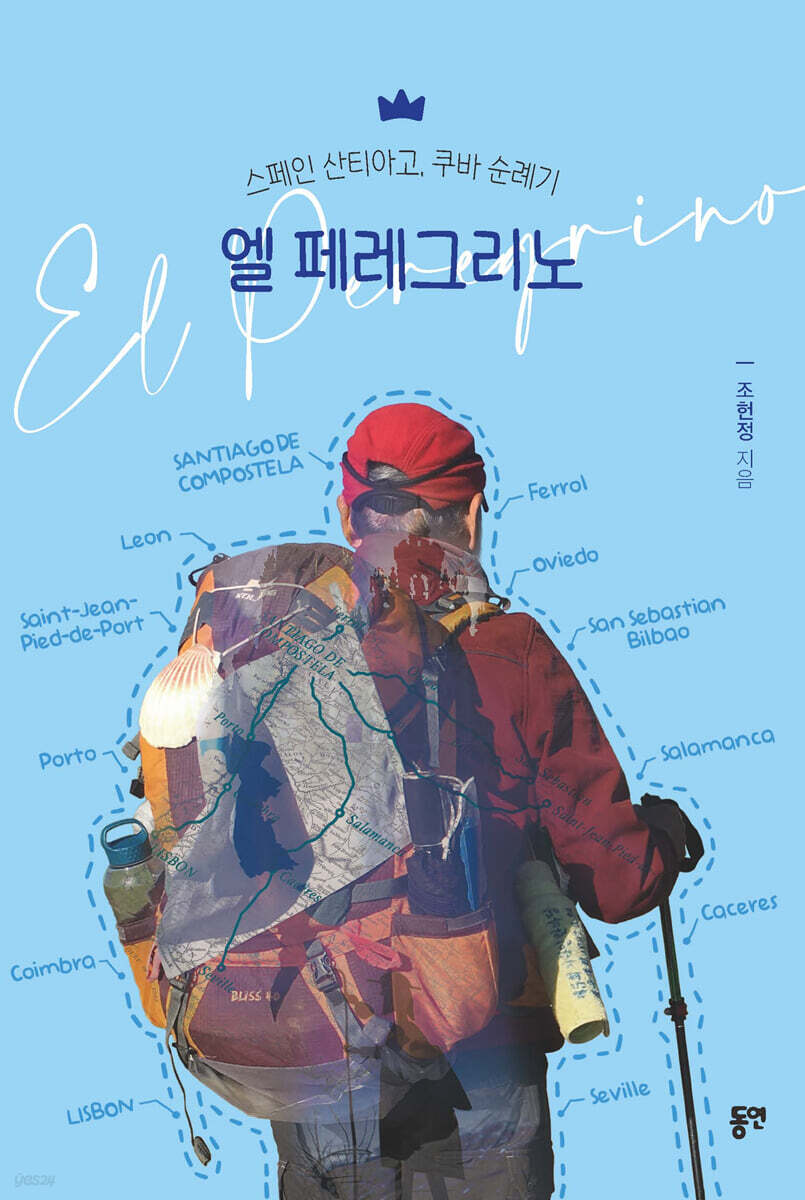
El Peregrino
 |
Description
Book Introduction
"El Peregrino" is a bit different from other books published so far.
The author began walking the Camino de Santiago in his 60s.
I walked mainly in winter for four years.
As the title of the book (Pilgrim) suggests, I walked alone, meditated, and shared peace with those I met along the way.
It wasn't smooth sailing.
I had blisters all over my feet and the soles of my shoes were falling off.
No matter how long I walked, no restaurant appeared, so I had to be satisfied with just a sip of water.
I got lost and came across broken bridges.
The heavy backpack caused pain in my young knees.
So why did I keep walking year after year without giving up?
The author says in the beginning, “Only when you find a remote road where communication is difficult and walk alone for even a few days can you truly discover yourself.”
Perhaps this thought led the author to make the Camino de Santiago pilgrimage every year.
The author, a pastor, not only finds his true self while walking the path, but also displays a spiritual insight that transcends time and space, unprecedented in any pilgrimage to Santiago de Compostela, encompassing theological understanding, religious sensitivity, critique of capitalist society and the contemporary era, and even a call for peace and unification on the Korean Peninsula.
The author's monologue about the events(?) that occur on the road and the episodes he experiences with other pilgrims make you laugh.
The author began walking the Camino de Santiago in his 60s.
I walked mainly in winter for four years.
As the title of the book (Pilgrim) suggests, I walked alone, meditated, and shared peace with those I met along the way.
It wasn't smooth sailing.
I had blisters all over my feet and the soles of my shoes were falling off.
No matter how long I walked, no restaurant appeared, so I had to be satisfied with just a sip of water.
I got lost and came across broken bridges.
The heavy backpack caused pain in my young knees.
So why did I keep walking year after year without giving up?
The author says in the beginning, “Only when you find a remote road where communication is difficult and walk alone for even a few days can you truly discover yourself.”
Perhaps this thought led the author to make the Camino de Santiago pilgrimage every year.
The author, a pastor, not only finds his true self while walking the path, but also displays a spiritual insight that transcends time and space, unprecedented in any pilgrimage to Santiago de Compostela, encompassing theological understanding, religious sensitivity, critique of capitalist society and the contemporary era, and even a call for peace and unification on the Korean Peninsula.
The author's monologue about the events(?) that occur on the road and the episodes he experiences with other pilgrims make you laugh.
index
On the way
Chapter 1.
French Way Camino Frances
Chapter 2.
Camino Portugues
Chapter 3.
Camino del Norte
Chapter 4.
Camino de la Plata
Chapter 5.
The Way of Cuba
Ending the trip
Chapter 1.
French Way Camino Frances
Chapter 2.
Camino Portugues
Chapter 3.
Camino del Norte
Chapter 4.
Camino de la Plata
Chapter 5.
The Way of Cuba
Ending the trip
Into the book
This book is a record of one's life.
While walking the Portuguese Way and the Great Plains Way, it is often the case that you will not meet a single pilgrim or villager for an entire day.
In a way, it is a record of loneliness and a record of struggle with oneself.
In my view, even if it's just two people, walking together as friends is more like a journey than a pilgrimage.
--- From "Setting Out"
Are freedom and wandering the same or different? They both share the same principle: living as one pleases, unconstrained by anything.
Although young people say they live freely, their parents see it as wandering.
Am I free or wandering now?
I've passed under and over the highway several times and meditated on the meaning of speed.
The 20km I walked today took 7 hours, but if I run at 80km/h, it will take me 15 minutes.
Why do they go so fast? And why do I walk so slowly? Ultimately, it's about the happiness of life.
In this competitive era, being faster than others is also a condition for success.
But isn't the destination ultimately the same? Getting there faster than others might feel good along the way, but once you get there, the difference is nothing.
I've run like them more than once or twice, but I'm dozens of times happier now than I was then.
When I went to get my pilgrimage certificate and looked at the registration card, there were about 40 people in front of me today, but there was only one person in their 50s and I was the only one in my 60s.
I feel a little proud.
Of course, it won’t be long before my body collapses…
--- From "Chapter 1 French Road"
After 4 p.m., the wind and rain began to pick up, and we still had another hour and a half to go.
But suddenly my right foot felt strange.
Looking down, I saw that the soles of my shoes were tattered and only the front was barely attached, on the verge of falling off.
Oh my!
I put on my raincoat and set out.
There may be several paths leading out of the city, so I just chose a direction and walked without paying much attention to the signs.
But after 30 minutes, the Camino sign was not visible.
The sun is hidden behind thick clouds, making it difficult to see, and cell phones can't receive signals.
--- From "Chapter 2: The Portuguese Road"
I call my path a pilgrimage from two perspectives.
First, because I walk alone.
Being alone is lonely and sometimes scary.
You will find yourself constantly having conversations with yourself.
Therefore, it becomes possible to communicate with the God within me.
Also, you will meet other pilgrims walking alone on this path.
Most of them are foreigners.
In our brief encounters with them, we come to recognize that we are all children of God and members of one global community.
Second, as a pastor, it is meaningful to examine the flow of the thousand-year history of Christianity.
When I wake up in the morning, I find it difficult to take even a single step.
I walked for two days holding onto the blister and it looks like it's starting to boil.
You can't ignore the soles of your feet.
You can't ignore the floor.
You can't ignore the sound of the floor.
--- From "Chapter 3: The Road North"
Spain is similar in national power to us.
The cost of living is low, and the cost of medical care and education is incomparably lower than ours.
Of course, the price of the house.
In our South Korea, everything is abnormal.
Where in the world can you find a house that goes up in value by hundreds of millions of won every year?
Here, even if you walk around like that, you will hardly see any soldiers or military units.
No, I've never seen it before.
If we just saved on defense spending and the money we pay to the US military, we could live like this.
Ah! How long must we live in this suffering?
I split the walk into two days, 12km yesterday and 13km today, to walk 27km tomorrow.
But today I got completely lost.
Sometimes when I get lost, I usually get back on track quickly, but today I walked along what we would call a rice paddy ridge path, which is not even on the map.
I walked along the small farm road that led to the river, but if I had come just one day earlier, the water would not have receded and I would have had to walk completely underwater.
I had come too far to turn back.
--- From "Chapter 4: The Great Plains Road"
Ever since I read Che Guevara's biography a long time ago, Cuba has been one of the countries I've always wanted to visit.
Against this backdrop, the first country chosen for the sabbatical year was Cuba.
Cuban society is in turmoil right now.
Just as TV came to rural areas in the 1960s and 1970s and people flocked to the cities and factories to watch commercials and soap operas featuring wealthy urban families, young people are also flocking here, but there are no jobs.
If you walk down the alleyways of the city during the day, you can easily see many young people just sitting in the alleys.
Often, we evaluate a country's economy by its per capita national income or monthly income.
A salary of ten thousand won per month.
If we evaluate it by this, it is an extreme poverty that does not even reach the level of poor African and Asian countries with a daily income of one dollar.
But it will depend on how you calculate everything the country provides.
How do economists educated in capitalist countries calculate per capita national income in socialist countries? I'm not an economist, so I don't know.
But, if you think about it logically, the numbers will vary greatly depending on how you approach it.
While walking the Portuguese Way and the Great Plains Way, it is often the case that you will not meet a single pilgrim or villager for an entire day.
In a way, it is a record of loneliness and a record of struggle with oneself.
In my view, even if it's just two people, walking together as friends is more like a journey than a pilgrimage.
--- From "Setting Out"
Are freedom and wandering the same or different? They both share the same principle: living as one pleases, unconstrained by anything.
Although young people say they live freely, their parents see it as wandering.
Am I free or wandering now?
I've passed under and over the highway several times and meditated on the meaning of speed.
The 20km I walked today took 7 hours, but if I run at 80km/h, it will take me 15 minutes.
Why do they go so fast? And why do I walk so slowly? Ultimately, it's about the happiness of life.
In this competitive era, being faster than others is also a condition for success.
But isn't the destination ultimately the same? Getting there faster than others might feel good along the way, but once you get there, the difference is nothing.
I've run like them more than once or twice, but I'm dozens of times happier now than I was then.
When I went to get my pilgrimage certificate and looked at the registration card, there were about 40 people in front of me today, but there was only one person in their 50s and I was the only one in my 60s.
I feel a little proud.
Of course, it won’t be long before my body collapses…
--- From "Chapter 1 French Road"
After 4 p.m., the wind and rain began to pick up, and we still had another hour and a half to go.
But suddenly my right foot felt strange.
Looking down, I saw that the soles of my shoes were tattered and only the front was barely attached, on the verge of falling off.
Oh my!
I put on my raincoat and set out.
There may be several paths leading out of the city, so I just chose a direction and walked without paying much attention to the signs.
But after 30 minutes, the Camino sign was not visible.
The sun is hidden behind thick clouds, making it difficult to see, and cell phones can't receive signals.
--- From "Chapter 2: The Portuguese Road"
I call my path a pilgrimage from two perspectives.
First, because I walk alone.
Being alone is lonely and sometimes scary.
You will find yourself constantly having conversations with yourself.
Therefore, it becomes possible to communicate with the God within me.
Also, you will meet other pilgrims walking alone on this path.
Most of them are foreigners.
In our brief encounters with them, we come to recognize that we are all children of God and members of one global community.
Second, as a pastor, it is meaningful to examine the flow of the thousand-year history of Christianity.
When I wake up in the morning, I find it difficult to take even a single step.
I walked for two days holding onto the blister and it looks like it's starting to boil.
You can't ignore the soles of your feet.
You can't ignore the floor.
You can't ignore the sound of the floor.
--- From "Chapter 3: The Road North"
Spain is similar in national power to us.
The cost of living is low, and the cost of medical care and education is incomparably lower than ours.
Of course, the price of the house.
In our South Korea, everything is abnormal.
Where in the world can you find a house that goes up in value by hundreds of millions of won every year?
Here, even if you walk around like that, you will hardly see any soldiers or military units.
No, I've never seen it before.
If we just saved on defense spending and the money we pay to the US military, we could live like this.
Ah! How long must we live in this suffering?
I split the walk into two days, 12km yesterday and 13km today, to walk 27km tomorrow.
But today I got completely lost.
Sometimes when I get lost, I usually get back on track quickly, but today I walked along what we would call a rice paddy ridge path, which is not even on the map.
I walked along the small farm road that led to the river, but if I had come just one day earlier, the water would not have receded and I would have had to walk completely underwater.
I had come too far to turn back.
--- From "Chapter 4: The Great Plains Road"
Ever since I read Che Guevara's biography a long time ago, Cuba has been one of the countries I've always wanted to visit.
Against this backdrop, the first country chosen for the sabbatical year was Cuba.
Cuban society is in turmoil right now.
Just as TV came to rural areas in the 1960s and 1970s and people flocked to the cities and factories to watch commercials and soap operas featuring wealthy urban families, young people are also flocking here, but there are no jobs.
If you walk down the alleyways of the city during the day, you can easily see many young people just sitting in the alleys.
Often, we evaluate a country's economy by its per capita national income or monthly income.
A salary of ten thousand won per month.
If we evaluate it by this, it is an extreme poverty that does not even reach the level of poor African and Asian countries with a daily income of one dollar.
But it will depend on how you calculate everything the country provides.
How do economists educated in capitalist countries calculate per capita national income in socialist countries? I'm not an economist, so I don't know.
But, if you think about it logically, the numbers will vary greatly depending on how you approach it.
--- From "Chapter 5: The Road to Cuba"
Publisher's Review
Walking the Camino, a path that is not lonely even when walked alone
There is already an abundance of information about the Camino de Santiago in Korea.
You can prepare perfectly before going on a pilgrimage through books, blogs, and social media.
Moreover, in this globalized world, it is possible to exchange information with one another even during pilgrimages, so it seems that no other means are needed.
However, the experiences of people who have visited Santiago are still being made into books, and many people are still looking for them.
This is probably proof that many people are longing for Santiago.
"El Peregrino" is a bit different from other books published so far.
The author began walking the Camino de Santiago in his 60s.
I walked mainly in winter for four years.
As the title of the book (Pilgrim) suggests, I walked alone, meditated, and shared peace with those I met along the way.
It wasn't smooth sailing.
I had blisters all over my feet and the soles of my shoes were falling off.
No matter how long I walked, no restaurant appeared, so I had to be satisfied with just a sip of water.
I got lost and came across broken bridges.
The heavy backpack caused pain in my young knees.
So why did I keep walking year after year without giving up?
The author says in the beginning, “Only when you find a remote road where communication is difficult and walk alone for even a few days can you truly discover yourself.”
Perhaps this thought led the author to make the Camino de Santiago pilgrimage every year.
The author, a pastor, not only finds his true self while walking the path, but also displays a spiritual insight that transcends time and space, unprecedented in any pilgrimage to Santiago de Compostela, encompassing theological understanding, religious sensitivity, critique of capitalist society and the contemporary era, and even a call for peace and unification on the Korean Peninsula.
The author's monologue about the events(?) that occur on the road and the episodes he experiences with other pilgrims make you laugh.
Do you need to do the Camino de Santiago? What if you can't leave right now? That's okay.
But I hope you don't give up on your dreams.
Until then, I hope this book can bring you some comfort.
No tengas prisa en llegar,el camino todavia tiene mucho que ensenarte.
Don't rush to get there.
The road still has much to give you.
There is already an abundance of information about the Camino de Santiago in Korea.
You can prepare perfectly before going on a pilgrimage through books, blogs, and social media.
Moreover, in this globalized world, it is possible to exchange information with one another even during pilgrimages, so it seems that no other means are needed.
However, the experiences of people who have visited Santiago are still being made into books, and many people are still looking for them.
This is probably proof that many people are longing for Santiago.
"El Peregrino" is a bit different from other books published so far.
The author began walking the Camino de Santiago in his 60s.
I walked mainly in winter for four years.
As the title of the book (Pilgrim) suggests, I walked alone, meditated, and shared peace with those I met along the way.
It wasn't smooth sailing.
I had blisters all over my feet and the soles of my shoes were falling off.
No matter how long I walked, no restaurant appeared, so I had to be satisfied with just a sip of water.
I got lost and came across broken bridges.
The heavy backpack caused pain in my young knees.
So why did I keep walking year after year without giving up?
The author says in the beginning, “Only when you find a remote road where communication is difficult and walk alone for even a few days can you truly discover yourself.”
Perhaps this thought led the author to make the Camino de Santiago pilgrimage every year.
The author, a pastor, not only finds his true self while walking the path, but also displays a spiritual insight that transcends time and space, unprecedented in any pilgrimage to Santiago de Compostela, encompassing theological understanding, religious sensitivity, critique of capitalist society and the contemporary era, and even a call for peace and unification on the Korean Peninsula.
The author's monologue about the events(?) that occur on the road and the episodes he experiences with other pilgrims make you laugh.
Do you need to do the Camino de Santiago? What if you can't leave right now? That's okay.
But I hope you don't give up on your dreams.
Until then, I hope this book can bring you some comfort.
No tengas prisa en llegar,el camino todavia tiene mucho que ensenarte.
Don't rush to get there.
The road still has much to give you.
GOODS SPECIFICS
- Publication date: November 5, 2021
- Page count, weight, size: 368 pages | 604g | 153*220*18mm
- ISBN13: 9788964477342
- ISBN10: 8964477340
You may also like
카테고리
korean


korean

![GQ KOREA Mark (Monthly): December [2025]](http://librairie.coreenne.fr/cdn/shop/files/8ef265dbbfbf186523ed75ba7319009d.jpg?v=1765340328&width=3840)


