

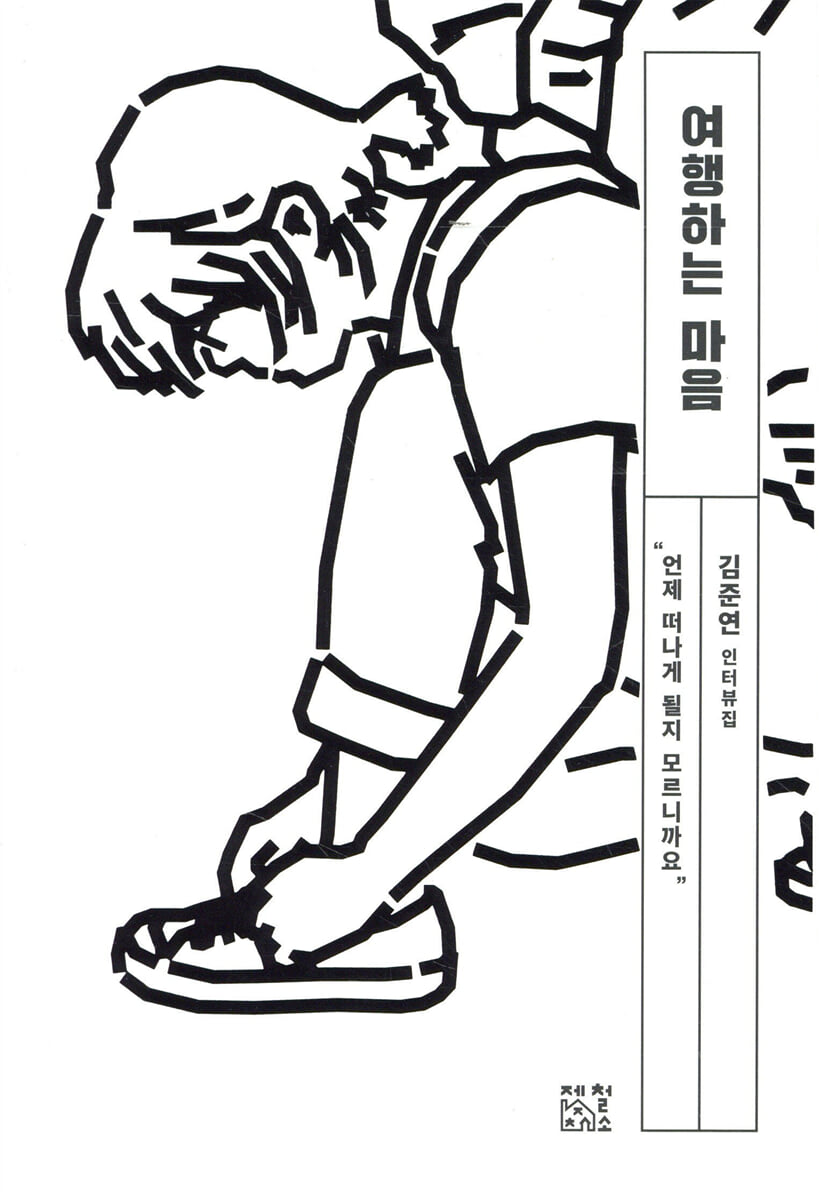
A traveling heart
 |
Description
Book Introduction
The fifth book in the steel mill interview series, “Working Mind.”
Kim Jun-yeon, author of 『Mr. Onda's Gangwon-do』 and 『North Korea Travel Conversation』, has collected stories from meeting people who travel as if it were their daily life and live their daily lives as if it were a trip, in one book.
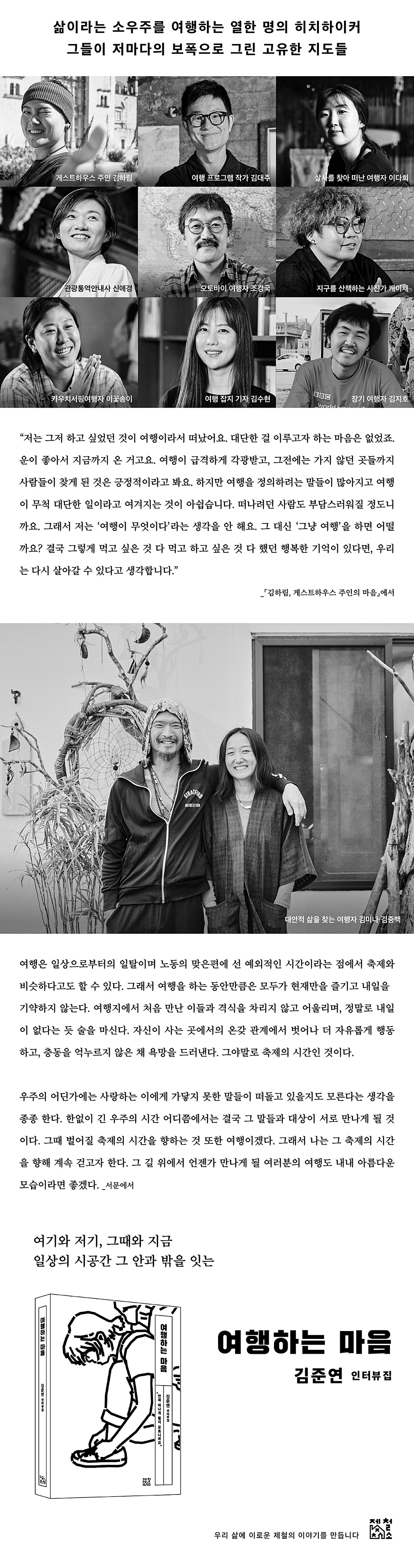
The author embraces the minds of those who engage in travel as labor, such as guesthouse operators, tour guides, travel magazine reporters, and travel variety show writers, as well as those who engage in forms of travel that go against the travel industry's consumer-oriented approach, such as couchsurfing, motorcycling, and long-term travel.
What began as a conversation about work and hobbies transcends those boundaries, exploring the interviewees' perspectives on life as travelers and their methods of managing it.
These special interviews with 11 people, connecting the inside and outside of space and time—"then and now" and "here and there"—will vividly rekindle the "sense of travel" we've forgotten due to the pandemic.
Kim Jun-yeon, author of 『Mr. Onda's Gangwon-do』 and 『North Korea Travel Conversation』, has collected stories from meeting people who travel as if it were their daily life and live their daily lives as if it were a trip, in one book.
The author embraces the minds of those who engage in travel as labor, such as guesthouse operators, tour guides, travel magazine reporters, and travel variety show writers, as well as those who engage in forms of travel that go against the travel industry's consumer-oriented approach, such as couchsurfing, motorcycling, and long-term travel.
What began as a conversation about work and hobbies transcends those boundaries, exploring the interviewees' perspectives on life as travelers and their methods of managing it.
These special interviews with 11 people, connecting the inside and outside of space and time—"then and now" and "here and there"—will vividly rekindle the "sense of travel" we've forgotten due to the pandemic.
- You can preview some of the book's contents.
Preview
index
introduction
Kim Ha-rim, the Heart of a Guesthouse Owner
Kim Mi-na and Kim Jung-baek: The Hearts of Travelers Seeking Alternative Lives
Kim Dae-joo, the mind of a travel program writer
Dahee Lee, the heart of a traveler in search of salsa
Shin Ae-kyung, the Heart of a Tour Guide
Kyung-Guk Cho, the Mind of a Motorcycle Traveler
K-Chae, the mind of a photographer walking the earth
This flower, the heart of a couchsurfing traveler
Kim Soo-hyun, the mind of a travel magazine reporter
Kim Ji-ho, The Mind of a Long-Term Traveler
Kim Ha-rim, the Heart of a Guesthouse Owner
Kim Mi-na and Kim Jung-baek: The Hearts of Travelers Seeking Alternative Lives
Kim Dae-joo, the mind of a travel program writer
Dahee Lee, the heart of a traveler in search of salsa
Shin Ae-kyung, the Heart of a Tour Guide
Kyung-Guk Cho, the Mind of a Motorcycle Traveler
K-Chae, the mind of a photographer walking the earth
This flower, the heart of a couchsurfing traveler
Kim Soo-hyun, the mind of a travel magazine reporter
Kim Ji-ho, The Mind of a Long-Term Traveler
Detailed image
Into the book
The ideal travel experience is different for everyone.
What is presented in this book is only a small part of those appearances.
I hope you will discover not only the clashes that arise between the ten interviewees, but also the clashes with your own ideas about what travel should be like.
And when the day comes when you can travel freely again, I hope that you too will go on your own journey and create your own solid world.
--- p.19
“I just wanted to travel, so I left.
I had no desire to achieve anything great.
I've been lucky to have come this far.
I think it's a positive thing that travel has suddenly become popular and people are going to places they wouldn't have gone before.
But it's a shame that there are so many words trying to define travel and that travel is considered to be something incredibly special.
It's to the point where even the person who was about to leave would feel burdened.
So I don't think about 'what is travel'.
Instead, what if we just "traveled"? Ultimately, if we have happy memories of eating everything we wanted and doing everything we wanted, I think we can live again."
--- p.49
“I told Jiyu, ‘I’m sorry. It wasn’t your fault, it was just that I was being stupid.’
Jiyu answered like this.
'It's okay, Dad.
My heart knows.
It's okay because I know my dad loves me.' It was really touching.
'Dad, shall I tell you how to get rid of the fool? If you stop thinking about the fool inside you, the fool will disappear.
So, stop thinking about that fool.' It was strange to hear a six-year-old say that to me, an adult.
Things like this happen when you travel with kids.
We have a chance to talk to each other
“It’s creepy.”
--- p.74-75
“I remember talking to the PD who went to Africa with me while covered in sweat.
"Author, I think we've been too successful." I knew right away what he meant.
Although I was working without being able to eat properly or sleep well, the memories I gained while making the show were amazing.
So I answered too.
“I think we’re doing a really good job,” he said.
--- p.108-109
“If I had to pick one more thing that salsa and travel have in common, it would be the one-off nature of the feeling.
If you visit a country you traveled to in your twenties again in your thirties, the feeling will definitely be different.
The same goes for dancing salsa.
Even if you dance with the same person, the feeling of the dance is different depending on the mood or emotion of the day.
“You can never get the feeling of dancing again.”
--- p.131
“I like Korea better after becoming a tour guide.
Maybe it's because I studied a lot about Korea.
When I see the customers' reactions, I start to like Korea more and more.
“I’m often surprised to see how well-maintained the roads are on the highway, and how clean the rest areas and restrooms are.”
--- p.150
“Once you set out to a destination, the most important thing is to arrive without any accidents.
Everything that I feel is a journey happens on a motorcycle.
Once you reach your destination, all your tension will melt away.
So the most I can do is look around the area near my accommodation or go to a bookstore.
But compared to running, the intensity of the pleasure is less than a tenth of that.”
--- p.180
“I think it’s actually difficult to encounter ordinary moments.
When we travel, we become strangers anyway, so it is bound to be difficult to encounter the daily lives of locals as strangers.
In an unfamiliar place, I tend to be drawn to tourist attractions or places that offer convenience to travelers.
“I try to block it out as much as possible.”
--- p.214
“I think the weight of life is enough to carry in one backpack.
I'm a third-year traveler and now I have everything in one backpack.
But as I traveled, the weight of my backpack decreased.
Because you only carry what you need.
The more greedy you are, the heavier your backpack becomes.
If you do that, your steps will become heavy and you will get irritated.
The lighter my backpack became, the lighter the weight of life felt.
“I think your level of satisfaction with life depends on how you think.”
--- p.252
“For the time being, the barriers to entry for travel will remain high.
People who value safety will avoid traveling until the situation calms down.
Where there is demand, there must be supply, but the changes brought about by COVID-19 will likely lead to higher travel prices.
If demand suddenly arises that cannot keep up with supply, the travel market landscape will change.
Some people who used to travel a lot will now find it difficult to think about traveling.
And I expect that safer and higher quality travel will take the place of cheap travel in the past.”
--- p.275
“I thought I would only ever go on a long trip like this once in my life.
It would be difficult to go back to a place I've already traveled to, and memories have their limits, so I tried to record as meticulously as possible what I did and saw in each country.
I also took a lot of pictures.
So the photos of the paths I walked are not scattered but connected.
“That’s why memories are connected as if watching a video.”
What is presented in this book is only a small part of those appearances.
I hope you will discover not only the clashes that arise between the ten interviewees, but also the clashes with your own ideas about what travel should be like.
And when the day comes when you can travel freely again, I hope that you too will go on your own journey and create your own solid world.
--- p.19
“I just wanted to travel, so I left.
I had no desire to achieve anything great.
I've been lucky to have come this far.
I think it's a positive thing that travel has suddenly become popular and people are going to places they wouldn't have gone before.
But it's a shame that there are so many words trying to define travel and that travel is considered to be something incredibly special.
It's to the point where even the person who was about to leave would feel burdened.
So I don't think about 'what is travel'.
Instead, what if we just "traveled"? Ultimately, if we have happy memories of eating everything we wanted and doing everything we wanted, I think we can live again."
--- p.49
“I told Jiyu, ‘I’m sorry. It wasn’t your fault, it was just that I was being stupid.’
Jiyu answered like this.
'It's okay, Dad.
My heart knows.
It's okay because I know my dad loves me.' It was really touching.
'Dad, shall I tell you how to get rid of the fool? If you stop thinking about the fool inside you, the fool will disappear.
So, stop thinking about that fool.' It was strange to hear a six-year-old say that to me, an adult.
Things like this happen when you travel with kids.
We have a chance to talk to each other
“It’s creepy.”
--- p.74-75
“I remember talking to the PD who went to Africa with me while covered in sweat.
"Author, I think we've been too successful." I knew right away what he meant.
Although I was working without being able to eat properly or sleep well, the memories I gained while making the show were amazing.
So I answered too.
“I think we’re doing a really good job,” he said.
--- p.108-109
“If I had to pick one more thing that salsa and travel have in common, it would be the one-off nature of the feeling.
If you visit a country you traveled to in your twenties again in your thirties, the feeling will definitely be different.
The same goes for dancing salsa.
Even if you dance with the same person, the feeling of the dance is different depending on the mood or emotion of the day.
“You can never get the feeling of dancing again.”
--- p.131
“I like Korea better after becoming a tour guide.
Maybe it's because I studied a lot about Korea.
When I see the customers' reactions, I start to like Korea more and more.
“I’m often surprised to see how well-maintained the roads are on the highway, and how clean the rest areas and restrooms are.”
--- p.150
“Once you set out to a destination, the most important thing is to arrive without any accidents.
Everything that I feel is a journey happens on a motorcycle.
Once you reach your destination, all your tension will melt away.
So the most I can do is look around the area near my accommodation or go to a bookstore.
But compared to running, the intensity of the pleasure is less than a tenth of that.”
--- p.180
“I think it’s actually difficult to encounter ordinary moments.
When we travel, we become strangers anyway, so it is bound to be difficult to encounter the daily lives of locals as strangers.
In an unfamiliar place, I tend to be drawn to tourist attractions or places that offer convenience to travelers.
“I try to block it out as much as possible.”
--- p.214
“I think the weight of life is enough to carry in one backpack.
I'm a third-year traveler and now I have everything in one backpack.
But as I traveled, the weight of my backpack decreased.
Because you only carry what you need.
The more greedy you are, the heavier your backpack becomes.
If you do that, your steps will become heavy and you will get irritated.
The lighter my backpack became, the lighter the weight of life felt.
“I think your level of satisfaction with life depends on how you think.”
--- p.252
“For the time being, the barriers to entry for travel will remain high.
People who value safety will avoid traveling until the situation calms down.
Where there is demand, there must be supply, but the changes brought about by COVID-19 will likely lead to higher travel prices.
If demand suddenly arises that cannot keep up with supply, the travel market landscape will change.
Some people who used to travel a lot will now find it difficult to think about traveling.
And I expect that safer and higher quality travel will take the place of cheap travel in the past.”
--- p.275
“I thought I would only ever go on a long trip like this once in my life.
It would be difficult to go back to a place I've already traveled to, and memories have their limits, so I tried to record as meticulously as possible what I did and saw in each country.
I also took a lot of pictures.
So the photos of the paths I walked are not scattered but connected.
“That’s why memories are connected as if watching a video.”
--- p.295
Publisher's Review
Here and there, then and now
Connecting the inside and outside of everyday space and time
The fifth book in the steel mill interview series, "Working Mind," "Traveling Mind," has been published.
Author Kim Jun-yeon, a traveler and photographer who wrote 『Mr. Onda's Gangwon-do』 and 『North Korea Travel Conversation』, has collected stories from meeting travelers who make travel part of their daily lives and live their daily lives like travel in one book.
As Kim Ha-rim, an interviewee for this book, said, travel is consumptive.
“Travel is actually a series of extremely consumerist activities.
“Because it’s a waste of time and money.” If that’s true, then this book is a collection of interviews with people whose travels are hardly productive at all.
Is it really appropriate for such a book to be included in the 'Working Mind' series?
_In the introduction
Can travel become work? That was the first question we faced as we began the project.
We decided to first tell the stories of those who participate in travel as labor, which inevitably exists beyond travel as a commodity.
We decided to bring together the stories of people who travel there, each in their own unique way.
So, I thought, maybe we can find meaning in travel somewhere between work and leisure.
As soon as the author finished arranging interviews, he began traveling to meet them scattered across the country.
From Seoul to Jinju, Jeju, and even the small town of Pai in Thailand… .
One day, he sent me an email from Mexico saying he had come to meet the interviewee.
This was possible before the pandemic.
In the spring of 2020, one day after all the interviews were completed, the World Health Organization declared COVID-19 a pandemic.
The world has locked its borders, and travel has come to a standstill.
The author carefully retraces the journeys he has encountered in a long tunnel with no end in sight, and writes about them.
I thought about the draft the author sent me.
What meaning do their stories hold for us in an age when travel has stopped?
But I realized this after reading the introduction that arrived the latest.
The act of traveling does not belong to a specific space and time, but is closely connected to our daily lives, which are life and death.
Half of the interviewees in this book work in travel-related professions, including tour guides, guesthouse operators, travel magazine reporters, and travel entertainment program writers.
And the other half are those who travel in a way that rebels against the travel industry that has become an object of consumption.
There are people who enjoy traveling in their own way, such as couchsurfing travelers, motorcyclists, and long-term travelers.
One thing I want to point out is that all the interviewees in this book who travel as a profession are also travelers.
They travel in a way that would not be considered tourists themselves, but rather because they deal with tourists or produce results simply because they make travel their business.
All interviewees, including them, travel in different ways.
_In the introduction
Starting from the realm of work and hobbies, "The Traveling Mind" transcends those boundaries and expands its world to include the interviewees' journeys through life, revealing their perspectives on life and the ways they navigate it.
Moreover, it connects the time and space that we think of when we talk about travel, that is, the inside and outside of ‘then and now’ and ‘here and there.’
While the book was being made, and with COVID-19 continuing for over a year, the current circumstances of several interviewees changed.
Kim Ha-rim, who ran a guesthouse in Mexico, has returned to Korea after wrapping up her life there and is working for a distribution company.
Broadcast writer Kim Dae-joo has been unable to produce a variety show that was being filmed overseas for a long time, and travel magazine reporter Kim Soo-hyun has changed careers to the IT industry.
Shin Ae-kyung, a Spanish tour guide who lost her job due to the decline in foreign visitors to Korea, is currently creating Korean language education content and uploading it to social media.
The impact of the pandemic on the travel industry has been truly enormous.
During the editing process, I debated for a long time whether to ask the author for additional interviews and reconceptualize the book as a "post-pandemic journey," but ultimately decided against it.
It was because of the belief that both travel and travelers would eventually find their place.
“Now is the time to think globally,” the author says, “and to dream of a journey as a molecule, blurring borders and roaming the globe.”
Has there ever been a time when the desire to travel, or to travel, has been as strong as it is today?
I hope this book will reawaken the 'sense of travel' that we have long forgotten.
*Steelworks [Working Mind] is a series of interviews in which we meet, ask questions, and listen to people who are making a difference in various fields.
By examining the various thoughts that connect work and people, we plan to continue to examine and interpret how individual labor and life are connected to our society.
Connecting the inside and outside of everyday space and time
The fifth book in the steel mill interview series, "Working Mind," "Traveling Mind," has been published.
Author Kim Jun-yeon, a traveler and photographer who wrote 『Mr. Onda's Gangwon-do』 and 『North Korea Travel Conversation』, has collected stories from meeting travelers who make travel part of their daily lives and live their daily lives like travel in one book.
As Kim Ha-rim, an interviewee for this book, said, travel is consumptive.
“Travel is actually a series of extremely consumerist activities.
“Because it’s a waste of time and money.” If that’s true, then this book is a collection of interviews with people whose travels are hardly productive at all.
Is it really appropriate for such a book to be included in the 'Working Mind' series?
_In the introduction
Can travel become work? That was the first question we faced as we began the project.
We decided to first tell the stories of those who participate in travel as labor, which inevitably exists beyond travel as a commodity.
We decided to bring together the stories of people who travel there, each in their own unique way.
So, I thought, maybe we can find meaning in travel somewhere between work and leisure.
As soon as the author finished arranging interviews, he began traveling to meet them scattered across the country.
From Seoul to Jinju, Jeju, and even the small town of Pai in Thailand… .
One day, he sent me an email from Mexico saying he had come to meet the interviewee.
This was possible before the pandemic.
In the spring of 2020, one day after all the interviews were completed, the World Health Organization declared COVID-19 a pandemic.
The world has locked its borders, and travel has come to a standstill.
The author carefully retraces the journeys he has encountered in a long tunnel with no end in sight, and writes about them.
I thought about the draft the author sent me.
What meaning do their stories hold for us in an age when travel has stopped?
But I realized this after reading the introduction that arrived the latest.
The act of traveling does not belong to a specific space and time, but is closely connected to our daily lives, which are life and death.
Half of the interviewees in this book work in travel-related professions, including tour guides, guesthouse operators, travel magazine reporters, and travel entertainment program writers.
And the other half are those who travel in a way that rebels against the travel industry that has become an object of consumption.
There are people who enjoy traveling in their own way, such as couchsurfing travelers, motorcyclists, and long-term travelers.
One thing I want to point out is that all the interviewees in this book who travel as a profession are also travelers.
They travel in a way that would not be considered tourists themselves, but rather because they deal with tourists or produce results simply because they make travel their business.
All interviewees, including them, travel in different ways.
_In the introduction
Starting from the realm of work and hobbies, "The Traveling Mind" transcends those boundaries and expands its world to include the interviewees' journeys through life, revealing their perspectives on life and the ways they navigate it.
Moreover, it connects the time and space that we think of when we talk about travel, that is, the inside and outside of ‘then and now’ and ‘here and there.’
While the book was being made, and with COVID-19 continuing for over a year, the current circumstances of several interviewees changed.
Kim Ha-rim, who ran a guesthouse in Mexico, has returned to Korea after wrapping up her life there and is working for a distribution company.
Broadcast writer Kim Dae-joo has been unable to produce a variety show that was being filmed overseas for a long time, and travel magazine reporter Kim Soo-hyun has changed careers to the IT industry.
Shin Ae-kyung, a Spanish tour guide who lost her job due to the decline in foreign visitors to Korea, is currently creating Korean language education content and uploading it to social media.
The impact of the pandemic on the travel industry has been truly enormous.
During the editing process, I debated for a long time whether to ask the author for additional interviews and reconceptualize the book as a "post-pandemic journey," but ultimately decided against it.
It was because of the belief that both travel and travelers would eventually find their place.
“Now is the time to think globally,” the author says, “and to dream of a journey as a molecule, blurring borders and roaming the globe.”
Has there ever been a time when the desire to travel, or to travel, has been as strong as it is today?
I hope this book will reawaken the 'sense of travel' that we have long forgotten.
*Steelworks [Working Mind] is a series of interviews in which we meet, ask questions, and listen to people who are making a difference in various fields.
By examining the various thoughts that connect work and people, we plan to continue to examine and interpret how individual labor and life are connected to our society.
GOODS SPECIFICS
- Date of issue: August 31, 2021
- Page count, weight, size: 304 pages | 294g | 130*190*20mm
- ISBN13: 9791188343485
- ISBN10: 1188343483
You may also like
카테고리
korean


korean

![GQ KOREA Mark (Monthly): December [2025]](http://librairie.coreenne.fr/cdn/shop/files/8ef265dbbfbf186523ed75ba7319009d.jpg?v=1765340328&width=3840)


