

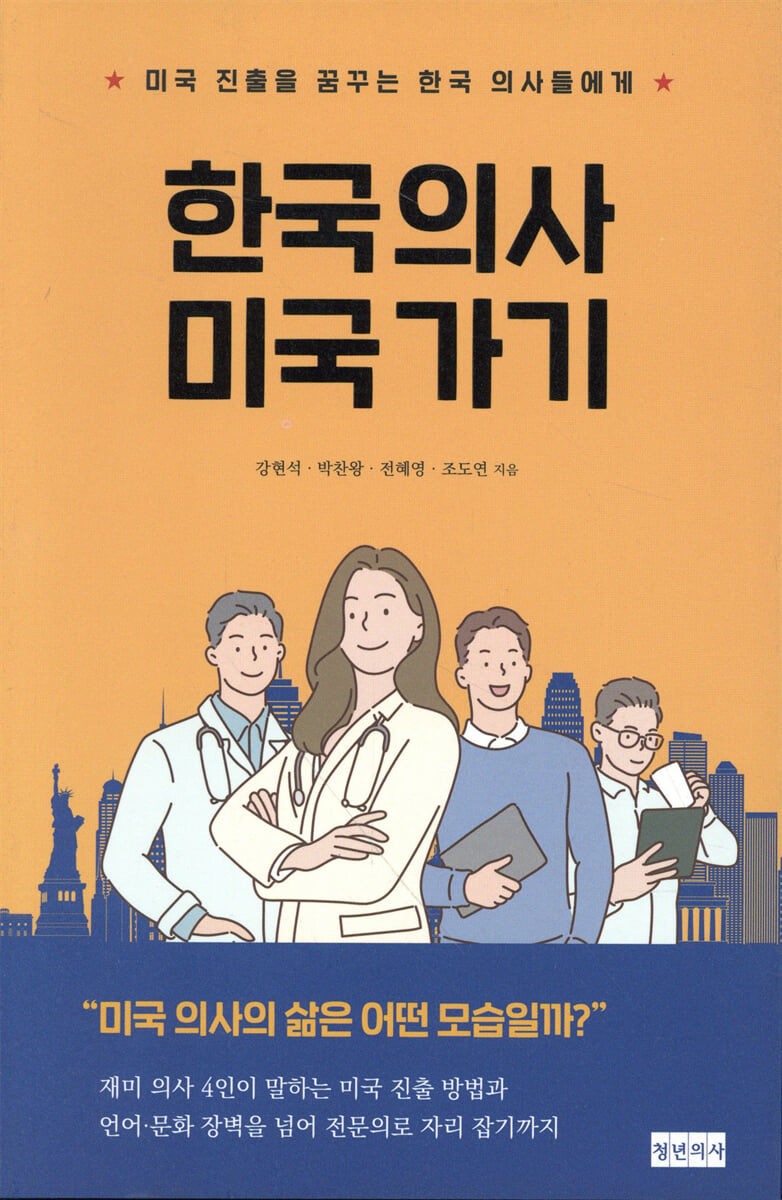
Korean doctors go to the US
 |
Description
Book Introduction
To Korean doctors dreaming of advancing into the United States "What is life like for an American doctor?" Four Korean-American doctors who have moved to the United States have gathered to discuss the topic for Korean doctors interested in practicing medicine in the United States. We wanted to provide accurate information and reality about entering the U.S. market, and to help with practical preparation by sharing our firsthand experience and know-how in interviews, matches, residency training, and visas. The authors also always lacked information when preparing to enter the U.S. market, as there were not many seniors who had walked that path before them. There will be many challenges to prepare for the match, enter the United States, and overcome language and cultural barriers to establish yourself as a professional, but if you have the will, I hope you can take on the challenge. If you have a dream, you can make it come true. |
- You can preview some of the book's contents.
Preview
index
About the Author
Prologue.
Through bitter times, become your true self
Part 1.
Basic information for entering the US market
Chapter 1.
Procedures for obtaining a US medical license
Chapter 2.
Types of visas available
Chapter 3.
Understanding Match and Choosing a Training Hospital
Chapter 4.
Match QnA
Chapter 5.
Interview Preparation and Precautions
Chapter 6.
Small information needed during the initial settlement process
Part 2.
During residency and after obtaining a specialist license
Chapter 7.
American residency training system
Chapter 8.
The Reality of Resident Life (1)
Chapter 9.
The Reality of Resident Life (2)
Chapter 10.
Should I do it or not, Fellow
Chapter 11.
Surviving in Academia
Chapter 12.
Surviving Outside the Academy
Part 3.
A person before being a doctor
Chapter 13.
Acquiring permanent residency and citizenship
Chapter 14.
Dating, marriage, and parents
Chapter 15.
Life in America is different from Korea
Chapter 16.
Is America a racist country?
Chapter 17.
Borderline people, loneliness, and work-life balance
Chapter 18.
What if it had been like that back then?
Epilogue.
The courage to live your own life
Prologue.
Through bitter times, become your true self
Part 1.
Basic information for entering the US market
Chapter 1.
Procedures for obtaining a US medical license
Chapter 2.
Types of visas available
Chapter 3.
Understanding Match and Choosing a Training Hospital
Chapter 4.
Match QnA
Chapter 5.
Interview Preparation and Precautions
Chapter 6.
Small information needed during the initial settlement process
Part 2.
During residency and after obtaining a specialist license
Chapter 7.
American residency training system
Chapter 8.
The Reality of Resident Life (1)
Chapter 9.
The Reality of Resident Life (2)
Chapter 10.
Should I do it or not, Fellow
Chapter 11.
Surviving in Academia
Chapter 12.
Surviving Outside the Academy
Part 3.
A person before being a doctor
Chapter 13.
Acquiring permanent residency and citizenship
Chapter 14.
Dating, marriage, and parents
Chapter 15.
Life in America is different from Korea
Chapter 16.
Is America a racist country?
Chapter 17.
Borderline people, loneliness, and work-life balance
Chapter 18.
What if it had been like that back then?
Epilogue.
The courage to live your own life
Into the book
Interviews usually started at 8 a.m., lasted 20 to 30 minutes per professor, and ended at 4 p.m.
To prepare for the interview, I practiced seven mock interviews with a friend who was a resident at Stanford University Hospital and my advisor, but I was really nervous for my first interview.
Although the mock interviews I conducted several times were very helpful, the interviews were by no means easy.
Unexpected questions also poured in.
“Tell me about a time when you had a problem while working as a team member, and how you resolved it through leadership.”, “How would you resolve a conflict with a senior resident, and how would you deal with other residents disliking you?”, “Tell me about your plans for the next 5, 10, and 20 years.”, etc. ---p.
Out of 80
Faculty members who received inadequate teaching evaluations from residents were required to enroll in special programs to receive continuing education in resident education.
This evaluation is reported to the higher-level ACGME and has a significant impact on the promotion of the professor, so as a professor supervising the residents, you must 'take good care of' the residents.
Therefore, during your residency, make sure to utilize this effectively and seek maximum assistance from your professors to successfully complete your training and further develop your skills.
By the way, there is a question I always ask residents when I meet them in the morning.
“How are you doing this morning? Is there anything I can help you or make it better?”---p.
Out of 111
One time, I was doing my internship in general surgery.
I had so much work to do that I couldn't even go home and it was already midnight.
I once snuck out to sleep on the hospital couch because I had to come back at 5 a.m. anyway, but the chief resident found out the next day and took my pager away.
He told me to go home and rest and not come to the hospital until tomorrow, as he would have my pager.
Honestly, I was so tired and exhausted that day that I was grateful for the consideration.
But it's not all about being thankful.
If this happens repeatedly, you will be labeled as a resident who cannot work and works late. ---p.
Out of 117
To make the difficult decision of whether or not to enter academia, you should first consider the following:
First, you need to think about your life goals and values.
As mentioned earlier, if it aligns with your life goals and values, there will be no problem.
Second, you need to think about whether it is suitable for your aptitude.
As a university professor, let's examine whether educating medical students and residents, writing research papers, and working to secure research grants is a good fit for you.
If it doesn't fit your aptitude, each and every process can be stressful.
Third, there is the economic issue.
As I said before, if you are in college, your salary is bound to be lower than if you are a private practitioner.
Therefore, it may not be an easy choice for those with a lot of student loans and a large family to support, and it requires full support from the family.---p.
Out of 148
American and Korean doctors have many similarities and differences in their professions, but if I had to pick one key difference, it would be that doctors may not be hospital employees.
In the United States, doctors and hospitals are generally separate entities, so there is no reason for a doctor to be restricted to only one hospital.
A doctor's work is not very different from seeing outpatients in a clinic to performing surgery and seeing inpatients in a hospital, but there may be more than one clinic and, of course, more than one hospital that performs surgery and sees inpatients. --pp.
Among 162~163
Doctors are also workers.
This proposition will not change in the future.
Unless a doctor is a hospital owner and specializes solely in management, he is at least partly a worker, and in many cases fully a worker.
In many cases, they are even emotional laborers.
The treatment and respect for doctors in the United States, which Korean doctors often talk about, is actually labor-related.
It's not that special compared to the treatment and respect given to the whole person.
Therefore, it would be good to come to the realization that the United States is not a country that treats medical professionals particularly well, but rather a country that has a better attitude and treatment of workers in society as a whole.
Of course, the United States is better, but it still has a long way to go before it can be called 'good.' --- From p.219
The discrimination and glass ceiling that permeate society is not limited to racial issues.
We face a wide variety of glass ceilings and discrimination in our respective organizations and societies, and the most serious problem is that we don't even recognize that they are glass ceilings and discrimination.
Of course, American society is far from ideal.
Although it still has many problems, at least if I were to simply compare the two societies I've experienced, I think the United States is a little ahead in that there is a more widespread awareness of discrimination and there are stronger punishments for it. ---p.
Out of 233
Residents don't have as much control over their schedules as attendings, but they do have more personal time than Korean residents.
Residents are also guaranteed personal time, as outlined in the ACGME work hours rules, and engage in a variety of hobbies.
The hospital I work at has a violinist who busks around New York City.
There are also residents who are active as YouTubers.
To summarize again, work-life balance is possible for American doctors.
That's why it's most important to know what you want and then build the skills to achieve it.
To prepare for the interview, I practiced seven mock interviews with a friend who was a resident at Stanford University Hospital and my advisor, but I was really nervous for my first interview.
Although the mock interviews I conducted several times were very helpful, the interviews were by no means easy.
Unexpected questions also poured in.
“Tell me about a time when you had a problem while working as a team member, and how you resolved it through leadership.”, “How would you resolve a conflict with a senior resident, and how would you deal with other residents disliking you?”, “Tell me about your plans for the next 5, 10, and 20 years.”, etc. ---p.
Out of 80
Faculty members who received inadequate teaching evaluations from residents were required to enroll in special programs to receive continuing education in resident education.
This evaluation is reported to the higher-level ACGME and has a significant impact on the promotion of the professor, so as a professor supervising the residents, you must 'take good care of' the residents.
Therefore, during your residency, make sure to utilize this effectively and seek maximum assistance from your professors to successfully complete your training and further develop your skills.
By the way, there is a question I always ask residents when I meet them in the morning.
“How are you doing this morning? Is there anything I can help you or make it better?”---p.
Out of 111
One time, I was doing my internship in general surgery.
I had so much work to do that I couldn't even go home and it was already midnight.
I once snuck out to sleep on the hospital couch because I had to come back at 5 a.m. anyway, but the chief resident found out the next day and took my pager away.
He told me to go home and rest and not come to the hospital until tomorrow, as he would have my pager.
Honestly, I was so tired and exhausted that day that I was grateful for the consideration.
But it's not all about being thankful.
If this happens repeatedly, you will be labeled as a resident who cannot work and works late. ---p.
Out of 117
To make the difficult decision of whether or not to enter academia, you should first consider the following:
First, you need to think about your life goals and values.
As mentioned earlier, if it aligns with your life goals and values, there will be no problem.
Second, you need to think about whether it is suitable for your aptitude.
As a university professor, let's examine whether educating medical students and residents, writing research papers, and working to secure research grants is a good fit for you.
If it doesn't fit your aptitude, each and every process can be stressful.
Third, there is the economic issue.
As I said before, if you are in college, your salary is bound to be lower than if you are a private practitioner.
Therefore, it may not be an easy choice for those with a lot of student loans and a large family to support, and it requires full support from the family.---p.
Out of 148
American and Korean doctors have many similarities and differences in their professions, but if I had to pick one key difference, it would be that doctors may not be hospital employees.
In the United States, doctors and hospitals are generally separate entities, so there is no reason for a doctor to be restricted to only one hospital.
A doctor's work is not very different from seeing outpatients in a clinic to performing surgery and seeing inpatients in a hospital, but there may be more than one clinic and, of course, more than one hospital that performs surgery and sees inpatients. --pp.
Among 162~163
Doctors are also workers.
This proposition will not change in the future.
Unless a doctor is a hospital owner and specializes solely in management, he is at least partly a worker, and in many cases fully a worker.
In many cases, they are even emotional laborers.
The treatment and respect for doctors in the United States, which Korean doctors often talk about, is actually labor-related.
It's not that special compared to the treatment and respect given to the whole person.
Therefore, it would be good to come to the realization that the United States is not a country that treats medical professionals particularly well, but rather a country that has a better attitude and treatment of workers in society as a whole.
Of course, the United States is better, but it still has a long way to go before it can be called 'good.' --- From p.219
The discrimination and glass ceiling that permeate society is not limited to racial issues.
We face a wide variety of glass ceilings and discrimination in our respective organizations and societies, and the most serious problem is that we don't even recognize that they are glass ceilings and discrimination.
Of course, American society is far from ideal.
Although it still has many problems, at least if I were to simply compare the two societies I've experienced, I think the United States is a little ahead in that there is a more widespread awareness of discrimination and there are stronger punishments for it. ---p.
Out of 233
Residents don't have as much control over their schedules as attendings, but they do have more personal time than Korean residents.
Residents are also guaranteed personal time, as outlined in the ACGME work hours rules, and engage in a variety of hobbies.
The hospital I work at has a violinist who busks around New York City.
There are also residents who are active as YouTubers.
To summarize again, work-life balance is possible for American doctors.
That's why it's most important to know what you want and then build the skills to achieve it.
---p.
Out of 242
Out of 242
Publisher's Review
For Korean doctors who dream of advancing to the United States
The experience and know-how of doctors in the US
What should you prepare to practice medicine in the United States? Four Korean-born American doctors decided to write this book to answer the many questions Korean doctors have and help them prepare practically.
The authors, who are specialists in internal medicine, anesthesiology, emergency medicine, and surgery, share their experiences and know-how, including what they actually prepared for entering the U.S., what trials and errors they experienced, and how they prepared for matches and selected programs.
Additionally, by interviewing residency applicants directly, we provide useful tips on what American programs are looking for in candidates, how to prepare for interviews that even American doctors find difficult, and various information needed during the initial settlement process such as finding a house, getting an ID, starting a bank account, finding furniture and household items, understanding the unfamiliar tipping culture, and the initial settlement funds required.
From residency and fellowship to advancement to academia
The joy of successfully completing the match and entering the training program after a long period of preparation is short-lived, as new challenges and hurdles await.
You have to adapt to the American residency training system, which is different from Korea's, and you have to perform well and be recognized for your skills in order to sign a residency contract every year.
This book provides a practical understanding of the daily life of American residents by including the authors' real-life experiences, including information on American residency education, welfare, and working hours.
He also offered helpful information for those considering whether to pursue a fellowship or pursue a different path after successfully completing their residency, as well as advice on how to survive and become fully established in the United States, both within and outside of academia.
Living in America as a Doctor, as a Family Member
Doing residency training in the United States is closer to immigration than studying abroad.
It is not easy to leave the country you have lived in all your life and live in another country as a professional, spouse, child, or parent.
The authors have lived in the United States for over ten years as physicians and as family members.
In doing so, he carefully but vividly included the essential information he learned firsthand about settling down in the United States, as well as his own answers to practical concerns such as dating, marriage, and raising children in the United States, as well as the question, "How long can I live in the United States?"
He speaks candidly about what it means to work and live like a human being while living as a doctor in the United States, the reality of racial discrimination and the glass ceiling, and the loneliness and work-life balance that immigrants can feel.
The experience and know-how of doctors in the US
What should you prepare to practice medicine in the United States? Four Korean-born American doctors decided to write this book to answer the many questions Korean doctors have and help them prepare practically.
The authors, who are specialists in internal medicine, anesthesiology, emergency medicine, and surgery, share their experiences and know-how, including what they actually prepared for entering the U.S., what trials and errors they experienced, and how they prepared for matches and selected programs.
Additionally, by interviewing residency applicants directly, we provide useful tips on what American programs are looking for in candidates, how to prepare for interviews that even American doctors find difficult, and various information needed during the initial settlement process such as finding a house, getting an ID, starting a bank account, finding furniture and household items, understanding the unfamiliar tipping culture, and the initial settlement funds required.
From residency and fellowship to advancement to academia
The joy of successfully completing the match and entering the training program after a long period of preparation is short-lived, as new challenges and hurdles await.
You have to adapt to the American residency training system, which is different from Korea's, and you have to perform well and be recognized for your skills in order to sign a residency contract every year.
This book provides a practical understanding of the daily life of American residents by including the authors' real-life experiences, including information on American residency education, welfare, and working hours.
He also offered helpful information for those considering whether to pursue a fellowship or pursue a different path after successfully completing their residency, as well as advice on how to survive and become fully established in the United States, both within and outside of academia.
Living in America as a Doctor, as a Family Member
Doing residency training in the United States is closer to immigration than studying abroad.
It is not easy to leave the country you have lived in all your life and live in another country as a professional, spouse, child, or parent.
The authors have lived in the United States for over ten years as physicians and as family members.
In doing so, he carefully but vividly included the essential information he learned firsthand about settling down in the United States, as well as his own answers to practical concerns such as dating, marriage, and raising children in the United States, as well as the question, "How long can I live in the United States?"
He speaks candidly about what it means to work and live like a human being while living as a doctor in the United States, the reality of racial discrimination and the glass ceiling, and the loneliness and work-life balance that immigrants can feel.
GOODS SPECIFICS
- Date of issue: May 20, 2020
- Page count, weight, size: 264 pages | 319g | 135*205*20mm
- ISBN13: 9788991232853
- ISBN10: 899123285X
You may also like
카테고리
korean


korean

![GQ KOREA Mark (Monthly): December [2025]](http://librairie.coreenne.fr/cdn/shop/files/8ef265dbbfbf186523ed75ba7319009d.jpg?v=1765340328&width=3840)


