

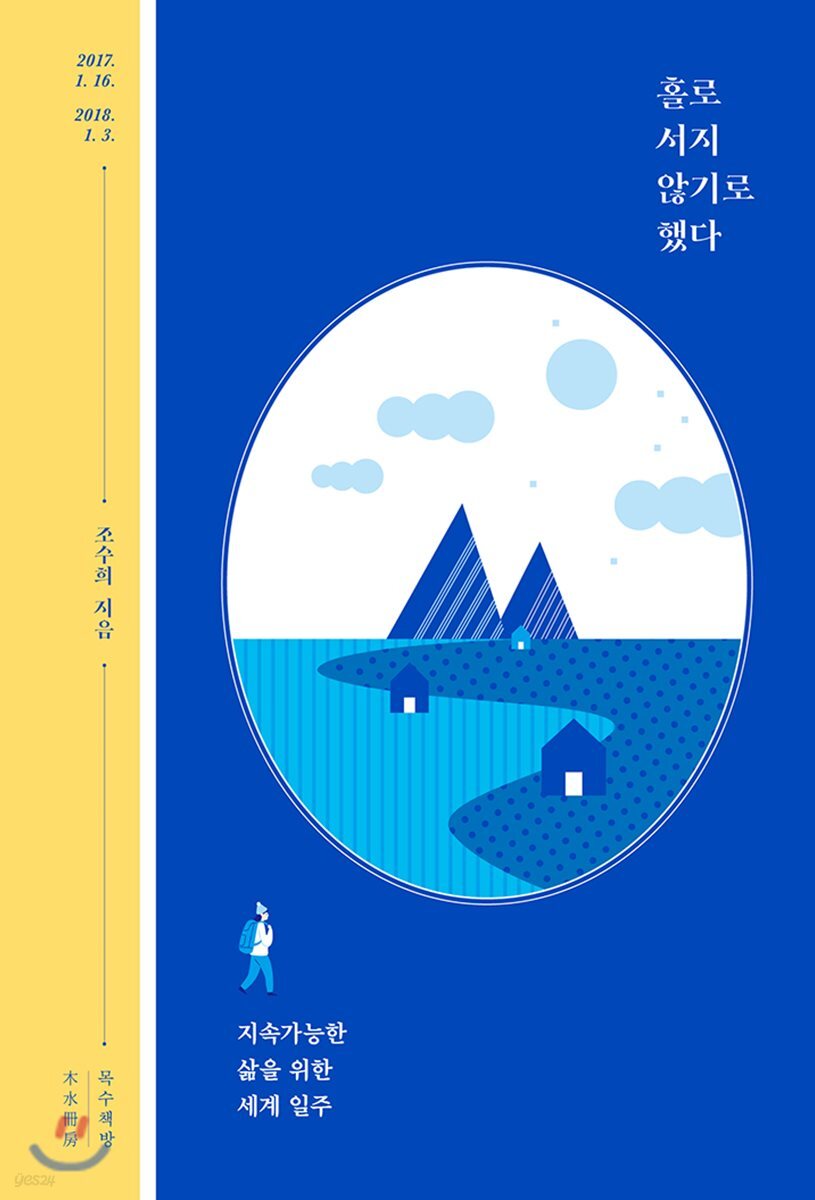
I decided not to stand alone
 |
Description
Book Introduction
This book contains the story of a young man who, tired of the 'eat-and-live' lifestyle, dreams of living 'differently' than before, leaves his daily life behind and embarks on a 357-day journey around the world.
The author's travel theme, "Sustainable Living," was to gain the conviction that life can be enriched even by choosing a "different life." Traveling around the world, he met diverse communities and people who pursue values other than money, gaining the courage and wisdom to live a "different life" and a "life of happiness together."
This book also provides practical information on new travel methods that young people can try, such as upping and workaways.
The author's travel theme, "Sustainable Living," was to gain the conviction that life can be enriched even by choosing a "different life." Traveling around the world, he met diverse communities and people who pursue values other than money, gaining the courage and wisdom to live a "different life" and a "life of happiness together."
This book also provides practical information on new travel methods that young people can try, such as upping and workaways.
- You can preview some of the book's contents.
Preview
index
prolog
A young CEO in Seoul dreams of a different life.
Chapter 1: Travel for Travel
“300,000 won a month is enough.” - Rohivinia, Finland
A Place Where Growing Old Isn't Fearful - The Konohana Family, Japan
Chapter 2 Australia + New Zealand
Eat Trash, Dumpster Diving - Melbourne, Australia
A country where 'different' diets are respected - Australia, a vegetarian paradise
Dreaming of a revolutionary shift toward sustainable living - New Zealand's Luminate Festival
Lessons Learned from a Community with Lack of Communication - Nelson Riverside Community, South Island, New Zealand
Chapter 3 South America
An Austrian Family Living on Kimchi in the Bolivian Mountains - Samaipata, Bolivia
A person who lives a decent life doing good deeds, fair trade traveler Han Young-jun - Poko Poko Village, Bolivia 1
A place that made me forget the loneliness of travel - Poco Poco Village, Bolivia 2
Why Vegetarians Had to Eat Chicken - Chile and Bolivia
More capitalist than a capitalist country - Havana, Cuba
Chapter 4: The United States
The community of my dreams that made me smile every day, even when I cried every day - Dancing Rabbit Eco Village 1 in Missouri, USA
A Life Without Effort, Become Infected by Their Leisure - Dancing Rabbit Eco Village 2, Missouri, USA
The place that helped me figure out what I wanted from my community - Eco Village in Los Angeles, USA
Challenge to a Zero Waste Life - San Francisco, USA
Katharine Kellogg, who left behind only one glass bottle's worth of trash in two years - Vallejo, near San Francisco, USA
It's Okay to Be a Freak! - San Francisco, USA
Smaller is freer, Tiny House - Portland, Oregon, USA
Food not bombs! - Los Angeles, San Francisco, Portland, USA
Other people are hell? In the end, what remains are people!
Chapter 5 Europe
Taking it slow, not being greedy, and caring for one another - Tenifron Community, Wales, UK
What's More Important Than Self-Sufficiency and Eco-Friendly Living - Old Chapel Farm, Wales, UK
A community that finds a balance between "us" and "me"—a village in Svanholm, Denmark.
A Perfect Day with Grandma Lerina and Homemade Pasta - Palomba Village, Italy
A life lesson discovered unexpectedly while searching for olive oil - Santa Maria Farm, Italy
Epilogue
What did I encounter at the end of my journey?
supplement
How to use Woof and Workaway?
How do I find the right eco-community for me?
A young CEO in Seoul dreams of a different life.
Chapter 1: Travel for Travel
“300,000 won a month is enough.” - Rohivinia, Finland
A Place Where Growing Old Isn't Fearful - The Konohana Family, Japan
Chapter 2 Australia + New Zealand
Eat Trash, Dumpster Diving - Melbourne, Australia
A country where 'different' diets are respected - Australia, a vegetarian paradise
Dreaming of a revolutionary shift toward sustainable living - New Zealand's Luminate Festival
Lessons Learned from a Community with Lack of Communication - Nelson Riverside Community, South Island, New Zealand
Chapter 3 South America
An Austrian Family Living on Kimchi in the Bolivian Mountains - Samaipata, Bolivia
A person who lives a decent life doing good deeds, fair trade traveler Han Young-jun - Poko Poko Village, Bolivia 1
A place that made me forget the loneliness of travel - Poco Poco Village, Bolivia 2
Why Vegetarians Had to Eat Chicken - Chile and Bolivia
More capitalist than a capitalist country - Havana, Cuba
Chapter 4: The United States
The community of my dreams that made me smile every day, even when I cried every day - Dancing Rabbit Eco Village 1 in Missouri, USA
A Life Without Effort, Become Infected by Their Leisure - Dancing Rabbit Eco Village 2, Missouri, USA
The place that helped me figure out what I wanted from my community - Eco Village in Los Angeles, USA
Challenge to a Zero Waste Life - San Francisco, USA
Katharine Kellogg, who left behind only one glass bottle's worth of trash in two years - Vallejo, near San Francisco, USA
It's Okay to Be a Freak! - San Francisco, USA
Smaller is freer, Tiny House - Portland, Oregon, USA
Food not bombs! - Los Angeles, San Francisco, Portland, USA
Other people are hell? In the end, what remains are people!
Chapter 5 Europe
Taking it slow, not being greedy, and caring for one another - Tenifron Community, Wales, UK
What's More Important Than Self-Sufficiency and Eco-Friendly Living - Old Chapel Farm, Wales, UK
A community that finds a balance between "us" and "me"—a village in Svanholm, Denmark.
A Perfect Day with Grandma Lerina and Homemade Pasta - Palomba Village, Italy
A life lesson discovered unexpectedly while searching for olive oil - Santa Maria Farm, Italy
Epilogue
What did I encounter at the end of my journey?
supplement
How to use Woof and Workaway?
How do I find the right eco-community for me?
Into the book
I believe that I am not the only one living a miserable life because of 'eat-and-live-ism'.
Most people actually live their lives thinking that they need to work long hours, earn a lot, and own a lot to be happy.
I hope this book can stimulate new imagination in those who are tired of that kind of life, so that they can dream of a different life.
Just as I mustered the courage to listen to my inner voice and embark on a journey to explore sustainable and alternative ways of living, I hope that those who read this book will also attempt to journey with their own individuality and intention.
I hope this book will give courage to those who dream of their own journey and their own life.
Dumpster diving wasn't a social movement that required stern shoulders and a serious face, nor was it a desperate measure backpackers resorted to to save money.
Dumpster diving was a game that took for granted the starving and the economic structure that prioritized corporate profits above all else, and made the world a better place.
Rather than learning how to operate solar panels or eat vegetarian food while living in a community, I want to learn how to live comfortably without working too much, and how to live as one with my neighbors and care for one another.
I want to witness the people next to me, whether they are visitors for a week or people who have declared that they will live in the village for life, living together while checking on each other to see if they are hungry or sick.
I want to draw my future in that image.
People living in tiny houses question the universal truth of capitalism that 'home is the foundation of wealth'.
Rather than relying on banks and construction capital for his life, he took up a hammer and nails in his hands and set out on an adventure to become the true master of his own life.
The people living in the tiny house took on the challenge even though they didn't know the first thing about architecture, and they didn't hesitate even though they knew that they would have to move around because of the lack of related laws.
I didn't think of my home as an asset, but rather as a cozy space where I could rest my body.
They chose to think a little differently and live in a tiny house, which allowed them to enjoy the stability of owning their own home and the freedom of a debt-free life while living in a capitalist society.
“Food Not Night helps the homeless because they are human.
Not only the homeless, but also citizens help each other.
I'm not forcing you to believe anything.
We're not just sharing free food.
“We want to make people aware of how much food American society wastes and expose the injustice in American society.”
As the trip got longer, the old me repeating Sartre's words, "Hell is other people," gradually faded away.
When I was crushed by depression, when loneliness tormented me and the breathtaking scenery before my eyes seemed as indifferent as a boulder on the roadside, when I was unsure whether I was on the right path, it was the kind words of encouragement from people and the warm meals I shared with them that sustained me.
The key to community life is trusting one another and finding a balance between community life and personal life.
The secret to maintaining community life is not individual sacrifice, but rather an atmosphere must be created in which each person receives in return for his or her contribution to the community.
To achieve harmony with others, it is also important to reduce my own greed and make space for others to enter my life.
This is why Svanholm has been able to last for 40 years.
Most people actually live their lives thinking that they need to work long hours, earn a lot, and own a lot to be happy.
I hope this book can stimulate new imagination in those who are tired of that kind of life, so that they can dream of a different life.
Just as I mustered the courage to listen to my inner voice and embark on a journey to explore sustainable and alternative ways of living, I hope that those who read this book will also attempt to journey with their own individuality and intention.
I hope this book will give courage to those who dream of their own journey and their own life.
Dumpster diving wasn't a social movement that required stern shoulders and a serious face, nor was it a desperate measure backpackers resorted to to save money.
Dumpster diving was a game that took for granted the starving and the economic structure that prioritized corporate profits above all else, and made the world a better place.
Rather than learning how to operate solar panels or eat vegetarian food while living in a community, I want to learn how to live comfortably without working too much, and how to live as one with my neighbors and care for one another.
I want to witness the people next to me, whether they are visitors for a week or people who have declared that they will live in the village for life, living together while checking on each other to see if they are hungry or sick.
I want to draw my future in that image.
People living in tiny houses question the universal truth of capitalism that 'home is the foundation of wealth'.
Rather than relying on banks and construction capital for his life, he took up a hammer and nails in his hands and set out on an adventure to become the true master of his own life.
The people living in the tiny house took on the challenge even though they didn't know the first thing about architecture, and they didn't hesitate even though they knew that they would have to move around because of the lack of related laws.
I didn't think of my home as an asset, but rather as a cozy space where I could rest my body.
They chose to think a little differently and live in a tiny house, which allowed them to enjoy the stability of owning their own home and the freedom of a debt-free life while living in a capitalist society.
“Food Not Night helps the homeless because they are human.
Not only the homeless, but also citizens help each other.
I'm not forcing you to believe anything.
We're not just sharing free food.
“We want to make people aware of how much food American society wastes and expose the injustice in American society.”
As the trip got longer, the old me repeating Sartre's words, "Hell is other people," gradually faded away.
When I was crushed by depression, when loneliness tormented me and the breathtaking scenery before my eyes seemed as indifferent as a boulder on the roadside, when I was unsure whether I was on the right path, it was the kind words of encouragement from people and the warm meals I shared with them that sustained me.
The key to community life is trusting one another and finding a balance between community life and personal life.
The secret to maintaining community life is not individual sacrifice, but rather an atmosphere must be created in which each person receives in return for his or her contribution to the community.
To achieve harmony with others, it is also important to reduce my own greed and make space for others to enter my life.
This is why Svanholm has been able to last for 40 years.
--- From the text
Publisher's Review
Here is a young CEO who chose to start a business instead of getting a job and has been running forward without looking back for several years.
One day, he suddenly finds himself tired of the 'eat and live' mentality of only chasing the money in front of him.
And I dream of a fundamentally ‘different life’ from the one I have now, rather than a life where I am always anxious and nervous, as if I am being chased by something.
In fact, everyone dreams of a better life than they have now.
A life where you are not burdened by the problem of making a living and are only concerned with solving the problems right in front of you, but rather a life where you can look around and take care of those around you.
But when I think about how to actually make that wish a reality, I feel lost.
The method the author chose to find the answer to this question was a 'different' journey.
A trip that allows you to step away from your current life and look at your life from a different perspective.
A journey that inspires and encourages you by meeting people who live their lives in various ways believing that there are values more important than money.
The author set his travel theme as 'sustainable living' and, rather than visiting famous tourist destinations, he sought out communities and special people who would become guides in life.
The author planned a trip to learn how to live 'differently', read books on 'sustainable living', and gathered information scattered across various channels.
Before embarking on a full-fledged trip, I flew to Rohivinia, Finland, to meet anarchists who reject the capitalist system, and visited the Konohana Family in Japan to imagine growing old in a warm community.
With the saying, “If you don’t live the way you think, you’ll end up thinking the way you live,” in mind, I checked what I was currently eating and consuming, and also organized specific ways to put it into practice in my daily life.
From Australia to Italy and France, the author traveled solo for 357 days around the world, meeting courageous and engaging people who are making diverse efforts to create diverse communities and alternative lifestyles.
People who 'rescue' perfectly good trash thrown away in supermarket trash cans every day, people who cook with discarded food and share it with the homeless to expose the injustice of American society, Korean fair trade travelers who find what they want while staying true to their desires and living a worthwhile life, people in an eco-community who warmly welcomed travelers from faraway countries they had never met, a person who left behind only one glass bottle's worth of trash in two years, people who found new freedom in 'tiny houses' instead of risking their lives on a housing loan, a grandmother who let me truly experience the charm of local food and slow food.
Many people the author met encouraged and inspired him to envision the life he wanted to live in a concrete way.
Of course, travel wasn't always filled with 'good' times.
There were times when vegetarians were forced to eat chicken, times when I was hurt by a community lacking communication, and times when my original travel goals wavered and I shuddered with loneliness.
But all these travel experiences provided the nutrients I needed to “slowly, step by step, reach the life I want.”
Above all, it made me realize that I can only be happy when I am 'together' and not 'alone', wherever I am.
This book contains a wealth of practical information for those who dream of not only a "different life" but also their own "different journey."
There's a lot of useful information, especially for those interested in WWOOFing or workaways, which allow you to help with farm work or group work, find lodging, learn about the country's culture, and travel.
Travel tips about the cities and communities the author visited are also included at the end of the text, which will be helpful to adventurous travelers.
One day, he suddenly finds himself tired of the 'eat and live' mentality of only chasing the money in front of him.
And I dream of a fundamentally ‘different life’ from the one I have now, rather than a life where I am always anxious and nervous, as if I am being chased by something.
In fact, everyone dreams of a better life than they have now.
A life where you are not burdened by the problem of making a living and are only concerned with solving the problems right in front of you, but rather a life where you can look around and take care of those around you.
But when I think about how to actually make that wish a reality, I feel lost.
The method the author chose to find the answer to this question was a 'different' journey.
A trip that allows you to step away from your current life and look at your life from a different perspective.
A journey that inspires and encourages you by meeting people who live their lives in various ways believing that there are values more important than money.
The author set his travel theme as 'sustainable living' and, rather than visiting famous tourist destinations, he sought out communities and special people who would become guides in life.
The author planned a trip to learn how to live 'differently', read books on 'sustainable living', and gathered information scattered across various channels.
Before embarking on a full-fledged trip, I flew to Rohivinia, Finland, to meet anarchists who reject the capitalist system, and visited the Konohana Family in Japan to imagine growing old in a warm community.
With the saying, “If you don’t live the way you think, you’ll end up thinking the way you live,” in mind, I checked what I was currently eating and consuming, and also organized specific ways to put it into practice in my daily life.
From Australia to Italy and France, the author traveled solo for 357 days around the world, meeting courageous and engaging people who are making diverse efforts to create diverse communities and alternative lifestyles.
People who 'rescue' perfectly good trash thrown away in supermarket trash cans every day, people who cook with discarded food and share it with the homeless to expose the injustice of American society, Korean fair trade travelers who find what they want while staying true to their desires and living a worthwhile life, people in an eco-community who warmly welcomed travelers from faraway countries they had never met, a person who left behind only one glass bottle's worth of trash in two years, people who found new freedom in 'tiny houses' instead of risking their lives on a housing loan, a grandmother who let me truly experience the charm of local food and slow food.
Many people the author met encouraged and inspired him to envision the life he wanted to live in a concrete way.
Of course, travel wasn't always filled with 'good' times.
There were times when vegetarians were forced to eat chicken, times when I was hurt by a community lacking communication, and times when my original travel goals wavered and I shuddered with loneliness.
But all these travel experiences provided the nutrients I needed to “slowly, step by step, reach the life I want.”
Above all, it made me realize that I can only be happy when I am 'together' and not 'alone', wherever I am.
This book contains a wealth of practical information for those who dream of not only a "different life" but also their own "different journey."
There's a lot of useful information, especially for those interested in WWOOFing or workaways, which allow you to help with farm work or group work, find lodging, learn about the country's culture, and travel.
Travel tips about the cities and communities the author visited are also included at the end of the text, which will be helpful to adventurous travelers.
GOODS SPECIFICS
- Date of issue: March 15, 2019
- Page count, weight, size: 264 pages | 276g | 127*187*20mm
- ISBN13: 9791188806065
- ISBN10: 1188806068
You may also like
카테고리
korean


korean

![GQ KOREA Mark (Monthly): December [2025]](http://librairie.coreenne.fr/cdn/shop/files/8ef265dbbfbf186523ed75ba7319009d.jpg?v=1765340328&width=3840)


