

busan
 |
Description
Book Introduction
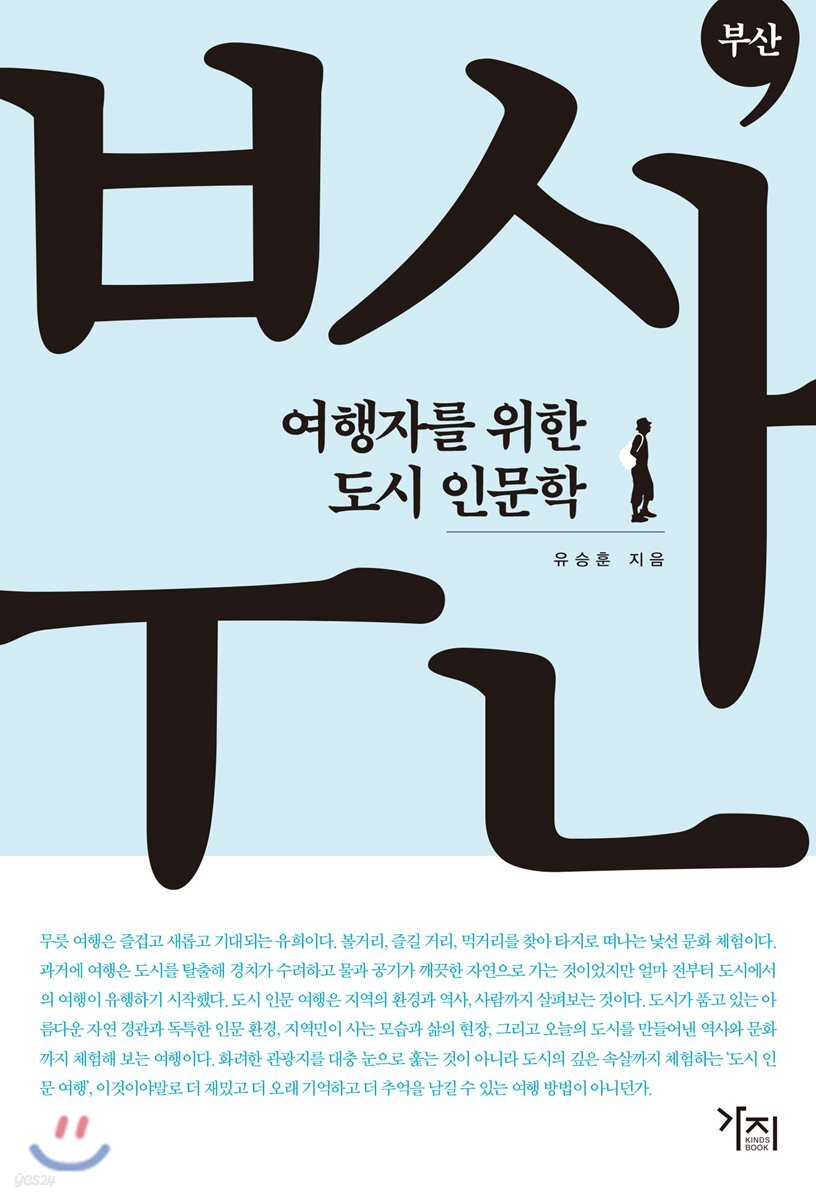
For those of you who want to delve a little deeper into Busan.
We tell the story of Busan's landscapes, flavors, people, and spaces that draw us in.
This is the first book in the 'Urban Humanities for Travelers' series, also known as 'Yedoin', published by Gaji Publishing.
Author Seung-Hoon Yoo, who introduced Busan's history and culture in detail through his previous work, "Busan is Wide," has compiled 55 storytelling pieces of background knowledge that he hopes travelers with a strong humanistic curiosity will read before coming to Busan.
As Korea's representative maritime gateway, Busan was the first to absorb, integrate, and develop foreign cultures, from the Joseon Dynasty through the Japanese colonial period and the Korean War after liberation. The book continuously presents the history of Busan, and it reveals the influence it has had on the scenery and flavors of Busan that we love, the spaces and objects we pass by in passing, and the lives of the people of Busan, who are often considered rough and blunt.
This book, "Busan: Urban Humanities for Travelers," will make you look at the familiar Haeundae scenery from a different perspective.
We tell the story of Busan's landscapes, flavors, people, and spaces that draw us in.
This is the first book in the 'Urban Humanities for Travelers' series, also known as 'Yedoin', published by Gaji Publishing.
Author Seung-Hoon Yoo, who introduced Busan's history and culture in detail through his previous work, "Busan is Wide," has compiled 55 storytelling pieces of background knowledge that he hopes travelers with a strong humanistic curiosity will read before coming to Busan.
As Korea's representative maritime gateway, Busan was the first to absorb, integrate, and develop foreign cultures, from the Joseon Dynasty through the Japanese colonial period and the Korean War after liberation. The book continuously presents the history of Busan, and it reveals the influence it has had on the scenery and flavors of Busan that we love, the spaces and objects we pass by in passing, and the lives of the people of Busan, who are often considered rough and blunt.
This book, "Busan: Urban Humanities for Travelers," will make you look at the familiar Haeundae scenery from a different perspective.
- You can preview some of the book's contents.
Preview
index
introduction
Busan Humanities Map
Part 1: Scenes that make Busan most Busan-like
16 Busan's '3 Major' Seaside Spots
23 Famous Mountains in the City with Great Views
31 The bare face of the Nakdong River
A mountain pass with 40 stories
45 Busan's Treasure Island, Yeongdo
50 Walking along the Galmatgil with Seagulls
Part 2: Delicious Busan, Cool Busan
From 60 noodles to wheat noodles, Busan's noodle road
72 Busan fish cakes that warm your heart
74 The origin of stir-fried octopus with vegetables
77 Sanseong Makgeolli, loved by Busan Choppae
80 Fish from Busan: Anchovies and Mackerel
85 There is also a Wang Seobang in Busan
87 Gwangalli Night View, a Luxury
90 Busan's two major beaches, Songdo and Haeundae
The Busan International Film Festival, which established Busan as a "film city" in 1995,
98 The Birth of Busan, the Wild City
101 The East Coast Byeolsingut is a festival
Part 3: Walking through Dongrae, Joseon's Busan
106 Dongrae Budongheon, the heart of Busan during the Joseon Dynasty
109 In search of traces of the Imjin War
114 Dongrae Market, the oldest in Busan
118 National Bathhouse, Dongrae Hot Springs
121 Suyeong, a former naval base in Gyeongsang Province
124 Yeonggadae and Joseon Tongsinsa
127 Gupo, a transportation node on the Nakdong River
134 People and Literature Who Came Down to Gijang in Exile
137 Dongrae Tug-of-War, a Symbol of Unity and Harmony
Part 4: The History of Modern Cities: From Ports to Cities
142 From Mt. Fuji to Busan, where on earth is Busan?
144 Climb up Yongdusan Park and see the city center.
147 The now-disappeared Japanese village
150 Anti-Japanese Resistance and Independence Activists in Busan
153 Do you know Busan Pier 1?
155 Modern architecture is a storehouse of memories.
158 Opening Your Eyes to Modern Weather
161 Again, [Return to Busan Port]
165 Busan's shoe industry, remembered through rubber shoes
Part 5: Visiting Busan's No. 1 Refuge
170 Provisional Capital Government Building and Provisional Capital Memorial Hall
173 Can the Busan tram run again?
175 The Mildawon Teahouse that gave birth to 'refugee literature'
178 Busan's innermost heart, the mountain villages and mountainside roads
185 International Market and Fire Monument
188 Bupyeong Market = Can Market
199 The Last Used Bookstore, Bosudong Bookstore Street
201 Changing Jagalchi Market
Let's meet at Yeongdo Bridge 204
207 UN Memorial Park, a place to learn about the value of peace
Part 6: Busan People, Busan Spirit
212 The world is alive and kicking!
215 Busan sailors who sailed across the distant seas
217 Jagalchi Ajumma and Kangkang Ajumma
222 Busan's spiritual leader, Mr. Kim Jeong-han
224 Modern Capitalist Yun Sang-eun and the Gupo Bank
Police Officer Park Eul-ryong, who sacrificed himself to save 248 people.
229 Symbol of Democracy: The Buma Uprising and Democracy Park
231 Presidents with the Tenacity Raised in Busan
236 Busan Citizens Park Blue Manjangsa (History)
239 Busan people are 'stuck'
Appendix_Recommended Course for a Walking Tour of Busan's Humanities
244 #1 Joseon's Busan is Dongrae
247 #2 In search of Busanpo, the origin of Busan
249 #3 From Port Opening to Colonization, Meet Busan's Modernity
252 #4 Walking through Busan, the refugee capital
255 #5 Choryang-dong Mountainside Road Excursion
257 Search_Reading Busan by Keyword
Busan Humanities Map
Part 1: Scenes that make Busan most Busan-like
16 Busan's '3 Major' Seaside Spots
23 Famous Mountains in the City with Great Views
31 The bare face of the Nakdong River
A mountain pass with 40 stories
45 Busan's Treasure Island, Yeongdo
50 Walking along the Galmatgil with Seagulls
Part 2: Delicious Busan, Cool Busan
From 60 noodles to wheat noodles, Busan's noodle road
72 Busan fish cakes that warm your heart
74 The origin of stir-fried octopus with vegetables
77 Sanseong Makgeolli, loved by Busan Choppae
80 Fish from Busan: Anchovies and Mackerel
85 There is also a Wang Seobang in Busan
87 Gwangalli Night View, a Luxury
90 Busan's two major beaches, Songdo and Haeundae
The Busan International Film Festival, which established Busan as a "film city" in 1995,
98 The Birth of Busan, the Wild City
101 The East Coast Byeolsingut is a festival
Part 3: Walking through Dongrae, Joseon's Busan
106 Dongrae Budongheon, the heart of Busan during the Joseon Dynasty
109 In search of traces of the Imjin War
114 Dongrae Market, the oldest in Busan
118 National Bathhouse, Dongrae Hot Springs
121 Suyeong, a former naval base in Gyeongsang Province
124 Yeonggadae and Joseon Tongsinsa
127 Gupo, a transportation node on the Nakdong River
134 People and Literature Who Came Down to Gijang in Exile
137 Dongrae Tug-of-War, a Symbol of Unity and Harmony
Part 4: The History of Modern Cities: From Ports to Cities
142 From Mt. Fuji to Busan, where on earth is Busan?
144 Climb up Yongdusan Park and see the city center.
147 The now-disappeared Japanese village
150 Anti-Japanese Resistance and Independence Activists in Busan
153 Do you know Busan Pier 1?
155 Modern architecture is a storehouse of memories.
158 Opening Your Eyes to Modern Weather
161 Again, [Return to Busan Port]
165 Busan's shoe industry, remembered through rubber shoes
Part 5: Visiting Busan's No. 1 Refuge
170 Provisional Capital Government Building and Provisional Capital Memorial Hall
173 Can the Busan tram run again?
175 The Mildawon Teahouse that gave birth to 'refugee literature'
178 Busan's innermost heart, the mountain villages and mountainside roads
185 International Market and Fire Monument
188 Bupyeong Market = Can Market
199 The Last Used Bookstore, Bosudong Bookstore Street
201 Changing Jagalchi Market
Let's meet at Yeongdo Bridge 204
207 UN Memorial Park, a place to learn about the value of peace
Part 6: Busan People, Busan Spirit
212 The world is alive and kicking!
215 Busan sailors who sailed across the distant seas
217 Jagalchi Ajumma and Kangkang Ajumma
222 Busan's spiritual leader, Mr. Kim Jeong-han
224 Modern Capitalist Yun Sang-eun and the Gupo Bank
Police Officer Park Eul-ryong, who sacrificed himself to save 248 people.
229 Symbol of Democracy: The Buma Uprising and Democracy Park
231 Presidents with the Tenacity Raised in Busan
236 Busan Citizens Park Blue Manjangsa (History)
239 Busan people are 'stuck'
Appendix_Recommended Course for a Walking Tour of Busan's Humanities
244 #1 Joseon's Busan is Dongrae
247 #2 In search of Busanpo, the origin of Busan
249 #3 From Port Opening to Colonization, Meet Busan's Modernity
252 #4 Walking through Busan, the refugee capital
255 #5 Choryang-dong Mountainside Road Excursion
257 Search_Reading Busan by Keyword
Detailed image

Into the book
Haeundae is not only a tourist attraction, but also a place that makes you reflect on the humanistic meaning of travel.
Next to the embankment of Dongbaekseom Lighthouse Square, there are traces of the visit of Choi Chi-won, a great scholar from the Silla Dynasty.
This is a stone carving (Busan City Monument No. 45) with the three characters ‘Haeundae’ engraved on a rough gray rock.
In fact, this place can be said to be the birthplace of Haeundae.
--- p.18
There are times when people from Seoul tilt their heads when they come to Busan.
I had imagined Busan to be a place with a blue ocean, but when I actually arrived, it was full of mountains and hills.
Busan, a city with many mountains, naturally has many tunnels.
Sujeong Tunnel, Baekyang Tunnel, Gudeok Tunnel, Yeongju Tunnel, Busan Tunnel, Mandeok Tunnel, etc.
In the past, there were many cases where tourists who were not familiar with Busan drove into the tunnel toll booth without coins and were confused.
Things have improved significantly since Hi-Pass was introduced.
--- p.40
The time when the grand noodle road connecting the South and the North was laid was during the Korean War.
The refugees who survived the near-death experience of the Hungnam evacuation and came to Busan did not only bring with them the despair of being separated from their families and the loss of their hometown.
I have not forgotten the taste of my hometown and have brought it to my tongue.
It's naengmyeon.
The refugees opened a cold noodle restaurant in the international market to relieve their endless longing.
A cold noodle restaurant in Uam-dong has launched soft wheat noodles for Busan residents who are confused by chewy noodles.
The noodles from the Korean War were made by mixing flour provided by the United States as relief food with starch, so they reached out to the world beyond the two Koreas.
--- p.70
A film director once described Busan as a "giant movie set."
He said that Busan's greatest charm is that new and old things coexist in one city.
In simple terms, it means that there is the glamorous Haeundae and the Busan Cinema Center, but there is also a simple and familiar mountain village.
This can be interpreted to mean that Busan can be sustainable as a film city only when the past and present coexist harmoniously, as they do now.
--- p.97
During the Joseon Dynasty, Busan was merely a township belonging to Dongrae-bu.
But after the opening of the port, the status was reversed.
The Japanese began to establish administrative agencies and modern facilities around the Port of Busan.
After the forced annexation of Korea by Japan, Busan was created, and the Japanese developed Busan according to their own intentions.
Thus, the jurisdiction of Dongrae-bu gradually changed to Busan-bu, and eventually Dongrae-do was incorporated into Busan.
The colonial history is evident in the transformation of ‘Joseon’s Dongrae’ into ‘modern Busan.’
--- p.106
Jangtaryeong is a part of the Gakseol-i Taryeong that begins with 'Eolssigu-na is good, Pumba-na is good too.'
The names of Busan's famous traditional markets all appear in this song.
It is no exaggeration to say that the characteristics of Busan Oil Market are fully captured in the long songs sung by Gakseol-i.
'I can't see the bottom of the ring at the bottom of the wind/I can't find the road to Busan Market through the alleys/I can't come to the bowing Gupo Market because my back hurts/I can't see the Dongrae Market because my legs hurt over the hill.'
--- p.132
Considering its humanistic value, Yongdusan Park is a must-visit for cultural tourists visiting Busan.
…It is no exaggeration to say that modern Busan began at Yongdusan Park.
After the establishment of the Choryang Waegwan in this area during the Joseon Dynasty, it became a Japanese residential area during the port opening period, and then a colonial city during the Japanese colonial period.
During the Korean War, it served as the center of the provisional capital.
As we confronted the turbulent modern and contemporary history of Busan head-on, we developed a unique hybrid culture.
--- p.144
Two months after the outbreak of the Korean War, Busan became a refugee capital.
In addition to government agencies including the executive, legislative, and judicial branches, schools, businesses, and organizations have moved to Busan.
In addition, hundreds of thousands of refugees flocked to Busan, making it look like a flea market.
With the explosive population growth, a unique 'refugee culture' has developed in Busan, one of which is the prosperity of tea houses.
At that time, the wealthy said that two things were increasing every day in the refugee capital: one was shacks and the other was teahouses.
--- p.175
A mountain road is a road that connects the middle of a mountain.
It is difficult to get there by bus or car, let alone walking, as you have to go around the winding road and climb the steep mountain slope.
But if you go to the mountain road, you can clearly see the world that Busan has walked through.
It's one thing to see the densely populated residential area on the hillside, but looking down at the port facilities on the Busan sea from above, you get the feeling, "Ah, so this is how Busan has always been."
--- p.182
For a long time, Yeongdo Bridge has been a landmark symbolizing Busan.
When the Korean War broke out, separated families were suddenly separated and shouted, “Let’s meet at Yeongdo Bridge.”
In fact, refugees flocked to Yeongdo Bridge to meet their separated families.
Yeongdo Bridge also appears in the song [Be Strong, Geumsoon] sung by Hyun In, a famous singer from Gupo, Busan in 1953.
--- p.186
The Busan dialect is characterized by strong pronunciation, abbreviated speech, and a lively intonation.
A circle is called 'donggeulbaegi', a hook is called 'kalkuri', and something that is delicious is called 'kkoshida'.
You can say '~ is what they say' as '~ra ka ddeunde' or '~wa kano' as 'why are you doing that'.
While people in Seoul speak in a horizontal tone like a calm lake, people in Busan speak with a distinct rising and falling tone like waves.
When you listen to Gangsan's breathtaking song [Wa Grano], you can feel the characteristics of the Busan dialect.
--- p.213
Even for people in Busan, the Kkang-Kkang Ajumma is unfamiliar.
Recently, as a folklorist from Busan Maritime University focused on the Yeongdo Kangkang-i Village, the lives of the Kangkang-i ladies began to attract attention.
A woman who removes rust and seashells from ships is called Kang Kang-i.
They make a living by carrying heavy hammers and scraping off rust from old ships.
It was called kkang-kkang-i-jil because it made a 'kang-kkang' sound every time it hit the boat.
Next to the embankment of Dongbaekseom Lighthouse Square, there are traces of the visit of Choi Chi-won, a great scholar from the Silla Dynasty.
This is a stone carving (Busan City Monument No. 45) with the three characters ‘Haeundae’ engraved on a rough gray rock.
In fact, this place can be said to be the birthplace of Haeundae.
--- p.18
There are times when people from Seoul tilt their heads when they come to Busan.
I had imagined Busan to be a place with a blue ocean, but when I actually arrived, it was full of mountains and hills.
Busan, a city with many mountains, naturally has many tunnels.
Sujeong Tunnel, Baekyang Tunnel, Gudeok Tunnel, Yeongju Tunnel, Busan Tunnel, Mandeok Tunnel, etc.
In the past, there were many cases where tourists who were not familiar with Busan drove into the tunnel toll booth without coins and were confused.
Things have improved significantly since Hi-Pass was introduced.
--- p.40
The time when the grand noodle road connecting the South and the North was laid was during the Korean War.
The refugees who survived the near-death experience of the Hungnam evacuation and came to Busan did not only bring with them the despair of being separated from their families and the loss of their hometown.
I have not forgotten the taste of my hometown and have brought it to my tongue.
It's naengmyeon.
The refugees opened a cold noodle restaurant in the international market to relieve their endless longing.
A cold noodle restaurant in Uam-dong has launched soft wheat noodles for Busan residents who are confused by chewy noodles.
The noodles from the Korean War were made by mixing flour provided by the United States as relief food with starch, so they reached out to the world beyond the two Koreas.
--- p.70
A film director once described Busan as a "giant movie set."
He said that Busan's greatest charm is that new and old things coexist in one city.
In simple terms, it means that there is the glamorous Haeundae and the Busan Cinema Center, but there is also a simple and familiar mountain village.
This can be interpreted to mean that Busan can be sustainable as a film city only when the past and present coexist harmoniously, as they do now.
--- p.97
During the Joseon Dynasty, Busan was merely a township belonging to Dongrae-bu.
But after the opening of the port, the status was reversed.
The Japanese began to establish administrative agencies and modern facilities around the Port of Busan.
After the forced annexation of Korea by Japan, Busan was created, and the Japanese developed Busan according to their own intentions.
Thus, the jurisdiction of Dongrae-bu gradually changed to Busan-bu, and eventually Dongrae-do was incorporated into Busan.
The colonial history is evident in the transformation of ‘Joseon’s Dongrae’ into ‘modern Busan.’
--- p.106
Jangtaryeong is a part of the Gakseol-i Taryeong that begins with 'Eolssigu-na is good, Pumba-na is good too.'
The names of Busan's famous traditional markets all appear in this song.
It is no exaggeration to say that the characteristics of Busan Oil Market are fully captured in the long songs sung by Gakseol-i.
'I can't see the bottom of the ring at the bottom of the wind/I can't find the road to Busan Market through the alleys/I can't come to the bowing Gupo Market because my back hurts/I can't see the Dongrae Market because my legs hurt over the hill.'
--- p.132
Considering its humanistic value, Yongdusan Park is a must-visit for cultural tourists visiting Busan.
…It is no exaggeration to say that modern Busan began at Yongdusan Park.
After the establishment of the Choryang Waegwan in this area during the Joseon Dynasty, it became a Japanese residential area during the port opening period, and then a colonial city during the Japanese colonial period.
During the Korean War, it served as the center of the provisional capital.
As we confronted the turbulent modern and contemporary history of Busan head-on, we developed a unique hybrid culture.
--- p.144
Two months after the outbreak of the Korean War, Busan became a refugee capital.
In addition to government agencies including the executive, legislative, and judicial branches, schools, businesses, and organizations have moved to Busan.
In addition, hundreds of thousands of refugees flocked to Busan, making it look like a flea market.
With the explosive population growth, a unique 'refugee culture' has developed in Busan, one of which is the prosperity of tea houses.
At that time, the wealthy said that two things were increasing every day in the refugee capital: one was shacks and the other was teahouses.
--- p.175
A mountain road is a road that connects the middle of a mountain.
It is difficult to get there by bus or car, let alone walking, as you have to go around the winding road and climb the steep mountain slope.
But if you go to the mountain road, you can clearly see the world that Busan has walked through.
It's one thing to see the densely populated residential area on the hillside, but looking down at the port facilities on the Busan sea from above, you get the feeling, "Ah, so this is how Busan has always been."
--- p.182
For a long time, Yeongdo Bridge has been a landmark symbolizing Busan.
When the Korean War broke out, separated families were suddenly separated and shouted, “Let’s meet at Yeongdo Bridge.”
In fact, refugees flocked to Yeongdo Bridge to meet their separated families.
Yeongdo Bridge also appears in the song [Be Strong, Geumsoon] sung by Hyun In, a famous singer from Gupo, Busan in 1953.
--- p.186
The Busan dialect is characterized by strong pronunciation, abbreviated speech, and a lively intonation.
A circle is called 'donggeulbaegi', a hook is called 'kalkuri', and something that is delicious is called 'kkoshida'.
You can say '~ is what they say' as '~ra ka ddeunde' or '~wa kano' as 'why are you doing that'.
While people in Seoul speak in a horizontal tone like a calm lake, people in Busan speak with a distinct rising and falling tone like waves.
When you listen to Gangsan's breathtaking song [Wa Grano], you can feel the characteristics of the Busan dialect.
--- p.213
Even for people in Busan, the Kkang-Kkang Ajumma is unfamiliar.
Recently, as a folklorist from Busan Maritime University focused on the Yeongdo Kangkang-i Village, the lives of the Kangkang-i ladies began to attract attention.
A woman who removes rust and seashells from ships is called Kang Kang-i.
They make a living by carrying heavy hammers and scraping off rust from old ships.
It was called kkang-kkang-i-jil because it made a 'kang-kkang' sound every time it hit the boat.
--- p.219
Publisher's Review
Rediscover the local flavor that you'll love even more the more you know about it!
A book that makes you think about the history and culture of the people who live there, beyond the travel destination.
When you go to Busan, you usually can't miss Haeundae Beach.
For a taste of the city, I go on a food tour of the Kkangtong Market near Busan Station, and enjoy a sophisticated city life in Centum City, which is home to the Busan Cinema Center and large shopping malls.
Some people visit Gamcheon Culture Village on the top of a mountain to take pretty pictures, or even go all the way to Gijang County, the production area, to buy fresh anchovies.
As I learn more about Busan, the number of places I want to visit increases.
But is that really all there is to it? Every time you visit, you notice the ever-changing scenery and shops, but if the "Busan people" you meet are completely unfamiliar, is that truly a worthwhile trip? The [Urban Humanities for Travelers] series delves deeper into the narratives of space held by our beloved cities and the cultures they create as they intertwine with the lives of their people.
The author defines Busan as a 'seaside city like a cultural melting pot.'
As a representative maritime gateway, Busan has been the first to accept foreign cultures at every turning point in history, constantly creating new ones by fusing them with existing cultures. It is a city that has experienced more cultural change than any other region.
The book is divided into six parts.
Part 1 explores the natural and geographical landscapes that make Busan most Busan-like and tells the humanistic stories embedded within them. Part 2 reveals the history of the flavors and styles that represent Busan today.
Part 3 explores the Dongrae region, which can be called the "Busan of the Joseon Dynasty," and Part 4 traces the footsteps of a modern city that began as a port from the port opening period to the Japanese colonial period.
Among the spaces introduced in parts 3 and 4, many no longer exist.
This is because there are many cases where history prior to the opening of ports was erased by the Japanese colonial period, and history during the Japanese colonial period was rapidly erased by the post-war generation.
However, the author says, “In humanities travel, it is more important to examine the historical nature of the space itself rather than the space itself.
“Isn’t designating empty land as a cultural asset, such as a historic site or monument, also having the same meaning?” (p. 107) he says, reflecting on the meaning of humanistic travel.
In Part 5, the image of Busan, which served as a 'refuge city' during the Korean War, is depicted relatively vividly, as if it happened yesterday.
Busan's old mountain villages (Gamcheon Culture Village, Ami-dong Stele Village, Huinnyeoul Culture Village), which are now popular tourist destinations, as well as Sanbok Road, Gukje Market, Kkangtong Market, Jagalchi Market, Bosu-dong Book Street, Yeongdo Bridge, etc... The stories of past lives intertwined in these spaces, familiar to even the current generation, seem to unfold like a movie.
Also, in Part 6, there are episodes that help us understand the 'spirit of Busan' along with people from Busan that we should remember.
After skimming through the articles from Part 1 to Part 6, you will have the experience of reinterpreting the places in Busan you have visited before with new meaning and having them etched in your mind.
The author encourages readers to mark their favorite places after reading this book, plan their own "Busan Humanities Walking Tour," and then go back again.
Additionally, the author also introduced five courses recommended by him.
#1 Dongrae tour to feel the Busan of Joseon, #2 Busanpo tour to find the origin of Busan, #3 Meet modern Busan from the opening of the port to colonization, #4 Walking around Busan, the refugee capital, #5 A trip to Choryang-dong Sanbok Road, these are the five things.
I sincerely hope that this book will serve as an opportunity for many visitors to Busan to gain a deeper understanding of the city and to warmly embrace even unfamiliar Busan residents.
[Urban Humanities for Travelers] The next installment will be in Jeonju.
A book that makes you think about the history and culture of the people who live there, beyond the travel destination.
When you go to Busan, you usually can't miss Haeundae Beach.
For a taste of the city, I go on a food tour of the Kkangtong Market near Busan Station, and enjoy a sophisticated city life in Centum City, which is home to the Busan Cinema Center and large shopping malls.
Some people visit Gamcheon Culture Village on the top of a mountain to take pretty pictures, or even go all the way to Gijang County, the production area, to buy fresh anchovies.
As I learn more about Busan, the number of places I want to visit increases.
But is that really all there is to it? Every time you visit, you notice the ever-changing scenery and shops, but if the "Busan people" you meet are completely unfamiliar, is that truly a worthwhile trip? The [Urban Humanities for Travelers] series delves deeper into the narratives of space held by our beloved cities and the cultures they create as they intertwine with the lives of their people.
The author defines Busan as a 'seaside city like a cultural melting pot.'
As a representative maritime gateway, Busan has been the first to accept foreign cultures at every turning point in history, constantly creating new ones by fusing them with existing cultures. It is a city that has experienced more cultural change than any other region.
The book is divided into six parts.
Part 1 explores the natural and geographical landscapes that make Busan most Busan-like and tells the humanistic stories embedded within them. Part 2 reveals the history of the flavors and styles that represent Busan today.
Part 3 explores the Dongrae region, which can be called the "Busan of the Joseon Dynasty," and Part 4 traces the footsteps of a modern city that began as a port from the port opening period to the Japanese colonial period.
Among the spaces introduced in parts 3 and 4, many no longer exist.
This is because there are many cases where history prior to the opening of ports was erased by the Japanese colonial period, and history during the Japanese colonial period was rapidly erased by the post-war generation.
However, the author says, “In humanities travel, it is more important to examine the historical nature of the space itself rather than the space itself.
“Isn’t designating empty land as a cultural asset, such as a historic site or monument, also having the same meaning?” (p. 107) he says, reflecting on the meaning of humanistic travel.
In Part 5, the image of Busan, which served as a 'refuge city' during the Korean War, is depicted relatively vividly, as if it happened yesterday.
Busan's old mountain villages (Gamcheon Culture Village, Ami-dong Stele Village, Huinnyeoul Culture Village), which are now popular tourist destinations, as well as Sanbok Road, Gukje Market, Kkangtong Market, Jagalchi Market, Bosu-dong Book Street, Yeongdo Bridge, etc... The stories of past lives intertwined in these spaces, familiar to even the current generation, seem to unfold like a movie.
Also, in Part 6, there are episodes that help us understand the 'spirit of Busan' along with people from Busan that we should remember.
After skimming through the articles from Part 1 to Part 6, you will have the experience of reinterpreting the places in Busan you have visited before with new meaning and having them etched in your mind.
The author encourages readers to mark their favorite places after reading this book, plan their own "Busan Humanities Walking Tour," and then go back again.
Additionally, the author also introduced five courses recommended by him.
#1 Dongrae tour to feel the Busan of Joseon, #2 Busanpo tour to find the origin of Busan, #3 Meet modern Busan from the opening of the port to colonization, #4 Walking around Busan, the refugee capital, #5 A trip to Choryang-dong Sanbok Road, these are the five things.
I sincerely hope that this book will serve as an opportunity for many visitors to Busan to gain a deeper understanding of the city and to warmly embrace even unfamiliar Busan residents.
[Urban Humanities for Travelers] The next installment will be in Jeonju.
GOODS SPECIFICS
- Date of publication: September 25, 2017
- Page count, weight, size: 264 pages | 290g | 128*188*17mm
- ISBN13: 9791186440186
- ISBN10: 118644018X
You may also like
카테고리
korean


korean

![GQ KOREA Mark (Monthly): December [2025]](http://librairie.coreenne.fr/cdn/shop/files/8ef265dbbfbf186523ed75ba7319009d.jpg?v=1765340328&width=3840)


