

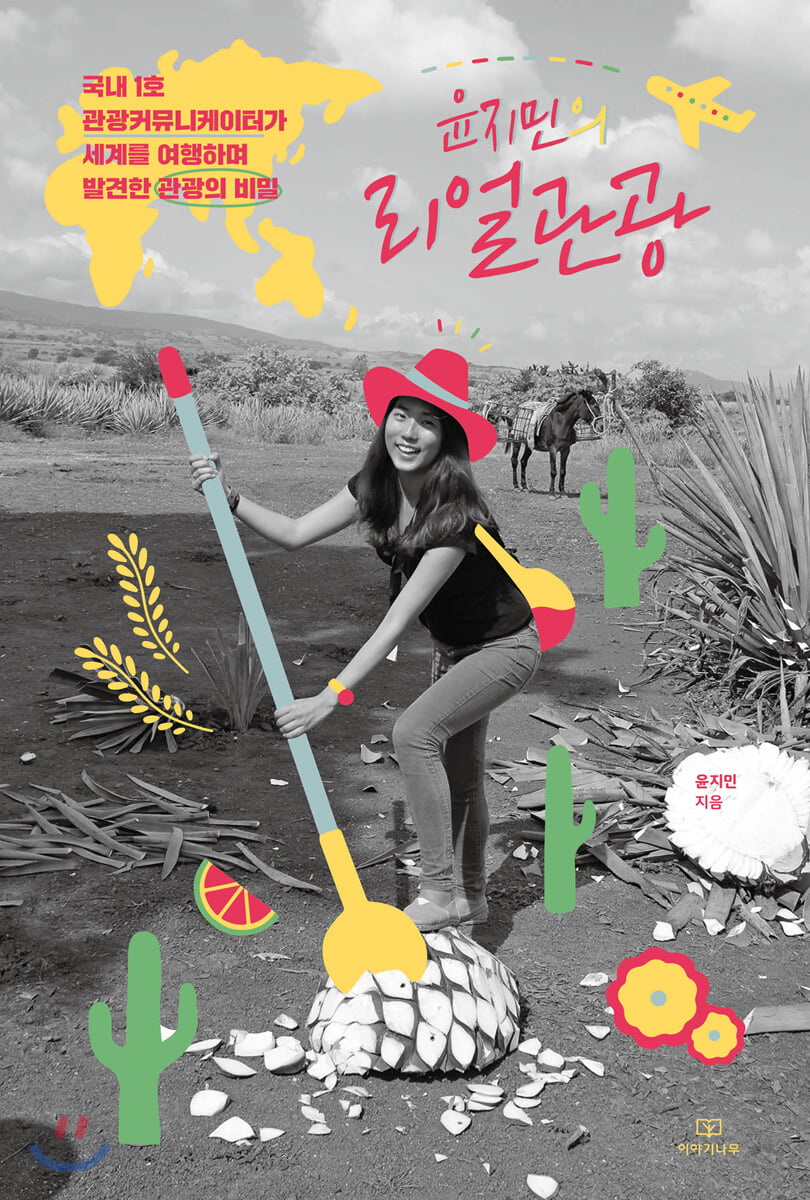
Yoon Ji-min's Real Tourism
 |
Description
Book Introduction
A book by Director Yoon Ji-min of the Real Tourism Research Institute.
This book divides the reasons why tourists visit tourist destinations into eight themes: nature/activities, festivals/events, entertainment/theme parks, architecture/design, community/history, nightlife, and city image, and contains various aspects of tourism sites.
Through this, we can learn about the position of tourism in each country's national economy, government support and attitude, and people's perception of tourism.
We also met with practitioners working at tourism offices in 16 cities and interviewed them about the reasons why people visit their cities, how the tourism offices are organized, how their budgets are secured, how they operate, how they prepare for the safety of tourists, and what they focus on when conducting promotional marketing.
Through their stories, you will learn how beloved tourist destinations are created and operated, as well as the perspective of those who run them.
This book divides the reasons why tourists visit tourist destinations into eight themes: nature/activities, festivals/events, entertainment/theme parks, architecture/design, community/history, nightlife, and city image, and contains various aspects of tourism sites.
Through this, we can learn about the position of tourism in each country's national economy, government support and attitude, and people's perception of tourism.
We also met with practitioners working at tourism offices in 16 cities and interviewed them about the reasons why people visit their cities, how the tourism offices are organized, how their budgets are secured, how they operate, how they prepare for the safety of tourists, and what they focus on when conducting promotional marketing.
Through their stories, you will learn how beloved tourist destinations are created and operated, as well as the perspective of those who run them.
- You can preview some of the book's contents.
Preview
index
Prologue
01.
Beginning of Travel
Travel the world to learn about real tourism
Making tourism your life's work
The worries begin
Travel the world to learn about real tourism
02.
Nature / Activities
Harness the beauty of rawness
Uluru Interview - Finding the Answer to Group Tourism at the Center of the World
Interlaken Interview - Enjoying the Alpine Scenery Along the Way
Tulum - An underwater world unlike any other in the world
Semuk Champei - Standing on the Edge of Danger and Thrill
Pokhara, Kathmandu - People recovering from the scars of the earthquake.
03.
Festivals / Events
It doesn't come every day
Munich - The Beer Festival That Captivated the World
Guadalajara Interview - Meet the Tourism Experts in One Place
Sydney - A Winter Festival in the Midst of Summer
Valle de Bravo - All-night party time for all the neighborhood people
04.
Entertainment / Theme Park
Creating a playground where children can play to their heart's content
LAInterview - Tourists Attracted by the Imagination of Content
Las Vegas Interview - Beyond the City of Pleasure, a City Where People Want to Live
Singapore Interview - Overcoming the Limitations of a City-State with Theme Parks
Cancun - Create a paradise with an unlimited ticket
North Island Interview - A Journey Through Film
05.
Design / Architecture
Paving the city
Melbourne - Attracting Tourists with Urban Design
Barcelona - Harnessing Genius to Create a City Image
London Interview - Selling a City Icon
Kuala Lumpur, Putrajaya Interview - Sejong City's Model City
Antigua - an exquisite ensemble of conservation and development
Kyoto - Harnessing the Memory of Space
06.
Community / Heritage
Conservation for all
Tequila Interview - People Living with Tequila
Bali, Ubud - There's still a royal palace in our neighborhood.
Siem Reap - World Heritage, Everyone's Heritage, Angkor Wat
Porto Interview - Living Like a Local
Koblenz, Bonn - World Heritage and Tourism Stories
07.
Nightlife
Harnessing Hidden Desires
Bangkok - Eat, Drink, and Play
Madrid Interview - The night starts at 2 a.m. here.
Havana - Bare faces revealed amidst the glamour every night
New York Interview - How to Enjoy the Big City
08.
City Image
Various ways to create a city image
Washington DC
- Administrative capital tourism leading positive nationalism
Boston - A Tourist Attraction for the University
Philadelphia - A Historical Tour Following the Flow of History
Paris Interview - Why is Paris so romantic?
Toronto Interview - The Soft Side of the Great City
Basel Interview: An Industrial City Transformed into an Art City
Epilogue
01.
Beginning of Travel
Travel the world to learn about real tourism
Making tourism your life's work
The worries begin
Travel the world to learn about real tourism
02.
Nature / Activities
Harness the beauty of rawness
Uluru Interview - Finding the Answer to Group Tourism at the Center of the World
Interlaken Interview - Enjoying the Alpine Scenery Along the Way
Tulum - An underwater world unlike any other in the world
Semuk Champei - Standing on the Edge of Danger and Thrill
Pokhara, Kathmandu - People recovering from the scars of the earthquake.
03.
Festivals / Events
It doesn't come every day
Munich - The Beer Festival That Captivated the World
Guadalajara Interview - Meet the Tourism Experts in One Place
Sydney - A Winter Festival in the Midst of Summer
Valle de Bravo - All-night party time for all the neighborhood people
04.
Entertainment / Theme Park
Creating a playground where children can play to their heart's content
LAInterview - Tourists Attracted by the Imagination of Content
Las Vegas Interview - Beyond the City of Pleasure, a City Where People Want to Live
Singapore Interview - Overcoming the Limitations of a City-State with Theme Parks
Cancun - Create a paradise with an unlimited ticket
North Island Interview - A Journey Through Film
05.
Design / Architecture
Paving the city
Melbourne - Attracting Tourists with Urban Design
Barcelona - Harnessing Genius to Create a City Image
London Interview - Selling a City Icon
Kuala Lumpur, Putrajaya Interview - Sejong City's Model City
Antigua - an exquisite ensemble of conservation and development
Kyoto - Harnessing the Memory of Space
06.
Community / Heritage
Conservation for all
Tequila Interview - People Living with Tequila
Bali, Ubud - There's still a royal palace in our neighborhood.
Siem Reap - World Heritage, Everyone's Heritage, Angkor Wat
Porto Interview - Living Like a Local
Koblenz, Bonn - World Heritage and Tourism Stories
07.
Nightlife
Harnessing Hidden Desires
Bangkok - Eat, Drink, and Play
Madrid Interview - The night starts at 2 a.m. here.
Havana - Bare faces revealed amidst the glamour every night
New York Interview - How to Enjoy the Big City
08.
City Image
Various ways to create a city image
Washington DC
- Administrative capital tourism leading positive nationalism
Boston - A Tourist Attraction for the University
Philadelphia - A Historical Tour Following the Flow of History
Paris Interview - Why is Paris so romantic?
Toronto Interview - The Soft Side of the Great City
Basel Interview: An Industrial City Transformed into an Art City
Epilogue
Publisher's Review
Stories from vivid tourist sites encountered while traveling the world!
After resigning from my position as Seoul City Hall's Hallyu chief, I embarked on a world tour.
Documenting the world's tourist attractions, firsthand experiences and discoveries from a tourist's perspective!
In this golden age of global tourism, we need a new definition of tourism!
New York, Paris, London, Uluru, Interlaken, Madrid, Toronto, etc.
Includes interviews with 16 city tourism offices!
Don't 'tour', 'travel'?
The era of global tourism,
We need a new definition of tourism.
Advances in transportation and increased free time have led to increased world travel.
Interlaken, Nepal, Angkor Wat, New Zealand, LA, Las Vegas, and Mexico are countries where tourism has become the center of their national economies.
It is now common to see Chinese tourists flocking to our country.
If you go to Myeongdong, you will hear more Japanese and Chinese than Korean.
It's common to see women wearing hijabs and blonde foreigners.
The world is truly in the age of tourism.
- “Tourism accounts for 9% of global GDP, 1 in 7 people travel abroad, and creates 1 in 11 jobs.
But even more important than these statistics is the impact tourism has on people's lives. (…) When you travel, you can experience the impact of tourism by seeing how many jobs are created and how much economic impact is returned to the community along the way.”
Excerpt from the UNWTO Secretary-General's speech, page 88 of "Yoon Ji-min's Real Tourism."
However, when you say 'tourism' to people in our country, most of them think of group tours where people flock together and passively watch.
Backpackers who travel a lot sometimes say that they should travel rather than sightseeing.
Why is that? Because our society has yet to reach a consensus on tourism.
- Korean tourism has focused on sightseeing tourism.
The sense of obligation to create a Sight and the pressure to produce something tangible have made public institutions leading tourism obsessed with hardware.
Because of the perception that there must be something for people to come and see, development has focused on visible tourist resources such as promotional materials and souvenirs, logo design, installation of buildings and structures, and hosting of events.
Excerpt from page 379 of "Yoon Ji-min's Real Tourism"
Unlike the West, where the Industrial Revolution made travel more convenient and gave people more leisure time, and where this travel naturally became a social phenomenon called tourism, in Korea, the tourism industry was established under government leadership and made known to the public in 1954 with the establishment of the Tourism Department within the Ministry of Transportation.
It is only natural that the term 'tourism', which has come to be seen as an industry rather than a phenomenon that has naturally formed in people's lives, feels awkward.
Tourism organizations, travel agencies, public institutions, academia, and the general public each have their own way of talking about tourism.
Now we too need a consensus and a new definition of tourism.
Korea's first tourism communicator,
Learning about 'real tourism' through world travel
How did Singapore, a city with a similar area to Seoul but with most of its tourist attractions concentrated along the southern coast, become one of Asia's leading tourist destinations? What is it about Singapore that draws tourists? This is where the author's curiosity about tourism began.
The author, who was drawn to tourism after attending the 'World Travel and Tourism' class to satisfy his curiosity, worked as a travel agency marketer, an intern at the Blue House Culture, Sports and Tourism Office, an intern at the Egypt Tourism Board's Korean PR office, and then became the Seoul Metropolitan Government's Hallyu Tourism Manager. He then set out on a world trip to learn about 'real tourism', which is about experiencing tourism firsthand rather than sitting in an office and talking about it on paper.
- Through the class, I learned that the appeal of a tourist destination is determined not only by the number of things to see and enjoy there, but also by numerous factors such as geographical location, marketing, language, and culture.
Tourism is a result of the complex interaction of these factors.
That was the first time I felt drawn to tourism and wanted to work in this field.
Excerpt from page 10 of "Yoon Ji-min's Real Tourism"
So what exactly is "real tourism"? To find the answer, the author met with over 150 people who have experienced tourism and lived their lives intertwined with it.
This book contains vivid stories from the tourist scene that the author encountered while traveling to 19 countries over 260 days.
And you can see the real face of a tourist destination through conversations with guides working in the tourist field and locals who actually live in the tourist destination.
From Angkor Wat, where Korean guides are in short supply and you must work in pairs with a local guide, to Semuc Champey, where you can enjoy extreme activities but there is no proper safety infrastructure, to Las Vegas, which is carrying out a downtown project to transform from a Sin City into a city with a human touch, to Singapore, which has turned everything into a theme park to overcome the limitations of a city-state, to New Zealand, which is encouraging repeat visits with a systematic tourism information service, to Barcelona, which is attracting a huge number of tourists by utilizing genius, to Antigua, which is using parts of a collapsed building as a tourist attraction, to Philadelphia, which is creating a brand for the city to create a new image.
The tourist scenes the author encountered were all different, but within them were people who accepted tourism as a part of their lives.
- Seeing Sergio and his friends consume and enjoy their culture made me curious about their culture and history, and I even came to love the country they live in.
People want to experience new environments through travel.
Through travel, I want to experience the everyday culture of a place - what the locals eat, see, wear, and where they go.
And in the process, you create your own unforgettable memories.
The moments that touched me the most were when I saw how the local people loved their culture and their place.
If I can enjoy it, others can enjoy it too.
This is probably the most important attitude we should have when welcoming someone from a foreign country.
Excerpt from page 107 of "Yoon Ji-min's Real Tourism"
The author says that the tourism industry, which originates from human instinct, can never be separated from everyone's life.
In today's globalized society, the potential for tourism development is limitless.
Korea, with over 10 million foreign tourists, also needs to redefine the concept of tourism and implement strategic and systematic policies at the government level.
And above all, we must break down the prejudice against tourism that is deeply ingrained in our society.
How can we achieve this? The author found the answer in "people."
- In the end, people are individuals.
We need to think about how tourism actually impacts our personal lives.
Wherever you go, focus on people's stories.
And think about how tourism can change that person's life.
Excerpt from the UNWTO Secretary-General's speech, page 88 of "Yoon Ji-min's Real Tourism."
In the book, the author argues that tourism is no longer a specific sector, but rather a part of society and applies to everyone.
It is now meaningless to distinguish between locals and tourists.
That is why both locals and tourists should strive for tourism that is happy.
We need to establish and implement policies that locals can enjoy, rather than policies that cater to specific foreigners.
And at the foundation of this must be the mindset of local people who love their culture.
I hope that through this book, we will recognize the importance of tourism, which has infinite possibilities, and that more people will talk about and practice tourism.
World tourism sites and topics to meet
Includes interviews with 16 city tourism offices!
This book divides the reasons why tourists visit tourist destinations into eight themes: nature/activities, festivals/events, entertainment/theme parks, architecture/design, community/history, nightlife, and city image, and contains various aspects of tourism sites.
Through this, we can learn about the position of tourism in each country's national economy, government support and attitude, and people's perception of tourism.
- For Cubans, who have difficulty obtaining manufactured goods and running their own businesses due to the US economic sanctions imposed on them by the communist system, tourism, which provides immediate income through person-to-person contact, is an important means of survival.
In particular, the value of the currency used by foreigners is 24 times higher than that of the currency used by locals, so there is no choice but to rely on foreign spending.
Excerpt from page 299 of "Yoon Ji-min's Real Tourism"
We also met with practitioners working at tourism offices in 16 cities and interviewed them about the reasons why people visit their cities, how the tourism offices are organized, how their budgets are secured, how they operate, how they prepare for the safety of tourists, and what they focus on when conducting promotional marketing.
Through their stories, you will learn how beloved tourist destinations are created and operated, as well as the perspective of those who run them.
- 40% of tourists visiting Paris are French, so domestic tourists are also a big target for the tourism office.
Tourists always want to experience Parisian life firsthand.
So rather than artificially creating the image of Paris, we're helping Parisians enrich their lives.
Not only Paris, but the whole of France has already recognized how important 'tourism' is to its economy.
Tourism is one of France's major industries and creates the most jobs in Paris.
That is why the tourism office also places importance on creating a structure where tourists can actually stay safely and comfortably in the local area rather than on marketing.
And I think the most important thing in creating such a structure is the Parisian people's welcoming attitude towards visitors.
Excerpt from "Yoon Ji-min's Real Tourism," page 355, interview with the Paris Tourism Office
After resigning from my position as Seoul City Hall's Hallyu chief, I embarked on a world tour.
Documenting the world's tourist attractions, firsthand experiences and discoveries from a tourist's perspective!
In this golden age of global tourism, we need a new definition of tourism!
New York, Paris, London, Uluru, Interlaken, Madrid, Toronto, etc.
Includes interviews with 16 city tourism offices!
Don't 'tour', 'travel'?
The era of global tourism,
We need a new definition of tourism.
Advances in transportation and increased free time have led to increased world travel.
Interlaken, Nepal, Angkor Wat, New Zealand, LA, Las Vegas, and Mexico are countries where tourism has become the center of their national economies.
It is now common to see Chinese tourists flocking to our country.
If you go to Myeongdong, you will hear more Japanese and Chinese than Korean.
It's common to see women wearing hijabs and blonde foreigners.
The world is truly in the age of tourism.
- “Tourism accounts for 9% of global GDP, 1 in 7 people travel abroad, and creates 1 in 11 jobs.
But even more important than these statistics is the impact tourism has on people's lives. (…) When you travel, you can experience the impact of tourism by seeing how many jobs are created and how much economic impact is returned to the community along the way.”
Excerpt from the UNWTO Secretary-General's speech, page 88 of "Yoon Ji-min's Real Tourism."
However, when you say 'tourism' to people in our country, most of them think of group tours where people flock together and passively watch.
Backpackers who travel a lot sometimes say that they should travel rather than sightseeing.
Why is that? Because our society has yet to reach a consensus on tourism.
- Korean tourism has focused on sightseeing tourism.
The sense of obligation to create a Sight and the pressure to produce something tangible have made public institutions leading tourism obsessed with hardware.
Because of the perception that there must be something for people to come and see, development has focused on visible tourist resources such as promotional materials and souvenirs, logo design, installation of buildings and structures, and hosting of events.
Excerpt from page 379 of "Yoon Ji-min's Real Tourism"
Unlike the West, where the Industrial Revolution made travel more convenient and gave people more leisure time, and where this travel naturally became a social phenomenon called tourism, in Korea, the tourism industry was established under government leadership and made known to the public in 1954 with the establishment of the Tourism Department within the Ministry of Transportation.
It is only natural that the term 'tourism', which has come to be seen as an industry rather than a phenomenon that has naturally formed in people's lives, feels awkward.
Tourism organizations, travel agencies, public institutions, academia, and the general public each have their own way of talking about tourism.
Now we too need a consensus and a new definition of tourism.
Korea's first tourism communicator,
Learning about 'real tourism' through world travel
How did Singapore, a city with a similar area to Seoul but with most of its tourist attractions concentrated along the southern coast, become one of Asia's leading tourist destinations? What is it about Singapore that draws tourists? This is where the author's curiosity about tourism began.
The author, who was drawn to tourism after attending the 'World Travel and Tourism' class to satisfy his curiosity, worked as a travel agency marketer, an intern at the Blue House Culture, Sports and Tourism Office, an intern at the Egypt Tourism Board's Korean PR office, and then became the Seoul Metropolitan Government's Hallyu Tourism Manager. He then set out on a world trip to learn about 'real tourism', which is about experiencing tourism firsthand rather than sitting in an office and talking about it on paper.
- Through the class, I learned that the appeal of a tourist destination is determined not only by the number of things to see and enjoy there, but also by numerous factors such as geographical location, marketing, language, and culture.
Tourism is a result of the complex interaction of these factors.
That was the first time I felt drawn to tourism and wanted to work in this field.
Excerpt from page 10 of "Yoon Ji-min's Real Tourism"
So what exactly is "real tourism"? To find the answer, the author met with over 150 people who have experienced tourism and lived their lives intertwined with it.
This book contains vivid stories from the tourist scene that the author encountered while traveling to 19 countries over 260 days.
And you can see the real face of a tourist destination through conversations with guides working in the tourist field and locals who actually live in the tourist destination.
From Angkor Wat, where Korean guides are in short supply and you must work in pairs with a local guide, to Semuc Champey, where you can enjoy extreme activities but there is no proper safety infrastructure, to Las Vegas, which is carrying out a downtown project to transform from a Sin City into a city with a human touch, to Singapore, which has turned everything into a theme park to overcome the limitations of a city-state, to New Zealand, which is encouraging repeat visits with a systematic tourism information service, to Barcelona, which is attracting a huge number of tourists by utilizing genius, to Antigua, which is using parts of a collapsed building as a tourist attraction, to Philadelphia, which is creating a brand for the city to create a new image.
The tourist scenes the author encountered were all different, but within them were people who accepted tourism as a part of their lives.
- Seeing Sergio and his friends consume and enjoy their culture made me curious about their culture and history, and I even came to love the country they live in.
People want to experience new environments through travel.
Through travel, I want to experience the everyday culture of a place - what the locals eat, see, wear, and where they go.
And in the process, you create your own unforgettable memories.
The moments that touched me the most were when I saw how the local people loved their culture and their place.
If I can enjoy it, others can enjoy it too.
This is probably the most important attitude we should have when welcoming someone from a foreign country.
Excerpt from page 107 of "Yoon Ji-min's Real Tourism"
The author says that the tourism industry, which originates from human instinct, can never be separated from everyone's life.
In today's globalized society, the potential for tourism development is limitless.
Korea, with over 10 million foreign tourists, also needs to redefine the concept of tourism and implement strategic and systematic policies at the government level.
And above all, we must break down the prejudice against tourism that is deeply ingrained in our society.
How can we achieve this? The author found the answer in "people."
- In the end, people are individuals.
We need to think about how tourism actually impacts our personal lives.
Wherever you go, focus on people's stories.
And think about how tourism can change that person's life.
Excerpt from the UNWTO Secretary-General's speech, page 88 of "Yoon Ji-min's Real Tourism."
In the book, the author argues that tourism is no longer a specific sector, but rather a part of society and applies to everyone.
It is now meaningless to distinguish between locals and tourists.
That is why both locals and tourists should strive for tourism that is happy.
We need to establish and implement policies that locals can enjoy, rather than policies that cater to specific foreigners.
And at the foundation of this must be the mindset of local people who love their culture.
I hope that through this book, we will recognize the importance of tourism, which has infinite possibilities, and that more people will talk about and practice tourism.
World tourism sites and topics to meet
Includes interviews with 16 city tourism offices!
This book divides the reasons why tourists visit tourist destinations into eight themes: nature/activities, festivals/events, entertainment/theme parks, architecture/design, community/history, nightlife, and city image, and contains various aspects of tourism sites.
Through this, we can learn about the position of tourism in each country's national economy, government support and attitude, and people's perception of tourism.
- For Cubans, who have difficulty obtaining manufactured goods and running their own businesses due to the US economic sanctions imposed on them by the communist system, tourism, which provides immediate income through person-to-person contact, is an important means of survival.
In particular, the value of the currency used by foreigners is 24 times higher than that of the currency used by locals, so there is no choice but to rely on foreign spending.
Excerpt from page 299 of "Yoon Ji-min's Real Tourism"
We also met with practitioners working at tourism offices in 16 cities and interviewed them about the reasons why people visit their cities, how the tourism offices are organized, how their budgets are secured, how they operate, how they prepare for the safety of tourists, and what they focus on when conducting promotional marketing.
Through their stories, you will learn how beloved tourist destinations are created and operated, as well as the perspective of those who run them.
- 40% of tourists visiting Paris are French, so domestic tourists are also a big target for the tourism office.
Tourists always want to experience Parisian life firsthand.
So rather than artificially creating the image of Paris, we're helping Parisians enrich their lives.
Not only Paris, but the whole of France has already recognized how important 'tourism' is to its economy.
Tourism is one of France's major industries and creates the most jobs in Paris.
That is why the tourism office also places importance on creating a structure where tourists can actually stay safely and comfortably in the local area rather than on marketing.
And I think the most important thing in creating such a structure is the Parisian people's welcoming attitude towards visitors.
Excerpt from "Yoon Ji-min's Real Tourism," page 355, interview with the Paris Tourism Office
GOODS SPECIFICS
- Date of publication: October 20, 2016
- Page count, weight, size: 316 pages | 663g | 152*225*30mm
- ISBN13: 9791185860244
- ISBN10: 118586024X
You may also like
카테고리
korean


korean

![GQ KOREA Mark (Monthly): December [2025]](http://librairie.coreenne.fr/cdn/shop/files/8ef265dbbfbf186523ed75ba7319009d.jpg?v=1765340328&width=3840)


