

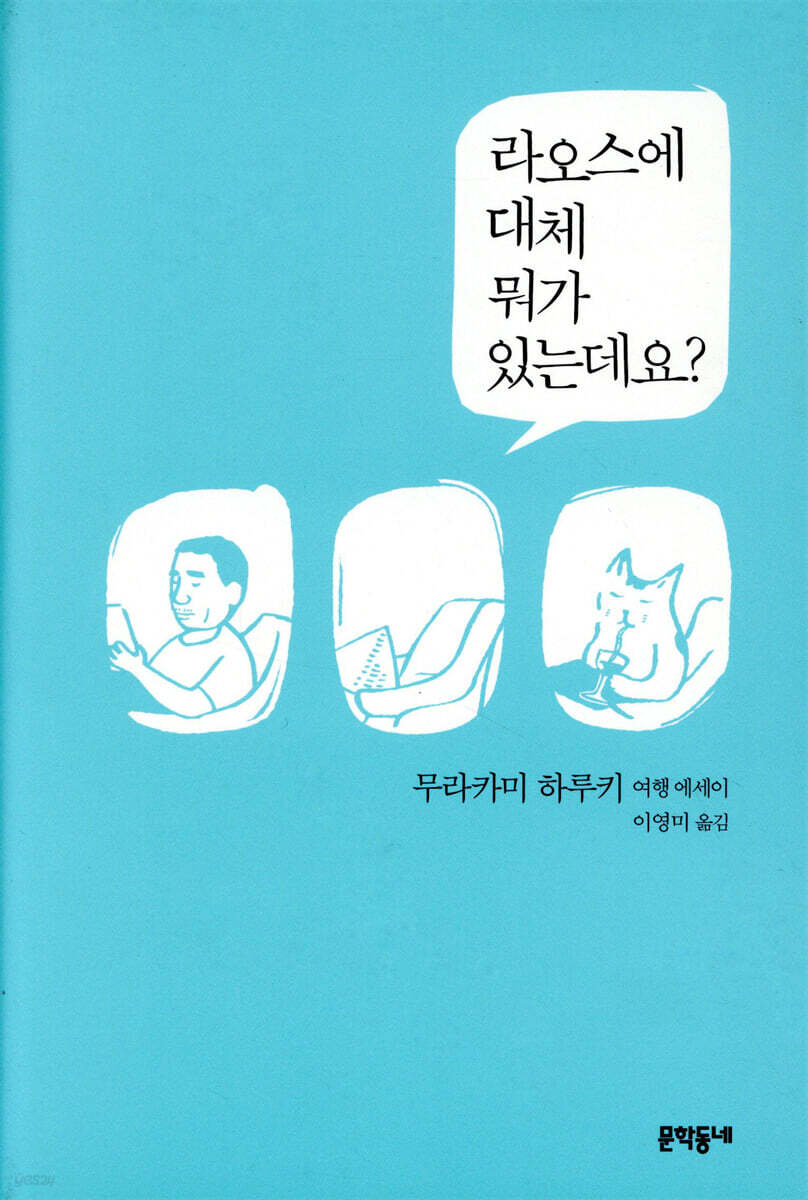
What on earth is there in Laos?
 |
Description
Book Introduction
Make everyday life like a trip, make travel like everyday life Haruki Murakami's latest travel essay “Traveling is a good thing. Sometimes it's tiring and disappointing, but there's always something there. Now, you too, get up and go somewhere.” The latest essay by 'traveling writer' Haruki Murakami. His travelogues, which sometimes calmly portray the joys and sorrows of living in a foreign land, and sometimes vividly convey delightful culinary experiences and adventures, have been loved by readers as much as novels. For the author, who frequently traveled abroad since his youth, travel was both an extension of his daily life and a valuable foundation for his creative work. In this new book, his first travel essay in nearly a decade, you can encounter Haruki-style reviews of fascinating travel destinations around the world, including Luang Prabang, Laos, a city of mystical religion; the Greek islands where the novel "Norwegian Wood" was born; Tuscany, the mecca of wine; Portland, a new paradise for gourmets; Finland and Iceland, where you can enjoy leisurely moments in the vastness of nature; New York nights filled with jazz melodies; and Kumamoto, Japan, which preserves traces of modern literature. |
- You can preview some of the book's contents.
Preview
index
What on earth is there in Laos?
Charles River Trail - Boston 1 7
Iceland 21: A Land of Green Moss and Hot Springs
I want to eat something delicious - Portland, Oregon, Portland, Maine 63
From the Two Longed-for Islands - Mykonos and Spetses 85
If I Had a Time Machine - New York's Jazz Club 117
In Search of Sibelius and Kaurismäki - Finland 133
On the banks of the mighty Mekong River - Luang Prabang, Laos 157
Baseball, Whales, and Donuts - Boston 2 183
White Roads and Red Wine - Tuscany (Italy) 197
From Soseki to Kumamon - Kumamoto (Japan) 215
Review 259
Charles River Trail - Boston 1 7
Iceland 21: A Land of Green Moss and Hot Springs
I want to eat something delicious - Portland, Oregon, Portland, Maine 63
From the Two Longed-for Islands - Mykonos and Spetses 85
If I Had a Time Machine - New York's Jazz Club 117
In Search of Sibelius and Kaurismäki - Finland 133
On the banks of the mighty Mekong River - Luang Prabang, Laos 157
Baseball, Whales, and Donuts - Boston 2 183
White Roads and Red Wine - Tuscany (Italy) 197
From Soseki to Kumamon - Kumamoto (Japan) 215
Review 259
Into the book
I think that having access to abundant water on a daily basis is of great significance to humans.
(……) When I just sit there and look at the water, I feel like I’m losing something little by little.
It's probably a bit similar to the feeling someone who loves music a lot feels when, for some reason, they are away from music for a long time.
---From "A Path Along the Charles River"
The landscape unfolding before us is a 'harmony' of the vast land, the silence that seems to last almost forever, the smell of the deep sea, the wind sweeping across the unimpeded surface of the earth, and the unique temporality that flows there.
(……) If you cut it out with a camera lens, or translate it into a scientific combination of colors, it will be something completely different from what is before your eyes now.
The heart that was there will almost disappear.
Therefore, we have no choice but to look at it with our own eyes for as long as possible and engrave it deep into our minds.
And you have no choice but to put them in a drawer of fleeting memories and move them somewhere yourself.
---From "A Place with Blue Moss and Hot Springs"
When I listen to the sound of that wooden hammer, my mind goes back twenty-four years.
At the time, I was a writer in my mid-thirties who had just finished a novel called "The End of the World and Hard-Boiled Wonderland" and was thinking about starting work on my next work, "Norwegian Wood."
First of all, he belonged to the 'young writer' group.
To be honest, I still feel like a 'young writer', but of course that's not the case.
Time passed, and of course I grew older.
That flow is difficult to avoid no matter what.
But as I sit on the grass in front of the lighthouse and listen to the sounds of the world around me, my own mind doesn't seem to have changed much since then.
Maybe it's just that I didn't grow up properly.
---From "On the Two Longed-for Islands"
By the way, wherever I go in the world, when I meet a publisher and ask, “How are the business conditions these days?”, I have never heard the response, “Wow, business is so good, it’s a big deal.”
Usually, everyone just has a gloomy expression and complains, “Well, that’s because the book isn’t selling well...”
It was the same in Finland.
Although it may not be as serious a problem as nuclear power or global warming, the phenomenon of books selling less and less year after year seems to be a global concern.
Hmm, what will become of our Earth in the future… …
---From "In Search of Sibelius and Kaurismäki"
I still haven't found a clear answer to the Vietnamese person's question, "What on earth is there in Laos (or somewhere like that)?"
All I brought back from Laos were some memories of the scenery and some small souvenirs.
But the scenery has a smell, a sound, and a feel.
There is a special light there, and a special wind blows.
The voice of someone saying something lingers in my ears.
I remember the trembling heart at that time.
That's what makes it different from a simple photo.
The scenery that existed only there still remains three-dimensionally within me, and will likely remain quite vivid in the future.
---From "By the Great Mekong River"
When I go to New York or stay in Tokyo, I often go to Starbucks and have a cup of coffee.
(……) But when I’m in Boston, my legs always naturally point towards the Dunkin’ Donuts logo.
There, I grimace, sip my hot coffee, nibble on a donut, and open the Boston Globe to check the results of last night's game.
Because, above all, it's Boston, and Dunkin' Donuts is an important part of the "Boston State of Mind."
---From "Baseball, Whales, and Donuts"
It would be wonderful to live in a city where castles are visible everywhere.
It's not like Kafka's 'The Castle', a place that is 'visible but unreachable'.
By the way, I think Kumamoto City has a rule that says, "No buildings can be built higher than the castle walls around the castle," which I think is really cool.
It's similar to the ordinance on the Hawaiian island of Kauai, which states, "No building can be built taller than a palm tree."
As a traveler, I hope that the leisurely pace and atmosphere of the 'walled city' will continue to be preserved.
(……) When I just sit there and look at the water, I feel like I’m losing something little by little.
It's probably a bit similar to the feeling someone who loves music a lot feels when, for some reason, they are away from music for a long time.
---From "A Path Along the Charles River"
The landscape unfolding before us is a 'harmony' of the vast land, the silence that seems to last almost forever, the smell of the deep sea, the wind sweeping across the unimpeded surface of the earth, and the unique temporality that flows there.
(……) If you cut it out with a camera lens, or translate it into a scientific combination of colors, it will be something completely different from what is before your eyes now.
The heart that was there will almost disappear.
Therefore, we have no choice but to look at it with our own eyes for as long as possible and engrave it deep into our minds.
And you have no choice but to put them in a drawer of fleeting memories and move them somewhere yourself.
---From "A Place with Blue Moss and Hot Springs"
When I listen to the sound of that wooden hammer, my mind goes back twenty-four years.
At the time, I was a writer in my mid-thirties who had just finished a novel called "The End of the World and Hard-Boiled Wonderland" and was thinking about starting work on my next work, "Norwegian Wood."
First of all, he belonged to the 'young writer' group.
To be honest, I still feel like a 'young writer', but of course that's not the case.
Time passed, and of course I grew older.
That flow is difficult to avoid no matter what.
But as I sit on the grass in front of the lighthouse and listen to the sounds of the world around me, my own mind doesn't seem to have changed much since then.
Maybe it's just that I didn't grow up properly.
---From "On the Two Longed-for Islands"
By the way, wherever I go in the world, when I meet a publisher and ask, “How are the business conditions these days?”, I have never heard the response, “Wow, business is so good, it’s a big deal.”
Usually, everyone just has a gloomy expression and complains, “Well, that’s because the book isn’t selling well...”
It was the same in Finland.
Although it may not be as serious a problem as nuclear power or global warming, the phenomenon of books selling less and less year after year seems to be a global concern.
Hmm, what will become of our Earth in the future… …
---From "In Search of Sibelius and Kaurismäki"
I still haven't found a clear answer to the Vietnamese person's question, "What on earth is there in Laos (or somewhere like that)?"
All I brought back from Laos were some memories of the scenery and some small souvenirs.
But the scenery has a smell, a sound, and a feel.
There is a special light there, and a special wind blows.
The voice of someone saying something lingers in my ears.
I remember the trembling heart at that time.
That's what makes it different from a simple photo.
The scenery that existed only there still remains three-dimensionally within me, and will likely remain quite vivid in the future.
---From "By the Great Mekong River"
When I go to New York or stay in Tokyo, I often go to Starbucks and have a cup of coffee.
(……) But when I’m in Boston, my legs always naturally point towards the Dunkin’ Donuts logo.
There, I grimace, sip my hot coffee, nibble on a donut, and open the Boston Globe to check the results of last night's game.
Because, above all, it's Boston, and Dunkin' Donuts is an important part of the "Boston State of Mind."
---From "Baseball, Whales, and Donuts"
It would be wonderful to live in a city where castles are visible everywhere.
It's not like Kafka's 'The Castle', a place that is 'visible but unreachable'.
By the way, I think Kumamoto City has a rule that says, "No buildings can be built higher than the castle walls around the castle," which I think is really cool.
It's similar to the ordinance on the Hawaiian island of Kauai, which states, "No building can be built taller than a palm tree."
As a traveler, I hope that the leisurely pace and atmosphere of the 'walled city' will continue to be preserved.
---From "From Soseki to Kumamon"
Publisher's Review
Iceland, Finland, Italy, Greece, the United States… …
Mr. Haruki, what on earth is there?
The title of this book, “What on earth is there in Laos?”, as written in the text, is a question a Vietnamese person I met in Hanoi, a transit point, asked me as I was heading to Laos.
What is it that is in Laos that is not in Vietnam?
That question left me speechless for a moment.
Come to think of it, what exactly is there in Laos? But when I actually went there, I found that there were things that were unique to Laos.
That's a given.
That's what travel is.
If we already knew what was there, no one would bother to take the time and effort to travel there.
No matter how many times you go to a place, every time you go there you are bound to feel a sense of surprise and say, 'Wow, there's something like this!'
That's travel.
_「Review」
"What on Earth is in Laos?" contains ten essays written by Haruki Murakami for magazines while traveling around the world between 1995 and 2015.
Among them, seven stories, including the title work, “On the Banks of the Great Mekong,” were serialized in Agora, published by Japan Airlines (JAL). At the time, it is said that Haruki Murakami wrote a longer version separately to be published as a book.
Perhaps due to the nature of the medium, in this book he not only meticulously records the characteristics and culture of the travel destinations with his keen observation skills, but also serves as a very friendly travel guide.
In Portland and New York, hot places where the old and the new coexist, he explains the city's history in an easy-to-understand way and recommends restaurants and clubs that suit each travel purpose. He bravely tours Kumamoto's tourist attractions even in the monsoon rain and leaves solid reviews. Even in the unexpected situation of "standing in front of an unmanned gas station with an empty tank," he never forgets to add the tip, "Gas stations in Iceland are unmanned, so it's a good idea to learn how to fill up in advance."
It is accompanied by twenty-five photographs, including those taken by his wife, Yoko Murakami.
“If everything goes well on a trip, it’s not a trip.”
A life guidebook woven from exotic landscapes by a professional traveler and novelist.
The joy of reading Haruki Murakami's essays is that you can glimpse into his everyday life and human side, aspects that don't often appear in the mass media.
Even while traveling, he never loses his daily rhythm, going to Dunkin' Donuts instead of Starbucks for his morning coffee in Boston, worrying about the global decline in book sales during a meal with employees of a Finnish publishing company, and spending a day immersed in the affectionate stray cats of Greece.
The Boston Marathon, a festival for amateur runners including Haruki Murakami himself; the Greek island of Mykonos, where he went one day in his late thirties, drawn by the sound of a distant drum; and the Village Vanguard, a legendary jazz club in New York that every jazz enthusiast dreams of visiting. These places, familiar to readers through his previous works, make a comeback, adding to the joy.
He has been consistently publishing travelogues or travelogues about his stay abroad since the 1980s, but he says that he stopped writing travelogues at some point because he wanted to escape the sense of obligation to "write about this trip."
That is why it took such a long time to collect one volume of writing.
“I read the collected writings again and secretly regretted it, thinking, ‘Oh, I should have written about other trips too.’
(……) But it’s no use regretting it now.
“It’s not just any other writing, but a travelogue, because if you don’t write it with determination right after the trip, you can’t really keep the vividness alive.” As he said, in this book, which vividly captures the travel records, you can enjoy the scenery and thoughts that the free-spirited and easy-going novelist saw and felt directly as a traveler and as a person living in the city.
If you want to see why Haruki Murakami is called a "master of travel writing," and if you're curious about the charming points on Earth selected by this seasoned professional traveler, why not join this journey filled with his own unique sensibility and humor?
Mr. Haruki, what on earth is there?
The title of this book, “What on earth is there in Laos?”, as written in the text, is a question a Vietnamese person I met in Hanoi, a transit point, asked me as I was heading to Laos.
What is it that is in Laos that is not in Vietnam?
That question left me speechless for a moment.
Come to think of it, what exactly is there in Laos? But when I actually went there, I found that there were things that were unique to Laos.
That's a given.
That's what travel is.
If we already knew what was there, no one would bother to take the time and effort to travel there.
No matter how many times you go to a place, every time you go there you are bound to feel a sense of surprise and say, 'Wow, there's something like this!'
That's travel.
_「Review」
"What on Earth is in Laos?" contains ten essays written by Haruki Murakami for magazines while traveling around the world between 1995 and 2015.
Among them, seven stories, including the title work, “On the Banks of the Great Mekong,” were serialized in Agora, published by Japan Airlines (JAL). At the time, it is said that Haruki Murakami wrote a longer version separately to be published as a book.
Perhaps due to the nature of the medium, in this book he not only meticulously records the characteristics and culture of the travel destinations with his keen observation skills, but also serves as a very friendly travel guide.
In Portland and New York, hot places where the old and the new coexist, he explains the city's history in an easy-to-understand way and recommends restaurants and clubs that suit each travel purpose. He bravely tours Kumamoto's tourist attractions even in the monsoon rain and leaves solid reviews. Even in the unexpected situation of "standing in front of an unmanned gas station with an empty tank," he never forgets to add the tip, "Gas stations in Iceland are unmanned, so it's a good idea to learn how to fill up in advance."
It is accompanied by twenty-five photographs, including those taken by his wife, Yoko Murakami.
“If everything goes well on a trip, it’s not a trip.”
A life guidebook woven from exotic landscapes by a professional traveler and novelist.
The joy of reading Haruki Murakami's essays is that you can glimpse into his everyday life and human side, aspects that don't often appear in the mass media.
Even while traveling, he never loses his daily rhythm, going to Dunkin' Donuts instead of Starbucks for his morning coffee in Boston, worrying about the global decline in book sales during a meal with employees of a Finnish publishing company, and spending a day immersed in the affectionate stray cats of Greece.
The Boston Marathon, a festival for amateur runners including Haruki Murakami himself; the Greek island of Mykonos, where he went one day in his late thirties, drawn by the sound of a distant drum; and the Village Vanguard, a legendary jazz club in New York that every jazz enthusiast dreams of visiting. These places, familiar to readers through his previous works, make a comeback, adding to the joy.
He has been consistently publishing travelogues or travelogues about his stay abroad since the 1980s, but he says that he stopped writing travelogues at some point because he wanted to escape the sense of obligation to "write about this trip."
That is why it took such a long time to collect one volume of writing.
“I read the collected writings again and secretly regretted it, thinking, ‘Oh, I should have written about other trips too.’
(……) But it’s no use regretting it now.
“It’s not just any other writing, but a travelogue, because if you don’t write it with determination right after the trip, you can’t really keep the vividness alive.” As he said, in this book, which vividly captures the travel records, you can enjoy the scenery and thoughts that the free-spirited and easy-going novelist saw and felt directly as a traveler and as a person living in the city.
If you want to see why Haruki Murakami is called a "master of travel writing," and if you're curious about the charming points on Earth selected by this seasoned professional traveler, why not join this journey filled with his own unique sensibility and humor?
GOODS SPECIFICS
- Date of issue: June 1, 2016
- Format: Hardcover book binding method guide
- Page count, weight, size: 264 pages | 426g | 128*188*20mm
- ISBN13: 9788954640466
- ISBN10: 895464046X
You may also like
카테고리
korean


korean

![GQ KOREA Mark (Monthly): December [2025]](http://librairie.coreenne.fr/cdn/shop/files/8ef265dbbfbf186523ed75ba7319009d.jpg?v=1765340328&width=3840)


