

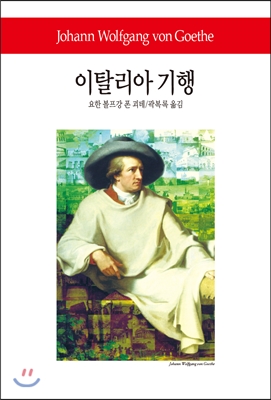
Italian travelogue
 |
Description
Book Introduction
“People do not travel to arrive,
“To travel.”―Goethe
The great poet Goethe's Italian art journey!
It is a record of a life-changing experience.
The essence of literary travel in beautiful nature
Goethe's Italian journey took place against the backdrop of that era.
After leaving Germany on September 3, 1786, at the age of 37, Goethe traveled extensively throughout Italy for one year and nine months, opening his eyes and heart and breathing deeply into a new world.
This journey marked an important turning point not only in Goethe's own personal maturation but also in the development of German literature.
This is because we call the period after Goethe's trip to Italy, when he turned his attention to the classical beauty of harmony and balance, the era of 'German Classicism.'
Goethe longed for free love and art, unfettered by morality or worldly reputation.
I thought that the gift of nature and love given by the bright and wide sky was the greatest happiness.
In the small northern world, where religions that strongly abhor nudity were blocking the way, ancient Greece.
I couldn't even imagine how beautiful the Roman nude statues were.
Goethe, the traveler, escaped from the rigid and dark confines of a cramped room obsessed with trivial formalities and experienced true beauty by sweating in the great outdoors.
Simple and natural sensual love, an overflowing expression of pure pleasure, freedom of life and decision-making.
The poet's wings of thought were flying in such a world.
Goethe described the day he arrived in Rome as his 'second birth' and 'the day when true life began again.'
Goethe was lonely and free.
No matter how I lived, wandered, or loved in Italy, I was completely free from the curious gaze of the Weimar people.
I was able to return from a hypocritical life to a human life.
The trip to Italy brought back the dazzling sensuality that Goethe had possessed since birth.
Goethe learned that there is art in nature and nature in art.
And he deeply realized that he was born not as a politician or a painter, but as a poet.
The solitude of travel gave Goethe back the life of a writer he had longed for.
Goethe never forgot to set aside time to complete the work he had been planning to write.
The subjects that Goethe was deeply absorbed in while in Italy were nature, humanity, society, and art.
He visited the ruins of Rome and enjoyed the architecture, sculptures, and paintings that are the heritage of mankind, and his literary output was rich.
He rewrote Iphigenie in verse, finally finished Egmont, and even took up Faust, which had been lying dormant for fifteen years, adding a few scenes.
It would not be an exaggeration to say that the perfection of the great writer Goethe's literature began with his trip to Italy.
“To travel.”―Goethe
The great poet Goethe's Italian art journey!
It is a record of a life-changing experience.
The essence of literary travel in beautiful nature
Goethe's Italian journey took place against the backdrop of that era.
After leaving Germany on September 3, 1786, at the age of 37, Goethe traveled extensively throughout Italy for one year and nine months, opening his eyes and heart and breathing deeply into a new world.
This journey marked an important turning point not only in Goethe's own personal maturation but also in the development of German literature.
This is because we call the period after Goethe's trip to Italy, when he turned his attention to the classical beauty of harmony and balance, the era of 'German Classicism.'
Goethe longed for free love and art, unfettered by morality or worldly reputation.
I thought that the gift of nature and love given by the bright and wide sky was the greatest happiness.
In the small northern world, where religions that strongly abhor nudity were blocking the way, ancient Greece.
I couldn't even imagine how beautiful the Roman nude statues were.
Goethe, the traveler, escaped from the rigid and dark confines of a cramped room obsessed with trivial formalities and experienced true beauty by sweating in the great outdoors.
Simple and natural sensual love, an overflowing expression of pure pleasure, freedom of life and decision-making.
The poet's wings of thought were flying in such a world.
Goethe described the day he arrived in Rome as his 'second birth' and 'the day when true life began again.'
Goethe was lonely and free.
No matter how I lived, wandered, or loved in Italy, I was completely free from the curious gaze of the Weimar people.
I was able to return from a hypocritical life to a human life.
The trip to Italy brought back the dazzling sensuality that Goethe had possessed since birth.
Goethe learned that there is art in nature and nature in art.
And he deeply realized that he was born not as a politician or a painter, but as a poet.
The solitude of travel gave Goethe back the life of a writer he had longed for.
Goethe never forgot to set aside time to complete the work he had been planning to write.
The subjects that Goethe was deeply absorbed in while in Italy were nature, humanity, society, and art.
He visited the ruins of Rome and enjoyed the architecture, sculptures, and paintings that are the heritage of mankind, and his literary output was rich.
He rewrote Iphigenie in verse, finally finished Egmont, and even took up Faust, which had been lying dormant for fifteen years, adding a few scenes.
It would not be an exaggeration to say that the perfection of the great writer Goethe's literature began with his trip to Italy.
index
Part 1: From Karlsbad to Rome (September 1786–February 1787)
From Karlsbad to Brenner… 41
From Brenner to Verona… 59
From Verona to Venice… 81
Venice… 116
From Ferrara to Rome… 166
Rome… 200
Part II: Naples and Sicily (February 1787–June 1787)
Naples… 285
Sicily… 347
Naples… 461
Part 3: Second stay in Rome (June 1787–April 1788)
Letter from June… 491
Letter from Tischbein to Goethe… 500
Letters from July… 513
Letters from August… 536
Letters from September… 552
Letters from October… 574
Letters from November… 597
December Letter… 612
January Letter… 643
February Letter… 685
Letters from March… 695
Letters from April… 713
Goethe and Italy… 728
Johann Wolfgang Goethe Chronology … 781
From Karlsbad to Brenner… 41
From Brenner to Verona… 59
From Verona to Venice… 81
Venice… 116
From Ferrara to Rome… 166
Rome… 200
Part II: Naples and Sicily (February 1787–June 1787)
Naples… 285
Sicily… 347
Naples… 461
Part 3: Second stay in Rome (June 1787–April 1788)
Letter from June… 491
Letter from Tischbein to Goethe… 500
Letters from July… 513
Letters from August… 536
Letters from September… 552
Letters from October… 574
Letters from November… 597
December Letter… 612
January Letter… 643
February Letter… 685
Letters from March… 695
Letters from April… 713
Goethe and Italy… 728
Johann Wolfgang Goethe Chronology … 781
Publisher's Review
“People do not travel to arrive,
“To travel.”―Goethe
The great poet Goethe's Italian art journey!
It is a record of a life-changing experience.
The essence of literary travel in beautiful nature
It would be most desirable if you could clearly perceive what is better and better among what you have seen.
But when you try to make it your own, it slips away from your hands.
People fail to grasp what is right and end up caught up in what is familiar.
To the Italy of my dreams
In 1775, Goethe moved to Weimar at the invitation of Duke Karl Augustus.
The next ten years, before he left for Italy, were incredibly busy as a politician and administrator.
He became a councilor, entered the ranks of the nobility, and rose to the position of prime minister.
Why would Goethe, such a man, leave everything behind and suddenly go to Italy? At the time, Goethe felt a sense of isolation in every area.
First, his love affair with Mrs. Stein, which was not physical, had reached a dead end.
Goethe was a man of great energy in his youth, and when he came to Weimar, he and his friend, Duke Karl August, who was the same age, seduced women and lived a life of wild debauchery.
After that, he met Madame Stein, the wife of the courtier, and gradually developed a balanced personality while receiving instruction on how to conduct himself as a courtier.
In literary terms, this belongs to the transitional period from Goethe's 'Storm and Stress' to classicism.
Goethe himself confessed that he inherited his womanizing personality from his maternal grandfather.
In fact, when my maternal grandfather was studying law in Wetzlar, he was the one who fled in a panic, throwing away his wig, after his affair with another man's wife was discovered.
However, he was a capable man and later served as mayor of Frankfurt.
Human, all too human desires
Goethe inherited his grandfather's bloodline and loved women, and he created beautiful poetry every time he parted ways with a woman he loved.
From his love with Fridike Brion, whom he loved in Strasbourg, he wrote the masterpieces “Wild Roses” and “May Songs”; from his love with Marianne Willemer, he wrote “West-Eastern Poems”; from his love with Frau Stein, he wrote “Iphigénie” and “To Frau Stein”; and from his love and disappointment with the 17-year-old Willike von Lewoch, at the age of 72, he wrote the trilogy “Appassionata”.
Goethe met Frau Stein in Weimar and dedicated many poems and letters to her.
In some poems, he even addresses his wife as, 'Ah, in a previous life you were my sister, my wife.'
Goethe loved Frau Stein so much that he sent her over 1,700 letters throughout his life.
《Italian Journey》 is also based on letters sent to her.
Mrs. Stein gave birth to seven children in her lifetime.
However, she firmly refused to have a physical relationship with Goethe.
Living in Weimar was a wise choice not only for herself but also for Goethe.
Goethe loved and agonized over Frau Stein, learning humility, resignation, and patience, but as his feelings for the married woman, who was seven years older than him, deepened, his feelings became more and more complex and subtle.
Goethe, realizing that continuing his relationship with her would not bring him physical fulfillment, decides to leave for Italy.
The trip to Italy was also a bittersweet farewell to Mrs. Stein.
Second, he felt that he had become unable to write poetry on his own.
Goethe originally considered himself a poet.
However, after coming to Weimar, he became busy with political affairs and was unable to write poetry that could be viewed positively.
There are no completed masterpieces, and there are not many outstanding lyric poems.
The only exception was the poem [Mignon], which expressed a longing for Italy.
His literary imagination gradually dulled and his reputation as a writer faded.
Goethe, who felt a sense of crisis that his life as a poet would end if things continued this way, decided to travel to Italy to regenerate his poetic talent and soul.
Third, I felt my limitations as a politician.
As a politician, he directed and planned mine development, road construction, and civil engineering projects, but in the small land of Weimar, Goethe did not achieve the results he had hoped for.
Weimar, which had brought him stability, now felt like a prison.
As a result, he became stressed and felt his limitations as a politician, and his health was also damaged.
In this way, the ties that pushed Goethe south, whether active or passive, piled up and piled up, finally leading him to leave for Italy.
Reborn as a great writer under the Roman sky
Goethe's Italian journey took place against the backdrop of that era.
After leaving Germany on September 3, 1786, at the age of 37, Goethe traveled extensively throughout Italy for one year and nine months, opening his eyes and heart and breathing deeply into a new world.
This journey marked an important turning point not only in Goethe's own personal maturation but also in the development of German literature.
This is because we call the period after Goethe's trip to Italy, when he turned his attention to the classical beauty of harmony and balance, the era of 'German Classicism.'
Just as German aesthetician Winckelmann defined Rome as "a great school for the whole world," Rome, Italy, along with Greece, has long been the cradle of European civilization and an object of admiration for people around the world.
Europeans, especially those north of the Alps, always harbor a yearning to escape their gloomy, gray skies and escape to the dazzlingly beautiful landscapes of Italy.
Goethe also admired Italy since his childhood.
But it's not just the country's beautiful scenery that attracts travelers to Italy.
Most Europeans visit Rome, the home of their civilization and its eternal capital, to cultivate their knowledge of history and culture and to cultivate themselves.
Goethe longed for free love and art, unfettered by morality or worldly reputation.
I thought that the gift of nature and love given by the bright and wide sky was the greatest happiness.
In the small world of the North, where religions that strongly abhorred nudity blocked access, it was impossible to imagine the beauty of the nude statues of ancient Greece and Rome.
Goethe, the traveler, escaped from the rigid and dark confines of a cramped room obsessed with trivial formalities and experienced true beauty by sweating in the great outdoors.
Simple and natural sensual love, an overflowing expression of pure pleasure, freedom of life and decision-making.
The poet's wings of thought were flying in such a world.
Goethe described the day he arrived in Rome as his 'second birth' and 'the day when true life began again.'
Goethe was lonely and free.
No matter how I lived, wandered, or loved in Italy, I was completely free from the curious gaze of the Weimar people.
I was able to return from a hypocritical life to a human life.
The trip to Italy brought back the dazzling sensuality that Goethe had possessed since birth.
Goethe learned that there is art in nature and nature in art.
And he deeply realized that he was born not as a politician or a painter, but as a poet.
The solitude of travel gave Goethe back the life of a writer he had longed for.
Goethe never forgot to set aside time to complete the work he had been planning to write.
The subjects that Goethe was deeply absorbed in in Italy were nature, humanity, society, and art.
He visited the ruins of Rome and enjoyed the architecture, sculptures, and paintings that are the heritage of mankind, and his literary output was rich.
He rewrote Iphigenie in verse, finally finished Egmont, and even took up Faust, which had been lying dormant for fifteen years, adding a few scenes.
It would not be an exaggeration to say that the perfection of the great writer Goethe's literature began with his trip to Italy.
“To travel.”―Goethe
The great poet Goethe's Italian art journey!
It is a record of a life-changing experience.
The essence of literary travel in beautiful nature
It would be most desirable if you could clearly perceive what is better and better among what you have seen.
But when you try to make it your own, it slips away from your hands.
People fail to grasp what is right and end up caught up in what is familiar.
To the Italy of my dreams
In 1775, Goethe moved to Weimar at the invitation of Duke Karl Augustus.
The next ten years, before he left for Italy, were incredibly busy as a politician and administrator.
He became a councilor, entered the ranks of the nobility, and rose to the position of prime minister.
Why would Goethe, such a man, leave everything behind and suddenly go to Italy? At the time, Goethe felt a sense of isolation in every area.
First, his love affair with Mrs. Stein, which was not physical, had reached a dead end.
Goethe was a man of great energy in his youth, and when he came to Weimar, he and his friend, Duke Karl August, who was the same age, seduced women and lived a life of wild debauchery.
After that, he met Madame Stein, the wife of the courtier, and gradually developed a balanced personality while receiving instruction on how to conduct himself as a courtier.
In literary terms, this belongs to the transitional period from Goethe's 'Storm and Stress' to classicism.
Goethe himself confessed that he inherited his womanizing personality from his maternal grandfather.
In fact, when my maternal grandfather was studying law in Wetzlar, he was the one who fled in a panic, throwing away his wig, after his affair with another man's wife was discovered.
However, he was a capable man and later served as mayor of Frankfurt.
Human, all too human desires
Goethe inherited his grandfather's bloodline and loved women, and he created beautiful poetry every time he parted ways with a woman he loved.
From his love with Fridike Brion, whom he loved in Strasbourg, he wrote the masterpieces “Wild Roses” and “May Songs”; from his love with Marianne Willemer, he wrote “West-Eastern Poems”; from his love with Frau Stein, he wrote “Iphigénie” and “To Frau Stein”; and from his love and disappointment with the 17-year-old Willike von Lewoch, at the age of 72, he wrote the trilogy “Appassionata”.
Goethe met Frau Stein in Weimar and dedicated many poems and letters to her.
In some poems, he even addresses his wife as, 'Ah, in a previous life you were my sister, my wife.'
Goethe loved Frau Stein so much that he sent her over 1,700 letters throughout his life.
《Italian Journey》 is also based on letters sent to her.
Mrs. Stein gave birth to seven children in her lifetime.
However, she firmly refused to have a physical relationship with Goethe.
Living in Weimar was a wise choice not only for herself but also for Goethe.
Goethe loved and agonized over Frau Stein, learning humility, resignation, and patience, but as his feelings for the married woman, who was seven years older than him, deepened, his feelings became more and more complex and subtle.
Goethe, realizing that continuing his relationship with her would not bring him physical fulfillment, decides to leave for Italy.
The trip to Italy was also a bittersweet farewell to Mrs. Stein.
Second, he felt that he had become unable to write poetry on his own.
Goethe originally considered himself a poet.
However, after coming to Weimar, he became busy with political affairs and was unable to write poetry that could be viewed positively.
There are no completed masterpieces, and there are not many outstanding lyric poems.
The only exception was the poem [Mignon], which expressed a longing for Italy.
His literary imagination gradually dulled and his reputation as a writer faded.
Goethe, who felt a sense of crisis that his life as a poet would end if things continued this way, decided to travel to Italy to regenerate his poetic talent and soul.
Third, I felt my limitations as a politician.
As a politician, he directed and planned mine development, road construction, and civil engineering projects, but in the small land of Weimar, Goethe did not achieve the results he had hoped for.
Weimar, which had brought him stability, now felt like a prison.
As a result, he became stressed and felt his limitations as a politician, and his health was also damaged.
In this way, the ties that pushed Goethe south, whether active or passive, piled up and piled up, finally leading him to leave for Italy.
Reborn as a great writer under the Roman sky
Goethe's Italian journey took place against the backdrop of that era.
After leaving Germany on September 3, 1786, at the age of 37, Goethe traveled extensively throughout Italy for one year and nine months, opening his eyes and heart and breathing deeply into a new world.
This journey marked an important turning point not only in Goethe's own personal maturation but also in the development of German literature.
This is because we call the period after Goethe's trip to Italy, when he turned his attention to the classical beauty of harmony and balance, the era of 'German Classicism.'
Just as German aesthetician Winckelmann defined Rome as "a great school for the whole world," Rome, Italy, along with Greece, has long been the cradle of European civilization and an object of admiration for people around the world.
Europeans, especially those north of the Alps, always harbor a yearning to escape their gloomy, gray skies and escape to the dazzlingly beautiful landscapes of Italy.
Goethe also admired Italy since his childhood.
But it's not just the country's beautiful scenery that attracts travelers to Italy.
Most Europeans visit Rome, the home of their civilization and its eternal capital, to cultivate their knowledge of history and culture and to cultivate themselves.
Goethe longed for free love and art, unfettered by morality or worldly reputation.
I thought that the gift of nature and love given by the bright and wide sky was the greatest happiness.
In the small world of the North, where religions that strongly abhorred nudity blocked access, it was impossible to imagine the beauty of the nude statues of ancient Greece and Rome.
Goethe, the traveler, escaped from the rigid and dark confines of a cramped room obsessed with trivial formalities and experienced true beauty by sweating in the great outdoors.
Simple and natural sensual love, an overflowing expression of pure pleasure, freedom of life and decision-making.
The poet's wings of thought were flying in such a world.
Goethe described the day he arrived in Rome as his 'second birth' and 'the day when true life began again.'
Goethe was lonely and free.
No matter how I lived, wandered, or loved in Italy, I was completely free from the curious gaze of the Weimar people.
I was able to return from a hypocritical life to a human life.
The trip to Italy brought back the dazzling sensuality that Goethe had possessed since birth.
Goethe learned that there is art in nature and nature in art.
And he deeply realized that he was born not as a politician or a painter, but as a poet.
The solitude of travel gave Goethe back the life of a writer he had longed for.
Goethe never forgot to set aside time to complete the work he had been planning to write.
The subjects that Goethe was deeply absorbed in in Italy were nature, humanity, society, and art.
He visited the ruins of Rome and enjoyed the architecture, sculptures, and paintings that are the heritage of mankind, and his literary output was rich.
He rewrote Iphigenie in verse, finally finished Egmont, and even took up Faust, which had been lying dormant for fifteen years, adding a few scenes.
It would not be an exaggeration to say that the perfection of the great writer Goethe's literature began with his trip to Italy.
GOODS SPECIFICS
- Date of issue: April 1, 2016
- Format: Hardcover book binding method guide
- Page count, weight, size: 794 pages | 1,264g | 160*230*40mm
- ISBN13: 9788949714011
- ISBN10: 8949714019
You may also like
카테고리
korean


korean

![GQ KOREA Mark (Monthly): December [2025]](http://librairie.coreenne.fr/cdn/shop/files/8ef265dbbfbf186523ed75ba7319009d.jpg?v=1765340328&width=3840)


