

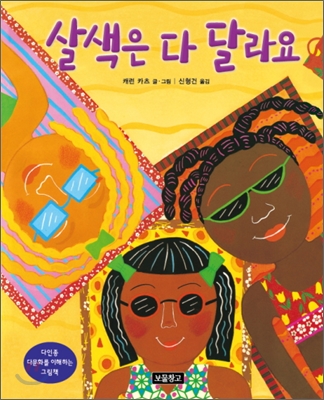
Skin tones are all different
 |
Description
Book Introduction
Is there anyone who knows how to distinguish between 'different' and 'wrong'?
My friend Lena's skin tone is different from mine, but we are really close friends.
As we enter a multiracial and multicultural era, we need our children more than ever to have the wisdom to not perceive "difference" as "wrong" and the flexible mindset to find beauty in "difference."
Like Lena, whom you can meet through this picture book, you will learn to be open-minded and find beauty and special in the skin tones of your friends and others, recalling the taste and scent of your favorite food, happy memories, and the strengths and charms of that person.
And it subtly provides courage and comfort to children who have had painful experiences of being teased or ostracized because of their skin color.
My friend Lena's skin tone is different from mine, but we are really close friends.
As we enter a multiracial and multicultural era, we need our children more than ever to have the wisdom to not perceive "difference" as "wrong" and the flexible mindset to find beauty in "difference."
Like Lena, whom you can meet through this picture book, you will learn to be open-minded and find beauty and special in the skin tones of your friends and others, recalling the taste and scent of your favorite food, happy memories, and the strengths and charms of that person.
And it subtly provides courage and comfort to children who have had painful experiences of being teased or ostracized because of their skin color.
- You can preview some of the book's contents.
Preview
Detailed image
Publisher's Review
In this multiracial and multicultural era, what does "flesh color" mean?
There is great power hidden in the words we use thoughtlessly in our daily lives.
Because language is a tool for expressing our thoughts and feelings, as well as a promise between members of society, it fully embodies the values of society and culture.
So sometimes, this language can become a problem that controls or dominates our thoughts and actions.
A representative example is the word ‘flesh color.’
This word, meaning 'skin color', has been used in Korea for quite some time as a 'color name' to refer to the skin color of Asian people.
However, because skin color varies depending on race and its color is also mysterious, it is difficult to define it as a specific color.
However, for convenience, our people's skin color has been called 'flesh color' for a long time, and it is highly likely that this has unknowingly created prejudice and discrimination against people with different skin colors in people's minds.
However, recently, our country is rapidly entering a multi-ethnic and multicultural society due to the rapid increase in the number of foreigners and multicultural families residing in the country due to factors such as the influx of migrant workers and international marriages.
In this reality, the use of the word 'flesh color' and the resulting false values are bound to become the seeds of conflict that cause social problems.
Fortunately, the fact that people sympathized with the idea that designating a specific color as flesh tone was racist led to the color name being changed.
The flesh color changed from light orange to light yellow-pink, and was finally confirmed as apricot in 2005.
As a result, the word flesh color, which was on the verge of being phased out, has returned to its original meaning of skin color. However, it is still misused as a color name, causing resentment, and it is not used more actively in daily life due to its stigma as a discriminatory word.
『Flesh Colors Are All Different』, recently published by Treasure Chest, is a meaningful picture book that corrects the negative image of the word 'flesh color' and helps people discover the beauty and charm of different skin tones.
Karen Katz, the author who has been loved by children around the world for her unique illustrations that depict the bright and innocent lives of children, began drawing children's picture books in earnest after adopting a daughter from Guatemala.
The author says she is "fascinated by the way people around the world look, the way they live, and the 'differences' that make us all special," drawing inspiration from raising her daughter in New York City, a city so diverse it's often called a showcase of race.
This book, created by a writer at the forefront of multiracial and multiculturalism, is expected to go beyond understanding and acknowledging "differences" and offer readers a way to discover the "special charm of difference."
‘Color difference’ has a unique charm!
Lena, a seven-year-old girl whose mother is a painter, has a cinnamon-reddish-brown complexion.
To teach Lena, who thinks there is only one color brown, that there are many different shades of brown, her mother suggests they go for a walk.
During her walk, Lena meets many friends and neighbors, and through this process, she realizes that people have different skin tones and each has its own unique beauty.
Children learn about the world by observing their surroundings and comparing themselves to their peers.
So, we tend to feel a sense of kinship with things that are ‘same or similar’ to ourselves, and we tend to be wary of and distance ourselves from things that are ‘different and unfamiliar’.
The problem is that things that were initially 'different and unfamiliar' are later mistakenly perceived as 'bad and wrong'.
The wall of prejudice created in this way is not easily broken down, and the same goes for prejudice against skin colors different from mine.
As we enter a multi-racial and multicultural era, we need our children more than ever to have the wisdom to not perceive "difference" as "wrong" and the flexible mindset to find beauty in "difference."
Through 『Flesh Colors Are All Different』, readers, like Lena, will be able to recall the taste and scent of their favorite food, happy memories, and the strengths and charms of that person from the skin color of their friends and others, and learn to be open-minded and find them beautiful and special.
And it will subtly offer courage and comfort to children who have had painful experiences of being teased or ostracized because of their skin color.
Key Contents
Seven-year-old Lena's skin color is a cinnamon-reddish brown.
Lena asks her mother, a painter, if all brown is the same, what is reddish brown?
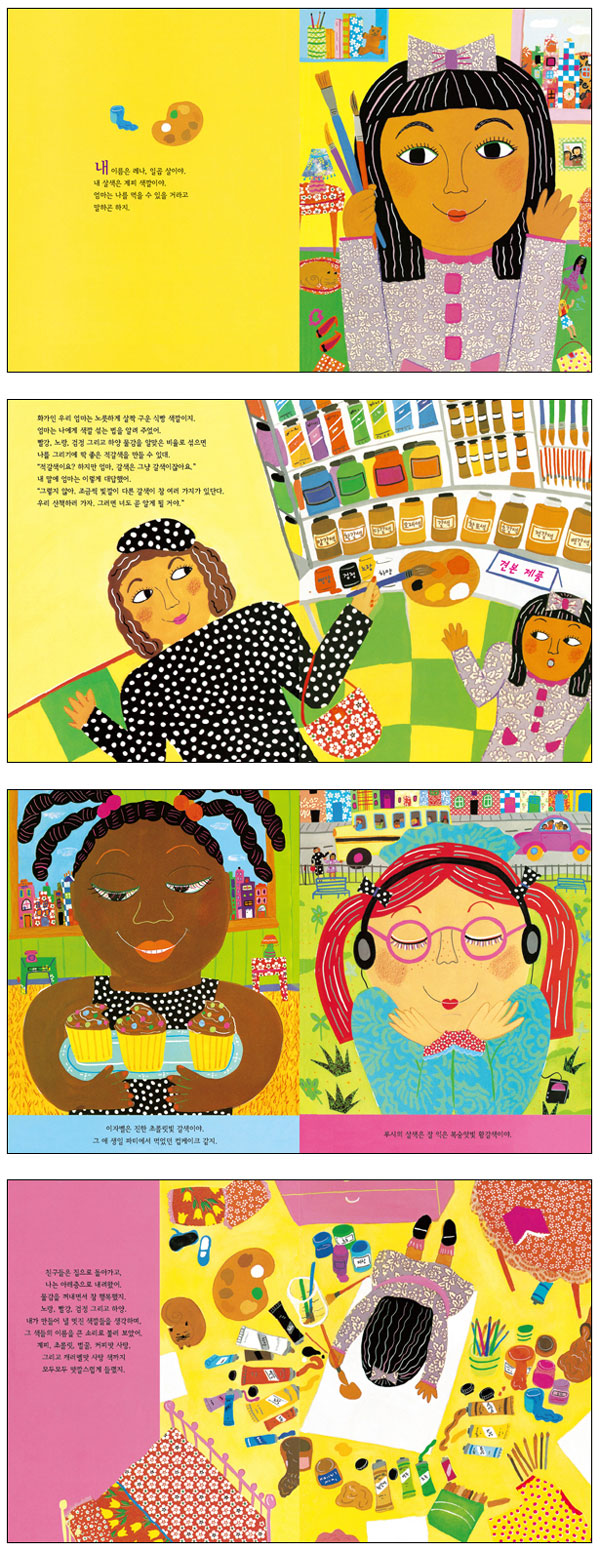
Mom tells her that if you mix several paints in the right proportions, you can make a reddish-brown like Lena's skin tone, and that there are many different shades of brown, each with a slightly different hue.
The two go out for a walk to find out.
While walking with her mother, Lena meets many neighbors and friends, including Sonia, Isabelle, Mina, Kyle, and Mr. Pellegrino.
And you realize that their skin tones are all different and beautiful shades of color—from a light tan like peanut butter jam to the chocolate brown of a birthday party, to a tan like fallen leaves, to a light brown like caramel candy.
Back home, Lena takes out her watercolors and memorizes the delicious-sounding flesh tones of her friends' faces, including cinnamon, chocolate, honey, coffee, and caramel candies, and finishes them off beautifully.
Translator's Note
Until recently, crayons contained 'flesh color'.
This color, now called 'apricot color', was called 'salsaek' because it was similar to the skin color of ordinary people in our country.
So people with darker or different skin tones were often the target of ridicule.
However, our country, which once had a strong sense of being a "single ethnic group," has now become a multi-racial and multicultural society, and people of various skin colors live together, as shown in this picture book.
I hope that many people will gain richer emotions and open hearts as they watch Lena, the protagonist of this book, experience the diverse flavors, fragrances, and beauty found in the colors of her neighbors and friends, each with a different appearance.
-Translator: Shin Hyeong-geon (poet, critic)
There is great power hidden in the words we use thoughtlessly in our daily lives.
Because language is a tool for expressing our thoughts and feelings, as well as a promise between members of society, it fully embodies the values of society and culture.
So sometimes, this language can become a problem that controls or dominates our thoughts and actions.
A representative example is the word ‘flesh color.’
This word, meaning 'skin color', has been used in Korea for quite some time as a 'color name' to refer to the skin color of Asian people.
However, because skin color varies depending on race and its color is also mysterious, it is difficult to define it as a specific color.
However, for convenience, our people's skin color has been called 'flesh color' for a long time, and it is highly likely that this has unknowingly created prejudice and discrimination against people with different skin colors in people's minds.
However, recently, our country is rapidly entering a multi-ethnic and multicultural society due to the rapid increase in the number of foreigners and multicultural families residing in the country due to factors such as the influx of migrant workers and international marriages.
In this reality, the use of the word 'flesh color' and the resulting false values are bound to become the seeds of conflict that cause social problems.
Fortunately, the fact that people sympathized with the idea that designating a specific color as flesh tone was racist led to the color name being changed.
The flesh color changed from light orange to light yellow-pink, and was finally confirmed as apricot in 2005.
As a result, the word flesh color, which was on the verge of being phased out, has returned to its original meaning of skin color. However, it is still misused as a color name, causing resentment, and it is not used more actively in daily life due to its stigma as a discriminatory word.
『Flesh Colors Are All Different』, recently published by Treasure Chest, is a meaningful picture book that corrects the negative image of the word 'flesh color' and helps people discover the beauty and charm of different skin tones.
Karen Katz, the author who has been loved by children around the world for her unique illustrations that depict the bright and innocent lives of children, began drawing children's picture books in earnest after adopting a daughter from Guatemala.
The author says she is "fascinated by the way people around the world look, the way they live, and the 'differences' that make us all special," drawing inspiration from raising her daughter in New York City, a city so diverse it's often called a showcase of race.
This book, created by a writer at the forefront of multiracial and multiculturalism, is expected to go beyond understanding and acknowledging "differences" and offer readers a way to discover the "special charm of difference."
‘Color difference’ has a unique charm!
Lena, a seven-year-old girl whose mother is a painter, has a cinnamon-reddish-brown complexion.
To teach Lena, who thinks there is only one color brown, that there are many different shades of brown, her mother suggests they go for a walk.
During her walk, Lena meets many friends and neighbors, and through this process, she realizes that people have different skin tones and each has its own unique beauty.
Children learn about the world by observing their surroundings and comparing themselves to their peers.
So, we tend to feel a sense of kinship with things that are ‘same or similar’ to ourselves, and we tend to be wary of and distance ourselves from things that are ‘different and unfamiliar’.
The problem is that things that were initially 'different and unfamiliar' are later mistakenly perceived as 'bad and wrong'.
The wall of prejudice created in this way is not easily broken down, and the same goes for prejudice against skin colors different from mine.
As we enter a multi-racial and multicultural era, we need our children more than ever to have the wisdom to not perceive "difference" as "wrong" and the flexible mindset to find beauty in "difference."
Through 『Flesh Colors Are All Different』, readers, like Lena, will be able to recall the taste and scent of their favorite food, happy memories, and the strengths and charms of that person from the skin color of their friends and others, and learn to be open-minded and find them beautiful and special.
And it will subtly offer courage and comfort to children who have had painful experiences of being teased or ostracized because of their skin color.
Key Contents
Seven-year-old Lena's skin color is a cinnamon-reddish brown.
Lena asks her mother, a painter, if all brown is the same, what is reddish brown?
Mom tells her that if you mix several paints in the right proportions, you can make a reddish-brown like Lena's skin tone, and that there are many different shades of brown, each with a slightly different hue.
The two go out for a walk to find out.
While walking with her mother, Lena meets many neighbors and friends, including Sonia, Isabelle, Mina, Kyle, and Mr. Pellegrino.
And you realize that their skin tones are all different and beautiful shades of color—from a light tan like peanut butter jam to the chocolate brown of a birthday party, to a tan like fallen leaves, to a light brown like caramel candy.
Back home, Lena takes out her watercolors and memorizes the delicious-sounding flesh tones of her friends' faces, including cinnamon, chocolate, honey, coffee, and caramel candies, and finishes them off beautifully.
Translator's Note
Until recently, crayons contained 'flesh color'.
This color, now called 'apricot color', was called 'salsaek' because it was similar to the skin color of ordinary people in our country.
So people with darker or different skin tones were often the target of ridicule.
However, our country, which once had a strong sense of being a "single ethnic group," has now become a multi-racial and multicultural society, and people of various skin colors live together, as shown in this picture book.
I hope that many people will gain richer emotions and open hearts as they watch Lena, the protagonist of this book, experience the diverse flavors, fragrances, and beauty found in the colors of her neighbors and friends, each with a different appearance.
-Translator: Shin Hyeong-geon (poet, critic)
GOODS SPECIFICS
- Date of issue: July 5, 2011
- Format: Hardcover book binding method guide
- Page count, weight, size: 32 pages | 299g | 204*254*15mm
- ISBN13: 9788961702300
- ISBN10: 8961702300
You may also like
카테고리
korean


korean

![GQ KOREA Mark (Monthly): December [2025]](http://librairie.coreenne.fr/cdn/shop/files/8ef265dbbfbf186523ed75ba7319009d.jpg?v=1765340328&width=3840)


