

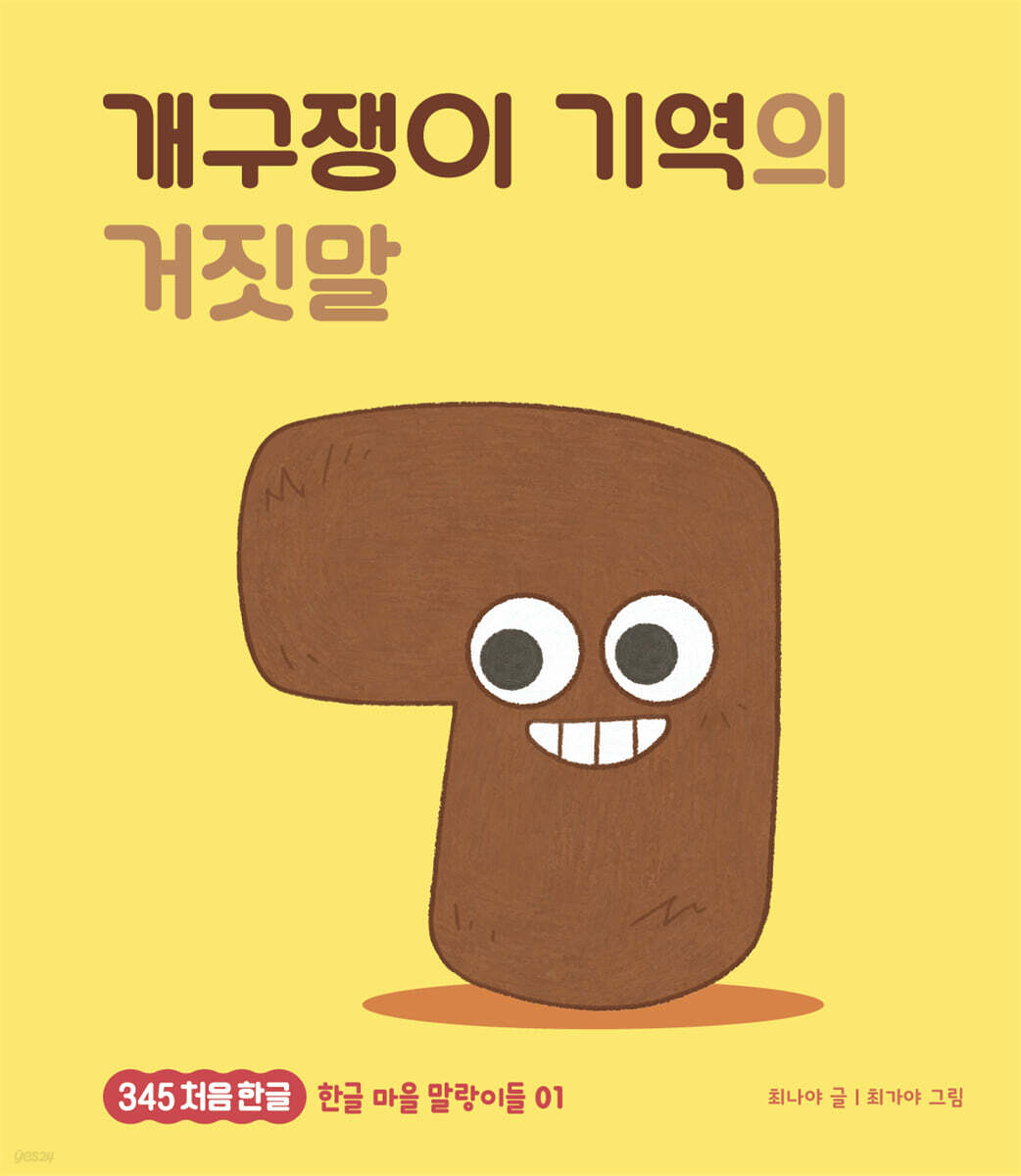
The lies of the naughty Giyeok
 |
Description
Book Introduction
A series of Korean picture books for children ages 3 to 5, planned and written by Professor Na-ya Choi of the Department of Child and Family Studies at Seoul National University, a leading authority on early childhood literacy education, based on extensive research and field experience.
It consists of 15 picture books, including 14 stories featuring 14 consonants from Giyeok to Hieut as main characters and 1 story that explains the principles of vowel and consonant combinations using a magic flute.
As you follow the big and small antics of the unique characters created based on the shapes of the letters, the names, shapes, and sound values of the consonants will be engraved in your head.
In addition, the principles of Hangul, such as the hieroglyphic principle, the principle of addition and subtraction, and the principle of composition, were incorporated into the worldview of Hangul Village, so that my children could naturally learn Hangul.
For parents concerned about teaching Korean to their children, the book also includes the “345 First Korean Parenting Guide” written by Professor Na-ya Choi herself, and the “345 First Korean Workbook” for enjoyable literacy activities for children and their parents.
- You can preview some of the book's contents.
Preview
Detailed image

Publisher's Review
Professor Choi Na-ya of Seoul National University, the highest authority on early childhood literacy education,
Scientifically designed and constructed based on the principles of Hangul
Our Child's First Korean Picture Book Series
Stop teaching single words without context!
No more non-interactive video training!
Start learning Korean with picture books that tell stories!
The first story in the "345 First Hangul" series, "The Lies of the Naughty Giyeok"
Giyeok is an unstoppable mischievous boy.
All day long, all I do is think about playing pranks.
Today I'm going to surprise my friends by sending a toy spider down the chimney of my house.
But then, while I was looking to see if the spider was going down properly, it fell down the chimney.
As the soot-covered Giyeok crawls out of the fireplace, Ni-eun, who was just coming out of the kitchen, asks in surprise.
“Who are you?” Ki-yeok, his playful spirit aroused, asks naturally.
“Hello? I’m Ni-eun.” Ni-eun, who thinks this strange guy claiming to be Ni-eun is a ghost, runs away far away.
When the commotion brings up the sound of Diggut and Ri-eul, two other friends who live in the hut, coming down from upstairs (it seems that Ti-eun, the farmer, has gone out to tend the fields), Ri-eul quickly puts the bread that Ni-eun dropped on her nose and imitates Ki-eun.
But will Diggut and Leeul also fall for Giyeok's lies like Nieun?
The best Korean language learning materials are picture books.
Professor Na-ya Choi, an expert in early childhood literacy education, considers picture books to be the best Korean language learning materials for young children.
They say that there is nothing better than a conversation between a caregiver and a child looking at picture books together and sharing them to develop a child's vocabulary and literacy skills.
Accordingly, the “345 First Hangul” series (15 volumes) is also composed of “story picture books” familiar to young children.
The main characters of each volume are 14 consonants.
As you follow the stories of the unique characters who have been created to reflect the shape of the letters, the names, shapes, and sound values of the consonants will naturally be engraved in your head.
The 14 consonant friends, or Malrangs, all have the same initial consonant, including their names, nicknames, and even colors.
The mischievous Giyeok is brown, the slow Nien is yellow, and the drowsy Diggut is crimson.
You don't have to try hard to memorize 'ㄱ/그/, 기역', you'll just memorize it.
〈345 First Hangul〉 was not composed in the order of consonants from Giyeok to Hieut.
After reading the basic pictographs of Hangul, namely Giyeok, Nieun, Mi-eum, Si-ot, and I-eung, you will learn vowels using the magic flute that I-eung received as a gift from a fairy.
The magic flute can produce a variety of sounds by blowing in different directions or by combining the three-hole long section with the short section.
Depending on which consonant is blown on the flute, different sounds are produced, creating magic.
It intuitively explains the principle of 'consonant synthesis', which creates syllables by combining consonants and vowels.
In addition, the principles of Hangul's disciples are naturally incorporated into the worldview of "345 First Hangul."
In Hangul Village, friends with the same articulation principles, such as giyeok and kiyeot (gum sounds), nieun, digeut, tiyeot, and rieul (tongue sounds), mieum, bieup, and piyeot (lip sounds), siot, jiyeot, and chiyeot (it sounds), and ieung and hiyeot (throat sounds), live together in one house.
You can naturally learn the principles of consonant hieroglyphics and strokes by reading out loud the names of friends who live in the same house and comparing their appearances.
It is also important to note that the program actively utilizes the rhyme method, which creates rhythm and rhyme by repeating consonants with the same initial sound, onomatopoeia and mimetic words, word chain games, poetry and songs to help students fully experience the joy of language.
We hope that the "345 First Hangul" series, which the authors have spent a long time researching and pondering, will be of some small help in helping young children easily and happily cross the threshold of "literacy," a fundamental human right and the foundation of lifelong learning.
GOODS SPECIFICS
- Date of issue: November 25, 2025
- Format: Hardcover book binding method guide
- Page count, weight, size: 36 pages | 190*220*9mm
- ISBN13: 9791158365752
- KC Certification: Certification Type: Conformity Confirmation
You may also like
카테고리
korean


korean


