

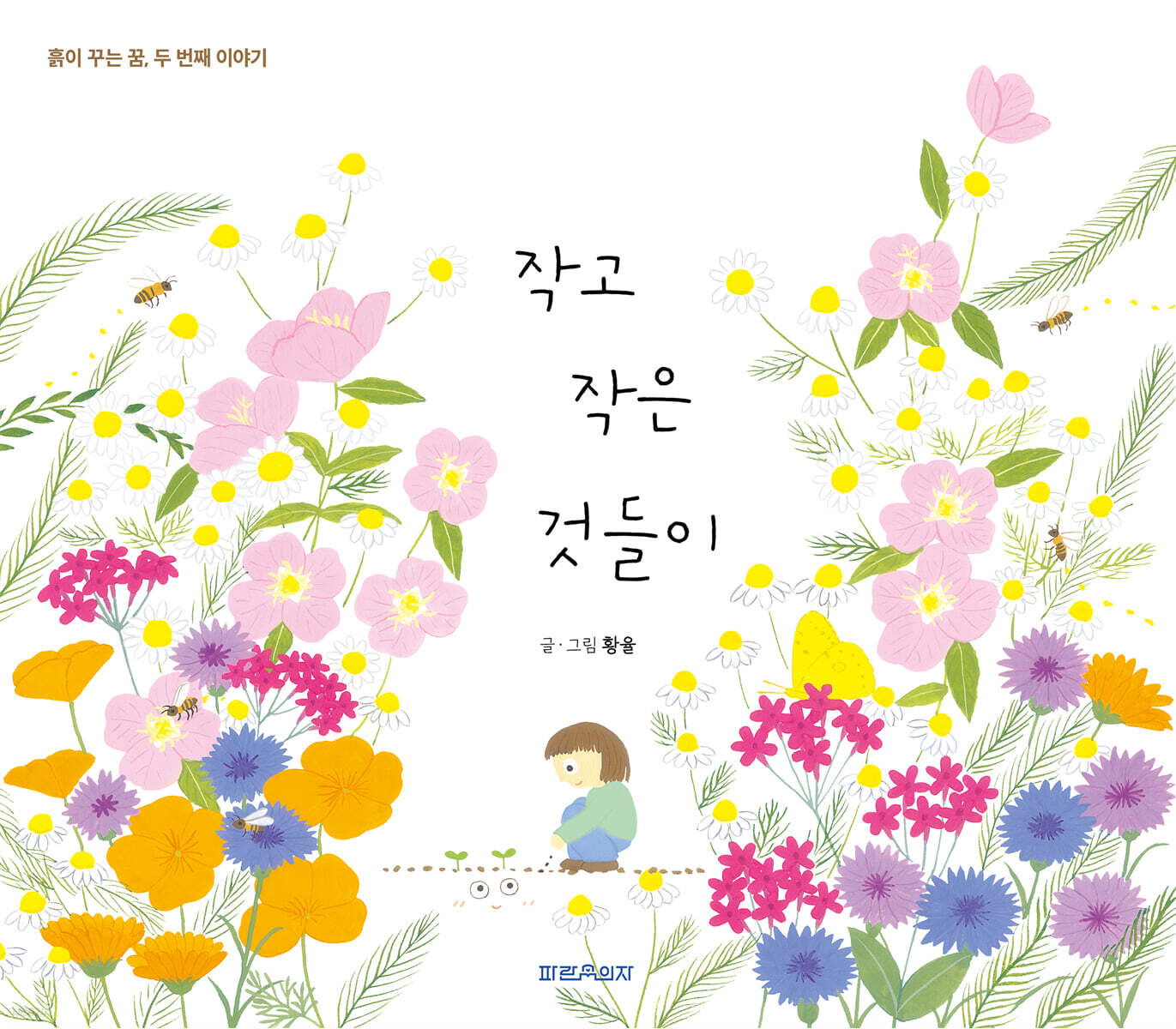
Small, small things
 |
Description
Book Introduction
The Big Changes Made by Small Lives! The Second Story of "The Dream of Soil"
“The Dream of the Earth” is included in elementary school science textbooks and reminds our children of the importance of nature.
The next story begins with 'The Child's Dream', not 'The Dream of the Earth'.
It warmly depicts, from a child's perspective, how the 'small things' of nature, including flowers, grass, insects, animals, and even invisible microorganisms, help each other and live together, and how the healthy ecosystem created through this harmony is created.
Will a child's dream of creating a flower garden come true? Discover the story of a child and the earth, sharing a friendship and growing together as they navigate spring, summer, fall, winter, and back to spring in "Small, Small Things."
- You can preview some of the book's contents.
Preview
Detailed image

Publisher's Review
A four-season ecological fairy tale that teaches the connection between nature and life.
Children should grow up seeing, hearing, and touching nature.
But for many children living in cities, nature is no longer a part of life, but something they must seek out.
For such children, “Small, Small Things” conveys the reason why we must live together with nature and how we can communicate with it through “a child’s dream.”
The goal of creating a flower garden is not just to make flowers bloom. It also fosters the ability to observe nature and learn on your own through the gradual growth that occurs during the waiting period.
This book teaches children ecological sensitivity, observation skills, and respect for life.
It is more important to see and feel nature directly than to learn about it through complicated words.
Connecting the concept of 'ecosystem' learned in textbooks with children's aspirations, it conveys the solidarity of life and the principles of nature with a gentle and warm gaze.
Meanwhile, this book turns its attention to 'beings too small to be seen.'
And it shows how these tiny, tiny beings save each other, save the earth, and ultimately comfort the human heart.
If you read it together with the elementary school nature textbook "The Dream of the Earth," your child's perspective on nature will deepen.
Tiny creatures living with the soil come together to save the land.
Flowers bloom in land where nothing once grew, and butterflies and bees follow those flowers.
As you follow the process of a single blade of grass growing into a healthy garden, you will learn how nature helps each other survive.
The story follows a child's dream of tending a flower garden, showing the diversity of life.
At the same time, it tells a warm story and illustrates how soil and roots, sunlight and rainwater, flowers and insects, microorganisms and underground animals interact with each other.
“Why won’t it sprout?”, “The soil is dry and cracked.
“What should I do?”, “It rained so much that it ruined the flower garden.” When the child worries, the soil quietly gives him an answer.
In the book, the child rejoices in a clump of grass that has grown after waiting, and discovers the value of possibility and connection contained in the small life before his eyes.
Nature seems to be teaching us that 'no life grows alone.'
A gardener drawing a flower garden, a record of an artist who converses with the soil through painting.
Born and raised in Seoul, the author moved to Yeosu in 2019 and began his first conversation with a 100-pyeong piece of land.
As I quietly tilled the soil and planted seeds according to the seasons, the dry land began to change little by little.
Chamomile, marigolds, and cornflowers… As the tiny seeds bloomed one by one into flowers, the garden became a simple yet deeply moving space.
After three years, the artist began to transfer the flower garden landscape onto paper.
By capturing the moments when a child's life and a flower garden meet in words and pictures, the garden is no longer just a flower garden, but a space where stories grow.
The reason why the illustrations in “Small, Small Things” are as vivid as photographs is simple.
Because it is not an imaginary garden, but a garden that the author has personally cultivated and cared for.
The author, who wants to tell a warm story that goes beyond conveying information and nurtures children's emotions and experiences, studied living ecosystem garden design at the 'Permaculture Education Center' in Australia and grain-structured soil at the 'Soil Food Web School' in the United States. He is currently learning 'ecologically-based garden design' and putting it into practice in his life.
◆ Children who read this book…
- Naturally learn about the changes in soil, plants, and insects according to the seasons.
- Experience the ‘composition and principles of the ecosystem’ learned in textbooks through stories and pictures.
-You will develop respect and responsibility for the lives around you.
GOODS SPECIFICS
- Date of issue: September 15, 2025
- Format: Hardcover book binding method guide
- Page count, weight, size: 56 pages | 240*210*10mm
- ISBN13: 9791197772542
- KC Certification: Certification Type: Conformity Confirmation
You may also like
카테고리
korean


korean


