

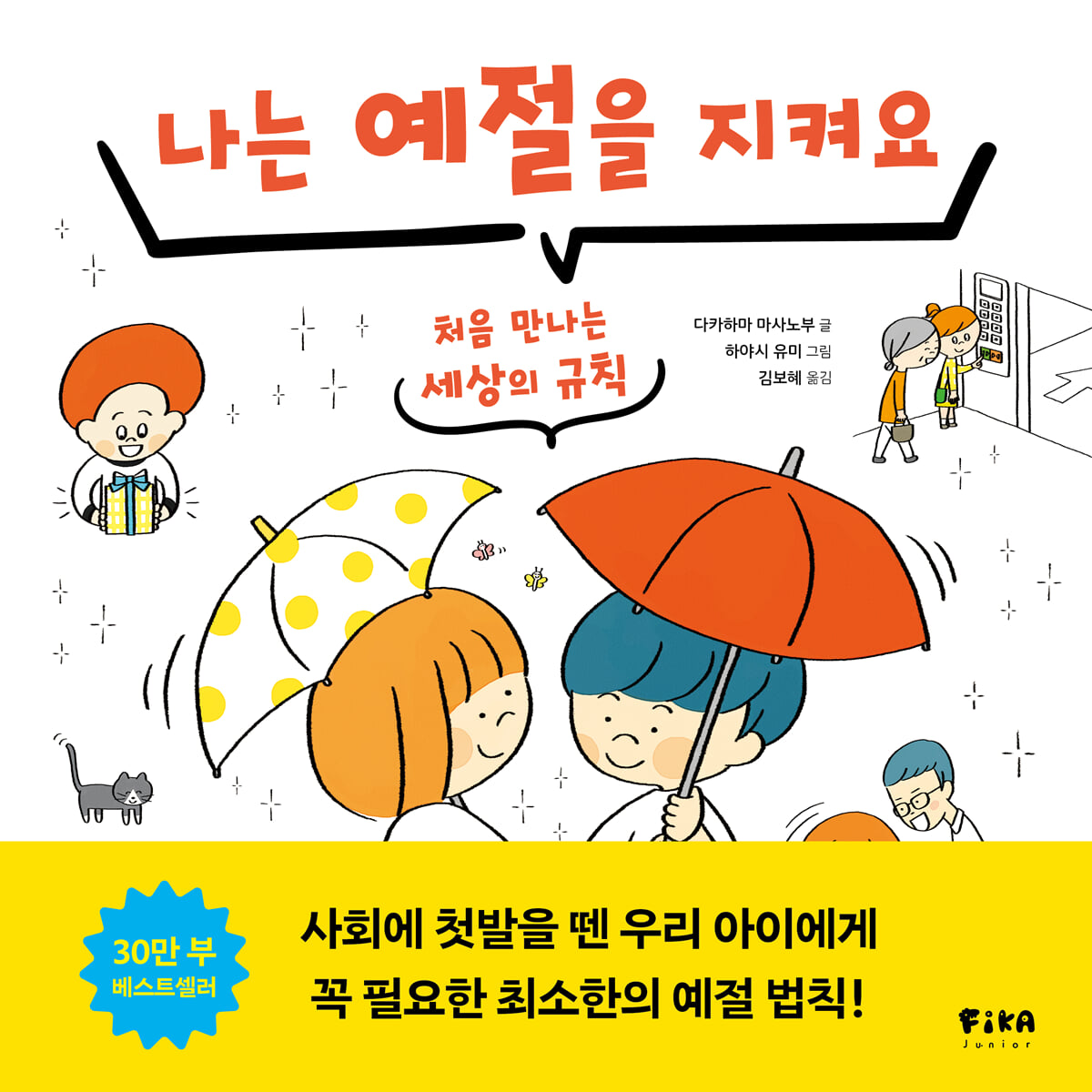
I am polite
 |
Description
Book Introduction
#1 bestseller in Korea for children and adults and on Amazon
Sequel to "I Keep My Promises" and "I Protect Myself"
22 Etiquette Habits You Want to Teach Your Kids Before They Enter Elementary School!
What and how should I tell you?
The sequel to "I Keep My Promises" and "I Protect Myself," which have sold over 300,000 copies (as of October 2023) and have become bestsellers in the Amazon children's category, "I Keep My Manners," has been published by Pikachu Junior.
Immediately after its domestic publication, 『I Keep My Promises』 became a bestseller for children, becoming a word-of-mouth hit among parents as “a book that stops mom from nagging” and “a book that teaches children to keep their promises.” 『I Protect Myself』 also gained great popularity, establishing itself as a “picture book on safe living habits.”
The new book, "I Observe Manners," contains 22 basic manners habits that children must learn at school and in everyday life, including greeting etiquette, conversation etiquette, clothing etiquette, and public place etiquette.
Our precious children can naturally learn various manners so that they can grow up to be healthy members of society.
Even without parents unilaterally teaching, children can develop the habit of reading on their own.
The last page of the text includes a post-reading activity, “Etiquette Quiz,” to help enhance the effectiveness of etiquette education.
- You can preview some of the book's contents.
Preview
Detailed image

Publisher's Review
Why do we need manners?
Etiquette Education: The Essential Foundation of Character for Our Children
Our country has been called the 'country of manners' since ancient times.
In the past, living with many brothers and sisters, we naturally learned manners such as respecting elders, greeting neighbors first, and being considerate of others.
Nowadays, with the increase in dual-income households and nuclear families, there are fewer opportunities for children to learn manners within the home.
And as society rapidly changes, children are becoming more individualistic, growing up in an environment of excessive competition for college entrance and conflict, and are increasingly moving away from words like "etiquette" and "courtesy."
Some people consider etiquette education to be tedious and out of place in modern education.
Etiquette is a way of speaking and showing respect and reverence for others. It is a considerate skill that we have maintained for a very long time to communicate naturally with others.
It is a social rule that forms healthy human relationships and a means of communication that must be observed to maintain order in social life, so it is an education that is absolutely necessary even in this day and age.
“Even my dad doesn’t say hello to the man who lives next door?”, “Why do I have to hold the door open for him when no one else does?”, “The teacher speaks informally to me, so why do I have to speak formally to him?” Etiquette is more important than anything else these days, when trust, communication, respect, and consideration for one another are gradually collapsing at home, at school, and in society.
What our precious children need most right now is not rapid growth, but ‘proper growth.’
What kind of manners should we teach our children and how should we teach them the basics of character?
“Etiquette is thinking about the other person’s situation and not forgetting to be considerate of the people and things around you.
“If you accept manners naturally and make them a habit, they will become a strong character for that person.” - From the author’s words
22 Etiquette Habits You Want to Teach Your Kids Before They Enter Elementary School!
A picture book on daily habits that provides detailed information from a child's perspective.
When we talk about etiquette education, we often think of tea ceremonies or the Cheonghak-dong where people say, "Confucius said, Mencius said."
Or, they think of etiquette education as simply a functional method, such as greetings or table manners.
The first step in etiquette education is to be considerate of others.
How can I be considerate of others? I must first organize my own mind.
You must have the right habit of filling your heart with hope and confidence and taking small steps forward.
Experts recommend using picture books or fairy tales, such as "I Have Manners," to teach about habits.
Because the story is simple and fun, children can easily get immersed in it.
Rather than controlling their children by saying, “Do this!” or “Don’t do that!”, parents should help their children develop good habits so that they can understand situations on their own and respect others.
"I Observe Manners" is a picture book on daily habits designed to help children, who are taking their first steps into society, develop the manners they need to observe in various relationships and locations.
It provides specific information on greeting etiquette, conversation etiquette, clothing etiquette, and public place etiquette, such as ‘greeting first,’ ‘using polite language to adults,’ ‘not judging others by their appearance,’ and ‘keeping one’s turn and giving in.’
We've created a book that teaches children etiquette habits that they can think about and follow on their own, using kind words and vivid, cute illustrations.
Even without parents unilaterally teaching, children can develop the habit of reading on their own.
Includes a post-reading activity called "Etiquette Quiz" to enhance the effectiveness of etiquette education.
Masanobu Takahama, a renowned Japanese education expert, says that in order for children to grow up to be adults who enjoy working, forming good relationships with people, and enjoying life, it is important for them to learn and practice the promise of the world before entering elementary school.
The author begins by discussing what etiquette is and why it is important to behave politely.
'Etiquette' is neither grand nor extravagant.
We say that we greet others first, listen to what others say, use chopsticks correctly, and make others happy and comfortable.
Children learn about the world through various relationships, learn to respect others, and grow a little more than yesterday.
To grow up to be a child with good character and not be rude, you must consistently develop good habits.
Teach them that in order to be respected themselves, they must first respect others.
Studying etiquette with your body is just as important as studying with your head.
The last page of the text includes a post-reading activity, "Etiquette Quiz," to help you develop etiquette habits.
Try to teach your child 'etiquette' one thing a day.
So that our children, who have just taken their first steps into society, can grow up to be healthy and wonderful members of society.
"This book contains 22 etiquette habits that will help children adapt to healthy interactions (relationship formation) with others.
Children who lived in a peaceful world where they were the main characters begin to feel uneasy as they form new relationships in the unfamiliar environment of school.
And you and I, we face various situations together and grow within them.
Manners are an essential virtue for children's social development.
Through this book, children can learn to look into the hearts of others and develop the virtue of courtesy, which is a way to be considerate of others and oneself.
This is a picture book that helps children discover and internalize important values on their own. _Park Su-yeon (Teacher at Gwangju Wolgok Elementary School)
★ Nuri Course Link | Social Relations, Communication
★ Elementary school curriculum linkage | Korean 1-1.
Greetings, Moral 3-5.
A happy world we protect together, Morality 3-7.
A world where we live together, morality 5-7.
Let's all watch together, Morality 5-8.
For all of us
GOODS SPECIFICS
- Date of issue: October 30, 2023
- Format: Hardcover book binding method guide
- Page count, weight, size: 60 pages | 366g | 217*217*10mm
- ISBN13: 9791192869087
- ISBN10: 1192869087
- KC Certification: Certification Type: Conformity Confirmation
You may also like
카테고리
korean


korean


