

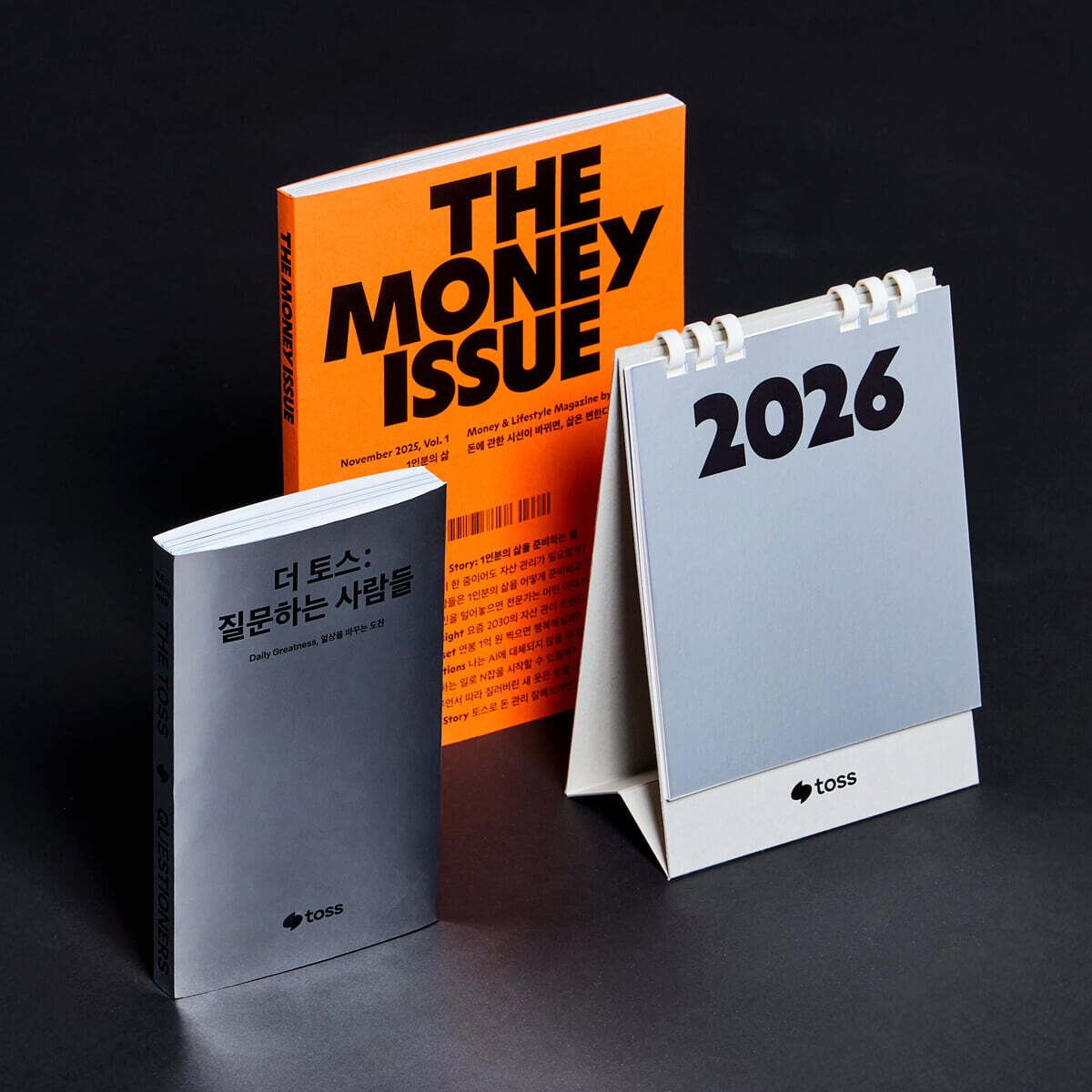
The Money Issue Magazine + Mini Brand Book + 2026 Lucky Calendar 3-piece set
 |
Description
Book Introduction
"If you change your perspective on money, your life will change."
The launch of The Money Issue, a magazine about money that never existed before.
Money is always at the center of life.
Everyone earns and spends money to live, but it is difficult to answer the question, “What standards or perspectives do I have about money?”
Because I have little experience establishing a relationship with money, money can become a source of anxiety or a means of freedom.
The Money Issue was started for those of us who are wavering at that boundary.
“Money Issue” means a magazine about money, but also carries the meaning that “issues about money are always issues about life.”
This book is an economic information magazine for today's people and a lifestyle magazine that suggests a change in attitude and perspective toward money.
If Toss's previous work, "The Money Book," was a survival guide that taught the basics of handling money, "The Money Issue" poses the following question.
"What role should money play in my life? What knowledge and mindset should I have for healthy relationships?" Amidst the endless stream of information streaming through our smartphones, books remain the most profound medium for thought.
Because I have to open the pages myself and digest the thoughts that come to mind between the lines.
This experience of independent reading is similar to the power to design one's own financial life.
With this belief in mind, Toss is launching a series that will take a little more time than usual to engage in deeper conversations with readers.
A life where you dig deep into things rather than vaguely fearing things because you don't know them, and where you set your own standards rather than just letting things flow indifferently.
The Money Issue aims to be a small catalyst that helps bring about such change.
When you are thinking about 'money and life balance',
The Money Issue's inaugural issue, Vol. 1: A Life for One Person
The theme of the inaugural issue is the life of one person.
This book contains various formats of content, including interviews, columns, case studies, essays, and short stories, about living one's part, based on 27 questions that people who need to plan for their own survival are curious about.
"Do I need asset management even if I only have a handful?" "Will I be happy with an annual salary of 100 million won?" "Can I avoid being replaced by AI?" Following these familiar yet essential questions, we explore the relationship between money and life from various perspectives, including economics, psychology, philosophy, culture, and data.
“Hidden Solutions to Questions About Money You’ve Been Asking for Years,” compiled by Jinyoung Park, CEO of economic media ‘APTI,’ and “Today’s 2030 Asset Management Trends,” analyzed by trend media ‘Carrit,’ are sufficiently helpful in increasing your understanding of money management.
In “How is Won So-yoon creating a quality life for one person?”, stand-up comedian Won So-yoon shares her own way of balancing work and life, in “What did ancient people call happiness?”, Professor Han Dong-il, author of “Latin Lessons,” shares his thoughts on happiness, and in “What is one person’s life in the vast universe?”, astronomer Lee Ju-won changes the scale of his perspective and looks at human life again, providing an opportunity to look beyond numbers.
The final chapter of "The Money Issue" has an open ending.
The moment a single sentence that accidentally touched your heart, a small desire to "give it a try" becomes part of your daily life, that's when the real story begins.
More important than a perfect plan is the small spark that starts you moving, and I sincerely hope this book will inspire you to do so.
Component 2: THE TOSS (mini brand book)
Through interviews with those in charge and digging up internal data,
The Official Toss Brand Book, Thoroughly Researched
The moment we question the inconveniences we took for granted, change begins.
This book chronicles the journey of the Toss brand, questioning what was taken for granted, creating better solutions, and changing the world's standards.
Chapter 1 explores Toss' business, including the results of how it has changed the world so far. Chapter 2 explores the work culture of the people who have shaped Toss' journey. Chapter 3 explores Toss' vision for the world it will create in the future.
* This is not for sale and can only be found through “The Money Issue, The Toss, 2026 Lucky Calendar 3-piece Set.”
Chapter 1.
Can't it be convenient and safe?
Can a single customer comment change the direction of a service?
What does it take to create the best product?
Chapter 2.
What happens when you honestly admit your failures?
Can corporate culture be maintained even as team members grow?
Chapter 3.
How far can technology change our lives?
Is convenient finance and daily life possible for everyone?
+ And 10 contents
Component 3: 2026 Toss Lucky Calendar
Every time I turn the page each month
2026 Lucky Calendar: Find Lucky Items from Around the World
Have you heard the old saying, "Keeping a bank calendar at home will bring you money?" To make this belief a reality, Toss created a calendar featuring lucky totems from around the world, including traditional Korean ones.
Throughout history and across cultures, people have kept small symbols of well-being in their daily lives.
Although their shapes and origins vary, these lucky items are filled with wishes for a peaceful life, increased wealth, and unwavering hope even in difficult times.
To celebrate the new year, Toss has prepared a calendar that brings together all those feelings.
As we turn the page each month and encounter new lucky items, we hope that our long-held wishes will come true for us today.
I sincerely hope that every day of 2026 will be filled with good luck, joy, and abundance.
The launch of The Money Issue, a magazine about money that never existed before.
Money is always at the center of life.
Everyone earns and spends money to live, but it is difficult to answer the question, “What standards or perspectives do I have about money?”
Because I have little experience establishing a relationship with money, money can become a source of anxiety or a means of freedom.
The Money Issue was started for those of us who are wavering at that boundary.
“Money Issue” means a magazine about money, but also carries the meaning that “issues about money are always issues about life.”
This book is an economic information magazine for today's people and a lifestyle magazine that suggests a change in attitude and perspective toward money.
If Toss's previous work, "The Money Book," was a survival guide that taught the basics of handling money, "The Money Issue" poses the following question.
"What role should money play in my life? What knowledge and mindset should I have for healthy relationships?" Amidst the endless stream of information streaming through our smartphones, books remain the most profound medium for thought.
Because I have to open the pages myself and digest the thoughts that come to mind between the lines.
This experience of independent reading is similar to the power to design one's own financial life.
With this belief in mind, Toss is launching a series that will take a little more time than usual to engage in deeper conversations with readers.
A life where you dig deep into things rather than vaguely fearing things because you don't know them, and where you set your own standards rather than just letting things flow indifferently.
The Money Issue aims to be a small catalyst that helps bring about such change.
When you are thinking about 'money and life balance',
The Money Issue's inaugural issue, Vol. 1: A Life for One Person
The theme of the inaugural issue is the life of one person.
This book contains various formats of content, including interviews, columns, case studies, essays, and short stories, about living one's part, based on 27 questions that people who need to plan for their own survival are curious about.
"Do I need asset management even if I only have a handful?" "Will I be happy with an annual salary of 100 million won?" "Can I avoid being replaced by AI?" Following these familiar yet essential questions, we explore the relationship between money and life from various perspectives, including economics, psychology, philosophy, culture, and data.
“Hidden Solutions to Questions About Money You’ve Been Asking for Years,” compiled by Jinyoung Park, CEO of economic media ‘APTI,’ and “Today’s 2030 Asset Management Trends,” analyzed by trend media ‘Carrit,’ are sufficiently helpful in increasing your understanding of money management.
In “How is Won So-yoon creating a quality life for one person?”, stand-up comedian Won So-yoon shares her own way of balancing work and life, in “What did ancient people call happiness?”, Professor Han Dong-il, author of “Latin Lessons,” shares his thoughts on happiness, and in “What is one person’s life in the vast universe?”, astronomer Lee Ju-won changes the scale of his perspective and looks at human life again, providing an opportunity to look beyond numbers.
The final chapter of "The Money Issue" has an open ending.
The moment a single sentence that accidentally touched your heart, a small desire to "give it a try" becomes part of your daily life, that's when the real story begins.
More important than a perfect plan is the small spark that starts you moving, and I sincerely hope this book will inspire you to do so.
Component 2: THE TOSS (mini brand book)
Through interviews with those in charge and digging up internal data,
The Official Toss Brand Book, Thoroughly Researched
The moment we question the inconveniences we took for granted, change begins.
This book chronicles the journey of the Toss brand, questioning what was taken for granted, creating better solutions, and changing the world's standards.
Chapter 1 explores Toss' business, including the results of how it has changed the world so far. Chapter 2 explores the work culture of the people who have shaped Toss' journey. Chapter 3 explores Toss' vision for the world it will create in the future.
* This is not for sale and can only be found through “The Money Issue, The Toss, 2026 Lucky Calendar 3-piece Set.”
Chapter 1.
Can't it be convenient and safe?
Can a single customer comment change the direction of a service?
What does it take to create the best product?
Chapter 2.
What happens when you honestly admit your failures?
Can corporate culture be maintained even as team members grow?
Chapter 3.
How far can technology change our lives?
Is convenient finance and daily life possible for everyone?
+ And 10 contents
Component 3: 2026 Toss Lucky Calendar
Every time I turn the page each month
2026 Lucky Calendar: Find Lucky Items from Around the World
Have you heard the old saying, "Keeping a bank calendar at home will bring you money?" To make this belief a reality, Toss created a calendar featuring lucky totems from around the world, including traditional Korean ones.
Throughout history and across cultures, people have kept small symbols of well-being in their daily lives.
Although their shapes and origins vary, these lucky items are filled with wishes for a peaceful life, increased wealth, and unwavering hope even in difficult times.
To celebrate the new year, Toss has prepared a calendar that brings together all those feelings.
As we turn the page each month and encounter new lucky items, we hope that our long-held wishes will come true for us today.
I sincerely hope that every day of 2026 will be filled with good luck, joy, and abundance.
index
Components
(1) THE MONEY ISSUE (magazine)
Editor's Letter
The idea of launching a magazine about money and life
Cover Story: How to Prepare for Life on Your Own
Is asset management necessary even if you only have a handful of money? by Park Ji-soo
What does it mean to make money work for you while you sleep?
How do people prepare for life as a single person?
- How did you save up your first seed money and what did you spend it on?
- How are you managing your assets?
- What do you think is important in life other than money?
- What content inspired you to live a good life?
How does Won So-yoon create a quality, single-serving life? by Won So-yoon
What would an expert say if you shared your money worries? by Apti
Is the cost of living for a single-person household only a quarter of that of a four-person household? by Noh Yoon-joo and Hong In-hye
What is life for one person in the vast universe? by Lee Ju-won
Data & Insight
What are the current asset management trends for 2030? by Carrit
Where did my unused salary go?
Mindset
Will Earning 100 Million Won Make You Happy? by Seo Eun-guk
What did ancient people call happiness? by Han Dong-il
What did Virginia Woolf think about money?
Life Inspirations
Would a Shorter Commute Make You Happy? by Jang Jae-min
Why do we receive our salaries once a month, as "monthly salaries"? by Sim Yong-hwan
Could I Be Replaced by AI? by Oh Soon-young
If AI Gives Humans "Complete Rest," What Will I Do? by Cheon Seon-ran
Can I start a career doing what I love?
- Is it possible to start a cafe with 10 million won while working at a company?
- Can I make money with my Instagram fan account?
- How to earn money for coffee by taking care of cute cats?
- How can I create a side character that synergizes with my main job based on an interest I developed while watching YouTube?
Would it be possible to suddenly move to an unfamiliar place and live there?
- What is the secret to opening a store in Tongyeong with your own taste?
- What made you find balance in your life by commuting between Seoul and Gurye?
- Why did you come down to Haenam and become serious about saving the village?
Lifestyle
How Much Does It Take to Maintain Mental Health? by Psychiatrist Brain Rich
Is that new outfit I bought after following an influencer really my style? by Hong Sang-ji
Lotto and Lottery Tickets: When Did We Start Buying Luck? by Sim Yong-hwan
How did F1, once a sport of its own, become a hit Netflix series? by Lee Jong-seong
What kind of music do people listen to when they want to get rich?
How to improve your luck with money?
Toss Story
How to manage your money well with Toss?
The Real Reason Your Face Is Special: Toss Original Film "The Power of Face"
Is there any easy and convenient investment information? by Toss Securities Research Center
What if one Toss app could handle everything from public services to games, transportation, and shopping?
Survey: Waiting for the reader postcards to arrive…
Where to find magazines
(2) THE TOSS (Brand Book)
(3) 2026 Toss Lucky Calendar
(1) THE MONEY ISSUE (magazine)
Editor's Letter
The idea of launching a magazine about money and life
Cover Story: How to Prepare for Life on Your Own
Is asset management necessary even if you only have a handful of money? by Park Ji-soo
What does it mean to make money work for you while you sleep?
How do people prepare for life as a single person?
- How did you save up your first seed money and what did you spend it on?
- How are you managing your assets?
- What do you think is important in life other than money?
- What content inspired you to live a good life?
How does Won So-yoon create a quality, single-serving life? by Won So-yoon
What would an expert say if you shared your money worries? by Apti
Is the cost of living for a single-person household only a quarter of that of a four-person household? by Noh Yoon-joo and Hong In-hye
What is life for one person in the vast universe? by Lee Ju-won
Data & Insight
What are the current asset management trends for 2030? by Carrit
Where did my unused salary go?
Mindset
Will Earning 100 Million Won Make You Happy? by Seo Eun-guk
What did ancient people call happiness? by Han Dong-il
What did Virginia Woolf think about money?
Life Inspirations
Would a Shorter Commute Make You Happy? by Jang Jae-min
Why do we receive our salaries once a month, as "monthly salaries"? by Sim Yong-hwan
Could I Be Replaced by AI? by Oh Soon-young
If AI Gives Humans "Complete Rest," What Will I Do? by Cheon Seon-ran
Can I start a career doing what I love?
- Is it possible to start a cafe with 10 million won while working at a company?
- Can I make money with my Instagram fan account?
- How to earn money for coffee by taking care of cute cats?
- How can I create a side character that synergizes with my main job based on an interest I developed while watching YouTube?
Would it be possible to suddenly move to an unfamiliar place and live there?
- What is the secret to opening a store in Tongyeong with your own taste?
- What made you find balance in your life by commuting between Seoul and Gurye?
- Why did you come down to Haenam and become serious about saving the village?
Lifestyle
How Much Does It Take to Maintain Mental Health? by Psychiatrist Brain Rich
Is that new outfit I bought after following an influencer really my style? by Hong Sang-ji
Lotto and Lottery Tickets: When Did We Start Buying Luck? by Sim Yong-hwan
How did F1, once a sport of its own, become a hit Netflix series? by Lee Jong-seong
What kind of music do people listen to when they want to get rich?
How to improve your luck with money?
Toss Story
How to manage your money well with Toss?
The Real Reason Your Face Is Special: Toss Original Film "The Power of Face"
Is there any easy and convenient investment information? by Toss Securities Research Center
What if one Toss app could handle everything from public services to games, transportation, and shopping?
Survey: Waiting for the reader postcards to arrive…
Where to find magazines
(2) THE TOSS (Brand Book)
(3) 2026 Toss Lucky Calendar
Detailed image

Into the book
Asset management is like gardening.
Just as a beautiful landscape is created over time by planning where, what, and how much to plant in advance, it's best to design a portfolio framework from the beginning, steadily fill it with financial products suited to each asset, and adjust it from time to time.
A portfolio refers to the proportion of various assets such as stocks, bonds, real estate, cash, and gold contained in a basket of assets.
If you want to manage your savings without risk, it's okay to increase the proportion of products with guaranteed principal until you're ready.
However, if you want to start investing a little more actively, you can set a desired ratio, such as 50% stocks, 35% bonds, and 15% alternative assets (gold, cryptocurrencies, etc.), and subscribe to products that match that ratio or purchase ETFs related to that field.
---From "Do I need to manage my assets even if I only have a handful of money?"
Can ‘quitting a job’ also be considered an investment?
I quit my job quickly to save energy and time.
I have a habit of using elimination to eliminate things once I start if I feel like it's not right.
I tend to do the things I really don't want to do as little as possible.
I know there's advice like, "You have to do things you don't want to do to improve," but I don't want to get used to doing things I don't want to do.
There must be a good reason why you don't want to do it, but you don't want to go against that instinct.
I try to focus on doing what I want to do as much as possible.
If you only choose to do things you like, your sense of what you like will become sharper.
---From "How is Won So-yoon creating a quality life for one person?"
I know that I need to reduce taxi fares, but I still take taxis because of the stress and desire for compensation when I get home after working late.
Even though I know the principle that 'you have to pay off your loans first,' I sometimes lose my will because of the emptiness of feeling like I'm pouring water into a bottomless pit while others' assets grow.
If you set a goal of 'saving 100 million won quickly' and save unconditionally, you may find yourself unable to control your desire to spend once it explodes, and you may end up in a state of self-abandonment.
The numbers may be clear, but life isn't as simple as numbers.
---From "What would an expert say if you told them about your money worries?"
They say we all have a piece of a star.
It's not just a cool word.
In fact, the sun, the earth, and life on this land are made of materials created by stars in the past.
Stars are all beautiful, big or small, bright or dim.
There is no such thing as a useless being.
When I gave up on a long-time dream and started down this path, I had this thought.
If we are truly descendants of the stars, then we are all indispensable to this world, just as the stars are.
Surely, somewhere out there, there is a job, a person, and a place that is right for me.
---From "What is the life of one person in the vast universe?"
How is Generation MZ currently preparing for retirement? "Reducing spending and saving" ranked first, at 40.2%.
A significant number of respondents also mentioned using pension products (26.9%) and active investment (25.8%).
Previously, we were able to confirm the tendency of the MZ generation to prefer investments with low risk and steady returns over investments with high risk and high returns.
In a similar vein, we can see that people are planning for retirement in a stable way, reducing consumption and saving, rather than making active investments.
One interesting thing is that, after conducting in-depth interviews, many MZ generation members responded that they would prepare for retirement by investing and saving little by little from an early age, taking into account the 'compound interest effect'.
This is a passage that shows that the so-called 'magic of compound interest' has emerged as a topic related to financial management among them.
---From "What are the asset management trends for 2030?"
On payday, I tilt my head when I see the numbers in my bankbook.
"My salary is clearly 2.5 million won, but why did I only get 2.1 million won?" 400,000 won disappeared before I even received it.
Where on earth did it go?
The salary written in the employment contract is usually the 'amount before tax deduction (pre-tax)'.
But what I actually receive is the 'after-tax amount'.
To be exact, the remaining amount after deducting taxes and social security premiums from your monthly salary is deposited into your bank account.
When a company paying this cost deducts it in advance and pays it to the government on its behalf, this is called 'withholding tax'.
After deducting the withholding tax, what you always end up with is a handful of your net take home pay.
But there's a reason for all the money you pay each month.
---From "Where did my unused salary go?"
We asked a simple question to 150,000 people living in various countries around the world.
“How many times have you eaten meals with other people in the past week?” We surveyed happiness indices along with responses to this question.
As a result, people who ate with others eight times a week had higher happiness indexes than those who ate with others twice a week.
What's surprising here is that the difference in happiness index was much greater than the difference in happiness index between people with an annual salary difference of tens of millions of won.
If you want to raise your annual salary by 30-40 million won, you'll have to put your life on the line, right? And there's no guarantee that your salary will skyrocket just because you put in the effort.
But more than that effort, eating one more meal with someone a week brings me greater happiness.
---From "Will I be happy if I earn 100 million won a year?"
Happiness is like a candy that you put in your mouth every now and then during that bitter process.
Even though it will soon melt away, it creates a moment of awakening that gives you the strength to move forward again with a recharged sugar.
There are times in life when you need candy, but candy itself cannot be the goal.
The sweet feeling of being respected, acknowledged, and loved is a great strength in life, but no matter what the external circumstances, there is no greater strength than the inner strength that is built up by gradually building a good attitude.
---From "What did the ancient people call happiness?"
If you look at the Samguk Sagi, there is a record that King Gyeongdeok “abolished the monthly stipends given to various central and local officials in March and gave them back their stipends.”
Here, the salary is the monthly salary.
Since the Three Kingdoms period, salaried workers have received a monthly salary.
For reference, Nok-eup means land.
We learn in school that the power of the nobility was strengthened because they were given land instead of wages.
In any case, the important fact for us is that even during the Three Kingdoms period, Gap-yeo was held 'once a month'.
---From "Why do we get paid once a month, as a monthly salary?"
Even if you want to buy a bag or a pair of jeans, hundreds or thousands of products appear on numerous websites.
The book "Stolen Concentration" explains that the amount of information that pours into a person every day is equivalent to reading 174 newspapers.
There is so much information that there is no time to focus on each piece of information.
Buying "recommended items" that have already been verified by influential figures is the most efficient way to save time, reduce the risk of failure, and keep up with trends.
It is a shortcut that helps you make the right choice without getting lost in the sea of information.
Maybe that's why.
The trendy word 'Son Min-su-hada', which is named after a character in the webtoon 'Cheese in the Trap' that darkly imitates the main character's fashion, hairstyle, and behavior, seems to have lost much of its negative nuance compared to before, following the trend of ditto consumption.
Just as a beautiful landscape is created over time by planning where, what, and how much to plant in advance, it's best to design a portfolio framework from the beginning, steadily fill it with financial products suited to each asset, and adjust it from time to time.
A portfolio refers to the proportion of various assets such as stocks, bonds, real estate, cash, and gold contained in a basket of assets.
If you want to manage your savings without risk, it's okay to increase the proportion of products with guaranteed principal until you're ready.
However, if you want to start investing a little more actively, you can set a desired ratio, such as 50% stocks, 35% bonds, and 15% alternative assets (gold, cryptocurrencies, etc.), and subscribe to products that match that ratio or purchase ETFs related to that field.
---From "Do I need to manage my assets even if I only have a handful of money?"
Can ‘quitting a job’ also be considered an investment?
I quit my job quickly to save energy and time.
I have a habit of using elimination to eliminate things once I start if I feel like it's not right.
I tend to do the things I really don't want to do as little as possible.
I know there's advice like, "You have to do things you don't want to do to improve," but I don't want to get used to doing things I don't want to do.
There must be a good reason why you don't want to do it, but you don't want to go against that instinct.
I try to focus on doing what I want to do as much as possible.
If you only choose to do things you like, your sense of what you like will become sharper.
---From "How is Won So-yoon creating a quality life for one person?"
I know that I need to reduce taxi fares, but I still take taxis because of the stress and desire for compensation when I get home after working late.
Even though I know the principle that 'you have to pay off your loans first,' I sometimes lose my will because of the emptiness of feeling like I'm pouring water into a bottomless pit while others' assets grow.
If you set a goal of 'saving 100 million won quickly' and save unconditionally, you may find yourself unable to control your desire to spend once it explodes, and you may end up in a state of self-abandonment.
The numbers may be clear, but life isn't as simple as numbers.
---From "What would an expert say if you told them about your money worries?"
They say we all have a piece of a star.
It's not just a cool word.
In fact, the sun, the earth, and life on this land are made of materials created by stars in the past.
Stars are all beautiful, big or small, bright or dim.
There is no such thing as a useless being.
When I gave up on a long-time dream and started down this path, I had this thought.
If we are truly descendants of the stars, then we are all indispensable to this world, just as the stars are.
Surely, somewhere out there, there is a job, a person, and a place that is right for me.
---From "What is the life of one person in the vast universe?"
How is Generation MZ currently preparing for retirement? "Reducing spending and saving" ranked first, at 40.2%.
A significant number of respondents also mentioned using pension products (26.9%) and active investment (25.8%).
Previously, we were able to confirm the tendency of the MZ generation to prefer investments with low risk and steady returns over investments with high risk and high returns.
In a similar vein, we can see that people are planning for retirement in a stable way, reducing consumption and saving, rather than making active investments.
One interesting thing is that, after conducting in-depth interviews, many MZ generation members responded that they would prepare for retirement by investing and saving little by little from an early age, taking into account the 'compound interest effect'.
This is a passage that shows that the so-called 'magic of compound interest' has emerged as a topic related to financial management among them.
---From "What are the asset management trends for 2030?"
On payday, I tilt my head when I see the numbers in my bankbook.
"My salary is clearly 2.5 million won, but why did I only get 2.1 million won?" 400,000 won disappeared before I even received it.
Where on earth did it go?
The salary written in the employment contract is usually the 'amount before tax deduction (pre-tax)'.
But what I actually receive is the 'after-tax amount'.
To be exact, the remaining amount after deducting taxes and social security premiums from your monthly salary is deposited into your bank account.
When a company paying this cost deducts it in advance and pays it to the government on its behalf, this is called 'withholding tax'.
After deducting the withholding tax, what you always end up with is a handful of your net take home pay.
But there's a reason for all the money you pay each month.
---From "Where did my unused salary go?"
We asked a simple question to 150,000 people living in various countries around the world.
“How many times have you eaten meals with other people in the past week?” We surveyed happiness indices along with responses to this question.
As a result, people who ate with others eight times a week had higher happiness indexes than those who ate with others twice a week.
What's surprising here is that the difference in happiness index was much greater than the difference in happiness index between people with an annual salary difference of tens of millions of won.
If you want to raise your annual salary by 30-40 million won, you'll have to put your life on the line, right? And there's no guarantee that your salary will skyrocket just because you put in the effort.
But more than that effort, eating one more meal with someone a week brings me greater happiness.
---From "Will I be happy if I earn 100 million won a year?"
Happiness is like a candy that you put in your mouth every now and then during that bitter process.
Even though it will soon melt away, it creates a moment of awakening that gives you the strength to move forward again with a recharged sugar.
There are times in life when you need candy, but candy itself cannot be the goal.
The sweet feeling of being respected, acknowledged, and loved is a great strength in life, but no matter what the external circumstances, there is no greater strength than the inner strength that is built up by gradually building a good attitude.
---From "What did the ancient people call happiness?"
If you look at the Samguk Sagi, there is a record that King Gyeongdeok “abolished the monthly stipends given to various central and local officials in March and gave them back their stipends.”
Here, the salary is the monthly salary.
Since the Three Kingdoms period, salaried workers have received a monthly salary.
For reference, Nok-eup means land.
We learn in school that the power of the nobility was strengthened because they were given land instead of wages.
In any case, the important fact for us is that even during the Three Kingdoms period, Gap-yeo was held 'once a month'.
---From "Why do we get paid once a month, as a monthly salary?"
Even if you want to buy a bag or a pair of jeans, hundreds or thousands of products appear on numerous websites.
The book "Stolen Concentration" explains that the amount of information that pours into a person every day is equivalent to reading 174 newspapers.
There is so much information that there is no time to focus on each piece of information.
Buying "recommended items" that have already been verified by influential figures is the most efficient way to save time, reduce the risk of failure, and keep up with trends.
It is a shortcut that helps you make the right choice without getting lost in the sea of information.
Maybe that's why.
The trendy word 'Son Min-su-hada', which is named after a character in the webtoon 'Cheese in the Trap' that darkly imitates the main character's fashion, hairstyle, and behavior, seems to have lost much of its negative nuance compared to before, following the trend of ditto consumption.
---From "Is the new clothes I bought following an influencer really my style?"
GOODS SPECIFICS
- Date of issue: December 1, 2025
- Page count, weight, size: 30 pages | 246*175*15mm
- ISBN13: 9791198686152
- ISBN10: 1198686154
You may also like
카테고리
korean


korean

![GQ KOREA Mark (Monthly): December [2025]](http://librairie.coreenne.fr/cdn/shop/files/8ef265dbbfbf186523ed75ba7319009d.jpg?v=1765340328&width=3840)


