

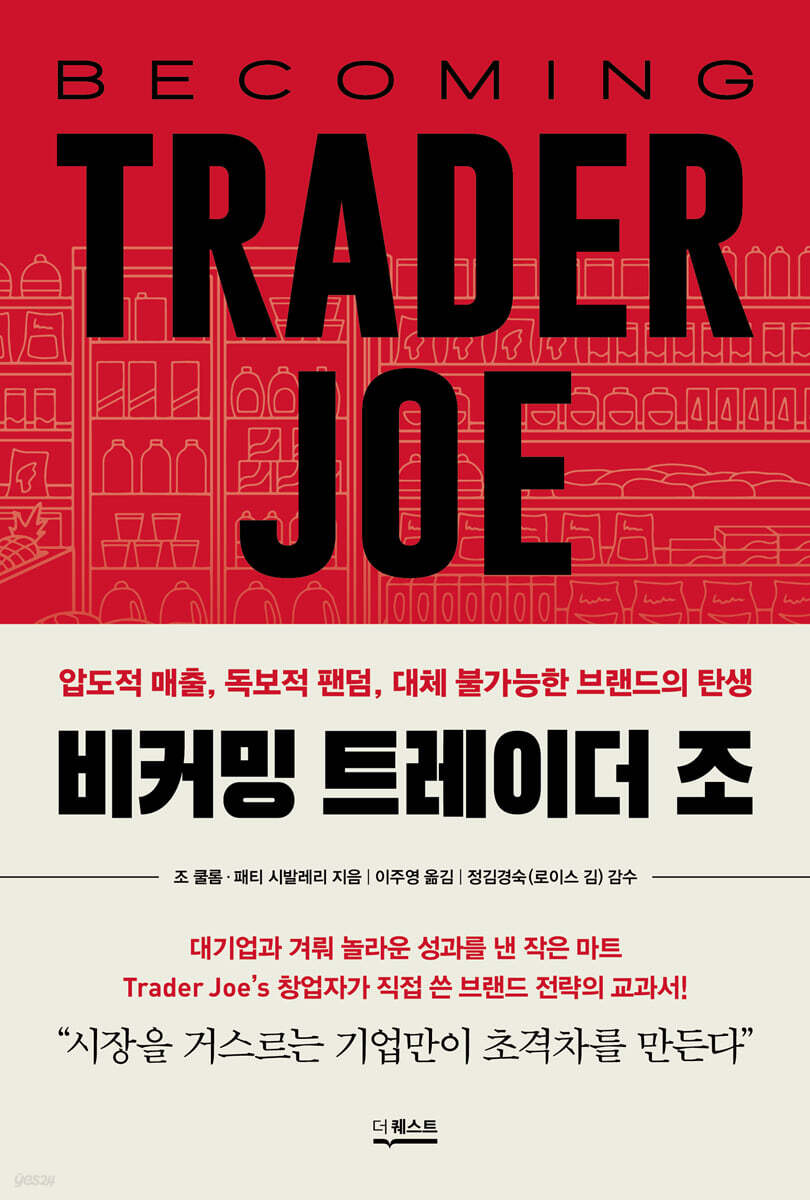
Becoming Trader Joe's
 |
Description
Book Introduction
The only book left behind by the founder of Trader Joe's!
The unconventional management strategy of a small mart that achieved surprising results by competing with large corporations!
The Korean version of "Becoming Trader Joe," a book by Joe Coulomb, founder of the American supermarket chain Trader Joe's, has been published by The Quest.
In this book, the author reveals the secrets of Trader Joe's success, which achieved first place in the American Customer Satisfaction Index (ACSI) and sales per square foot, competing with giant retailers such as Walmart, Costco, and Whole Foods.
· Creative planning: How to discover new products that never existed before and dominate the market.
· Reverse Marketing: Building a Fandom Through Naming and Packaging Strategies Without Advertising or Discounts
· Management Insight: The Power of Focus and a Change of Perspective to Turn Crisis into Opportunity
"Instead of reckless business expansion, innovate with 'brand identity'!"
_The only strategy needed by Korean retailers to survive offline in the online age
To the public, Trader Joe's is still known only as an American supermarket that sells 'eco-bags' and 'frozen kimbap.'
However, to practitioners who consider sales, marketing, and business strategy, Trader Joe's is considered the most trusted brand by American consumers and an unprecedented success story that has triumphed over the retail giants with its "small-town supermarket" sensibility.
In an era when offline retail is struggling globally, Trader Joe's is the only brand that has grown both sales and fanbase without expanding its store network.
The recently published management strategy book by Trader Joe's founder clearly demonstrates how a company can grow through "strengthening its identity" rather than "expanding its scale" in a diversified market.
In today's world of rapidly changing trends and highly fragmented customer preferences, Trader Joe's strategy offers practical insights that can be immediately applied to the Korean retail and branding industries.
In the Korean market, which is heavily focused on large-scale and automated operations, Trader Joe's principle of "small, simple, deep" will be a powerful alternative.
In particular, the management philosophy of creating a 'brand loved even without advertising' is a useful strategy in an era when customer loyalty is wavering.
This book, which contains the secrets of Trader Joe's remarkable success for over 50 years, including bold SKU reduction, employee-centered operations, a local store philosophy, and differentiated product development, is a must-read for distribution companies, F&B brands, retail startups, marketers, and entrepreneurs, offering survival strategies for today's times.
The unconventional management strategy of a small mart that achieved surprising results by competing with large corporations!
The Korean version of "Becoming Trader Joe," a book by Joe Coulomb, founder of the American supermarket chain Trader Joe's, has been published by The Quest.
In this book, the author reveals the secrets of Trader Joe's success, which achieved first place in the American Customer Satisfaction Index (ACSI) and sales per square foot, competing with giant retailers such as Walmart, Costco, and Whole Foods.
· Creative planning: How to discover new products that never existed before and dominate the market.
· Reverse Marketing: Building a Fandom Through Naming and Packaging Strategies Without Advertising or Discounts
· Management Insight: The Power of Focus and a Change of Perspective to Turn Crisis into Opportunity
"Instead of reckless business expansion, innovate with 'brand identity'!"
_The only strategy needed by Korean retailers to survive offline in the online age
To the public, Trader Joe's is still known only as an American supermarket that sells 'eco-bags' and 'frozen kimbap.'
However, to practitioners who consider sales, marketing, and business strategy, Trader Joe's is considered the most trusted brand by American consumers and an unprecedented success story that has triumphed over the retail giants with its "small-town supermarket" sensibility.
In an era when offline retail is struggling globally, Trader Joe's is the only brand that has grown both sales and fanbase without expanding its store network.
The recently published management strategy book by Trader Joe's founder clearly demonstrates how a company can grow through "strengthening its identity" rather than "expanding its scale" in a diversified market.
In today's world of rapidly changing trends and highly fragmented customer preferences, Trader Joe's strategy offers practical insights that can be immediately applied to the Korean retail and branding industries.
In the Korean market, which is heavily focused on large-scale and automated operations, Trader Joe's principle of "small, simple, deep" will be a powerful alternative.
In particular, the management philosophy of creating a 'brand loved even without advertising' is a useful strategy in an era when customer loyalty is wavering.
This book, which contains the secrets of Trader Joe's remarkable success for over 50 years, including bold SKU reduction, employee-centered operations, a local store philosophy, and differentiated product development, is a must-read for distribution companies, F&B brands, retail startups, marketers, and entrepreneurs, offering survival strategies for today's times.
- You can preview some of the book's contents.
Preview
index
Reviewer's note
Praise poured in for this book
Introduction: There are no miracles in business, only strategies.
Co-author's note
Trader Joe's Sampler: The Best Deals We've Ever Made
Part 1: The Birth of Trader Joe's
Chapter 1: Crisis Comes Suddenly
Chapter 2: Twenty-Seven: Becoming President of Pronto Market
Chapter 3: Efforts and Results for Success
Chapter 4: The Road to Trader Joe's
Chapter 5: Finding Differentiation in a Uniform Market
Chapter 6, First Version, Good Time Charlie
Chapter 7: Wine for People with High Education and Low Income
Chapter 8, Second Edition, Whole Earth Harry
Chapter 9: Don't Sell, Make People Buy
Chapter 10: Turning Crisis into Opportunity
Part 2: The Secret of an Irreplaceable Brand
Chapter 11, Third Edition, Mac the Knife
Chapter 12: Focused Purchasing Strategy
Chapter 13: Integrated Logistics System
Chapter 14 Private Label Products
Chapter 15: Inventory Clearance or Treasure Hunt
Chapter 16: Conditions for a Strong Store
Chapter 17: The Skunk in the Office
Chapter 18: Double-entry bookkeeping in retail
Chapter 19: The Demand Side of Retail
Chapter 20: The Supply Side of Retailing
Chapter 21: The Final Five-Year Plan
The Final Decision of the Third Part Founder
Chapter 22 Employee Ownership System
Chapter 23: Trader Joe's Sale
Chapter 24: Back to Entrepreneurship
Going Out: Work and Life Outside Trader Joe's
Praise poured in for this book
Introduction: There are no miracles in business, only strategies.
Co-author's note
Trader Joe's Sampler: The Best Deals We've Ever Made
Part 1: The Birth of Trader Joe's
Chapter 1: Crisis Comes Suddenly
Chapter 2: Twenty-Seven: Becoming President of Pronto Market
Chapter 3: Efforts and Results for Success
Chapter 4: The Road to Trader Joe's
Chapter 5: Finding Differentiation in a Uniform Market
Chapter 6, First Version, Good Time Charlie
Chapter 7: Wine for People with High Education and Low Income
Chapter 8, Second Edition, Whole Earth Harry
Chapter 9: Don't Sell, Make People Buy
Chapter 10: Turning Crisis into Opportunity
Part 2: The Secret of an Irreplaceable Brand
Chapter 11, Third Edition, Mac the Knife
Chapter 12: Focused Purchasing Strategy
Chapter 13: Integrated Logistics System
Chapter 14 Private Label Products
Chapter 15: Inventory Clearance or Treasure Hunt
Chapter 16: Conditions for a Strong Store
Chapter 17: The Skunk in the Office
Chapter 18: Double-entry bookkeeping in retail
Chapter 19: The Demand Side of Retail
Chapter 20: The Supply Side of Retailing
Chapter 21: The Final Five-Year Plan
The Final Decision of the Third Part Founder
Chapter 22 Employee Ownership System
Chapter 23: Trader Joe's Sale
Chapter 24: Back to Entrepreneurship
Going Out: Work and Life Outside Trader Joe's
Detailed image

Into the book
I've been asked many times, "Why hasn't anyone else successfully copied Trader Joe's?"
The answer to this question is that no one was willing to offer high wages and benefits, and thus failed to attract and retain talented employees like Trader Joe's employees.
My criteria were simple.
The average full-time employee working in a store would need to earn the median household income in California.
--- p.57, from “Chapter 3 Efforts and Results for Success”
What I needed was a small but good opportunity for a small but good company.
This is an opportunity to run a differentiated distribution business rather than selling standardized products.
Of course, I could have sold the chain to 7-Eleven and continued working there, or I could have worked for another company.
But the tedious management environment I experienced, first at Rexall and then at Hughes Aircraft, convinced me that if I wanted true stability, I needed to start my own business.
--- p.71, from “Chapter 4: The Road to Trader Joe’s”
When dealing with customers, never use coercive language or give orders.
Trader Joe's ad contains the following subliminal message:
“We will be together for a long time.
Even if you miss this opportunity, there will be another one next time.
“All you need is time and the will to come.”
--- p.141, from “Chapter 9: Don’t Sell, Make People Buy”
The basic job of a retailer is to buy goods in bulk, divide them into smaller pieces, and sell them to the end consumer.
This is the most important idea I can give to anyone who wants to get into retail.
Most 'retailers' have no idea what this term really means.
--- p.167, from “Chapter 11, Third Version, Mac the Knife”
In the process, we discontinued numerous products that customers wanted to see in our stores, even though they were selling at reasonable prices.
(…) We also eliminated the price discount system for bulk purchases and continued to shorten business hours.
We've thrown out all the conventional wisdom that's been used in the retail industry.
But one thing that most retailers fail to do is to offer great value.
--- p.169, from “Chapter 11, Third Version, Mac the Knife”
Of their private label coffees, my favorite was the 'Heisenberg Uncertainty Blend' coffee beans.
As coffee roasters roast different types of beans, some of them may fall under the conveyor belt.
They periodically collect these fallen beans, roast them, and sell them to us at a very low price.
(…) How many customers have heard of Heisenberg? Probably not many.
But the customers who got the joke literally connected with us forever.
Moreover, this product was so cheap that even people who didn't know much about coffee bought it.
--- p.213, from “Chapter 14 Private Label Products”
My experience working in the front market gave me the confidence that where there is no competition today, there will be competition tomorrow.
Except in rare cases where a location is geographically difficult for competitors to enter, or even more rarely, where the city council is rightfully protecting the commercial area, you should assume that there will be competition nearby.
The answer is to design a store that has no competitors.
So Mac the Knife shouldn't carry any SKUs that aren't excellent.
--- p.235, from “Chapter 16 Conditions for a Strong Store”
“In fact, we are one of the most efficient grocery retailers in Los Angeles.
(…) ready to push hard to survive the early 1980s.
We are leaders in satisfying the tastes of today's educated public.
Their income may decrease, but they will maintain their new tastes.
“You will find even more value in our best-selling products.”
The answer to this question is that no one was willing to offer high wages and benefits, and thus failed to attract and retain talented employees like Trader Joe's employees.
My criteria were simple.
The average full-time employee working in a store would need to earn the median household income in California.
--- p.57, from “Chapter 3 Efforts and Results for Success”
What I needed was a small but good opportunity for a small but good company.
This is an opportunity to run a differentiated distribution business rather than selling standardized products.
Of course, I could have sold the chain to 7-Eleven and continued working there, or I could have worked for another company.
But the tedious management environment I experienced, first at Rexall and then at Hughes Aircraft, convinced me that if I wanted true stability, I needed to start my own business.
--- p.71, from “Chapter 4: The Road to Trader Joe’s”
When dealing with customers, never use coercive language or give orders.
Trader Joe's ad contains the following subliminal message:
“We will be together for a long time.
Even if you miss this opportunity, there will be another one next time.
“All you need is time and the will to come.”
--- p.141, from “Chapter 9: Don’t Sell, Make People Buy”
The basic job of a retailer is to buy goods in bulk, divide them into smaller pieces, and sell them to the end consumer.
This is the most important idea I can give to anyone who wants to get into retail.
Most 'retailers' have no idea what this term really means.
--- p.167, from “Chapter 11, Third Version, Mac the Knife”
In the process, we discontinued numerous products that customers wanted to see in our stores, even though they were selling at reasonable prices.
(…) We also eliminated the price discount system for bulk purchases and continued to shorten business hours.
We've thrown out all the conventional wisdom that's been used in the retail industry.
But one thing that most retailers fail to do is to offer great value.
--- p.169, from “Chapter 11, Third Version, Mac the Knife”
Of their private label coffees, my favorite was the 'Heisenberg Uncertainty Blend' coffee beans.
As coffee roasters roast different types of beans, some of them may fall under the conveyor belt.
They periodically collect these fallen beans, roast them, and sell them to us at a very low price.
(…) How many customers have heard of Heisenberg? Probably not many.
But the customers who got the joke literally connected with us forever.
Moreover, this product was so cheap that even people who didn't know much about coffee bought it.
--- p.213, from “Chapter 14 Private Label Products”
My experience working in the front market gave me the confidence that where there is no competition today, there will be competition tomorrow.
Except in rare cases where a location is geographically difficult for competitors to enter, or even more rarely, where the city council is rightfully protecting the commercial area, you should assume that there will be competition nearby.
The answer is to design a store that has no competitors.
So Mac the Knife shouldn't carry any SKUs that aren't excellent.
--- p.235, from “Chapter 16 Conditions for a Strong Store”
“In fact, we are one of the most efficient grocery retailers in Los Angeles.
(…) ready to push hard to survive the early 1980s.
We are leaders in satisfying the tastes of today's educated public.
Their income may decrease, but they will maintain their new tastes.
“You will find even more value in our best-selling products.”
--- p.315, from “Chapter 21: The Last Five-Year Plan”
Publisher's Review
"No ads! No discounts! No online store! And yet, it's the overwhelming #1!"
_The Unconventional Management and Marketing Formula for Creating a 'Fandom'
No unnecessary advertising.
→ Instead, publish your own paper newsletter and actively reach out to your target audience to capture their attention.
There is no price discount.
→ Focus only on ‘buying good products and selling them cheaply.’
We do not operate an online mall.
→ The essence of food retailing is the store.
Even in the digital age, analog sensibility is bound to be effective.
This book vividly tells the story of Trader Joe's founding, from the founder's perspective, through detailed accounts of purchasing and pricing strategies, advertising, logistics, store operations, and talent management.
This ultimately answers the question, "How did Trader Joe's manage to compete with the big franchises and achieve unparalleled success?"
① Creative planning: Trader Joe's discovers new items that are not available in the market and is the first to monopolize the opportunity.
We do not carry popular products that can be found anywhere, such as Coca-Cola.
Rather than stocking a wide variety of products, they focus on a small selection of products that consumers clearly want, and sell only "edible products" that fit the essence of a grocery store.
② Reverse marketing: We do not engage in price competition or advertising competition that lowers profitability.
Instead, they target a small group of fans precisely by publishing their own paper newsletter and including news from local groups in their shopping bags.
A friendly staff with extensive product knowledge and a welcoming store atmosphere create a store that customers want to keep visiting, ultimately forming a 'fandom'.
③ Management Insight: Trader Joe's doesn't hesitate to make changes to improve efficiency.
It pays its employees top wages and was the first in the industry to accept credit card payments.
By reducing the management to three groups—purchasing, human resources/sales, and accounting—the focus is solely on the essentials of retail: buying and selling goods.
“How are irreplaceable brands created?”
_Three versions of Trader Joe's that turned a crisis into an opportunity
Whenever faced with a crisis, Joe Coulombe strives to find a reasonable solution, not an optimal one.
Because business is always changing, we wanted to adapt our corporate branding strategy to change, that is, to respond flexibly and in different versions.
Through this evolutionary process, we can learn about the secrets of Trader Joe's, which was founded in 1967 and has been loved for over 50 years, establishing itself as an "irreplaceable brand."
First version, Good Time Charlie
With the large franchise 7-Eleven about to enter the market, Joe Coulombe sought to differentiate himself from the competition.
He recognized the growing trend of consumers experiencing various cultures as the cost of overseas travel decreased, and he believed that there would be a need for fun and adventurous items for these consumers.
By offering items available only at Trader Joe's, they created a new market and reached out to their target audience: a small, educated, and well-traveled demographic.
To differentiate the product, we set four conditions: high value per unit area, high consumption rate, easy handling, and products not sold by competitors.
Second version, Whole Earth Harry
With the economic recession of the early 1970s, consumers closed their wallets to 'pleasure spending'.
Joe Coulombe recognized the growing interest in healthier foods and consumption habits and capitalized on this by pioneering new markets for healthy granola, vitamin C, and nuts like pistachios and cashews.
Additionally, they targeted wine collectors and gourmets by importing and selling wines such as 'Chateau Margaux', which Hemingway loved, at low prices.
Third version, Mac the Knife
Sales plummeted due to industry-shaking policy changes, including the abolition of the Fair Trade Act and the abolition of minimum milk prices.
Accordingly, they changed their strategy and found a breakthrough by increasing their private label (PB) products instead of handling mass-market brands.
This third version of 'Mac the Knife', which was a move to survive in a changing market, has become Trader Joe's irreplaceable brand identity that continues for over 40 years to this day.
There is no magic or miracle in business.
There is only strategy and execution.
Trader Joe's story of bold innovation and breaking the market "norm" offers practical and actionable solutions not only for founders and executives, but also for anyone who takes the initiative to do their own thing.
If you're struggling with rapidly changing markets and unexpected challenges, consider Joe Coulomb's advice.
“Every business has problems.
And that very problem creates opportunity.”
_The Unconventional Management and Marketing Formula for Creating a 'Fandom'
No unnecessary advertising.
→ Instead, publish your own paper newsletter and actively reach out to your target audience to capture their attention.
There is no price discount.
→ Focus only on ‘buying good products and selling them cheaply.’
We do not operate an online mall.
→ The essence of food retailing is the store.
Even in the digital age, analog sensibility is bound to be effective.
This book vividly tells the story of Trader Joe's founding, from the founder's perspective, through detailed accounts of purchasing and pricing strategies, advertising, logistics, store operations, and talent management.
This ultimately answers the question, "How did Trader Joe's manage to compete with the big franchises and achieve unparalleled success?"
① Creative planning: Trader Joe's discovers new items that are not available in the market and is the first to monopolize the opportunity.
We do not carry popular products that can be found anywhere, such as Coca-Cola.
Rather than stocking a wide variety of products, they focus on a small selection of products that consumers clearly want, and sell only "edible products" that fit the essence of a grocery store.
② Reverse marketing: We do not engage in price competition or advertising competition that lowers profitability.
Instead, they target a small group of fans precisely by publishing their own paper newsletter and including news from local groups in their shopping bags.
A friendly staff with extensive product knowledge and a welcoming store atmosphere create a store that customers want to keep visiting, ultimately forming a 'fandom'.
③ Management Insight: Trader Joe's doesn't hesitate to make changes to improve efficiency.
It pays its employees top wages and was the first in the industry to accept credit card payments.
By reducing the management to three groups—purchasing, human resources/sales, and accounting—the focus is solely on the essentials of retail: buying and selling goods.
“How are irreplaceable brands created?”
_Three versions of Trader Joe's that turned a crisis into an opportunity
Whenever faced with a crisis, Joe Coulombe strives to find a reasonable solution, not an optimal one.
Because business is always changing, we wanted to adapt our corporate branding strategy to change, that is, to respond flexibly and in different versions.
Through this evolutionary process, we can learn about the secrets of Trader Joe's, which was founded in 1967 and has been loved for over 50 years, establishing itself as an "irreplaceable brand."
First version, Good Time Charlie
With the large franchise 7-Eleven about to enter the market, Joe Coulombe sought to differentiate himself from the competition.
He recognized the growing trend of consumers experiencing various cultures as the cost of overseas travel decreased, and he believed that there would be a need for fun and adventurous items for these consumers.
By offering items available only at Trader Joe's, they created a new market and reached out to their target audience: a small, educated, and well-traveled demographic.
To differentiate the product, we set four conditions: high value per unit area, high consumption rate, easy handling, and products not sold by competitors.
Second version, Whole Earth Harry
With the economic recession of the early 1970s, consumers closed their wallets to 'pleasure spending'.
Joe Coulombe recognized the growing interest in healthier foods and consumption habits and capitalized on this by pioneering new markets for healthy granola, vitamin C, and nuts like pistachios and cashews.
Additionally, they targeted wine collectors and gourmets by importing and selling wines such as 'Chateau Margaux', which Hemingway loved, at low prices.
Third version, Mac the Knife
Sales plummeted due to industry-shaking policy changes, including the abolition of the Fair Trade Act and the abolition of minimum milk prices.
Accordingly, they changed their strategy and found a breakthrough by increasing their private label (PB) products instead of handling mass-market brands.
This third version of 'Mac the Knife', which was a move to survive in a changing market, has become Trader Joe's irreplaceable brand identity that continues for over 40 years to this day.
There is no magic or miracle in business.
There is only strategy and execution.
Trader Joe's story of bold innovation and breaking the market "norm" offers practical and actionable solutions not only for founders and executives, but also for anyone who takes the initiative to do their own thing.
If you're struggling with rapidly changing markets and unexpected challenges, consider Joe Coulomb's advice.
“Every business has problems.
And that very problem creates opportunity.”
GOODS SPECIFICS
- Date of issue: December 10, 2025
- Page count, weight, size: 376 pages | 684g | 152*225*23mm
- ISBN13: 9791140716609
- ISBN10: 1140716603
You may also like
카테고리
korean


korean

![GQ KOREA Mark (Monthly): December [2025]](http://librairie.coreenne.fr/cdn/shop/files/8ef265dbbfbf186523ed75ba7319009d.jpg?v=1765340328&width=3840)


