

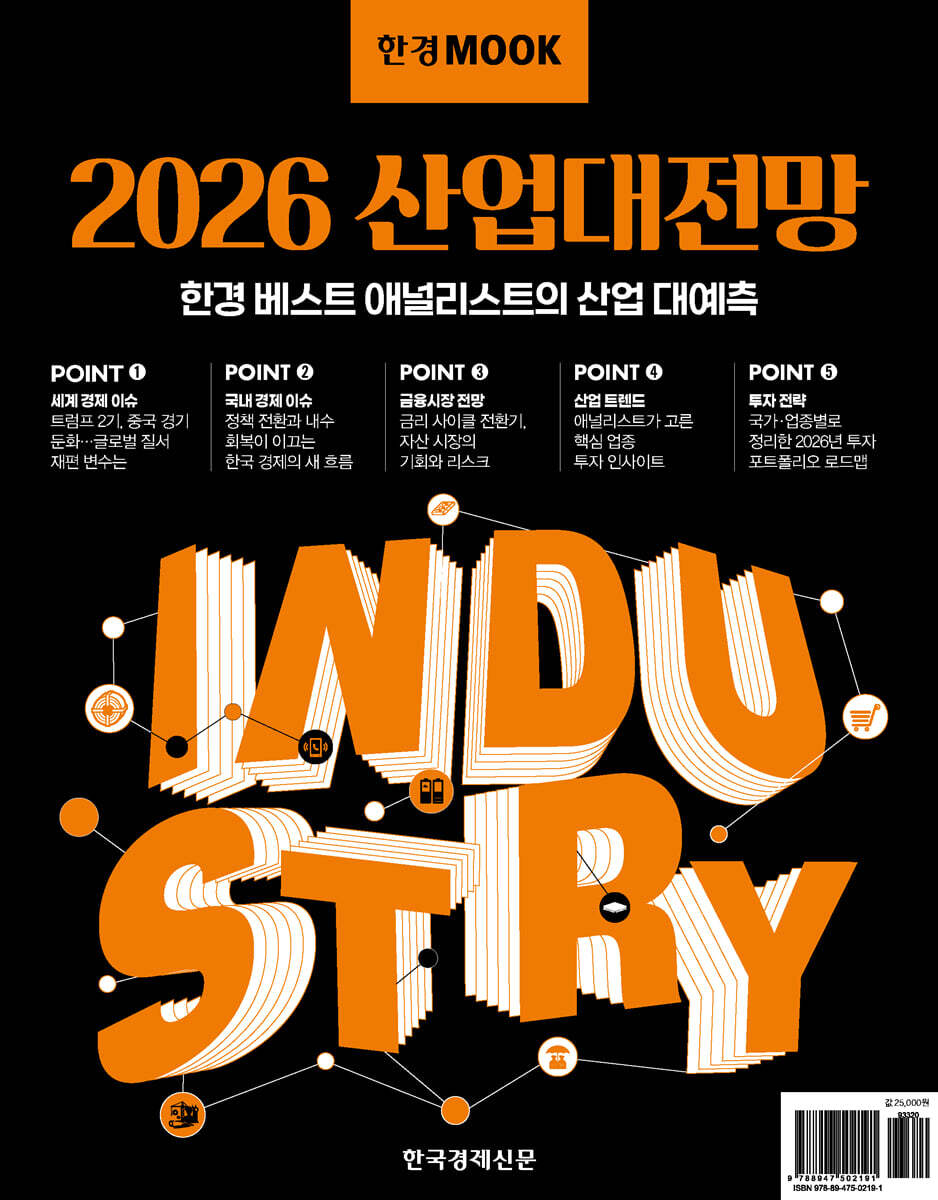
Hankyung Mook 2026 Industrial Outlook
 |
Description
Book Introduction
What should we do as the Korean economy faces a wave of change?
* Industry outlook for 2026 as seen by Han Sang-chun, editorial writer for the Korea Economic Daily and a senior reporter for international finance at Hankyung Media, and 32 of Hankyung's best analysts
* A complete analysis of the impact of Trump's tariff war, the KOSPI breaking through 4000, and the rapid growth of artificial intelligence (AI) on domestic and international industries in 2026.
* Presentation of domestic industrial market trends and investment strategies for 2026, including semiconductors, pharmaceuticals and biotechnology, distribution, refining and chemicals, and the Internet.
Looking back on 2025, countless unimaginable things happened.
Countless events that were completely unpredictable just a year ago have occurred, including the president's declaration of martial law and the citizens' resistance to it, the election of President Lee Jae-myung, and the KOSPI breaking through 4,000.
The situation was the same not only domestically but also internationally.
US President Trump's all-out tariff war and the resulting shift in international dynamics were also dramatic.
In this context, artificial intelligence (AI) technology, which can bring about disruptive changes to human life, has also developed rapidly.
There is a clear reason why we need to take a closer look at the changing landscape of the industry.
However, it is difficult to find data that summarizes such important industry trends all at once.
Hankyung Business's "2026 Industrial Outlook" systematically contains comprehensive information on each industry.
The entire industry is classified by sector and the important change points of each sector are specifically covered.
In particular, the expertise of the 'Best Analysts' from domestic securities firms selected by Hankyung Business participated and was verified.
This year, 『2026 Industrial Outlook』 added design elements such as graphics and figures throughout the book to effectively convey the content.
Through this, we took care to ensure that readers can enjoy the 'taste of seeing' at a glance without any burden.
"2026 Industrial Outlook" is a book that can help all economic entities plan their business and make successful investments for 2026.
* Industry outlook for 2026 as seen by Han Sang-chun, editorial writer for the Korea Economic Daily and a senior reporter for international finance at Hankyung Media, and 32 of Hankyung's best analysts
* A complete analysis of the impact of Trump's tariff war, the KOSPI breaking through 4000, and the rapid growth of artificial intelligence (AI) on domestic and international industries in 2026.
* Presentation of domestic industrial market trends and investment strategies for 2026, including semiconductors, pharmaceuticals and biotechnology, distribution, refining and chemicals, and the Internet.
Looking back on 2025, countless unimaginable things happened.
Countless events that were completely unpredictable just a year ago have occurred, including the president's declaration of martial law and the citizens' resistance to it, the election of President Lee Jae-myung, and the KOSPI breaking through 4,000.
The situation was the same not only domestically but also internationally.
US President Trump's all-out tariff war and the resulting shift in international dynamics were also dramatic.
In this context, artificial intelligence (AI) technology, which can bring about disruptive changes to human life, has also developed rapidly.
There is a clear reason why we need to take a closer look at the changing landscape of the industry.
However, it is difficult to find data that summarizes such important industry trends all at once.
Hankyung Business's "2026 Industrial Outlook" systematically contains comprehensive information on each industry.
The entire industry is classified by sector and the important change points of each sector are specifically covered.
In particular, the expertise of the 'Best Analysts' from domestic securities firms selected by Hankyung Business participated and was verified.
This year, 『2026 Industrial Outlook』 added design elements such as graphics and figures throughout the book to effectively convey the content.
Through this, we took care to ensure that readers can enjoy the 'taste of seeing' at a glance without any burden.
"2026 Industrial Outlook" is a book that can help all economic entities plan their business and make successful investments for 2026.
- You can preview some of the book's contents.
Preview
index
2026 Industrial Outlook
CONTENTS
012 PROLOGUE
What should we do as the Korean economy faces a wave of change?
Section 1
GLOBAL ECONOMY
018 World Economic Outlook
Trump's second term, MAGA, marks the beginning of "Economics 4.0," undermining multilateralism.
030 Key Issues in Major Countries
What path will major economies take in 2026?
042 Monetary Policy
Monetary Policy Framework Reform and the US-China Currency and Coin Wars
052 Korean Economy
The Korean economy is in a state of "boiled frog syndrome," and the Maradona effect is needed.
Section 2
2026 INDUSTRY TREND
058 Semiconductors and Electrical and Electronics
The engine of KOSPI profit growth
062 Secondary battery
From Data to Batteries, Expanding Security Assets
066 Communication
The three major telecom companies' operating profits are expected to grow only 3% in 2026.
070 Internet/Games
The Second Act of the Internet and Gaming: AI and Stablecoins
074 Entertainment & Media
Stable demand due to tritonomics
078 Distribution
Increased marriages and births, recovery in inbound tourism… Conditions ripe for a retail rebound
082 Transportation
A year of restructuring after a recession, a time for differentiation.
086 Securities
Securities industry rerating fueled by policy and performance... KOSPI targets 5000
090 Insurance
Insurance stocks shift leadership… A structural turnaround is imminent.
094 Bank
Bank stocks re-rate amid uncertainty, boosting value.
098 Utility
Another period of growth for the electric power industry, with AI and nuclear power intertwined.
102 cars
In an era of structural cost pressures, marginal companies are being eliminated.
106 Shipbuilding and Heavy Industry
The price of Joseonjoo stocks has risen too high. It's not over yet!
110 Defense, Space, and Machinery
A structural rally driven by geopolitics, energy, and infrastructure… An opportunity amidst chaos.
114 Pharmaceuticals and Biotechnology
From the periphery to the center
118 Oil Refining and Chemicals
After four years of stagnation, the energy industry's 'supercycle' begins.
122 Food and Tobacco
The era of domestic demand is over… Overseas growth and shareholder returns are the key.
126 Construction and Building Materials
The domestic market remains strong, but the US and nuclear power plants offer opportunities.
130 holding companies
A turning point in governance transparency: the first year of holding company rerating.
134 AI·Robotics
As robots move toward commercialization, the key lies in the usability of their hands.
138 small cap
AI is driving small and medium-sized businesses, drawing attention from B2C companies and the space industry.
Section 3
Investment Strategy
144 Global Corporate Analysis
Who will be the protagonists of the "token war"? Beneficiaries like Nvidia and Vertiv are rapidly emerging.
146 Macroeconomics and Interest Rates
In the AI era, only 20% will enjoy wealth.
148 Investment Strategy
The return of the "three lows" boom... The Korean stock market enters its first long-term bull market in 40 years.
150 Quantitative Analysis
The elimination of the domestic stock market discount has just begun.
152 Daily Market Conditions
Government Policy 3.0 for Capital Market Structural Reform
154 Credit Analysis
"Money circulates, but the gap widens"… Credit market polarization expected to worsen again by 2026.
156 Asset Allocation
The Year of the "Slow Landing"… An Opportunity for Balance with AI
158 ETF
The ETF market offers a variety of options despite recurring stories.
160 raw materials
Why You Should Still Hold Gold in Your Portfolio in 2026
162 Global Investment (USA)
S&P 500 forecast: 6,550-8,000; Focus on 4C and 4E
164 Global Investment (China)
Beyond Catch Up: Bridging the Technological Gap Between the US and China
166 ESG
A Capital Market Transformation Driven by Governance Innovation
168 SPECIALIST
Hankyung's Best Analyst, who created the "2026 Industrial Outlook"
CONTENTS
012 PROLOGUE
What should we do as the Korean economy faces a wave of change?
Section 1
GLOBAL ECONOMY
018 World Economic Outlook
Trump's second term, MAGA, marks the beginning of "Economics 4.0," undermining multilateralism.
030 Key Issues in Major Countries
What path will major economies take in 2026?
042 Monetary Policy
Monetary Policy Framework Reform and the US-China Currency and Coin Wars
052 Korean Economy
The Korean economy is in a state of "boiled frog syndrome," and the Maradona effect is needed.
Section 2
2026 INDUSTRY TREND
058 Semiconductors and Electrical and Electronics
The engine of KOSPI profit growth
062 Secondary battery
From Data to Batteries, Expanding Security Assets
066 Communication
The three major telecom companies' operating profits are expected to grow only 3% in 2026.
070 Internet/Games
The Second Act of the Internet and Gaming: AI and Stablecoins
074 Entertainment & Media
Stable demand due to tritonomics
078 Distribution
Increased marriages and births, recovery in inbound tourism… Conditions ripe for a retail rebound
082 Transportation
A year of restructuring after a recession, a time for differentiation.
086 Securities
Securities industry rerating fueled by policy and performance... KOSPI targets 5000
090 Insurance
Insurance stocks shift leadership… A structural turnaround is imminent.
094 Bank
Bank stocks re-rate amid uncertainty, boosting value.
098 Utility
Another period of growth for the electric power industry, with AI and nuclear power intertwined.
102 cars
In an era of structural cost pressures, marginal companies are being eliminated.
106 Shipbuilding and Heavy Industry
The price of Joseonjoo stocks has risen too high. It's not over yet!
110 Defense, Space, and Machinery
A structural rally driven by geopolitics, energy, and infrastructure… An opportunity amidst chaos.
114 Pharmaceuticals and Biotechnology
From the periphery to the center
118 Oil Refining and Chemicals
After four years of stagnation, the energy industry's 'supercycle' begins.
122 Food and Tobacco
The era of domestic demand is over… Overseas growth and shareholder returns are the key.
126 Construction and Building Materials
The domestic market remains strong, but the US and nuclear power plants offer opportunities.
130 holding companies
A turning point in governance transparency: the first year of holding company rerating.
134 AI·Robotics
As robots move toward commercialization, the key lies in the usability of their hands.
138 small cap
AI is driving small and medium-sized businesses, drawing attention from B2C companies and the space industry.
Section 3
Investment Strategy
144 Global Corporate Analysis
Who will be the protagonists of the "token war"? Beneficiaries like Nvidia and Vertiv are rapidly emerging.
146 Macroeconomics and Interest Rates
In the AI era, only 20% will enjoy wealth.
148 Investment Strategy
The return of the "three lows" boom... The Korean stock market enters its first long-term bull market in 40 years.
150 Quantitative Analysis
The elimination of the domestic stock market discount has just begun.
152 Daily Market Conditions
Government Policy 3.0 for Capital Market Structural Reform
154 Credit Analysis
"Money circulates, but the gap widens"… Credit market polarization expected to worsen again by 2026.
156 Asset Allocation
The Year of the "Slow Landing"… An Opportunity for Balance with AI
158 ETF
The ETF market offers a variety of options despite recurring stories.
160 raw materials
Why You Should Still Hold Gold in Your Portfolio in 2026
162 Global Investment (USA)
S&P 500 forecast: 6,550-8,000; Focus on 4C and 4E
164 Global Investment (China)
Beyond Catch Up: Bridging the Technological Gap Between the US and China
166 ESG
A Capital Market Transformation Driven by Governance Innovation
168 SPECIALIST
Hankyung's Best Analyst, who created the "2026 Industrial Outlook"
Detailed image

Into the book
The 2026 US-China battle for advanced technology hegemony will be condensed into a confrontation between "Beijing governance" and "Trump governance."
The former is a model that competes between authoritarian control and strategic tolerance.
While from the outside, China's regulations may appear to hinder the development of advanced technologies, they actually serve to promote high-tech innovation.
The latter, on the other hand, is a model that protects American high-tech companies by imposing punitive tariffs on countries that regulate them.
The two models are similar in that they subordinate individual rights to geopolitical competition, but they differ in that the former chose cutting-edge technological innovation as a price for sacrifice, while the latter chose nationalism to protect vested interests in cutting-edge technology.
--- p.23, from "Trump's Second Term MAGA: The Beginning of 'Economics 4.0' That Destroyed Multilateralism"
The growth potential of the Indian economy remains large.
India's population has officially surpassed China's.
The domestic demand ratio also reaches 75%, which can cushion the impact from external variables such as friction between the US and China.
The economic age is also around 25 years old (37 years old in China, 47 years old in Korea), and it has a population structure that is suitable for the 4th Industrial Revolution, which requires creative and flexible thinking.
The potential of information technology (IT) and artificial intelligence (AI) is also outstanding.
For this reason, forecasting agencies predict that growth of more than 5% will continue in 2026, despite difficult conditions.
--- p.41, from “What path will the major economies take in 2026?”
LG Energy Solution is currently the only company in the United States that locally produces LFP (lithium iron phosphate) ESS batteries.
Based on this, the company recently received an order from Tesla for an average annual volume of 15 GWh, and there is still the possibility of receiving additional orders in the future.
The electric vehicle battery sector is currently estimated to be generating an annual deficit of approximately KRW 800 billion, but the ESS sector is expected to generate annual profits of over KRW 2 trillion after 2026, sufficient to offset the sluggish performance of the electric vehicle sector.
With profit normalization and a significant reduction in capital expenditure (CAPEX), free cash flow is expected to turn positive starting in 2026.
--- p.65, from “Expanding Security Assets: From Data to Batteries”
It's clear why you should pay attention to Hive in 2026.
This is because we are entering a period where new momentum is secured while performance growth is guaranteed.
HYBE's 2026 revenue is projected to reach KRW 3.5 trillion (+35% YoY) and operating profit to reach KRW 444 billion (+145% YoY). Considering that the detailed schedule for BTS's world tour has not yet been announced, these estimates conservatively assume an audience of 50,000 per show and a total of 50 concerts. However, operating profit is expected to more than double this year.
In addition, Weverse is expected to enter a full-scale monetization phase through structural improvements and expansion of TAM.
--- p.77, from “Stable Demand According to Tritonomics”
Maintain the ‘increased weight’ of securities stocks.
As funds previously concentrated in real estate shift to venture capital and financial assets, the overall business environment is expected to improve and securities firms' role in supplying capital is expected to be strengthened.
The most preferred stocks are Korea Financial Holdings and Kiwoom Securities.
Korea Financial Holdings is rapidly demonstrating compound capital growth effects based on the industry-leading equity capital of its subsidiary, Korea Investment & Securities.
The capital-efficient structure and stable profit-generating capabilities of affiliates, centered around Korea Investment & Securities, create a significant gap in both the quality and quantity of capital compared to other securities firms.
The most attractive aspect is the long-term compound growth aspect.
--- p.85, from “Securities industry rerating fueled by policies and performance… Aiming for KOSPI 5000”
In 2026, the power industry will experience another period of growth, driven by the proliferation of AI data centers and the revival of nuclear power plants.
As the benefits of overseas exports, particularly to the United States, expand from large corporations to small and medium-sized enterprises, investment opportunities are expected to diversify.
Meanwhile, a data center market is also forming in Korea.
To support this, normalizing electricity rates and expanding investment in the power grid are essential. These factors, along with attractive valuations and expectations for nuclear power, are factors that brighten the outlook for KEPCO's stock price.
--- p.101, from “Another period of growth for the electric power industry, where AI and nuclear power plants are intertwined”
The cost competitiveness of Korean chemical companies, which had been at a disadvantage compared to their competitors, will also be restored.
The cost of producing ethylene in the United States has been lower than in Korea for the past 15 years.
The United States produced ethylene based on cheap natural gas thanks to the shale boom, but Korea had to procure and produce high-priced crude oil.
However, with the increase in demand for natural gas power generation in the U.S. due to AI and data centers, and Trump's policy to expand LNG exports, natural gas prices in the U.S. are likely to rise in the medium to long term.
This will ultimately lead to a weakening of the cost competitiveness of U.S. natural gas (ethane)-based petrochemical companies and a decrease in exports.
--- p.121, from “After four years of stagnation, the prelude to the energy industry’s ‘super cycle’”
If the United States and Europe now embark on nuclear power plant reconstruction, it will not simply be the construction of nuclear power plants, but the revival of a new nuclear power cycle that has been in place for 40 years in the Western world.
The value of Korean nuclear power plants must be re-evaluated.
Investors should not forget that 1) continuous, rather than one-off, orders are expected, and 2) the Korean supply chain is expected to clearly benefit.
Korea, which has consistently and repeatedly built up successful nuclear power plant operations in the free world, cannot help but be highly regarded.
A rerating of the entire Korean nuclear power industry, not just a few companies, is warranted.
The top picks in the nuclear power industry are Doosan Energy, Hyundai Engineering & Construction, and Korea Electric Power Corporation.
--- p.129, from “The Domestic Market Remains Strong, but the US and Nuclear Power Plants Are Opportunities”
Among the most preferred stocks for innovation growth in 2026, the valuation theme focused on operating profit growth.
The growth theme used sales growth as its main indicator.
The operating profit growth rate of valuation stocks in 2026 is 20.1%.
The sales growth rate of growth theme stocks in 2026 is expected to be 27.9%.
There is a high possibility that the stock price will be revalued as the number of small and mid-cap stocks increases and the number of leading stocks increases.
We believe this is a key stock that should not be missed in the KOSPI 4000 era.
Our top picks include Sanil Electric, Iljin Electric, SNT Energy, GNC Energy, and Samhwa Electric, which are in the AI infrastructure sector, and Vitzrocell, which is in the defense sector. These companies are demonstrating their ability to benefit from the surge in AI power demand and the CapEx cycle, both through their performance and stock prices. These companies are also highly likely to join the leading stocks.
As defense-related companies such as Bitzrosel increase their defense sales, they are likely to see their stock prices revaluated as they are recognized as part of the defense value chain.
--- p.141, from “AI-driven small and medium-sized enterprises are taking the lead, and B2C-utilizing companies and the space industry are drawing attention”
It is not desirable to think in a dichotomous way, such as asking who is the winner between Nvidia and Broadcom.
Huge amounts of money are currently being invested in AI data centers, and this should be viewed as an expansion of the market itself, rather than competition between specific companies.
In fact, the capital expenditure (Capex) level of the top four hyperscalers (CSPs) reached 21% of the entire S&P 500 over the past year.
As this market expands, we expect AI-related companies to continue to benefit.
--- p.145, from "Who Are the Heroes of the 'Token War'? Beneficiaries Like Nvidia and Vertiv Rise Rapidly"
Investments should be expected in the second half of the year.
Construction investment, which had been sluggish, is expected to recover somewhat, and facility investment is also expected to show signs of recovery in the second half of the year, supported by government policies.
But warning lights have been turned on on the export front.
There are concerns that the growth in AI-related semiconductor exports, which has driven growth so far, may slow in the second half of 2026.
--- p.147, from “Only 20% Enjoy Wealth in the AI Era”
The expected gold price range for 2026 is $3,800 to $5,000 per ounce.
We maintain our "increase weight" stance on gold investments amid the Federal Reserve's easing monetary policy.
In an easing phase, investor buying of gold bars, coins, and ETFs is the driving force behind the rise in gold prices.
With global central banks expected to continue purchasing approximately 20% of global gold annually to diversify their foreign exchange reserves, the upward trend in gold prices is likely to continue into 2026.
--- p.161, from “Reasons to Keep Gold in Your Portfolio in 2026”
4E is the four core axes that will highlight growth potential in the AI diffusion and economic recovery phase.
△Solar Energy (solar power) has significant potential for a rebound, with most of last year's negative factors already factored in, thanks to increased power generation and the "AI put" effect resulting from increased power demand from AI data centers.
△Electrical Engineering (power semiconductors) is expected to benefit from the advancement of 800V direct current (DC) power systems and across high-power industries, including AI servers, electric vehicles, and robots.
△E-commerce (e-commerce) is likely to see both improved advertising efficiency and purchase conversion rates through the advancement of AI-based recommendation algorithms.
△The Exchange/Brokerage (finance) sector is expected to simultaneously benefit from increased transaction volume due to expanded AI investment and active M&A, as well as the inflow of funds following the normalization of interest rates.
The former is a model that competes between authoritarian control and strategic tolerance.
While from the outside, China's regulations may appear to hinder the development of advanced technologies, they actually serve to promote high-tech innovation.
The latter, on the other hand, is a model that protects American high-tech companies by imposing punitive tariffs on countries that regulate them.
The two models are similar in that they subordinate individual rights to geopolitical competition, but they differ in that the former chose cutting-edge technological innovation as a price for sacrifice, while the latter chose nationalism to protect vested interests in cutting-edge technology.
--- p.23, from "Trump's Second Term MAGA: The Beginning of 'Economics 4.0' That Destroyed Multilateralism"
The growth potential of the Indian economy remains large.
India's population has officially surpassed China's.
The domestic demand ratio also reaches 75%, which can cushion the impact from external variables such as friction between the US and China.
The economic age is also around 25 years old (37 years old in China, 47 years old in Korea), and it has a population structure that is suitable for the 4th Industrial Revolution, which requires creative and flexible thinking.
The potential of information technology (IT) and artificial intelligence (AI) is also outstanding.
For this reason, forecasting agencies predict that growth of more than 5% will continue in 2026, despite difficult conditions.
--- p.41, from “What path will the major economies take in 2026?”
LG Energy Solution is currently the only company in the United States that locally produces LFP (lithium iron phosphate) ESS batteries.
Based on this, the company recently received an order from Tesla for an average annual volume of 15 GWh, and there is still the possibility of receiving additional orders in the future.
The electric vehicle battery sector is currently estimated to be generating an annual deficit of approximately KRW 800 billion, but the ESS sector is expected to generate annual profits of over KRW 2 trillion after 2026, sufficient to offset the sluggish performance of the electric vehicle sector.
With profit normalization and a significant reduction in capital expenditure (CAPEX), free cash flow is expected to turn positive starting in 2026.
--- p.65, from “Expanding Security Assets: From Data to Batteries”
It's clear why you should pay attention to Hive in 2026.
This is because we are entering a period where new momentum is secured while performance growth is guaranteed.
HYBE's 2026 revenue is projected to reach KRW 3.5 trillion (+35% YoY) and operating profit to reach KRW 444 billion (+145% YoY). Considering that the detailed schedule for BTS's world tour has not yet been announced, these estimates conservatively assume an audience of 50,000 per show and a total of 50 concerts. However, operating profit is expected to more than double this year.
In addition, Weverse is expected to enter a full-scale monetization phase through structural improvements and expansion of TAM.
--- p.77, from “Stable Demand According to Tritonomics”
Maintain the ‘increased weight’ of securities stocks.
As funds previously concentrated in real estate shift to venture capital and financial assets, the overall business environment is expected to improve and securities firms' role in supplying capital is expected to be strengthened.
The most preferred stocks are Korea Financial Holdings and Kiwoom Securities.
Korea Financial Holdings is rapidly demonstrating compound capital growth effects based on the industry-leading equity capital of its subsidiary, Korea Investment & Securities.
The capital-efficient structure and stable profit-generating capabilities of affiliates, centered around Korea Investment & Securities, create a significant gap in both the quality and quantity of capital compared to other securities firms.
The most attractive aspect is the long-term compound growth aspect.
--- p.85, from “Securities industry rerating fueled by policies and performance… Aiming for KOSPI 5000”
In 2026, the power industry will experience another period of growth, driven by the proliferation of AI data centers and the revival of nuclear power plants.
As the benefits of overseas exports, particularly to the United States, expand from large corporations to small and medium-sized enterprises, investment opportunities are expected to diversify.
Meanwhile, a data center market is also forming in Korea.
To support this, normalizing electricity rates and expanding investment in the power grid are essential. These factors, along with attractive valuations and expectations for nuclear power, are factors that brighten the outlook for KEPCO's stock price.
--- p.101, from “Another period of growth for the electric power industry, where AI and nuclear power plants are intertwined”
The cost competitiveness of Korean chemical companies, which had been at a disadvantage compared to their competitors, will also be restored.
The cost of producing ethylene in the United States has been lower than in Korea for the past 15 years.
The United States produced ethylene based on cheap natural gas thanks to the shale boom, but Korea had to procure and produce high-priced crude oil.
However, with the increase in demand for natural gas power generation in the U.S. due to AI and data centers, and Trump's policy to expand LNG exports, natural gas prices in the U.S. are likely to rise in the medium to long term.
This will ultimately lead to a weakening of the cost competitiveness of U.S. natural gas (ethane)-based petrochemical companies and a decrease in exports.
--- p.121, from “After four years of stagnation, the prelude to the energy industry’s ‘super cycle’”
If the United States and Europe now embark on nuclear power plant reconstruction, it will not simply be the construction of nuclear power plants, but the revival of a new nuclear power cycle that has been in place for 40 years in the Western world.
The value of Korean nuclear power plants must be re-evaluated.
Investors should not forget that 1) continuous, rather than one-off, orders are expected, and 2) the Korean supply chain is expected to clearly benefit.
Korea, which has consistently and repeatedly built up successful nuclear power plant operations in the free world, cannot help but be highly regarded.
A rerating of the entire Korean nuclear power industry, not just a few companies, is warranted.
The top picks in the nuclear power industry are Doosan Energy, Hyundai Engineering & Construction, and Korea Electric Power Corporation.
--- p.129, from “The Domestic Market Remains Strong, but the US and Nuclear Power Plants Are Opportunities”
Among the most preferred stocks for innovation growth in 2026, the valuation theme focused on operating profit growth.
The growth theme used sales growth as its main indicator.
The operating profit growth rate of valuation stocks in 2026 is 20.1%.
The sales growth rate of growth theme stocks in 2026 is expected to be 27.9%.
There is a high possibility that the stock price will be revalued as the number of small and mid-cap stocks increases and the number of leading stocks increases.
We believe this is a key stock that should not be missed in the KOSPI 4000 era.
Our top picks include Sanil Electric, Iljin Electric, SNT Energy, GNC Energy, and Samhwa Electric, which are in the AI infrastructure sector, and Vitzrocell, which is in the defense sector. These companies are demonstrating their ability to benefit from the surge in AI power demand and the CapEx cycle, both through their performance and stock prices. These companies are also highly likely to join the leading stocks.
As defense-related companies such as Bitzrosel increase their defense sales, they are likely to see their stock prices revaluated as they are recognized as part of the defense value chain.
--- p.141, from “AI-driven small and medium-sized enterprises are taking the lead, and B2C-utilizing companies and the space industry are drawing attention”
It is not desirable to think in a dichotomous way, such as asking who is the winner between Nvidia and Broadcom.
Huge amounts of money are currently being invested in AI data centers, and this should be viewed as an expansion of the market itself, rather than competition between specific companies.
In fact, the capital expenditure (Capex) level of the top four hyperscalers (CSPs) reached 21% of the entire S&P 500 over the past year.
As this market expands, we expect AI-related companies to continue to benefit.
--- p.145, from "Who Are the Heroes of the 'Token War'? Beneficiaries Like Nvidia and Vertiv Rise Rapidly"
Investments should be expected in the second half of the year.
Construction investment, which had been sluggish, is expected to recover somewhat, and facility investment is also expected to show signs of recovery in the second half of the year, supported by government policies.
But warning lights have been turned on on the export front.
There are concerns that the growth in AI-related semiconductor exports, which has driven growth so far, may slow in the second half of 2026.
--- p.147, from “Only 20% Enjoy Wealth in the AI Era”
The expected gold price range for 2026 is $3,800 to $5,000 per ounce.
We maintain our "increase weight" stance on gold investments amid the Federal Reserve's easing monetary policy.
In an easing phase, investor buying of gold bars, coins, and ETFs is the driving force behind the rise in gold prices.
With global central banks expected to continue purchasing approximately 20% of global gold annually to diversify their foreign exchange reserves, the upward trend in gold prices is likely to continue into 2026.
--- p.161, from “Reasons to Keep Gold in Your Portfolio in 2026”
4E is the four core axes that will highlight growth potential in the AI diffusion and economic recovery phase.
△Solar Energy (solar power) has significant potential for a rebound, with most of last year's negative factors already factored in, thanks to increased power generation and the "AI put" effect resulting from increased power demand from AI data centers.
△Electrical Engineering (power semiconductors) is expected to benefit from the advancement of 800V direct current (DC) power systems and across high-power industries, including AI servers, electric vehicles, and robots.
△E-commerce (e-commerce) is likely to see both improved advertising efficiency and purchase conversion rates through the advancement of AI-based recommendation algorithms.
△The Exchange/Brokerage (finance) sector is expected to simultaneously benefit from increased transaction volume due to expanded AI investment and active M&A, as well as the inflow of funds following the normalization of interest rates.
--- p.168, from "S&P 500 6550~8000 Outlook, Pay Attention to 4C·4E"
Publisher's Review
Section 1 - GLOBAL ECONOMY
In 2026, the global economy will enter a new normal era where the abnormal becomes the norm.
We are at a turning point amid the collapse of order and the emergence of a new paradigm.
The Trump administration's nationalism, including its own, threatens the existing economic order, and the development of artificial intelligence (AI) heralds yet another economic restructuring.
Countries and companies are seeking sustainable solutions and flexible strategies amid uncertainty.
Section 2 - 2026 INDUSTRY TREND
We will take a closer look at the BIG 5 domestic industrial trends for 2026, including 'semiconductors' led by Samsung Electronics and Hynix, 'pharmaceuticals and bio' sectors that are transforming into sectors where FDA approvals can be expected every year, 'distribution' sectors where the number of marriages and births play a significant role, 'oil refining and chemicals' sectors that can be expected to change from inferior to superior, and 'internet' sectors where AI commercialization will bring about increased value.
Section 3 - INVESTMENT STRATEGY
In 2026, the global economy will enter an era of "hyper-polarization" created by artificial intelligence (AI) and government policies.
Even in the second year of the Trump administration, the AI industry remains a key topic in the market.
Based on this, we analyze how to establish an investment strategy for 2026 through 'global corporate analysis', 'macroeconomics', 'ETF', 'raw materials', 'ESG', and 'global investment strategy' centered on the US and China.
In 2026, the global economy will enter a new normal era where the abnormal becomes the norm.
We are at a turning point amid the collapse of order and the emergence of a new paradigm.
The Trump administration's nationalism, including its own, threatens the existing economic order, and the development of artificial intelligence (AI) heralds yet another economic restructuring.
Countries and companies are seeking sustainable solutions and flexible strategies amid uncertainty.
Section 2 - 2026 INDUSTRY TREND
We will take a closer look at the BIG 5 domestic industrial trends for 2026, including 'semiconductors' led by Samsung Electronics and Hynix, 'pharmaceuticals and bio' sectors that are transforming into sectors where FDA approvals can be expected every year, 'distribution' sectors where the number of marriages and births play a significant role, 'oil refining and chemicals' sectors that can be expected to change from inferior to superior, and 'internet' sectors where AI commercialization will bring about increased value.
Section 3 - INVESTMENT STRATEGY
In 2026, the global economy will enter an era of "hyper-polarization" created by artificial intelligence (AI) and government policies.
Even in the second year of the Trump administration, the AI industry remains a key topic in the market.
Based on this, we analyze how to establish an investment strategy for 2026 through 'global corporate analysis', 'macroeconomics', 'ETF', 'raw materials', 'ESG', and 'global investment strategy' centered on the US and China.
GOODS SPECIFICS
- Date of issue: November 28, 2025
- Page count, weight, size: 174 pages | 180*230*20mm
- ISBN13: 9788947502191
- ISBN10: 8947502197
You may also like
카테고리
korean


korean

![GQ KOREA Mark (Monthly): December [2025]](http://librairie.coreenne.fr/cdn/shop/files/8ef265dbbfbf186523ed75ba7319009d.jpg?v=1765340328&width=3840)


