

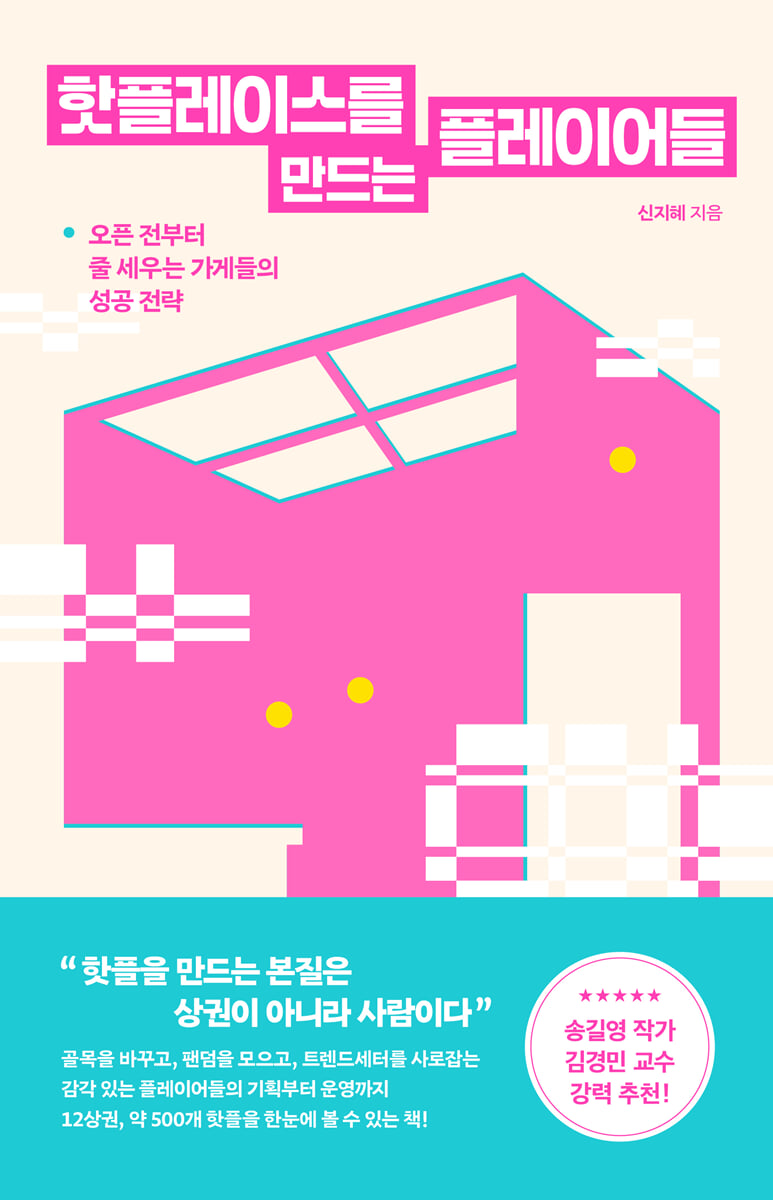
Players who create hot places
 |
Description
Book Introduction
A space that attracts people even in a recession,
A retail strategy book that dissects the true structure of 'hot places'!
A book that lets you see 12 commercial districts and approximately 500 hot spots at a glance!
What's the hottest place in South Korea right now? In a rapidly changing economic environment, the commercial districts people frequent have also undergone significant changes.
While traditional bustling districts like Myeongdong, Gangnam, and Sinchon, once home to large corporations and foreign brands, were once the top commercial districts, at some point, the familiar and stale streets were replaced by alleys armed with unique planning and fresh sensibilities, attracting trendy visitors and emerging as new cultural hubs.
At the starting point of this change is the 'player' who boldly took his first step into a quiet alley.
These are the places that attract people with their unique signature menus, photo spots known as photogenic spots, and 'Instagrammable' space designs.
Their efforts created various hashtags, lined up people, and ultimately proved the region's potential.
And as fast followers who caught its charm gathered, the alley became a complete 'hot place'.
This book is a record of the people who started it and the strategies of the players who grew the distance together.
This is also a secret notebook introducing 'favorite' hot spots hand-picked by a retail developer who has been exploring commercial districts across the country for many years.
Through nine commercial districts created by brilliant players and three newly emerging ones, we explore the growth formula of Korea's hippest retail sector.
A retail strategy book that dissects the true structure of 'hot places'!
A book that lets you see 12 commercial districts and approximately 500 hot spots at a glance!
What's the hottest place in South Korea right now? In a rapidly changing economic environment, the commercial districts people frequent have also undergone significant changes.
While traditional bustling districts like Myeongdong, Gangnam, and Sinchon, once home to large corporations and foreign brands, were once the top commercial districts, at some point, the familiar and stale streets were replaced by alleys armed with unique planning and fresh sensibilities, attracting trendy visitors and emerging as new cultural hubs.
At the starting point of this change is the 'player' who boldly took his first step into a quiet alley.
These are the places that attract people with their unique signature menus, photo spots known as photogenic spots, and 'Instagrammable' space designs.
Their efforts created various hashtags, lined up people, and ultimately proved the region's potential.
And as fast followers who caught its charm gathered, the alley became a complete 'hot place'.
This book is a record of the people who started it and the strategies of the players who grew the distance together.
This is also a secret notebook introducing 'favorite' hot spots hand-picked by a retail developer who has been exploring commercial districts across the country for many years.
Through nine commercial districts created by brilliant players and three newly emerging ones, we explore the growth formula of Korea's hippest retail sector.
- You can preview some of the book's contents.
Preview
index
Prologue: People Who Turn Space into Trends and Alleyways into Brands
PART 1: Yongsan Ginkgo Tree Road: A Trend-Leading Hot Spot on a Street Where Time Stands Still
The best location in Korea, the beautiful streets of Yongsan
The beginning of the Ginkgo Tree Road, Blue Dot F&C
Rope Company, a trend-setting player
Differentiation Created by the Balance of 'Oldness' and 'Newness'
A trendy street quietly preparing for a huge change
Player Interview | Rope Company CEO Park Jae-hyun
PART 2 Seoul Station and the Beginning of Seoul, Manrijae
Seoul Station transformed into a future transportation and cultural hub.
The most 'Seoul-like' place to change old clothes
Players who create regulars, often called Zongzhong Company
A place with both software and hardware
A fresh breeze blowing through old buildings and narrow streets
PART 3: Incheon Port Road: Beyond Seoul's "○-ri Dan-gil"
The Gaehangno Project, a player that makes old streets hip
A charming city with a diverse mix of cultures
A hot place that started from my love for my local area
True local change begins with the love of its residents.
Player Interview | Lee Chang-gil, CEO of Gaehangro Project
PART 4: The Transformation of Ssajeong-ri into a Hot Place: Shindangdong
The Future of Jungang Market, Transformed
A prepared hot place covering the neighborhood and the wider area
TDTD, a player who wins with outstanding concept planning
Unique food, unique space, and unique operation
The birth of a lifestyle complex that goes beyond F&B.
The activities of players who have integrated into the central market
Player Interview | TDTD CEO Jang Ji-ho
PART 5: Dosan Park, From a 40% Vacancy Rate to a Shopping Mecca for Millennials
Target young trendsetters
GFFG, the representative player symbolizing 'Made in Dosan'
A high-end commercial district is being redesigned with a youthful sensibility.
The secret to the revival of a hot place that has regained its former fame
Player Interview | GFFG Director Kim Dong-hyun
PART 6 From a run-down entertainment district to Siridan-gil, Gwangju's Synergy Tower
Cutting-edge spaces created by Synergy Tower
Synergy Town's Big Picture
The Developer's Role in Driving 'Planned Change'
Player Interview | Synergy Tower Vice President Oh Jeong-hyeon
PART 7 From Newtro Alley to Global Night Market Mecca, Ikseon-dong
Reimagining Hanok Village as a Brand
Glow Seoul, a player who created a local landmark
The "Oncheon Village" project captures the joy of empty space.
Growing into a global tourist destination where tradition and trends coexist
Player Interview | Glow Seoul CEO Yoo Jeong-su
PART 8 Yeonhui-dong, a village enterprise growing together with its neighbors
Kuum Partners, a player designing space
A modern reinterpretation of the alleyway's sentiment
A flexible lease structure that considers the region: the "responsible lease" strategy.
Connecting Culture and Space: A Coexistence
Players who truly love the place are different.
Player Interview | Kim Jong-seok, CEO of Kuum Partners
PART 9 From Hongdae for Seniors to a Global Fashion Mecca, Dongmyo
Reborn as a fashion icon that captures the world's attention
A fusion of vintage props and retro sensibility
Dongmyo's most respected player, Park Sang-hyun
A living hot place with a 'heritage' feel
Player Interview | John & Mark CEO Park Sang-hyun
PART 10 Mini Hot Places: Seongbukcheon Area, Cheongnyangni, and Jangchung-dong
From a walking path for residents to a cafe street full of emotions, the Seongbukcheon area
From the train station to Chuncheon to the global local market, Cheongnyangni
A cup of coffee in the living room of a conglomerate house, Jangchung-dong
Epilogue: Looking forward to a new hot place that someone will create
PART 1: Yongsan Ginkgo Tree Road: A Trend-Leading Hot Spot on a Street Where Time Stands Still
The best location in Korea, the beautiful streets of Yongsan
The beginning of the Ginkgo Tree Road, Blue Dot F&C
Rope Company, a trend-setting player
Differentiation Created by the Balance of 'Oldness' and 'Newness'
A trendy street quietly preparing for a huge change
Player Interview | Rope Company CEO Park Jae-hyun
PART 2 Seoul Station and the Beginning of Seoul, Manrijae
Seoul Station transformed into a future transportation and cultural hub.
The most 'Seoul-like' place to change old clothes
Players who create regulars, often called Zongzhong Company
A place with both software and hardware
A fresh breeze blowing through old buildings and narrow streets
PART 3: Incheon Port Road: Beyond Seoul's "○-ri Dan-gil"
The Gaehangno Project, a player that makes old streets hip
A charming city with a diverse mix of cultures
A hot place that started from my love for my local area
True local change begins with the love of its residents.
Player Interview | Lee Chang-gil, CEO of Gaehangro Project
PART 4: The Transformation of Ssajeong-ri into a Hot Place: Shindangdong
The Future of Jungang Market, Transformed
A prepared hot place covering the neighborhood and the wider area
TDTD, a player who wins with outstanding concept planning
Unique food, unique space, and unique operation
The birth of a lifestyle complex that goes beyond F&B.
The activities of players who have integrated into the central market
Player Interview | TDTD CEO Jang Ji-ho
PART 5: Dosan Park, From a 40% Vacancy Rate to a Shopping Mecca for Millennials
Target young trendsetters
GFFG, the representative player symbolizing 'Made in Dosan'
A high-end commercial district is being redesigned with a youthful sensibility.
The secret to the revival of a hot place that has regained its former fame
Player Interview | GFFG Director Kim Dong-hyun
PART 6 From a run-down entertainment district to Siridan-gil, Gwangju's Synergy Tower
Cutting-edge spaces created by Synergy Tower
Synergy Town's Big Picture
The Developer's Role in Driving 'Planned Change'
Player Interview | Synergy Tower Vice President Oh Jeong-hyeon
PART 7 From Newtro Alley to Global Night Market Mecca, Ikseon-dong
Reimagining Hanok Village as a Brand
Glow Seoul, a player who created a local landmark
The "Oncheon Village" project captures the joy of empty space.
Growing into a global tourist destination where tradition and trends coexist
Player Interview | Glow Seoul CEO Yoo Jeong-su
PART 8 Yeonhui-dong, a village enterprise growing together with its neighbors
Kuum Partners, a player designing space
A modern reinterpretation of the alleyway's sentiment
A flexible lease structure that considers the region: the "responsible lease" strategy.
Connecting Culture and Space: A Coexistence
Players who truly love the place are different.
Player Interview | Kim Jong-seok, CEO of Kuum Partners
PART 9 From Hongdae for Seniors to a Global Fashion Mecca, Dongmyo
Reborn as a fashion icon that captures the world's attention
A fusion of vintage props and retro sensibility
Dongmyo's most respected player, Park Sang-hyun
A living hot place with a 'heritage' feel
Player Interview | John & Mark CEO Park Sang-hyun
PART 10 Mini Hot Places: Seongbukcheon Area, Cheongnyangni, and Jangchung-dong
From a walking path for residents to a cafe street full of emotions, the Seongbukcheon area
From the train station to Chuncheon to the global local market, Cheongnyangni
A cup of coffee in the living room of a conglomerate house, Jangchung-dong
Epilogue: Looking forward to a new hot place that someone will create
Into the book
This book follows the vivid process of how players turned their places into 'hot spots'.
Just like the case of CEO Jang Jin-woo, who opened over a dozen stores on Gyeongridan-gil and stirred up the alley, stories will unfold of first movers opening stores in various places in Dosan, Shindang, and Yongsan, followed by fast followers, spreading the craze.
Those who create hot places are not only those who open and operate stores.
Space planners and developers are also important players.
We cannot leave out what choices they made and what devices they installed to change the streets.
---From the "Prologue"
Near Yongsan Ginkgo Tree Road, this area, which had quietly maintained its place like a rural village even during a time when numerous development plans were turbulent, is now bustling.
For a long time, this street was an ordinary alley with only a newspaper delivery office, a milk dealership, and restaurants frequented by office workers from the surrounding large offices.
This street is growing into a hot spot where attractive players and customers who recognize them gather, amidst the relocation of headquarters of large corporations and major entertainment companies and development plans touted as "the greatest since Dangun."
---「PART 1.
From “Page 50”
Right next to Seoul Station, which is used by tens of millions of people a year, the previously disconnected traffic route was restored with the opening of Seoullo 7017 and the creation of Manri Plaza.
Thanks to this, the narrow streets, which had long been lined with industrial buildings and restaurants, began to transform as players armed with individuality began to move in.
In particular, it is said that the number of foreign customers coming through the west exit of Seoul Station, which is connected to Lotte Mart Seoul Station, which is called the 'mart mecca' among foreign tourists, has increased recently.
These movements are bringing together the 'station restaurant street', which can be found around any station but is not easily found in Seoul Station, and is starting to take shape to some extent.
---「PART 2.
From page 78
It is not easy for a 'planned street' to remain established for a long time on its own.
For a hot place to become firmly established, it must constantly communicate and interact with its neighbors, and it also needs harmony and balance with the surrounding space.
In other words, rather than simply focusing on rising land prices or economic logic, there must be genuine interest and affection for the region and its residents.
Only then will a space that fits the area perfectly be created and will be loved for a long time.
It is perhaps natural that the Gaehangro Project, which began with interest in one's hometown, is loved by the citizens of Incheon.
I wonder if, using this love as a nutrient, another region will create a ‘○○ port opening road’ instead of ‘Incheon’s Gyeongridan-gil.’
---「PART 3.
From page 108
Opened in April 2023, Mailroom is a classic espresso bar with an analog feel.
The first floor consists of a standing bar where you can enjoy your order right away.
The second floor and above are operated as a cafe with a unique design reminiscent of an old European post office or general store.
This place is also a speakeasy type of place where you have to look for the entrance to the second floor for a while.
The ordering method is also in line with the name Mailroom, where customers select a menu and fill out an order form like a letter.
When the coffee comes out, you can have a fun experience of opening the mailbox with the key and taking it.
Since its opening, Mailroom has consistently ranked high in #Sindang Station Cafe and #Sindang Station Hot Place, as it offers a rare panoramic view of Sindang-dong from the rooftop.
---「PART 4.
From page 134
Over the past three years, starting in 2023, Dosan has regained its former reputation as one of the hottest commercial districts in Seoul.
It is becoming a hot place for young people where they can enjoy everything from fine dining to shopping and experiences.
There are many factors that have led to the revival of this commercial district, but a large part of this is the efforts of F&B players who have created restaurants that draw long lines and attracted a young population.
Just like the case of CEO Jang Jin-woo, who opened over a dozen stores on Gyeongridan-gil and stirred up the alley, stories will unfold of first movers opening stores in various places in Dosan, Shindang, and Yongsan, followed by fast followers, spreading the craze.
Those who create hot places are not only those who open and operate stores.
Space planners and developers are also important players.
We cannot leave out what choices they made and what devices they installed to change the streets.
---From the "Prologue"
Near Yongsan Ginkgo Tree Road, this area, which had quietly maintained its place like a rural village even during a time when numerous development plans were turbulent, is now bustling.
For a long time, this street was an ordinary alley with only a newspaper delivery office, a milk dealership, and restaurants frequented by office workers from the surrounding large offices.
This street is growing into a hot spot where attractive players and customers who recognize them gather, amidst the relocation of headquarters of large corporations and major entertainment companies and development plans touted as "the greatest since Dangun."
---「PART 1.
From “Page 50”
Right next to Seoul Station, which is used by tens of millions of people a year, the previously disconnected traffic route was restored with the opening of Seoullo 7017 and the creation of Manri Plaza.
Thanks to this, the narrow streets, which had long been lined with industrial buildings and restaurants, began to transform as players armed with individuality began to move in.
In particular, it is said that the number of foreign customers coming through the west exit of Seoul Station, which is connected to Lotte Mart Seoul Station, which is called the 'mart mecca' among foreign tourists, has increased recently.
These movements are bringing together the 'station restaurant street', which can be found around any station but is not easily found in Seoul Station, and is starting to take shape to some extent.
---「PART 2.
From page 78
It is not easy for a 'planned street' to remain established for a long time on its own.
For a hot place to become firmly established, it must constantly communicate and interact with its neighbors, and it also needs harmony and balance with the surrounding space.
In other words, rather than simply focusing on rising land prices or economic logic, there must be genuine interest and affection for the region and its residents.
Only then will a space that fits the area perfectly be created and will be loved for a long time.
It is perhaps natural that the Gaehangro Project, which began with interest in one's hometown, is loved by the citizens of Incheon.
I wonder if, using this love as a nutrient, another region will create a ‘○○ port opening road’ instead of ‘Incheon’s Gyeongridan-gil.’
---「PART 3.
From page 108
Opened in April 2023, Mailroom is a classic espresso bar with an analog feel.
The first floor consists of a standing bar where you can enjoy your order right away.
The second floor and above are operated as a cafe with a unique design reminiscent of an old European post office or general store.
This place is also a speakeasy type of place where you have to look for the entrance to the second floor for a while.
The ordering method is also in line with the name Mailroom, where customers select a menu and fill out an order form like a letter.
When the coffee comes out, you can have a fun experience of opening the mailbox with the key and taking it.
Since its opening, Mailroom has consistently ranked high in #Sindang Station Cafe and #Sindang Station Hot Place, as it offers a rare panoramic view of Sindang-dong from the rooftop.
---「PART 4.
From page 134
Over the past three years, starting in 2023, Dosan has regained its former reputation as one of the hottest commercial districts in Seoul.
It is becoming a hot place for young people where they can enjoy everything from fine dining to shopping and experiences.
There are many factors that have led to the revival of this commercial district, but a large part of this is the efforts of F&B players who have created restaurants that draw long lines and attracted a young population.
---「PART 5.
From page 189
From page 189
Publisher's Review
“How are hot places created?”
Reading the space, reading the mind of the consumer, reading the sensitivity of the times
The players' brilliant performance
The value of this book goes far beyond simply satisfying the fleeting curiosity of, "Who developed this hot place?"
This book offers a deep and insightful look at hot spots and the players who created them, as seen through the eyes of a true retail developer.
Kim Kyung-min, author of "Real Estate Trends 2026" and professor at Seoul National University
South Korea's hot places have already been reorganized.
At some point, places with somewhat unfamiliar names like '~gil' and '~geori' began to decorate restaurant maps and social media feeds.
Breaking the old formula that 'wide streets with a lot of foot traffic are good commercial districts', small shops that are only accessible by walking down a long alley are now attracting people.
Places like Ikseon-dong, Dosan Park, and Yeonhui-dong, which have emerged as new cultural centers, have been the result of meticulous planning, branding, and the continuous experimentation of players.
Mimiok, opened by Rope Company CEO Park Jae-hyun on Yongsan Ginkgo Tree Road, has continuously attempted new things, such as the Hansik Daecheop Master pop-up, collaboration with Nongshim, and the launch of 'Mimiok Makgeolli', based on the beautiful interior and exterior of a Hanok.
These experiments made “Mimiok” a landmark on this street, and Rope Company subsequently opened “Baton,” “Shonino,” and “Burger Boy,” driving the growth of Ginkgo Tree Road.
This book analyzes 12 commercial districts that are attracting attention as hot streets and faithfully records the activities of key players.
In particular, it vividly captures how they met with the best players in our country, how they overcame regional limitations, and where they are focusing their attention now.
We dissect retail success strategies through the stories and voices of those who created "hot places," such as Lee Chang-gil, CEO of the Gaehangno Project, who created the Incheon Gaehangno Road, and Jang Ji-ho, CEO of TDTD, who breathed new life into Sindang-dong.
“All the hot places in Korea you want to visit right now are gathered here!”
Shindang-dong, Dosan Park, Yongsan Ginkgo Tree Road, Manrijae-ro, Ikseon-dong, Dongmyo,
Yeonhui-dong, Incheon Gaehang-ro-gil, Gwangju Cheomdan District, and where next?
This book is a story about people who brought life back to a dying alley.
The struggles of those who, through their own ingenuity and effort, have attracted customers willing to endure the hardships of finding a place offer us new hope.
-Song Gil-young, author of "Sidae Yebo" and Mind Miner
There are places where you have to wait in line for an hour or two to get in, making the word recession meaningless.
These are places where feeds come up saying people waited for hours, and people are pouring in with proof that they have been there too.
Thanks to the 2030 generation who are willing to go to these hot places armed with such ingenious ideas and despite the hardships, the alleys are coming alive.
This book contains over 500 attractive hot spots that you may have seen on social media or want to visit right away.
It's a great guide for retail developers and players, providing practical planning and branding know-how, and for city travelers, providing information on "hot spots."
Shindangdong's speakeasy bar, "Jin-soo-dang," which hides its entrance so only those in the know can find it; Dongmyo's "John & Mark," which serves fusion dishes like bracken fern linguine with traditional liquors centered around makgeolli; and Yongsan's "Oncheonjip" on Ginkgo Tree Road, where you can heal while eating, are places that have consistently been loved by hipsters who value unique cultural codes.
In addition, this book is full of attractive hot spots that retail developers have personally experienced and verified through extensive experience.
The key to a hot place is that it is not fixed but constantly changing.
People change, urban planning changes, and streets are remade to accommodate those changes.
Only those who have truly enjoyed the current hot spots can read the next trends.
And those who catch that trend first end up creating new hot places.
The 'new coordinates' presented in this book raise expectations for the 'next-generation hot place.'
This book is like a 'comprehensive gift set' that not only provides the fun of having numerous hot spots in one hand, but also allows you to learn players' strategies and senses.
Reading the space, reading the mind of the consumer, reading the sensitivity of the times
The players' brilliant performance
The value of this book goes far beyond simply satisfying the fleeting curiosity of, "Who developed this hot place?"
This book offers a deep and insightful look at hot spots and the players who created them, as seen through the eyes of a true retail developer.
Kim Kyung-min, author of "Real Estate Trends 2026" and professor at Seoul National University
South Korea's hot places have already been reorganized.
At some point, places with somewhat unfamiliar names like '~gil' and '~geori' began to decorate restaurant maps and social media feeds.
Breaking the old formula that 'wide streets with a lot of foot traffic are good commercial districts', small shops that are only accessible by walking down a long alley are now attracting people.
Places like Ikseon-dong, Dosan Park, and Yeonhui-dong, which have emerged as new cultural centers, have been the result of meticulous planning, branding, and the continuous experimentation of players.
Mimiok, opened by Rope Company CEO Park Jae-hyun on Yongsan Ginkgo Tree Road, has continuously attempted new things, such as the Hansik Daecheop Master pop-up, collaboration with Nongshim, and the launch of 'Mimiok Makgeolli', based on the beautiful interior and exterior of a Hanok.
These experiments made “Mimiok” a landmark on this street, and Rope Company subsequently opened “Baton,” “Shonino,” and “Burger Boy,” driving the growth of Ginkgo Tree Road.
This book analyzes 12 commercial districts that are attracting attention as hot streets and faithfully records the activities of key players.
In particular, it vividly captures how they met with the best players in our country, how they overcame regional limitations, and where they are focusing their attention now.
We dissect retail success strategies through the stories and voices of those who created "hot places," such as Lee Chang-gil, CEO of the Gaehangno Project, who created the Incheon Gaehangno Road, and Jang Ji-ho, CEO of TDTD, who breathed new life into Sindang-dong.
“All the hot places in Korea you want to visit right now are gathered here!”
Shindang-dong, Dosan Park, Yongsan Ginkgo Tree Road, Manrijae-ro, Ikseon-dong, Dongmyo,
Yeonhui-dong, Incheon Gaehang-ro-gil, Gwangju Cheomdan District, and where next?
This book is a story about people who brought life back to a dying alley.
The struggles of those who, through their own ingenuity and effort, have attracted customers willing to endure the hardships of finding a place offer us new hope.
-Song Gil-young, author of "Sidae Yebo" and Mind Miner
There are places where you have to wait in line for an hour or two to get in, making the word recession meaningless.
These are places where feeds come up saying people waited for hours, and people are pouring in with proof that they have been there too.
Thanks to the 2030 generation who are willing to go to these hot places armed with such ingenious ideas and despite the hardships, the alleys are coming alive.
This book contains over 500 attractive hot spots that you may have seen on social media or want to visit right away.
It's a great guide for retail developers and players, providing practical planning and branding know-how, and for city travelers, providing information on "hot spots."
Shindangdong's speakeasy bar, "Jin-soo-dang," which hides its entrance so only those in the know can find it; Dongmyo's "John & Mark," which serves fusion dishes like bracken fern linguine with traditional liquors centered around makgeolli; and Yongsan's "Oncheonjip" on Ginkgo Tree Road, where you can heal while eating, are places that have consistently been loved by hipsters who value unique cultural codes.
In addition, this book is full of attractive hot spots that retail developers have personally experienced and verified through extensive experience.
The key to a hot place is that it is not fixed but constantly changing.
People change, urban planning changes, and streets are remade to accommodate those changes.
Only those who have truly enjoyed the current hot spots can read the next trends.
And those who catch that trend first end up creating new hot places.
The 'new coordinates' presented in this book raise expectations for the 'next-generation hot place.'
This book is like a 'comprehensive gift set' that not only provides the fun of having numerous hot spots in one hand, but also allows you to learn players' strategies and senses.
GOODS SPECIFICS
- Date of issue: December 15, 2025
- Page count, weight, size: 368 pages | 145*225*30mm
- ISBN13: 9791124011058
- ISBN10: 1124011056
You may also like
카테고리
korean


korean

![GQ KOREA Mark (Monthly): December [2025]](http://librairie.coreenne.fr/cdn/shop/files/8ef265dbbfbf186523ed75ba7319009d.jpg?v=1765340328&width=3840)


