

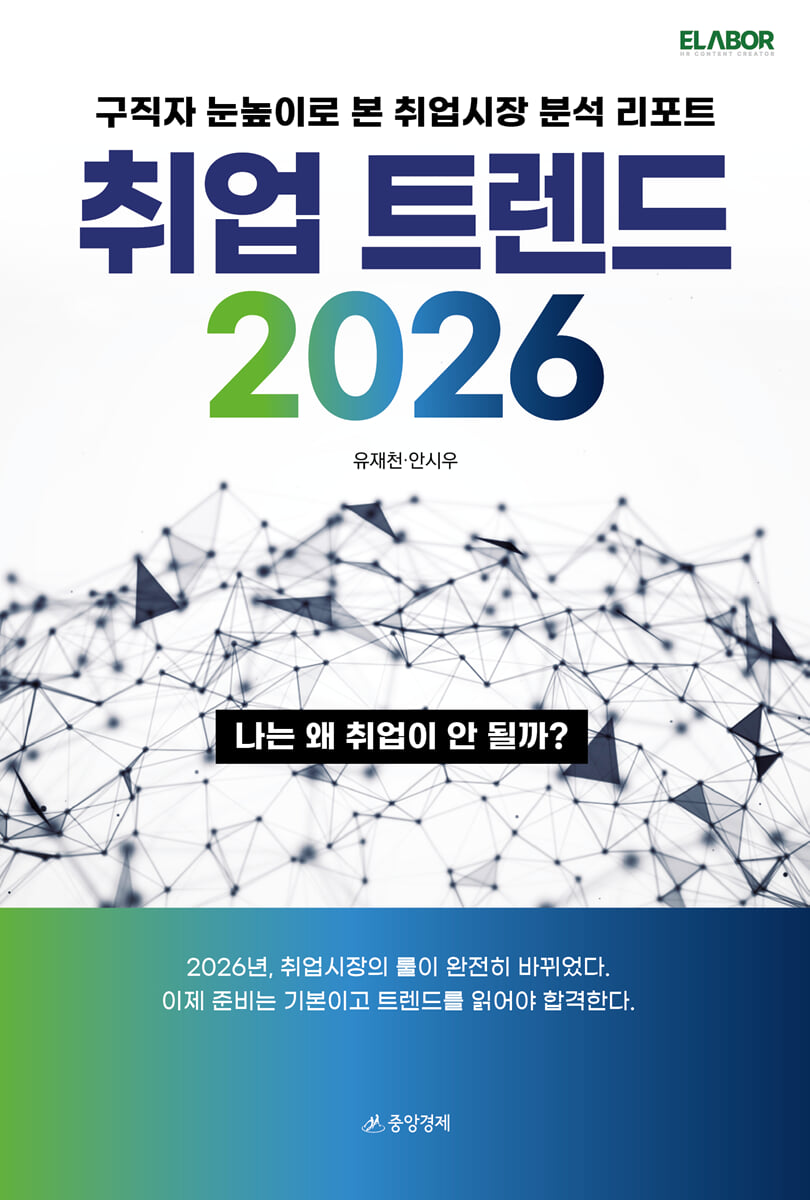
Employment Trends 2026
 |
Description
Book Introduction
Even TOEIC scores of 900 and above are dropping, but bootcamp graduates are passing... The "rules of the game" in the 2026 job market have changed.
"Employment Trends 2026," a practical employment guide for job seekers, has been published.
In 2025, a post became a hot topic in an online community.
The story was about a business administration graduate from a prestigious university with a TOEIC score of 900, a GPA of 4.0, and 10 certifications who applied to over 100 companies but were rejected by all of them.
During the same period, the employment rate of graduates of the Samsung Youth SW Academy (SSAFY) was 85%.
It wasn't a difference in flashy specs or academic background.
Because the rules of the job market in 2026 have completely changed.
A book has been published that summarizes the changing employment landscape from the perspective of job seekers.
The new book, "Employment Trends 2026," is different from existing employment trend books.
It's not a theory book for recruiters, but rather contains practical strategies that can be put to use starting tomorrow.
"Employment Trends 2026," a practical employment guide for job seekers, has been published.
In 2025, a post became a hot topic in an online community.
The story was about a business administration graduate from a prestigious university with a TOEIC score of 900, a GPA of 4.0, and 10 certifications who applied to over 100 companies but were rejected by all of them.
During the same period, the employment rate of graduates of the Samsung Youth SW Academy (SSAFY) was 85%.
It wasn't a difference in flashy specs or academic background.
Because the rules of the job market in 2026 have completely changed.
A book has been published that summarizes the changing employment landscape from the perspective of job seekers.
The new book, "Employment Trends 2026," is different from existing employment trend books.
It's not a theory book for recruiters, but rather contains practical strategies that can be put to use starting tomorrow.
index
prolog.
Why can't I get a job?
Part 1.
2025 Job Market Diagnosis
Chapter 1.
Current State of the Job Market for Four-Year College Graduates
Chapter 2.
Changing hiring trends by generation
Chapter 3.
The New Landscape of the Job Market Post-COVID
Part 2.
2026 Teen Job Trends & How to Use Them
Trend 1.
Job seekers looking for work experience
Trend 2.
In a job market where boot camps have become a necessity
Trend 3.
Project experience is more important than certification
Trend 4.
Anyway, job, job, job
Trend 5.
Portfolio, a new language to prove myself
Trend 6.
Entering the era of second-hand and new hires, job-hopping
Trend 7. AI-Powered Job Preparation
Trend 8.
Culture Fit: A Hiring Strategy Tailored to Your Organization's DNA
Trend 9.
Rolling Recruitment: A New Formula for Seizing Opportunities
Trend 10.
Mental Health: The Final Gateway to Employment
Part 3.
Employment Trends by Industry/Job
Chapter 1.
Employment Trends by Industry (Manufacturing/Services)
Chapter 2.
Current job trends (Humanities/Social Sciences/Business/Language Arts)
Chapter 3.
Current job trends (science and engineering)
Part 4.
Practical Guide to Job Preparation
Chapter 1.
365-day battle-ready system
Chapter 2. Smart Employment Strategies with AI
Chapter 3.
Strategic Career Planning and a Roadmap for New and Recruited Employees
Chapter 4.
Motivation Fit Interview Mastery
Chapter 5.
Prove your skills with a portfolio
Chapter 6.
Master Plan for 120% Utilization of Bootcamp
Chapter 7.
Mental Health: The Final Battleground in Job Hunting
Epilogue.
Cheers to your employment in 2026
Why can't I get a job?
Part 1.
2025 Job Market Diagnosis
Chapter 1.
Current State of the Job Market for Four-Year College Graduates
Chapter 2.
Changing hiring trends by generation
Chapter 3.
The New Landscape of the Job Market Post-COVID
Part 2.
2026 Teen Job Trends & How to Use Them
Trend 1.
Job seekers looking for work experience
Trend 2.
In a job market where boot camps have become a necessity
Trend 3.
Project experience is more important than certification
Trend 4.
Anyway, job, job, job
Trend 5.
Portfolio, a new language to prove myself
Trend 6.
Entering the era of second-hand and new hires, job-hopping
Trend 7. AI-Powered Job Preparation
Trend 8.
Culture Fit: A Hiring Strategy Tailored to Your Organization's DNA
Trend 9.
Rolling Recruitment: A New Formula for Seizing Opportunities
Trend 10.
Mental Health: The Final Gateway to Employment
Part 3.
Employment Trends by Industry/Job
Chapter 1.
Employment Trends by Industry (Manufacturing/Services)
Chapter 2.
Current job trends (Humanities/Social Sciences/Business/Language Arts)
Chapter 3.
Current job trends (science and engineering)
Part 4.
Practical Guide to Job Preparation
Chapter 1.
365-day battle-ready system
Chapter 2. Smart Employment Strategies with AI
Chapter 3.
Strategic Career Planning and a Roadmap for New and Recruited Employees
Chapter 4.
Motivation Fit Interview Mastery
Chapter 5.
Prove your skills with a portfolio
Chapter 6.
Master Plan for 120% Utilization of Bootcamp
Chapter 7.
Mental Health: The Final Battleground in Job Hunting
Epilogue.
Cheers to your employment in 2026
Detailed image

Publisher's Review
Large-scale public recruitment has disappeared, and a 365-day hiring war has begun.
The biggest change this book points out is the disappearance of the job season.
In the past, you could just focus on preparing for the first and second half of the year.
But now it's different.
The era of the '365-day job war' has arrived, where you never know when or from which company a job posting will be posted.
News about large corporations' public offerings, which used to grace the front pages of newspapers in March and September, has now been pushed to the back pages.
Most companies have switched to a hiring method where they hire people on an ad-hoc basis whenever they need to.
What's even more surprising is the change in hiring criteria.
The phenomenon of preferring 'second-hand new hires' who require 1-2 years of work experience when hiring new employees has become commonplace.
Now the importance of your first job has grown even more.
The time has come to build your career strategically.
The End of the Specs Era, the Emergence of the Skill Era
A notable point in the book is the rapid rise of bootcamps.
There is a phenomenon where non-majors who learned at Samsung's SSAFY or Naver's Boost Camp are actually getting better jobs than graduates from prestigious universities.
This means that actual project experience is a more powerful weapon than academic background and qualifications.
This means that the selection criteria of recruiters have fundamentally changed.
It's not about the specifications listed on your resume, but about your actual ability to perform in the field.
Likewise, new standards have emerged in the AI era.
Writing a cover letter with ChatGPT is a skill, but what makes it a skill is that recruiters are already discerning AI-generated text.
From Quantity to Quality: The Era of Strategic Preparation
In the past, job seekers applied to most of the companies they were interested in.
But the job market trends in 2026 are different.
The average number of companies that job seekers apply to has decreased to 6-7.
Instead, we thoroughly analyze and prepare for those companies.
This means that we have entered an era where quality is more important than quantity.
This is also in line with the core message of this book.
We can no longer leave things to chance and cling to old formulas.
Get started right away with practical tools and a monthly roadmap.
"Employment Trends 2026" doesn't stop at just analyzing the harsh realities.
From marketing to ESG experts, we present specific hiring criteria that vary by industry and job title, and explain step-by-step what skills to prepare and how.
In addition, we have organized a monthly roadmap and practical tools so that you can start implementing them tomorrow.
This book was written from the perspective of job seekers, for university career guidance professors, career consultants, and, above all, for job seekers currently preparing for employment.
It contains only practical strategies that can be used immediately, rather than foreign examples or forced new words.
The 2026 job market has already begun.
Only those who can read the changes and prepare strategically can survive in this fierce competition.
Understanding the rules of a new game is the first step.
The biggest change this book points out is the disappearance of the job season.
In the past, you could just focus on preparing for the first and second half of the year.
But now it's different.
The era of the '365-day job war' has arrived, where you never know when or from which company a job posting will be posted.
News about large corporations' public offerings, which used to grace the front pages of newspapers in March and September, has now been pushed to the back pages.
Most companies have switched to a hiring method where they hire people on an ad-hoc basis whenever they need to.
What's even more surprising is the change in hiring criteria.
The phenomenon of preferring 'second-hand new hires' who require 1-2 years of work experience when hiring new employees has become commonplace.
Now the importance of your first job has grown even more.
The time has come to build your career strategically.
The End of the Specs Era, the Emergence of the Skill Era
A notable point in the book is the rapid rise of bootcamps.
There is a phenomenon where non-majors who learned at Samsung's SSAFY or Naver's Boost Camp are actually getting better jobs than graduates from prestigious universities.
This means that actual project experience is a more powerful weapon than academic background and qualifications.
This means that the selection criteria of recruiters have fundamentally changed.
It's not about the specifications listed on your resume, but about your actual ability to perform in the field.
Likewise, new standards have emerged in the AI era.
Writing a cover letter with ChatGPT is a skill, but what makes it a skill is that recruiters are already discerning AI-generated text.
From Quantity to Quality: The Era of Strategic Preparation
In the past, job seekers applied to most of the companies they were interested in.
But the job market trends in 2026 are different.
The average number of companies that job seekers apply to has decreased to 6-7.
Instead, we thoroughly analyze and prepare for those companies.
This means that we have entered an era where quality is more important than quantity.
This is also in line with the core message of this book.
We can no longer leave things to chance and cling to old formulas.
Get started right away with practical tools and a monthly roadmap.
"Employment Trends 2026" doesn't stop at just analyzing the harsh realities.
From marketing to ESG experts, we present specific hiring criteria that vary by industry and job title, and explain step-by-step what skills to prepare and how.
In addition, we have organized a monthly roadmap and practical tools so that you can start implementing them tomorrow.
This book was written from the perspective of job seekers, for university career guidance professors, career consultants, and, above all, for job seekers currently preparing for employment.
It contains only practical strategies that can be used immediately, rather than foreign examples or forced new words.
The 2026 job market has already begun.
Only those who can read the changes and prepare strategically can survive in this fierce competition.
Understanding the rules of a new game is the first step.
GOODS SPECIFICS
- Date of issue: December 1, 2025
- Page count, weight, size: 232 pages | 150*225*12mm
- ISBN13: 9788970175768
- ISBN10: 8970175768
You may also like
카테고리
korean


korean

![GQ KOREA Mark (Monthly): December [2025]](http://librairie.coreenne.fr/cdn/shop/files/8ef265dbbfbf186523ed75ba7319009d.jpg?v=1765340328&width=3840)


