

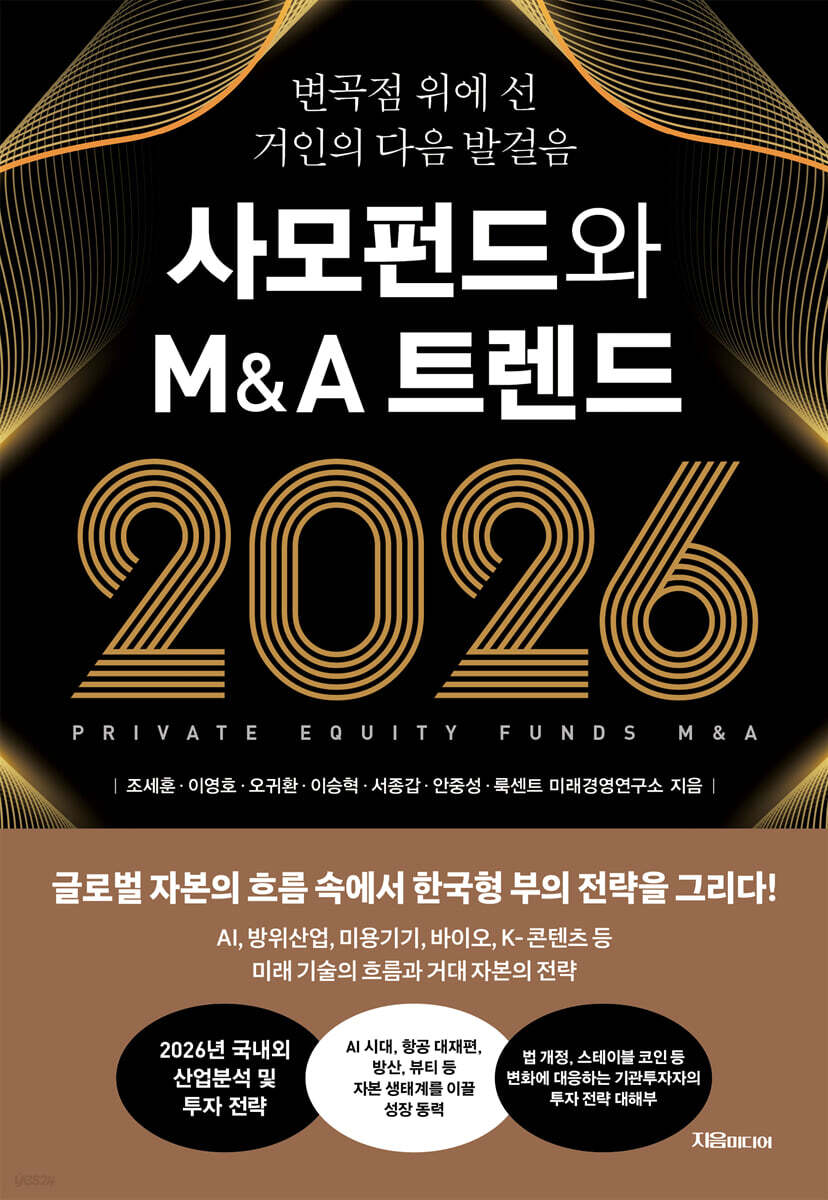
Private Equity and M&A Trends 2026
 |
Description
Book Introduction
In the midst of a major shift in regulation and technology
Private Equity Strategy Designing the Future of Capital
Growth industries that will become key battlegrounds in 2026
AI, bio, K-content
Creating new value through the next step of private equity funds
Read industry insights!
“He who reads change dominates the market!”
In 2026, the Korean mergers and acquisitions (M&A) market will face an unprecedented turning point, driven by the simultaneous convergence of technological innovation, regulatory tightening, and structural changes in the industry.
This book analyzes what strategies private equity funds and investors should adopt going forward amidst these changes.
Starting with the MBK Partners Homeplus incident in 2025, we believe we have entered an era where private equity funds cannot prove their value solely through financial returns.
As institutional changes continue, including revisions to the Commercial Act and strengthened LBO regulations, trust and social responsibility have emerged as core elements of investment strategies.
Global private equity funds are restructuring their investment strategies to focus on companies with global growth potential and brand IP, rather than large-scale deals as in the past.
In industries like K-beauty, AI data centers, and the aviation and defense industries, growth stories and industry narratives, rather than tangible assets, are now key factors in determining value.
"The Korean M&A market operates under completely different rules than in the past, and those who first understand and utilize the language of the new era will be the future winners." This book comprehensively analyzes strategies, policy and regulatory changes, and industrial structures across future industry sectors such as AI, K-beauty, aviation, defense, and data centers, offering practical guidance for investors to seize opportunities even amidst uncertainty.
Private Equity Strategy Designing the Future of Capital
Growth industries that will become key battlegrounds in 2026
AI, bio, K-content
Creating new value through the next step of private equity funds
Read industry insights!
“He who reads change dominates the market!”
In 2026, the Korean mergers and acquisitions (M&A) market will face an unprecedented turning point, driven by the simultaneous convergence of technological innovation, regulatory tightening, and structural changes in the industry.
This book analyzes what strategies private equity funds and investors should adopt going forward amidst these changes.
Starting with the MBK Partners Homeplus incident in 2025, we believe we have entered an era where private equity funds cannot prove their value solely through financial returns.
As institutional changes continue, including revisions to the Commercial Act and strengthened LBO regulations, trust and social responsibility have emerged as core elements of investment strategies.
Global private equity funds are restructuring their investment strategies to focus on companies with global growth potential and brand IP, rather than large-scale deals as in the past.
In industries like K-beauty, AI data centers, and the aviation and defense industries, growth stories and industry narratives, rather than tangible assets, are now key factors in determining value.
"The Korean M&A market operates under completely different rules than in the past, and those who first understand and utilize the language of the new era will be the future winners." This book comprehensively analyzes strategies, policy and regulatory changes, and industrial structures across future industry sectors such as AI, K-beauty, aviation, defense, and data centers, offering practical guidance for investors to seize opportunities even amidst uncertainty.
- You can preview some of the book's contents.
Preview
index
Recommendation
Prologue: Private Equity Funds Stand at a Turning Point: Where Are They Headed?
PART 1.
M&A Market and Private Equity Trends in 2025
Chapter 1: Review of Private Equity Market Trends in 2025
01 Regulatory Counterattack: The Crisis of Private Equity Funds
02 The Evolution of Global Private Equity Funds: The "Korean Strategy" Has Changed
03 Seeing the Potential of 'K-Consumer Goods' as a New Driver in the M&A Market
04 The resurgent Saemaul Geumgo and the "dark horse" Shinhyup are breathing new life into the funding market.
05 After the 'MBK Incident'… Private Equity Funds' Social Roles Become More Important
06 The Rise and Challenges of Mid- and Small-Cap Private Equity Funds
07 Large company rebalancing continues.
Interview 1.
Ahn Seong-wook, CEO of Arc & Partners, a "growth buyout" firm
Chapter 2: Areas of Interest and Outlook for Institutional Investors
01 2024 Investment Outlook Review and 2025 Performance Analysis
02 Waste Industry: A Portfolio Shield That Remains Unshaken Even in a Recession
03 K-Beauty: Changing the Global Market with Culture and Technology
04 The AI Data Center Industry: A Huge Turning Point That Changed Everything
05 The 'Well-dying Industry': A New Investment Opportunity Driven by Population Changes
Interview 2.
Keystone Partners, the company behind the success of its pub, dreams of becoming an F&B group. _ Shin Hyo-sik, CEO of Keystone Partners
Interview 3.
Yoa Jeong's "Cinematic" Investments... Anticipation for Harvard Textbook Inclusion Soars _Heo Jun-young, CEO of J&Partners
PART 2.
M&A Market and Private Equity Outlook for 2026
Chapter 3: Domestic and International Private Equity Fund Investment Trends
01 A Look at the Industrial Economy in 2026
02 Credit Fund Creates Large-Scale Blinds… All That's Left to Do
03 VCs Jumping into Buyouts…Blurring Lines
04 Stablecoins Become a Trend: Will the Return of the Investment Fever Become a Key Investment Destination for Private Equity Funds?
05 Impatient Minority Shareholders, Empowered Activism
Interview 4.
"Value-up and commercial law are on track, but taxation is blocking the way." _Lee Chang-hwan, CEO of Align Partners
Chapter 4: Attorney Ahn Jung-seong's Analysis of Changes in the Private Equity Fund System and Regulations
01 Amendment to the Commercial Act: What are the pros and cons for private equity funds?
02 Background and Impact of Strengthening LBO Regulations
03 The significance of the introduction of the mandatory public offering system and practical responses
04 Restrictions on the Use of Treasury Stock and Governance Issues
05 Changes in the relationship between GPs and LPs: Restoring trust and profit-sharing structure
06 Supervisory Authority Inspection and Legal Issues
Chapter 5: Luxent's Key Industrial Investments and Management Strategy Case Studies
01 Investment Insights in the AI Era
02 Aviation Reorganization: The Sky Is Changing
03 K-Defense: For the backlog of orders to become a real jackpot…
04 The Secret to the Rapid Growth of the Beauty Device Market: What's Next?
Chapter 6: Political and Social Risks Facing Private Equity Funds
01 Private Equity Investment Strategies in an Age of Uncertainty
02 Capital Market Norms: Conditions for Restoring Confidence
03 Reestablishing the Relationship with Media and Public Opinion
04 PE's Attempts to 'Coexist' with Society
Epilogue: From Barbarians to Designers… Private Equity Funds Are Evolving
Prologue: Private Equity Funds Stand at a Turning Point: Where Are They Headed?
PART 1.
M&A Market and Private Equity Trends in 2025
Chapter 1: Review of Private Equity Market Trends in 2025
01 Regulatory Counterattack: The Crisis of Private Equity Funds
02 The Evolution of Global Private Equity Funds: The "Korean Strategy" Has Changed
03 Seeing the Potential of 'K-Consumer Goods' as a New Driver in the M&A Market
04 The resurgent Saemaul Geumgo and the "dark horse" Shinhyup are breathing new life into the funding market.
05 After the 'MBK Incident'… Private Equity Funds' Social Roles Become More Important
06 The Rise and Challenges of Mid- and Small-Cap Private Equity Funds
07 Large company rebalancing continues.
Interview 1.
Ahn Seong-wook, CEO of Arc & Partners, a "growth buyout" firm
Chapter 2: Areas of Interest and Outlook for Institutional Investors
01 2024 Investment Outlook Review and 2025 Performance Analysis
02 Waste Industry: A Portfolio Shield That Remains Unshaken Even in a Recession
03 K-Beauty: Changing the Global Market with Culture and Technology
04 The AI Data Center Industry: A Huge Turning Point That Changed Everything
05 The 'Well-dying Industry': A New Investment Opportunity Driven by Population Changes
Interview 2.
Keystone Partners, the company behind the success of its pub, dreams of becoming an F&B group. _ Shin Hyo-sik, CEO of Keystone Partners
Interview 3.
Yoa Jeong's "Cinematic" Investments... Anticipation for Harvard Textbook Inclusion Soars _Heo Jun-young, CEO of J&Partners
PART 2.
M&A Market and Private Equity Outlook for 2026
Chapter 3: Domestic and International Private Equity Fund Investment Trends
01 A Look at the Industrial Economy in 2026
02 Credit Fund Creates Large-Scale Blinds… All That's Left to Do
03 VCs Jumping into Buyouts…Blurring Lines
04 Stablecoins Become a Trend: Will the Return of the Investment Fever Become a Key Investment Destination for Private Equity Funds?
05 Impatient Minority Shareholders, Empowered Activism
Interview 4.
"Value-up and commercial law are on track, but taxation is blocking the way." _Lee Chang-hwan, CEO of Align Partners
Chapter 4: Attorney Ahn Jung-seong's Analysis of Changes in the Private Equity Fund System and Regulations
01 Amendment to the Commercial Act: What are the pros and cons for private equity funds?
02 Background and Impact of Strengthening LBO Regulations
03 The significance of the introduction of the mandatory public offering system and practical responses
04 Restrictions on the Use of Treasury Stock and Governance Issues
05 Changes in the relationship between GPs and LPs: Restoring trust and profit-sharing structure
06 Supervisory Authority Inspection and Legal Issues
Chapter 5: Luxent's Key Industrial Investments and Management Strategy Case Studies
01 Investment Insights in the AI Era
02 Aviation Reorganization: The Sky Is Changing
03 K-Defense: For the backlog of orders to become a real jackpot…
04 The Secret to the Rapid Growth of the Beauty Device Market: What's Next?
Chapter 6: Political and Social Risks Facing Private Equity Funds
01 Private Equity Investment Strategies in an Age of Uncertainty
02 Capital Market Norms: Conditions for Restoring Confidence
03 Reestablishing the Relationship with Media and Public Opinion
04 PE's Attempts to 'Coexist' with Society
Epilogue: From Barbarians to Designers… Private Equity Funds Are Evolving
Detailed image

Into the book
The most symbolic example of the new strategy of global private equity funds was Blackstone's acquisition of Juno Hair, the world's largest alternative investment management company.
The market initially reacted with skepticism to the news that Blackstone was investing approximately 800 billion won to acquire the country's leading beauty salon franchise.
But this was a textbook example of their evolved investment formula.
--- p.25
But now, companies that have already achieved success, like Samyang Foods, are taking their growth story to the next chapter through M&A.
Also, as in the case of JKL, private equity funds have begun to view intangible brand IP itself, rather than tangible assets, as a key investment target.
Ultimately, the success or failure of the future M&A market will depend on which company meets which partner (private equity fund or other company) and how compelling a "global growth story" it creates.
--- p.33
Asset rebalancing by large corporations continued in 2025, following 2024. SK Group continues to sell and merge affiliates, and other conglomerates are also actively exploring asset securitization.
Despite the large number of conglomerate affiliates being put up for sale in 2024, a wider range of industries and groups are expected to be put up for sale in 2025.
Amidst the tectonic shifts in the industry, there are still potential properties that have not been digested or that will be added to the market.
The breathless asset sales are likely to continue in 2026, following 2025.
--- p.54
This is an era where trash becomes money.
Where does the garbage that pours out every day go and who handles it?
The amount of household, industrial, and construction waste generated increases by 2-3% every year, but the number of landfills and incinerators to process this waste is not increasing easily due to licensing barriers and local complaints.
In a market with limited supply, the per-ton processing cost becomes a 'safety net' that does not go down.
Although unit prices in some regions were slightly adjusted in 2024, large-scale landfill and incineration assets still boasted high margins and cash-generating capabilities.
The plan for the metropolitan landfill, which is scheduled to end in 2025, is merely a nominal one; in reality, discussions about extension and replacement sites are ongoing, increasing the risk of recalculating transportation and processing costs by region and unit price fluctuations.
--- p.78
The well-dying industry is growing every year as it sees these people off on their final journey.
The service area has also been segmented and diversified, expanding into a comprehensive life care service.
The well-dying industry is evolving into a high-value-added service encompassing the entire final journey of life, including nursing, senior living, and digital legacy management.
The well-dying industry is bound to see an increase in customers over time, and the services they seek will inevitably diversify.
It is an industry that is on the rise.
Domestic and foreign PE and SI firms cannot afford to ignore high-growth industries.
Through M&A, we are bringing together companies that were previously divided by service and region.
--- p.106
The fact that domestic companies are effectively being mobilized in the US drive to contain China raises further concerns.
The United States is controlling the import of advanced semiconductor chips and equipment into China to curb China's AI industry.
Domestic semiconductor companies that have a significant proportion of sales in China will suffer direct damage.
The fact that a single word from the Trump administration could overturn corporate management strategies at any time is a significant management risk.
--- p.134
As traditional financial institutions actively enter the coin ecosystem, the impact is also spreading to the private equity industry.
It is difficult to find examples of PE firms actively investing in the coin ecosystem right now.
However, it is expected that investments in companies related to the ecosystem, such as transaction infrastructure, storage services, and regulatory compliance solutions, will continue.
The market initially reacted with skepticism to the news that Blackstone was investing approximately 800 billion won to acquire the country's leading beauty salon franchise.
But this was a textbook example of their evolved investment formula.
--- p.25
But now, companies that have already achieved success, like Samyang Foods, are taking their growth story to the next chapter through M&A.
Also, as in the case of JKL, private equity funds have begun to view intangible brand IP itself, rather than tangible assets, as a key investment target.
Ultimately, the success or failure of the future M&A market will depend on which company meets which partner (private equity fund or other company) and how compelling a "global growth story" it creates.
--- p.33
Asset rebalancing by large corporations continued in 2025, following 2024. SK Group continues to sell and merge affiliates, and other conglomerates are also actively exploring asset securitization.
Despite the large number of conglomerate affiliates being put up for sale in 2024, a wider range of industries and groups are expected to be put up for sale in 2025.
Amidst the tectonic shifts in the industry, there are still potential properties that have not been digested or that will be added to the market.
The breathless asset sales are likely to continue in 2026, following 2025.
--- p.54
This is an era where trash becomes money.
Where does the garbage that pours out every day go and who handles it?
The amount of household, industrial, and construction waste generated increases by 2-3% every year, but the number of landfills and incinerators to process this waste is not increasing easily due to licensing barriers and local complaints.
In a market with limited supply, the per-ton processing cost becomes a 'safety net' that does not go down.
Although unit prices in some regions were slightly adjusted in 2024, large-scale landfill and incineration assets still boasted high margins and cash-generating capabilities.
The plan for the metropolitan landfill, which is scheduled to end in 2025, is merely a nominal one; in reality, discussions about extension and replacement sites are ongoing, increasing the risk of recalculating transportation and processing costs by region and unit price fluctuations.
--- p.78
The well-dying industry is growing every year as it sees these people off on their final journey.
The service area has also been segmented and diversified, expanding into a comprehensive life care service.
The well-dying industry is evolving into a high-value-added service encompassing the entire final journey of life, including nursing, senior living, and digital legacy management.
The well-dying industry is bound to see an increase in customers over time, and the services they seek will inevitably diversify.
It is an industry that is on the rise.
Domestic and foreign PE and SI firms cannot afford to ignore high-growth industries.
Through M&A, we are bringing together companies that were previously divided by service and region.
--- p.106
The fact that domestic companies are effectively being mobilized in the US drive to contain China raises further concerns.
The United States is controlling the import of advanced semiconductor chips and equipment into China to curb China's AI industry.
Domestic semiconductor companies that have a significant proportion of sales in China will suffer direct damage.
The fact that a single word from the Trump administration could overturn corporate management strategies at any time is a significant management risk.
--- p.134
As traditional financial institutions actively enter the coin ecosystem, the impact is also spreading to the private equity industry.
It is difficult to find examples of PE firms actively investing in the coin ecosystem right now.
However, it is expected that investments in companies related to the ecosystem, such as transaction infrastructure, storage services, and regulatory compliance solutions, will continue.
--- p.155
Publisher's Review
Domestic and International Industry Analysis and Investment Strategies for 2026
In the AI era, pay attention to megatrends driving the capital ecosystem, including aviation restructuring, defense, and beauty.
Amidst a period of transition where technological, regulatory, and industrial structural changes are all occurring simultaneously, this report provides insight into the future direction of the Korean M&A market.
As Korea's M&A market is being reorganized under entirely new rules, the core objective is to provide investors with practical guidance in a situation where the old formulas for success no longer apply.
This book highlights the reality that capital flows are expanding beyond simple transactions and financial technology to capital that unlocks future industries. It explores in a multi-layered manner how key industries that shape the future of the Korean economy—such as the power and infrastructure gaps in AI data centers, shifting geopolitical demands in the defense industry, the structural growth of aviation MRO and cargo transportation, and the global expansion of K-beauty and platform companies—have shifted to become central axes of the M&A market.
The author persuasively demonstrates, through data and case studies, that these industries are not short-term themes, but rather long-term growth engines that will reshape the Korean capital market beyond 2026.
“Who will be the next winner?”
We also pay attention to the shocking events that shook the market in 2025.
In particular, the MBK Partners Homeplus incident was not the failure of a single company, but rather shook the very foundations of the market by raising the social question, “What kind of entity is a private equity fund?”
This incident prompted political circles and regulatory authorities to push for strong regulatory reforms, including revisions to the Commercial Act, strengthening regulations on leveraged buyouts (LBOs), and restricting the use of treasury stock. These reforms began to impose new burdens and set new standards for both investors and asset managers.
Based on this reality, we analyze how regulation and uncertainty have actually served as opportunities to refine market strategies by asking, "How do markets evolve in times of crisis?"
Nevertheless, the market found a new path for itself.
Rather than pursuing multi-billion dollar deals as they did in the past, global private equity funds are beginning to select companies with global scalability, brand IP, and platform network effects, even if they are small in size.
Samyang Foods' global leap forward and JKL Partners' investment in the London Bagel Museum IP indicate that the Korean M&A market is no longer focused on tangible assets, but has entered a phase where transactions are focused on stories, narratives, brands, and growth potential itself.
This book doesn't explain this trend as a simple phenomenon, but interprets it as a signal that determines competitiveness in a new era, and meticulously analyzes where the "power to determine the next winner" comes from.
"Those who can read change dominate the market."
The significant value of this book lies in proposing a new definition of how private equity funds should exist.
The days when private equity funds were evaluated solely on their returns are over.
Going forward, private equity funds will lose their place in the market if they fail to build social trust. Conversely, if they evolve into industry designers and ecosystem builders, they will lead a new phase of growth.
[PART 1.
"2025 M&A Market and Private Equity Trends" provides an in-depth review of the turbulent 2025 M&A and private equity market through four key trends: regulation, global private equity, K-consumer goods, and the funding market.
And we analyze the performance of key sectors that institutional investors have been paying attention to with a cool-headed approach, uncovering the causes of success and failure.
[PART 2.
[2026 M&A Market and Private Equity Fund Outlook] uses the chaos of 2025 as a stepping stone to forecast the future of the M&A market and private equity funds in 2026.
Unpredictable institutional changes, including strengthened regulations, will lead the market. We present investment strategies for key sectors that will reshape the landscape of future industries, including AI, waste management, aviation, defense, and beauty devices. We also explore new strategies for private equity funds to go beyond survival and lead the market amidst political and social risks.
This book provides practical strategies and insights for investors lost in the fog of uncertainty and regulation.
In the Korean market, where industrial trends, technological changes, policy restructuring, and capital strategies are all intertwined, this book delves into what to watch for, what not to miss, and how to approach the market to increase your chances of success.
“The market of 2026 will operate under completely different rules than in the past,” and those who first perceive and act on the new era will ultimately determine the future.
This book will serve as a much-needed compass for all investors who need to understand the Korean capital market, private equity industry, and future industries.
In the AI era, pay attention to megatrends driving the capital ecosystem, including aviation restructuring, defense, and beauty.
Amidst a period of transition where technological, regulatory, and industrial structural changes are all occurring simultaneously, this report provides insight into the future direction of the Korean M&A market.
As Korea's M&A market is being reorganized under entirely new rules, the core objective is to provide investors with practical guidance in a situation where the old formulas for success no longer apply.
This book highlights the reality that capital flows are expanding beyond simple transactions and financial technology to capital that unlocks future industries. It explores in a multi-layered manner how key industries that shape the future of the Korean economy—such as the power and infrastructure gaps in AI data centers, shifting geopolitical demands in the defense industry, the structural growth of aviation MRO and cargo transportation, and the global expansion of K-beauty and platform companies—have shifted to become central axes of the M&A market.
The author persuasively demonstrates, through data and case studies, that these industries are not short-term themes, but rather long-term growth engines that will reshape the Korean capital market beyond 2026.
“Who will be the next winner?”
We also pay attention to the shocking events that shook the market in 2025.
In particular, the MBK Partners Homeplus incident was not the failure of a single company, but rather shook the very foundations of the market by raising the social question, “What kind of entity is a private equity fund?”
This incident prompted political circles and regulatory authorities to push for strong regulatory reforms, including revisions to the Commercial Act, strengthening regulations on leveraged buyouts (LBOs), and restricting the use of treasury stock. These reforms began to impose new burdens and set new standards for both investors and asset managers.
Based on this reality, we analyze how regulation and uncertainty have actually served as opportunities to refine market strategies by asking, "How do markets evolve in times of crisis?"
Nevertheless, the market found a new path for itself.
Rather than pursuing multi-billion dollar deals as they did in the past, global private equity funds are beginning to select companies with global scalability, brand IP, and platform network effects, even if they are small in size.
Samyang Foods' global leap forward and JKL Partners' investment in the London Bagel Museum IP indicate that the Korean M&A market is no longer focused on tangible assets, but has entered a phase where transactions are focused on stories, narratives, brands, and growth potential itself.
This book doesn't explain this trend as a simple phenomenon, but interprets it as a signal that determines competitiveness in a new era, and meticulously analyzes where the "power to determine the next winner" comes from.
"Those who can read change dominate the market."
The significant value of this book lies in proposing a new definition of how private equity funds should exist.
The days when private equity funds were evaluated solely on their returns are over.
Going forward, private equity funds will lose their place in the market if they fail to build social trust. Conversely, if they evolve into industry designers and ecosystem builders, they will lead a new phase of growth.
[PART 1.
"2025 M&A Market and Private Equity Trends" provides an in-depth review of the turbulent 2025 M&A and private equity market through four key trends: regulation, global private equity, K-consumer goods, and the funding market.
And we analyze the performance of key sectors that institutional investors have been paying attention to with a cool-headed approach, uncovering the causes of success and failure.
[PART 2.
[2026 M&A Market and Private Equity Fund Outlook] uses the chaos of 2025 as a stepping stone to forecast the future of the M&A market and private equity funds in 2026.
Unpredictable institutional changes, including strengthened regulations, will lead the market. We present investment strategies for key sectors that will reshape the landscape of future industries, including AI, waste management, aviation, defense, and beauty devices. We also explore new strategies for private equity funds to go beyond survival and lead the market amidst political and social risks.
This book provides practical strategies and insights for investors lost in the fog of uncertainty and regulation.
In the Korean market, where industrial trends, technological changes, policy restructuring, and capital strategies are all intertwined, this book delves into what to watch for, what not to miss, and how to approach the market to increase your chances of success.
“The market of 2026 will operate under completely different rules than in the past,” and those who first perceive and act on the new era will ultimately determine the future.
This book will serve as a much-needed compass for all investors who need to understand the Korean capital market, private equity industry, and future industries.
GOODS SPECIFICS
- Date of issue: December 8, 2025
- Page count, weight, size: 344 pages | 470g | 145*210*21mm
- ISBN13: 9791193780220
You may also like
카테고리
korean


korean

![GQ KOREA Mark (Monthly): December [2025]](http://librairie.coreenne.fr/cdn/shop/files/8ef265dbbfbf186523ed75ba7319009d.jpg?v=1765340328&width=3840)


