

Uniqlo
 |
Description
Book Introduction
From a tailor shop born in a fallen coal mining town
From becoming a brand loved by people all over the world
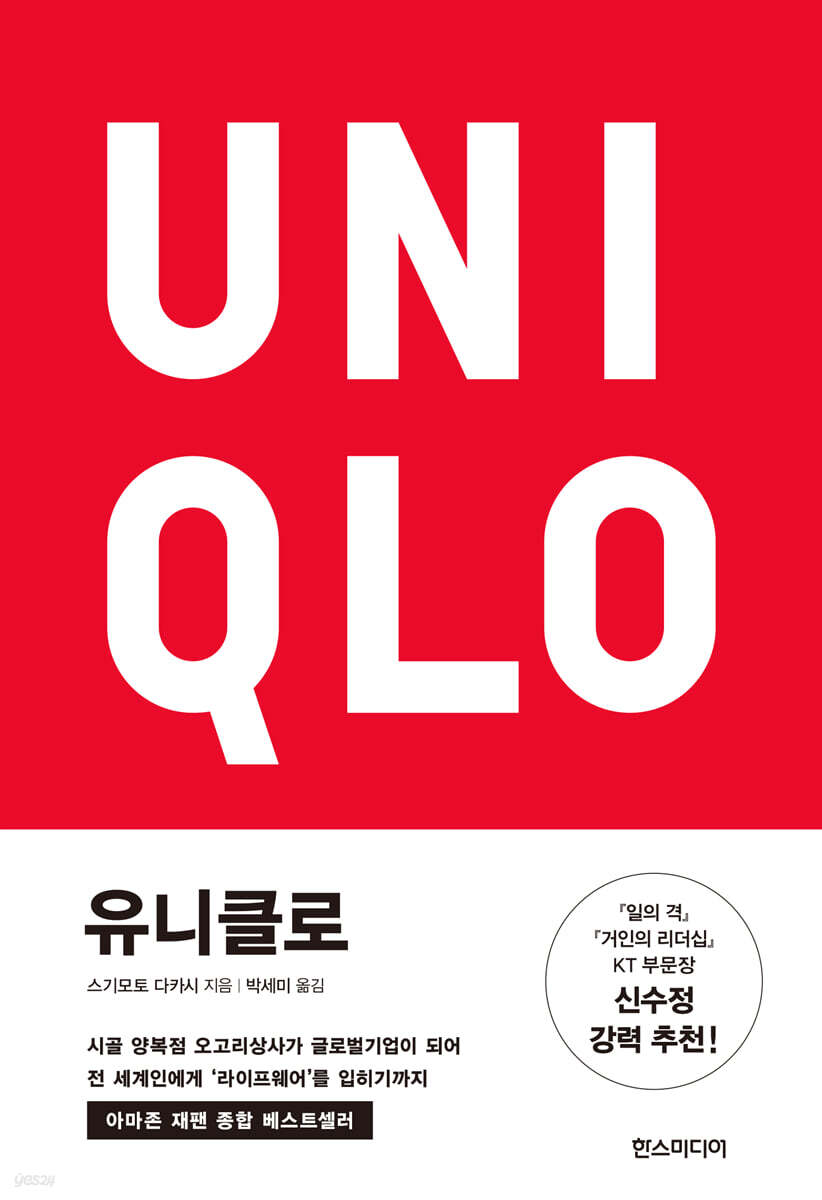
LifeWear: A 40-Year Story of Uniqlo
"Connecting," "The Class of Work," and "Leadership of Giants" are highly recommended by Shin Soo-jung, KT division head.
Amazon Japan Comprehensive Bestseller of 2024
Everyone probably has at least one piece of Uniqlo clothing in their closet.
Uniqlo's attractive point to today's consumers is its "cost-effectiveness" with basic items that can be styled in various ways for a small amount of money, including a design that is acceptable to wear with any other clothes, a certain level of guaranteed quality, and even an affordable price.
The fact that Uniqlo is expecting to achieve its best performance for four consecutive years, especially in an era of global economic crisis and high prices, can be seen as evidence that the brand has correctly answered the question of what clothing consumers want and how to provide it reliably.
This book, "Uniqlo," tells the story of Uniqlo's founder, Tadashi Yanai, who is also Japan's richest man, as he inherited a tailor shop in his hometown from his father and grew it into what is now Uniqlo. It goes beyond the framework of a simple business management book and approaches you as an exciting story.
From becoming a brand loved by people all over the world
LifeWear: A 40-Year Story of Uniqlo
"Connecting," "The Class of Work," and "Leadership of Giants" are highly recommended by Shin Soo-jung, KT division head.
Amazon Japan Comprehensive Bestseller of 2024
Everyone probably has at least one piece of Uniqlo clothing in their closet.
Uniqlo's attractive point to today's consumers is its "cost-effectiveness" with basic items that can be styled in various ways for a small amount of money, including a design that is acceptable to wear with any other clothes, a certain level of guaranteed quality, and even an affordable price.
The fact that Uniqlo is expecting to achieve its best performance for four consecutive years, especially in an era of global economic crisis and high prices, can be seen as evidence that the brand has correctly answered the question of what clothing consumers want and how to provide it reliably.
This book, "Uniqlo," tells the story of Uniqlo's founder, Tadashi Yanai, who is also Japan's richest man, as he inherited a tailor shop in his hometown from his father and grew it into what is now Uniqlo. It goes beyond the framework of a simple business management book and approaches you as an exciting story.
- You can preview some of the book's contents.
Preview
index
Main characters
prolog.
A deserted shopping street
Chapter 1.
The Lazy Bunny: How a Lethargic Youth Awoke
Gintengai | A Fifteen-Year-Old's Hire | Ogori Trading Company, a Suits Store | Parent-Child Discord | Days of Idleness | An Encounter in Granada | A Persistent Man | Nine Months at Jasco | The Teachings of Chizuko Kojima | Living with a Hidden Person, Conflict, This Can't Go On | I'll Go From Here
Chapter 2.
The Dark Ages: A Decade of Struggle and Hiding
Back at Gintengai | Another Brother | A Departing Employee | Loss of Confidence | Self-Analysis Written in a Notebook | A Delegated Seal and Bankbook | 10 Dark Years | Failure at This Rate | The Admired Konosuke Matsushita | "This Guy's an Idiot" | Ray Kroc | Be Daring, Be First, Be Different | Hints from Uniqlo
Chapter 3.
Goldmine: Uniqlo Born in a Back Alley
Casual Wear Warehouse | The Morning at Uniqlo's First Store in 1984 | Unearthing a Goldmine | The Failure of the Second Store, I Was Overconfident | The Success of Suburban Stores | Questions About Fast Fashion | Polo Shirts in Hong Kong | Meeting Jimmy Lai | A Batting Average Below 1/100 | My Connection with the Overseas Chinese | A Lesson from the Successful Daiei | Three-Line Management Theory
Chapter 4.
Conflict: Ambition that is not understood
Uniqlo's Partner | A Serious Competition | The Immature Uniqlo | My Father's Opposition | One-Man Management | The Standard Store Model and Accounting Thinking | An Arrogant Branch Manager | A Name Change and a Risky Plan | Don't Set Your Goals as an Extension of Reality | Discord with Your Main Bank | "Are You Trying to Fool Me?" | An Angry Letter | Ready for a Complete Withdrawal | IPO Date | Farewell to My Father | Tadashi Yanai's Tears
Chapter 5.
Leap Forward: Tokyo Expansion and the Fleece Craze
National Stadium | Athletic Brother | A Proposal to the Itochu President | "How Can I Wait 10 Years!" | Little Uncle | Reality Seen from Amemura | ABC Reform | Fighting Corporate Disease | Most Fail | Questions for Success | Winning with Fleece | Harajuku Store | Scouting My Little Brother | Dumpling Shop in the Market
Chapter 6.
Frustration: 'The company is going under,' new talent and veterans leaving.
A Rival Seen in Barcelona | The Man Who Built Zara | "The Company Is Going Down" | Talent Gathering | Meeting John Jay | Lessons Learned from the Nike Founder | "If You Can't Swim, Sink" | Yanai's Admired Brand | Entering London | Forgotten Questions | Uniqlo's Rebound | Tamatsuka's Passion
Chapter 7.
Backlash: The Lost Sun Yang Drama
Cleaning Up After the Festival | The Limits of the Bungeoppang Method | Breaking with President-Centricism | A New, Hands-On President | Frustration in China | Partnership with Toray | Dismissal | Mr. Rugby's Point of View | I Can't Refuse Your Request
Chapter 8.
Breakthrough: The 'Question' That Led to Global Expansion
A Young Man from Beijing | Failure in Shanghai | What Were Lacking? | The Breakthrough Lies in Hong Kong | Banning's Discovery | Hints from the Founder of US Limited | The Rebirth of Uniqlo in China | Meeting Sato Kashiwa | Repeated Failures in the US | A Conversation Between Two Men | Flagship Store Strategy | What is Clothing? | Six Definitions | The Katakana Logo | A Sense of Discomfort
Chapter 9.
Contradiction: Questions Raised by Criticism of "Black Companies"
Uniqlo's Little Brother | The Uniqlo Method for Vegetables | Public Execution | 990 Yen Jeans | Three Lessons from GU Recycling | "Give It Back 100-fold" | McDonald's as an Example | The Nameless Manager | The Unspoken Heartache | Undercover Investigation | Lessons from Bangladesh | Double Accounting | The Devil's Proof | Haruki Murakami's Questions on "Walls and Eggs"
Chapter 10.
Resurrection: The Conflict Behind the Long-Awaited North American Rebuild
Uniqlo in form only | Similar yet different | More Uniqlo-like | The Japanese spy arrives | Yanai's successor candidate | The great migration | Changing Uniqlo's history | The conflict of a young ace | Learning from China | A deserted New York | Closing the 34th Street store | Declaring a counterattack
Chapter 11.
Evolution: Disruption and Creation in Information Manufacturing Retail
The Ariake Project | The Impact of the Mobile Internet | "The Opponent We Fight Has Changed" | Evolution into Information Manufacturing and Retail | Comrade Son Jeong-ui | A Journey in Search of Hints | Chemical Reaction | Logistics Collapse | Breaking It Again | Doubts About Jack Ma | Alibaba's Lessons | Edison in Southern Osaka | The Ultimate Choice
Epilogue.
The world is connected
References
Cardinal
prolog.
A deserted shopping street
Chapter 1.
The Lazy Bunny: How a Lethargic Youth Awoke
Gintengai | A Fifteen-Year-Old's Hire | Ogori Trading Company, a Suits Store | Parent-Child Discord | Days of Idleness | An Encounter in Granada | A Persistent Man | Nine Months at Jasco | The Teachings of Chizuko Kojima | Living with a Hidden Person, Conflict, This Can't Go On | I'll Go From Here
Chapter 2.
The Dark Ages: A Decade of Struggle and Hiding
Back at Gintengai | Another Brother | A Departing Employee | Loss of Confidence | Self-Analysis Written in a Notebook | A Delegated Seal and Bankbook | 10 Dark Years | Failure at This Rate | The Admired Konosuke Matsushita | "This Guy's an Idiot" | Ray Kroc | Be Daring, Be First, Be Different | Hints from Uniqlo
Chapter 3.
Goldmine: Uniqlo Born in a Back Alley
Casual Wear Warehouse | The Morning at Uniqlo's First Store in 1984 | Unearthing a Goldmine | The Failure of the Second Store, I Was Overconfident | The Success of Suburban Stores | Questions About Fast Fashion | Polo Shirts in Hong Kong | Meeting Jimmy Lai | A Batting Average Below 1/100 | My Connection with the Overseas Chinese | A Lesson from the Successful Daiei | Three-Line Management Theory
Chapter 4.
Conflict: Ambition that is not understood
Uniqlo's Partner | A Serious Competition | The Immature Uniqlo | My Father's Opposition | One-Man Management | The Standard Store Model and Accounting Thinking | An Arrogant Branch Manager | A Name Change and a Risky Plan | Don't Set Your Goals as an Extension of Reality | Discord with Your Main Bank | "Are You Trying to Fool Me?" | An Angry Letter | Ready for a Complete Withdrawal | IPO Date | Farewell to My Father | Tadashi Yanai's Tears
Chapter 5.
Leap Forward: Tokyo Expansion and the Fleece Craze
National Stadium | Athletic Brother | A Proposal to the Itochu President | "How Can I Wait 10 Years!" | Little Uncle | Reality Seen from Amemura | ABC Reform | Fighting Corporate Disease | Most Fail | Questions for Success | Winning with Fleece | Harajuku Store | Scouting My Little Brother | Dumpling Shop in the Market
Chapter 6.
Frustration: 'The company is going under,' new talent and veterans leaving.
A Rival Seen in Barcelona | The Man Who Built Zara | "The Company Is Going Down" | Talent Gathering | Meeting John Jay | Lessons Learned from the Nike Founder | "If You Can't Swim, Sink" | Yanai's Admired Brand | Entering London | Forgotten Questions | Uniqlo's Rebound | Tamatsuka's Passion
Chapter 7.
Backlash: The Lost Sun Yang Drama
Cleaning Up After the Festival | The Limits of the Bungeoppang Method | Breaking with President-Centricism | A New, Hands-On President | Frustration in China | Partnership with Toray | Dismissal | Mr. Rugby's Point of View | I Can't Refuse Your Request
Chapter 8.
Breakthrough: The 'Question' That Led to Global Expansion
A Young Man from Beijing | Failure in Shanghai | What Were Lacking? | The Breakthrough Lies in Hong Kong | Banning's Discovery | Hints from the Founder of US Limited | The Rebirth of Uniqlo in China | Meeting Sato Kashiwa | Repeated Failures in the US | A Conversation Between Two Men | Flagship Store Strategy | What is Clothing? | Six Definitions | The Katakana Logo | A Sense of Discomfort
Chapter 9.
Contradiction: Questions Raised by Criticism of "Black Companies"
Uniqlo's Little Brother | The Uniqlo Method for Vegetables | Public Execution | 990 Yen Jeans | Three Lessons from GU Recycling | "Give It Back 100-fold" | McDonald's as an Example | The Nameless Manager | The Unspoken Heartache | Undercover Investigation | Lessons from Bangladesh | Double Accounting | The Devil's Proof | Haruki Murakami's Questions on "Walls and Eggs"
Chapter 10.
Resurrection: The Conflict Behind the Long-Awaited North American Rebuild
Uniqlo in form only | Similar yet different | More Uniqlo-like | The Japanese spy arrives | Yanai's successor candidate | The great migration | Changing Uniqlo's history | The conflict of a young ace | Learning from China | A deserted New York | Closing the 34th Street store | Declaring a counterattack
Chapter 11.
Evolution: Disruption and Creation in Information Manufacturing Retail
The Ariake Project | The Impact of the Mobile Internet | "The Opponent We Fight Has Changed" | Evolution into Information Manufacturing and Retail | Comrade Son Jeong-ui | A Journey in Search of Hints | Chemical Reaction | Logistics Collapse | Breaking It Again | Doubts About Jack Ma | Alibaba's Lessons | Edison in Southern Osaka | The Ultimate Choice
Epilogue.
The world is connected
References
Cardinal
Detailed image

Into the book
In 1994, when Uniqlo was growing rapidly, Yanai also announced the “Three Promises.”
One of them was, “If you are not satisfied with the product, you can return or exchange it within 3 months of purchase, even without a receipt.”
Although he faced fierce opposition from management regarding the unconditional return, the words “build trust step by step” were something that his father Hitoshi emphasized to his son until his mouth was dry, calling it the “business mindset.”
--- pp.73-74, 「Chapter 1.
From "The Lazy Bumblebee: How a Lethargic Youth Awoke - Teachings of Chizuko Kojima"
It was a waste of time worrying about something that couldn't be solved in the first place.
If you share your concerns from the beginning, you can then organize things one by one, starting with 'things worth trying' without overthinking them.
If you keep going like this, you might see the exit of the tunnel someday.
Yanai had this mindset ingrained in him as he experienced the turmoil of senior staff leaving.
--- p.98, Chapter 2.
From "The Dark Ages: Ten Years of Struggling and Hiding - Self-Analysis Written in Notes"
Yanai had finally found his golden opportunity. As Uniqlo began to gain traction, he began to consider a completely different business model, even when Uniqlo was still in its infancy.
It was a path to transforming from a 'casual wear warehouse' that gathered clothes from various domestic and foreign companies into a full-fledged SPA.
--- p.150, Chapter 3.
From "Gold Vein: Uniqlo Born in the Back Alleys - Encounter with Jimmy Lai"
Hitoshi always opposed his son's expansion of the store.
I thought I could put down roots in the area and do business as far as my vision allowed.
I thought that if I could feed my family and a few employees, that would be enough.
His way of thinking was fundamentally different from that of his son, who started out with the goal of becoming the 'world's best Uniqlo.'
--- p.215, Chapter 4.
From "Clash: Ambition Not Understood - Parting with Father"
“When you try something new, you are bound to fail.
But failure is not the problem.
(The important point) is what you gain from failure.
As a manager, you need to think about the reasons for failure and what you can do to avoid failure next time.
So, what this means is that if there is no failure, there is no beginning.”
--- p.253, Chapter 5.
From "Leap: Tokyo Expansion and the Fleece Fever - Most Fail"
It's really simple, but not easy to put into practice.
The flagship store strategy carries significant risks.
Building a massive store in a major city around the world requires a significant amount of capital, and having everything in one place requires stocking even the most underwhelming items.
Naturally, inventory risk is also high.
How to build supply chains for both well-selling and poorly-selling clothes.
This is an area where the capabilities of SPA, which assumes full purchase, are required.
--- p.368, Chapter 8.
Breakthrough: The 'Question' That Led to Global Expansion - Hints from the Founder of American Limited
Sato confesses, “I always had that kind of dialogue with Mr. Yanai.”
At the time, the branding strategy of 'New York Soho store should fully promote Japan' was an urgent task, but the conversation between the two was looking further than the immediate story.
The conversation at this time continued with the question and answer about 'What are Uniqlo clothes?'
--- pp.385-386, 「Chapter 8.
Breakthrough: The 'Question' That Led to Global Expansion - What Are Clothes?
“Head office has taken away the power of thought from stores.
The store lost its ownership and became a store manager in name only.
Such situations were rampant.
(Otherwise) I was reprimanded by my boss.
It was mostly similar across the country.
“I thought this was where Uniqlo’s limits ended.”
--- p.422, Chapter 9.
Contradiction: Questions Raised by Criticism of 'Black Companies' - From "The Manager in Name Only"
'The opponent we're fighting has changed.' That's the only way to think about it.
Until now, all I had to do was follow the ZARA and H&M stores lined up on the same street.
Of course, the fact that they are still huge rivals remains unchanged.
But the world is changing faster than we think.
There is no guarantee that a new competitor will be right in front of you.
Rather, it is more likely that it does not exist at all now.
One of them was, “If you are not satisfied with the product, you can return or exchange it within 3 months of purchase, even without a receipt.”
Although he faced fierce opposition from management regarding the unconditional return, the words “build trust step by step” were something that his father Hitoshi emphasized to his son until his mouth was dry, calling it the “business mindset.”
--- pp.73-74, 「Chapter 1.
From "The Lazy Bumblebee: How a Lethargic Youth Awoke - Teachings of Chizuko Kojima"
It was a waste of time worrying about something that couldn't be solved in the first place.
If you share your concerns from the beginning, you can then organize things one by one, starting with 'things worth trying' without overthinking them.
If you keep going like this, you might see the exit of the tunnel someday.
Yanai had this mindset ingrained in him as he experienced the turmoil of senior staff leaving.
--- p.98, Chapter 2.
From "The Dark Ages: Ten Years of Struggling and Hiding - Self-Analysis Written in Notes"
Yanai had finally found his golden opportunity. As Uniqlo began to gain traction, he began to consider a completely different business model, even when Uniqlo was still in its infancy.
It was a path to transforming from a 'casual wear warehouse' that gathered clothes from various domestic and foreign companies into a full-fledged SPA.
--- p.150, Chapter 3.
From "Gold Vein: Uniqlo Born in the Back Alleys - Encounter with Jimmy Lai"
Hitoshi always opposed his son's expansion of the store.
I thought I could put down roots in the area and do business as far as my vision allowed.
I thought that if I could feed my family and a few employees, that would be enough.
His way of thinking was fundamentally different from that of his son, who started out with the goal of becoming the 'world's best Uniqlo.'
--- p.215, Chapter 4.
From "Clash: Ambition Not Understood - Parting with Father"
“When you try something new, you are bound to fail.
But failure is not the problem.
(The important point) is what you gain from failure.
As a manager, you need to think about the reasons for failure and what you can do to avoid failure next time.
So, what this means is that if there is no failure, there is no beginning.”
--- p.253, Chapter 5.
From "Leap: Tokyo Expansion and the Fleece Fever - Most Fail"
It's really simple, but not easy to put into practice.
The flagship store strategy carries significant risks.
Building a massive store in a major city around the world requires a significant amount of capital, and having everything in one place requires stocking even the most underwhelming items.
Naturally, inventory risk is also high.
How to build supply chains for both well-selling and poorly-selling clothes.
This is an area where the capabilities of SPA, which assumes full purchase, are required.
--- p.368, Chapter 8.
Breakthrough: The 'Question' That Led to Global Expansion - Hints from the Founder of American Limited
Sato confesses, “I always had that kind of dialogue with Mr. Yanai.”
At the time, the branding strategy of 'New York Soho store should fully promote Japan' was an urgent task, but the conversation between the two was looking further than the immediate story.
The conversation at this time continued with the question and answer about 'What are Uniqlo clothes?'
--- pp.385-386, 「Chapter 8.
Breakthrough: The 'Question' That Led to Global Expansion - What Are Clothes?
“Head office has taken away the power of thought from stores.
The store lost its ownership and became a store manager in name only.
Such situations were rampant.
(Otherwise) I was reprimanded by my boss.
It was mostly similar across the country.
“I thought this was where Uniqlo’s limits ended.”
--- p.422, Chapter 9.
Contradiction: Questions Raised by Criticism of 'Black Companies' - From "The Manager in Name Only"
'The opponent we're fighting has changed.' That's the only way to think about it.
Until now, all I had to do was follow the ZARA and H&M stores lined up on the same street.
Of course, the fact that they are still huge rivals remains unchanged.
But the world is changing faster than we think.
There is no guarantee that a new competitor will be right in front of you.
Rather, it is more likely that it does not exist at all now.
--- p.491, Chapter 11.
Evolution: Destruction and Creation in Information Manufacturing Retail? From "The Opponents We Fight Have Changed"
Evolution: Destruction and Creation in Information Manufacturing Retail? From "The Opponents We Fight Have Changed"
Publisher's Review
Founder Tadashi Yanai and with him
The story of the people who created today's Uniqlo
Clean and tidy store, reasonable prices, decent design, and reliable quality.
This is the image of Uniqlo, the world's largest SPA brand.
No matter where you visit a Uniqlo store around the world—in Korea, Japan, the United States, or Europe—you can be sure that your purchase will be a success.
Thanks to this, Uniqlo was able to achieve its goal of creating everyday clothing for people around the world, or “LifeWear.”
Tadashi Yanai, the founder of Uniqlo and chairman of the brand's parent company, Fast Retailing, graduated from the prestigious Waseda University, but returned home to his father's suit shop, "Ogori Shosha," located in the shopping district of Ube City, Yamaguchi Prefecture, a declining coal mining town.
Yanai, a lazy member of the Dankai generation who had nothing in particular he wanted to do, inherits his father's store because he is the eldest son.
How did Yanai, who began his career as a manager facing the harsh gaze of long-time employees and those around him at Ogori Trading Co., build the global lifestyle apparel brand Uniqlo? Takashi Sugimoto, a reporter for the Nihon Keizai Shimbun and author of "Uniqlo," interviewed not only Tadashi Yanai himself, but also his family, close friends, and current and former employees who played a crucial role in making Uniqlo what it is today, weaving together a captivating story.
Described without embellishment or concealment
The Light and Shadow of Uniqlo's Path
Uniqlo has faced numerous crises since its founding.
The second store, which was opened in a rush, relying on the success of the first store, failed miserably, and there have been many bitter experiences in overseas markets where the company entered the market with only a focus on its reputation in Japan.
This is because we did not think deeply about what consumers in each country, such as China, the United States, and Europe, want.
Beyond these aspects of sales and performance, Uniqlo is not a company with only bright sides in terms of labor-management relations.
Uniqlo cannot be free from the 'black company' controversy, which is already well known in Korea, as well as the problem of labor exploitation in the garment industry in underdeveloped countries in South Asia, which almost all SPA brands are responsible for.
This book not only covers Uniqlo's success story, but also addresses some of these somewhat uncomfortable and darker issues, ensuring readers' trustworthiness.
The story of the people who created today's Uniqlo
Clean and tidy store, reasonable prices, decent design, and reliable quality.
This is the image of Uniqlo, the world's largest SPA brand.
No matter where you visit a Uniqlo store around the world—in Korea, Japan, the United States, or Europe—you can be sure that your purchase will be a success.
Thanks to this, Uniqlo was able to achieve its goal of creating everyday clothing for people around the world, or “LifeWear.”
Tadashi Yanai, the founder of Uniqlo and chairman of the brand's parent company, Fast Retailing, graduated from the prestigious Waseda University, but returned home to his father's suit shop, "Ogori Shosha," located in the shopping district of Ube City, Yamaguchi Prefecture, a declining coal mining town.
Yanai, a lazy member of the Dankai generation who had nothing in particular he wanted to do, inherits his father's store because he is the eldest son.
How did Yanai, who began his career as a manager facing the harsh gaze of long-time employees and those around him at Ogori Trading Co., build the global lifestyle apparel brand Uniqlo? Takashi Sugimoto, a reporter for the Nihon Keizai Shimbun and author of "Uniqlo," interviewed not only Tadashi Yanai himself, but also his family, close friends, and current and former employees who played a crucial role in making Uniqlo what it is today, weaving together a captivating story.
Described without embellishment or concealment
The Light and Shadow of Uniqlo's Path
Uniqlo has faced numerous crises since its founding.
The second store, which was opened in a rush, relying on the success of the first store, failed miserably, and there have been many bitter experiences in overseas markets where the company entered the market with only a focus on its reputation in Japan.
This is because we did not think deeply about what consumers in each country, such as China, the United States, and Europe, want.
Beyond these aspects of sales and performance, Uniqlo is not a company with only bright sides in terms of labor-management relations.
Uniqlo cannot be free from the 'black company' controversy, which is already well known in Korea, as well as the problem of labor exploitation in the garment industry in underdeveloped countries in South Asia, which almost all SPA brands are responsible for.
This book not only covers Uniqlo's success story, but also addresses some of these somewhat uncomfortable and darker issues, ensuring readers' trustworthiness.
GOODS SPECIFICS
- Date of issue: January 20, 2025
- Format: Hardcover book binding method guide
- Page count, weight, size: 544 pages | 131*193*35mm
- ISBN13: 9791193712719
- ISBN10: 1193712718
You may also like
카테고리
korean


korean

![GQ KOREA Mark (Monthly): December [2025]](http://librairie.coreenne.fr/cdn/shop/files/8ef265dbbfbf186523ed75ba7319009d.jpg?v=1765340328&width=3840)


