

The Power of Gyeonggi-do Real Estate
 |
Description
Book Introduction
Seoul is expensive, and the countryside is unstable.
From buying a "quasi-Seoul" home to investing at a "high-value" price, Gyeonggi-do is the answer!
Complete analysis of 26 regions, from the original new towns to the third-generation new towns.
This book analyzes the Gyeonggi-do real estate market broadly and deeply, offering detailed, individual investment strategies based on investment period, purpose, and size.
The author is a person who needs no further explanation with just his nickname, 'Passion', but he has also recently garnered attention by being selected as the best real estate expert in Korea by generative AI (Chat GPT).
He says that for those seeking to buy a home and apartment investors who are feeling overwhelmed by the high cost of living in Seoul and the uncertainty of the countryside, Gyeonggi-do is the best alternative to Seoul with high growth potential.
The book thoroughly examines the characteristics, development status, and investment points of 26 key regions in Gyeonggi Province, from original new cities like Gwacheon and Seongnam to third-generation new cities like Wangsuk in Namyangju and Daejang in Bucheon, and presents investment strategies tailored to each region.
He also advises that by analyzing the significance and influence of the GTX lines (A-F) and anticipating the potential transportation windfall that will blow to the Gyeonggi-do real estate market, a significant opportunity can be seized.
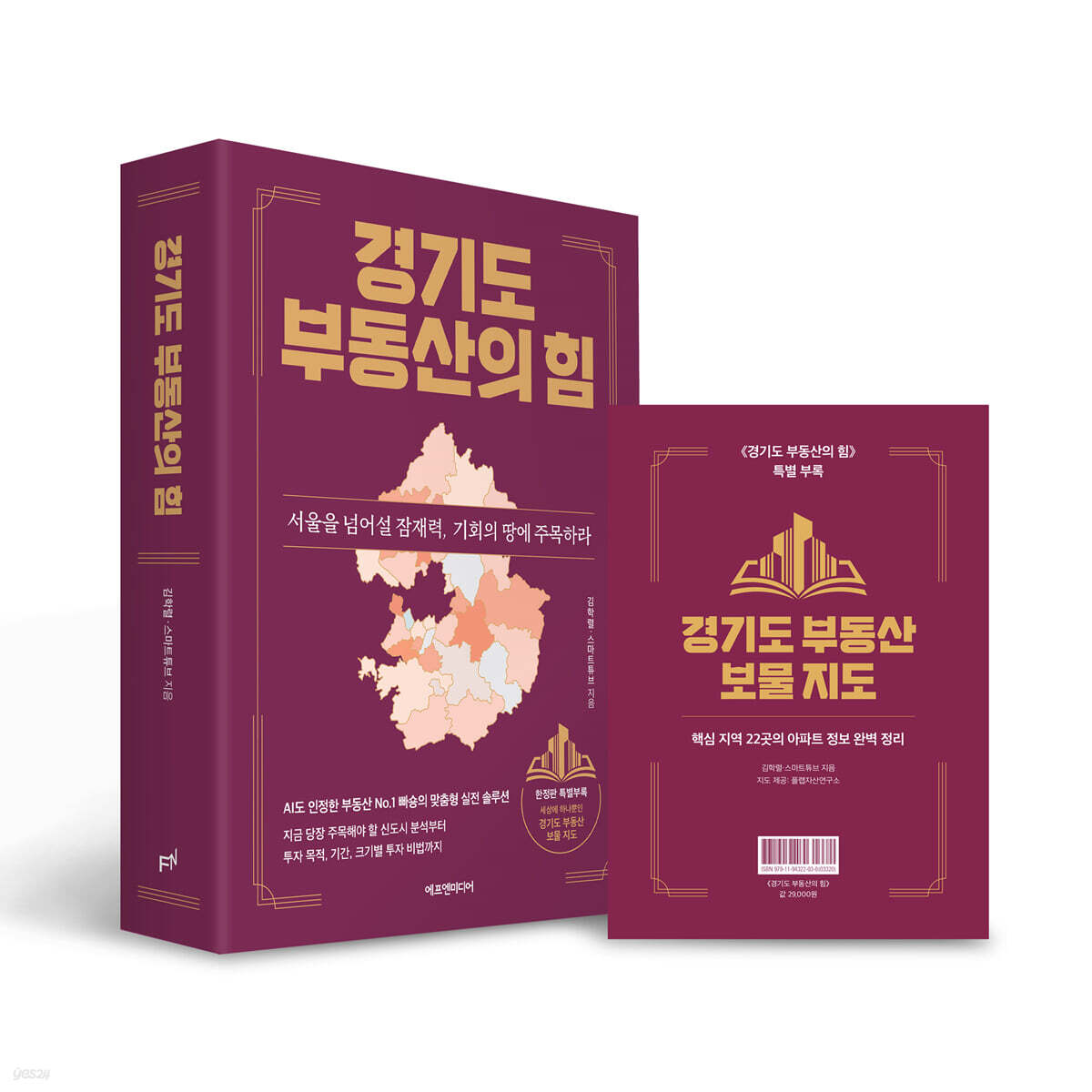
A special supplement, "Gyeonggi-do Real Estate Treasure Map" (48 pages, full color), containing investment information on 22 key regions, further enhances the book's value and practicality.
It displays not only the status of each complex undergoing redevelopment, reconstruction, and remodeling projects, but also small-scale redevelopment projects and street housing redevelopment projects.
You can see at a glance which apartments are good to live in, with good education, transportation, and living infrastructure, and it is also useful to carry around when visiting a site.
From buying a "quasi-Seoul" home to investing at a "high-value" price, Gyeonggi-do is the answer!
Complete analysis of 26 regions, from the original new towns to the third-generation new towns.
This book analyzes the Gyeonggi-do real estate market broadly and deeply, offering detailed, individual investment strategies based on investment period, purpose, and size.
The author is a person who needs no further explanation with just his nickname, 'Passion', but he has also recently garnered attention by being selected as the best real estate expert in Korea by generative AI (Chat GPT).
He says that for those seeking to buy a home and apartment investors who are feeling overwhelmed by the high cost of living in Seoul and the uncertainty of the countryside, Gyeonggi-do is the best alternative to Seoul with high growth potential.
The book thoroughly examines the characteristics, development status, and investment points of 26 key regions in Gyeonggi Province, from original new cities like Gwacheon and Seongnam to third-generation new cities like Wangsuk in Namyangju and Daejang in Bucheon, and presents investment strategies tailored to each region.
He also advises that by analyzing the significance and influence of the GTX lines (A-F) and anticipating the potential transportation windfall that will blow to the Gyeonggi-do real estate market, a significant opportunity can be seized.
A special supplement, "Gyeonggi-do Real Estate Treasure Map" (48 pages, full color), containing investment information on 22 key regions, further enhances the book's value and practicality.
It displays not only the status of each complex undergoing redevelopment, reconstruction, and remodeling projects, but also small-scale redevelopment projects and street housing redevelopment projects.
You can see at a glance which apartments are good to live in, with good education, transportation, and living infrastructure, and it is also useful to carry around when visiting a site.
- You can preview some of the book's contents.
Preview
index
Prologue | Seize the Land of Opportunity!
Part 1: Getting to Know Gyeonggi Province
1.
Location and Transportation
Location | Transportation
2.
Seeds of Development and Growth
Industrial Complex | Advanced Research Complex
Part 2: Gyeonggi-do Apartment Market
1.
Price fluctuations
Reasons for Rising | Reasons for Falling
2.
Regional development projects
Southern Gyeonggi Province | Northern Gyeonggi Province | Eastern Gyeonggi Province | Western Gyeonggi Province | What Makes Gyeonggi Province Real Estate Different?
3.
Reconstruction and redevelopment in Gyeonggi Province
Gyeonggi Province's Redevelopment Projects | Redevelopment Project Investment Strategies | Gyeonggi Province Redevelopment Investment
Part 3: Smart Investment Strategies
1.
Depending on the investment period
Key Objectives and Locations | Setting Location, Product, and Pricing
2.
Depending on the investment purpose
For residential purposes | For investment purposes
3.
Investment value by balance sheet
Demand by Balanced Platform | Popular Areas by Balanced Platform
4.
For beginner investors
Jobs (Demand for Workplace-Residency Proximity) | Transportation (Accessibility to Seoul and GTX) | School District (Prestigious Schools and Educational Infrastructure) | Commercial Area (Convenience) | Environment (Natural Environment and Residential Amenities) | Find Real Estate Information
Part 4: Key Investment Areas
1.
0th generation new town
Gwacheon | (formerly) Seongnam | (formerly) Anyang | (formerly) Bucheon | Uijeongbu
2.
1st new city
Bundang | Ilsan | Pyeongchon | Sanbon | Jungdong | 1st New Town Investment Strategy Summary
3.
2nd new town
Pangyo | Dongtan | Gwanggyo | Gimpo | Hangang | Wirye | Unjeong | Yangju | Byeollae | Dasan | Samsong | Pyeongtaek | 2nd New Town Investment Strategy Summary
4.
3rd new town
Namyangju Wangsuk | Hanam Gyosan | Goyang Changneung | Bucheon Daejang | Gwacheon Gwacheon | 3rd New Town Investment Strategy Summary
Part 5 Regulations and Outlook
1.
Regulation and Response
Types of Regulation | Regulatory Awareness and Response | Investment Strategies in Regulated and Non-Regulated Areas
2.
Future Outlook for Gyeonggi-do Real Estate
supplement
[1] Real estate investment success and failure cases
[2] Questions and Answers
[3] Jobs and commuting to work and school in Gyeonggi-do
Epilogue | Gyeonggi Province's Potential to Surpass Seoul
Part 1: Getting to Know Gyeonggi Province
1.
Location and Transportation
Location | Transportation
2.
Seeds of Development and Growth
Industrial Complex | Advanced Research Complex
Part 2: Gyeonggi-do Apartment Market
1.
Price fluctuations
Reasons for Rising | Reasons for Falling
2.
Regional development projects
Southern Gyeonggi Province | Northern Gyeonggi Province | Eastern Gyeonggi Province | Western Gyeonggi Province | What Makes Gyeonggi Province Real Estate Different?
3.
Reconstruction and redevelopment in Gyeonggi Province
Gyeonggi Province's Redevelopment Projects | Redevelopment Project Investment Strategies | Gyeonggi Province Redevelopment Investment
Part 3: Smart Investment Strategies
1.
Depending on the investment period
Key Objectives and Locations | Setting Location, Product, and Pricing
2.
Depending on the investment purpose
For residential purposes | For investment purposes
3.
Investment value by balance sheet
Demand by Balanced Platform | Popular Areas by Balanced Platform
4.
For beginner investors
Jobs (Demand for Workplace-Residency Proximity) | Transportation (Accessibility to Seoul and GTX) | School District (Prestigious Schools and Educational Infrastructure) | Commercial Area (Convenience) | Environment (Natural Environment and Residential Amenities) | Find Real Estate Information
Part 4: Key Investment Areas
1.
0th generation new town
Gwacheon | (formerly) Seongnam | (formerly) Anyang | (formerly) Bucheon | Uijeongbu
2.
1st new city
Bundang | Ilsan | Pyeongchon | Sanbon | Jungdong | 1st New Town Investment Strategy Summary
3.
2nd new town
Pangyo | Dongtan | Gwanggyo | Gimpo | Hangang | Wirye | Unjeong | Yangju | Byeollae | Dasan | Samsong | Pyeongtaek | 2nd New Town Investment Strategy Summary
4.
3rd new town
Namyangju Wangsuk | Hanam Gyosan | Goyang Changneung | Bucheon Daejang | Gwacheon Gwacheon | 3rd New Town Investment Strategy Summary
Part 5 Regulations and Outlook
1.
Regulation and Response
Types of Regulation | Regulatory Awareness and Response | Investment Strategies in Regulated and Non-Regulated Areas
2.
Future Outlook for Gyeonggi-do Real Estate
supplement
[1] Real estate investment success and failure cases
[2] Questions and Answers
[3] Jobs and commuting to work and school in Gyeonggi-do
Epilogue | Gyeonggi Province's Potential to Surpass Seoul
Into the book
Seoul is now physically unable to expand.
Moreover, its overwhelming position continues to be maintained due to the waiting demand for entry into Seoul.
So, Seoul has high market prices, and it is difficult to enter the market if you lack economic ability.
Gyeonggi-do is the place that perfectly complements Seoul's strengths and weaknesses.
Gyeonggi Province still has room for expansion.
Expansion is possible even within urban areas, and if it includes non-urban areas, unlimited growth is possible for the time being.
And it's actually the fastest growing region.
--- p.10, from "Prologue"
The GTX line operates at an average speed of approximately 100 km/h, significantly reducing travel time between Gyeonggi-do and Seoul.
For example, using the GTX-A line, you can travel from Paju Unjeong to Seoul Samseong Station in about 20 minutes.
It is a speed that is hard to imagine with existing subways and intercity buses.
As commuting times are drastically reduced, the demand for workers commuting to and from Seoul will expand to Gyeonggi Province, and as a result, the demand for housing in Seoul is likely to be dispersed to Gyeonggi Province.
--- p.28, from “Part 1: Getting to Know Gyeonggi-do”
Gyeonggi Province is growing beyond its role as a mere residential area behind Seoul into an economic hub centered around self-sufficient new cities.
Pangyo Techno Valley, Gwanggyo Techno Valley, Pyeongtaek Godeok New Town, and Yongin Semiconductor Cluster are key investment destinations, combining cutting-edge industrial complexes with residential areas and creating future-oriented cities with a growing number of high-income professionals.
Areas where these advanced industrial complexes and residential areas are combined are considered to have high mid- to long-term investment value due to their high rental demand and potential for price increases.
--- pp.84~85, from “Part 2: Gyeonggi-do Apartment Market”
For short-term investments, it is advantageous to aim for quick profits by focusing on small apartments or apartments scheduled for reconstruction in areas where transportation networks with Seoul are expected to expand (Gwangmyeong, Deogyang-gu, Goyang, Uijeongbu).
For mid-term investments, stable price increases can be expected, centered on mid- to large-sized apartments or newly built apartments in new city development areas (Namyangju Wangsuk, Pyeongtaek Godeok, Hanam Misagangbyeon).
For long-term investments, it is advisable to invest in rental income-generating properties in areas eligible for redevelopment (Bundang, Seongnam; Cheoin-gu, Yongin) or near industrial complexes (Yongin Semiconductor Cluster, Pyeongtaek Godeok) to simultaneously expect long-term development profits and rental income.
--- p.109, from “Part 3: Smart Investment Strategies”
Gwacheon public housing complexes are currently undergoing reconstruction, and as the profits from reconstruction are large, long-term price increases are expected.
In particular, complexes 1 and 8 have been rebuilt into high-end brand apartments and have high investment value.
If you invest in an apartment in the early stages of reconstruction, such as the 7th complex, you can expect premium price gains after reconstruction is completed.
--- p.144, from “Part 4: Key Investment Regions”
The GTX-A line is a key transportation boon for Unjeong New Town.
The GTX-A line, scheduled to open in full in 2028, will significantly improve accessibility to downtown Seoul by quickly connecting Seoul Station and Samseong Station via Unjeong Station.
Additionally, the extension of the Gyeongui-Jungang Line and Seoul Subway Line 3 is planned, which will improve connectivity to the northwestern part of Seoul.
This increases the proximity to work and is an important factor in absorbing the demand from office workers commuting to Seoul.
--- p.249, from “Part 4: Key Investment Regions”
Investor G invested in an apartment in Gimpo based solely on the news of the GTX-D line development.
At the time, Gimpo was a deregulated area with favorable loan conditions, making it possible to purchase an apartment without investing a large amount of capital.
However, the improvement of the transportation network was delayed more than expected as the GTX-D line did not proceed as planned and some parts of the line were shortened.
As a result, expectations of rising apartment prices have decreased, and investors are facing asset liquidity problems while holding apartments whose future value has become uncertain.
Lesson: Development plans are always subject to change.
Please keep in mind that the development schedule may be delayed or changed depending on changes in government policy or market conditions.
Risk Management: It is safer to invest in areas where clear transportation benefits are already reflected or where transportation network expansion is already underway.
Rather than relying on a single development opportunity, make investment decisions after comprehensively evaluating various factors (commercial infrastructure, proximity to work, convenience of living, etc.).
It is advisable to avoid over-reliance on a specific region and to spread your risk across multiple regions.
--- pp.363~364, from 「Appendix | Real Estate Investment Success and Failure Cases」
Question: Is it a good idea to invest in the third new city now?
Answer: The third new city will be fully occupied after 2025, with the long-term goal of decentralizing Seoul's population and meeting housing demand.
Namyangju Wangsuk, Hanam Gyosan, and Goyang Changneung are in the early stages of new city development, and residential and commercial infrastructure are being built simultaneously, so mid- to long-term price increases are expected.
At the time of initial investment, the infrastructure may not be fully developed, which may be somewhat inconvenient, but once development is complete, residential convenience will be greatly improved.
In particular, with the expansion of the transportation network (e.g., GTX, subway extension), there is a high possibility that actual residential demand will continue to increase, so preemptive investment can bring about large price differences in the long term.
Moreover, its overwhelming position continues to be maintained due to the waiting demand for entry into Seoul.
So, Seoul has high market prices, and it is difficult to enter the market if you lack economic ability.
Gyeonggi-do is the place that perfectly complements Seoul's strengths and weaknesses.
Gyeonggi Province still has room for expansion.
Expansion is possible even within urban areas, and if it includes non-urban areas, unlimited growth is possible for the time being.
And it's actually the fastest growing region.
--- p.10, from "Prologue"
The GTX line operates at an average speed of approximately 100 km/h, significantly reducing travel time between Gyeonggi-do and Seoul.
For example, using the GTX-A line, you can travel from Paju Unjeong to Seoul Samseong Station in about 20 minutes.
It is a speed that is hard to imagine with existing subways and intercity buses.
As commuting times are drastically reduced, the demand for workers commuting to and from Seoul will expand to Gyeonggi Province, and as a result, the demand for housing in Seoul is likely to be dispersed to Gyeonggi Province.
--- p.28, from “Part 1: Getting to Know Gyeonggi-do”
Gyeonggi Province is growing beyond its role as a mere residential area behind Seoul into an economic hub centered around self-sufficient new cities.
Pangyo Techno Valley, Gwanggyo Techno Valley, Pyeongtaek Godeok New Town, and Yongin Semiconductor Cluster are key investment destinations, combining cutting-edge industrial complexes with residential areas and creating future-oriented cities with a growing number of high-income professionals.
Areas where these advanced industrial complexes and residential areas are combined are considered to have high mid- to long-term investment value due to their high rental demand and potential for price increases.
--- pp.84~85, from “Part 2: Gyeonggi-do Apartment Market”
For short-term investments, it is advantageous to aim for quick profits by focusing on small apartments or apartments scheduled for reconstruction in areas where transportation networks with Seoul are expected to expand (Gwangmyeong, Deogyang-gu, Goyang, Uijeongbu).
For mid-term investments, stable price increases can be expected, centered on mid- to large-sized apartments or newly built apartments in new city development areas (Namyangju Wangsuk, Pyeongtaek Godeok, Hanam Misagangbyeon).
For long-term investments, it is advisable to invest in rental income-generating properties in areas eligible for redevelopment (Bundang, Seongnam; Cheoin-gu, Yongin) or near industrial complexes (Yongin Semiconductor Cluster, Pyeongtaek Godeok) to simultaneously expect long-term development profits and rental income.
--- p.109, from “Part 3: Smart Investment Strategies”
Gwacheon public housing complexes are currently undergoing reconstruction, and as the profits from reconstruction are large, long-term price increases are expected.
In particular, complexes 1 and 8 have been rebuilt into high-end brand apartments and have high investment value.
If you invest in an apartment in the early stages of reconstruction, such as the 7th complex, you can expect premium price gains after reconstruction is completed.
--- p.144, from “Part 4: Key Investment Regions”
The GTX-A line is a key transportation boon for Unjeong New Town.
The GTX-A line, scheduled to open in full in 2028, will significantly improve accessibility to downtown Seoul by quickly connecting Seoul Station and Samseong Station via Unjeong Station.
Additionally, the extension of the Gyeongui-Jungang Line and Seoul Subway Line 3 is planned, which will improve connectivity to the northwestern part of Seoul.
This increases the proximity to work and is an important factor in absorbing the demand from office workers commuting to Seoul.
--- p.249, from “Part 4: Key Investment Regions”
Investor G invested in an apartment in Gimpo based solely on the news of the GTX-D line development.
At the time, Gimpo was a deregulated area with favorable loan conditions, making it possible to purchase an apartment without investing a large amount of capital.
However, the improvement of the transportation network was delayed more than expected as the GTX-D line did not proceed as planned and some parts of the line were shortened.
As a result, expectations of rising apartment prices have decreased, and investors are facing asset liquidity problems while holding apartments whose future value has become uncertain.
Lesson: Development plans are always subject to change.
Please keep in mind that the development schedule may be delayed or changed depending on changes in government policy or market conditions.
Risk Management: It is safer to invest in areas where clear transportation benefits are already reflected or where transportation network expansion is already underway.
Rather than relying on a single development opportunity, make investment decisions after comprehensively evaluating various factors (commercial infrastructure, proximity to work, convenience of living, etc.).
It is advisable to avoid over-reliance on a specific region and to spread your risk across multiple regions.
--- pp.363~364, from 「Appendix | Real Estate Investment Success and Failure Cases」
Question: Is it a good idea to invest in the third new city now?
Answer: The third new city will be fully occupied after 2025, with the long-term goal of decentralizing Seoul's population and meeting housing demand.
Namyangju Wangsuk, Hanam Gyosan, and Goyang Changneung are in the early stages of new city development, and residential and commercial infrastructure are being built simultaneously, so mid- to long-term price increases are expected.
At the time of initial investment, the infrastructure may not be fully developed, which may be somewhat inconvenient, but once development is complete, residential convenience will be greatly improved.
In particular, with the expansion of the transportation network (e.g., GTX, subway extension), there is a high possibility that actual residential demand will continue to increase, so preemptive investment can bring about large price differences in the long term.
--- pp.370~371, from 「Appendix | Questions and Answers」
Publisher's Review
"Find opportunities and possibilities in Gyeonggi-do, a place with a secure future!"
When considering the key keywords for real estate investment—location, demand, and products—it goes without saying that Seoul is the best.
However, Seoul real estate is not a place that is easily accessible to everyone.
Because of the price.
If price is an issue, just go to a place that has products in your price range.
If that's the case, then fat is the answer.
However, more study is needed to develop an eye for local real estate.
You must have the insight to read market trends and the relationship between supply and demand, and be able to analyze locations and products.
In short, going to Seoul is expensive, and going to the countryside is unstable.
So, is there no alternative? There is.
It's Gyeonggi-do.
Gyeonggi Province holds diverse potential and opportunities, including population dispersion within the metropolitan area, new city development, transportation network expansion, and a rapidly growing regional economy.
Therefore, for those interested in real estate, Gyeonggi-do will be a stage where challenges and success intersect.
So, where specifically should you look in Gyeonggi-do? Here's Passion's helpful and detailed analysis and explanation of Gyeonggi-do real estate.
In addition, it provides specific, realistic investment strategies tailored to your situation and goals.
Now, let's find future value in Gyeonggi-do with Passion!
26 New Cities We've Taken a Closer Look
The development of new cities, which began to accommodate Seoul's overflowing population, began with the original new cities of Gwacheon and Seongnam in the 1970s and continued to the third generation of new cities, including Wangsuk in Namyangju and Gyosan in Hanam in the 2020s.
The author thoroughly examines the key characteristics, development status, and investment points of 26 new cities in Gyeonggi Province, and then proposes investment strategies tailored to the characteristics of each new city.
You can learn how to find a suitable investment location by considering commuting and travel routes, focusing on accessibility to Seoul.
Additionally, it would be a good idea to look into areas where reconstruction is being promoted due to a long development period, or areas where redevelopment potential is predicted due to aging facilities, and seek investment directions.
The changing landscape of Gyeonggi-do's real estate market, particularly through transportation benefits, especially the GTX.
The biggest reason why Gyeonggi Province has greater potential than Seoul is its transportation network.
While Gyeonggi Province and Seoul already boast a dense network of subways and roads, the new GTX line, which will cut travel time to central Seoul by around 20 minutes, is bringing about a transformational change to Gyeonggi Province. Following the opening of GTX-A Line, Lines B and C are also slated for service, and Lines D, E, and F are gradually taking shape.
If we anticipate and prepare for the winds of change that these transportation windfalls will bring to the Gyeonggi-do real estate market, we will be able to seize greater opportunities than ever before.
We offer a variety of investment strategies tailored to your needs.
Although the direction of successful investment may be the same, each investor's situation and goals are different.
The interests of someone who is about to buy their first home and someone who is seeking future value for a more comfortable retirement are bound to be different.
Considering the diverse needs of these investors, the author offers a variety of options to help investors choose the right investment strategy for their goals.
It divides the investment period into three categories: short-term investment with the goal of generating profits within two years, medium-term investment with the goal of generating profits within two to five years, and long-term investment with the goal of generating profits over a period of five years or more. It also presents strategies to be taken for each period, as well as regions to watch, products to watch, and pricing strategies.
We also suggest strategies and regions that should vary depending on whether the purpose is actual residence or investment, and examine the demand base, characteristics, and investment strategies for each size range, from medium-sized units with exclusive use areas of 60 to 85 square meters to small-sized units with exclusive use areas of 60 to 85 square meters and larger units.
If you carefully consider your situation and set an appropriate goal, you will be able to find an investment strategy that suits you, as recommended by Passion.
Future investment value secured through the potential for reconstruction and redevelopment
One of the biggest issues in Gyeonggi-do real estate today is reconstruction and redevelopment.
Reconstruction and redevelopment are being promoted, focusing on aging facilities in the first-generation new cities of Bundang, Ilsan, Pyeongchon, Sanbon, and Jungdong. In particular, new issues such as the announcement of pilot district designations centered on the Special Act on Aging City Planning are continuously emerging.
As the designation of a pilot district increases the floor area ratio and accelerates the progress of redevelopment projects, new investment opportunities will emerge.
We recommend that you closely monitor the progress of reconstruction and redevelopment projects in each new city, as guided by Passion, and then anticipate the potential changes that may result and make proactive investments.
A Gift More Precious Than Jewels: The Limited Edition "Gyeonggi-do Real Estate Treasure Map"
Book buyers will receive a special limited edition of the Gyeonggi-do Real Estate Treasure Map (48 pages, full color) as a special appendix.
It contains real estate information for 22 key areas in Gyeonggi-do, which are expected to see steady population growth due to abundant transportation and job opportunities.
We've selected areas that will receive even more attention due to the opening of the GTX line, subway extensions, and new city development, rather than simply being areas with a large number of apartments. Whether you're a homebuyer or an investor looking for an investment, we recommend you own these properties.
Not only did it survey complexes undergoing redevelopment, reconstruction, and remodeling projects and indicate their respective statuses, but it also showed small-scale redevelopment projects and street housing redevelopment projects, so the value of each of these maps is incomparable to that of a jewel.
It's a must-have before going on a real estate tour, as it allows you to easily identify key investment destinations at a glance and find a comfortable apartment with good education, transportation, and living infrastructure.
When considering the key keywords for real estate investment—location, demand, and products—it goes without saying that Seoul is the best.
However, Seoul real estate is not a place that is easily accessible to everyone.
Because of the price.
If price is an issue, just go to a place that has products in your price range.
If that's the case, then fat is the answer.
However, more study is needed to develop an eye for local real estate.
You must have the insight to read market trends and the relationship between supply and demand, and be able to analyze locations and products.
In short, going to Seoul is expensive, and going to the countryside is unstable.
So, is there no alternative? There is.
It's Gyeonggi-do.
Gyeonggi Province holds diverse potential and opportunities, including population dispersion within the metropolitan area, new city development, transportation network expansion, and a rapidly growing regional economy.
Therefore, for those interested in real estate, Gyeonggi-do will be a stage where challenges and success intersect.
So, where specifically should you look in Gyeonggi-do? Here's Passion's helpful and detailed analysis and explanation of Gyeonggi-do real estate.
In addition, it provides specific, realistic investment strategies tailored to your situation and goals.
Now, let's find future value in Gyeonggi-do with Passion!
26 New Cities We've Taken a Closer Look
The development of new cities, which began to accommodate Seoul's overflowing population, began with the original new cities of Gwacheon and Seongnam in the 1970s and continued to the third generation of new cities, including Wangsuk in Namyangju and Gyosan in Hanam in the 2020s.
The author thoroughly examines the key characteristics, development status, and investment points of 26 new cities in Gyeonggi Province, and then proposes investment strategies tailored to the characteristics of each new city.
You can learn how to find a suitable investment location by considering commuting and travel routes, focusing on accessibility to Seoul.
Additionally, it would be a good idea to look into areas where reconstruction is being promoted due to a long development period, or areas where redevelopment potential is predicted due to aging facilities, and seek investment directions.
The changing landscape of Gyeonggi-do's real estate market, particularly through transportation benefits, especially the GTX.
The biggest reason why Gyeonggi Province has greater potential than Seoul is its transportation network.
While Gyeonggi Province and Seoul already boast a dense network of subways and roads, the new GTX line, which will cut travel time to central Seoul by around 20 minutes, is bringing about a transformational change to Gyeonggi Province. Following the opening of GTX-A Line, Lines B and C are also slated for service, and Lines D, E, and F are gradually taking shape.
If we anticipate and prepare for the winds of change that these transportation windfalls will bring to the Gyeonggi-do real estate market, we will be able to seize greater opportunities than ever before.
We offer a variety of investment strategies tailored to your needs.
Although the direction of successful investment may be the same, each investor's situation and goals are different.
The interests of someone who is about to buy their first home and someone who is seeking future value for a more comfortable retirement are bound to be different.
Considering the diverse needs of these investors, the author offers a variety of options to help investors choose the right investment strategy for their goals.
It divides the investment period into three categories: short-term investment with the goal of generating profits within two years, medium-term investment with the goal of generating profits within two to five years, and long-term investment with the goal of generating profits over a period of five years or more. It also presents strategies to be taken for each period, as well as regions to watch, products to watch, and pricing strategies.
We also suggest strategies and regions that should vary depending on whether the purpose is actual residence or investment, and examine the demand base, characteristics, and investment strategies for each size range, from medium-sized units with exclusive use areas of 60 to 85 square meters to small-sized units with exclusive use areas of 60 to 85 square meters and larger units.
If you carefully consider your situation and set an appropriate goal, you will be able to find an investment strategy that suits you, as recommended by Passion.
Future investment value secured through the potential for reconstruction and redevelopment
One of the biggest issues in Gyeonggi-do real estate today is reconstruction and redevelopment.
Reconstruction and redevelopment are being promoted, focusing on aging facilities in the first-generation new cities of Bundang, Ilsan, Pyeongchon, Sanbon, and Jungdong. In particular, new issues such as the announcement of pilot district designations centered on the Special Act on Aging City Planning are continuously emerging.
As the designation of a pilot district increases the floor area ratio and accelerates the progress of redevelopment projects, new investment opportunities will emerge.
We recommend that you closely monitor the progress of reconstruction and redevelopment projects in each new city, as guided by Passion, and then anticipate the potential changes that may result and make proactive investments.
A Gift More Precious Than Jewels: The Limited Edition "Gyeonggi-do Real Estate Treasure Map"
Book buyers will receive a special limited edition of the Gyeonggi-do Real Estate Treasure Map (48 pages, full color) as a special appendix.
It contains real estate information for 22 key areas in Gyeonggi-do, which are expected to see steady population growth due to abundant transportation and job opportunities.
We've selected areas that will receive even more attention due to the opening of the GTX line, subway extensions, and new city development, rather than simply being areas with a large number of apartments. Whether you're a homebuyer or an investor looking for an investment, we recommend you own these properties.
Not only did it survey complexes undergoing redevelopment, reconstruction, and remodeling projects and indicate their respective statuses, but it also showed small-scale redevelopment projects and street housing redevelopment projects, so the value of each of these maps is incomparable to that of a jewel.
It's a must-have before going on a real estate tour, as it allows you to easily identify key investment destinations at a glance and find a comfortable apartment with good education, transportation, and living infrastructure.
GOODS SPECIFICS
- Date of issue: January 1, 2025
- Format: Hardcover book binding method guide
- Page count, weight, size: 408 pages | 920g | 152*213*33mm
- ISBN13: 9791194322030
- ISBN10: 1194322034
You may also like
카테고리
korean


korean

![GQ KOREA Mark (Monthly): December [2025]](http://librairie.coreenne.fr/cdn/shop/files/8ef265dbbfbf186523ed75ba7319009d.jpg?v=1765340328&width=3840)


