

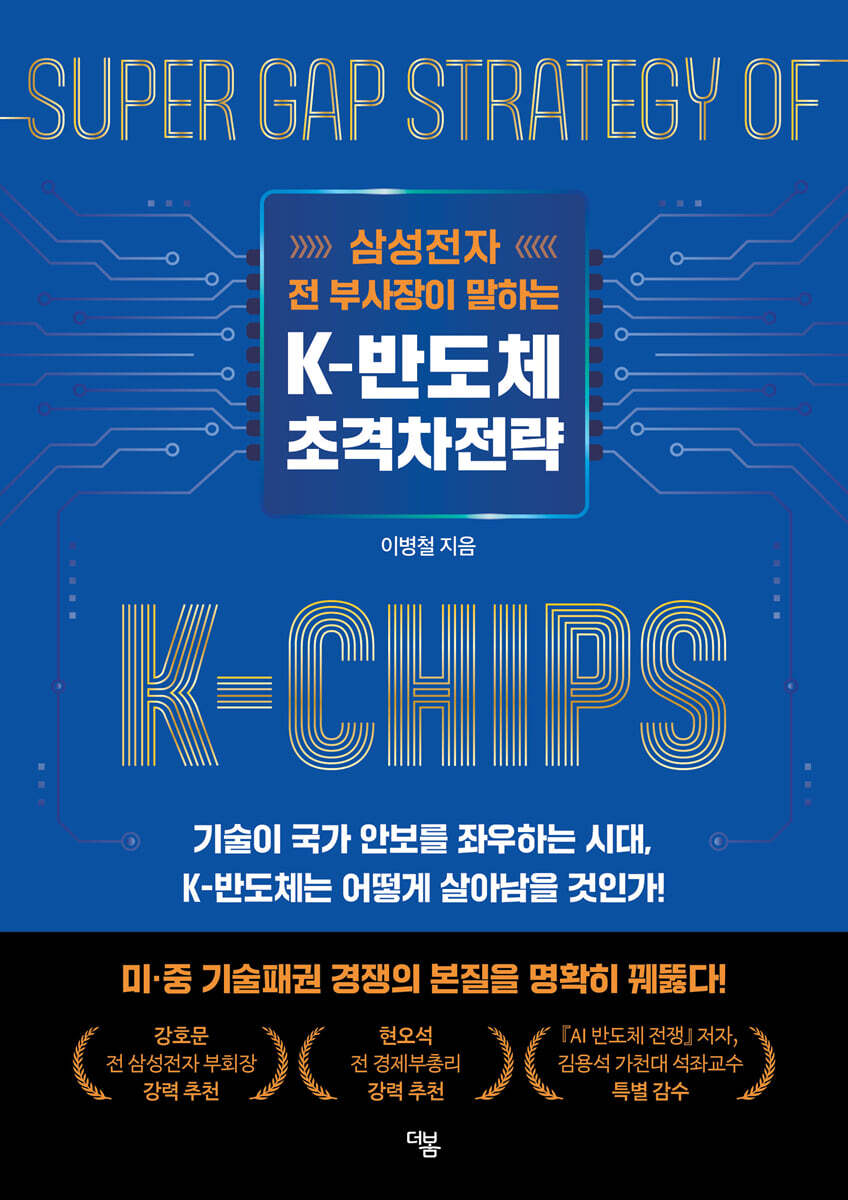
K-Semiconductor Super Gap Strategy
 |
Description
Book Introduction
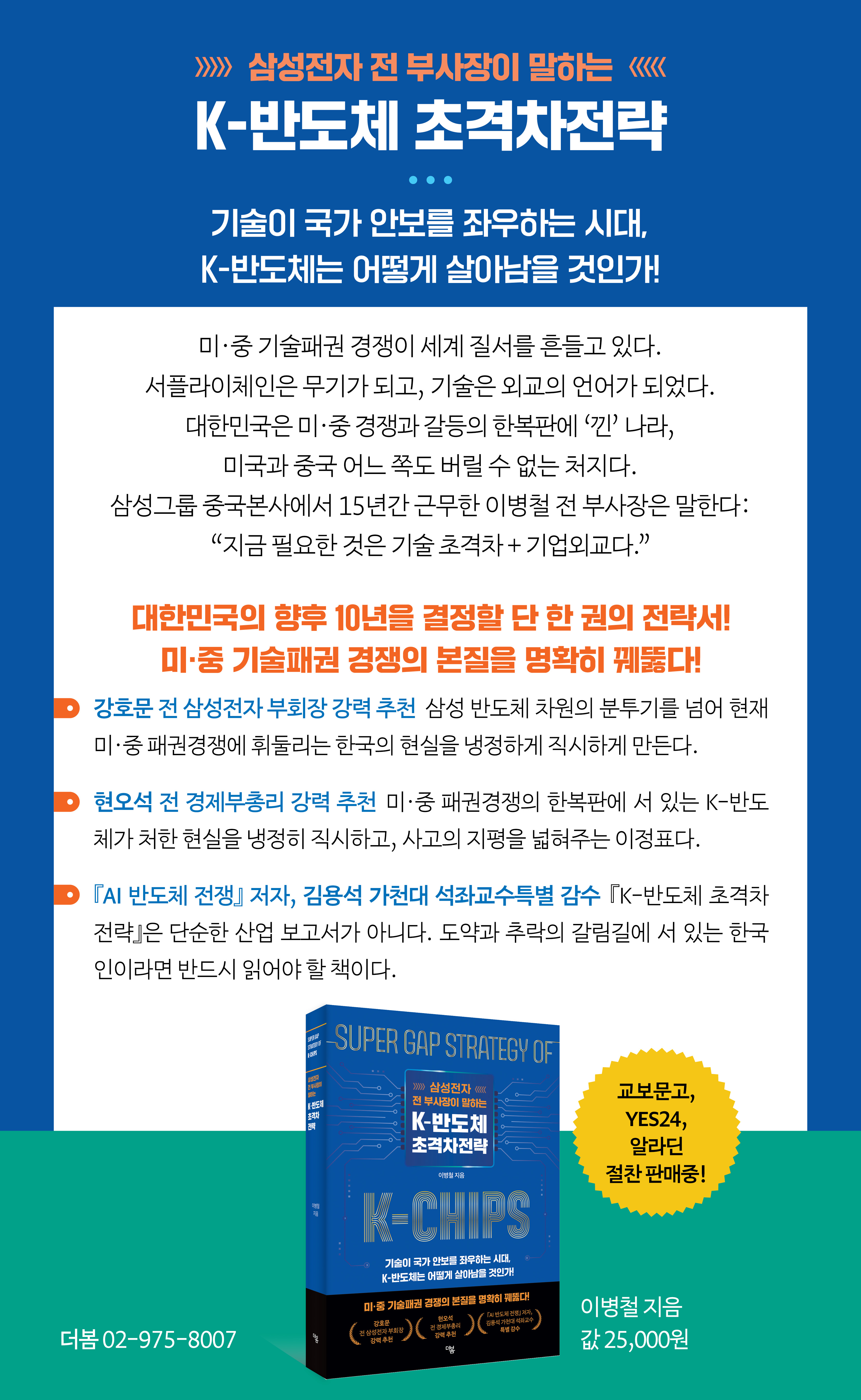
In an era where technology determines national security,
How will K-semiconductors survive?
The hegemony competition between the US and China is essentially a semiconductor war.
Semiconductors are also at the center of the power struggle between the United States and China. AI, robotics, space, and key weapons systems all operate on semiconductors.
Therefore, who controls the semiconductor supply chain will soon determine the direction of global hegemony.
The United States is attempting to restore its manufacturing capabilities, pressure its allies, and seize the semiconductor leadership through measures such as chip export controls, equipment controls, investment restrictions, and the CHIPS Act.
On the other hand, China recognizes this as an unavoidable national challenge and is making 'technological self-reliance' and 'semiconductor self-reliance' national tasks.
In the midst of the strategic competition between the US and China, Korea is facing the reality of being a 'caught in' country.
How can Korea, caught in the dilemma of technological alliance pressure and market dependence, turn this crisis into an opportunity? This book demonstrates that, in this very reality, technological advancement and corporate diplomacy are practical survival strategies for overcoming geopolitical crises.
How will K-semiconductors survive?
The hegemony competition between the US and China is essentially a semiconductor war.
Semiconductors are also at the center of the power struggle between the United States and China. AI, robotics, space, and key weapons systems all operate on semiconductors.
Therefore, who controls the semiconductor supply chain will soon determine the direction of global hegemony.
The United States is attempting to restore its manufacturing capabilities, pressure its allies, and seize the semiconductor leadership through measures such as chip export controls, equipment controls, investment restrictions, and the CHIPS Act.
On the other hand, China recognizes this as an unavoidable national challenge and is making 'technological self-reliance' and 'semiconductor self-reliance' national tasks.
In the midst of the strategic competition between the US and China, Korea is facing the reality of being a 'caught in' country.
How can Korea, caught in the dilemma of technological alliance pressure and market dependence, turn this crisis into an opportunity? This book demonstrates that, in this very reality, technological advancement and corporate diplomacy are practical survival strategies for overcoming geopolitical crises.
- You can preview some of the book's contents.
Preview
index
Author's Note _4
Opening remarks: The era of the Confucian scholar is one where technology is diplomacy and technology is security! _12
Chapter 1: The US-China Hegemony Competition and China's Rise _23
China is a 'potential threat' to the United States _24
From China's perspective, the United States is the 'No.
1' _39
China's Theory of Scientific and Technological Self-Reliance and Self-Strengthening_47
"Wandaoqiaoche"? Daochao? China's strategy for overtaking at corners _55
Live Talk 1_66
Samsung's "New Management Declaration" Leads to Overtaking a Corner? Samsung Takes the Lead | Samsung Galaxy: The LCD TV Era's Market Leader, Nokia
Chapter 2: The Semiconductor War between the U.S. and China _71
Operation to Reclaim America's Semiconductor Territory _72
China's Search for Independent Innovation _103
Gain or Lose Dilemma _139
The State of "Sandwiched" Countries and "Sandwiched" Companies _149
Live Talk 2 _168
Chairman Lee Jae-yong, who prioritizes practicality over formality? A frugal and practical style | Leadership driven by realistic judgment and consideration.
Chapter 3: Survival Strategies for Semiconductor Companies _175
Survival Coordinates of Major Semiconductor Companies _176
How do investment strategies change? _192
Sales and procurement strategies must also change to survive _200
Business Success and Risk Management Strategies _228
Live Talk 3 _228
The late Chairman Lee Kun-hee's vision and solutions for conquering China? Build a second Samsung in China | The rapid rise and decline of Samsung's management in China | GE and Honeywell's success stories in conquering China | Orion's success story in China
Chapter 4: US-China Corporate Diplomacy in Action _245
The Difference Between Creating and Not Creating Results _246
In China, 'sincerity' comes first _253
In the United States, 'lobbying' and 'investment' take precedence _271
Live Talk 4 _278
China's Future: Huawei's Corporate Culture | Founder Ren Zhengfei's Leadership | Wolf Culture | Unconventional Compensation System | Practical Management Philosophy | Feeling Huawei's Momentum
Chapter 5: China's Power: Witnessed and Experienced Firsthand _287
The Force That Moves China _288
Bureaucratic Contact Strategies to Get Things Done _303
Behind the Scenes of Samsung's Investment in China _314
Foreign-funded companies between 'welcoming' and 'cold' _334
Live Talk 5 _355
My experiences in China and what I learned there? Maotai | Chinese cultural codes in numbers | March 15 Consumers' Day | China's scale
Closing Remarks: Five Strategies for Korean Companies to Win in the Age of the Established School of Economics _355
Opening remarks: The era of the Confucian scholar is one where technology is diplomacy and technology is security! _12
Chapter 1: The US-China Hegemony Competition and China's Rise _23
China is a 'potential threat' to the United States _24
From China's perspective, the United States is the 'No.
1' _39
China's Theory of Scientific and Technological Self-Reliance and Self-Strengthening_47
"Wandaoqiaoche"? Daochao? China's strategy for overtaking at corners _55
Live Talk 1_66
Samsung's "New Management Declaration" Leads to Overtaking a Corner? Samsung Takes the Lead | Samsung Galaxy: The LCD TV Era's Market Leader, Nokia
Chapter 2: The Semiconductor War between the U.S. and China _71
Operation to Reclaim America's Semiconductor Territory _72
China's Search for Independent Innovation _103
Gain or Lose Dilemma _139
The State of "Sandwiched" Countries and "Sandwiched" Companies _149
Live Talk 2 _168
Chairman Lee Jae-yong, who prioritizes practicality over formality? A frugal and practical style | Leadership driven by realistic judgment and consideration.
Chapter 3: Survival Strategies for Semiconductor Companies _175
Survival Coordinates of Major Semiconductor Companies _176
How do investment strategies change? _192
Sales and procurement strategies must also change to survive _200
Business Success and Risk Management Strategies _228
Live Talk 3 _228
The late Chairman Lee Kun-hee's vision and solutions for conquering China? Build a second Samsung in China | The rapid rise and decline of Samsung's management in China | GE and Honeywell's success stories in conquering China | Orion's success story in China
Chapter 4: US-China Corporate Diplomacy in Action _245
The Difference Between Creating and Not Creating Results _246
In China, 'sincerity' comes first _253
In the United States, 'lobbying' and 'investment' take precedence _271
Live Talk 4 _278
China's Future: Huawei's Corporate Culture | Founder Ren Zhengfei's Leadership | Wolf Culture | Unconventional Compensation System | Practical Management Philosophy | Feeling Huawei's Momentum
Chapter 5: China's Power: Witnessed and Experienced Firsthand _287
The Force That Moves China _288
Bureaucratic Contact Strategies to Get Things Done _303
Behind the Scenes of Samsung's Investment in China _314
Foreign-funded companies between 'welcoming' and 'cold' _334
Live Talk 5 _355
My experiences in China and what I learned there? Maotai | Chinese cultural codes in numbers | March 15 Consumers' Day | China's scale
Closing Remarks: Five Strategies for Korean Companies to Win in the Age of the Established School of Economics _355
Detailed image
Into the book
'Technological gap' and 'corporate diplomacy' are not choices, but prerequisites for survival!
The essence of the US-China hegemony competition is a competition for technological hegemony.
Technology is the fundamental solution to overcoming geopolitical risks.
But technology alone is not enough.
If a technological gap is the foundation of a company's competitiveness, a shield is needed to protect that competitiveness in the face of an uncertain international order.
That's corporate diplomacy.
In other words, the strategy of Korean companies responding to the US-China technological hegemony competition must be a self-reliant strategy based on a technological gap and protecting themselves through corporate diplomacy.
---From the "Opening Remarks"
China's rapid rise is what we must be most wary of.
News about technological innovations originating from China is pouring in every day, and their influence is threatening the position of Korean industries.
From now on, it is truly an all-out national war.
Even if the government creates a favorable policy environment through various efforts, it will be ineffective if it is not supported by companies' technological competitiveness.
Conversely, even if a company develops technology, it will be difficult to secure sustainability in international competition if the government does not provide policy support.
Ultimately, a cooperative system in which the state, businesses, and citizens join forces and move together is essential.
If Korea responds in a fragmented manner to China's attack, which integrates the state and businesses through a state capitalist model, it will inevitably fall behind in the competition.
The nation must create an environment through diplomacy and policy, businesses must enhance their competitiveness through technology and strategy, and the people must contribute with understanding and support.
The essence of the US-China hegemony competition is a competition for technological hegemony.
Technology is the fundamental solution to overcoming geopolitical risks.
But technology alone is not enough.
If a technological gap is the foundation of a company's competitiveness, a shield is needed to protect that competitiveness in the face of an uncertain international order.
That's corporate diplomacy.
In other words, the strategy of Korean companies responding to the US-China technological hegemony competition must be a self-reliant strategy based on a technological gap and protecting themselves through corporate diplomacy.
---From the "Opening Remarks"
China's rapid rise is what we must be most wary of.
News about technological innovations originating from China is pouring in every day, and their influence is threatening the position of Korean industries.
From now on, it is truly an all-out national war.
Even if the government creates a favorable policy environment through various efforts, it will be ineffective if it is not supported by companies' technological competitiveness.
Conversely, even if a company develops technology, it will be difficult to secure sustainability in international competition if the government does not provide policy support.
Ultimately, a cooperative system in which the state, businesses, and citizens join forces and move together is essential.
If Korea responds in a fragmented manner to China's attack, which integrates the state and businesses through a state capitalist model, it will inevitably fall behind in the competition.
The nation must create an environment through diplomacy and policy, businesses must enhance their competitiveness through technology and strategy, and the people must contribute with understanding and support.
---From the "Closing Notes"
Publisher's Review
The era of technopolitics, where technology is diplomacy and technology is security.
A former Samsung Electronics vice president shares his K-semiconductor survival strategy!
The 21st century world order is once again in turmoil.
The international economic system, once built on globalization and interdependence, is now mired in a whirlwind of US-China technological hegemony competition, the politicization of supply chains, and geopolitical risks.
At its center is a single industry: semiconductors.
We have entered an era where chips, data, submarine cables, and standards will determine supremacy, not guns and tanks.
"K-Semiconductor Super Gap Strategy" dissects the forces at work deep within this great transition.
Author Lee Byung-chul, former Vice President of Samsung Electronics, worked as a resident at Samsung Group's Chinese headquarters for 15 years from 2005 to 2020, implementing Samsung's China strategy. Based on this practical experience, he provides a three-dimensional analysis that combines international affairs, industrial policy, technological innovation, and corporate management.
The reality of the US-China technological hegemony competition, China's corporate and political systems, and the reality of the global supply chain, which he observed on the ground, are raw insights that cannot be obtained through existing research or articles.
The rise of China and the intensification of the US-China hegemony competition,
K-semiconductors could crash in an instant!
Former Samsung Electronics Vice President Lee Byung-chul defines the present as the era of technopolitics.
An era where technology is diplomacy, technology is security, and technology is national strategy.
The US-China competition is no longer an ideological battle, but a competition for technological hegemony surrounding semiconductors, AI, batteries, and 5G.
The author, who also holds a doctorate in political science, diagnoses that China, which emerged as a global manufacturing hub after reform and opening up in 1978, has now entered a phase where it is trying to dominate technology, data, and standards.
With its "Made in China 2025" and "China Standards 2035" strategies, China is openly pursuing technological independence and a restructuring of the global order.
Meanwhile, the United States is increasing pressure on its allies by mobilizing strategies such as high tariffs, export controls, and subsidy policies to maintain its technological hegemony centered on semiconductors, AI, and 5G.
Korea is a country 'caught' in the middle of that pressure.
Neither the US nor China can afford to give up.
It is also in the most dangerous geopolitical position.
This is because, although it owns the world's number one semiconductor company, it is intertwined with both the United States and China in terms of supply chain, market, and security.
Although it has the world's number one semiconductor company, it is the most vulnerable to geopolitical risks.
A vivid analysis of the rise and fall of Samsung's China strategy, Huawei's corporate culture, and more.
Therefore, the author argues that Korea's semiconductor strategy cannot survive if it remains solely focused on technology R&D.
The conclusion is clear.
Korean companies cannot survive without a 'technology gap + corporate diplomacy.'
This is an era where companies must become diplomatic actors themselves, implementing investment strategies aligned with supply chain restructuring, corporate diplomacy that balances the US and China, non-market strategies that consider alliances, markets, and the political environment, and building networks for CSR, global norms, and policies.
In other words, the old formula that 'if you excel in technology, you will win' no longer works.
Corporate diplomacy is not a short-term lobbying or government work.
This is a long-term survival strategy that adjusts investment locations to prepare for supply chain crises, builds relationships with local governments and communities, and manages global norms, standards, and even CSR.
The author also included a wealth of firsthand case studies, including Samsung's strategy and withdrawal from China, Huawei's wolf culture, and the success stories of GE, Honeywell, and Orion in China.
It vividly shows how political, cultural, and market characteristics determine the success or failure of a company.
A comprehensive strategy for maintaining K-semiconductor hegemony.
A practical guide that shows the direction Korea should take!
Therefore, 『K-Semiconductor Super Gap Strategy』 is not simply an economics book.
This comprehensive strategy book for the advanced industrial era combines international politics, industrial policy, technology strategy, global supply chains, and corporate management, applicable beyond the semiconductor industry to all future industries.
It contains the 'language of survival' most needed now for all companies and policymakers working in future industries such as semiconductors, AI, batteries, autonomous driving, and bio.
Korea is now facing an unprecedented opportunity.
The crisis is certainly significant, but by combining technological advancements with strategic thinking, we can leap forward as a key axis in reshaping the global order.
This book is a practical guide and survival manual that suggests the direction Korea should take.
□ Author's Note
This book objectively analyzes China's recent rise and the US-China technological hegemony competition, providing insights necessary for developing response strategies in each field.
From 2005 to 2020, I worked in China for 15 years as a Samsung Group resident at its headquarters in China, experiencing firsthand the two sides of cooperation and competition between Korea and China.
Afterwards, while studying for a doctorate in international relations at Ajou University Graduate School, I felt the need to more systematically analyze the US-China technological competition and China's rise.
To achieve this, I interacted with several businesspeople with experience in China and those doing semiconductor business with China, and also read and researched a wide range of related academic papers.
This book is the result of these various sources.
Therefore, I hope that this will serve as a small clue to Korea's survival and advancement amid the US-China hegemony competition.
In this era of technological advancement, where technological gaps are becoming increasingly important amidst the turbulent changes in industry, technology, and geopolitics—an era of convergence between technology and geopolitics—I hope this book will serve as a small compass for all those who are examining their own positions and contemplating strategic choices.
□ Special Supervision
Under pressure from the United States and the rapid rise of China,
Insights and vision for sustaining K-semiconductor hegemony!
My connection with the author began at a seminar on Chinese semiconductors, where he gave a presentation titled “US-China Technological Hegemony Competition and Korea’s Survival Strategy,” and we discussed Korea’s future direction.
After the seminar, we moved to a coffee shop and had a deep conversation. I was able to hear the author's sharp and detailed analysis and solutions, and I agreed with many of them.
Amid China's rapid rise, we felt the urgent need for a talent development strategy to strengthen the competitiveness of Korea's semiconductor industry.
Recently, the KBS documentary "Insight" aired, "China's Crazy About Engineering Schools, Korea's Crazy About Medical Schools," which shocked the entire nation. People were astonished by China's technological advancements in AI, self-driving cars, and humanoid robots.
In particular, DeepSeek's rapid rise was a good example of how Chinese AI technology is pursuing independent innovation beyond mere imitation.
Above all, the recent crisis in our eight major industries is all linked to the rise of China.
China's semiconductor industry is also not easy.
Semiconductors are often likened to the "rice of industry." They are key components in essential electronic devices like TVs, smartphones, automobiles, and computers.
It is a dual-use technology for both civilian and military use, also used in aerospace and quantum computers.
In particular, semiconductors are key to implementing artificial intelligence (AI).
This is why the United States has targeted semiconductors in its hegemony war with China.
『K-Semiconductor Super Gap Strategy』 is not a simple industry report.
In an era where technology determines national security, we clearly analyze the nature of the US-China hegemony competition.
In particular, the last part of the book emphasizes that the most important thing to overcome the geopolitical crisis is the 'technological gap.'
He says it should be the starting point for all policy priorities.
It also provides a concrete demonstration, through on-site experience, of how China's technological rise, which is causing a crisis in Korean industry, emerged and is unfolding.
Dr. Lee Byung-chul warns of the 'crisis of Korean companies' as an imminent reality.
Beyond the semiconductor issue, this signals the survival of the entire Korean industry.
Therefore, I recommend it to businesspeople as a strategy book on global management, to policymakers as a roadmap for economic security, and to scholars as a new commentary analyzing technological hegemony.
This is a must-read for Koreans who are at a crossroads between leap and fall.
Kim Yong-seok, Professor Emeritus, College of Semiconductors, Gachon University
Chairman of the AI Semiconductor Alliance of the Ministry of Trade, Industry and Energy and author of "AI Semiconductor Wars"
A former Samsung Electronics vice president shares his K-semiconductor survival strategy!
The 21st century world order is once again in turmoil.
The international economic system, once built on globalization and interdependence, is now mired in a whirlwind of US-China technological hegemony competition, the politicization of supply chains, and geopolitical risks.
At its center is a single industry: semiconductors.
We have entered an era where chips, data, submarine cables, and standards will determine supremacy, not guns and tanks.
"K-Semiconductor Super Gap Strategy" dissects the forces at work deep within this great transition.
Author Lee Byung-chul, former Vice President of Samsung Electronics, worked as a resident at Samsung Group's Chinese headquarters for 15 years from 2005 to 2020, implementing Samsung's China strategy. Based on this practical experience, he provides a three-dimensional analysis that combines international affairs, industrial policy, technological innovation, and corporate management.
The reality of the US-China technological hegemony competition, China's corporate and political systems, and the reality of the global supply chain, which he observed on the ground, are raw insights that cannot be obtained through existing research or articles.
The rise of China and the intensification of the US-China hegemony competition,
K-semiconductors could crash in an instant!
Former Samsung Electronics Vice President Lee Byung-chul defines the present as the era of technopolitics.
An era where technology is diplomacy, technology is security, and technology is national strategy.
The US-China competition is no longer an ideological battle, but a competition for technological hegemony surrounding semiconductors, AI, batteries, and 5G.
The author, who also holds a doctorate in political science, diagnoses that China, which emerged as a global manufacturing hub after reform and opening up in 1978, has now entered a phase where it is trying to dominate technology, data, and standards.
With its "Made in China 2025" and "China Standards 2035" strategies, China is openly pursuing technological independence and a restructuring of the global order.
Meanwhile, the United States is increasing pressure on its allies by mobilizing strategies such as high tariffs, export controls, and subsidy policies to maintain its technological hegemony centered on semiconductors, AI, and 5G.
Korea is a country 'caught' in the middle of that pressure.
Neither the US nor China can afford to give up.
It is also in the most dangerous geopolitical position.
This is because, although it owns the world's number one semiconductor company, it is intertwined with both the United States and China in terms of supply chain, market, and security.
Although it has the world's number one semiconductor company, it is the most vulnerable to geopolitical risks.
A vivid analysis of the rise and fall of Samsung's China strategy, Huawei's corporate culture, and more.
Therefore, the author argues that Korea's semiconductor strategy cannot survive if it remains solely focused on technology R&D.
The conclusion is clear.
Korean companies cannot survive without a 'technology gap + corporate diplomacy.'
This is an era where companies must become diplomatic actors themselves, implementing investment strategies aligned with supply chain restructuring, corporate diplomacy that balances the US and China, non-market strategies that consider alliances, markets, and the political environment, and building networks for CSR, global norms, and policies.
In other words, the old formula that 'if you excel in technology, you will win' no longer works.
Corporate diplomacy is not a short-term lobbying or government work.
This is a long-term survival strategy that adjusts investment locations to prepare for supply chain crises, builds relationships with local governments and communities, and manages global norms, standards, and even CSR.
The author also included a wealth of firsthand case studies, including Samsung's strategy and withdrawal from China, Huawei's wolf culture, and the success stories of GE, Honeywell, and Orion in China.
It vividly shows how political, cultural, and market characteristics determine the success or failure of a company.
A comprehensive strategy for maintaining K-semiconductor hegemony.
A practical guide that shows the direction Korea should take!
Therefore, 『K-Semiconductor Super Gap Strategy』 is not simply an economics book.
This comprehensive strategy book for the advanced industrial era combines international politics, industrial policy, technology strategy, global supply chains, and corporate management, applicable beyond the semiconductor industry to all future industries.
It contains the 'language of survival' most needed now for all companies and policymakers working in future industries such as semiconductors, AI, batteries, autonomous driving, and bio.
Korea is now facing an unprecedented opportunity.
The crisis is certainly significant, but by combining technological advancements with strategic thinking, we can leap forward as a key axis in reshaping the global order.
This book is a practical guide and survival manual that suggests the direction Korea should take.
□ Author's Note
This book objectively analyzes China's recent rise and the US-China technological hegemony competition, providing insights necessary for developing response strategies in each field.
From 2005 to 2020, I worked in China for 15 years as a Samsung Group resident at its headquarters in China, experiencing firsthand the two sides of cooperation and competition between Korea and China.
Afterwards, while studying for a doctorate in international relations at Ajou University Graduate School, I felt the need to more systematically analyze the US-China technological competition and China's rise.
To achieve this, I interacted with several businesspeople with experience in China and those doing semiconductor business with China, and also read and researched a wide range of related academic papers.
This book is the result of these various sources.
Therefore, I hope that this will serve as a small clue to Korea's survival and advancement amid the US-China hegemony competition.
In this era of technological advancement, where technological gaps are becoming increasingly important amidst the turbulent changes in industry, technology, and geopolitics—an era of convergence between technology and geopolitics—I hope this book will serve as a small compass for all those who are examining their own positions and contemplating strategic choices.
□ Special Supervision
Under pressure from the United States and the rapid rise of China,
Insights and vision for sustaining K-semiconductor hegemony!
My connection with the author began at a seminar on Chinese semiconductors, where he gave a presentation titled “US-China Technological Hegemony Competition and Korea’s Survival Strategy,” and we discussed Korea’s future direction.
After the seminar, we moved to a coffee shop and had a deep conversation. I was able to hear the author's sharp and detailed analysis and solutions, and I agreed with many of them.
Amid China's rapid rise, we felt the urgent need for a talent development strategy to strengthen the competitiveness of Korea's semiconductor industry.
Recently, the KBS documentary "Insight" aired, "China's Crazy About Engineering Schools, Korea's Crazy About Medical Schools," which shocked the entire nation. People were astonished by China's technological advancements in AI, self-driving cars, and humanoid robots.
In particular, DeepSeek's rapid rise was a good example of how Chinese AI technology is pursuing independent innovation beyond mere imitation.
Above all, the recent crisis in our eight major industries is all linked to the rise of China.
China's semiconductor industry is also not easy.
Semiconductors are often likened to the "rice of industry." They are key components in essential electronic devices like TVs, smartphones, automobiles, and computers.
It is a dual-use technology for both civilian and military use, also used in aerospace and quantum computers.
In particular, semiconductors are key to implementing artificial intelligence (AI).
This is why the United States has targeted semiconductors in its hegemony war with China.
『K-Semiconductor Super Gap Strategy』 is not a simple industry report.
In an era where technology determines national security, we clearly analyze the nature of the US-China hegemony competition.
In particular, the last part of the book emphasizes that the most important thing to overcome the geopolitical crisis is the 'technological gap.'
He says it should be the starting point for all policy priorities.
It also provides a concrete demonstration, through on-site experience, of how China's technological rise, which is causing a crisis in Korean industry, emerged and is unfolding.
Dr. Lee Byung-chul warns of the 'crisis of Korean companies' as an imminent reality.
Beyond the semiconductor issue, this signals the survival of the entire Korean industry.
Therefore, I recommend it to businesspeople as a strategy book on global management, to policymakers as a roadmap for economic security, and to scholars as a new commentary analyzing technological hegemony.
This is a must-read for Koreans who are at a crossroads between leap and fall.
Kim Yong-seok, Professor Emeritus, College of Semiconductors, Gachon University
Chairman of the AI Semiconductor Alliance of the Ministry of Trade, Industry and Energy and author of "AI Semiconductor Wars"
GOODS SPECIFICS
- Date of issue: December 2, 2025
- Page count, weight, size: 384 pages | 152*215*30mm
- ISBN13: 9791192386409
- ISBN10: 119238640X
You may also like
카테고리
korean


korean

![GQ KOREA Mark (Monthly): December [2025]](http://librairie.coreenne.fr/cdn/shop/files/8ef265dbbfbf186523ed75ba7319009d.jpg?v=1765340328&width=3840)


