

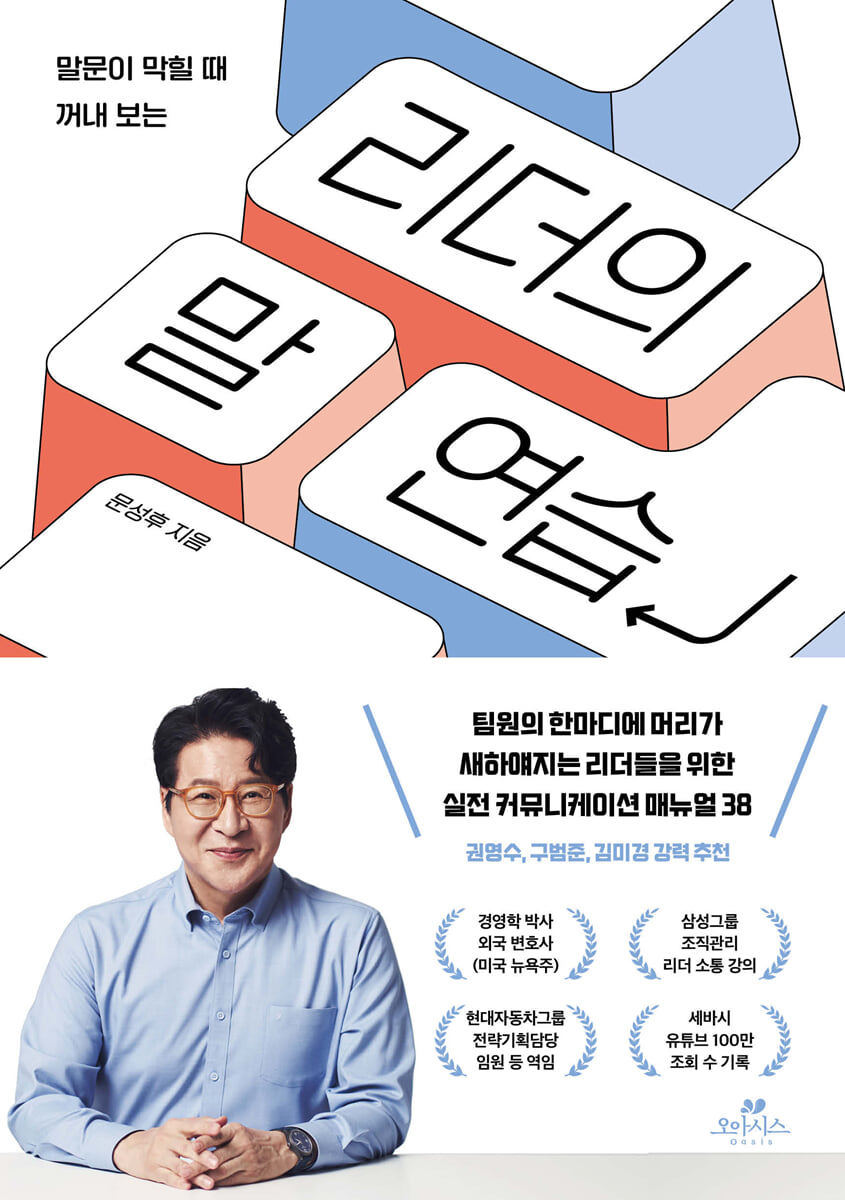
Leader's Speaking Practice
 |
Description
Book Introduction
Leaders who find it difficult to speak today,
The answer is in this book!
From “So?” to “I’ll take care of that.”
For leaders who are shocked by a single word from their team members
Practical Communication Manual 38
Strongly recommended by Kwon Young-soo, Koo Beom-jun, and Kim Mi-kyung
As soon as the meeting starts, my mind goes blank, and when I listen to a report and a team member asks, “So?”, my heart sinks.
It's not unfamiliar to experience the air in a conference room suddenly freezes and the flow of progress comes to a halt just because you've carefully given feedback.
These difficult moments that many novice leaders face every day are not due to a lack of ability.
That's because they've never learned the 'leader's words' that move things along.
Being a leader isn't just about distributing work and receiving reports. It's about being the person who can align the team's spirit with a single word and regain momentum when things get out of whack.
So, for leaders, ‘practice in handling words’ is absolutely necessary.
The author of this book, Dr. Moon Sung-hoo, is a practical communication expert who has worked for 24 years in the field at organizations such as the Financial Supervisory Service, Doosan Group, POSCO, and Hyundai Motor Group, serving as a leader, executive, and leadership coach for hundreds of companies.
He knows better than anyone the moments when leaders actually get stuck, and based on his own experience, he has compiled in this book "38 Emergency Conversation Techniques for Leaders," which can be used right away when you feel like "What should I say?"
"Leader's Speech Practice" provides immediately applicable speaking skills and language standards to leaders who have just become team leaders, leaders who have blamed themselves for being unfit to lead, and leaders who have experienced relationships being damaged and team trust being lost due to a single word.
By following the most realistic and effective conversation formulas designed for the situations leaders face every day—from feedback and meetings to praise and conflict resolution—you'll naturally realize how a single line can dramatically change the pace and mood of a team.
Above all, this book is a practical training book that allows you to experience firsthand how stable and strong a team becomes the moment a leader's words change.
It will give you the power of words to overcome dangerous situations so that you will never be frozen in the same moment again.
The answer is in this book!
From “So?” to “I’ll take care of that.”
For leaders who are shocked by a single word from their team members
Practical Communication Manual 38
Strongly recommended by Kwon Young-soo, Koo Beom-jun, and Kim Mi-kyung
As soon as the meeting starts, my mind goes blank, and when I listen to a report and a team member asks, “So?”, my heart sinks.
It's not unfamiliar to experience the air in a conference room suddenly freezes and the flow of progress comes to a halt just because you've carefully given feedback.
These difficult moments that many novice leaders face every day are not due to a lack of ability.
That's because they've never learned the 'leader's words' that move things along.
Being a leader isn't just about distributing work and receiving reports. It's about being the person who can align the team's spirit with a single word and regain momentum when things get out of whack.
So, for leaders, ‘practice in handling words’ is absolutely necessary.
The author of this book, Dr. Moon Sung-hoo, is a practical communication expert who has worked for 24 years in the field at organizations such as the Financial Supervisory Service, Doosan Group, POSCO, and Hyundai Motor Group, serving as a leader, executive, and leadership coach for hundreds of companies.
He knows better than anyone the moments when leaders actually get stuck, and based on his own experience, he has compiled in this book "38 Emergency Conversation Techniques for Leaders," which can be used right away when you feel like "What should I say?"
"Leader's Speech Practice" provides immediately applicable speaking skills and language standards to leaders who have just become team leaders, leaders who have blamed themselves for being unfit to lead, and leaders who have experienced relationships being damaged and team trust being lost due to a single word.
By following the most realistic and effective conversation formulas designed for the situations leaders face every day—from feedback and meetings to praise and conflict resolution—you'll naturally realize how a single line can dramatically change the pace and mood of a team.
Above all, this book is a practical training book that allows you to experience firsthand how stable and strong a team becomes the moment a leader's words change.
It will give you the power of words to overcome dangerous situations so that you will never be frozen in the same moment again.
- You can preview some of the book's contents.
Preview
index
Prologue: A leader's words are the engine that moves the team.
Chapter 1.
A single word from a leader determines the direction of the team.
1.
"I don't know why you told me to do that." The real reason your teammates don't respond to your commands.
2.
"Isn't this enough?" How to Converse When Authority Is Shaky
3.
"So?" The Art of Answering Without Going Gray
4.
“Well, so, so…….” A sentence that saves a leader who is always on the lookout
Chapter 2.
Trust begins with consistency of words.
1.
"It was my fault." Saying this without avoiding responsibility
2.
"What the heck are the standards?" The language habits of a leader with integrity
3.
"I'll take care of that." Three ways to escape the team leader's trap
4.
“I had an accident.” The first sentence you say to the team member who caused the accident.
5.
"You really do what you say." The linguistic habits of leaders who do what they say.
6.
“You seem to be feeling a little different.” Don’t let your emotions become your attitude.
*A leader's emergency prescription for when you're at a loss for words 1.
Q.
I think my team members listen to the manager more than I do.
Chapter 3.
Leadership skills are determined by the temperature of the words.
1.
I said, 'Good job, good job!' and...
The negative effects of excessive praise
2.
"Let's talk about that later." Postponing an uncomfortable conversation can lead to a bombshell.
3.
The feedback formula is perfected with the taboo detail, "You'll figure it out."
4.
"I couldn't help it back then." Instead of making excuses, speak with responsibility.
5.
"Whose side are you on, Team Leader?" Three conversational strategies to consider when faced with a difficult situation.
6.
“…….” Reading the message hidden in silence
*A leader's emergency prescription for when you're at a loss for words 2.
Q.
I just said one word and the team atmosphere froze.
Chapter 4.
Awaken your team members' initiative with a single word.
1.
"How far should I go?" Finding the line between intervention and delegation
2.
"That guy is just hopeless." How to Show Strength to a Problematic Teammate
3.
"I just need to work harder." The kindness of a leader that weakens the team.
4.
“Your strength is….” A word from a leader who brings out vision
5.
“I just said one word and they all left.” Don’t let your advice hurt.
6.
"I'm feeling unmotivated these days." The formula for getting even the most listless team members moving.
*3 Emergency Prescriptions for Leaders to Use When You're Speechless
Q.
Even when I ask, "Any opinions?", everyone just lowers their heads.
Chapter 5.
Take control of the meeting with the right words at the right time.
1.
"Let's get together!" Stop holding purposeless meetings.
2.
"My team members' reporting skills are a mess!" Teach them the language of reporting.
3.
"I'm nervous about interviews." How to feel comfortable in one-on-one conversations
4.
"What do you think of this from your perspective?" The Art of Asking Questions That Awaken Initiative
5.
"I can't do that." How to win over a rebellious teammate
6.
"Wait a minute, where are we now?" A phrase that holds back a meeting that's drifting without context.
*A leader's emergency prescription for when you're at a loss for words 4.
Q.
My team members keep misunderstanding my instructions.
Chapter 6.
A Leader's Words That Resonate Across Generations
1.
"That sounds a bit old-fashioned." Listening training that opens your ears
2.
“We don’t use that word these days.” Leader’s words that MZ people immediately respond to
3.
"How far should we trust AI?" Drawing boundaries in the age of technology.
4.
“I said it all with an emoticon.” The swamp of countless meanings contained in a single letter. The exact nature of non-face-to-face feedback.
language
5.
"Are you angry with me?" The right distance for online communication
6.
"No matter what, our team is the best!" You, me, we become one team.
Chapter 1.
A single word from a leader determines the direction of the team.
1.
"I don't know why you told me to do that." The real reason your teammates don't respond to your commands.
2.
"Isn't this enough?" How to Converse When Authority Is Shaky
3.
"So?" The Art of Answering Without Going Gray
4.
“Well, so, so…….” A sentence that saves a leader who is always on the lookout
Chapter 2.
Trust begins with consistency of words.
1.
"It was my fault." Saying this without avoiding responsibility
2.
"What the heck are the standards?" The language habits of a leader with integrity
3.
"I'll take care of that." Three ways to escape the team leader's trap
4.
“I had an accident.” The first sentence you say to the team member who caused the accident.
5.
"You really do what you say." The linguistic habits of leaders who do what they say.
6.
“You seem to be feeling a little different.” Don’t let your emotions become your attitude.
*A leader's emergency prescription for when you're at a loss for words 1.
Q.
I think my team members listen to the manager more than I do.
Chapter 3.
Leadership skills are determined by the temperature of the words.
1.
I said, 'Good job, good job!' and...
The negative effects of excessive praise
2.
"Let's talk about that later." Postponing an uncomfortable conversation can lead to a bombshell.
3.
The feedback formula is perfected with the taboo detail, "You'll figure it out."
4.
"I couldn't help it back then." Instead of making excuses, speak with responsibility.
5.
"Whose side are you on, Team Leader?" Three conversational strategies to consider when faced with a difficult situation.
6.
“…….” Reading the message hidden in silence
*A leader's emergency prescription for when you're at a loss for words 2.
Q.
I just said one word and the team atmosphere froze.
Chapter 4.
Awaken your team members' initiative with a single word.
1.
"How far should I go?" Finding the line between intervention and delegation
2.
"That guy is just hopeless." How to Show Strength to a Problematic Teammate
3.
"I just need to work harder." The kindness of a leader that weakens the team.
4.
“Your strength is….” A word from a leader who brings out vision
5.
“I just said one word and they all left.” Don’t let your advice hurt.
6.
"I'm feeling unmotivated these days." The formula for getting even the most listless team members moving.
*3 Emergency Prescriptions for Leaders to Use When You're Speechless
Q.
Even when I ask, "Any opinions?", everyone just lowers their heads.
Chapter 5.
Take control of the meeting with the right words at the right time.
1.
"Let's get together!" Stop holding purposeless meetings.
2.
"My team members' reporting skills are a mess!" Teach them the language of reporting.
3.
"I'm nervous about interviews." How to feel comfortable in one-on-one conversations
4.
"What do you think of this from your perspective?" The Art of Asking Questions That Awaken Initiative
5.
"I can't do that." How to win over a rebellious teammate
6.
"Wait a minute, where are we now?" A phrase that holds back a meeting that's drifting without context.
*A leader's emergency prescription for when you're at a loss for words 4.
Q.
My team members keep misunderstanding my instructions.
Chapter 6.
A Leader's Words That Resonate Across Generations
1.
"That sounds a bit old-fashioned." Listening training that opens your ears
2.
“We don’t use that word these days.” Leader’s words that MZ people immediately respond to
3.
"How far should we trust AI?" Drawing boundaries in the age of technology.
4.
“I said it all with an emoticon.” The swamp of countless meanings contained in a single letter. The exact nature of non-face-to-face feedback.
language
5.
"Are you angry with me?" The right distance for online communication
6.
"No matter what, our team is the best!" You, me, we become one team.
Detailed image

Into the book
I call powerless words 'the ant hell of words'.
There are plenty of nice words, but the team is at a standstill.
A leader's words should be an engine, not decoration.
So Chapter 1 begins with “How to strip away superficiality and get your intentions straight.”
In a moment of crisis, it's not a long speech that saves a team, it's a single, well-placed word.
--- p.009
Wouldn't it be nice if leaders spoke coolly? Of course it would be nice.
But, if you show off too much, there is one big side effect.
A leader's words must lead team members to the threshold of action.
However, if you show off, a filter is created that prevents you from directly conveying important messages, and because of that filter, your power to lead team members to action is weakened.
If you go to an automobile museum, you will see many cars that look shiny on the outside but actually have empty engines or are completely undriveable.
A leader's words are like the engine of a car.
You may be in a state like a car without an engine right now.
That's not what a leader should say.
--- p.019
Phrases like “Do your best” and “Try hard” are auxiliary means to emphasize the meaning and do not convey a clear message in themselves.
Isn't there a pun that older men often use?
“I will work really hard at the company.”, “Hard work is the basics and I have to do well.
“What’s the point of just working hard?” In my view, ‘working hard’ and ‘doing well’ are the same.
A leader should not give such vague instructions.
We need a routine to request and deliver 'action units'.
--- p.031
Here are three tips to instantly improve your speaking skills:
First, get into the habit of sticking to one topic in a conversation and speaking sharply.
Second, no matter how awkward you are at speaking, prepare 15 minutes for a 5-minute speech.
If you practice, you will inevitably become good at speaking.
Third, decide on the structure of your speech and speak in order.
When people have a structure, it becomes easier to understand and make choices.
If you consistently practice these three tips, Manager Oh will also be able to grow into a leader who is very good at speaking.
--- p.064
Emotional labor leads to emotional exhaustion and lower job satisfaction.
Especially leaders and teams
The greater the power distance between groups, that is, the more clearly the hierarchy is established, the more likely team members are to engage in superficial behavior, and the greater the negative impact.
The president's frequent 'dad jokes' are more tiring than the team leader's unfunny jokes.
--- p.119
If you are silent while talking, you will look at that person.
At that time, the listener's concentration increases and they begin to think more about the later parts of the content.
Silence is a skill that creates concentration in the listener.
Instead of nagging your team members to come up with creative ideas, be silent and create space.
People have a tendency to not be able to stand silence, and they are anxious to break that silence themselves.
Even quiet team members will begin to speak up.
--- p.177
There aren't many team members who like change in the first place.
The same goes for leaders.
When a company introduces a new system, complaints like, “Does this make sense?” and “It won’t last long” come out first.
Moreover, when a change occurs, the first thought that comes to mind is, 'There will be more work.'
So, change is bound to be burdensome.
Change is always uncomfortable.
There are many other reasons for resisting change.
It is also the leader's job to figure out why.
If team members resist change, leaders should examine why and design conversations.
Let's have a conversation with the rebel team members like this:
There are plenty of nice words, but the team is at a standstill.
A leader's words should be an engine, not decoration.
So Chapter 1 begins with “How to strip away superficiality and get your intentions straight.”
In a moment of crisis, it's not a long speech that saves a team, it's a single, well-placed word.
--- p.009
Wouldn't it be nice if leaders spoke coolly? Of course it would be nice.
But, if you show off too much, there is one big side effect.
A leader's words must lead team members to the threshold of action.
However, if you show off, a filter is created that prevents you from directly conveying important messages, and because of that filter, your power to lead team members to action is weakened.
If you go to an automobile museum, you will see many cars that look shiny on the outside but actually have empty engines or are completely undriveable.
A leader's words are like the engine of a car.
You may be in a state like a car without an engine right now.
That's not what a leader should say.
--- p.019
Phrases like “Do your best” and “Try hard” are auxiliary means to emphasize the meaning and do not convey a clear message in themselves.
Isn't there a pun that older men often use?
“I will work really hard at the company.”, “Hard work is the basics and I have to do well.
“What’s the point of just working hard?” In my view, ‘working hard’ and ‘doing well’ are the same.
A leader should not give such vague instructions.
We need a routine to request and deliver 'action units'.
--- p.031
Here are three tips to instantly improve your speaking skills:
First, get into the habit of sticking to one topic in a conversation and speaking sharply.
Second, no matter how awkward you are at speaking, prepare 15 minutes for a 5-minute speech.
If you practice, you will inevitably become good at speaking.
Third, decide on the structure of your speech and speak in order.
When people have a structure, it becomes easier to understand and make choices.
If you consistently practice these three tips, Manager Oh will also be able to grow into a leader who is very good at speaking.
--- p.064
Emotional labor leads to emotional exhaustion and lower job satisfaction.
Especially leaders and teams
The greater the power distance between groups, that is, the more clearly the hierarchy is established, the more likely team members are to engage in superficial behavior, and the greater the negative impact.
The president's frequent 'dad jokes' are more tiring than the team leader's unfunny jokes.
--- p.119
If you are silent while talking, you will look at that person.
At that time, the listener's concentration increases and they begin to think more about the later parts of the content.
Silence is a skill that creates concentration in the listener.
Instead of nagging your team members to come up with creative ideas, be silent and create space.
People have a tendency to not be able to stand silence, and they are anxious to break that silence themselves.
Even quiet team members will begin to speak up.
--- p.177
There aren't many team members who like change in the first place.
The same goes for leaders.
When a company introduces a new system, complaints like, “Does this make sense?” and “It won’t last long” come out first.
Moreover, when a change occurs, the first thought that comes to mind is, 'There will be more work.'
So, change is bound to be burdensome.
Change is always uncomfortable.
There are many other reasons for resisting change.
It is also the leader's job to figure out why.
If team members resist change, leaders should examine why and design conversations.
Let's have a conversation with the rebel team members like this:
--- p.285
Publisher's Review
The success or failure of leadership ultimately depends on
It's all about one word
The success or failure of leadership ultimately depends on a single word.
A single sentence thrown out in a meeting, a single line spoken in an interview, or a brief response in a conflict situation determines the team's atmosphere and execution ability.
But most leaders have never learned the 'leader's language'.
This book structurally identifies the reasons why novice leaders are at a loss for words in the most common situations they encounter: the moment when they are struck dumb by the question, "So what?", the moment when the air freezes over with a single line of clumsy feedback, and the moment when a team leader's authority is shaken in a conversation.
Dr. Moon Sung-hoo is a hands-on communications expert with 24 years of practical and leadership experience at the Financial Supervisory Service, Doosan, POSCO, and Hyundai Motor Group, and has since coached leaders at hundreds of companies.
This book, written through his experiences, clearly shows that a leader's words are not mere conveyance, but a 'design language' that moves the team.
The moment when feedback, meetings, and conflicts are blocked
38 Emergency Communication Skills You Can Use Right Away
The book's greatest strength is that it presents 38 quick-response sentences that can be used immediately in those awkward moments when you wonder, "What should I say now?"
A formula for summarizing all those potentially complex moments—when a team member makes excuses, when a meeting goes off the rails, when praise becomes toxic, when silence signals conflict, when a rebellious team member reacts emotionally—in a single sentence, in actual language.
It also systematically organizes the conversation skills necessary for leaders, including the structure of questions that encourage initiative, speaking habits that prevent emotions from spilling over into attitudes, temperature-regulating language that reduces misunderstandings between generations, and key sentence structures that revive the flow of meetings.
As a result, the leader's words become clearer, misunderstandings are reduced, and execution naturally becomes a flowing process within the team.
Through this book, you will find immediately applicable "speech standards" and "conversation blueprints" that will allow you to speak according to your own standards without wavering in any situation.
Changing execution power, trust, and atmosphere
Practical Leadership Language Strategies
A leader's words have the power to move the team's energy, trust, and direction of action, beyond mere expression.
This book uses language patterns discovered in the field to demonstrate how a single statement from a leader can turn the tide, redefine each person's role, and stabilize the rhythm of the entire team.
When you become a leader who knows how to handle sentences, the team's response changes.
Discussions that had been dragging on and on find a center, cracks caused by minor misunderstandings are quickly mended, and the intent of feedback is conveyed without distortion.
The moment the structure of the speech is established, the team gains the strength to stand up again, and the leader holds an unshakable standard in his hands.
Many leaders are torn apart by a single word that can change their day.
Some people lose their momentum because of one sentence, while others rebuild their team with that one sentence.
"Leader's Speech Practice" is a book that organizes the language strategies that create that crossroads in the most practical form.
From a single sentence that corrects a shaky moment to a conversational standard that revives the team's flow, it clearly presents the verbal tools that leaders can immediately use in the field.
Ultimately, this book will be the most practical answer any leader struggling with words needs to regain their focus and lead their team in the same direction.
It's all about one word
The success or failure of leadership ultimately depends on a single word.
A single sentence thrown out in a meeting, a single line spoken in an interview, or a brief response in a conflict situation determines the team's atmosphere and execution ability.
But most leaders have never learned the 'leader's language'.
This book structurally identifies the reasons why novice leaders are at a loss for words in the most common situations they encounter: the moment when they are struck dumb by the question, "So what?", the moment when the air freezes over with a single line of clumsy feedback, and the moment when a team leader's authority is shaken in a conversation.
Dr. Moon Sung-hoo is a hands-on communications expert with 24 years of practical and leadership experience at the Financial Supervisory Service, Doosan, POSCO, and Hyundai Motor Group, and has since coached leaders at hundreds of companies.
This book, written through his experiences, clearly shows that a leader's words are not mere conveyance, but a 'design language' that moves the team.
The moment when feedback, meetings, and conflicts are blocked
38 Emergency Communication Skills You Can Use Right Away
The book's greatest strength is that it presents 38 quick-response sentences that can be used immediately in those awkward moments when you wonder, "What should I say now?"
A formula for summarizing all those potentially complex moments—when a team member makes excuses, when a meeting goes off the rails, when praise becomes toxic, when silence signals conflict, when a rebellious team member reacts emotionally—in a single sentence, in actual language.
It also systematically organizes the conversation skills necessary for leaders, including the structure of questions that encourage initiative, speaking habits that prevent emotions from spilling over into attitudes, temperature-regulating language that reduces misunderstandings between generations, and key sentence structures that revive the flow of meetings.
As a result, the leader's words become clearer, misunderstandings are reduced, and execution naturally becomes a flowing process within the team.
Through this book, you will find immediately applicable "speech standards" and "conversation blueprints" that will allow you to speak according to your own standards without wavering in any situation.
Changing execution power, trust, and atmosphere
Practical Leadership Language Strategies
A leader's words have the power to move the team's energy, trust, and direction of action, beyond mere expression.
This book uses language patterns discovered in the field to demonstrate how a single statement from a leader can turn the tide, redefine each person's role, and stabilize the rhythm of the entire team.
When you become a leader who knows how to handle sentences, the team's response changes.
Discussions that had been dragging on and on find a center, cracks caused by minor misunderstandings are quickly mended, and the intent of feedback is conveyed without distortion.
The moment the structure of the speech is established, the team gains the strength to stand up again, and the leader holds an unshakable standard in his hands.
Many leaders are torn apart by a single word that can change their day.
Some people lose their momentum because of one sentence, while others rebuild their team with that one sentence.
"Leader's Speech Practice" is a book that organizes the language strategies that create that crossroads in the most practical form.
From a single sentence that corrects a shaky moment to a conversational standard that revives the team's flow, it clearly presents the verbal tools that leaders can immediately use in the field.
Ultimately, this book will be the most practical answer any leader struggling with words needs to regain their focus and lead their team in the same direction.
GOODS SPECIFICS
- Date of issue: December 1, 2025
- Format: Hardcover book binding method guide
- Page count, weight, size: 360 pages | 148*210*30mm
- ISBN13: 9791168273825
- ISBN10: 116827382X
You may also like
카테고리
korean


korean

![GQ KOREA Mark (Monthly): December [2025]](http://librairie.coreenne.fr/cdn/shop/files/8ef265dbbfbf186523ed75ba7319009d.jpg?v=1765340328&width=3840)


