

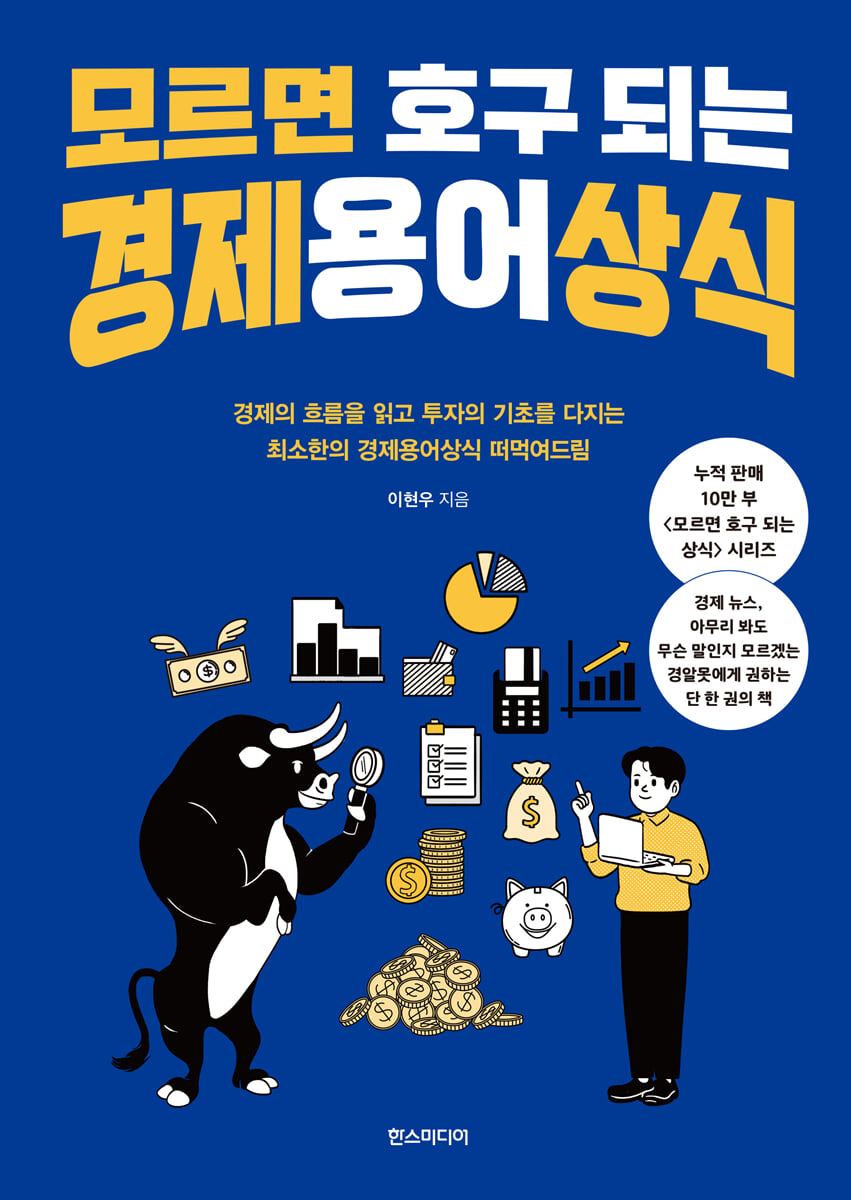
Economic terms that you can be fooled if you don't know them
 |
Description
Book Introduction
Cumulative sales exceed 100,000 copies [Common Sense You'll Be Fooled If You Don't Know] series
Before studying economic common sense, you must first understand economic 'terminology'!
The author of "Economic Common Sense That Will Make You a Fool If You Don't Know" by Vessel, a 7-year veteran
The Basics of Economic Issues for the Economically Illiterate: 'Terminology'
Published in 2019, 『Economic Common Sense: A Fool's Guide』 (hereafter referred to as 『Economic Common Sense』) was selected for the Sejong Books liberal arts category and has been a bestseller for seven years. It is a book that has firmly established the foundation of the current [Common Sense: A Fool's Guide] series.
Author Lee Hyeon-woo, who has meticulously compiled and clearly explained the basic common sense needed by young office workers just starting out in society, college students about to graduate, and other 'economic illiterates' who get a headache just hearing the word 'economics', has now meticulously organized common sense economic 'terms'.
The new book, "Economic Terms You Should Know to Be Fooled," is a good book to read before reading the previous work, "Economic Common Sense."
This book will be a welcome introduction to economics studies for anyone who finds themselves unable to understand the unfamiliar words in books and articles.
Before studying economic common sense, you must first understand economic 'terminology'!
The author of "Economic Common Sense That Will Make You a Fool If You Don't Know" by Vessel, a 7-year veteran
The Basics of Economic Issues for the Economically Illiterate: 'Terminology'
Published in 2019, 『Economic Common Sense: A Fool's Guide』 (hereafter referred to as 『Economic Common Sense』) was selected for the Sejong Books liberal arts category and has been a bestseller for seven years. It is a book that has firmly established the foundation of the current [Common Sense: A Fool's Guide] series.
Author Lee Hyeon-woo, who has meticulously compiled and clearly explained the basic common sense needed by young office workers just starting out in society, college students about to graduate, and other 'economic illiterates' who get a headache just hearing the word 'economics', has now meticulously organized common sense economic 'terms'.
The new book, "Economic Terms You Should Know to Be Fooled," is a good book to read before reading the previous work, "Economic Common Sense."
This book will be a welcome introduction to economics studies for anyone who finds themselves unable to understand the unfamiliar words in books and articles.
- You can preview some of the book's contents.
Preview
index
prolog.
A new economics where you are the main character
Chapter 1.
Just knowing this is enough to escape from being a beginner in economics.
Economics, Finance, and Accounting: Just Knowing the Differences Will Get You Out of the Beginner's Level! | Fed, FRB, and FOMC: The World's Money Makers | The Core of Capitalism: Market Interest Rates | Market Interest Rates Constantly Fluctuate! | The Essentials of Economic Forecasting: Prices | Consumption and Production: The Direction and Speed of the Economy | GDP: Developing Economic Insight | Understanding the Economy Reveals the Flow of Money | The Economic Compass: Exchange Rates | Exchange Rates: The Navigation of the Global Economy | International Crude Oil: The Blood Flowing Through the Body of the Economy | The Economic Vitamin: The Raw Materials Market | The Economy is a Psychological Game | The Velocity of Money Reveals the Flow of Money!
Chapter 2.
Fundamentals of Investment Finance
The wondrous universe of the financial market | Time and risk flowing through the financial universe | Wise risk management through hedging | Bulls and bears in the stock market | Capitalism's highways, loans and credit | Companies that grow rapidly by eating funds | Banks are lakes where capital gathers | Funds, rivers that draw in funds | Modern alchemy, the financial industry | Companies transforming through financial technology | Securities firms, links on the train of capitalism | Tightrope walking, real estate PF | Seat belts and airbags, insurance and trusts in capitalism
Chapter 3.
Economic policies that make money when understood
Doves and Hawks: A Look at the Economy | The Deep Roots of the Nation: Economic Ministries | Loan Diet: Deleveraging | The Secret to a Healthy Bank | Financial Institution Traffic Management Methods | Capitalism's Judges and Firefighters | Various Interest Rate Application Formulas | The Seeds of International Trade and Tariff Wars | Accounting: The Language of Trade and Commerce | The Tug-of-War on Exchange Rates | Cryptocurrencies: Between Technological Innovation and Speculation
Chapter 4.
Practical Economic News Strategy
The Rise of the Yen Carry Trade | Diverse Perspectives on the Economy | Supply Chain Earthquake: Reshoring | Donghak Ants Taken aback | The Unpredictable Economic Perfect Storm | Evolving Investment Technologies | The Long Road to Investment Profits | Warning on the Potential of Debt-Based Investments | Value Investing Unwavering in the Market | The Economy is Still in Adolescence
Chapter 5.
Tips on Everyday Economic Terms
Smart People's Foolish Choices | Voluntary Problem Solving, Nudge | Marketing That Tenfolds Your Profits | From Consumption to Experience | The Subtle Difference Between Stock Investing and Gambling | Everyone Thinks About Capital and Profit | Is Everyone Really Rich Except Me? | The New Era of Labor
A new economics where you are the main character
Chapter 1.
Just knowing this is enough to escape from being a beginner in economics.
Economics, Finance, and Accounting: Just Knowing the Differences Will Get You Out of the Beginner's Level! | Fed, FRB, and FOMC: The World's Money Makers | The Core of Capitalism: Market Interest Rates | Market Interest Rates Constantly Fluctuate! | The Essentials of Economic Forecasting: Prices | Consumption and Production: The Direction and Speed of the Economy | GDP: Developing Economic Insight | Understanding the Economy Reveals the Flow of Money | The Economic Compass: Exchange Rates | Exchange Rates: The Navigation of the Global Economy | International Crude Oil: The Blood Flowing Through the Body of the Economy | The Economic Vitamin: The Raw Materials Market | The Economy is a Psychological Game | The Velocity of Money Reveals the Flow of Money!
Chapter 2.
Fundamentals of Investment Finance
The wondrous universe of the financial market | Time and risk flowing through the financial universe | Wise risk management through hedging | Bulls and bears in the stock market | Capitalism's highways, loans and credit | Companies that grow rapidly by eating funds | Banks are lakes where capital gathers | Funds, rivers that draw in funds | Modern alchemy, the financial industry | Companies transforming through financial technology | Securities firms, links on the train of capitalism | Tightrope walking, real estate PF | Seat belts and airbags, insurance and trusts in capitalism
Chapter 3.
Economic policies that make money when understood
Doves and Hawks: A Look at the Economy | The Deep Roots of the Nation: Economic Ministries | Loan Diet: Deleveraging | The Secret to a Healthy Bank | Financial Institution Traffic Management Methods | Capitalism's Judges and Firefighters | Various Interest Rate Application Formulas | The Seeds of International Trade and Tariff Wars | Accounting: The Language of Trade and Commerce | The Tug-of-War on Exchange Rates | Cryptocurrencies: Between Technological Innovation and Speculation
Chapter 4.
Practical Economic News Strategy
The Rise of the Yen Carry Trade | Diverse Perspectives on the Economy | Supply Chain Earthquake: Reshoring | Donghak Ants Taken aback | The Unpredictable Economic Perfect Storm | Evolving Investment Technologies | The Long Road to Investment Profits | Warning on the Potential of Debt-Based Investments | Value Investing Unwavering in the Market | The Economy is Still in Adolescence
Chapter 5.
Tips on Everyday Economic Terms
Smart People's Foolish Choices | Voluntary Problem Solving, Nudge | Marketing That Tenfolds Your Profits | From Consumption to Experience | The Subtle Difference Between Stock Investing and Gambling | Everyone Thinks About Capital and Profit | Is Everyone Really Rich Except Me? | The New Era of Labor
Detailed image

Into the book
Studying accounting will help you read the economic patterns hidden in numbers and make sound decisions.
Announcements from the media, experts, and government reflect their respective positions and perspectives, making it difficult to unconditionally trust them.
However, by understanding the meaning of numbers through accounting and considering the other party's perspective, we can discover the economic phenomena hidden behind the numbers.
---「Chapter 1.
Just knowing this will help you escape from being a beginner in economics - Economics, finance, and accounting, just knowing the difference between these three will help you escape from being a beginner!
When distinguishing economic indicators, it is important to distinguish between leading and lagging indicators.
It is necessary to clearly distinguish whether the indicator has already been reflected in the market or will be reflected in the future.
Since the outbreak of COVID-19, stock prices have plummeted and unemployment rates have skyrocketed.
Some people believed that stock prices would fall further because the economy was struggling due to high unemployment.
But the result went in the opposite direction.
We made the mistake of predicting the economy based on lagging indicators, which led to a wrong judgment.
---「Chapter 1.
From "Escape from Beginner Economics with Just This - Knowing the Economy Shows You the Flow of Money"
The principle that using a lever allows you to accomplish more with less force has been applied in a variety of fields.
Especially in finance, leverage has come to mean borrowing significantly more money than one's own capital to make larger investments and ventures.
Leverage can increase your profits relative to your capital, but it can also increase your losses.
While the alchemy of finance has certainly brought about many opportunities and wealth for individuals and society, it also has its limitations, much like the alchemy that failed to create gold.
---「Chapter 2.
From "Fundamentals of Investment: Finance - Modern Alchemy, the Financial Industry"
During the Great Depression, many banks failed, destroying depositors' confidence that they would get their money back.
The scale of the damage was also large because there was no system to protect depositors.
Therefore, the Federal Deposit Insurance Corporation (FDIC) was established to protect depositors.
Just as our country's Deposit Insurance Corporation guarantees depositors up to 50 million won, the FDIC in the United States guarantees depositors up to 250,000 dollars (approximately 340 million won).
The great financial crisis created the various safeguards we have today.
---「Chapter 3.
From "Economic Policies That Make Money Visible When You Understand Them - Financial Institution Traffic Management Methods"
With the recent resurgence of protectionism, 'antidumping regulation' policies are appearing frequently.
Dumping means selling a product at a price significantly lower than its normal price.
If left unchecked, the importing country's industry could suffer a serious blow.
In particular, if local competitors go bankrupt, the dumping company can raise prices again, leading to "predatory pricing," which can cause significant long-term harm to consumers.
---「Chapter 3.
Economic policies that make money when understood - From "The Seeds of International Trade and Tariff Wars"
As supply chain flows change, the flow of money naturally changes as well.
If the paths along which money and goods have flowed until now were changed, the world would look different.
We may be in the midst of that change.
When the existing flow changes, many people are afraid.
But it may be unsettling because no one has experienced this change before.
If you prepare well, you may be able to grab more opportunities.
---「Chapter 4.
From "Practical Economic News Strategy - Supply Chain Earthquake, Reshoring"
We strive to reduce risk in financial markets and increase trust in the financial system and government policies through nudges.
But these attempts cannot solve all the problems of financial markets and the economy.
Nudge is a new approach to understanding and improving irrational human behavior.
It is difficult to completely eliminate human psychological biases, and even if behavioral changes are made, they are unlikely to be sustained.
Nonetheless, nudges are an effective tool for inducing voluntary behavioral change.
Announcements from the media, experts, and government reflect their respective positions and perspectives, making it difficult to unconditionally trust them.
However, by understanding the meaning of numbers through accounting and considering the other party's perspective, we can discover the economic phenomena hidden behind the numbers.
---「Chapter 1.
Just knowing this will help you escape from being a beginner in economics - Economics, finance, and accounting, just knowing the difference between these three will help you escape from being a beginner!
When distinguishing economic indicators, it is important to distinguish between leading and lagging indicators.
It is necessary to clearly distinguish whether the indicator has already been reflected in the market or will be reflected in the future.
Since the outbreak of COVID-19, stock prices have plummeted and unemployment rates have skyrocketed.
Some people believed that stock prices would fall further because the economy was struggling due to high unemployment.
But the result went in the opposite direction.
We made the mistake of predicting the economy based on lagging indicators, which led to a wrong judgment.
---「Chapter 1.
From "Escape from Beginner Economics with Just This - Knowing the Economy Shows You the Flow of Money"
The principle that using a lever allows you to accomplish more with less force has been applied in a variety of fields.
Especially in finance, leverage has come to mean borrowing significantly more money than one's own capital to make larger investments and ventures.
Leverage can increase your profits relative to your capital, but it can also increase your losses.
While the alchemy of finance has certainly brought about many opportunities and wealth for individuals and society, it also has its limitations, much like the alchemy that failed to create gold.
---「Chapter 2.
From "Fundamentals of Investment: Finance - Modern Alchemy, the Financial Industry"
During the Great Depression, many banks failed, destroying depositors' confidence that they would get their money back.
The scale of the damage was also large because there was no system to protect depositors.
Therefore, the Federal Deposit Insurance Corporation (FDIC) was established to protect depositors.
Just as our country's Deposit Insurance Corporation guarantees depositors up to 50 million won, the FDIC in the United States guarantees depositors up to 250,000 dollars (approximately 340 million won).
The great financial crisis created the various safeguards we have today.
---「Chapter 3.
From "Economic Policies That Make Money Visible When You Understand Them - Financial Institution Traffic Management Methods"
With the recent resurgence of protectionism, 'antidumping regulation' policies are appearing frequently.
Dumping means selling a product at a price significantly lower than its normal price.
If left unchecked, the importing country's industry could suffer a serious blow.
In particular, if local competitors go bankrupt, the dumping company can raise prices again, leading to "predatory pricing," which can cause significant long-term harm to consumers.
---「Chapter 3.
Economic policies that make money when understood - From "The Seeds of International Trade and Tariff Wars"
As supply chain flows change, the flow of money naturally changes as well.
If the paths along which money and goods have flowed until now were changed, the world would look different.
We may be in the midst of that change.
When the existing flow changes, many people are afraid.
But it may be unsettling because no one has experienced this change before.
If you prepare well, you may be able to grab more opportunities.
---「Chapter 4.
From "Practical Economic News Strategy - Supply Chain Earthquake, Reshoring"
We strive to reduce risk in financial markets and increase trust in the financial system and government policies through nudges.
But these attempts cannot solve all the problems of financial markets and the economy.
Nudge is a new approach to understanding and improving irrational human behavior.
It is difficult to completely eliminate human psychological biases, and even if behavioral changes are made, they are unlikely to be sustained.
Nonetheless, nudges are an effective tool for inducing voluntary behavioral change.
---「Chapter 5.
From "Economic Terms in Daily Life: Voluntary Problem Solving, Nudge"
From "Economic Terms in Daily Life: Voluntary Problem Solving, Nudge"
Publisher's Review
If you don't know the words, it's like you can't speak English.
If you don't know economic terms, you don't know economics!
The most important thing to emphasize to children who are learning English for the first time is vocabulary, first and foremost.
In order to read and understand complex English texts, you must be familiar with the alphabet and basic words to make progress.
In other words, the foundation of English is words.
But the same thing applies when studying economics.
Even if you read an article or book that's written in an easy-to-understand manner, if you don't know the meaning of frequently appearing terms like "current account index," "trade balance," "Fed," and "yen carry trade," you won't be able to grasp the content and context, and your long-awaited passion for learning will quickly fade.
"Economic Terms You Don't Know" is a new book written by author Lee Hyeon-woo, who felt the need to organize only the terms after witnessing the frustration of such beginners.
In the book's prologue, the author emphasizes that ordinary people should be able to find their own path on the vast map of the economy by properly understanding economic terminology, rather than simply following the lines drawn by experts such as economists and economic policymakers. They can, and certainly do, do so.
From the basics like interest rates, prices, and GDP
From global supply chain changes to new forms of labor,
This book, "Economic Terms You Should Know," is divided into five parts and explains the economic terms that readers absolutely must know.
The first chapter begins with terms so basic that it's embarrassing to ask others about them, such as the differences between economics, finance, and accounting, the differences between the Fed, FRB, and FOMC, and the meaning of prices or GDP and their functions as indicators.
In addition, the second chapter explores the functions and significance of the financial market, also called the flower of capitalism, as well as frequently used terms. In the third chapter, we will examine in detail terms related to the government's economic policy, such as hawks and doves, exchange rates, accounting, and virtual currencies.
The fourth chapter provides detailed explanations of economic terms frequently encountered in the news these days, such as supply chain, reshoring, yen carry trade, and the perfect storm.
Finally, the fifth chapter organizes economic terms we can experience in our daily lives, such as marketing, investment, and new forms of labor, emphasizing that everything we've covered so far is deeply relevant not only to the economic elite but also to ordinary people who work hard every day.
If you don't know economic terms, you don't know economics!
The most important thing to emphasize to children who are learning English for the first time is vocabulary, first and foremost.
In order to read and understand complex English texts, you must be familiar with the alphabet and basic words to make progress.
In other words, the foundation of English is words.
But the same thing applies when studying economics.
Even if you read an article or book that's written in an easy-to-understand manner, if you don't know the meaning of frequently appearing terms like "current account index," "trade balance," "Fed," and "yen carry trade," you won't be able to grasp the content and context, and your long-awaited passion for learning will quickly fade.
"Economic Terms You Don't Know" is a new book written by author Lee Hyeon-woo, who felt the need to organize only the terms after witnessing the frustration of such beginners.
In the book's prologue, the author emphasizes that ordinary people should be able to find their own path on the vast map of the economy by properly understanding economic terminology, rather than simply following the lines drawn by experts such as economists and economic policymakers. They can, and certainly do, do so.
From the basics like interest rates, prices, and GDP
From global supply chain changes to new forms of labor,
This book, "Economic Terms You Should Know," is divided into five parts and explains the economic terms that readers absolutely must know.
The first chapter begins with terms so basic that it's embarrassing to ask others about them, such as the differences between economics, finance, and accounting, the differences between the Fed, FRB, and FOMC, and the meaning of prices or GDP and their functions as indicators.
In addition, the second chapter explores the functions and significance of the financial market, also called the flower of capitalism, as well as frequently used terms. In the third chapter, we will examine in detail terms related to the government's economic policy, such as hawks and doves, exchange rates, accounting, and virtual currencies.
The fourth chapter provides detailed explanations of economic terms frequently encountered in the news these days, such as supply chain, reshoring, yen carry trade, and the perfect storm.
Finally, the fifth chapter organizes economic terms we can experience in our daily lives, such as marketing, investment, and new forms of labor, emphasizing that everything we've covered so far is deeply relevant not only to the economic elite but also to ordinary people who work hard every day.
GOODS SPECIFICS
- Date of issue: May 22, 2025
- Page count, weight, size: 312 pages | 548g | 152*215*19mm
- ISBN13: 9791194777069
- ISBN10: 1194777066
You may also like
카테고리
korean


korean

![GQ KOREA Mark (Monthly): December [2025]](http://librairie.coreenne.fr/cdn/shop/files/8ef265dbbfbf186523ed75ba7319009d.jpg?v=1765340328&width=3840)


