

South Korea's 2025 Business Map
 |
Description
Book Introduction
The great force driving the Korean economy,
If you don't understand big business, there's no investment!
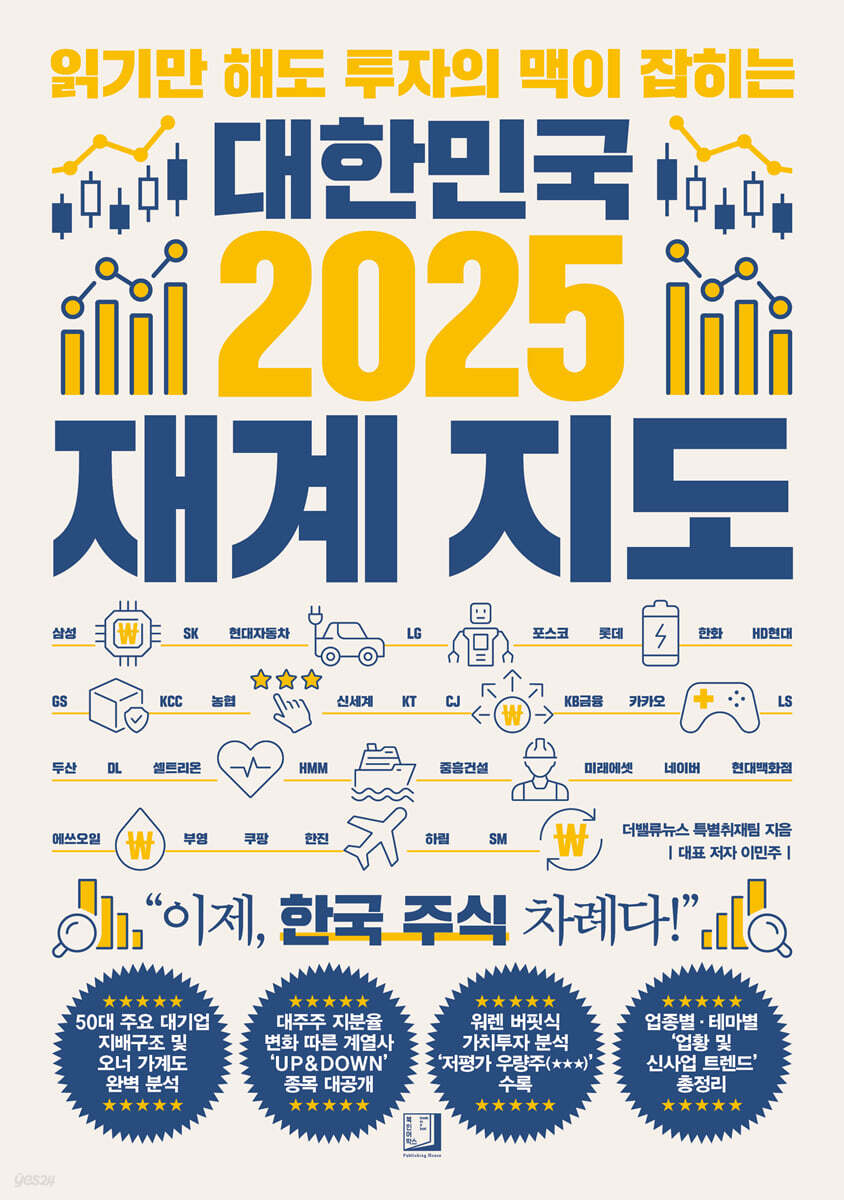
This is Korea's first large-scale investment guidebook, analyzing the structure and strategies of the 50 largest conglomerates that drive the "real" Korean economy, based on data and interpretation.
We've structurally organized the complexly intertwined ecosystem of large corporations, encompassing everything from governance structures and affiliate relationships to industry-specific positions, major shareholder intentions, and new business trends. Within this framework, we've designed the system to selectively identify undervalued companies and those poised for growth.
Investing based on feelings is 100% guaranteed to fail.
Only those who understand the 'structure' can seize the opportunity.
This book is a 'strategy map' that teaches you how to read that structure.
If you don't understand big business, there's no investment!
This is Korea's first large-scale investment guidebook, analyzing the structure and strategies of the 50 largest conglomerates that drive the "real" Korean economy, based on data and interpretation.
We've structurally organized the complexly intertwined ecosystem of large corporations, encompassing everything from governance structures and affiliate relationships to industry-specific positions, major shareholder intentions, and new business trends. Within this framework, we've designed the system to selectively identify undervalued companies and those poised for growth.
Investing based on feelings is 100% guaranteed to fail.
Only those who understand the 'structure' can seize the opportunity.
This book is a 'strategy map' that teaches you how to read that structure.
- You can preview some of the book's contents.
Preview
index
Preface: Ultimately, you have to climb aboard a large conglomerate.
CHAPTER 1: Why "Conglomerate"?
The "too big for you" conglomerates of the Korean economy
How Korea's Large Business Groups Grow and Survive
Promising stocks are right in front of you: How to get on board a conglomerate
Heavy, long, and complex manufacturing is on the decline, while nimble ICT and distribution logistics are gaining ground.
CHAPTER 2 MANUFACTURING COMPANIES
"Corporate Standards" Driving the Korean Economy Through Mass Production
01 Samsung Group | Why the Forecast Says "No. 1 in the Business World, Will Remain for Another 30 Years"
How long can Samsung Group maintain its top position in the business world?
Why the Lee Jae-yong family's stake in Samsung Electronics is low
Samsung's next-generation growth engines: Samsung BioLogics and Samsung C&T
|Wait a minute!| Why are holding company stocks always undervalued? | Characteristics of holding company stocks
SK Group | Ranked 2nd in the business world after three successful "big M&As" including Hynix
SK Group, which has grown through a series of M&As, is making a qualitative leap forward in bio, AI, and secondary batteries.
SK Hynix leads HBM competitiveness, while SK Biopharmaceuticals' innovative new drug Xcopri achieves success.
Hyundai Motor Group | The Global "Big 3" Automotive Companies Remain Even in the Era of Disruptive Electric Vehicles
Even amidst the wave of the electric vehicle revolution, its presence has grown stronger.
Will the tangled web of "governance reform" become the detonator for Hyundai Motor?
04 LG Group | The Big 4 in the business world, 118, are venturing into new businesses in secondary batteries, AI (artificial intelligence), and biotechnology.
LG Group prepares for the future with electronics as the driving force and energizer as the driving force.
LG Energy Solution and LG Innotek: "Big Picture" But "Shareholder Value" Comes First
05 POSCO Group | 3 Secrets to Success in the Secondary Battery Business Despite Half a Century of Political Storms
From a "steel powerhouse" to a "secondary battery powerhouse," POSCO Group's evolution.
Despite political pressure, POSCO FutureM is poised to grow into a top-tier technology company.
06 Hanwha Group | Beyond land, sea, and air, into space: Korea's Lockheed Martin.
From the cradle of "dynamite," we dream of leaping to become a leader in defense and space technology.
Hanwha Ocean, Aerospace, and Systems are gaining traction as the nation's leading defense chain.
GS Group | Ranked 9th in the Korean economy thanks to family management. When will new business results become visible?
GS Group's Concern: "Find a New Growth Engine"
From a family business to a sustainable enterprise, discovering new sources of income is key.
08 CJ Group | Key food and beverage player experimenting with "culture" as a new food
With culture as its core business, the company aims to become a global content powerhouse.
CJ Freshway, the No. 1 food ingredients company in a growing industry.
LS Group | AI Drives Boom in Core Power Line Business, New Secondary Battery Business Also Seeking Growth
LS Group, now in its sizable size, is targeting the secondary battery market beyond power cables.
LS Electric, Gaon Cable, and LS Marine Solutions are booming as AI increases electricity demand.
Doosan Group | Korea's Longest-Oldest Company: Transforming its Business DNA from B2C to B2B
Will B2B transform the "nature of business" and overcome the risks of contract-based businesses?
With the aftermath of restructuring and the risk of losing orders, restoring trust comes first.
11 Celltrion Group | Despite the launch of the integrated corporation, the bio market remains cloudy.
Can a bio-specialized company enter the top 10 conglomerates?
Will Chairman Seo Jung-jin's Return Be a Signal for Celltrion's Revival?
12 S-Oil | Aramco's Stability Remains, the Only Large Conglomerate in the "Single Oil Refining Industry" 238
Korea's only foreign-funded refinery transforms into a petrochemical company.
Can the advantages of "stability in crude oil supply and demand," "high-dividend stocks," and "oil refining stocks" overcome their limitations?
|Wait a minute!| Why is it so difficult to predict oil prices (and refining stocks)? | Characteristics of the refining and petrochemical industries
13 Harim Group | Korea's No. 1 chicken group aims to become a "Korean Cargill" through vertical integration.
Sowing the seeds of a "Korean Cargill" one by one
Succession planning underway, 600 billion won investment in Northeast Asia's food hub in full swing
14 Youngpoong Group | A global leader in non-ferrous metals refining, led by Korea Zinc, the "hidden gem of the stock market."
Korea Zinc, the world's leading non-ferrous metals company, produces silver and gold as byproducts.
Korea Zinc, which was boosted by the refining company's move into the Onsan Industrial Complex, became the spark for a management dispute.
Hyosung Group | Restructuring and Group Separation Lead to Second Leap Forward to Global No. 1 Spandex Company
Can a key player with the core technology for "chemical fibers" rise again?
Group separation finalized, Chairman Cho Hyun-joon's management skills put to the test
16 KT&G Group | 'K-Tobacco' Expands Beyond Korea to Global Markets
Will the company, which holds the top spot in the tobacco market share, continue its legacy as a high-dividend growth stock?
Market stagnation, declining profitability, and succession are areas for improvement. Looking for high-dividend stocks? Clear.
17 KCC Group | “We are not a construction materials company.
“It is the global silicon ‘lynchpin’.”
Will it take off toward cutting-edge industries based on paints, building materials, and silicone?
KCC Glass, independently managed by Chairman Chung Mong-ik, accelerates growth driven by Hyundai Motor and Kia.
18 Kolon Group | Beyond Fashion, Key Players in 'Bio' and 'Automobile Distribution' Warm Up
Can the "Leeds era" of the 1970s be recaptured with "bio-pharmaceuticals"?
What the promotion of Lee Kyu-ho, the owner's only son, to Vice Chairman means
19 OCI Group | Beyond Solar Power, Expanding into Semiconductor Materials with Polysilicon
Key polysilicon players, driving the solar market, are eyeing new opportunities.
SGC Energy's Stable Profit Model: Combined Heat and Power
20 Sea Group | Korea's largest steel pipe and special steel conglomerate, achieving global market success.
Excluding POSCO, the largest pure steel conglomerate in Korea
SeAH Steel Holdings and SeAH Steel see ↑ in global market performance.
|Wait a minute!| The two biggest variables driving steel stocks: exchange rates and raw material prices.
21 LX Group | Entering the top 40 conglomerates in just three years, warming up to secure a "cash cow."
Can LX's size increase and 'strengthening its internal structure' improve stability?
Will Chairman Koo Bon-joon's "Build-Up" Plan, a "Game-Making Game," Lead to Dramatic Growth?
22 Kumho Petrochemical | Korea's largest pure petrochemical group launches new carbon nanotube (CNT) business
Will the world's largest pure-play petrochemical group secure sales stability through new growth engines?
Can "Nephew's Rebellion" and "Yu Hwa-ju" overcome their limitations and increase in value?
23 Dongwon Group | M&A Driven and New Businesses Driven, Warming Up as a "Comprehensive Consumer Goods Group"
Building on its solid tuna business, will it also expand into logistics and secondary batteries?
Dongwon Industries, with its high percentage of major shareholders, is drawing attention from StarKist.
CHAPTER 3 Order-Winning Companies
Heavy and heavy industry, building buildings and ships
01 HD Hyundai Group | A Global No. 1 Shipbuilder Aiming to Transform into a Technology Company
The "triple power" of shipbuilding, oil refining, and industrial machinery enters the "70 trillion won club" in group sales.
Will owner-managed management, after 30 years, overcome its limitations as a "cyclical stock"?
|Wait!| How to Successfully Invest in Volatile Stocks | Characteristics of Shipbuilding and Shipping Stocks
02 DL Group | Expanding through M&A, Accelerating with SMR, and Warming Up as a Key Player in AI Power
Without a captive market, the company leaps to become the No. 1 construction group thanks to apartment market growth.
Future prosperity hinges on DL Chemical's performance, not its construction business.
03 Jungheung Group | Daewoo Engineering & Construction, Overseas Markets 'Going Forward', Concludes Conversion to Holding Company
Daewoo E&C's acquisition catapults the company to 20th place among conglomerates, making it a "dark horse" in the construction industry.
Will Daewoo E&C overcome its limitations as a construction company by transforming into a holding company centered around Jungheung Construction?
|Wait a minute!| 4 Reasons Why Successful Investment in Construction Stocks Is Difficult
04 HDC Group | The Apgujeong Hyundai Apartment Mystery: A Transformation Afoot with the Development of the Kwangwoon University Station Area
The Apgujeong Hyundai Apartment legend aims for a second leap forward through smart city development.
Overcoming domestic demand limitations and increasing price negotiation power are essential.
CHAPTER 4 Distribution and Logistics Companies
A paradigm shift from offline to online: a tectonic shift
01 Lotte Group | A "distribution dinosaur" diversifying into secondary battery materials and biotechnology companies.
"New Lotte" in crisis seeks a turnaround with battery materials and biotechnology.
Governance Risks, Retail and Petrochemical Downturns... Will a Breakthrough Be Found?
02 Shinsegae Group | Offline 'Key Player' Faces Coupang's Challenge
Can Korea's Walmart Reclaim Its Presence?
From "affiliate separation" to a "population cliff," will this crisis become an opportunity?
03 Hanjin Group | Korean Air-Asiana Airlines Merger, Leaping Forward to a "Mega Airline"
Aiming for higher growth than before the pandemic, fueled by a boom in travelers and cargo.
Korean Air and Jin Air anticipate a jump in their respective earnings thanks to synergies from the Asiana Airlines merger.
04 Hyundai Department Store Group | A Key Offline Distribution Player Targeting Global Markets Through M&A
Despite sluggish distribution, the company is achieving visible results and diversifying into overseas markets.
Maintaining the "Brotherly Management" model... Zinus achieves global market growth, while Hyundai Green Food increases its domestic market share.
05 Coupang | Joining a large conglomerate just 11 years after its founding, Rocket Delivery transforms the distribution paradigm.
How far will Coupang's "rocket run" take it, joining the ranks of large conglomerates in just 11 years?
Coupang, the "Korean Amazon," is taking the road less traveled.
06 SM Group | M&A Drives Its Rise into the Top 20 of the Korean Business World, M&A in Progress
M&A brings the company within sight of a top 20 ranking, but it faces the challenge of overcoming "group risk."
The complex governance structure needs improvement for group stability.
07 E-Land Group | "The 2-pyeong Myth in Front of Ewha Womans University" Breaks into the Chinese Market, Embarking on a Second Leap
Achieving consecutive surpluses starting in 2022, the company aims for a second leap forward in the Chinese market.
E-Land's Second Leap: If Stability is Pursued, Ritz Stocks Will Seek Value Increase
08 Aekyung Group (AK Holdings) | Selling "household goods" to launch "airplanes" and taking on the global "K-beauty" challenge.
Entering the financial world with Jeju Air and finding future growth with Aekyung Chemical.
Despite management crisis, Jeju Air has a chance to leap forward amid the restructuring of the LCC market.
CHAPTER 5 IT/Service Companies
It's rising along with smartphones and e-commerce.
01 KT Group | Korea's No. 1 telecommunications company, 20 years after privatization, is taking a leap forward with AI and ICT.
Korea's leading telecommunications carrier… #1 in IPTV, high-speed internet, and landline telephony markets
Millie's Library sees double-digit growth thanks to e-books.
02 Kakao | The ICT group that rose to the highest rank (15th) as a "self-made" company.
The first IT startup to enter the top 15 in the Korean financial world, the "CEO risk" is being shaken.
Despite the risks of "overvaluation" and "over-representation," Kakao's new growth engine remains premium.
03 Naver | Amid stagnation in its core business, the "first generation of ICT" is venturing into new businesses across webtoons, resale, and AI.
The first large conglomerate of the "first generation of ICT" is heating up again.
Naver, a family-run company with "innovative DNA," is leading new businesses.
04 Nexon | The "King of Gaming" with a Preemptive Advantage and Development Prowess, Taking on Multi-Platform Challenges
Korea's largest gaming group leverages its "first mover advantage" to rapidly diversify.
Despite the founder's legacy, gaming stocks are strong.
05 Hive | Korea's first conglomerate in the entertainment business
The conglomerate that created the BTS legend is aiming for a "post-BTS" future.
Chairman Bang Si-hyuk's regime is solid, but there are three things to consider before investing.
06 Netmarble | From a "dirt spoon" gaming company to a top 50 conglomerate, Netmarble's rebellion
Acquiring Coway, using gaming as a springboard, accelerates global expansion.
A Coway-centric gaming company? Coway's global growth is on the rise.
CHAPTER 6 Financial Companies
The "Invisible Vein" of Korean Capitalist Development
KB Financial Group | Korea's No. 1 financial group with strong capital and a stable business portfolio.
The "King of the Top 5 Financial Holding Companies" in Equity Capital and Net Income
Financial stocks are perennially undervalued. Will KB Financial be any different?
02 Shinhan Financial Group | Aiming for No. 1 in Financial Services with "Global Performance," a cornerstone of trust.
Competing with KB Financial Group for the top financial holding company title, the company ranked first in non-bank profit contribution.
Shinhan Financial Group, a Korean-Japanese investment bank, is seeing three factors driving its rerating.
03 Hana Financial Group | The "Big 3" Financial Groups Preparing for a Leap Forward with Strengthening Non-Banking Businesses and Value-Uplifting Strategy
Will M&A and digital finance overcome the "bank bias" and "number three" position?
Will Hana Financial Group narrow the gap with KB and Shinhan through digital platform innovation?
04 Woori Financial Group | A "corporate finance powerhouse" shaken by "two families under one roof"
Non-financial contribution, decline in corporate lending, and the faltering corporate finance powerhouse.
20 Years After Merger, 50:50 Personnel Management: Why There's a Long Way to Go to Resolve Undervaluation
05 Nonghyup | Government-led and Green Revolution-driven, it leaps to become the top 10 business group.
The "Big 10" conglomerate's only cooperative organization
At the center of change, the National Agricultural Cooperative Federation (NACF) is banking its future on the "seeds" of growth industries.
Mirae Asset Group | The "Securities King": Reading the "Brokerage → Fund" Shift and Leaping Forward
The first conglomerate in the Korean financial world to specialize in securities
Despite global performance, financial market volatility remains high.
DB Group 07 | Ending the trial and error of "all-in on heavy equipment" and warming up for a second leap forward.
Why the "Construction" and "Steel" Groups Transformed into "Finance" and "Semiconductor" Groups
DB Insurance Rides the Growth Industry, Achieving Global Success
08 Dunamu | The 'Blockchain Unicorn' that Entered the Large Business Group in the Shortest Time
Korea's leading virtual asset operator, with 12 affiliates and a large corporate group.
09 Kyobo Life Group | The "Eldest Life Insurance Company" Embarks on a Path to Overcoming Low Birth Rates and Aging Population by Transitioning to a Holding Company
Low birth rates, low interest rates, and IFRS 17 are the three major challenges. Response strategies include transitioning to a holding company structure and strengthening digital capabilities.
Kyobo Life Insurance's transition to a holding company is gaining momentum with the resolution of its put option dispute.
CHAPTER 1: Why "Conglomerate"?
The "too big for you" conglomerates of the Korean economy
How Korea's Large Business Groups Grow and Survive
Promising stocks are right in front of you: How to get on board a conglomerate
Heavy, long, and complex manufacturing is on the decline, while nimble ICT and distribution logistics are gaining ground.
CHAPTER 2 MANUFACTURING COMPANIES
"Corporate Standards" Driving the Korean Economy Through Mass Production
01 Samsung Group | Why the Forecast Says "No. 1 in the Business World, Will Remain for Another 30 Years"
How long can Samsung Group maintain its top position in the business world?
Why the Lee Jae-yong family's stake in Samsung Electronics is low
Samsung's next-generation growth engines: Samsung BioLogics and Samsung C&T
|Wait a minute!| Why are holding company stocks always undervalued? | Characteristics of holding company stocks
SK Group | Ranked 2nd in the business world after three successful "big M&As" including Hynix
SK Group, which has grown through a series of M&As, is making a qualitative leap forward in bio, AI, and secondary batteries.
SK Hynix leads HBM competitiveness, while SK Biopharmaceuticals' innovative new drug Xcopri achieves success.
Hyundai Motor Group | The Global "Big 3" Automotive Companies Remain Even in the Era of Disruptive Electric Vehicles
Even amidst the wave of the electric vehicle revolution, its presence has grown stronger.
Will the tangled web of "governance reform" become the detonator for Hyundai Motor?
04 LG Group | The Big 4 in the business world, 118, are venturing into new businesses in secondary batteries, AI (artificial intelligence), and biotechnology.
LG Group prepares for the future with electronics as the driving force and energizer as the driving force.
LG Energy Solution and LG Innotek: "Big Picture" But "Shareholder Value" Comes First
05 POSCO Group | 3 Secrets to Success in the Secondary Battery Business Despite Half a Century of Political Storms
From a "steel powerhouse" to a "secondary battery powerhouse," POSCO Group's evolution.
Despite political pressure, POSCO FutureM is poised to grow into a top-tier technology company.
06 Hanwha Group | Beyond land, sea, and air, into space: Korea's Lockheed Martin.
From the cradle of "dynamite," we dream of leaping to become a leader in defense and space technology.
Hanwha Ocean, Aerospace, and Systems are gaining traction as the nation's leading defense chain.
GS Group | Ranked 9th in the Korean economy thanks to family management. When will new business results become visible?
GS Group's Concern: "Find a New Growth Engine"
From a family business to a sustainable enterprise, discovering new sources of income is key.
08 CJ Group | Key food and beverage player experimenting with "culture" as a new food
With culture as its core business, the company aims to become a global content powerhouse.
CJ Freshway, the No. 1 food ingredients company in a growing industry.
LS Group | AI Drives Boom in Core Power Line Business, New Secondary Battery Business Also Seeking Growth
LS Group, now in its sizable size, is targeting the secondary battery market beyond power cables.
LS Electric, Gaon Cable, and LS Marine Solutions are booming as AI increases electricity demand.
Doosan Group | Korea's Longest-Oldest Company: Transforming its Business DNA from B2C to B2B
Will B2B transform the "nature of business" and overcome the risks of contract-based businesses?
With the aftermath of restructuring and the risk of losing orders, restoring trust comes first.
11 Celltrion Group | Despite the launch of the integrated corporation, the bio market remains cloudy.
Can a bio-specialized company enter the top 10 conglomerates?
Will Chairman Seo Jung-jin's Return Be a Signal for Celltrion's Revival?
12 S-Oil | Aramco's Stability Remains, the Only Large Conglomerate in the "Single Oil Refining Industry" 238
Korea's only foreign-funded refinery transforms into a petrochemical company.
Can the advantages of "stability in crude oil supply and demand," "high-dividend stocks," and "oil refining stocks" overcome their limitations?
|Wait a minute!| Why is it so difficult to predict oil prices (and refining stocks)? | Characteristics of the refining and petrochemical industries
13 Harim Group | Korea's No. 1 chicken group aims to become a "Korean Cargill" through vertical integration.
Sowing the seeds of a "Korean Cargill" one by one
Succession planning underway, 600 billion won investment in Northeast Asia's food hub in full swing
14 Youngpoong Group | A global leader in non-ferrous metals refining, led by Korea Zinc, the "hidden gem of the stock market."
Korea Zinc, the world's leading non-ferrous metals company, produces silver and gold as byproducts.
Korea Zinc, which was boosted by the refining company's move into the Onsan Industrial Complex, became the spark for a management dispute.
Hyosung Group | Restructuring and Group Separation Lead to Second Leap Forward to Global No. 1 Spandex Company
Can a key player with the core technology for "chemical fibers" rise again?
Group separation finalized, Chairman Cho Hyun-joon's management skills put to the test
16 KT&G Group | 'K-Tobacco' Expands Beyond Korea to Global Markets
Will the company, which holds the top spot in the tobacco market share, continue its legacy as a high-dividend growth stock?
Market stagnation, declining profitability, and succession are areas for improvement. Looking for high-dividend stocks? Clear.
17 KCC Group | “We are not a construction materials company.
“It is the global silicon ‘lynchpin’.”
Will it take off toward cutting-edge industries based on paints, building materials, and silicone?
KCC Glass, independently managed by Chairman Chung Mong-ik, accelerates growth driven by Hyundai Motor and Kia.
18 Kolon Group | Beyond Fashion, Key Players in 'Bio' and 'Automobile Distribution' Warm Up
Can the "Leeds era" of the 1970s be recaptured with "bio-pharmaceuticals"?
What the promotion of Lee Kyu-ho, the owner's only son, to Vice Chairman means
19 OCI Group | Beyond Solar Power, Expanding into Semiconductor Materials with Polysilicon
Key polysilicon players, driving the solar market, are eyeing new opportunities.
SGC Energy's Stable Profit Model: Combined Heat and Power
20 Sea Group | Korea's largest steel pipe and special steel conglomerate, achieving global market success.
Excluding POSCO, the largest pure steel conglomerate in Korea
SeAH Steel Holdings and SeAH Steel see ↑ in global market performance.
|Wait a minute!| The two biggest variables driving steel stocks: exchange rates and raw material prices.
21 LX Group | Entering the top 40 conglomerates in just three years, warming up to secure a "cash cow."
Can LX's size increase and 'strengthening its internal structure' improve stability?
Will Chairman Koo Bon-joon's "Build-Up" Plan, a "Game-Making Game," Lead to Dramatic Growth?
22 Kumho Petrochemical | Korea's largest pure petrochemical group launches new carbon nanotube (CNT) business
Will the world's largest pure-play petrochemical group secure sales stability through new growth engines?
Can "Nephew's Rebellion" and "Yu Hwa-ju" overcome their limitations and increase in value?
23 Dongwon Group | M&A Driven and New Businesses Driven, Warming Up as a "Comprehensive Consumer Goods Group"
Building on its solid tuna business, will it also expand into logistics and secondary batteries?
Dongwon Industries, with its high percentage of major shareholders, is drawing attention from StarKist.
CHAPTER 3 Order-Winning Companies
Heavy and heavy industry, building buildings and ships
01 HD Hyundai Group | A Global No. 1 Shipbuilder Aiming to Transform into a Technology Company
The "triple power" of shipbuilding, oil refining, and industrial machinery enters the "70 trillion won club" in group sales.
Will owner-managed management, after 30 years, overcome its limitations as a "cyclical stock"?
|Wait!| How to Successfully Invest in Volatile Stocks | Characteristics of Shipbuilding and Shipping Stocks
02 DL Group | Expanding through M&A, Accelerating with SMR, and Warming Up as a Key Player in AI Power
Without a captive market, the company leaps to become the No. 1 construction group thanks to apartment market growth.
Future prosperity hinges on DL Chemical's performance, not its construction business.
03 Jungheung Group | Daewoo Engineering & Construction, Overseas Markets 'Going Forward', Concludes Conversion to Holding Company
Daewoo E&C's acquisition catapults the company to 20th place among conglomerates, making it a "dark horse" in the construction industry.
Will Daewoo E&C overcome its limitations as a construction company by transforming into a holding company centered around Jungheung Construction?
|Wait a minute!| 4 Reasons Why Successful Investment in Construction Stocks Is Difficult
04 HDC Group | The Apgujeong Hyundai Apartment Mystery: A Transformation Afoot with the Development of the Kwangwoon University Station Area
The Apgujeong Hyundai Apartment legend aims for a second leap forward through smart city development.
Overcoming domestic demand limitations and increasing price negotiation power are essential.
CHAPTER 4 Distribution and Logistics Companies
A paradigm shift from offline to online: a tectonic shift
01 Lotte Group | A "distribution dinosaur" diversifying into secondary battery materials and biotechnology companies.
"New Lotte" in crisis seeks a turnaround with battery materials and biotechnology.
Governance Risks, Retail and Petrochemical Downturns... Will a Breakthrough Be Found?
02 Shinsegae Group | Offline 'Key Player' Faces Coupang's Challenge
Can Korea's Walmart Reclaim Its Presence?
From "affiliate separation" to a "population cliff," will this crisis become an opportunity?
03 Hanjin Group | Korean Air-Asiana Airlines Merger, Leaping Forward to a "Mega Airline"
Aiming for higher growth than before the pandemic, fueled by a boom in travelers and cargo.
Korean Air and Jin Air anticipate a jump in their respective earnings thanks to synergies from the Asiana Airlines merger.
04 Hyundai Department Store Group | A Key Offline Distribution Player Targeting Global Markets Through M&A
Despite sluggish distribution, the company is achieving visible results and diversifying into overseas markets.
Maintaining the "Brotherly Management" model... Zinus achieves global market growth, while Hyundai Green Food increases its domestic market share.
05 Coupang | Joining a large conglomerate just 11 years after its founding, Rocket Delivery transforms the distribution paradigm.
How far will Coupang's "rocket run" take it, joining the ranks of large conglomerates in just 11 years?
Coupang, the "Korean Amazon," is taking the road less traveled.
06 SM Group | M&A Drives Its Rise into the Top 20 of the Korean Business World, M&A in Progress
M&A brings the company within sight of a top 20 ranking, but it faces the challenge of overcoming "group risk."
The complex governance structure needs improvement for group stability.
07 E-Land Group | "The 2-pyeong Myth in Front of Ewha Womans University" Breaks into the Chinese Market, Embarking on a Second Leap
Achieving consecutive surpluses starting in 2022, the company aims for a second leap forward in the Chinese market.
E-Land's Second Leap: If Stability is Pursued, Ritz Stocks Will Seek Value Increase
08 Aekyung Group (AK Holdings) | Selling "household goods" to launch "airplanes" and taking on the global "K-beauty" challenge.
Entering the financial world with Jeju Air and finding future growth with Aekyung Chemical.
Despite management crisis, Jeju Air has a chance to leap forward amid the restructuring of the LCC market.
CHAPTER 5 IT/Service Companies
It's rising along with smartphones and e-commerce.
01 KT Group | Korea's No. 1 telecommunications company, 20 years after privatization, is taking a leap forward with AI and ICT.
Korea's leading telecommunications carrier… #1 in IPTV, high-speed internet, and landline telephony markets
Millie's Library sees double-digit growth thanks to e-books.
02 Kakao | The ICT group that rose to the highest rank (15th) as a "self-made" company.
The first IT startup to enter the top 15 in the Korean financial world, the "CEO risk" is being shaken.
Despite the risks of "overvaluation" and "over-representation," Kakao's new growth engine remains premium.
03 Naver | Amid stagnation in its core business, the "first generation of ICT" is venturing into new businesses across webtoons, resale, and AI.
The first large conglomerate of the "first generation of ICT" is heating up again.
Naver, a family-run company with "innovative DNA," is leading new businesses.
04 Nexon | The "King of Gaming" with a Preemptive Advantage and Development Prowess, Taking on Multi-Platform Challenges
Korea's largest gaming group leverages its "first mover advantage" to rapidly diversify.
Despite the founder's legacy, gaming stocks are strong.
05 Hive | Korea's first conglomerate in the entertainment business
The conglomerate that created the BTS legend is aiming for a "post-BTS" future.
Chairman Bang Si-hyuk's regime is solid, but there are three things to consider before investing.
06 Netmarble | From a "dirt spoon" gaming company to a top 50 conglomerate, Netmarble's rebellion
Acquiring Coway, using gaming as a springboard, accelerates global expansion.
A Coway-centric gaming company? Coway's global growth is on the rise.
CHAPTER 6 Financial Companies
The "Invisible Vein" of Korean Capitalist Development
KB Financial Group | Korea's No. 1 financial group with strong capital and a stable business portfolio.
The "King of the Top 5 Financial Holding Companies" in Equity Capital and Net Income
Financial stocks are perennially undervalued. Will KB Financial be any different?
02 Shinhan Financial Group | Aiming for No. 1 in Financial Services with "Global Performance," a cornerstone of trust.
Competing with KB Financial Group for the top financial holding company title, the company ranked first in non-bank profit contribution.
Shinhan Financial Group, a Korean-Japanese investment bank, is seeing three factors driving its rerating.
03 Hana Financial Group | The "Big 3" Financial Groups Preparing for a Leap Forward with Strengthening Non-Banking Businesses and Value-Uplifting Strategy
Will M&A and digital finance overcome the "bank bias" and "number three" position?
Will Hana Financial Group narrow the gap with KB and Shinhan through digital platform innovation?
04 Woori Financial Group | A "corporate finance powerhouse" shaken by "two families under one roof"
Non-financial contribution, decline in corporate lending, and the faltering corporate finance powerhouse.
20 Years After Merger, 50:50 Personnel Management: Why There's a Long Way to Go to Resolve Undervaluation
05 Nonghyup | Government-led and Green Revolution-driven, it leaps to become the top 10 business group.
The "Big 10" conglomerate's only cooperative organization
At the center of change, the National Agricultural Cooperative Federation (NACF) is banking its future on the "seeds" of growth industries.
Mirae Asset Group | The "Securities King": Reading the "Brokerage → Fund" Shift and Leaping Forward
The first conglomerate in the Korean financial world to specialize in securities
Despite global performance, financial market volatility remains high.
DB Group 07 | Ending the trial and error of "all-in on heavy equipment" and warming up for a second leap forward.
Why the "Construction" and "Steel" Groups Transformed into "Finance" and "Semiconductor" Groups
DB Insurance Rides the Growth Industry, Achieving Global Success
08 Dunamu | The 'Blockchain Unicorn' that Entered the Large Business Group in the Shortest Time
Korea's leading virtual asset operator, with 12 affiliates and a large corporate group.
09 Kyobo Life Group | The "Eldest Life Insurance Company" Embarks on a Path to Overcoming Low Birth Rates and Aging Population by Transitioning to a Holding Company
Low birth rates, low interest rates, and IFRS 17 are the three major challenges. Response strategies include transitioning to a holding company structure and strengthening digital capabilities.
Kyobo Life Insurance's transition to a holding company is gaining momentum with the resolution of its put option dispute.
Detailed image
Into the book
The reason Samsung Electronics is currently lagging behind SK Hynix in the HBM market is simple.
This is due to yield issues, which refers to the ratio of normal products. SK Hynix has secured stable yields and a mass production system through MR-MUF (a process that simultaneously processes molding and underfill), and is supplying 12-layer HBM3E to NVIDIA, following the 8-layer HBM3E.
On the other hand, Samsung Electronics has introduced the TC-NCF (thermocompression non-conductive film) process, but is having difficulty securing yield stability in the early stages.
As a result, Samsung Electronics has currently received approval to supply 8-layer HBM3E, but 12-layer HBM3E has not passed NVIDIA's technical test (2025.
2).
Experts assess that Samsung Electronics has a good chance of resolving the yield issue in the near future and overtaking SK Hynix.
Samsung Electronics' TC-NCF process is expected to have a higher stacking layer count and improved power efficiency than SK Hynix's MR-MUF process.
In other words, although it is technically a more advanced method than SK Hynix's HBM process, yield stability is holding it back.
Accordingly, as Samsung Electronics focuses on stabilizing yields, it is expected to quickly regain its competitiveness in the HBM market.
--- p.71, from “Samsung Group”
There is a reason why Samsung Electronics' HBM supply to Nvidia is not easy.
The price of the B100 GPU produced by NVIDIA is estimated to be between $30,000 and $40,000 (about 51 million won), and the price of the HBM (192GB HBM3e) included in it is estimated to be around $2,900 (about 380,000 won).
From Nvidia's perspective, if they use unverified HBM from Samsung or Micron and the product is defective, they will not only lose $2,900, but also the entire GPU worth $30,000 to $40,000, so they have no choice but to be very careful when selecting their suppliers.
That's why it's difficult for Nvidia to easily accept even if Samsung Electronics or Micron offer discounted prices.
--- p.109, from “SK Group”
From the perspective of stock market participants, it is not easy to predict stocks related to Hyundai Motor Group.
This is because they are exposed to various variables and risks, such as restructuring of the management structure in conjunction with the transition to electric and autonomous vehicles.
First of all, as mentioned earlier, the Hyundai Motor Group's main topic is restructuring its management structure.
As pressure from the Fair Trade Commission intensifies, Hyundai Motor Group is faced with the need to simplify its tangled governance structure and transform into a holding company.
This is an area where trends must be examined separately from performance.
If Hyundai Motor Group considers Hyundai Mobis as its holding company, Hyundai Mobis' stock price is likely to remain depressed.
From the perspective of Hyundai Motor Chairman Chung Eui-sun, the lower the Hyundai Mobis stock price, the cheaper it is to purchase.
If Chairman Chung Eui-sun increases his stake in Hyundai Mobis, he may not be happy about the stock price rising.
--- p.114, from “Hyundai Motor Group”
The investment point of POSCO Future M is that it is positioned at the top of the secondary battery value chain.
This is a strength compared to POSCO International.
Another investment point is that the National Pension Service holds a 5.60% stake (Q2 2024).
POSCO Future M produces intermediate materials (precursors) and final materials (positive electrode materials, negative electrode materials, and solid electrolytes) for secondary batteries.
Secondary batteries operate on the principle of generating electricity by moving lithium (Li) ions between the positive (+) and negative (-) electrodes.
It can be reused multiple times through charging, and is used as an energy source for eco-friendly mobility, including electric vehicles, IT devices, and various home appliances.
As of 2023, POSCO Future M's sales ratio is 66.0% for cathode materials, 29.3% for anode materials, and 4.7% for others.
Before focusing on secondary batteries as its main business, it produced refractories and shafts.
--- p.146, from “POSCO Group”
Hanwha Ocean's investment point is, above all, the super cycle of the shipbuilding industry.
The shipbuilding industry experiences extreme cycles of boom and bust every 10 to 15 years. Once a boom or bust begins, it tends to last for a long period of time, lasting 5 to 10 years.
The shipbuilding period is a long one, 2 to 5 years, and once an order is placed, it is difficult to cancel.
This contrasts with the semiconductor industry, where core companies can adapt to booms and busts by adjusting their semiconductor production.
As of October 2024, the shipbuilding industry is estimated to be in the early stages of a boom.
Hanwha Ocean is one of the 'Big 3' shipbuilding companies (HD Hyundai Heavy Industries, Hanwha Ocean, and Samsung Heavy Industries) and turned a profit in 2024.
Although the debt ratio reached an unmanageable level of 1,542% (2022), it fell below 300% in March 2024 thanks to financial support from Hanwha Group and improved performance, and then slightly exceeded 600% as of the third quarter of 2024.
This is due to yield issues, which refers to the ratio of normal products. SK Hynix has secured stable yields and a mass production system through MR-MUF (a process that simultaneously processes molding and underfill), and is supplying 12-layer HBM3E to NVIDIA, following the 8-layer HBM3E.
On the other hand, Samsung Electronics has introduced the TC-NCF (thermocompression non-conductive film) process, but is having difficulty securing yield stability in the early stages.
As a result, Samsung Electronics has currently received approval to supply 8-layer HBM3E, but 12-layer HBM3E has not passed NVIDIA's technical test (2025.
2).
Experts assess that Samsung Electronics has a good chance of resolving the yield issue in the near future and overtaking SK Hynix.
Samsung Electronics' TC-NCF process is expected to have a higher stacking layer count and improved power efficiency than SK Hynix's MR-MUF process.
In other words, although it is technically a more advanced method than SK Hynix's HBM process, yield stability is holding it back.
Accordingly, as Samsung Electronics focuses on stabilizing yields, it is expected to quickly regain its competitiveness in the HBM market.
--- p.71, from “Samsung Group”
There is a reason why Samsung Electronics' HBM supply to Nvidia is not easy.
The price of the B100 GPU produced by NVIDIA is estimated to be between $30,000 and $40,000 (about 51 million won), and the price of the HBM (192GB HBM3e) included in it is estimated to be around $2,900 (about 380,000 won).
From Nvidia's perspective, if they use unverified HBM from Samsung or Micron and the product is defective, they will not only lose $2,900, but also the entire GPU worth $30,000 to $40,000, so they have no choice but to be very careful when selecting their suppliers.
That's why it's difficult for Nvidia to easily accept even if Samsung Electronics or Micron offer discounted prices.
--- p.109, from “SK Group”
From the perspective of stock market participants, it is not easy to predict stocks related to Hyundai Motor Group.
This is because they are exposed to various variables and risks, such as restructuring of the management structure in conjunction with the transition to electric and autonomous vehicles.
First of all, as mentioned earlier, the Hyundai Motor Group's main topic is restructuring its management structure.
As pressure from the Fair Trade Commission intensifies, Hyundai Motor Group is faced with the need to simplify its tangled governance structure and transform into a holding company.
This is an area where trends must be examined separately from performance.
If Hyundai Motor Group considers Hyundai Mobis as its holding company, Hyundai Mobis' stock price is likely to remain depressed.
From the perspective of Hyundai Motor Chairman Chung Eui-sun, the lower the Hyundai Mobis stock price, the cheaper it is to purchase.
If Chairman Chung Eui-sun increases his stake in Hyundai Mobis, he may not be happy about the stock price rising.
--- p.114, from “Hyundai Motor Group”
The investment point of POSCO Future M is that it is positioned at the top of the secondary battery value chain.
This is a strength compared to POSCO International.
Another investment point is that the National Pension Service holds a 5.60% stake (Q2 2024).
POSCO Future M produces intermediate materials (precursors) and final materials (positive electrode materials, negative electrode materials, and solid electrolytes) for secondary batteries.
Secondary batteries operate on the principle of generating electricity by moving lithium (Li) ions between the positive (+) and negative (-) electrodes.
It can be reused multiple times through charging, and is used as an energy source for eco-friendly mobility, including electric vehicles, IT devices, and various home appliances.
As of 2023, POSCO Future M's sales ratio is 66.0% for cathode materials, 29.3% for anode materials, and 4.7% for others.
Before focusing on secondary batteries as its main business, it produced refractories and shafts.
--- p.146, from “POSCO Group”
Hanwha Ocean's investment point is, above all, the super cycle of the shipbuilding industry.
The shipbuilding industry experiences extreme cycles of boom and bust every 10 to 15 years. Once a boom or bust begins, it tends to last for a long period of time, lasting 5 to 10 years.
The shipbuilding period is a long one, 2 to 5 years, and once an order is placed, it is difficult to cancel.
This contrasts with the semiconductor industry, where core companies can adapt to booms and busts by adjusting their semiconductor production.
As of October 2024, the shipbuilding industry is estimated to be in the early stages of a boom.
Hanwha Ocean is one of the 'Big 3' shipbuilding companies (HD Hyundai Heavy Industries, Hanwha Ocean, and Samsung Heavy Industries) and turned a profit in 2024.
Although the debt ratio reached an unmanageable level of 1,542% (2022), it fell below 300% in March 2024 thanks to financial support from Hanwha Group and improved performance, and then slightly exceeded 600% as of the third quarter of 2024.
--- p.160, from “Hanwha Group”
Publisher's Review
If you can't decipher Korean stocks and conglomerates, you'll be lost.
The most important keyword that permeates the Korean stock market is undoubtedly ‘large corporations.’
Large corporate groups, which account for more than half of total exports and 70% of the stock market capitalization, are key variables that determine the direction of the Korean economy and the investment landscape.
However, most individual investors are only familiar with "representative stocks" like Samsung Electronics, and they invest without a thorough understanding of the holding company structure, the sales structure of key affiliates, and the strategic decision-making of the owner's family.
Herein lies the problem.
Large corporations are not single companies, but rather 'complex economic ecosystems.'
Numerous factors, including holding companies and investment firms, listed and unlisted affiliates, new business ventures, and restructuring, are intricately intertwined. Without understanding these trends, neither performance nor stock prices can be understood.
A true investment decision can only be made by comprehensively understanding the industry's position, business structure, vertical integration between affiliates, and risk transfer structure.
Driven by this critical awareness, "Korea 2025 Business Map" is Korea's first large-scale investment analysis book designed to provide a comprehensive overview of Korea's conglomerates and identify undervalued growth affiliates within them.
For investors struggling with complex corporate structures, we provide an 'investment guide' rather than simple information.
2024 is the 'Korea Discount', 2025 is the opportunity!
Stock market experts say that the Korean stock market has now reached a turning point for a structural rebound.
The average PER of KOSPI in 2024 was approximately 9 times.
Compared to the US S&P 500, which is around 20 times, it was less than half.
The term "Korea discount" was once again being circulated, and the domestic stock market showed a trend that lagged far behind that of major emerging countries.
The deepening undervaluation was driven by a complex mix of factors, including an economic slowdown, oversupply from China, weakening global industrial competitiveness, political uncertainty, institutional distrust, low confidence in the governance structure of domestic companies, and a long-term outflow of foreign capital.
But 2025 is likely to be a turning point in that trend.
Experts believe that once the domestic political upheaval is over and a clear direction for policy direction emerges, the market may pass the "peak" of uncertainty.
On a global scale, former President Trump's tariff offensive continues, but some analysts say it will be difficult for the situation to spread into a one-sided trade shock like the one in the early 2020s, as countries work together to contain and stabilize supply chains.
With the stabilization of the exchange rate, improvement in domestic liquidity flow, and expectations of a recovery in the semiconductor industry, the market is gradually entering a period of recovery in the sense that the worst is over.
At this juncture, large-cap-focused analysis and investment strategies are needed that enable conservative risk management while also targeting the points most likely to rebound first in a recovery phase.
Rather than following the entire market, it is more important than ever to select "real companies" that are structurally strong and have a solid performance foundation.
The first "business map" to structure the complex corporate ecosystem.
《Korea 2025 Business Map》 goes beyond a simple corporate report.
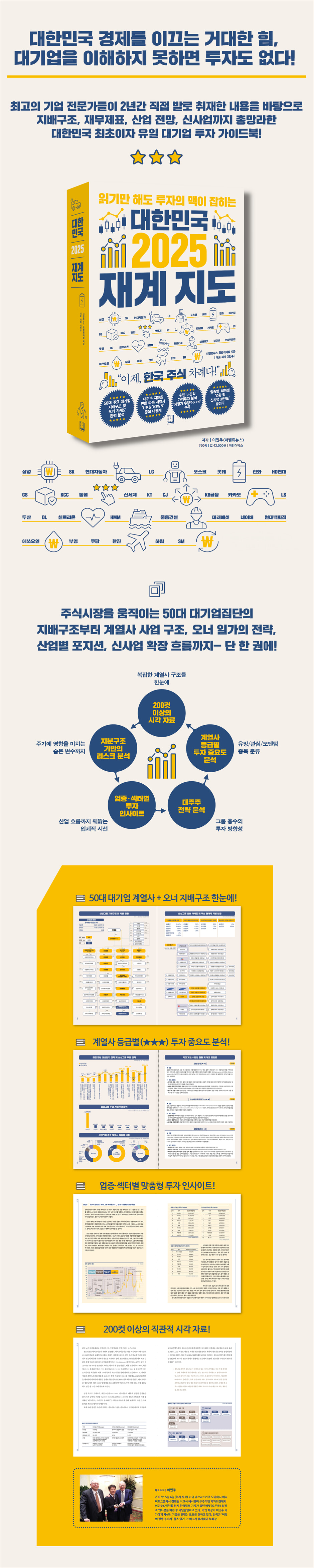
This investment reference book, compiled like a single, comprehensive map, is based on two years of in-depth research and data analysis, covering the governance structures of Korea's top 50 conglomerates, their business structures by affiliate, their industry-specific positions, major shareholders' investment strategies, and even the flow of new business expansion.
Each group's major affiliates are categorized into three levels: Promising (★★★), Interest (★★), and Momentum (★) based on their business performance and strategy, allowing investors to select stocks based on their "strategic position within the group" rather than simply their stock price.
In particular, the biggest difference of this book is that it presents 'industry trends and investment points viewed from a group perspective' rather than a single company.
Additionally, through over 200 illustrations, it is designed to allow for a glance at the complex governance structure, affiliate family tree, industry flow chart, new business expansion direction, equity connection relationship, and vertical and horizontal integration flow between major companies.
This provides a framework for intuitively interpreting complex corporate ecosystems, both for general investors with limited access to information and for practitioners who need to quickly understand the structure.
Rereading Korea's Large Corporations Through Warren Buffett's Eyes
The book's main author, Lee Min-joo, CEO of The Value News, is a former journalist who was the first Korean media outlet to conduct an exclusive interview with Chairman Warren Buffett in 2007. He is a leading long-term investment expert who has introduced and practiced the value investment philosophy in Korea through the Buffett Institute for a long time.
Beyond articles, he is recognized as a figure who has established Buffett-style analytical methodology in the Korean market through his writings, interviews, and data analysis.
In this book, he also directly applied Warren Buffett's investment principles to large Korean companies.
Rather than simply searching for undervalued stocks, we focused on companies with ROEs of 15% or higher, PBRs of 1x or lower, and stable cash flows, and among them, we selected stocks with sustainable profit structures and competitive advantages within the industry.
In particular, we are wary of market trends focused on short-term themes, and focus on the actual cash flow of major shareholders, their willingness to invest in new businesses, and the volatility of corporate value brought about by changes in the governance structure, rather than on the company's stock price.
CEO Lee Min-joo emphasizes that true investment begins with "understanding which affiliates will lead the group's future and where the major shareholders' intentions lie," going beyond simple numerical analysis.
This philosophy is fully reflected throughout “Korea 2025 Business Map.”
Structure, not intuition. Now is the time to have a framework for reading the market. 《Korea 2025 Business Map》 is not a book that simply lists information.
This analytical investment book is designed to help you evaluate stocks within the context of numbers, structure, governance, and industry context, without being swayed by emerging themes or market sentiment.
For working professionals and novice investors, this book serves as an introductory and insightful guide that unravels the complex industrial structure and interconnectedness of the corporate ecosystem. For financial professionals, journalists, and researchers, this book provides concise corporate information and a map of affiliates that can be immediately applied in practice.
It can also serve as a roadmap for long-term investors to specifically implement a value-oriented, selective investment strategy.
Starting with the question, "Why are large corporations important?" and reaching a practical answer to the question, "Within that structure, which stocks should we look at now?", this book provides a framework for interpreting the market across three layers: data, structure, and strategy.
This book goes beyond a simple reference book and provides a three-dimensional perspective on the Korean economy and stock market.
The most important keyword that permeates the Korean stock market is undoubtedly ‘large corporations.’
Large corporate groups, which account for more than half of total exports and 70% of the stock market capitalization, are key variables that determine the direction of the Korean economy and the investment landscape.
However, most individual investors are only familiar with "representative stocks" like Samsung Electronics, and they invest without a thorough understanding of the holding company structure, the sales structure of key affiliates, and the strategic decision-making of the owner's family.
Herein lies the problem.
Large corporations are not single companies, but rather 'complex economic ecosystems.'
Numerous factors, including holding companies and investment firms, listed and unlisted affiliates, new business ventures, and restructuring, are intricately intertwined. Without understanding these trends, neither performance nor stock prices can be understood.
A true investment decision can only be made by comprehensively understanding the industry's position, business structure, vertical integration between affiliates, and risk transfer structure.
Driven by this critical awareness, "Korea 2025 Business Map" is Korea's first large-scale investment analysis book designed to provide a comprehensive overview of Korea's conglomerates and identify undervalued growth affiliates within them.
For investors struggling with complex corporate structures, we provide an 'investment guide' rather than simple information.
2024 is the 'Korea Discount', 2025 is the opportunity!
Stock market experts say that the Korean stock market has now reached a turning point for a structural rebound.
The average PER of KOSPI in 2024 was approximately 9 times.
Compared to the US S&P 500, which is around 20 times, it was less than half.
The term "Korea discount" was once again being circulated, and the domestic stock market showed a trend that lagged far behind that of major emerging countries.
The deepening undervaluation was driven by a complex mix of factors, including an economic slowdown, oversupply from China, weakening global industrial competitiveness, political uncertainty, institutional distrust, low confidence in the governance structure of domestic companies, and a long-term outflow of foreign capital.
But 2025 is likely to be a turning point in that trend.
Experts believe that once the domestic political upheaval is over and a clear direction for policy direction emerges, the market may pass the "peak" of uncertainty.
On a global scale, former President Trump's tariff offensive continues, but some analysts say it will be difficult for the situation to spread into a one-sided trade shock like the one in the early 2020s, as countries work together to contain and stabilize supply chains.
With the stabilization of the exchange rate, improvement in domestic liquidity flow, and expectations of a recovery in the semiconductor industry, the market is gradually entering a period of recovery in the sense that the worst is over.
At this juncture, large-cap-focused analysis and investment strategies are needed that enable conservative risk management while also targeting the points most likely to rebound first in a recovery phase.
Rather than following the entire market, it is more important than ever to select "real companies" that are structurally strong and have a solid performance foundation.
The first "business map" to structure the complex corporate ecosystem.
《Korea 2025 Business Map》 goes beyond a simple corporate report.
This investment reference book, compiled like a single, comprehensive map, is based on two years of in-depth research and data analysis, covering the governance structures of Korea's top 50 conglomerates, their business structures by affiliate, their industry-specific positions, major shareholders' investment strategies, and even the flow of new business expansion.
Each group's major affiliates are categorized into three levels: Promising (★★★), Interest (★★), and Momentum (★) based on their business performance and strategy, allowing investors to select stocks based on their "strategic position within the group" rather than simply their stock price.
In particular, the biggest difference of this book is that it presents 'industry trends and investment points viewed from a group perspective' rather than a single company.
Additionally, through over 200 illustrations, it is designed to allow for a glance at the complex governance structure, affiliate family tree, industry flow chart, new business expansion direction, equity connection relationship, and vertical and horizontal integration flow between major companies.
This provides a framework for intuitively interpreting complex corporate ecosystems, both for general investors with limited access to information and for practitioners who need to quickly understand the structure.
Rereading Korea's Large Corporations Through Warren Buffett's Eyes
The book's main author, Lee Min-joo, CEO of The Value News, is a former journalist who was the first Korean media outlet to conduct an exclusive interview with Chairman Warren Buffett in 2007. He is a leading long-term investment expert who has introduced and practiced the value investment philosophy in Korea through the Buffett Institute for a long time.
Beyond articles, he is recognized as a figure who has established Buffett-style analytical methodology in the Korean market through his writings, interviews, and data analysis.
In this book, he also directly applied Warren Buffett's investment principles to large Korean companies.
Rather than simply searching for undervalued stocks, we focused on companies with ROEs of 15% or higher, PBRs of 1x or lower, and stable cash flows, and among them, we selected stocks with sustainable profit structures and competitive advantages within the industry.
In particular, we are wary of market trends focused on short-term themes, and focus on the actual cash flow of major shareholders, their willingness to invest in new businesses, and the volatility of corporate value brought about by changes in the governance structure, rather than on the company's stock price.
CEO Lee Min-joo emphasizes that true investment begins with "understanding which affiliates will lead the group's future and where the major shareholders' intentions lie," going beyond simple numerical analysis.
This philosophy is fully reflected throughout “Korea 2025 Business Map.”
Structure, not intuition. Now is the time to have a framework for reading the market. 《Korea 2025 Business Map》 is not a book that simply lists information.
This analytical investment book is designed to help you evaluate stocks within the context of numbers, structure, governance, and industry context, without being swayed by emerging themes or market sentiment.
For working professionals and novice investors, this book serves as an introductory and insightful guide that unravels the complex industrial structure and interconnectedness of the corporate ecosystem. For financial professionals, journalists, and researchers, this book provides concise corporate information and a map of affiliates that can be immediately applied in practice.
It can also serve as a roadmap for long-term investors to specifically implement a value-oriented, selective investment strategy.
Starting with the question, "Why are large corporations important?" and reaching a practical answer to the question, "Within that structure, which stocks should we look at now?", this book provides a framework for interpreting the market across three layers: data, structure, and strategy.
This book goes beyond a simple reference book and provides a three-dimensional perspective on the Korean economy and stock market.
GOODS SPECIFICS
- Date of issue: April 11, 2025
- Page count, weight, size: 760 pages | 173*246*40mm
- ISBN13: 9791198563262
- ISBN10: 1198563265
You may also like
카테고리
korean


korean

![GQ KOREA Mark (Monthly): December [2025]](http://librairie.coreenne.fr/cdn/shop/files/8ef265dbbfbf186523ed75ba7319009d.jpg?v=1765340328&width=3840)


