

monetary economics
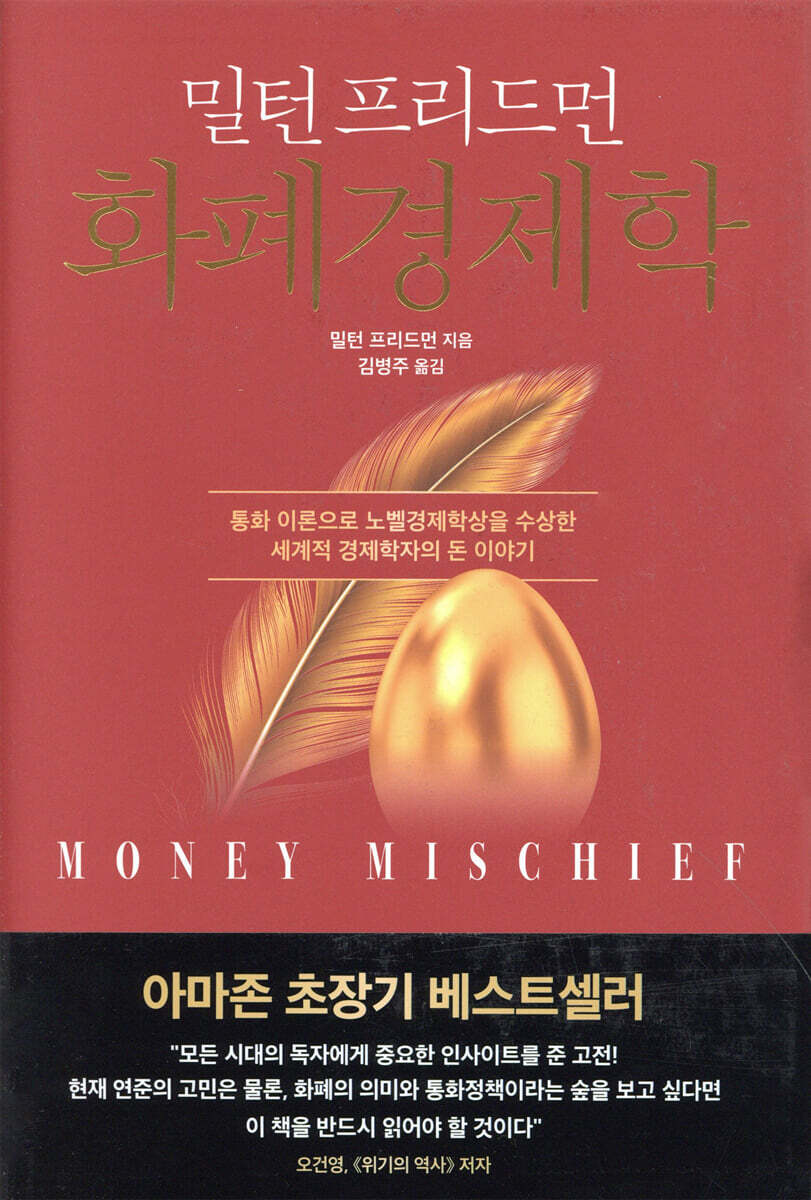 |
Description
Book Introduction
Predictions from inflation to the rise of Bitcoin!
The scholar who had the greatest influence on mainstream economics in the 20th century
Milton Friedman's masterpiece
A message from a timeless giant
This is a representative book by Milton Friedman, winner of the Nobel Prize in Economics.
Milton Friedman is also considered an economist who laid the foundation for modern mainstream economics.
This book, "Monetary Economics," covers the meaning and role of money and the core of the monetary system. It is a long-term Amazon bestseller and has been loved by many readers for a long time.
Through a variety of historical examples, it details how money affects the economy, the economic disasters caused by inflation, and solutions.
In this book, he left the famous statement, “Inflation is a monetary phenomenon always and everywhere.”
He then emphasized that inflation is ultimately related to an increase in the money supply and that it is a phenomenon that occurs when the money supply increases, not in a specific country or at a specific time.
Therefore, if the government increases the amount of money issued without control to easily cover the fiscal deficit, inflation can occur anytime, anywhere.
Milton Friedman once said, “I fear that in the coming decades the world will experience more instances of high inflation and even full-blown hyperinflation.”
As he feared, we are now living in an age of inflation.
So, we need to listen carefully to the solution he is talking about.
He was also credited with predicting Bitcoin by saying, "A trust-based electronic currency will emerge over the Internet, and the government will not be able to intervene."
By following his keen insight and visionary message on money through this book, you will gain a broader understanding of today's economic situation.
The scholar who had the greatest influence on mainstream economics in the 20th century
Milton Friedman's masterpiece
A message from a timeless giant
This is a representative book by Milton Friedman, winner of the Nobel Prize in Economics.
Milton Friedman is also considered an economist who laid the foundation for modern mainstream economics.
This book, "Monetary Economics," covers the meaning and role of money and the core of the monetary system. It is a long-term Amazon bestseller and has been loved by many readers for a long time.
Through a variety of historical examples, it details how money affects the economy, the economic disasters caused by inflation, and solutions.
In this book, he left the famous statement, “Inflation is a monetary phenomenon always and everywhere.”
He then emphasized that inflation is ultimately related to an increase in the money supply and that it is a phenomenon that occurs when the money supply increases, not in a specific country or at a specific time.
Therefore, if the government increases the amount of money issued without control to easily cover the fiscal deficit, inflation can occur anytime, anywhere.
Milton Friedman once said, “I fear that in the coming decades the world will experience more instances of high inflation and even full-blown hyperinflation.”
As he feared, we are now living in an age of inflation.
So, we need to listen carefully to the solution he is talking about.
He was also credited with predicting Bitcoin by saying, "A trust-based electronic currency will emerge over the Internet, and the government will not be able to intervene."
By following his keen insight and visionary message on money through this book, you will gain a broader understanding of today's economic situation.
- You can preview some of the book's contents.
Preview
index
At the beginning of the book, “How has money affected us?”
While translating this book, "Why Does the Disaster of Inflation Come?"
Chapter 1: The Island of Stone Currency
Chapter 2 The Mystery of Money
Chapter 3: The Crimes of 1873
Chapter 4 Counterfactual Experiments
Chapter 5 William Jennings Bryan and the Qinghua Method
Chapter 6 Rethinking the Biographical System
Chapter 7: Roosevelt's Silver Purchase and China
Appendix: Alternative Interpretations of China's Departure from the Silver Standard
Chapter 8: Causes and Prescriptions for Inflation
Chapter 9 Chile and Israel: Same Policies, Opposite Results
Chapter 10: Monetary Policy in a Fiat World
Epilogue: "Money: A Thing with Widespread and Unexpected Effects"
References
main
While translating this book, "Why Does the Disaster of Inflation Come?"
Chapter 1: The Island of Stone Currency
Chapter 2 The Mystery of Money
Chapter 3: The Crimes of 1873
Chapter 4 Counterfactual Experiments
Chapter 5 William Jennings Bryan and the Qinghua Method
Chapter 6 Rethinking the Biographical System
Chapter 7: Roosevelt's Silver Purchase and China
Appendix: Alternative Interpretations of China's Departure from the Silver Standard
Chapter 8: Causes and Prescriptions for Inflation
Chapter 9 Chile and Israel: Same Policies, Opposite Results
Chapter 10: Monetary Policy in a Fiat World
Epilogue: "Money: A Thing with Widespread and Unexpected Effects"
References
main
Into the book
Is there really a difference between the Federal Reserve's belief that a mark on a drawer in a vault weakened the value of the U.S. currency and the people of Yap who believe a mark on a stone made them poor? Or is there a difference between the Bank of France's belief that a mark on a vault drawer 3,000 miles away strengthened the currency and the family on Epsom who believe a stone submerged hundreds of miles offshore made them rich? Speaking of which, how many of us have actually personally experienced the existence of the very things we consider to be the building blocks of wealth?
---From "Chapter 1: The Island of Stone Currency"
Another source of discontent is that, like inflation, the effects of deflation vary from person to person.
What is particularly relevant to the Greenback, Populism, and silver liberation movements in the United States is that the effects of deflation on creditors and debtors are very different.
At that time, most farmers were debtors, as were most small businessmen, and their debts were mostly fixed in dollars, calculated at a fixed nominal interest rate.
A fall in prices increases the quantity of goods equivalent to the same amount of dollars.
Therefore, debtors lose from deflation, while creditors gain.
---From "Chapter 5 William Jennings Bryan and the Qinghua Method"
The temporary advantage China had in international trade thanks to the silver standard was not gradually eroded, but rather completely disappeared in an instant and turned into a disadvantage when even the United States left the gold standard in 1933.
The Chinese dollar appreciated further against the pound, the yen, and the rupee, and for the first time, it appreciated against the US dollar from 19 cents at the end of 1932 to 33 cents by the end of 1933, almost returning to its 1929 level.
Prices in dollars and other currencies rose, partially offsetting the effects of the Chinese dollar's appreciation.
However, the price of silver in the United States rose sharply above the general price level, so the effect of the appreciation was minimal.
---From "Chapter 7 Roosevelt's Silver Purchase Project and China"
A more effective analogy is to compare inflation to alcoholism.
When an alcoholic starts drinking, he or she feels good at first.
But the bad effects only become apparent when you wake up the next morning with a hangover.
So sometimes he can't resist the temptation of 'hangover cure'.
This analogy is perfectly applicable to inflation.
When a country enters an inflationary process, the initial effects appear to be positive.
An increase in money allows whoever has the power to dispose of it (today, usually the government) to increase spending without forcing anyone else to reduce spending.
As a result, jobs are created, businesses are booming, and almost everyone is happy.
At first, yes.
This is a good effect.
But then, as spending increases, prices begin to rise.
Workers see their purchasing power decline even though their nominal wages have risen.
Businesses also find that while sales have increased due to increased production costs, they are not making as much profit as expected without raising the price of their products.
---From "Chapter 8: Causes and Prescriptions for Inflation"
Even if two countries decide on the same monetary policy, the six-year time difference can lead to conflicting results: failure in one country and success in the other.
A single change in the monetary system can leave us adrift after a decade of sailing on a sea of uncertainty and turmoil.
There are many more such sad stories, far beyond the cases covered in this book.
Perhaps the most important and thoroughly documented, yet stubbornly resisted, proposition is that “inflation is always and everywhere a monetary phenomenon.”
(…) And I fear that in the coming decades the world will experience more instances of high inflation and full-blown hyperinflation.
A rapid increase in the money supply causes inflation, and a rapid decrease causes a recession.
This is also a well-proven proposition.
---From "Chapter 1: The Island of Stone Currency"
Another source of discontent is that, like inflation, the effects of deflation vary from person to person.
What is particularly relevant to the Greenback, Populism, and silver liberation movements in the United States is that the effects of deflation on creditors and debtors are very different.
At that time, most farmers were debtors, as were most small businessmen, and their debts were mostly fixed in dollars, calculated at a fixed nominal interest rate.
A fall in prices increases the quantity of goods equivalent to the same amount of dollars.
Therefore, debtors lose from deflation, while creditors gain.
---From "Chapter 5 William Jennings Bryan and the Qinghua Method"
The temporary advantage China had in international trade thanks to the silver standard was not gradually eroded, but rather completely disappeared in an instant and turned into a disadvantage when even the United States left the gold standard in 1933.
The Chinese dollar appreciated further against the pound, the yen, and the rupee, and for the first time, it appreciated against the US dollar from 19 cents at the end of 1932 to 33 cents by the end of 1933, almost returning to its 1929 level.
Prices in dollars and other currencies rose, partially offsetting the effects of the Chinese dollar's appreciation.
However, the price of silver in the United States rose sharply above the general price level, so the effect of the appreciation was minimal.
---From "Chapter 7 Roosevelt's Silver Purchase Project and China"
A more effective analogy is to compare inflation to alcoholism.
When an alcoholic starts drinking, he or she feels good at first.
But the bad effects only become apparent when you wake up the next morning with a hangover.
So sometimes he can't resist the temptation of 'hangover cure'.
This analogy is perfectly applicable to inflation.
When a country enters an inflationary process, the initial effects appear to be positive.
An increase in money allows whoever has the power to dispose of it (today, usually the government) to increase spending without forcing anyone else to reduce spending.
As a result, jobs are created, businesses are booming, and almost everyone is happy.
At first, yes.
This is a good effect.
But then, as spending increases, prices begin to rise.
Workers see their purchasing power decline even though their nominal wages have risen.
Businesses also find that while sales have increased due to increased production costs, they are not making as much profit as expected without raising the price of their products.
---From "Chapter 8: Causes and Prescriptions for Inflation"
Even if two countries decide on the same monetary policy, the six-year time difference can lead to conflicting results: failure in one country and success in the other.
A single change in the monetary system can leave us adrift after a decade of sailing on a sea of uncertainty and turmoil.
There are many more such sad stories, far beyond the cases covered in this book.
Perhaps the most important and thoroughly documented, yet stubbornly resisted, proposition is that “inflation is always and everywhere a monetary phenomenon.”
(…) And I fear that in the coming decades the world will experience more instances of high inflation and full-blown hyperinflation.
A rapid increase in the money supply causes inflation, and a rapid decrease causes a recession.
This is also a well-proven proposition.
---From the "Epilogue"
Publisher's Review
A bible that comprehensively covers the properties and history of currency.
Amazon's record-breaking long-term bestseller in the US
The influence of money on the economy is absolute.
After the global financial crisis that began with the subprime mortgage crisis, the last resort for governments was to use money (currency), the most powerful and last resort, to stimulate the economy by increasing the money supply by lowering interest rates to near zero.
This is evidence that the influence of money on the economy is direct and powerful.
However, an increase in the money supply inevitably causes inflation.
The author of this book, Milton Friedman, is a scholar who famously said, “Inflation is always and everywhere a monetary phenomenon.” In this book, he argues for the truth that an increase in the money supply inevitably leads to inflation.
As fears of inflation grew following the subprime mortgage crisis, the book once again received explosive interest from Americans, entering the top 10 on Amazon.
This book contains everything about money written by Milton Friedman, who devoted his life to monetary research and ultimately won the Nobel Prize in Economics for his monetary theory.
In times of economic turmoil, including the financial crisis and the resulting inflationary fears, Friedman's advice is worth heeding.
His keen insight and foresight on currency remain relevant today.
How to deal with the financial disaster of inflation
Solutions from a Nobel Prize Winner in Economics
It is true that after the global financial crisis, the Keynesian school has gained relative recognition, while the Chicago school's theory, which advocates a free market system, is on the defensive.
Nevertheless, the reason why the monetary theory of Milton Friedman, who is called the leader of the Chicago School, must be reexamined in this era is because nothing explains today's crisis-ridden phenomenon more accurately than his theory.
It also has significant implications for us, who are suffering from inflation as liquidity is released.
Chapter 1 piques the reader's interest by illustrating how the appearance of money can be misleading in dealing with monetary phenomena.
Chapter 2 briefly explains the essence of monetary theory.
Chapters 3 through 5 cover real-life examples of seemingly trivial events that have had far-reaching and completely unexpected consequences.
These are very interesting and instructive contents.
Following this historical reflection, Chapter 6 addresses the central issue of debate: the bimetallic gold standard, arguing that the traditional view of the pros and cons of the bimetallic gold standard as a monetary system is largely mistaken.
Chapter 7 revisits the impact of the silver-buying business in the United States in the 1930s, a historical anecdote.
The final step in the causal chain contributed by America's silver-buying policy was hyperinflation, a disease that had similar effects to those that had struck countless nations over thousands of years.
Chapter 8 examines the causes and countermeasures for inflation, drawing on recent and historical data from many countries to illustrate the core proposition that “inflation is a monetary phenomenon, always and everywhere.”
Chapter 9 demonstrates the role that chance can play in influencing currency.
For example, events that occurred in the United States, and therefore were outside the sphere of influence of Chilean and Israeli policymakers, testify to the fact that Chilean policymakers were made villains while Israeli policymakers were made heroes.
Chapter 10 explores the potential future consequences of today's globally accepted, yet historically unprecedented, monetary system.
Amazon's record-breaking long-term bestseller in the US
The influence of money on the economy is absolute.
After the global financial crisis that began with the subprime mortgage crisis, the last resort for governments was to use money (currency), the most powerful and last resort, to stimulate the economy by increasing the money supply by lowering interest rates to near zero.
This is evidence that the influence of money on the economy is direct and powerful.
However, an increase in the money supply inevitably causes inflation.
The author of this book, Milton Friedman, is a scholar who famously said, “Inflation is always and everywhere a monetary phenomenon.” In this book, he argues for the truth that an increase in the money supply inevitably leads to inflation.
As fears of inflation grew following the subprime mortgage crisis, the book once again received explosive interest from Americans, entering the top 10 on Amazon.
This book contains everything about money written by Milton Friedman, who devoted his life to monetary research and ultimately won the Nobel Prize in Economics for his monetary theory.
In times of economic turmoil, including the financial crisis and the resulting inflationary fears, Friedman's advice is worth heeding.
His keen insight and foresight on currency remain relevant today.
How to deal with the financial disaster of inflation
Solutions from a Nobel Prize Winner in Economics
It is true that after the global financial crisis, the Keynesian school has gained relative recognition, while the Chicago school's theory, which advocates a free market system, is on the defensive.
Nevertheless, the reason why the monetary theory of Milton Friedman, who is called the leader of the Chicago School, must be reexamined in this era is because nothing explains today's crisis-ridden phenomenon more accurately than his theory.
It also has significant implications for us, who are suffering from inflation as liquidity is released.
Chapter 1 piques the reader's interest by illustrating how the appearance of money can be misleading in dealing with monetary phenomena.
Chapter 2 briefly explains the essence of monetary theory.
Chapters 3 through 5 cover real-life examples of seemingly trivial events that have had far-reaching and completely unexpected consequences.
These are very interesting and instructive contents.
Following this historical reflection, Chapter 6 addresses the central issue of debate: the bimetallic gold standard, arguing that the traditional view of the pros and cons of the bimetallic gold standard as a monetary system is largely mistaken.
Chapter 7 revisits the impact of the silver-buying business in the United States in the 1930s, a historical anecdote.
The final step in the causal chain contributed by America's silver-buying policy was hyperinflation, a disease that had similar effects to those that had struck countless nations over thousands of years.
Chapter 8 examines the causes and countermeasures for inflation, drawing on recent and historical data from many countries to illustrate the core proposition that “inflation is a monetary phenomenon, always and everywhere.”
Chapter 9 demonstrates the role that chance can play in influencing currency.
For example, events that occurred in the United States, and therefore were outside the sphere of influence of Chilean and Israeli policymakers, testify to the fact that Chilean policymakers were made villains while Israeli policymakers were made heroes.
Chapter 10 explores the potential future consequences of today's globally accepted, yet historically unprecedented, monetary system.
GOODS SPECIFICS
- Date of issue: April 4, 2024
- Format: Hardcover book binding method guide
- Page count, weight, size: 340 pages | 734g | 153*224*25mm
- ISBN13: 9788947549486
- ISBN10: 8947549487
You may also like
카테고리
korean


korean

![GQ KOREA Mark (Monthly): December [2025]](http://librairie.coreenne.fr/cdn/shop/files/8ef265dbbfbf186523ed75ba7319009d.jpg?v=1765340328&width=3840)


