

Idea barrage
 |
Description
Book Introduction
- Stanford University's d.school's top lecture on creativity
- Amazon Bestseller in the Economics and Management category
- The first collaborative work by authors selected for the 2023 Thinkers50, the Oscars of the business world.
“Your organization needs a burst of creativity!”
Google, Microsoft, Apple, Nike, Disney…
From giant global corporations to agile startups
The most creative problem-solving method proven in business settings over the past decade.
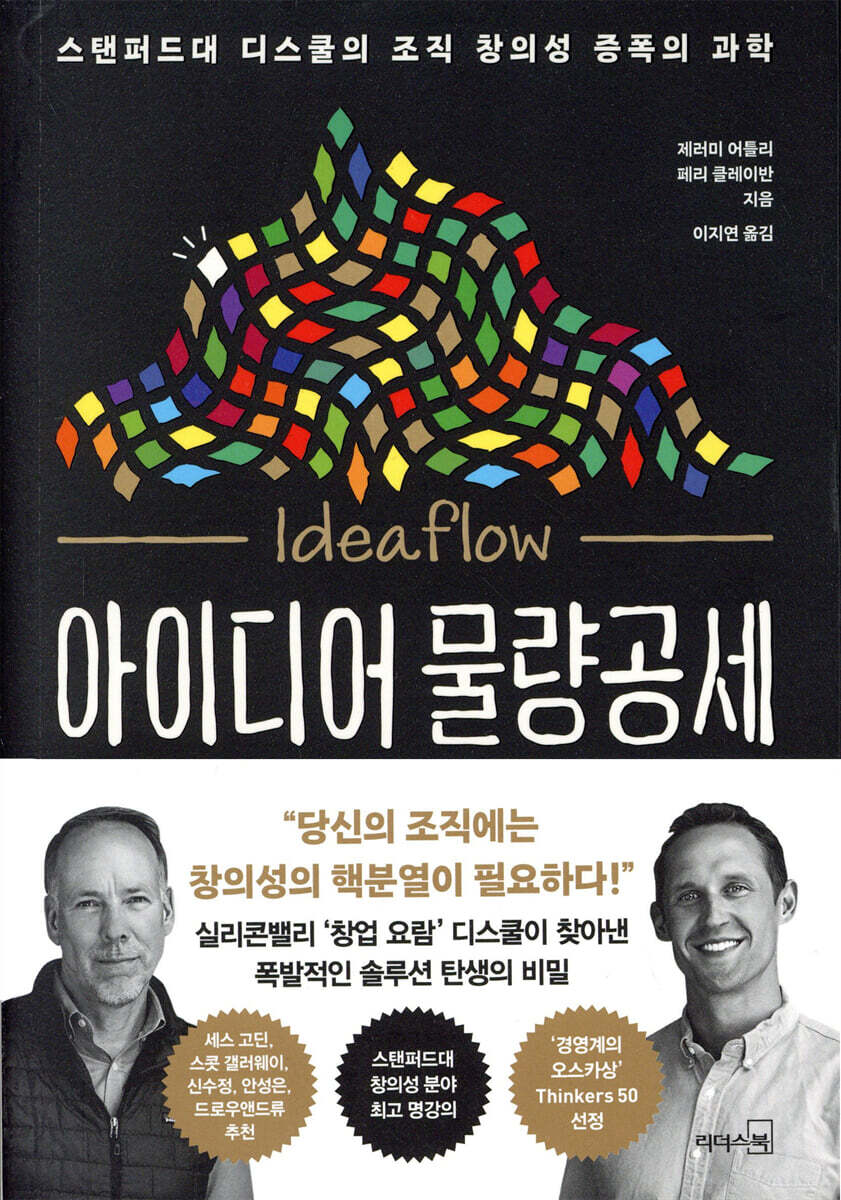
In the dog-eat-dog world of business, where today's success doesn't guarantee tomorrow's survival and maintaining the status quo often means extinction, how can we emerge victorious in this cutthroat competition? Jeremy Utley, an innovation mentor to giant global corporations and a master of organizational creativity, and Perry Clayban, founding professor at Stanford University's d.school, known as the cradle of entrepreneurial innovation and creativity, offer their answers in their new book, "The Idea Barrage."
They explain the innovation methodology that increases the production of ideas within an organization, overcomes crises, and creates an overwhelming gap with competitors in the market through an indicator called "ideaflow."
Filled with case studies from a diverse spectrum of organizations, from a startup that created customized nail stickers to the semiconductor giant Fairchild Semiconductor, "Idea Blitz" is a panacea for business problems.
It covers virtually every business challenge you'll face in real life, from launching new businesses, measuring customer preferences, improving your supply chain, and acquiring new customers, to scientific methods for boosting creativity across teams and entire organizations that would otherwise shut down simply by brainstorming.
This book, packed with creative and practical problem-solving techniques that have captivated leaders and middle managers around the world, will serve as a valuable guide to the unpredictable world of business.
- Amazon Bestseller in the Economics and Management category
- The first collaborative work by authors selected for the 2023 Thinkers50, the Oscars of the business world.
“Your organization needs a burst of creativity!”
Google, Microsoft, Apple, Nike, Disney…
From giant global corporations to agile startups
The most creative problem-solving method proven in business settings over the past decade.
In the dog-eat-dog world of business, where today's success doesn't guarantee tomorrow's survival and maintaining the status quo often means extinction, how can we emerge victorious in this cutthroat competition? Jeremy Utley, an innovation mentor to giant global corporations and a master of organizational creativity, and Perry Clayban, founding professor at Stanford University's d.school, known as the cradle of entrepreneurial innovation and creativity, offer their answers in their new book, "The Idea Barrage."
They explain the innovation methodology that increases the production of ideas within an organization, overcomes crises, and creates an overwhelming gap with competitors in the market through an indicator called "ideaflow."
Filled with case studies from a diverse spectrum of organizations, from a startup that created customized nail stickers to the semiconductor giant Fairchild Semiconductor, "Idea Blitz" is a panacea for business problems.
It covers virtually every business challenge you'll face in real life, from launching new businesses, measuring customer preferences, improving your supply chain, and acquiring new customers, to scientific methods for boosting creativity across teams and entire organizations that would otherwise shut down simply by brainstorming.
This book, packed with creative and practical problem-solving techniques that have captivated leaders and middle managers around the world, will serve as a valuable guide to the unpredictable world of business.
- You can preview some of the book's contents.
Preview
index
Recommendation
introduction.
Who needs ideas?
Intro.
If your organization desperately needs a burst of creativity right now,
Part 1.
Running over the cliff of creativity
Chapter 1.
All the world's problems are problems of ideas.
If only I hadn't stifled my creativity so much back then
The problem only responds to one thing
The misconception of 'innate talent'
Ideaflow, the lifeblood of business
Why You Should Leave Your Desk Right Now
Chapter 2.
The first step to increasing Ideaflow
A Tale of Two Leaders
Daily Morning Quota Filling Project
Escape the 'temptation of censorship'
The two recording principles of the Dischool
How to Use Your 'Previous Me'
Save Friday
Ultimately, creativity is also a habit.
Chapter 3.
The Secret of a Team That Overflows with Ideas
The 2,000 to 1 rule applies everywhere.
Why Typical Brainstorming Fails
Six Keys to Spark-Evoking Brainstorming
Chapter 4.
A validation process to identify the best ideas
We are made to avoid tigers.
Don't pedal with your eyes closed.
Divide your bets into smaller pieces and place multiple bets.
One question to weed out the chaff
A quick and dirty test will suffice.
Using Signal Mining
Chapter 5.
Designing Tests That Drive Market Voices
Fast-forward strategy to overcome resistance
Smaller, faster, cheaper
Nike's Founder's Testing Secrets
The test that gave birth to Netflix
5 Principles for Effective and Useful Test Design
Chapter 6.
Make the whole world your laboratory
Sell Before You Build: Man Crate
Observe and Observe Again: Cybex
When in doubt, go outside: Westpac Bank New Zealand
Pretend It's Already Made: Bridgestone
Big Ideas, Small Tests: Lendlease
Put Perfectionism on Hold: Manimie Label
Find a way to see the results: BJ's Restaurant
Part 2.
Idea circuits that solve real-world problems
Chapter 7.
Eight Tools to Uncover Fresh Perspectives
Why Patagonia Entrusted Surfwear Development to a Surfing Novice
Something that no great person could ever do
The Franklin Society, which lasted for 40 years
The most revolutionary intellectual leap in history, born of 'sharing'
Entrepreneur consulted by 100 children
'Weak Ties' Lead to Exciting Discoveries
A thriller director who oversaw action films
Attention newcomers
Two very different people change history.
A space to be honest
Chapter 8.
Spotting the extraordinary ideas hiding right in front of you
Find a 'better problem'
Turning the blind eye to the assumptions
One 'why' is not enough
A wonder discovered in one square meter of land
Chapter 9.
Managing curiosity intentionally and strategically
How to ask questions that utilize 100% of your brain
Don't go looking for the perfect question.
Decompression keywords
Chapter 10.
Incite a clash of creativity
Why People Who Only Eat Cucumbers Don't Succeed in the Pickle Business
The walk that gave birth to the Macintosh
Find someone who has the same concerns
Chapter 11.
How to untangle your clutter
The Virtue of Procrastination 424
Even the other side should be 'smart'
conclusion.
Let your ideas flow like a flood
References
introduction.
Who needs ideas?
Intro.
If your organization desperately needs a burst of creativity right now,
Part 1.
Running over the cliff of creativity
Chapter 1.
All the world's problems are problems of ideas.
If only I hadn't stifled my creativity so much back then
The problem only responds to one thing
The misconception of 'innate talent'
Ideaflow, the lifeblood of business
Why You Should Leave Your Desk Right Now
Chapter 2.
The first step to increasing Ideaflow
A Tale of Two Leaders
Daily Morning Quota Filling Project
Escape the 'temptation of censorship'
The two recording principles of the Dischool
How to Use Your 'Previous Me'
Save Friday
Ultimately, creativity is also a habit.
Chapter 3.
The Secret of a Team That Overflows with Ideas
The 2,000 to 1 rule applies everywhere.
Why Typical Brainstorming Fails
Six Keys to Spark-Evoking Brainstorming
Chapter 4.
A validation process to identify the best ideas
We are made to avoid tigers.
Don't pedal with your eyes closed.
Divide your bets into smaller pieces and place multiple bets.
One question to weed out the chaff
A quick and dirty test will suffice.
Using Signal Mining
Chapter 5.
Designing Tests That Drive Market Voices
Fast-forward strategy to overcome resistance
Smaller, faster, cheaper
Nike's Founder's Testing Secrets
The test that gave birth to Netflix
5 Principles for Effective and Useful Test Design
Chapter 6.
Make the whole world your laboratory
Sell Before You Build: Man Crate
Observe and Observe Again: Cybex
When in doubt, go outside: Westpac Bank New Zealand
Pretend It's Already Made: Bridgestone
Big Ideas, Small Tests: Lendlease
Put Perfectionism on Hold: Manimie Label
Find a way to see the results: BJ's Restaurant
Part 2.
Idea circuits that solve real-world problems
Chapter 7.
Eight Tools to Uncover Fresh Perspectives
Why Patagonia Entrusted Surfwear Development to a Surfing Novice
Something that no great person could ever do
The Franklin Society, which lasted for 40 years
The most revolutionary intellectual leap in history, born of 'sharing'
Entrepreneur consulted by 100 children
'Weak Ties' Lead to Exciting Discoveries
A thriller director who oversaw action films
Attention newcomers
Two very different people change history.
A space to be honest
Chapter 8.
Spotting the extraordinary ideas hiding right in front of you
Find a 'better problem'
Turning the blind eye to the assumptions
One 'why' is not enough
A wonder discovered in one square meter of land
Chapter 9.
Managing curiosity intentionally and strategically
How to ask questions that utilize 100% of your brain
Don't go looking for the perfect question.
Decompression keywords
Chapter 10.
Incite a clash of creativity
Why People Who Only Eat Cucumbers Don't Succeed in the Pickle Business
The walk that gave birth to the Macintosh
Find someone who has the same concerns
Chapter 11.
How to untangle your clutter
The Virtue of Procrastination 424
Even the other side should be 'smart'
conclusion.
Let your ideas flow like a flood
References
Detailed image

Into the book
Creativity can be learned.
In the process, you will also learn how to properly support the creativity of others.
This means that you too can build or manage a world-class company with creativity and innovation capabilities.
To do this, we need to throw away all the old myths about creativity.
Creativity is the art of problem solving.
Just as creativity is needed to paint or write poetry, it is also needed to conduct mergers and acquisitions.
In business, creativity is as basic and practical as double-entry bookkeeping.
Creativity fosters and accelerates what we want to achieve.
---「Intro.
If your organization desperately needs a burst of creativity right now,
Ideaflow is a concept and approach to creativity.
The great thing about Ideaflow is that it dramatically reduces the pressure and stress of the entire idea generation process by increasing the number of ideas generated.
While increasing the probability of success, it also minimizes costs and risks.
Whether you want to develop your creativity or launch a full-fledged innovation lab at a Fortune 500 company, this book will help you solve the "problem of problem solving" once and for all.
---「Intro.
If your organization desperately needs a burst of creativity right now,
Ideaflow is a useful proxy for measuring overall innovation capacity.
Because whether you can pour out ideas like a flood when needed has a lot to do with whether you maintain healthy creativity overall.
It's a kind of barometer, so to speak.
A barometer can't tell you where each cloud is, but it can tell you when a storm is coming.
Just as Perry's focus on "selling products" led to a halt in employee input, a decline in idea flow suggests a larger problem with the organizational culture surrounding creativity.
---「Chapter 1.
From “All the world’s problems are problems of ideas”
It's brainstorming time.
As expected, such a large meeting is sandwiched in the middle of an awkward afternoon.
It's a time when everyone's energy is likely depleted.
The worst thing is scheduling a meeting right before work hours when everyone is just thinking about going home.
As everyone glances down at their phones, wondering, "Why am I here?", the worsening traffic congestion on the way home from work inevitably causes a grimace.
(Omitted) Considering the possibility of appearing foolish or ignorant if you interject a word in an unfamiliar matter, it seems risky to make even the slightest unusual or ambitious statement.
It seems safer to just keep quiet and go along with other people's opinions.
---「Chapter 3.
From "The Secret of a Team That Overflows with Ideas"
If we look at successful innovation cases, this idea ratio appears repeatedly.
The same goes for how Taco Bell's Insights Labs developed the mega-hit Doritos Locos Taco.
Initially, Taco Bell started with about 30 core recipes and created a "huge number of variations."
Each and every one of them needed to be tasted.
How many variations did product development manager Steve Gomez try before perfecting this game-changing new product? Speaking to a journalist, Gomez said:
“If I said 2,000, you’d think I was exaggerating, right?” The reason Taco Bell is recognized as the embodiment of innovation in the fast-food industry is because of this ideaflow.
“I come up with 50 idea concepts a month,” senior marketing manager Cat Garcia told this journalist (who is also responsible for the beloved Double Decker Taco).
“We review between 300 and 500 ideas a year during the planning stage.
After selecting and selecting them, only about 20 to 30 are actually released.
“A lot of them get discarded in the middle.”
---「Chapter 3.
From "The Secret of a Team That Overflows with Ideas"
"The coach would always sneak into the locker room and steal our shoes," Phil Knight, then a track and field player, later wrote.
'The director took several days to take the shoes apart and sew them back together, returning them with slightly changed shapes.
Then we had to either run like deer or bleed.' Bowerman, the track team coach, had a laboratory and mice.
The ultimate goal of all these prototypes was 'lightness'.
'Shaving one ounce (28.3 grams) off a pair of shoes is equivalent to 55 pounds (24.9 kilograms) less per mile (1.6 kilometers),' the coach said. Cutting weight meant trying a huge variety of alternative materials.
Bowerman has used everything from kangaroo skin to cod skin to track the effects on athletes' running times.
---「Chapter 5.
From “Designing Tests That Elicit the Voice of the Market”
By hiring someone who is good at their job but has no experience with the industry in particular, you can leverage their beginner's experience.
When Marvel makes superhero movies, they often hire directors from other genres, like comedies (Taika Waititi for Thor: Ragnarok and Peyton Reed for Ant-Man) or thrillers (Jon Watts for Spider-Man: Homecoming).
Marvel has mastered the art of making special effects-driven action movies, so why would they need someone with the same expertise?
---「Chapter 7.
Among the eight tools that will help you discover fresh perspectives,
A good question is specific.
For example, think of a white object.
What came to mind? How quickly did it come to mind? Now, think of a white object commonly found in the refrigerator.
Do you notice the difference? The first question is a flurry of ideas that come to mind here and there.
eye.
hmm….
white bear.
Paper? The second question sparks a flurry of ideas.
Should milk, cheese, yogurt, cottage cheese, disposable containers, eggs, and white bread also be white?
The more specific the frame, the stronger the flow of ideas that emerge.
A good frame sparks curiosity.
Once interest arises, the brain works hard to solve the problem and the flow of ideas increases.
A compelling question can make it difficult to 'stop' new ideas from coming to you.
On the other hand, boring questions produce no results.
Curiosity cannot be faked.
Unless you're really interested in a problem, don't expect creative solutions.
---「Chapter 9.
From “Managing Curiosity Intentionally and Strategically”
There is a study that interviewed 40 scientists over 30 years.
Among the interviewees were four people who later won the Nobel Prize.
The researchers wanted to find out what factors, from personal habits to research techniques, contribute to problem solving and creativity over the long term.
Ultimately, the factor the researchers found to be strongly correlated with long-term success was how these scientists spent their time "outside" the lab.
Things like hobbies, travel, and artistic pursuits.
More input equals better output.
You can't revolutionize the pickle business by eating only cucumbers all day.
The more 'distant' the input sources, the more valuable and interesting the combinations become.
Don't try to find meaning (don't think 'I'll know it when I see it'), just think that everything has meaning.
Look at the world closely, without prejudice, and let your mind make connections.
---「Chapter 10.
From “Creating a Clash of Creativity”
Creativity is the art of possibility.
When faced with dilemmas and deadlines, who hasn't been tempted to just push through as usual? When we're under pressure, the last thing we want to do is consider more options.
But as the first-year middle school student said at the beginning of this book, creativity is 'having the first thing that comes to mind, but then trying more.'
If we want to achieve great things, whether in business or anything else, we have to do just that.
Creativity isn't just about solving problems; it's about coming up with the best ideas I can.
In the process, you will also learn how to properly support the creativity of others.
This means that you too can build or manage a world-class company with creativity and innovation capabilities.
To do this, we need to throw away all the old myths about creativity.
Creativity is the art of problem solving.
Just as creativity is needed to paint or write poetry, it is also needed to conduct mergers and acquisitions.
In business, creativity is as basic and practical as double-entry bookkeeping.
Creativity fosters and accelerates what we want to achieve.
---「Intro.
If your organization desperately needs a burst of creativity right now,
Ideaflow is a concept and approach to creativity.
The great thing about Ideaflow is that it dramatically reduces the pressure and stress of the entire idea generation process by increasing the number of ideas generated.
While increasing the probability of success, it also minimizes costs and risks.
Whether you want to develop your creativity or launch a full-fledged innovation lab at a Fortune 500 company, this book will help you solve the "problem of problem solving" once and for all.
---「Intro.
If your organization desperately needs a burst of creativity right now,
Ideaflow is a useful proxy for measuring overall innovation capacity.
Because whether you can pour out ideas like a flood when needed has a lot to do with whether you maintain healthy creativity overall.
It's a kind of barometer, so to speak.
A barometer can't tell you where each cloud is, but it can tell you when a storm is coming.
Just as Perry's focus on "selling products" led to a halt in employee input, a decline in idea flow suggests a larger problem with the organizational culture surrounding creativity.
---「Chapter 1.
From “All the world’s problems are problems of ideas”
It's brainstorming time.
As expected, such a large meeting is sandwiched in the middle of an awkward afternoon.
It's a time when everyone's energy is likely depleted.
The worst thing is scheduling a meeting right before work hours when everyone is just thinking about going home.
As everyone glances down at their phones, wondering, "Why am I here?", the worsening traffic congestion on the way home from work inevitably causes a grimace.
(Omitted) Considering the possibility of appearing foolish or ignorant if you interject a word in an unfamiliar matter, it seems risky to make even the slightest unusual or ambitious statement.
It seems safer to just keep quiet and go along with other people's opinions.
---「Chapter 3.
From "The Secret of a Team That Overflows with Ideas"
If we look at successful innovation cases, this idea ratio appears repeatedly.
The same goes for how Taco Bell's Insights Labs developed the mega-hit Doritos Locos Taco.
Initially, Taco Bell started with about 30 core recipes and created a "huge number of variations."
Each and every one of them needed to be tasted.
How many variations did product development manager Steve Gomez try before perfecting this game-changing new product? Speaking to a journalist, Gomez said:
“If I said 2,000, you’d think I was exaggerating, right?” The reason Taco Bell is recognized as the embodiment of innovation in the fast-food industry is because of this ideaflow.
“I come up with 50 idea concepts a month,” senior marketing manager Cat Garcia told this journalist (who is also responsible for the beloved Double Decker Taco).
“We review between 300 and 500 ideas a year during the planning stage.
After selecting and selecting them, only about 20 to 30 are actually released.
“A lot of them get discarded in the middle.”
---「Chapter 3.
From "The Secret of a Team That Overflows with Ideas"
"The coach would always sneak into the locker room and steal our shoes," Phil Knight, then a track and field player, later wrote.
'The director took several days to take the shoes apart and sew them back together, returning them with slightly changed shapes.
Then we had to either run like deer or bleed.' Bowerman, the track team coach, had a laboratory and mice.
The ultimate goal of all these prototypes was 'lightness'.
'Shaving one ounce (28.3 grams) off a pair of shoes is equivalent to 55 pounds (24.9 kilograms) less per mile (1.6 kilometers),' the coach said. Cutting weight meant trying a huge variety of alternative materials.
Bowerman has used everything from kangaroo skin to cod skin to track the effects on athletes' running times.
---「Chapter 5.
From “Designing Tests That Elicit the Voice of the Market”
By hiring someone who is good at their job but has no experience with the industry in particular, you can leverage their beginner's experience.
When Marvel makes superhero movies, they often hire directors from other genres, like comedies (Taika Waititi for Thor: Ragnarok and Peyton Reed for Ant-Man) or thrillers (Jon Watts for Spider-Man: Homecoming).
Marvel has mastered the art of making special effects-driven action movies, so why would they need someone with the same expertise?
---「Chapter 7.
Among the eight tools that will help you discover fresh perspectives,
A good question is specific.
For example, think of a white object.
What came to mind? How quickly did it come to mind? Now, think of a white object commonly found in the refrigerator.
Do you notice the difference? The first question is a flurry of ideas that come to mind here and there.
eye.
hmm….
white bear.
Paper? The second question sparks a flurry of ideas.
Should milk, cheese, yogurt, cottage cheese, disposable containers, eggs, and white bread also be white?
The more specific the frame, the stronger the flow of ideas that emerge.
A good frame sparks curiosity.
Once interest arises, the brain works hard to solve the problem and the flow of ideas increases.
A compelling question can make it difficult to 'stop' new ideas from coming to you.
On the other hand, boring questions produce no results.
Curiosity cannot be faked.
Unless you're really interested in a problem, don't expect creative solutions.
---「Chapter 9.
From “Managing Curiosity Intentionally and Strategically”
There is a study that interviewed 40 scientists over 30 years.
Among the interviewees were four people who later won the Nobel Prize.
The researchers wanted to find out what factors, from personal habits to research techniques, contribute to problem solving and creativity over the long term.
Ultimately, the factor the researchers found to be strongly correlated with long-term success was how these scientists spent their time "outside" the lab.
Things like hobbies, travel, and artistic pursuits.
More input equals better output.
You can't revolutionize the pickle business by eating only cucumbers all day.
The more 'distant' the input sources, the more valuable and interesting the combinations become.
Don't try to find meaning (don't think 'I'll know it when I see it'), just think that everything has meaning.
Look at the world closely, without prejudice, and let your mind make connections.
---「Chapter 10.
From “Creating a Clash of Creativity”
Creativity is the art of possibility.
When faced with dilemmas and deadlines, who hasn't been tempted to just push through as usual? When we're under pressure, the last thing we want to do is consider more options.
But as the first-year middle school student said at the beginning of this book, creativity is 'having the first thing that comes to mind, but then trying more.'
If we want to achieve great things, whether in business or anything else, we have to do just that.
Creativity isn't just about solving problems; it's about coming up with the best ideas I can.
---"conclusion.
From "Let the ideas flow like a flood"
From "Let the ideas flow like a flood"
Publisher's Review
■ “The principle of ‘quality over quantity’ is wrong! What matters is quantity, not quality.”
The Truth About Amplifying Organizational Creativity Discovered by Stanford University's d.school, the "Cradle of Innovation."
Apple, which has held the top spot in terms of market capitalization in the US for over a decade, is being closely pursued by Nvidia, and Samsung's semiconductor operating profit has already been surpassed by SK Hynix.
Even if a product you release today shakes up the market, it doesn't guarantee tomorrow's success, let alone survival.
Elimination and failure come equally, regardless of past glories.
That's why companies are always thirsty for creative ideas that will differentiate them from their competitors and expand their influence in the market.
So how can companies overcome this thirst? Should they carefully consider what constitutes the "right answer" to generate creative ideas?
Jeremy Utley and Perry Klayban, professors at Stanford University's d.school, known as the "innovation hotbed" of Silicon Valley, and innovation mentors for global giants such as Google, Apple, Amazon, and Microsoft, say that selecting and presenting ideas from a "small number of elite" individuals is the worst option that actually reduces the creativity of an organization.
According to the two professors, excellent solutions emerge not from carefully thrown ideas, but from an "absurd" number of ideas thrown around.
Why did General Motors' car-sharing service fail, while Netflix's DVD delivery service succeed? When you throw not just one or two sharp darts, but hundreds or even thousands of darts, even seemingly dull ones, the odds of hitting the bullseye increase dramatically.
The new book, "Idea Mass Offensive," presents compelling case studies demonstrating the correlation between an organization's idea productivity and performance, evidenced by the authors' observations of organizational success and decline over the past decade.
■ “Behind every great solution are 2,000 failed ideas.”
― The one indicator that will boost your organization's creativity: Ideaflow
The authors present a metric called "ideaflow" to explain why an organization's idea production is the lifeblood of business.
Idea flow refers to the number of new ideas that an individual or group can generate for a given problem in a given amount of time.
According to the author, organizations that dominate the market have always exhibited high idea flow.
The more ideas you have, the more creative the results.
(The Korean title uses the word 'water bombardment' to capture this feeling.) The act of pouring out ideas is a process of first pouring out useless ones to create a channel for great ideas to emerge, and it is a very effective way to prevent ideas that could be successful in the market from being swallowed in the mouth by internal censorship.
According to the authors' research on organizations in the business sector, there are roughly 2,000 ideas behind one great idea.
The numbers may vary slightly from field to field, but the one thing that remains constant is that a 'huge' amount of ideas is needed.
Dyson's 'bagless vacuum cleaner', which established it as a winner in the vacuum cleaner market, was born after making 5,127 prototypes (page 127), and Taco Bell, a famous taco franchise, experimented with over 2,000 recipes before launching its mega-hit Doritos Locos Taco (page 125).
Japanese pharmaceutical company Eisai tests approximately 20,000 candidate substances before launching a single drug (p. 127).
The wider you cast your net, the greater your chances of catching a big fish.
■ “If you have an idea, test it.
Likewise, very much”
― A test design strategy for discovering gems among poor ideas
It doesn't end with simply throwing out ideas.
Now that you've brainstormed your ideas, it's time to test them to see if they'll catch on in the marketplace.
The important thing here is ‘quantity’.
Testing, like coming up with ideas, requires a lot of experimentation.
Marvel Studios digitally animates entire scenes before filming.
We test every possible camera movement, stunt, and special effect to present the best scenes to the audience (page 206).
Testing can be sloppy and cheap.
Bill Bowerman, Nike's co-founder and track and field team coach, repeatedly repaired shoes himself and reflected feedback from athletes to develop record-breaking running shoes (p. 212).
While testing can quickly identify good ideas, testing numerous ideas can also lead to the collision and resonance of ideas, ultimately leading to the creation of even better ones.
Netflix's webpage was also perfected after Reed Hastings and Marc Randolph tested countless combinations of images, text, and interfaces that boosted DVD sales.
They didn't discard failed combinations, but combined them with new ideas, tweaked them, and found a webpage design that maximized sales (p. 215). "Idea Mass Attack" also presents inexpensive and effective testing methods that can be applied to any organization, such as the "fast-forward strategy" and "completing the testing loop."
■ “Creativity is not a talent, but a skill that can be honed.”
― A strategy to utilize 'Ideaplow' to encourage even ordinary businesspeople to generate creative ideas.
Ideaflow will certainly exist in a 'spectral form', but it may seem that some people 'have' ideaflow and others 'don't' have it.
When a problem is presented, one team member can voice his or her opinion while the rest of the team sits quietly.
In this regard, the authors warn against the misconception that creativity is an 'innate talent'.
The fact that creativity is the ability to generate a lot of ideas means that, like any other ability, it is a 'skill' that can be learned and trained.
So, your organization can elevate the creativity of all its members without having to rely on a single genius.
This book is filled with ways to generate quality ideas.
In addition to the '8 principles for providing fresh input (Chapter 7)' and the 'How to create 'what-to-do' questions that stimulate ideas (Chapter 9)', it also includes organizational-level creativity training methods that stimulate members' ideas, such as 'Collect initial opinions that are not contaminated by others' opinions', 'Conduct warm-up meetings with topics similar to the meeting topic but lighter', and 'Get answers quickly so that your own opinions cannot be censored (Chapter 3)'.
■ “Developing new products, securing new customers, improving the supply chain… Ultimately, it all comes down to a question of ‘ideas’!”
― Solutions to business challenges that have leaders around the world excited.
Another unique feature of this book is that it provides a wealth of examples of how the abstract concept of creativity has been used to solve specific business problems.
This book details problems faced at almost every stage of business, along with creative solutions that can be used immediately, such as Patagonia (page 286), which developed a body-maintaining swimsuit aimed at beginners by gathering the experiences of first-time surfers; TaylorMade Golf (page 346), which successfully attracted young golfers by positioning its products based on the concept of specific situations rather than functions; and Fairchild (page 412), which prevented customer churn despite a sharp decline in sales due to an unstable supply chain by referencing the operation method of a flower shop that shared reservation data with competitors.
This book, which compiles the methodology the authors have proven over the past decade through collaborations with diverse organizations around the world and resulting in remarkable results, became an Amazon bestseller in the economics and management category immediately after its publication.
In addition, it was selected as a recommended book in the field of economics and management by the book club [Next Big Idea] run by renowned gurus such as Malcolm Gladwell, Adam Grant, and Daniel Pink, and has garnered enthusiastic responses from leaders, managers, businesspeople, and aspiring entrepreneurs around the world.
I hope that every individual and organization in Korea, who lives fiercely to outperform competitors and achieve outstanding results, will be able to experience the amazing effects of this book by pouring out ideas like a flood.
The Truth About Amplifying Organizational Creativity Discovered by Stanford University's d.school, the "Cradle of Innovation."
Apple, which has held the top spot in terms of market capitalization in the US for over a decade, is being closely pursued by Nvidia, and Samsung's semiconductor operating profit has already been surpassed by SK Hynix.
Even if a product you release today shakes up the market, it doesn't guarantee tomorrow's success, let alone survival.
Elimination and failure come equally, regardless of past glories.
That's why companies are always thirsty for creative ideas that will differentiate them from their competitors and expand their influence in the market.
So how can companies overcome this thirst? Should they carefully consider what constitutes the "right answer" to generate creative ideas?
Jeremy Utley and Perry Klayban, professors at Stanford University's d.school, known as the "innovation hotbed" of Silicon Valley, and innovation mentors for global giants such as Google, Apple, Amazon, and Microsoft, say that selecting and presenting ideas from a "small number of elite" individuals is the worst option that actually reduces the creativity of an organization.
According to the two professors, excellent solutions emerge not from carefully thrown ideas, but from an "absurd" number of ideas thrown around.
Why did General Motors' car-sharing service fail, while Netflix's DVD delivery service succeed? When you throw not just one or two sharp darts, but hundreds or even thousands of darts, even seemingly dull ones, the odds of hitting the bullseye increase dramatically.
The new book, "Idea Mass Offensive," presents compelling case studies demonstrating the correlation between an organization's idea productivity and performance, evidenced by the authors' observations of organizational success and decline over the past decade.
■ “Behind every great solution are 2,000 failed ideas.”
― The one indicator that will boost your organization's creativity: Ideaflow
The authors present a metric called "ideaflow" to explain why an organization's idea production is the lifeblood of business.
Idea flow refers to the number of new ideas that an individual or group can generate for a given problem in a given amount of time.
According to the author, organizations that dominate the market have always exhibited high idea flow.
The more ideas you have, the more creative the results.
(The Korean title uses the word 'water bombardment' to capture this feeling.) The act of pouring out ideas is a process of first pouring out useless ones to create a channel for great ideas to emerge, and it is a very effective way to prevent ideas that could be successful in the market from being swallowed in the mouth by internal censorship.
According to the authors' research on organizations in the business sector, there are roughly 2,000 ideas behind one great idea.
The numbers may vary slightly from field to field, but the one thing that remains constant is that a 'huge' amount of ideas is needed.
Dyson's 'bagless vacuum cleaner', which established it as a winner in the vacuum cleaner market, was born after making 5,127 prototypes (page 127), and Taco Bell, a famous taco franchise, experimented with over 2,000 recipes before launching its mega-hit Doritos Locos Taco (page 125).
Japanese pharmaceutical company Eisai tests approximately 20,000 candidate substances before launching a single drug (p. 127).
The wider you cast your net, the greater your chances of catching a big fish.
■ “If you have an idea, test it.
Likewise, very much”
― A test design strategy for discovering gems among poor ideas
It doesn't end with simply throwing out ideas.
Now that you've brainstormed your ideas, it's time to test them to see if they'll catch on in the marketplace.
The important thing here is ‘quantity’.
Testing, like coming up with ideas, requires a lot of experimentation.
Marvel Studios digitally animates entire scenes before filming.
We test every possible camera movement, stunt, and special effect to present the best scenes to the audience (page 206).
Testing can be sloppy and cheap.
Bill Bowerman, Nike's co-founder and track and field team coach, repeatedly repaired shoes himself and reflected feedback from athletes to develop record-breaking running shoes (p. 212).
While testing can quickly identify good ideas, testing numerous ideas can also lead to the collision and resonance of ideas, ultimately leading to the creation of even better ones.
Netflix's webpage was also perfected after Reed Hastings and Marc Randolph tested countless combinations of images, text, and interfaces that boosted DVD sales.
They didn't discard failed combinations, but combined them with new ideas, tweaked them, and found a webpage design that maximized sales (p. 215). "Idea Mass Attack" also presents inexpensive and effective testing methods that can be applied to any organization, such as the "fast-forward strategy" and "completing the testing loop."
■ “Creativity is not a talent, but a skill that can be honed.”
― A strategy to utilize 'Ideaplow' to encourage even ordinary businesspeople to generate creative ideas.
Ideaflow will certainly exist in a 'spectral form', but it may seem that some people 'have' ideaflow and others 'don't' have it.
When a problem is presented, one team member can voice his or her opinion while the rest of the team sits quietly.
In this regard, the authors warn against the misconception that creativity is an 'innate talent'.
The fact that creativity is the ability to generate a lot of ideas means that, like any other ability, it is a 'skill' that can be learned and trained.
So, your organization can elevate the creativity of all its members without having to rely on a single genius.
This book is filled with ways to generate quality ideas.
In addition to the '8 principles for providing fresh input (Chapter 7)' and the 'How to create 'what-to-do' questions that stimulate ideas (Chapter 9)', it also includes organizational-level creativity training methods that stimulate members' ideas, such as 'Collect initial opinions that are not contaminated by others' opinions', 'Conduct warm-up meetings with topics similar to the meeting topic but lighter', and 'Get answers quickly so that your own opinions cannot be censored (Chapter 3)'.
■ “Developing new products, securing new customers, improving the supply chain… Ultimately, it all comes down to a question of ‘ideas’!”
― Solutions to business challenges that have leaders around the world excited.
Another unique feature of this book is that it provides a wealth of examples of how the abstract concept of creativity has been used to solve specific business problems.
This book details problems faced at almost every stage of business, along with creative solutions that can be used immediately, such as Patagonia (page 286), which developed a body-maintaining swimsuit aimed at beginners by gathering the experiences of first-time surfers; TaylorMade Golf (page 346), which successfully attracted young golfers by positioning its products based on the concept of specific situations rather than functions; and Fairchild (page 412), which prevented customer churn despite a sharp decline in sales due to an unstable supply chain by referencing the operation method of a flower shop that shared reservation data with competitors.
This book, which compiles the methodology the authors have proven over the past decade through collaborations with diverse organizations around the world and resulting in remarkable results, became an Amazon bestseller in the economics and management category immediately after its publication.
In addition, it was selected as a recommended book in the field of economics and management by the book club [Next Big Idea] run by renowned gurus such as Malcolm Gladwell, Adam Grant, and Daniel Pink, and has garnered enthusiastic responses from leaders, managers, businesspeople, and aspiring entrepreneurs around the world.
I hope that every individual and organization in Korea, who lives fiercely to outperform competitors and achieve outstanding results, will be able to experience the amazing effects of this book by pouring out ideas like a flood.
GOODS SPECIFICS
- Date of issue: April 1, 2024
- Page count, weight, size: 476 pages | 612g | 140*210*28mm
- ISBN13: 9788901280424
- ISBN10: 8901280426
You may also like
카테고리
korean


korean

![GQ KOREA Mark (Monthly): December [2025]](http://librairie.coreenne.fr/cdn/shop/files/8ef265dbbfbf186523ed75ba7319009d.jpg?v=1765340328&width=3840)


