

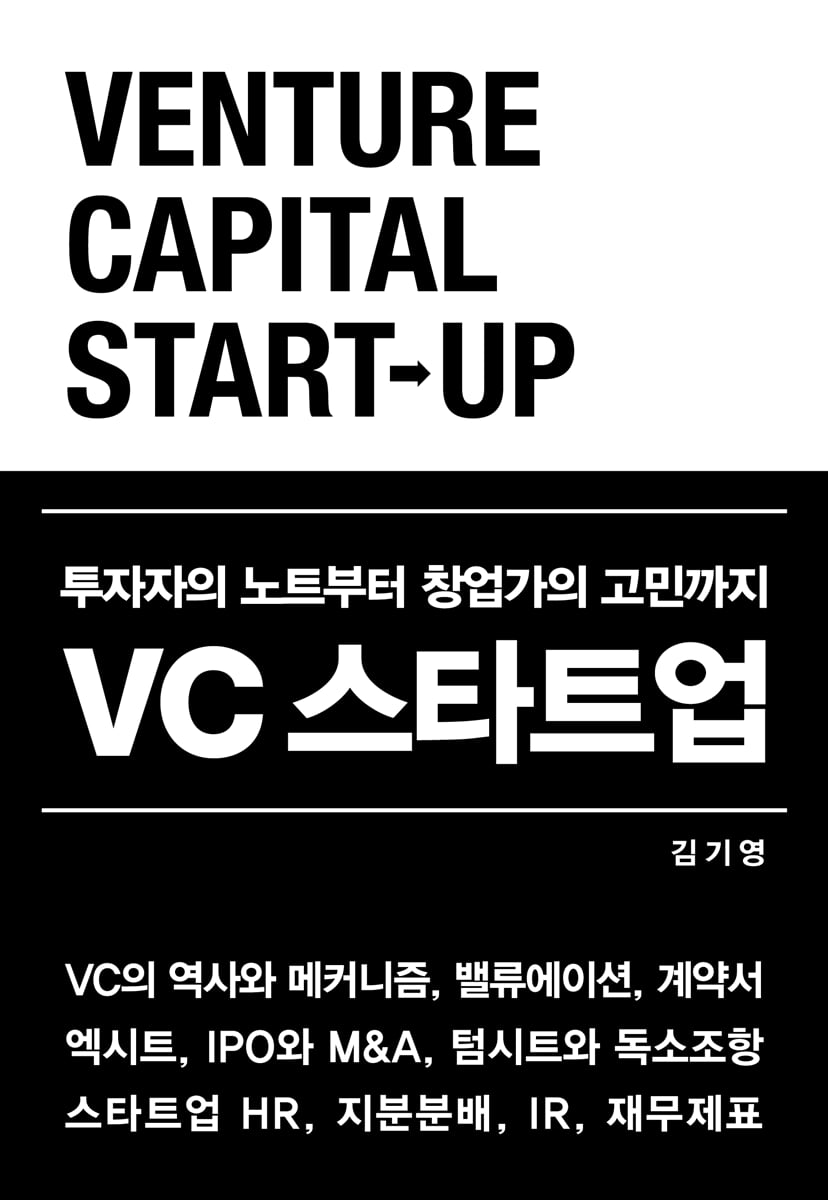
VC startups
 |
Description
Book Introduction
VC's history and mechanism, valuation, term sheet, contract,
From IPOs and M&A to startup HR, equity distribution, IR, and financial statements.
A Guide for Entrepreneurs, Aspiring Entrepreneurs, Startup Professionals, and Investment Reviewers
“If a startup doesn’t know VCs, it’s only seeing half of the ecosystem.
“If VCs don’t understand the struggles of startups, they’re only seeing half the ecosystem.”
This book is a must-read for startup founders, aspiring startup founders, VC (venture capital) investment reviewers, and college students and job seekers interested in VCs and startups. It begins with a VC's role and work process, and then provides essential information on startup valuation and exit methodologies, as well as IPOs and M&As, in an easily understandable manner.
The author, who has experience with both VCs and startups, shares his knowledge and insights gained in the field, covering everything from co-founder equity allocation to the appropriate timing and amount of investment, to HR and financial statements for startups, to ensure successful startup establishment.
Section-by-section tips add depth to the content through real-world examples and provide key practical tips.
And as institutional investors betting on the market, VCs question the trends of the times that could change the world, and to work with startups seeking answers to those questions, they discuss key market trends such as artificial intelligence, blockchain, education, K-bio, K-healthcare, and the environment.
The author argues that venture capital and startups are a single, organic entity. This book, filled with insights only an author with experience in both VC and startups could have, is essential for both VCs and startups. I highly recommend it to all startup professionals as a first step toward understanding VC.
From IPOs and M&A to startup HR, equity distribution, IR, and financial statements.
A Guide for Entrepreneurs, Aspiring Entrepreneurs, Startup Professionals, and Investment Reviewers
“If a startup doesn’t know VCs, it’s only seeing half of the ecosystem.
“If VCs don’t understand the struggles of startups, they’re only seeing half the ecosystem.”
This book is a must-read for startup founders, aspiring startup founders, VC (venture capital) investment reviewers, and college students and job seekers interested in VCs and startups. It begins with a VC's role and work process, and then provides essential information on startup valuation and exit methodologies, as well as IPOs and M&As, in an easily understandable manner.
The author, who has experience with both VCs and startups, shares his knowledge and insights gained in the field, covering everything from co-founder equity allocation to the appropriate timing and amount of investment, to HR and financial statements for startups, to ensure successful startup establishment.
Section-by-section tips add depth to the content through real-world examples and provide key practical tips.
And as institutional investors betting on the market, VCs question the trends of the times that could change the world, and to work with startups seeking answers to those questions, they discuss key market trends such as artificial intelligence, blockchain, education, K-bio, K-healthcare, and the environment.
The author argues that venture capital and startups are a single, organic entity. This book, filled with insights only an author with experience in both VC and startups could have, is essential for both VCs and startups. I highly recommend it to all startup professionals as a first step toward understanding VC.
- You can preview some of the book's contents.
Preview
index
Recommendation
prolog
Chapter 1: What is VC Investment?
01. The Role and Influence of VC
02. History of VC
Tip] Introducing Major Global VCs
03.
The Past and Present of Korean VCs
Tip] Introduction to Major Domestic VCs
04. VC's work process
[Tip] Venture Capitalist Deal Sourcing
Tip] Accelerators and Private Equity
Chapter 2 GP and LP
01. VC's profit structure
Tip] What is the fund return IRR?
02.
Incentives for judges
03.
Main types of domestic GPs (venture capital companies/LLCs/new articles)
Tip] VCs that are doing IPOs
04. Role and characteristics of LP (feat.
Mother Fund)
Chapter 3: Startup Valuation & Exit
01.
Startup valuation methodology
Tip] Anthony Tan, founder of Southeast Asia's leading super app, Grab
02.
What is the fair value of a startup?
Tip] Is Softbank a bubble maker?
03.
Exit Methodology and IPO of Unlisted Companies
Tip] Differences between NYSE and NASDAQ
Tip] SPAC Listing Case Study
04.
Startup M&A
Chapter 4 Contract
01.
Term Sheet and Key Provisions
Tip] Pre-money and post-money
02.
Composition of a standard contract
03.
Potential poison pill provisions
Tip] Standard Venture Investment Contract
04.
Let's take a closer look at stock options.
Chapter 5: Startup Concerns
01.
Distribution of shares with co-founders
02.
What you like to do, what you are good at
Tip] Entrepreneurial Temperament
03.
What successful startups have in common
Tip] The Core of IR Deck
[Tip] Elon Musk: The Size of Your Dreams Determines the Size of Your Success
04.
Appropriate timing and amount of investment attraction
Tip] Uber founder Kalanick and CEO Khosrowshahi
05.
HR for Startups
06.
Startup Financial Statements
Tip] Loans & Government Subsidies
Chapter 6 Addendum
01.
Artificial Intelligence and Blockchain
02.
19th-century classroom, 21st-century student
03.
K-Bio, K-Healthcare
04.
Environment, a matter of survival
Appendix I.
Is the Korean unicorn okay as it is?
Appendix II.
angel investment
Appendix III. Stocks like VC
Appendix IV.
introduction
Epilogue: VCs and Startups Are One Organism
prolog
Chapter 1: What is VC Investment?
01. The Role and Influence of VC
02. History of VC
Tip] Introducing Major Global VCs
03.
The Past and Present of Korean VCs
Tip] Introduction to Major Domestic VCs
04. VC's work process
[Tip] Venture Capitalist Deal Sourcing
Tip] Accelerators and Private Equity
Chapter 2 GP and LP
01. VC's profit structure
Tip] What is the fund return IRR?
02.
Incentives for judges
03.
Main types of domestic GPs (venture capital companies/LLCs/new articles)
Tip] VCs that are doing IPOs
04. Role and characteristics of LP (feat.
Mother Fund)
Chapter 3: Startup Valuation & Exit
01.
Startup valuation methodology
Tip] Anthony Tan, founder of Southeast Asia's leading super app, Grab
02.
What is the fair value of a startup?
Tip] Is Softbank a bubble maker?
03.
Exit Methodology and IPO of Unlisted Companies
Tip] Differences between NYSE and NASDAQ
Tip] SPAC Listing Case Study
04.
Startup M&A
Chapter 4 Contract
01.
Term Sheet and Key Provisions
Tip] Pre-money and post-money
02.
Composition of a standard contract
03.
Potential poison pill provisions
Tip] Standard Venture Investment Contract
04.
Let's take a closer look at stock options.
Chapter 5: Startup Concerns
01.
Distribution of shares with co-founders
02.
What you like to do, what you are good at
Tip] Entrepreneurial Temperament
03.
What successful startups have in common
Tip] The Core of IR Deck
[Tip] Elon Musk: The Size of Your Dreams Determines the Size of Your Success
04.
Appropriate timing and amount of investment attraction
Tip] Uber founder Kalanick and CEO Khosrowshahi
05.
HR for Startups
06.
Startup Financial Statements
Tip] Loans & Government Subsidies
Chapter 6 Addendum
01.
Artificial Intelligence and Blockchain
02.
19th-century classroom, 21st-century student
03.
K-Bio, K-Healthcare
04.
Environment, a matter of survival
Appendix I.
Is the Korean unicorn okay as it is?
Appendix II.
angel investment
Appendix III. Stocks like VC
Appendix IV.
introduction
Epilogue: VCs and Startups Are One Organism
Detailed image

Into the book
The domestic VC market experienced a downturn due to the dot-com bubble, but is now entering growth mode again thanks to the influx of government funds, such as the Mother Fund.
In line with this trend, second-generation VCs such as Stonebridge, Company K, and DSC Investment emerged, achieving remarkable returns in a short period of time and establishing themselves as absolute powerhouses in the market.
The mobile boom that began in the late 2000s, coupled with active government support, presented a significant opportunity for second-generation VCs.
National services such as 'Kakao', 'Baedal Minjok', 'Coupang', and 'Toss' were created, and mobile games recorded enormous sales both domestically and internationally.
Second-generation VCs who invested in startups that operated these services were able to generate astronomical profits.
--- p.38
VC's influence in the Korean economy remains strong.
As of 2022, approximately 60% of newly listed companies on KOSDAQ had received VC investment.
The scale of investment is also clearly on a dramatic upward trend compared to the early days.
The world is changing rapidly, and technological advancements are accelerating the pace of change. Yet, despite this, VCs have always been at the center of new changes.
The past 40 years have been like that, and the next 40 years won't be much different.
--- p.40
In addition to LPs with strong financial objectives, such as pension funds, and LPs with strong policy objectives, such as mother funds, there are also institutions that invest in GPs for "business purposes." Large corporations and mid-sized companies participating as LPs fall into this category.
Large and medium-sized companies have many concerns about new businesses.
Because we know that if we fail to respond appropriately to market changes, we can quickly be eliminated.
They usually have solid cash cows and good cash flow.
Since we have a lot of cash on hand, we invest a certain amount of it in VC funds to check the flow of venture companies.
If there is a startup with clear business synergy in the fund's portfolio, it is considered for M&A.
Of course, we are not ignoring financial value as well.
If you meet a capable operator and achieve a large-scale recovery, you can also achieve significant financial gains.
--- p.92
So, how can we determine the benchmarks we can use to evaluate Startup B? The answer is simple.
It's 50 billion won.
In fact, when we were talking to Startup B, we started negotiations with a target of 50 billion won.
However, the final corporate value was measured at 60 billion won on a post-money basis, because Startup B's development team was judged to be superior to Startup A's.
The most common method is to find startups with similar external indicators and use their officially recorded corporate values to conduct valuations.
However, in this case, we consider the intangible competitiveness of Startup B's development team and give it a plus or minus.
--- p.98
The 'fair value' of a startup is always a subject of controversy.
Unlike listed markets, where information is public and trading is free, unlisted markets involve a small number of participants who determine prices and trade company stocks.
Looking at domestic VCs, it is estimated that there are approximately 1,000 evaluators, of which approximately 20% are senior-level personnel with decision-making authority over corporate value selection. Therefore, it is no exaggeration to say that the value of startups is effectively determined by around 200 venture capitalists.
--- p.107
Because startups are unlisted companies, the criteria for measuring corporate value are somewhat vague.
So, the point that usually serves as a benchmark is the valuation that has been most recently recognized by institutions such as VCs.
For example, if a company successfully attracted investment at a corporate value of 100 billion won before M&A review, there are many cases where the value is plus or minus based on 100 billion won.
There were many cases where the management premium was recognized within the range of 20-30% to calculate the equity value.
--- p.144
Liquidation priority is a clause that startups want to avoid if possible.
Unlike the example mentioned above, if the founder has debts that need to be repaid, the bank account balance may actually go into the red after liquidation.
However, from the VC's perspective, there may be some aspects that feel a bit unfair.
If the founder sells the company for a low price, the investment institution will suffer a huge loss.
Liquidation preferences can be a poison pill for founders, but for VCs, they can be a useful tool to protect against downside.
In line with this trend, second-generation VCs such as Stonebridge, Company K, and DSC Investment emerged, achieving remarkable returns in a short period of time and establishing themselves as absolute powerhouses in the market.
The mobile boom that began in the late 2000s, coupled with active government support, presented a significant opportunity for second-generation VCs.
National services such as 'Kakao', 'Baedal Minjok', 'Coupang', and 'Toss' were created, and mobile games recorded enormous sales both domestically and internationally.
Second-generation VCs who invested in startups that operated these services were able to generate astronomical profits.
--- p.38
VC's influence in the Korean economy remains strong.
As of 2022, approximately 60% of newly listed companies on KOSDAQ had received VC investment.
The scale of investment is also clearly on a dramatic upward trend compared to the early days.
The world is changing rapidly, and technological advancements are accelerating the pace of change. Yet, despite this, VCs have always been at the center of new changes.
The past 40 years have been like that, and the next 40 years won't be much different.
--- p.40
In addition to LPs with strong financial objectives, such as pension funds, and LPs with strong policy objectives, such as mother funds, there are also institutions that invest in GPs for "business purposes." Large corporations and mid-sized companies participating as LPs fall into this category.
Large and medium-sized companies have many concerns about new businesses.
Because we know that if we fail to respond appropriately to market changes, we can quickly be eliminated.
They usually have solid cash cows and good cash flow.
Since we have a lot of cash on hand, we invest a certain amount of it in VC funds to check the flow of venture companies.
If there is a startup with clear business synergy in the fund's portfolio, it is considered for M&A.
Of course, we are not ignoring financial value as well.
If you meet a capable operator and achieve a large-scale recovery, you can also achieve significant financial gains.
--- p.92
So, how can we determine the benchmarks we can use to evaluate Startup B? The answer is simple.
It's 50 billion won.
In fact, when we were talking to Startup B, we started negotiations with a target of 50 billion won.
However, the final corporate value was measured at 60 billion won on a post-money basis, because Startup B's development team was judged to be superior to Startup A's.
The most common method is to find startups with similar external indicators and use their officially recorded corporate values to conduct valuations.
However, in this case, we consider the intangible competitiveness of Startup B's development team and give it a plus or minus.
--- p.98
The 'fair value' of a startup is always a subject of controversy.
Unlike listed markets, where information is public and trading is free, unlisted markets involve a small number of participants who determine prices and trade company stocks.
Looking at domestic VCs, it is estimated that there are approximately 1,000 evaluators, of which approximately 20% are senior-level personnel with decision-making authority over corporate value selection. Therefore, it is no exaggeration to say that the value of startups is effectively determined by around 200 venture capitalists.
--- p.107
Because startups are unlisted companies, the criteria for measuring corporate value are somewhat vague.
So, the point that usually serves as a benchmark is the valuation that has been most recently recognized by institutions such as VCs.
For example, if a company successfully attracted investment at a corporate value of 100 billion won before M&A review, there are many cases where the value is plus or minus based on 100 billion won.
There were many cases where the management premium was recognized within the range of 20-30% to calculate the equity value.
--- p.144
Liquidation priority is a clause that startups want to avoid if possible.
Unlike the example mentioned above, if the founder has debts that need to be repaid, the bank account balance may actually go into the red after liquidation.
However, from the VC's perspective, there may be some aspects that feel a bit unfair.
If the founder sells the company for a low price, the investment institution will suffer a huge loss.
Liquidation preferences can be a poison pill for founders, but for VCs, they can be a useful tool to protect against downside.
--- p.176
Publisher's Review
Can't get it anywhere
The author has experience in both VC and startups.
Knowledge and information accumulated on the spot!
Tesla, Microsoft, OpenAI, Facebook, Google.
What do these companies have in common? They all started as startups and, through VC investment, successfully grew into global enterprises.
Coupang, which successfully listed on the New York Stock Exchange, was also able to establish itself as a new distribution powerhouse through VC investment.
The same goes for Ford Motor Company, which succeeded in the mass production revolution, and Apple, which developed the smartphone.
So, what exactly is VC investment, and what criteria do they use to determine the startups they invest in? The essence of VC (venture capital) investment is "venture capital."
In other words, it is ‘funds invested in businesses with high risk but expected high returns.’
However, rather than simply expecting 2-3 times the profits, we are looking to discover startups that we can work with for the next 5-10 years.
The author argues that venture capital and startups are a single, organic entity. This book, filled with insights only an author with experience in both VC and startups could have, is essential for both VCs and startups. I highly recommend it to all startup professionals as a first step toward understanding VC.
Planning great products and services that can change the startup world
→ Completed with venture capital provided by VC
When startup founders plan products and services that will change the world, VCs provide venture capital to help them achieve their goals.
The world is changing rapidly, and technological advancements are accelerating the pace of change. VCs and startups are always at the center of this change.
If you don't know the VC and startup ecosystem, you'll inevitably fall behind the times.
This book is for both VCs and startup professionals.
It also contains information that is necessary for college students who want to enter the market and those preparing to change jobs.
If you are a startup founder or employee, you need to know how VC works.
This is because the flow of capital will directly impact a company's operations and strategy. For VC practitioners, the VC process, startup valuation and exit, and term sheet and contract drafting outlined in this book will be of great help in their practice.
Looking at the examples of VC investments and startups such as SoftBank, Southeast Asia's top super-up company 'Grab' founder Anthony Tan, Uber founder Kalanick and CEO Khosrowshahi, and Elon Musk, we can sympathize with Elon Musk's words, "The size of your dreams is the size of your success."
It's also a good idea to read the supplementary comments on key market trends, including artificial intelligence, blockchain, education, K-bio and K-healthcare, and the environment.
It will be of great help in broadening your investment horizons in the future.
The appendix presents an introductory course on stock investment from the perspective of angel investment and VC, and VC for college students and job seekers, providing information you won't find anywhere else.
This book is a special one, with a breadth and depth that only an author with experience in both VC and startups can unravel, and it contains extremely useful content for anyone interested in VC and startups.
The author has experience in both VC and startups.
Knowledge and information accumulated on the spot!
Tesla, Microsoft, OpenAI, Facebook, Google.
What do these companies have in common? They all started as startups and, through VC investment, successfully grew into global enterprises.
Coupang, which successfully listed on the New York Stock Exchange, was also able to establish itself as a new distribution powerhouse through VC investment.
The same goes for Ford Motor Company, which succeeded in the mass production revolution, and Apple, which developed the smartphone.
So, what exactly is VC investment, and what criteria do they use to determine the startups they invest in? The essence of VC (venture capital) investment is "venture capital."
In other words, it is ‘funds invested in businesses with high risk but expected high returns.’
However, rather than simply expecting 2-3 times the profits, we are looking to discover startups that we can work with for the next 5-10 years.
The author argues that venture capital and startups are a single, organic entity. This book, filled with insights only an author with experience in both VC and startups could have, is essential for both VCs and startups. I highly recommend it to all startup professionals as a first step toward understanding VC.
Planning great products and services that can change the startup world
→ Completed with venture capital provided by VC
When startup founders plan products and services that will change the world, VCs provide venture capital to help them achieve their goals.
The world is changing rapidly, and technological advancements are accelerating the pace of change. VCs and startups are always at the center of this change.
If you don't know the VC and startup ecosystem, you'll inevitably fall behind the times.
This book is for both VCs and startup professionals.
It also contains information that is necessary for college students who want to enter the market and those preparing to change jobs.
If you are a startup founder or employee, you need to know how VC works.
This is because the flow of capital will directly impact a company's operations and strategy. For VC practitioners, the VC process, startup valuation and exit, and term sheet and contract drafting outlined in this book will be of great help in their practice.
Looking at the examples of VC investments and startups such as SoftBank, Southeast Asia's top super-up company 'Grab' founder Anthony Tan, Uber founder Kalanick and CEO Khosrowshahi, and Elon Musk, we can sympathize with Elon Musk's words, "The size of your dreams is the size of your success."
It's also a good idea to read the supplementary comments on key market trends, including artificial intelligence, blockchain, education, K-bio and K-healthcare, and the environment.
It will be of great help in broadening your investment horizons in the future.
The appendix presents an introductory course on stock investment from the perspective of angel investment and VC, and VC for college students and job seekers, providing information you won't find anywhere else.
This book is a special one, with a breadth and depth that only an author with experience in both VC and startups can unravel, and it contains extremely useful content for anyone interested in VC and startups.
GOODS SPECIFICS
- Date of issue: March 15, 2024
- Page count, weight, size: 312 pages | 430g | 145*210*20mm
- ISBN13: 9791193780022
- ISBN10: 1193780020
You may also like
카테고리
korean


korean

![GQ KOREA Mark (Monthly): December [2025]](http://librairie.coreenne.fr/cdn/shop/files/8ef265dbbfbf186523ed75ba7319009d.jpg?v=1765340328&width=3840)


