

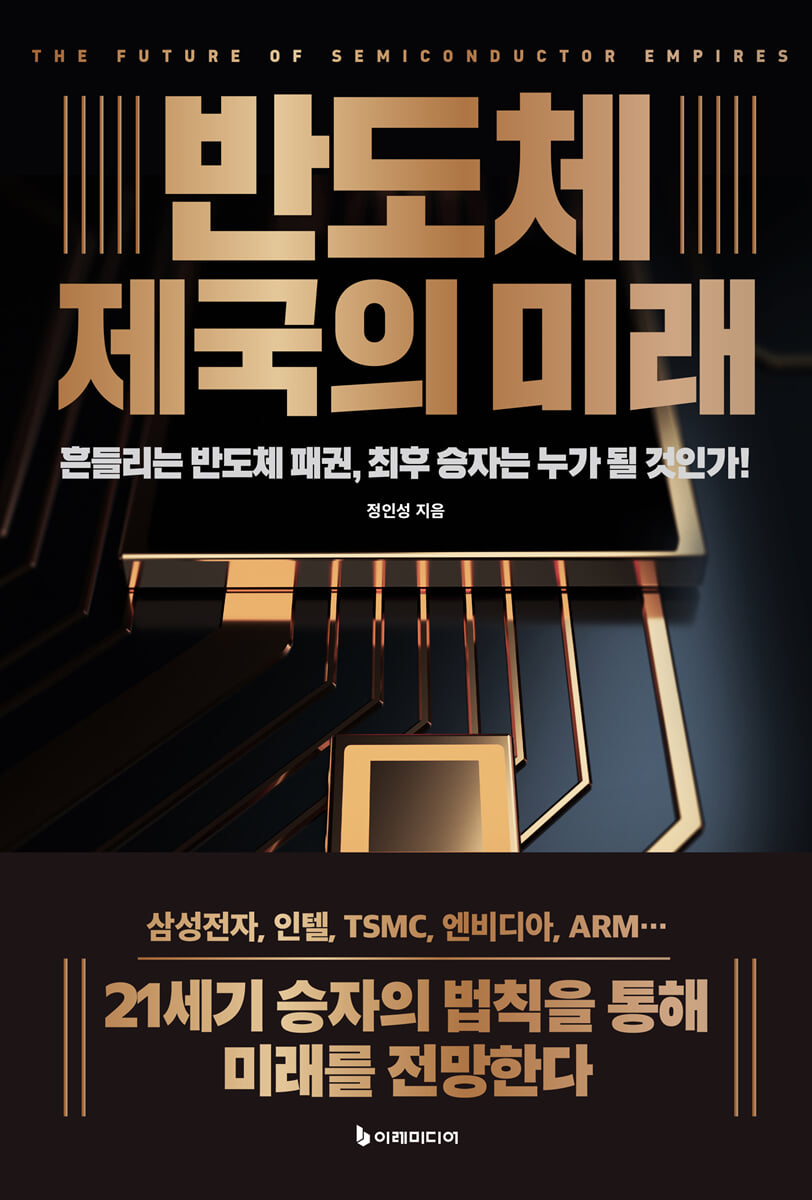
The Future of the Semiconductor Empire
 |
Description
Book Introduction
Understanding the Foundry Business from a Fabless Perspective - What's the Future of the Samsung Electronics and TSMC Bipolar Structure?
The White House's announcement of the Semiconductor Supply Chain Report and Intel's ambition to create a new ecosystem.
US pressures global companies to strengthen their semiconductor manufacturing capabilities.
We delve into the latest trends in the semiconductor industry, vying for hegemony!
Recently, the movements of each country toward the semiconductor foundry industry are unusual.
Following the decision by Taiwan's TSMC, the world's largest foundry, to build a new factory in Japan, Micron of the United States also announced that it would invest approximately 176 trillion won over 10 years to expand its facilities and build new factories in Japan.
Some have commented that the Japanese government's efforts to revive the semiconductor industry have borne fruit.
The "Semiconductor Supply Chain Report" released by the White House in June 2021 reveals a commitment to strengthening semiconductor manufacturing capabilities.
As if to prove this, the United States has demanded information comparable to internal confidentiality from global semiconductor companies with operations in the United States, including Samsung Electronics, SK Hynix, TSMC, and Intel, citing “semiconductor supply chain transparency.”
With TSMC, the industry leader that has refused to disclose its data, deciding to submit the data to the U.S. Department of Commerce, the pressure on South Korean companies is expected to intensify.
A series of events has once again made us realize that semiconductors are not just a core national industry, but a matter of survival that will determine our lives.
"The Future of the Semiconductor Empire," which explained the process of innovation and strategy, including the competitiveness and strategies of the top semiconductor companies and the challenges of new winners, based on cases of technological advancement and data, has been newly published in a revised and expanded edition after two years with 40 additional pages to help understand the confusing domestic and international semiconductor environment.
We've added content to the existing rich structure, showing the evolution of vacuum tubes, transistors, and MOSFETs to become the semiconductors we know today, and we can get a glimpse of Intel's ambitions to create a new ecosystem by recruiting a new CEO.
While the existing appendix provided detailed explanations of semiconductor processes to aid readers' understanding, this revised and expanded edition also provides insights into future market trends.
First, readers will learn about the foundry business from a fabless perspective and gain an understanding of the rapidly evolving foundry market. Second, they will be able to gauge the efforts companies will make in the increasingly fierce competition through the Semiconductor Supply Chain Report released by the White House in June 2021.
The pace of development and change in the semiconductor industry is incomparable to that of any other field.
"The Future of the Semiconductor Empire" presents concrete and vivid examples of the strategies employed by each company through the author's keen eye, along with evidence and forecasts based on data and expert journals, and even reasonable predictions of the future.
This revised and expanded edition adds the latest industry trends to the existing core content, helping readers predict the future direction of the industry amidst the chaotic power struggle.
This one book will allow you to look back on the past and present of the semiconductor industry at a glance and look ahead to its future.
The White House's announcement of the Semiconductor Supply Chain Report and Intel's ambition to create a new ecosystem.
US pressures global companies to strengthen their semiconductor manufacturing capabilities.
We delve into the latest trends in the semiconductor industry, vying for hegemony!
Recently, the movements of each country toward the semiconductor foundry industry are unusual.
Following the decision by Taiwan's TSMC, the world's largest foundry, to build a new factory in Japan, Micron of the United States also announced that it would invest approximately 176 trillion won over 10 years to expand its facilities and build new factories in Japan.
Some have commented that the Japanese government's efforts to revive the semiconductor industry have borne fruit.
The "Semiconductor Supply Chain Report" released by the White House in June 2021 reveals a commitment to strengthening semiconductor manufacturing capabilities.
As if to prove this, the United States has demanded information comparable to internal confidentiality from global semiconductor companies with operations in the United States, including Samsung Electronics, SK Hynix, TSMC, and Intel, citing “semiconductor supply chain transparency.”
With TSMC, the industry leader that has refused to disclose its data, deciding to submit the data to the U.S. Department of Commerce, the pressure on South Korean companies is expected to intensify.
A series of events has once again made us realize that semiconductors are not just a core national industry, but a matter of survival that will determine our lives.
"The Future of the Semiconductor Empire," which explained the process of innovation and strategy, including the competitiveness and strategies of the top semiconductor companies and the challenges of new winners, based on cases of technological advancement and data, has been newly published in a revised and expanded edition after two years with 40 additional pages to help understand the confusing domestic and international semiconductor environment.
We've added content to the existing rich structure, showing the evolution of vacuum tubes, transistors, and MOSFETs to become the semiconductors we know today, and we can get a glimpse of Intel's ambitions to create a new ecosystem by recruiting a new CEO.
While the existing appendix provided detailed explanations of semiconductor processes to aid readers' understanding, this revised and expanded edition also provides insights into future market trends.
First, readers will learn about the foundry business from a fabless perspective and gain an understanding of the rapidly evolving foundry market. Second, they will be able to gauge the efforts companies will make in the increasingly fierce competition through the Semiconductor Supply Chain Report released by the White House in June 2021.
The pace of development and change in the semiconductor industry is incomparable to that of any other field.
"The Future of the Semiconductor Empire" presents concrete and vivid examples of the strategies employed by each company through the author's keen eye, along with evidence and forecasts based on data and expert journals, and even reasonable predictions of the future.
This revised and expanded edition adds the latest industry trends to the existing core content, helping readers predict the future direction of the industry amidst the chaotic power struggle.
This one book will allow you to look back on the past and present of the semiconductor industry at a glance and look ahead to its future.
- You can preview some of the book's contents.
Preview
index
In the era of limitless competition in semiconductors, you need to know how to win.
Author's Note: Learning the Rules of Success in the 21st Century Semiconductor Industry
Chapter 1: Why Semiconductors Can Change the World
Chapter 2: Making Semiconductors - Understanding the Manufacturing Process
Part 1: The Birth of a Semiconductor Empire
Chapter 1: Samsung Electronics: From Reckless Challenges to Champions
The memory field that anyone can challenge
Simplicity Creates Fierce Business Rules
The DRAM market winner who redefined cutting-edge technology
NAND, the low-quality memory that changed the world
Chapter 2: Intel, the Benevolent Dictator: Reigning as the CPU Powerhouse
The Real Reason We Buy CPUs
Past programming with too many variables
IBM, Intel, and Microsoft's dominance
Intel, the "good dictator" that satisfies both compatibility and performance
A software ecosystem that even Intel can't resist
AMD's Gamble: A Showdown with Intel
Chapter 3 Fabless and Foundry: Survivors of the Great IDM Gap
The Dilemma of Integrated Device Manufacturing (IDM), a Consolidated Semiconductor Company
The situation of less important semiconductors
Fabless and Foundry Companies Seize the Opportunity
Part 2: The New Rules of Winners in the Fourth Industrial Revolution
Chapter 4 Nothing Lasts Forever: The Challenges and Challenges of Winning Companies
The Free Lunch Is Gone: The Rising Difficulty of Design Manufacturing
The Mobile Revolution: A Rethinking of Mobile Devices
Data Soars: Artificial Intelligence and Virtualization
The Emergence of Giant Clients: Search Engines and Smartphones
Chapter 5 Champions and Challengers: The Emergence of New Powers and the Changing Landscape
Intel: One Mistake, But Never-ending Challenges
ARM: Flexibility in the Mobile Era: Exploiting Intel's Vulnerabilities
NVIDIA: A Dark Horse From the Edge to the Center of Computing
TSMC: The Biggest Beneficiary of Manufacturing Division
Google: The semiconductor giant that dominates usage scenarios.
Samsung Electronics: The largest consumer and supplier
Chapter 6: The Desire for Technological Hegemony: Can China's Semiconductor Rise Succeed?
The Reality and Potential of Semiconductor Expansion
Can We Make It?: The Challenges of Memory Manufacturing
Can You Sell It?: The Difficulties of Entering the Memory Market
Is it Possible?: Design and Foundry
The rules of the final winner are changing.
Technical understanding and overall understanding of the IT industry
Lessons from the Past: No Winner Ever Wins Alone
A Changing World: Monopolies and Diversification
In closing, I predict the future through the present.
Appendix 1: Semiconductor Processes and Related Companies in Korea
Appendix 2: The Future of the Market: The Breakdown of the Foundry Two-Power System
Appendix 3: Significance of the White House Semiconductor Supply Chain Report
Glossary of Terms
References
Author's Note: Learning the Rules of Success in the 21st Century Semiconductor Industry
Chapter 1: Why Semiconductors Can Change the World
Chapter 2: Making Semiconductors - Understanding the Manufacturing Process
Part 1: The Birth of a Semiconductor Empire
Chapter 1: Samsung Electronics: From Reckless Challenges to Champions
The memory field that anyone can challenge
Simplicity Creates Fierce Business Rules
The DRAM market winner who redefined cutting-edge technology
NAND, the low-quality memory that changed the world
Chapter 2: Intel, the Benevolent Dictator: Reigning as the CPU Powerhouse
The Real Reason We Buy CPUs
Past programming with too many variables
IBM, Intel, and Microsoft's dominance
Intel, the "good dictator" that satisfies both compatibility and performance
A software ecosystem that even Intel can't resist
AMD's Gamble: A Showdown with Intel
Chapter 3 Fabless and Foundry: Survivors of the Great IDM Gap
The Dilemma of Integrated Device Manufacturing (IDM), a Consolidated Semiconductor Company
The situation of less important semiconductors
Fabless and Foundry Companies Seize the Opportunity
Part 2: The New Rules of Winners in the Fourth Industrial Revolution
Chapter 4 Nothing Lasts Forever: The Challenges and Challenges of Winning Companies
The Free Lunch Is Gone: The Rising Difficulty of Design Manufacturing
The Mobile Revolution: A Rethinking of Mobile Devices
Data Soars: Artificial Intelligence and Virtualization
The Emergence of Giant Clients: Search Engines and Smartphones
Chapter 5 Champions and Challengers: The Emergence of New Powers and the Changing Landscape
Intel: One Mistake, But Never-ending Challenges
ARM: Flexibility in the Mobile Era: Exploiting Intel's Vulnerabilities
NVIDIA: A Dark Horse From the Edge to the Center of Computing
TSMC: The Biggest Beneficiary of Manufacturing Division
Google: The semiconductor giant that dominates usage scenarios.
Samsung Electronics: The largest consumer and supplier
Chapter 6: The Desire for Technological Hegemony: Can China's Semiconductor Rise Succeed?
The Reality and Potential of Semiconductor Expansion
Can We Make It?: The Challenges of Memory Manufacturing
Can You Sell It?: The Difficulties of Entering the Memory Market
Is it Possible?: Design and Foundry
The rules of the final winner are changing.
Technical understanding and overall understanding of the IT industry
Lessons from the Past: No Winner Ever Wins Alone
A Changing World: Monopolies and Diversification
In closing, I predict the future through the present.
Appendix 1: Semiconductor Processes and Related Companies in Korea
Appendix 2: The Future of the Market: The Breakdown of the Foundry Two-Power System
Appendix 3: Significance of the White House Semiconductor Supply Chain Report
Glossary of Terms
References
Detailed image
.jpg)
Into the book
Likewise with semiconductors, you first select the desired product through market research.
Memory companies like Samsung Electronics listen to their customers and find out what storage capacities are most in demand.
And it comprehensively determines how much power consumption the customer can tolerate.
The same is true for logic companies like Intel.
We research how much CPU performance customers require, how much battery life laptop customers require, and how much power and heat they can tolerate from the CPU.
Based on this information, each company begins to create the optimal design for its chip to meet market requirements. This process is called semiconductor design.
---From "Chapter 2: Making Semiconductors - Understanding the Manufacturing Process"
Samsung Electronics' achievements in the flash memory market are partially similar to those in the DRAM market, but the details are quite different.
In the DRAM market, Samsung Electronics acknowledged the simplicity of the market and used overwhelming cost competitiveness to drive out competitors. In the NAND market, however, the difference is that Samsung Electronics used the DRAM strategy but read the market trends to understand what users want and provided solutions that mixed NAND with other hardware to provide value.
And this was supported by strong vertical integration.
---「Chapter 1.
Samsung Electronics: From a reckless challenge to becoming a champion
Although Intel ascended to the throne, it could not enjoy the fruits of its labor as leisurely as the oil monopolies.
By canceling outsourcing manufacturing, they succeeded in eliminating major competitors such as NEC and TI.
However, AMD refused to give up and began designing its own CPUs. Internally, this was due to the nature of the market, where Intel was essentially a competitor. Since CPUs had a virtually infinite lifespan, if Intel's new CPUs weren't better than their older counterparts, they wouldn't have been able to generate demand.
For this reason, Intel could not afford to cut back on investments and remain stagnant, relying on the profits of its monopoly market.
At least this year's stuff had to be worth more than last year's stuff.
---「Chapter 2.
From "Intel, the Good Dictator: Reigning as the CPU Powerhouse"
Semiconductors can't do anything with just a blueprint.
We must secure the actual semiconductors at all costs.
Companies specializing in contract manufacturing based on existing blueprints are also growing in size, and are called foundries.
This phenomenon was a win-win for both design firms and foundries.
Many semiconductor companies, eager to continue to enjoy the benefits of advanced processes but unable to increase operating rates with their own facilities, have branched out into design and manufacturing.
The model changed from one where the two restaurants separately procured ingredients and cooked, to one where the two restaurants agreed that one person would only procure ingredients and the other person would only cook in the kitchen.
This division of labor has allowed fabless companies to reduce the burden of heavy capital investment and thus their management burden, while also enabling them to quickly transform their structure to adapt to the rapidly changing IT industry.
---「Chapter 3.
From "Fabless and Foundry: Survivors of the Great IDM Gap"
Intel's seemingly eternal CPU dominance has been eroded by the emergence of mobile platforms.
Traditional PC manufacturers that worked with Intel and Taiwanese PC component companies also had to endure difficult times.
Nevertheless, Intel has continued to reign supreme, dominating the high-value-added market, having defeated numerous ARM server challenges for over five years.
Still, no one has emerged to replace Intel in the enterprise server market, and its acquisition of FPGA company Altera, one of the next-generation compute chip candidates, may give Intel another chance to strike back.
---「Chapter 4.
From "Nothing Lasts Forever: Challenges and Tasks of Winning Companies"
Even this model assumes that the NAND cells have the same performance, so it is highly unlikely that the NAND from Chinese companies, which are technologically inferior, will have cell read characteristics comparable to those of global manufacturers.
Therefore, the IO performance gained by using one more wafer is likely to be ultimately eaten up by the lack of cell performance.
To put it simply, these NANDs are like a highway with 20 lanes of tollgates.
The wide toll gates allow cars to quickly enter the highway, but what's the point if the maximum speed on the two-lane highway that follows the toll gate is 80 km/h? What matters to highway users is the total time it takes to reach their destination, not how quickly they pass the toll gate.
If you pass through a toll gate but the highway is actually congested, is it really worth it?
Memory companies like Samsung Electronics listen to their customers and find out what storage capacities are most in demand.
And it comprehensively determines how much power consumption the customer can tolerate.
The same is true for logic companies like Intel.
We research how much CPU performance customers require, how much battery life laptop customers require, and how much power and heat they can tolerate from the CPU.
Based on this information, each company begins to create the optimal design for its chip to meet market requirements. This process is called semiconductor design.
---From "Chapter 2: Making Semiconductors - Understanding the Manufacturing Process"
Samsung Electronics' achievements in the flash memory market are partially similar to those in the DRAM market, but the details are quite different.
In the DRAM market, Samsung Electronics acknowledged the simplicity of the market and used overwhelming cost competitiveness to drive out competitors. In the NAND market, however, the difference is that Samsung Electronics used the DRAM strategy but read the market trends to understand what users want and provided solutions that mixed NAND with other hardware to provide value.
And this was supported by strong vertical integration.
---「Chapter 1.
Samsung Electronics: From a reckless challenge to becoming a champion
Although Intel ascended to the throne, it could not enjoy the fruits of its labor as leisurely as the oil monopolies.
By canceling outsourcing manufacturing, they succeeded in eliminating major competitors such as NEC and TI.
However, AMD refused to give up and began designing its own CPUs. Internally, this was due to the nature of the market, where Intel was essentially a competitor. Since CPUs had a virtually infinite lifespan, if Intel's new CPUs weren't better than their older counterparts, they wouldn't have been able to generate demand.
For this reason, Intel could not afford to cut back on investments and remain stagnant, relying on the profits of its monopoly market.
At least this year's stuff had to be worth more than last year's stuff.
---「Chapter 2.
From "Intel, the Good Dictator: Reigning as the CPU Powerhouse"
Semiconductors can't do anything with just a blueprint.
We must secure the actual semiconductors at all costs.
Companies specializing in contract manufacturing based on existing blueprints are also growing in size, and are called foundries.
This phenomenon was a win-win for both design firms and foundries.
Many semiconductor companies, eager to continue to enjoy the benefits of advanced processes but unable to increase operating rates with their own facilities, have branched out into design and manufacturing.
The model changed from one where the two restaurants separately procured ingredients and cooked, to one where the two restaurants agreed that one person would only procure ingredients and the other person would only cook in the kitchen.
This division of labor has allowed fabless companies to reduce the burden of heavy capital investment and thus their management burden, while also enabling them to quickly transform their structure to adapt to the rapidly changing IT industry.
---「Chapter 3.
From "Fabless and Foundry: Survivors of the Great IDM Gap"
Intel's seemingly eternal CPU dominance has been eroded by the emergence of mobile platforms.
Traditional PC manufacturers that worked with Intel and Taiwanese PC component companies also had to endure difficult times.
Nevertheless, Intel has continued to reign supreme, dominating the high-value-added market, having defeated numerous ARM server challenges for over five years.
Still, no one has emerged to replace Intel in the enterprise server market, and its acquisition of FPGA company Altera, one of the next-generation compute chip candidates, may give Intel another chance to strike back.
---「Chapter 4.
From "Nothing Lasts Forever: Challenges and Tasks of Winning Companies"
Even this model assumes that the NAND cells have the same performance, so it is highly unlikely that the NAND from Chinese companies, which are technologically inferior, will have cell read characteristics comparable to those of global manufacturers.
Therefore, the IO performance gained by using one more wafer is likely to be ultimately eaten up by the lack of cell performance.
To put it simply, these NANDs are like a highway with 20 lanes of tollgates.
The wide toll gates allow cars to quickly enter the highway, but what's the point if the maximum speed on the two-lane highway that follows the toll gate is 80 km/h? What matters to highway users is the total time it takes to reach their destination, not how quickly they pass the toll gate.
If you pass through a toll gate but the highway is actually congested, is it really worth it?
---「Chapter 6.
From "The Desire for Technological Hegemony: Can China's Semiconductor Rise Succeed?"
From "The Desire for Technological Hegemony: Can China's Semiconductor Rise Succeed?"
Publisher's Review
The latest revised and expanded edition was published in 2021.
Semiconductors aren't a matter of choice! They're a matter of survival!
Uncovering the latest trends in the semiconductor industry, including the significance of the U.S. Semiconductor Supply Chain Report!
“Korea is an export-oriented country and is located in Northeast Asia, a region where sharp conflicts occur repeatedly.
The electronics industry, especially the semiconductor industry, is a key industry for the country.
The fact that the US-China trade dispute reached its peak and even affected Taiwan's TSMC is not something that can be dismissed as a thing of the past.
As a follow-up to the fight, China invested in SMIC, and the United States and Europe are fiercely competing nationally to attract manufacturing plants.
All these events show that semiconductors are not simply a matter of convenience or not, but a matter of survival. “From the author’s note
Following the recent decision by Taiwan's TSMC, the world's largest foundry, to build a new factory in Japan, Micron of the United States also announced that it would invest approximately 176 trillion won over 10 years to expand its facilities and build new factories in Japan.
Japan's all-out efforts to revive the semiconductor industry have borne fruit.
The "Semiconductor Supply Chain Report" released by the White House in June 2021 reveals a commitment to strengthening semiconductor manufacturing capabilities.
The United States has demanded information equivalent to internal confidentiality from global semiconductor companies with operations in the country, including Samsung Electronics, SK Hynix, TSMC, and Intel, citing "semiconductor supply chain transparency."
With industry leader TSMC, which has continued to refuse to disclose its data, deciding to submit the data to the U.S. Department of Commerce, pressure on South Korean companies is expected to intensify.
Each country risked its life to protect its semiconductor industry.
This shows that semiconductors are not a matter of choice, but a matter of survival.
The author, who graduated from the Department of Physics at Seoul National University and worked in semiconductor development verification at SK Hynix, explores the laws of success that global semiconductor companies such as Samsung Electronics and Intel have learned and implemented through years of change and innovation in this revised and expanded edition of "The Future of the Semiconductor Empire."
Additionally, in the era of the Fourth Industrial Revolution, we will examine the strategies and technologies employed by companies that have emerged as new powerhouses through division of labor, as well as the challenges they face, to discover what breakthroughs they can offer.
From specific and vivid examples of the strategies employed by each company, to evidence and forecasts based on data and expert journals, to reasonable future predictions.
This single volume will allow readers to see the past and present of the semiconductor industry at a glance and forecast its future.
The inevitable weaponization of semiconductor strategies
A world without semiconductors does not exist!
“We will examine the history of the semiconductor industry and the struggle for hegemony to determine why semiconductors have come to influence our lives and global hegemony to such an extent.
We'll examine the unique characteristics of semiconductors compared to other commodities, and explore the numerous innovations and consequences that these characteristics have brought about that would not have been possible without semiconductors.
And we will examine together the chain of innovations that this innovation brings about.
The numerous innovations we'll explore below are all responsible for our lives, and you, the reader, will easily understand what would happen if even one of them were absent.
I believe you will also understand why semiconductors have become strategic weapons, that is, how important they are and how difficult they are to replace.” From the author’s note
Semiconductors are the foundation of the Fourth Industrial Revolution, Korea's leading export item, and the driving force behind our economy.
They even say, 'No country in the world can achieve the Fourth Industrial Revolution without Korea's semiconductors.'
Semiconductors are used in a wide range of products, from home appliances such as smartphones, watches, portable TVs, and plant-growing appliances to automobiles.
Regardless of the simplicity or complexity of semiconductor components, it is a key component that creates another world, whether it is cryptocurrency mining, artificial intelligence (AI), the metaverse, cloud services, self-driving cars, or drones.
Semiconductors are high-tech products in themselves, and the industry also embodies advanced technologies, know-how, and systems.
Just as we cannot imagine a world without semiconductors, we cannot expect any technological development or economic growth without understanding the semiconductor industry.
However, most people do not know exactly what a semiconductor is, how it is made, what the structure of the semiconductor industry is, and what competitive relationships it has.
The semiconductor industry is facing more intense competition than ever before.
In an era where current winners cannot be complacent, and where continuous change is essential to becoming a future leader, who will seize semiconductor hegemony?
"The Future of the Semiconductor Empire" explains the complex and difficult semiconductor technology in a way that even beginners can easily understand, using analogies to construction and cooking.
Additionally, it explains the technical aspects of semiconductors by product, such as memory, non-memory, NAND flash, and manufacturing processes, so that anyone can understand them.
By deriving the hidden laws of winners that explain how changes in core semiconductor technologies have transformed the semiconductor industry, we provide insight that can help diagnose the future.
It will be beneficial to those working in the semiconductor industry, the general public and investors seeking to understand the industry, and businesspeople seeking insight.
Looking into the future through the laws of the 21st century winners!
Contains over 170 illustrations and diagrams covering technology and management.
The revised and expanded edition of "The Future of the Semiconductor Empire" provides a detailed explanation of the entire process, from semiconductor design and manufacturing to post-processes such as packaging, using numerous diagrams and data.
The semiconductor manufacturing process is largely composed of market research, design, manufacturing, testing, and packaging.
Among these, the manufacturing process is divided into the process of preparing the wafer surface by washing it and then applying a thick layer of material equivalent to the thickness of the desired pillar (coating), the process of applying photoresist and then burning away the surrounding area except for the area to be the pillar (exposure), and the process of using hydrogen fluoride gas to cut away the surrounding area (etching).
Among the items subject to Japan's export controls that still remain, materials used in the semiconductor manufacturing process include photoresist (PR) and hydrogen fluoride (HF).
Why are these key materials used in each process? Photoresist is used in the "exposure" process, and hydrogen fluoride is used in the "etching" process.
Through the wealth of information provided in this book, readers will gain an understanding of the pre- and post-processes of semiconductor manufacturing, as well as acquire semiconductor industry common sense appropriate for the era of the Fourth Industrial Revolution.
Furthermore, we will examine what the foundry business is from a fabless perspective and examine what changes are likely to occur for Samsung Electronics and TSMC, which are currently leading the industry in the rapidly changing foundry market.
In addition, the Semiconductor Supply Chain Report released by the White House in June 2021 provided insights into the efforts companies will make in the increasingly fierce competition, providing insights into the future direction of the market.
'Part 1.
In "The Birth of a Semiconductor Empire," we delve into the IT industry's dynamics and the secrets to their success, examining the circumstances surrounding these two dominant players in the 20th century: Samsung Electronics and Intel.
By understanding what rules the winning companies have identified in the semiconductor market and what they've been satisfying everyone's thirst for, we can understand why these rules and these winners emerged.
'Part 2.
In 'The Fourth Industrial Revolution: New Rules of Winners,' we examine the numerous challenges and trials facing 21st-century industries, as well as the responses of each company, and examine the rules of winners that have changed from the past century.
We examine each company's strategies for overcoming various challenges, including physical limitations in design, limitations in hardware innovation, the rise of low power and portability due to the mobile revolution, and changes in demand due to artificial intelligence and virtualization.
We examine the existing winners and challengers—Intel, ARM, Nvidia, TSMC, Google, and Samsung Electronics—and their current status to understand the threats they face and the potential breakthroughs they may face.
We examine the reality and potential of China's ambitious semiconductor drive and argue whether it poses a threat to the Korean semiconductor industry, based on market conditions, technological differences, and data.
In particular, attention is focused on what kind of new ecosystem Intel, which has been showing poor performance for a while, will create with the appointment of new CEO Raja Koduri.
This book also utilizes over 170 illustrations and diagrams to facilitate understanding of manufacturing processes and the competitive landscape of companies. It also offers a wealth of technical information, including EUV circuit photos, the differences between conventional and FPGA chip simulations, and the differences between conventional SSDs and kr-SSDs. It also covers a range of business topics, including ARM's business model, TSMC and Samsung Electronics' foundry strategies, TSMC's quarterly sales, and the net profit margins of Chinese companies based on their technological gap with Hynix.
Semiconductors aren't a matter of choice! They're a matter of survival!
Uncovering the latest trends in the semiconductor industry, including the significance of the U.S. Semiconductor Supply Chain Report!
“Korea is an export-oriented country and is located in Northeast Asia, a region where sharp conflicts occur repeatedly.
The electronics industry, especially the semiconductor industry, is a key industry for the country.
The fact that the US-China trade dispute reached its peak and even affected Taiwan's TSMC is not something that can be dismissed as a thing of the past.
As a follow-up to the fight, China invested in SMIC, and the United States and Europe are fiercely competing nationally to attract manufacturing plants.
All these events show that semiconductors are not simply a matter of convenience or not, but a matter of survival. “From the author’s note
Following the recent decision by Taiwan's TSMC, the world's largest foundry, to build a new factory in Japan, Micron of the United States also announced that it would invest approximately 176 trillion won over 10 years to expand its facilities and build new factories in Japan.
Japan's all-out efforts to revive the semiconductor industry have borne fruit.
The "Semiconductor Supply Chain Report" released by the White House in June 2021 reveals a commitment to strengthening semiconductor manufacturing capabilities.
The United States has demanded information equivalent to internal confidentiality from global semiconductor companies with operations in the country, including Samsung Electronics, SK Hynix, TSMC, and Intel, citing "semiconductor supply chain transparency."
With industry leader TSMC, which has continued to refuse to disclose its data, deciding to submit the data to the U.S. Department of Commerce, pressure on South Korean companies is expected to intensify.
Each country risked its life to protect its semiconductor industry.
This shows that semiconductors are not a matter of choice, but a matter of survival.
The author, who graduated from the Department of Physics at Seoul National University and worked in semiconductor development verification at SK Hynix, explores the laws of success that global semiconductor companies such as Samsung Electronics and Intel have learned and implemented through years of change and innovation in this revised and expanded edition of "The Future of the Semiconductor Empire."
Additionally, in the era of the Fourth Industrial Revolution, we will examine the strategies and technologies employed by companies that have emerged as new powerhouses through division of labor, as well as the challenges they face, to discover what breakthroughs they can offer.
From specific and vivid examples of the strategies employed by each company, to evidence and forecasts based on data and expert journals, to reasonable future predictions.
This single volume will allow readers to see the past and present of the semiconductor industry at a glance and forecast its future.
The inevitable weaponization of semiconductor strategies
A world without semiconductors does not exist!
“We will examine the history of the semiconductor industry and the struggle for hegemony to determine why semiconductors have come to influence our lives and global hegemony to such an extent.
We'll examine the unique characteristics of semiconductors compared to other commodities, and explore the numerous innovations and consequences that these characteristics have brought about that would not have been possible without semiconductors.
And we will examine together the chain of innovations that this innovation brings about.
The numerous innovations we'll explore below are all responsible for our lives, and you, the reader, will easily understand what would happen if even one of them were absent.
I believe you will also understand why semiconductors have become strategic weapons, that is, how important they are and how difficult they are to replace.” From the author’s note
Semiconductors are the foundation of the Fourth Industrial Revolution, Korea's leading export item, and the driving force behind our economy.
They even say, 'No country in the world can achieve the Fourth Industrial Revolution without Korea's semiconductors.'
Semiconductors are used in a wide range of products, from home appliances such as smartphones, watches, portable TVs, and plant-growing appliances to automobiles.
Regardless of the simplicity or complexity of semiconductor components, it is a key component that creates another world, whether it is cryptocurrency mining, artificial intelligence (AI), the metaverse, cloud services, self-driving cars, or drones.
Semiconductors are high-tech products in themselves, and the industry also embodies advanced technologies, know-how, and systems.
Just as we cannot imagine a world without semiconductors, we cannot expect any technological development or economic growth without understanding the semiconductor industry.
However, most people do not know exactly what a semiconductor is, how it is made, what the structure of the semiconductor industry is, and what competitive relationships it has.
The semiconductor industry is facing more intense competition than ever before.
In an era where current winners cannot be complacent, and where continuous change is essential to becoming a future leader, who will seize semiconductor hegemony?
"The Future of the Semiconductor Empire" explains the complex and difficult semiconductor technology in a way that even beginners can easily understand, using analogies to construction and cooking.
Additionally, it explains the technical aspects of semiconductors by product, such as memory, non-memory, NAND flash, and manufacturing processes, so that anyone can understand them.
By deriving the hidden laws of winners that explain how changes in core semiconductor technologies have transformed the semiconductor industry, we provide insight that can help diagnose the future.
It will be beneficial to those working in the semiconductor industry, the general public and investors seeking to understand the industry, and businesspeople seeking insight.
Looking into the future through the laws of the 21st century winners!
Contains over 170 illustrations and diagrams covering technology and management.
The revised and expanded edition of "The Future of the Semiconductor Empire" provides a detailed explanation of the entire process, from semiconductor design and manufacturing to post-processes such as packaging, using numerous diagrams and data.
The semiconductor manufacturing process is largely composed of market research, design, manufacturing, testing, and packaging.
Among these, the manufacturing process is divided into the process of preparing the wafer surface by washing it and then applying a thick layer of material equivalent to the thickness of the desired pillar (coating), the process of applying photoresist and then burning away the surrounding area except for the area to be the pillar (exposure), and the process of using hydrogen fluoride gas to cut away the surrounding area (etching).
Among the items subject to Japan's export controls that still remain, materials used in the semiconductor manufacturing process include photoresist (PR) and hydrogen fluoride (HF).
Why are these key materials used in each process? Photoresist is used in the "exposure" process, and hydrogen fluoride is used in the "etching" process.
Through the wealth of information provided in this book, readers will gain an understanding of the pre- and post-processes of semiconductor manufacturing, as well as acquire semiconductor industry common sense appropriate for the era of the Fourth Industrial Revolution.
Furthermore, we will examine what the foundry business is from a fabless perspective and examine what changes are likely to occur for Samsung Electronics and TSMC, which are currently leading the industry in the rapidly changing foundry market.
In addition, the Semiconductor Supply Chain Report released by the White House in June 2021 provided insights into the efforts companies will make in the increasingly fierce competition, providing insights into the future direction of the market.
'Part 1.
In "The Birth of a Semiconductor Empire," we delve into the IT industry's dynamics and the secrets to their success, examining the circumstances surrounding these two dominant players in the 20th century: Samsung Electronics and Intel.
By understanding what rules the winning companies have identified in the semiconductor market and what they've been satisfying everyone's thirst for, we can understand why these rules and these winners emerged.
'Part 2.
In 'The Fourth Industrial Revolution: New Rules of Winners,' we examine the numerous challenges and trials facing 21st-century industries, as well as the responses of each company, and examine the rules of winners that have changed from the past century.
We examine each company's strategies for overcoming various challenges, including physical limitations in design, limitations in hardware innovation, the rise of low power and portability due to the mobile revolution, and changes in demand due to artificial intelligence and virtualization.
We examine the existing winners and challengers—Intel, ARM, Nvidia, TSMC, Google, and Samsung Electronics—and their current status to understand the threats they face and the potential breakthroughs they may face.
We examine the reality and potential of China's ambitious semiconductor drive and argue whether it poses a threat to the Korean semiconductor industry, based on market conditions, technological differences, and data.
In particular, attention is focused on what kind of new ecosystem Intel, which has been showing poor performance for a while, will create with the appointment of new CEO Raja Koduri.
This book also utilizes over 170 illustrations and diagrams to facilitate understanding of manufacturing processes and the competitive landscape of companies. It also offers a wealth of technical information, including EUV circuit photos, the differences between conventional and FPGA chip simulations, and the differences between conventional SSDs and kr-SSDs. It also covers a range of business topics, including ARM's business model, TSMC and Samsung Electronics' foundry strategies, TSMC's quarterly sales, and the net profit margins of Chinese companies based on their technological gap with Hynix.
GOODS SPECIFICS
- Date of issue: February 9, 2024
- Page count, weight, size: 440 pages | 808g | 152*225*26mm
- ISBN13: 9791193394205
- ISBN10: 1193394201
You may also like
카테고리
korean


korean

![GQ KOREA Mark (Monthly): December [2025]](http://librairie.coreenne.fr/cdn/shop/files/8ef265dbbfbf186523ed75ba7319009d.jpg?v=1765340328&width=3840)


