

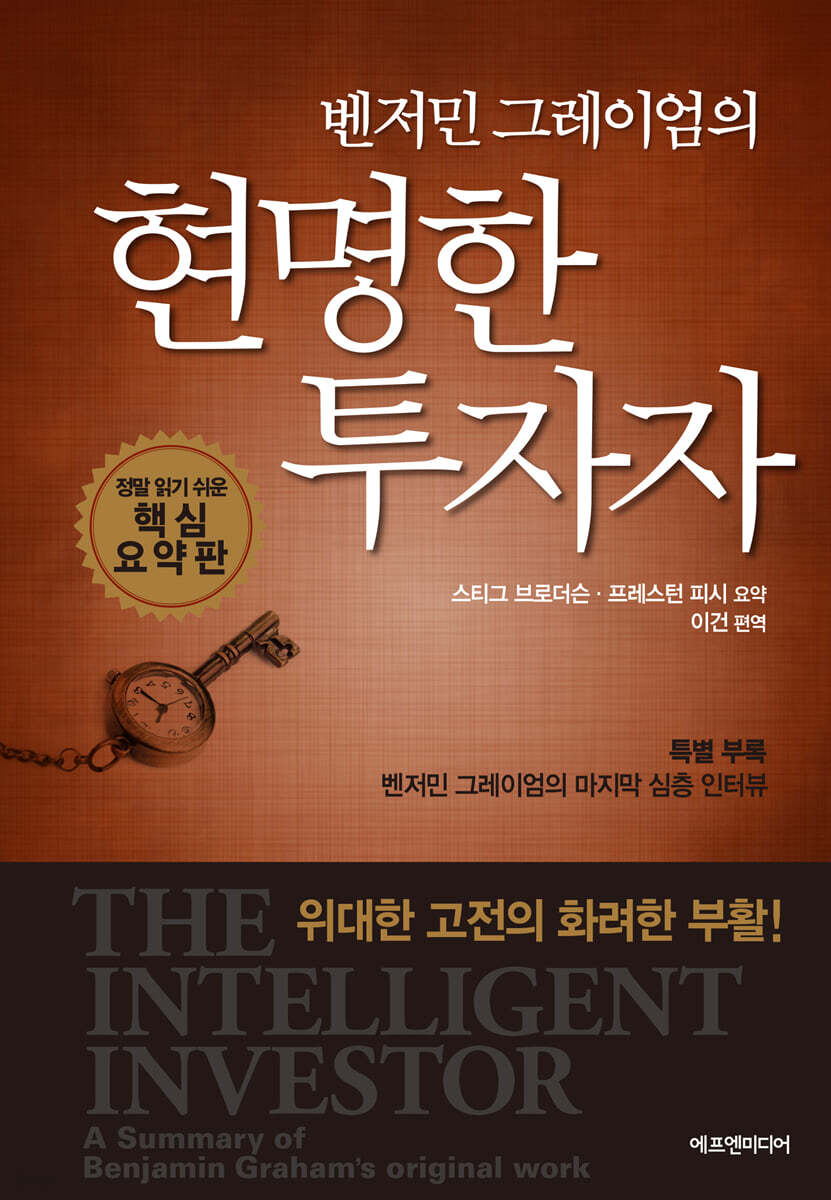
Benjamin Graham's The Intelligent Investor
 |
Description
Book Introduction
The essentials of Benjamin Graham's "The Intelligent Investor" An introductory and summary book that even beginners can easily understand. A simple and concise summary of the timeless investment classic, The Intelligent Investor. The book's key content is carefully covered, but it is polished smoothly so that even beginners in stock investment can read it without difficulty, making it easy to turn the pages. This is a revised edition that improves the accuracy and quality of translation in line with the original 4th edition. Widely recognized as the father of modern security analysis and the founder of value investing, Graham's famous book, "The Intelligent Investor," has been a must-read for investors around the world since its first publication in 1949. However, the content is so difficult that even a 'summary' version was published in the United States and received a good response, and the 'vast volume and difficult text' are too much of a burden, especially for beginner Korean investors. Focusing on resolving this issue, "Benjamin Graham's Intelligent Investor: A Truly Readable Summary" is summarized by American investment experts and translated by a Korean investment book translator, helping readers grasp the essence in a short period of time. Korean investment experts also praised the book, saying, “It’s perfect for guiding readers with profound insights while lowering the burden of the original hurdles” (Park Sung-jin), and “Although the content is condensed, the unique essence of ‘The Intelligent Investor’ that transcends the times shines even brighter” (Choi Jun-cheol). He also recommended, “If you have read ‘The Intelligent Investor’, use it as an introductory book, and if you have read it, use it as a summary of the key points” (Sukhyang). A special appendix includes Graham's final in-depth interview, bringing his voice to life. |
- You can preview some of the book's contents.
Preview
index
Recommended Preface (Park Seong-jin)
Translator's Preface (This)
Preface to the 4th Edition (Warren Buffett)
introduction
01.
Investment and Speculation: What Smart Investors Expect
02.
Investment and Inflation
03.
A History of the Stock Market Over the Past 100 Years: Stock Prices in Early 1972
04.
General Portfolio Strategy: Defensive Investor
05.
Defensive Investors and Stocks
06.
Aggressive Investor Portfolio Strategy: Investments to Avoid
07.
Aggressive Investor Portfolio Strategy: Investments Worth Considering
08.
Investment and Market Fluctuations
09.
Fund investment
10.
Investment Advice
11.
Beginner's Stock Analysis
12. The Reality of EPS
13.
Comparison of four listed companies
14.
Stock Picks for Defensive Investors
15.
Stock Picks for Aggressive Investors
16.
Convertible bonds and stock warrants
17.
Extreme cases
18.
Comparative analysis of companies
19.
Shareholders and Management: Dividend Policy
20.
The most important concept is the margin of safety
Appendix: Prominent Investors in Graham-Dodd Village
Reviews
The theme that runs through this book
Special Korean Edition Supplement: Benjamin Graham's Final In-Depth Interview
Translator's Preface (This)
Preface to the 4th Edition (Warren Buffett)
introduction
01.
Investment and Speculation: What Smart Investors Expect
02.
Investment and Inflation
03.
A History of the Stock Market Over the Past 100 Years: Stock Prices in Early 1972
04.
General Portfolio Strategy: Defensive Investor
05.
Defensive Investors and Stocks
06.
Aggressive Investor Portfolio Strategy: Investments to Avoid
07.
Aggressive Investor Portfolio Strategy: Investments Worth Considering
08.
Investment and Market Fluctuations
09.
Fund investment
10.
Investment Advice
11.
Beginner's Stock Analysis
12. The Reality of EPS
13.
Comparison of four listed companies
14.
Stock Picks for Defensive Investors
15.
Stock Picks for Aggressive Investors
16.
Convertible bonds and stock warrants
17.
Extreme cases
18.
Comparative analysis of companies
19.
Shareholders and Management: Dividend Policy
20.
The most important concept is the margin of safety
Appendix: Prominent Investors in Graham-Dodd Village
Reviews
The theme that runs through this book
Special Korean Edition Supplement: Benjamin Graham's Final In-Depth Interview
Into the book
If you haven't read "The Intelligent Investor" yet or find it difficult to read, I recommend starting with this book.
Buffett said, “Many people who followed Graham’s teachings became rich, and it is difficult to find cases where they became poor.
“There are few people who can teach this,” he said.
I recommend this book in the hope that you too can see the light in the darkness that Buffett saw.
--- p.6, from the “Recommended Preface”
Getting into the habit of evaluating or quantifying your intrinsic value will help you reduce mistakes.
You should get in the habit of comparing the market price you pay with the intrinsic value you acquire to determine whether the price is low enough to buy.
You should buy stocks pragmatically, like buying groceries rather than perfume.
--- p.15, from the "Preface"
Even beginners can achieve decent, if not spectacular, investment results with just a little effort.
Even if you are a beginner, if you use your limited knowledge to think outside the box, it may lead to bad results.
--- p.15, from the "Preface"
Investing is about securing satisfactory returns while safeguarding your principal through thorough analysis.
Otherwise, it's speculation.
However, when the market crashes and the stocks reach their most attractive prices, they perceive stocks as speculative and risky. Conversely, when the market rises and reaches risky levels, they actually speculate but mistake it for investment.
--- p.20, Chapter 1.
From “Investment and Speculation”
An easy strategy is to allocate 50% of your portfolio to stocks and 50% to bonds.
However, it is better to adjust the proportion between 25% and 75% depending on market conditions.
For example, at the bottom of a bear market, you might increase your stock allocation to 75% and hold only 25% in bonds.
However, this method is not easy to implement because human nature is to follow the flow of the market.
In fact, even investment professionals who manage funds find it difficult to do this.
--- p.40, Chapter 4.
Among the “general portfolio strategies”
Even if the market appears to have reached a high or low, you should not trade hastily.
Investors should act like partners in the business.
You shouldn't be looking for daily stock prices or trying to find new partners.
Bond prices are unpredictable, but experienced investors can predict the relative magnitude of price fluctuations across bond types.
--- p.75, Chapter 8.
From “Investment and Market Fluctuations”
Speculators who want to make money in the short term use timing, while investors who can wait for an opportunity use pricing.
If the general public thinks they can make money by predicting the market, they are mistaken.
--- p.77, Chapter 8.
From “Investment and Market Fluctuations”
If you must rely on the advice of others, you should avoid using your imagination and stick to a conservative investment approach.
--- p.100, Chapter 10.
From “Investment Advice”
I have never seen a reliable security analysis that goes beyond simple arithmetic or basic algebra.
If calculus or advanced algebra appears in the analysis, it may be an attempt to disguise speculation as investment by presenting a plausible theory.
Investors need to understand the analyst's intent and be able to distinguish between sound and superficial analysis.
The analysis begins with the interpretation of annual financial statements.
--- p.111, Chapter 11.
From “Beginner’s Stock Analysis”
A stock's margin of safety is secured 'when the company's earnings power far exceeds the bond yield.'
For example, let's assume a company's earnings yield (EPS/stock price) is 9% and its bond yield is 4%.
These stocks offer a 5 percentage point annual advantage over bonds in terms of yield.
The company will pay out a portion of its excess returns to investors and reinvest the remainder to increase the company's value.
--- p.193, Chapter 20.
The most important concept is “Safety Margin”
The most business-like investment is the wisest investment.
It's surprising how many successful businessmen who adhere to sound principles completely ignore them when investing on Wall Street.
--- p.196, Chapter 20.
The most important concept is “Safety Margin”
The act of trading securities to make a profit is also a type of business, so it must be carried out while adhering to principles as if running a business.
(Omitted) You should not start a business unless you can clearly calculate that you can expect a reasonable profit.
Stay away from risky ventures that involve little gain and much loss.
The basis of investment should be solid numbers, not vague optimism.
--- p.197, Chapter 20.
The most important concept is “Safety Margin”
Use your knowledge and experience courageously.
If I have reached a conclusion based on facts and I believe that this judgment is sound, I will act on it even if it differs from what others think.
In investing, courage is the greatest asset only when accompanied by sufficient knowledge and judgment.
The average investor can succeed in investing even if he or she lacks these qualities, as long as he or she restrains his or her ambitions and sticks to safe, defensive investments.
--- p.198, Chapter 20.
The most important concept is “Safety Margin”
There are many ways to make and keep money on Wall Street, and one stroke of luck or a brilliant decision can be worth more than a lifetime of hard work.
However, to achieve good luck or make great decisions, you need to build up your skills over a long period of time.
Buffett said, “Many people who followed Graham’s teachings became rich, and it is difficult to find cases where they became poor.
“There are few people who can teach this,” he said.
I recommend this book in the hope that you too can see the light in the darkness that Buffett saw.
--- p.6, from the “Recommended Preface”
Getting into the habit of evaluating or quantifying your intrinsic value will help you reduce mistakes.
You should get in the habit of comparing the market price you pay with the intrinsic value you acquire to determine whether the price is low enough to buy.
You should buy stocks pragmatically, like buying groceries rather than perfume.
--- p.15, from the "Preface"
Even beginners can achieve decent, if not spectacular, investment results with just a little effort.
Even if you are a beginner, if you use your limited knowledge to think outside the box, it may lead to bad results.
--- p.15, from the "Preface"
Investing is about securing satisfactory returns while safeguarding your principal through thorough analysis.
Otherwise, it's speculation.
However, when the market crashes and the stocks reach their most attractive prices, they perceive stocks as speculative and risky. Conversely, when the market rises and reaches risky levels, they actually speculate but mistake it for investment.
--- p.20, Chapter 1.
From “Investment and Speculation”
An easy strategy is to allocate 50% of your portfolio to stocks and 50% to bonds.
However, it is better to adjust the proportion between 25% and 75% depending on market conditions.
For example, at the bottom of a bear market, you might increase your stock allocation to 75% and hold only 25% in bonds.
However, this method is not easy to implement because human nature is to follow the flow of the market.
In fact, even investment professionals who manage funds find it difficult to do this.
--- p.40, Chapter 4.
Among the “general portfolio strategies”
Even if the market appears to have reached a high or low, you should not trade hastily.
Investors should act like partners in the business.
You shouldn't be looking for daily stock prices or trying to find new partners.
Bond prices are unpredictable, but experienced investors can predict the relative magnitude of price fluctuations across bond types.
--- p.75, Chapter 8.
From “Investment and Market Fluctuations”
Speculators who want to make money in the short term use timing, while investors who can wait for an opportunity use pricing.
If the general public thinks they can make money by predicting the market, they are mistaken.
--- p.77, Chapter 8.
From “Investment and Market Fluctuations”
If you must rely on the advice of others, you should avoid using your imagination and stick to a conservative investment approach.
--- p.100, Chapter 10.
From “Investment Advice”
I have never seen a reliable security analysis that goes beyond simple arithmetic or basic algebra.
If calculus or advanced algebra appears in the analysis, it may be an attempt to disguise speculation as investment by presenting a plausible theory.
Investors need to understand the analyst's intent and be able to distinguish between sound and superficial analysis.
The analysis begins with the interpretation of annual financial statements.
--- p.111, Chapter 11.
From “Beginner’s Stock Analysis”
A stock's margin of safety is secured 'when the company's earnings power far exceeds the bond yield.'
For example, let's assume a company's earnings yield (EPS/stock price) is 9% and its bond yield is 4%.
These stocks offer a 5 percentage point annual advantage over bonds in terms of yield.
The company will pay out a portion of its excess returns to investors and reinvest the remainder to increase the company's value.
--- p.193, Chapter 20.
The most important concept is “Safety Margin”
The most business-like investment is the wisest investment.
It's surprising how many successful businessmen who adhere to sound principles completely ignore them when investing on Wall Street.
--- p.196, Chapter 20.
The most important concept is “Safety Margin”
The act of trading securities to make a profit is also a type of business, so it must be carried out while adhering to principles as if running a business.
(Omitted) You should not start a business unless you can clearly calculate that you can expect a reasonable profit.
Stay away from risky ventures that involve little gain and much loss.
The basis of investment should be solid numbers, not vague optimism.
--- p.197, Chapter 20.
The most important concept is “Safety Margin”
Use your knowledge and experience courageously.
If I have reached a conclusion based on facts and I believe that this judgment is sound, I will act on it even if it differs from what others think.
In investing, courage is the greatest asset only when accompanied by sufficient knowledge and judgment.
The average investor can succeed in investing even if he or she lacks these qualities, as long as he or she restrains his or her ambitions and sticks to safe, defensive investments.
--- p.198, Chapter 20.
The most important concept is “Safety Margin”
There are many ways to make and keep money on Wall Street, and one stroke of luck or a brilliant decision can be worth more than a lifetime of hard work.
However, to achieve good luck or make great decisions, you need to build up your skills over a long period of time.
--- p.204, from “Afterword”
Publisher's Review
Benjamin Graham's "The Intelligent Investor" is a timeless investment classic.
However, the content is difficult to read
Benjamin Graham is widely recognized as the father of modern security analysis and the founder of value investing.
He published The Intelligent Investor “to guide even beginners to develop and implement sound investment strategies.”
The purpose of the book, as he stated in the preface, is as follows:
1.
It tells you about a serious mistake that investors often make.
2.
We introduce investment strategies that will help you proceed with peace of mind.
3.
Guides you through choosing and implementing an investment strategy.
4.
Guides beginners on appropriate investment methods.
5.
Emphasizes the principles and attitudes of investment.
Since its first publication in 1949, it has been revised in 1959, 1965, and 1973, establishing itself as a must-read for global investors.
However, even in the United States, it is difficult to read unless you are a highly skilled person, and the 'vast volume and difficult text' are especially burdensome for beginner Korean investors.
Just the essentials of 『The Intelligent Investor』,
An introductory and summary book that even beginners can easily understand.
The 'Hawking Index' is a measure of whether people who buy a book actually read it.
If you buy a book because you're interested, but give up without reading much, your Hawking index will go down.
The Hawking index of The Intelligent Investor would also be very low.
However, 『Benjamin Graham's Intelligent Investor: A Truly Readable Summary』, which was designed with a focus on resolving this problem, can be said to have a '100% Hawking Index'.
First, experts who run investment firms in the United States summarized only the core of nuclear power plants.
This was translated fluently by a professional investment translator.
The book's strength is that it meticulously preserves the core content of the original work, but is polished smoothly so that Korean readers can read it without difficulty, making it a smooth read.
This is a revised edition that improves the accuracy and quality of translation in line with the original 4th edition.
Domestic investment experts also praised the book, saying, “It’s perfect for guiding readers with profound insights while lowering the burden of the hurdles of the original text” (Park Sung-jin, CEO of Ian Investment Consulting), and “Although the content is condensed, the unique essence of ‘The Intelligent Investor’ that transcends the times shines even brighter” (Choi Jun-cheol, CEO of VIP Asset Management).
He also recommended, “If you have read ‘The Intelligent Investor’, use it as an introductory book, and if you have read it, use it as a summary of the key points” (Sook-hyang, author of ‘Warren Buffett Next Door, Sook-hyang’s Stock Investment Story’).
A special appendix includes Graham's final in-depth interview, bringing his voice to life.
The theme that runs through this book
· This book does not cover 'how to hit the jackpot'.
· Since this book is written for investors, not speculators, we first distinguish between investment and speculation.
· No matter how rapidly the market changes, sound investment principles should not change frequently.
· This book divides investors into two types.
A defensive investor is someone who hates losses or doesn't want to think about investments too often.
An aggressive investor is someone who spares no time and effort in finding promising and attractive stocks, and as a result, hopes to achieve higher returns than a defensive investor.
· A bright growth outlook does not necessarily mean high profitability.
· The most fearsome enemy that can put an investor in trouble is himself.
Because it is easy to lose your mind and get swept away by the market.
When investing, you should always maintain a sound mindset.
· Measuring and quantifying intrinsic value can reduce the risk of mistakes.
You need to calculate whether the stock price is a good buy. When buying stocks, you should be pragmatic, like buying groceries rather than perfume.
· Market average performance is easily obtained.
You just have to buy the index.
However, it is very difficult to obtain excess returns.
You can see this by looking at the performance of funds that have been managed for a long time.
· It is better to keep your portfolio simple.
Consist of high-quality bonds and a variety of representative stocks.
· The principle of 'margin of safety' should be the basis of investment.
· Always remember that if you get swept up in the market, you will almost invariably fail.
· I must always maintain the habit of comparing the market price I pay with the intrinsic value I acquire.
· The wisest investment is the one that is most business-like.
· Securities should be viewed as ownership of a portion of the company.
· The act of trading securities to make a profit is also a type of business, so it should be conducted as if running a business.
· The basis of business should be numbers, not optimism.
· In investing, courage is the greatest asset only when accompanied by sufficient knowledge and judgment.
However, the content is difficult to read
Benjamin Graham is widely recognized as the father of modern security analysis and the founder of value investing.
He published The Intelligent Investor “to guide even beginners to develop and implement sound investment strategies.”
The purpose of the book, as he stated in the preface, is as follows:
1.
It tells you about a serious mistake that investors often make.
2.
We introduce investment strategies that will help you proceed with peace of mind.
3.
Guides you through choosing and implementing an investment strategy.
4.
Guides beginners on appropriate investment methods.
5.
Emphasizes the principles and attitudes of investment.
Since its first publication in 1949, it has been revised in 1959, 1965, and 1973, establishing itself as a must-read for global investors.
However, even in the United States, it is difficult to read unless you are a highly skilled person, and the 'vast volume and difficult text' are especially burdensome for beginner Korean investors.
Just the essentials of 『The Intelligent Investor』,
An introductory and summary book that even beginners can easily understand.
The 'Hawking Index' is a measure of whether people who buy a book actually read it.
If you buy a book because you're interested, but give up without reading much, your Hawking index will go down.
The Hawking index of The Intelligent Investor would also be very low.
However, 『Benjamin Graham's Intelligent Investor: A Truly Readable Summary』, which was designed with a focus on resolving this problem, can be said to have a '100% Hawking Index'.
First, experts who run investment firms in the United States summarized only the core of nuclear power plants.
This was translated fluently by a professional investment translator.
The book's strength is that it meticulously preserves the core content of the original work, but is polished smoothly so that Korean readers can read it without difficulty, making it a smooth read.
This is a revised edition that improves the accuracy and quality of translation in line with the original 4th edition.
Domestic investment experts also praised the book, saying, “It’s perfect for guiding readers with profound insights while lowering the burden of the hurdles of the original text” (Park Sung-jin, CEO of Ian Investment Consulting), and “Although the content is condensed, the unique essence of ‘The Intelligent Investor’ that transcends the times shines even brighter” (Choi Jun-cheol, CEO of VIP Asset Management).
He also recommended, “If you have read ‘The Intelligent Investor’, use it as an introductory book, and if you have read it, use it as a summary of the key points” (Sook-hyang, author of ‘Warren Buffett Next Door, Sook-hyang’s Stock Investment Story’).
A special appendix includes Graham's final in-depth interview, bringing his voice to life.
The theme that runs through this book
· This book does not cover 'how to hit the jackpot'.
· Since this book is written for investors, not speculators, we first distinguish between investment and speculation.
· No matter how rapidly the market changes, sound investment principles should not change frequently.
· This book divides investors into two types.
A defensive investor is someone who hates losses or doesn't want to think about investments too often.
An aggressive investor is someone who spares no time and effort in finding promising and attractive stocks, and as a result, hopes to achieve higher returns than a defensive investor.
· A bright growth outlook does not necessarily mean high profitability.
· The most fearsome enemy that can put an investor in trouble is himself.
Because it is easy to lose your mind and get swept away by the market.
When investing, you should always maintain a sound mindset.
· Measuring and quantifying intrinsic value can reduce the risk of mistakes.
You need to calculate whether the stock price is a good buy. When buying stocks, you should be pragmatic, like buying groceries rather than perfume.
· Market average performance is easily obtained.
You just have to buy the index.
However, it is very difficult to obtain excess returns.
You can see this by looking at the performance of funds that have been managed for a long time.
· It is better to keep your portfolio simple.
Consist of high-quality bonds and a variety of representative stocks.
· The principle of 'margin of safety' should be the basis of investment.
· Always remember that if you get swept up in the market, you will almost invariably fail.
· I must always maintain the habit of comparing the market price I pay with the intrinsic value I acquire.
· The wisest investment is the one that is most business-like.
· Securities should be viewed as ownership of a portion of the company.
· The act of trading securities to make a profit is also a type of business, so it should be conducted as if running a business.
· The basis of business should be numbers, not optimism.
· In investing, courage is the greatest asset only when accompanied by sufficient knowledge and judgment.
GOODS SPECIFICS
- Date of issue: October 2, 2023
- Format: Hardcover book binding method guide
- Page count, weight, size: 232 pages | 376g | 128*188*18mm
- ISBN13: 9791188754878
- ISBN10: 1188754874
You may also like
카테고리
korean


korean

![GQ KOREA Mark (Monthly): December [2025]](http://librairie.coreenne.fr/cdn/shop/files/8ef265dbbfbf186523ed75ba7319009d.jpg?v=1765340328&width=3840)


