

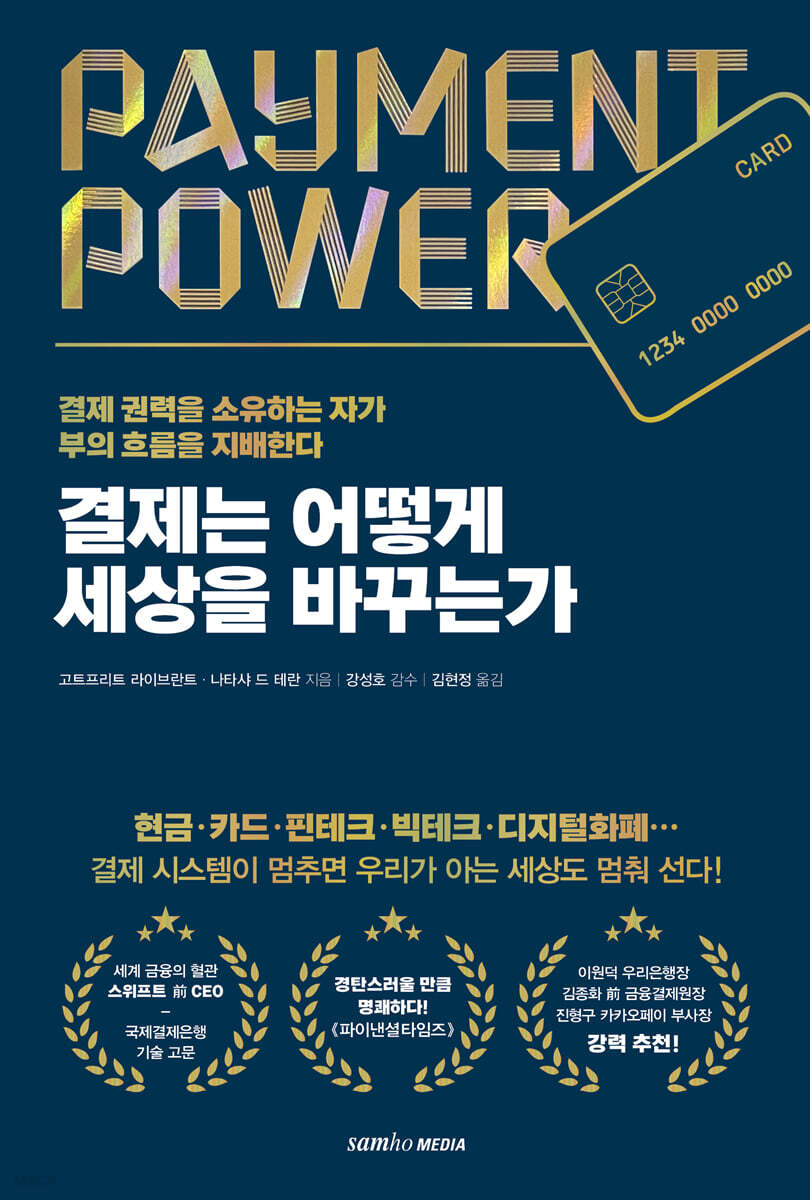
How Payments Are Changing the World
 |
Description
Book Introduction
Moving money, dominating the market, changing the world
Watch the payment power!
Two experts at the center of SWIFT, the blood vessel of global finance, tell us.
A profound and surprising story about money, payments, and our lives.
Shatter our common sense about where true financial power lies!
In the world of money, nothing is more important than payment.
Nothing is more neglected than payment.
Payment is probably the most neglected aspect of our daily lives, despite being an important issue.
We all use a payment system whenever we buy or sell something.
But few people understand how that system works.
We usually don't even wonder how our money gets to the seller through payment methods like credit cards or bank transfers, who makes money during that process, and what kind of competition there is to control the process.
Whether rich or poor, criminal, communist, or capitalist, everyone in this world must use a payment system every single day to survive, and if this payment system fails to function properly, it could lead to not only economic stagnation but also the collapse of law and social order.
Yet, why do we understand so little about how this system works? Perhaps it's because we take it for granted, like water or electricity, as a basic infrastructure.
Payment systems may seem like essential infrastructure for our society, like plumbing or electrical wiring, but they involve far more complex and vast issues.
And as technological advancements rapidly transform payment methods, their complexity, scale, and influence are only growing.
Watch the payment power!
Two experts at the center of SWIFT, the blood vessel of global finance, tell us.
A profound and surprising story about money, payments, and our lives.
Shatter our common sense about where true financial power lies!
In the world of money, nothing is more important than payment.
Nothing is more neglected than payment.
Payment is probably the most neglected aspect of our daily lives, despite being an important issue.
We all use a payment system whenever we buy or sell something.
But few people understand how that system works.
We usually don't even wonder how our money gets to the seller through payment methods like credit cards or bank transfers, who makes money during that process, and what kind of competition there is to control the process.
Whether rich or poor, criminal, communist, or capitalist, everyone in this world must use a payment system every single day to survive, and if this payment system fails to function properly, it could lead to not only economic stagnation but also the collapse of law and social order.
Yet, why do we understand so little about how this system works? Perhaps it's because we take it for granted, like water or electricity, as a basic infrastructure.
Payment systems may seem like essential infrastructure for our society, like plumbing or electrical wiring, but they involve far more complex and vast issues.
And as technological advancements rapidly transform payment methods, their complexity, scale, and influence are only growing.
- You can preview some of the book's contents.
Preview
index
Praise for this book… … 4
Reviewer's Note... ... 10
Introduction In the world of money, nothing is as important as payment, yet nothing is as neglected as payment… … 15
Part 1: Moving Money / When the Flow of Money Stops, the World Stops
01 So what is payment? … … 31
02 But in reality, money doesn't move... ... 44
03 Three Fundamental Challenges Facing Payments… … 51
Part 2: History / Payment methods are evolving to become more convenient and sophisticated.
04 The Mystery Surrounding Cash… … 61
05 The War on Cash… … 73
06 Fantastic Plastic: The Rise of the Cards… … 86
07 Cards Meet New Technology: The Evolution of Cards… …96
08 How Card Companies Conquered the Payment Market: From Credit Cards to Debit Cards… … 111
Part 3: Geography / Why Payment Habits Don't Cross Borders
09 Prisoners of Geography: Why Countries Prefer Different Payment Methods… … 123
10 Creating Something from Nothing: Mobile Payments in China and Kenya… … 139
11 Transforming Finance: India's Real-Time Payments Revolution… … 149
Part 4: The Economics of Money / Those Who Pay Payment Costs and Those Who Make Money from Payments
12 Payment for Payment: The Hidden Indirect Costs of Payment… … 161
13 Making Money by Moving Money: Who Benefits from Payments… … 172
Part 5: Big Money / The Invisible Pipes Connecting Global Financial Markets
How to Steal $14 Billion: How North Korea Robbed the Central Bank of Bangladesh… … 187
15 Invisible Pipes: How Payments Are Made… … 202
How to Move $16 Trillion: Or Why We Need Central Banks… … 214
17 How do we send money abroad if money doesn't actually move? ... 231
Part 6: The Technological Revolution / The Innovation Race to Seize the Future of Payments
18 Is the Party Ending?: Companies Challenging the Role of Banks… … 255
19 Driving Cards in the Online Market: The Rise of Online Specialist Acquirers… … 263
20. Pay first, pay later: The allure of invisible payments… 274
21 New Oil? Open Payment Data… … 284
22 Belief in Code: Meet Cryptocurrency… … 297
23 Big Tech and Banks Enter the Competition… … 318
24 Transforming with Crypto: The Challenges for Central Banks Preparing for Digitalization… … 330
25 Open vs. Closed: What's the Answer?: The Payment Networks' Race for Customer Acquisition… … 341
Part 7: Politics and Regulation / Who Controls Payments?
26 Who is responsible for the payment system: Regulation and regulators… … 355
27 How EU Regulators Restructured Payments… … 366
28 How Payments Become a Powerful Weapon… … 374
29 Follow the Money: The Payment Trail and the War on Financial Crime… … 392
30 If your payment method disappears: Exclusion from the payment system… … 407
Epilogue What happens next? … … 413
Acknowledgments … … 422 References … … 424 Index … … 44
Reviewer's Note... ... 10
Introduction In the world of money, nothing is as important as payment, yet nothing is as neglected as payment… … 15
Part 1: Moving Money / When the Flow of Money Stops, the World Stops
01 So what is payment? … … 31
02 But in reality, money doesn't move... ... 44
03 Three Fundamental Challenges Facing Payments… … 51
Part 2: History / Payment methods are evolving to become more convenient and sophisticated.
04 The Mystery Surrounding Cash… … 61
05 The War on Cash… … 73
06 Fantastic Plastic: The Rise of the Cards… … 86
07 Cards Meet New Technology: The Evolution of Cards… …96
08 How Card Companies Conquered the Payment Market: From Credit Cards to Debit Cards… … 111
Part 3: Geography / Why Payment Habits Don't Cross Borders
09 Prisoners of Geography: Why Countries Prefer Different Payment Methods… … 123
10 Creating Something from Nothing: Mobile Payments in China and Kenya… … 139
11 Transforming Finance: India's Real-Time Payments Revolution… … 149
Part 4: The Economics of Money / Those Who Pay Payment Costs and Those Who Make Money from Payments
12 Payment for Payment: The Hidden Indirect Costs of Payment… … 161
13 Making Money by Moving Money: Who Benefits from Payments… … 172
Part 5: Big Money / The Invisible Pipes Connecting Global Financial Markets
How to Steal $14 Billion: How North Korea Robbed the Central Bank of Bangladesh… … 187
15 Invisible Pipes: How Payments Are Made… … 202
How to Move $16 Trillion: Or Why We Need Central Banks… … 214
17 How do we send money abroad if money doesn't actually move? ... 231
Part 6: The Technological Revolution / The Innovation Race to Seize the Future of Payments
18 Is the Party Ending?: Companies Challenging the Role of Banks… … 255
19 Driving Cards in the Online Market: The Rise of Online Specialist Acquirers… … 263
20. Pay first, pay later: The allure of invisible payments… 274
21 New Oil? Open Payment Data… … 284
22 Belief in Code: Meet Cryptocurrency… … 297
23 Big Tech and Banks Enter the Competition… … 318
24 Transforming with Crypto: The Challenges for Central Banks Preparing for Digitalization… … 330
25 Open vs. Closed: What's the Answer?: The Payment Networks' Race for Customer Acquisition… … 341
Part 7: Politics and Regulation / Who Controls Payments?
26 Who is responsible for the payment system: Regulation and regulators… … 355
27 How EU Regulators Restructured Payments… … 366
28 How Payments Become a Powerful Weapon… … 374
29 Follow the Money: The Payment Trail and the War on Financial Crime… … 392
30 If your payment method disappears: Exclusion from the payment system… … 407
Epilogue What happens next? … … 413
Acknowledgments … … 422 References … … 424 Index … … 44
Detailed image
Into the book
Banks have been at the heart of payments for centuries thanks to their ability to create money.
But the way we pay our money is changing every day.
New technologies are changing everything, and new competitors are eager to offer alternatives to traditional banking.
Banks may need the payments industry to survive, but do we really need banks to make payments?
---From "02 But in reality, money doesn't move"
As the fear and suffering of the COVID-19 pandemic deepened and reports of the virus spreading while exchanging money continued to surface, consumers and merchants began to avoid using banknotes and coins, and instead, payment methods that eliminated the physical exchange of objects suddenly gained popularity.
Digital payments have surged amid predictions that the COVID-19 pandemic could be a turning point in the march toward a cashless future.
Ironically, however, the giant digital payments provider Wirecard collapsed at the very moment it should have seized the opportunity.
---From "05 War on Cash"
Card companies have been constantly innovating, adopting new ideas, and striving to modernize.
As we've seen with Apple Pay and PayPal, and we'll see again with the fintech craze, the power of credit card companies is enormous.
No matter how many new entrants to the payment market seek innovation and come up with new ideas, everything develops around the card companies, ultimately strengthening their influence.
Like it or not, it's now impossible to imagine a world without credit card companies.
---From "07 Card, Meet New Technology: The Evolution of Cards"
Path dependence may sound trivial, but its impact is sometimes referred to as "lock-in."
Consumers and regulators are effectively trapped in a frustrating situation.
Consumers are trapped in systems like Facebook and Alipay and find it difficult to break free.
Entire countries may be locked into a particular payment method, leaving individual consumers with little choice.
Consumers are prisoners of geography.
People's payment methods cannot escape the customs prevailing in each country.
---From "09 Prisoners of Geography: Why Countries Prefer Different Payment Methods"
Consumers who carefully check information may be surprised to hear this story and think:
"I almost never see anything explicitly stated as a payment fee. I read every single word on my credit card. And I never withdraw cash with my credit card. ... (omitted) ... And yet, we consumers pay for transactions one way or another.
Consumers spend a total of about $1 trillion on payments, accounting for 50-70% of all payments companies' revenue.
Consumers are a very valuable asset to payment companies.
So how do payment companies so easily empty our pockets without us even knowing?
---From "12 Payments for Payments: Hidden Indirect Costs of Payments"
The Herstadt Bank failure taught us that it is extremely dangerous to leave large amounts of interbank debt outstanding even for a short period of time.
Debts between banks must be settled through settlement as quickly as possible.
This required a new type of financial pipe connecting banks and central banks.
We needed a very large pipe that could move billions of dollars in the blink of an eye, trillions of dollars before lunch.
---From "How to Move $16 Trillion: Or Why We Need Central Banks"
Big tech companies have significant financial clout, allowing them to offer more consumer services in exchange for payment data, but the business models of Apple Pay, Amazon Pay, and Google Pay are not based on leveraging payment data.
Of course, that doesn't mean it won't happen again in the future.
It remains to be seen what Big Tech companies will do with user payment data once they have sufficient market share.
---From "21 New Oils? Open Payment Data"
The race to seize the future of payments has begun, and no one wants to be last.
Central banks want to control everything, banks want profits, and tech companies want growth.
And what they all know is that technology enables a 'winner-takes-all' scenario.
If not the global market, then at least in each individual market, there is a high possibility that a winner-takes-all scenario will become a reality.
---From "Transforming with Cryptography: The Challenges of Central Banks Preparing for Digitalization"
One of the reasons why the US dollar has been given such excessive privileges is that any bank in any country above a certain size must process large amounts of dollar payments.
This requires access to dollar liquidity and a large dollar settlement system, and the only place where this can be done is the New York interbank market.
For a bank to do international business, it must either have a U.S. subsidiary or branch that directly participates in the large dollar settlement system, or partner with a representative bank that can handle this work.
This is also the reason why Citibank and JP Morgan became the world's largest agent banks.
Both banks enjoy home advantage.
But the way we pay our money is changing every day.
New technologies are changing everything, and new competitors are eager to offer alternatives to traditional banking.
Banks may need the payments industry to survive, but do we really need banks to make payments?
---From "02 But in reality, money doesn't move"
As the fear and suffering of the COVID-19 pandemic deepened and reports of the virus spreading while exchanging money continued to surface, consumers and merchants began to avoid using banknotes and coins, and instead, payment methods that eliminated the physical exchange of objects suddenly gained popularity.
Digital payments have surged amid predictions that the COVID-19 pandemic could be a turning point in the march toward a cashless future.
Ironically, however, the giant digital payments provider Wirecard collapsed at the very moment it should have seized the opportunity.
---From "05 War on Cash"
Card companies have been constantly innovating, adopting new ideas, and striving to modernize.
As we've seen with Apple Pay and PayPal, and we'll see again with the fintech craze, the power of credit card companies is enormous.
No matter how many new entrants to the payment market seek innovation and come up with new ideas, everything develops around the card companies, ultimately strengthening their influence.
Like it or not, it's now impossible to imagine a world without credit card companies.
---From "07 Card, Meet New Technology: The Evolution of Cards"
Path dependence may sound trivial, but its impact is sometimes referred to as "lock-in."
Consumers and regulators are effectively trapped in a frustrating situation.
Consumers are trapped in systems like Facebook and Alipay and find it difficult to break free.
Entire countries may be locked into a particular payment method, leaving individual consumers with little choice.
Consumers are prisoners of geography.
People's payment methods cannot escape the customs prevailing in each country.
---From "09 Prisoners of Geography: Why Countries Prefer Different Payment Methods"
Consumers who carefully check information may be surprised to hear this story and think:
"I almost never see anything explicitly stated as a payment fee. I read every single word on my credit card. And I never withdraw cash with my credit card. ... (omitted) ... And yet, we consumers pay for transactions one way or another.
Consumers spend a total of about $1 trillion on payments, accounting for 50-70% of all payments companies' revenue.
Consumers are a very valuable asset to payment companies.
So how do payment companies so easily empty our pockets without us even knowing?
---From "12 Payments for Payments: Hidden Indirect Costs of Payments"
The Herstadt Bank failure taught us that it is extremely dangerous to leave large amounts of interbank debt outstanding even for a short period of time.
Debts between banks must be settled through settlement as quickly as possible.
This required a new type of financial pipe connecting banks and central banks.
We needed a very large pipe that could move billions of dollars in the blink of an eye, trillions of dollars before lunch.
---From "How to Move $16 Trillion: Or Why We Need Central Banks"
Big tech companies have significant financial clout, allowing them to offer more consumer services in exchange for payment data, but the business models of Apple Pay, Amazon Pay, and Google Pay are not based on leveraging payment data.
Of course, that doesn't mean it won't happen again in the future.
It remains to be seen what Big Tech companies will do with user payment data once they have sufficient market share.
---From "21 New Oils? Open Payment Data"
The race to seize the future of payments has begun, and no one wants to be last.
Central banks want to control everything, banks want profits, and tech companies want growth.
And what they all know is that technology enables a 'winner-takes-all' scenario.
If not the global market, then at least in each individual market, there is a high possibility that a winner-takes-all scenario will become a reality.
---From "Transforming with Cryptography: The Challenges of Central Banks Preparing for Digitalization"
One of the reasons why the US dollar has been given such excessive privileges is that any bank in any country above a certain size must process large amounts of dollar payments.
This requires access to dollar liquidity and a large dollar settlement system, and the only place where this can be done is the New York interbank market.
For a bank to do international business, it must either have a U.S. subsidiary or branch that directly participates in the large dollar settlement system, or partner with a representative bank that can handle this work.
This is also the reason why Citibank and JP Morgan became the world's largest agent banks.
Both banks enjoy home advantage.
---From "28 How Payment Becomes a Powerful Weapon"
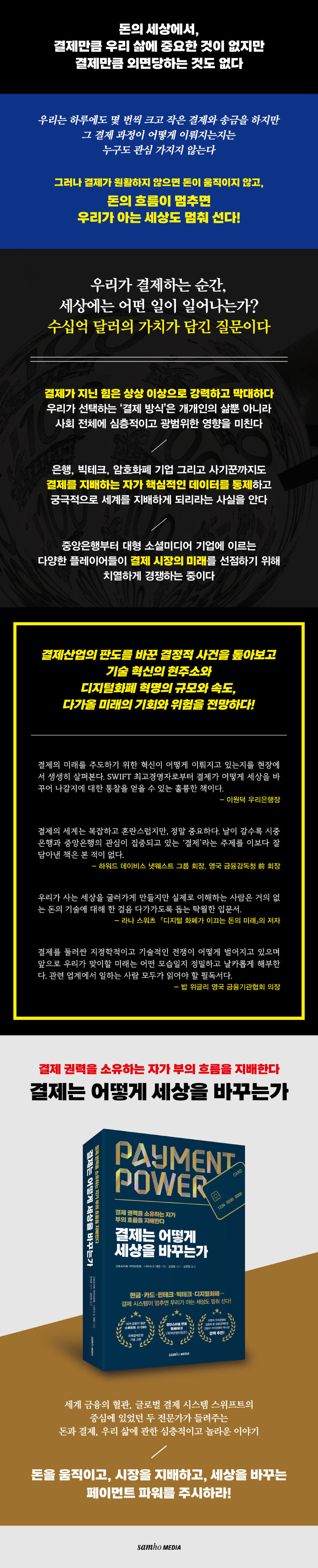
Publisher's Review
What happens in the world the moment we make a payment?
It's a question worth billions of dollars.
Cash, cards, fintech, big tech, digital currency…
Whoever holds the power to pay controls the flow of wealth.
The power of payment is much more powerful and immense than you can imagine.
Paying money may be a simple and immediate act, but the way we choose to pay has a profound and far-reaching impact not only on our individual lives but also on society as a whole.
Moreover, payment methods are changing more rapidly than ever before, and the means we use are also changing accordingly.
What used to be done by handing over cash or sending money has now become a payment that can be completed with just a few clicks, and now you can make payments with just a swipe or touch of your phone screen.
This change doesn't stop at eliminating physical wallets from our pockets.
The payment method we choose affects how much we pay, the risks involved, and who has access to our personal data.
This is because not only the payment method is changing, but also the system that supports it and the entity that owns the system are changing.
This could change the landscape of economics, politics, and even national security.
It determines how much wealth a group will have, who 'owns' payment power and how they exercise it, and who will be excluded from the payment system and marginalized in society as a result.
The consequences of this change are hard to imagine.
Currently, various players, ranging from central banks around the world to large social media companies, are fiercely competing to dominate the payments industry.
Banks, Big Tech, cryptocurrency companies, and even fraudsters know that whoever controls payments will control critical data and ultimately rule the world.
Let's take a look at the decisive events that changed the landscape of the payment industry.
The current state of global technological innovation and the scale and speed of the digital currency revolution.
Anticipating future opportunities and risks
The payments industry is evolving rapidly.
Beyond simply enhancing consumer convenience, it is moving toward a level where payment behavior is not even recognized, and by combining it with various technologies, it is expanding its scope into the data business.
Many of the technologies driving change in payments today have actually only been around for a decade.
Just a decade ago, big tech companies like Amazon and Facebook were, at best, medium tech.
Who could have imagined that China would process the majority of global electronic payments thanks to two wildly popular apps, Alipay and Tenpay? Who could have imagined that mobile phones would revolutionize payment access in developing countries and bring a third of the world's population into financial services? Who could have imagined that central banks would seriously consider the cashless trend and experiment with cryptocurrencies? Who could have predicted that payment service providers like Visa, Mastercard, PayPal, Square, and Adyen would now be valued higher than most banks? Payments today rely on semiconductors, telecommunications devices, mobile phones, networks, and currencies.
But who knows what technologies will be used in the future? The payments industry is transforming our lives and even the industrial landscape, but few truly understand what's driving this change, and what consequences, regardless of whether it's right or wrong, will result.
"How Payments Change the World" is an in-depth and surprising story about money, payments, and our lives told by two experts who were at the heart of SWIFT, the global payment system known as the "blood vessel of global finance."
Gottfried Leibland, currently a technical advisor at the Bank for International Settlements, served as Swift's CEO for over a decade, while another author, Natasha de Teran, is a financial journalist who has written for the Wall Street Journal, the Financial Times, and other publications, and was head of Swift's corporate division.
These two authors, with their deep understanding and expertise across the world of payments, present significant innovations and crises in the payments industry in an accessible and engaging narrative, while also clearly illustrating the macroeconomic trends encompassing the past, present, and future of payments.
It explains the mechanisms of payment, the "way money moves" that powers modern society, and reveals how the payment system we all rely on actually operates and how it is sometimes abused.
This book provides a detailed and in-depth historical and core context on how payment methods and systems have evolved, intertwined with the evolution of currency and banking, geopolitical factors, socio-political and economic conditions, and technological advancements.
This helps bridge the huge gap between the importance of payments and the perceived indifference to them, and provides a more three-dimensional understanding of the world of payments.
Packed with all the common sense and in-depth information on payments, finance, and global affairs, "How Payments Change the World" will dramatically change the way we understand and think about payments.
As the geopolitical and technological battle over payments intensifies, this book offers insights that will help us anticipate the enormous risks we face and prepare for a future of boundless possibilities.
Discover the true power of 'payment power': moving money, dominating markets, and changing the world!
It's a question worth billions of dollars.
Cash, cards, fintech, big tech, digital currency…
Whoever holds the power to pay controls the flow of wealth.
The power of payment is much more powerful and immense than you can imagine.
Paying money may be a simple and immediate act, but the way we choose to pay has a profound and far-reaching impact not only on our individual lives but also on society as a whole.
Moreover, payment methods are changing more rapidly than ever before, and the means we use are also changing accordingly.
What used to be done by handing over cash or sending money has now become a payment that can be completed with just a few clicks, and now you can make payments with just a swipe or touch of your phone screen.
This change doesn't stop at eliminating physical wallets from our pockets.
The payment method we choose affects how much we pay, the risks involved, and who has access to our personal data.
This is because not only the payment method is changing, but also the system that supports it and the entity that owns the system are changing.
This could change the landscape of economics, politics, and even national security.
It determines how much wealth a group will have, who 'owns' payment power and how they exercise it, and who will be excluded from the payment system and marginalized in society as a result.
The consequences of this change are hard to imagine.
Currently, various players, ranging from central banks around the world to large social media companies, are fiercely competing to dominate the payments industry.
Banks, Big Tech, cryptocurrency companies, and even fraudsters know that whoever controls payments will control critical data and ultimately rule the world.
Let's take a look at the decisive events that changed the landscape of the payment industry.
The current state of global technological innovation and the scale and speed of the digital currency revolution.
Anticipating future opportunities and risks
The payments industry is evolving rapidly.
Beyond simply enhancing consumer convenience, it is moving toward a level where payment behavior is not even recognized, and by combining it with various technologies, it is expanding its scope into the data business.
Many of the technologies driving change in payments today have actually only been around for a decade.
Just a decade ago, big tech companies like Amazon and Facebook were, at best, medium tech.
Who could have imagined that China would process the majority of global electronic payments thanks to two wildly popular apps, Alipay and Tenpay? Who could have imagined that mobile phones would revolutionize payment access in developing countries and bring a third of the world's population into financial services? Who could have imagined that central banks would seriously consider the cashless trend and experiment with cryptocurrencies? Who could have predicted that payment service providers like Visa, Mastercard, PayPal, Square, and Adyen would now be valued higher than most banks? Payments today rely on semiconductors, telecommunications devices, mobile phones, networks, and currencies.
But who knows what technologies will be used in the future? The payments industry is transforming our lives and even the industrial landscape, but few truly understand what's driving this change, and what consequences, regardless of whether it's right or wrong, will result.
"How Payments Change the World" is an in-depth and surprising story about money, payments, and our lives told by two experts who were at the heart of SWIFT, the global payment system known as the "blood vessel of global finance."
Gottfried Leibland, currently a technical advisor at the Bank for International Settlements, served as Swift's CEO for over a decade, while another author, Natasha de Teran, is a financial journalist who has written for the Wall Street Journal, the Financial Times, and other publications, and was head of Swift's corporate division.
These two authors, with their deep understanding and expertise across the world of payments, present significant innovations and crises in the payments industry in an accessible and engaging narrative, while also clearly illustrating the macroeconomic trends encompassing the past, present, and future of payments.
It explains the mechanisms of payment, the "way money moves" that powers modern society, and reveals how the payment system we all rely on actually operates and how it is sometimes abused.
This book provides a detailed and in-depth historical and core context on how payment methods and systems have evolved, intertwined with the evolution of currency and banking, geopolitical factors, socio-political and economic conditions, and technological advancements.
This helps bridge the huge gap between the importance of payments and the perceived indifference to them, and provides a more three-dimensional understanding of the world of payments.
Packed with all the common sense and in-depth information on payments, finance, and global affairs, "How Payments Change the World" will dramatically change the way we understand and think about payments.
As the geopolitical and technological battle over payments intensifies, this book offers insights that will help us anticipate the enormous risks we face and prepare for a future of boundless possibilities.
Discover the true power of 'payment power': moving money, dominating markets, and changing the world!
GOODS SPECIFICS
- Date of issue: January 30, 2023
- Page count, weight, size: 456 pages | 798g | 152*225*28mm
- ISBN13: 9788978496766
- ISBN10: 8978496768
You may also like
카테고리
korean


korean

![GQ KOREA Mark (Monthly): December [2025]](http://librairie.coreenne.fr/cdn/shop/files/8ef265dbbfbf186523ed75ba7319009d.jpg?v=1765340328&width=3840)


