

Currency Wars 5: The Greed Economy
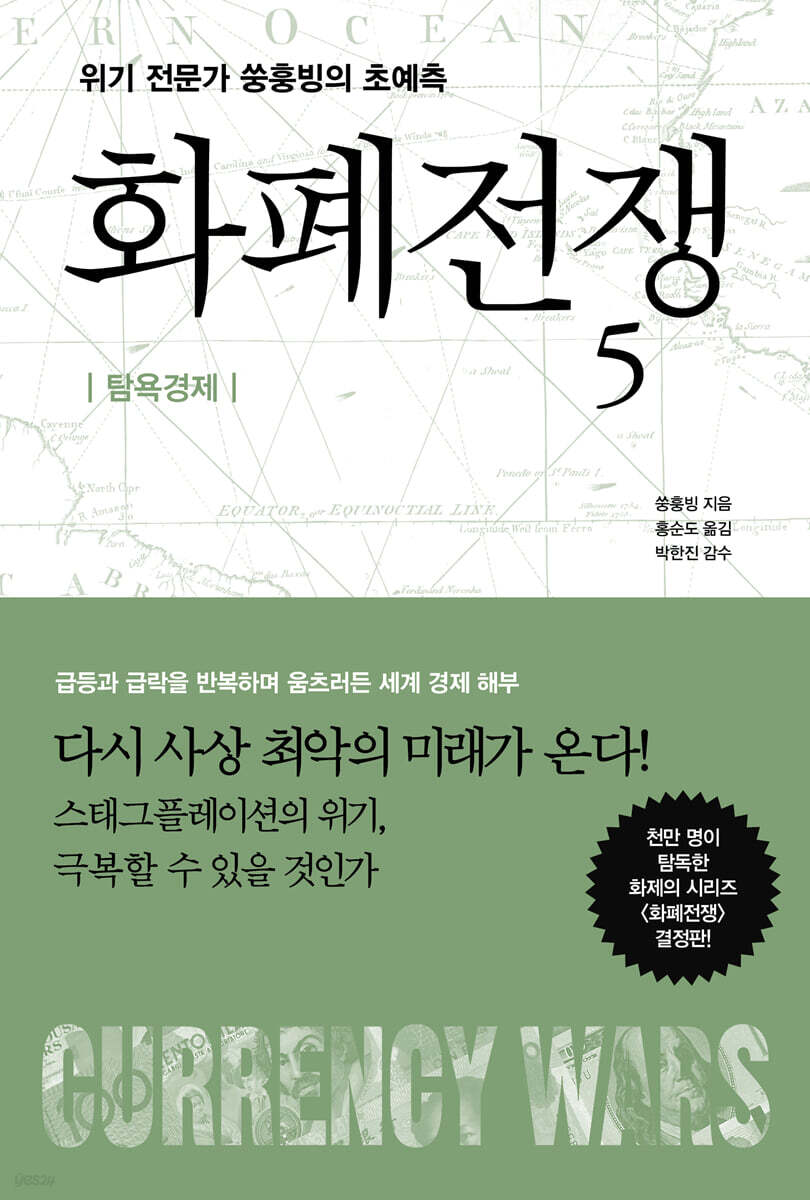 |
Description
Book Introduction
“The worst future ever is coming!”
Austerity, welfare cuts, corporate deregulation…
Let's break down the illusion that we are looking for opportunity in a crisis.
The super-forecast of world-renowned financial expert Song Hongbing
Song Hongbing, the international finance scholar who made surprising predictions during every global financial crisis, has returned.
This book is a re-publication of 『Greed Economy』, which was published in 2014 as part of the previous [Currency Wars] series.
This completes the five-part best-selling series [Currency Wars], which has been read by major countries around the world, including superpowers like the United States and China, as well as financial meccas like Hong Kong, Japan, and South Korea.
Why should you reread "Currency Wars" now? The author, Song Hongbing, accurately predicted the US-originated financial crisis and the shift in the gold market the following year in his 2007 book, which caused a stir in political, business, and academic circles.
Afterwards, in volumes 2-4 of the same-titled book, he looked back on the financial history of the United States, Europe, and Asia, and predicted an era of currency wars in which the dollar, euro, and yuan (the single Asian currency) would compete, creating much buzz.
Finally, in the fifth volume of this series, the author warns of a super global financial crisis by capturing the reality that the greed of financial power has created an asset bubble larger than that of the 2008 financial crisis, yet no one raises the issue.
And now, in 2022, we are facing another economic downturn, with high interest rates, a real estate crash, a sharp decline in exports due to the prolonged Ukraine crisis, and the negative impact of a strong dollar, along with a surge in the consumer price index.
Amidst the anxious predictions that the economic downturn will be even more severe than the one experienced during the last IMF crisis, this book will present solutions to overcome the financial crisis.
Austerity, welfare cuts, corporate deregulation…
Let's break down the illusion that we are looking for opportunity in a crisis.
The super-forecast of world-renowned financial expert Song Hongbing
Song Hongbing, the international finance scholar who made surprising predictions during every global financial crisis, has returned.
This book is a re-publication of 『Greed Economy』, which was published in 2014 as part of the previous [Currency Wars] series.
This completes the five-part best-selling series [Currency Wars], which has been read by major countries around the world, including superpowers like the United States and China, as well as financial meccas like Hong Kong, Japan, and South Korea.
Why should you reread "Currency Wars" now? The author, Song Hongbing, accurately predicted the US-originated financial crisis and the shift in the gold market the following year in his 2007 book, which caused a stir in political, business, and academic circles.
Afterwards, in volumes 2-4 of the same-titled book, he looked back on the financial history of the United States, Europe, and Asia, and predicted an era of currency wars in which the dollar, euro, and yuan (the single Asian currency) would compete, creating much buzz.
Finally, in the fifth volume of this series, the author warns of a super global financial crisis by capturing the reality that the greed of financial power has created an asset bubble larger than that of the 2008 financial crisis, yet no one raises the issue.
And now, in 2022, we are facing another economic downturn, with high interest rates, a real estate crash, a sharp decline in exports due to the prolonged Ukraine crisis, and the negative impact of a strong dollar, along with a surge in the consumer price index.
Amidst the anxious predictions that the economic downturn will be even more severe than the one experienced during the last IMF crisis, this book will present solutions to overcome the financial crisis.
- You can preview some of the book's contents.
Preview
index
Reviewer's note
To Korean readers
introduction
Chapter 1: The Gold Massacre: The Prelude to the War for the Dollar
The Full Story of the 'April 12 Gold Massacre' | April 15th: The First Extreme Fear in 2 Million Years in the Gold Market | 'Chinese Bullionists' Counterattack Wall Street | London Gold Market: Noble Class, Secret Activities | The Rapid Expansion of the Swiss Gold Market | New York Gold Market: A Cowboy's Paradise, a Gambler's Paradise | QE3 Creates a Massive Wave, Shaking the US Dollar's Status | A Fierce Competition to Devalue Currency Among Advanced Countries | Currency 'Revolts' Aimed at the Impending Dollar | Germany Repatriates Its Reserves | Chain Reaction: The Bank of England's Self-Produced Play Using the Queen | The EU's Open Looting Spreads Fear Among Cyprus Depositors | COMEX Gold Inventory on Red Alert | Inventory Suspicions | Gold ETFs: The 'Slush Funds' of Wall Street Bigwigs | Inside Story | A Preliminary Look at the Future of Gold and Silver | Conclusion
Chapter 2: The Truth Revealed Beyond the Bubble Space
Black Eagles in the Stock Market | Why Ben Bernanke Was So Shocked | Is the US Stock Market a Real Boom or a False Prosperity? | The Real Reason for Share Buybacks | What is the Future of Debt-Buying Stocks? | The Growing Problem of Corporate Asset Aging | The Future of the Stock Market After Removing Respirators | The Bond Market in Turmoil | Shrinking Corporate Bond Inventories, Market Makers in Crisis | Junk Bonds: The "Subprime Mortgage Loans" of Corporate Bonds | Conclusion
Chapter 3: The Money Drought and the Reality of Shadow Banking
A shower of rain on Wall Street, the Syrian civil war | Repos: Transactions using bonds as collateral | June's nightmare in the repo market | The traditional banking system's money creation principles | A new concept in currency: 'shadow money' | Re-collateralization: The trick of sealing multiple bottles with a single lid | 'Repo maturity' transactions: A new trick for financial magicians | Junk bonds' 'fantastic drift' | Shadow money and shadow banking | The scale of shadow money creation in the repo market | The causes of the June money drought | Conclusion
Chapter 4: The 'Final Judgment' Caused by the Asset Collapse
Ben Bernanke's capriciousness has eroded the Fed's tapering policy | The QE Titanic crashes into the RP iceberg | BIS regulations worsen the collateral asset shortage | How can shadow banks break through the layers of encirclement? | Interest rate distortion: The game in which the Fed plays both referee and goalkeeper | Interest rate volcano: The ultimate killer of asset bubbles | Interest rate swaps: The wounded New Yorkers | The dark hand behind the Detroit bankruptcy | Interest rate swaps: A rate 'trap' | The origin of Libor | Who manipulates interest rates? | The ultra-low interest rate policy that created the largest asset bubble in history | Ending QE or continuing it, that is the question | Conclusion
Chapter 5: The Changing Landscape: The Rise of Wall Street Real Estate Speculators
Foreclosures: The Root Cause of Declining Real Estate Prices | Foreclosure Moratorium: A Shortcut to Calming the Real Estate Downturn | The Wall Street Real Estate Speculators' Scheme to Reverse Real Estate Prices | Phoenix, the First Test Site | A Big Gamble in the 'Gambling City' | Traveling Through Southern California | Blackstone, America's Largest Landlord | Who Are the Victims of the Wall Street Real Estate Speculators' Scheme? | Has the Real Estate Market Revived, or Are We Still in a Dream? | The 'Kangaroo Tribe': A New Trend Among Millennials | The Interest Rate Volcano That Will Soon Ignite the Real Estate Market | The Fatal Trap of Invitation Homes | The Great Escape Route | The Second Exit: Rental-Backed Securities | Conclusion
Chapter 6: Wealth Polarization and the Lost American Dream
A President Shunned on Wall Street | The Volcker Rule | The London Whale Story | The Lawless and the Lawless | The Decline of the Middle Class | The Current State of the American Job Market | A House Built on Rock or a House Built on Sand? | The Growing Wealth Polarization: The American Dream Crushed | A Dream Trampled by Greed | Wealth Inequality Worse Than Income | Conclusion
Chapter 7: The Decline and Fall of Ancient Rome, Marked by Greed
The Death of the Tribune Gracchus | The Rise of Gracchus | The Land Reform of the Gracchus Brothers | The Roman Republic: Founded by Diligence, Overthrown by Greed | The Transition from Internal Plunder to External Expansion | The Monetary Economy of the Roman Empire | The Weakened Monetary Circulation System | The Latent Economic Crisis | The Economic Nature of Military Dictatorship | Currency Devaluation and Hyperinflation | The Collapse of the Monetary System: The End of the Roman Empire | Conclusion
Chapter 8: The Fall of the Northern Song Dynasty: The Dark Side Hidden Behind the Glamour
The Northern Song Dynasty, the dynasty that blossomed the second monetary civilization in human history | Liquidity overload and inflation | The rise of the bankers | The struggle between money and power | The 6-7% of the wealthy own 60-70% of the land | The collapse of the Northern Song dream | The 'money drought' that made matters worse | The reasons for the failure of Wang Anshi's reforms | The final whirlwind of greed | The world's first paper money, the dumplings | Unstoppable greed | Conclusion
Chapter 9: What the China Dream Isn't
Lessons from the Roman Dream, the Song Dream, and the American Dream's Downfall | America's Second Wealth Concentration | What the China Dream Isn't | Real Estate and Income Distribution | The Key to Urbanization: Job Creation | Land Transfer and Farmer Income | A Strong Faith Makes Dreams Come True
Reviews
Translator's Note
main
Search
To Korean readers
introduction
Chapter 1: The Gold Massacre: The Prelude to the War for the Dollar
The Full Story of the 'April 12 Gold Massacre' | April 15th: The First Extreme Fear in 2 Million Years in the Gold Market | 'Chinese Bullionists' Counterattack Wall Street | London Gold Market: Noble Class, Secret Activities | The Rapid Expansion of the Swiss Gold Market | New York Gold Market: A Cowboy's Paradise, a Gambler's Paradise | QE3 Creates a Massive Wave, Shaking the US Dollar's Status | A Fierce Competition to Devalue Currency Among Advanced Countries | Currency 'Revolts' Aimed at the Impending Dollar | Germany Repatriates Its Reserves | Chain Reaction: The Bank of England's Self-Produced Play Using the Queen | The EU's Open Looting Spreads Fear Among Cyprus Depositors | COMEX Gold Inventory on Red Alert | Inventory Suspicions | Gold ETFs: The 'Slush Funds' of Wall Street Bigwigs | Inside Story | A Preliminary Look at the Future of Gold and Silver | Conclusion
Chapter 2: The Truth Revealed Beyond the Bubble Space
Black Eagles in the Stock Market | Why Ben Bernanke Was So Shocked | Is the US Stock Market a Real Boom or a False Prosperity? | The Real Reason for Share Buybacks | What is the Future of Debt-Buying Stocks? | The Growing Problem of Corporate Asset Aging | The Future of the Stock Market After Removing Respirators | The Bond Market in Turmoil | Shrinking Corporate Bond Inventories, Market Makers in Crisis | Junk Bonds: The "Subprime Mortgage Loans" of Corporate Bonds | Conclusion
Chapter 3: The Money Drought and the Reality of Shadow Banking
A shower of rain on Wall Street, the Syrian civil war | Repos: Transactions using bonds as collateral | June's nightmare in the repo market | The traditional banking system's money creation principles | A new concept in currency: 'shadow money' | Re-collateralization: The trick of sealing multiple bottles with a single lid | 'Repo maturity' transactions: A new trick for financial magicians | Junk bonds' 'fantastic drift' | Shadow money and shadow banking | The scale of shadow money creation in the repo market | The causes of the June money drought | Conclusion
Chapter 4: The 'Final Judgment' Caused by the Asset Collapse
Ben Bernanke's capriciousness has eroded the Fed's tapering policy | The QE Titanic crashes into the RP iceberg | BIS regulations worsen the collateral asset shortage | How can shadow banks break through the layers of encirclement? | Interest rate distortion: The game in which the Fed plays both referee and goalkeeper | Interest rate volcano: The ultimate killer of asset bubbles | Interest rate swaps: The wounded New Yorkers | The dark hand behind the Detroit bankruptcy | Interest rate swaps: A rate 'trap' | The origin of Libor | Who manipulates interest rates? | The ultra-low interest rate policy that created the largest asset bubble in history | Ending QE or continuing it, that is the question | Conclusion
Chapter 5: The Changing Landscape: The Rise of Wall Street Real Estate Speculators
Foreclosures: The Root Cause of Declining Real Estate Prices | Foreclosure Moratorium: A Shortcut to Calming the Real Estate Downturn | The Wall Street Real Estate Speculators' Scheme to Reverse Real Estate Prices | Phoenix, the First Test Site | A Big Gamble in the 'Gambling City' | Traveling Through Southern California | Blackstone, America's Largest Landlord | Who Are the Victims of the Wall Street Real Estate Speculators' Scheme? | Has the Real Estate Market Revived, or Are We Still in a Dream? | The 'Kangaroo Tribe': A New Trend Among Millennials | The Interest Rate Volcano That Will Soon Ignite the Real Estate Market | The Fatal Trap of Invitation Homes | The Great Escape Route | The Second Exit: Rental-Backed Securities | Conclusion
Chapter 6: Wealth Polarization and the Lost American Dream
A President Shunned on Wall Street | The Volcker Rule | The London Whale Story | The Lawless and the Lawless | The Decline of the Middle Class | The Current State of the American Job Market | A House Built on Rock or a House Built on Sand? | The Growing Wealth Polarization: The American Dream Crushed | A Dream Trampled by Greed | Wealth Inequality Worse Than Income | Conclusion
Chapter 7: The Decline and Fall of Ancient Rome, Marked by Greed
The Death of the Tribune Gracchus | The Rise of Gracchus | The Land Reform of the Gracchus Brothers | The Roman Republic: Founded by Diligence, Overthrown by Greed | The Transition from Internal Plunder to External Expansion | The Monetary Economy of the Roman Empire | The Weakened Monetary Circulation System | The Latent Economic Crisis | The Economic Nature of Military Dictatorship | Currency Devaluation and Hyperinflation | The Collapse of the Monetary System: The End of the Roman Empire | Conclusion
Chapter 8: The Fall of the Northern Song Dynasty: The Dark Side Hidden Behind the Glamour
The Northern Song Dynasty, the dynasty that blossomed the second monetary civilization in human history | Liquidity overload and inflation | The rise of the bankers | The struggle between money and power | The 6-7% of the wealthy own 60-70% of the land | The collapse of the Northern Song dream | The 'money drought' that made matters worse | The reasons for the failure of Wang Anshi's reforms | The final whirlwind of greed | The world's first paper money, the dumplings | Unstoppable greed | Conclusion
Chapter 9: What the China Dream Isn't
Lessons from the Roman Dream, the Song Dream, and the American Dream's Downfall | America's Second Wealth Concentration | What the China Dream Isn't | Real Estate and Income Distribution | The Key to Urbanization: Job Creation | Land Transfer and Farmer Income | A Strong Faith Makes Dreams Come True
Reviews
Translator's Note
main
Search
Detailed image
.jpg)
Into the book
The reason why people do not properly recognize the nature of economic activity lies elsewhere.
This is because it lacks a deep and unified logical framework.
People do not generally engage in economic activities based on highly rational judgment.
They simply pursue wealth under the dominance of strong desire.
Human nature, especially the deep-seated greed within it, has been the fundamental force driving the economy from ancient times to the present.
Since the beginning of time, all human activities have fundamentally not gone beyond the categories of ‘wealth creation’ and ‘wealth distribution.’
All other activities are derived from these two.
Moreover, it was human 'greed' that acted as the ultimate driving force, intervening in the entire process of wealth creation and distribution from beginning to end.
---From the "Preface"
Britain was the first country in the world to introduce the gold standard in the early 19th century.
European countries followed Britain's lead and implemented the gold standard one after another.
At that time, the United States was seen by Europeans as an 'uncivilized land' completely separated from financial civilization.
At that time, the United States had neither a modern central bank nor a stable monetary system.
From colonial times, a wide variety of currencies were produced, from colonial banknotes to gold and silver coins and even Lincoln's greenbacks.
Even each bank had the legal right to issue its own currency.
Thus, the 19th century was a time when the American monetary system experimentally developed amidst great confusion and controversy.
The irony is that this monetary chaos did not hinder economic development.
Rather, the U.S. economy achieved remarkable growth during this period.
Thanks to this, the United States, once a British colony, rose to become the world's most powerful nation in the 19th century, surpassing the advanced countries of Europe.
When people become rich overnight, they want to imitate nobles, something they never thought of before.
Even the United States, after emerging as an economic power, realized that its chaotic monetary system was somewhat unsightly.
It was judged that while the constant concentration of wealth and power was good, the chaos of the monetary system did not fit the image of an economic powerhouse.
Eventually, the United States also adopted the gold standard in 1900.
The price of gold is legally set at $20.67 per ounce.
America became a nouveau riche during World War I.
The influx of large amounts of European gold into the United States created a booming American economy in the 1920s and a subsequent gold bubble.
Finally, in 1929, the U.S. stock market crashed, and in 1931, U.S. banks began to fail one after another.
---From "Chapter 1: The Golden Massacre, the Prelude to the War for the Dollar"
QE policies led to a sharp decline in the dollar exchange rate.
S&P 500 listed companies are leading companies in each sector of the U.S. economy, and their overseas sales account for 30-50% of their total sales.
The decline in the value of the dollar has had a positive effect on the international competitiveness of these companies, leading to a significant increase in their overseas market sales.
In addition, by converting overseas profits into dollars and reflecting them in the company's financial statements, the effect of asset expansion through exchange rates can be achieved.
In short, the company's profits increased significantly thanks to growth in overseas sales and the 'positive effect of the exchange rate.'
The following five factors can be cited as the reasons for the significant increase in corporate earnings per share since 2009.
These include reduced operating costs through large-scale layoffs, increased productivity, reduced financial costs, increased overseas sales due to the depreciation of the dollar, and increased book profits due to the positive effect of exchange rates.
---From "Chapter 2: The Truth Revealed Beyond the Bubble Space"
The U.S. government is the most creditworthy borrower of Treasury bonds in the market.
Everyone faces the possibility of bankruptcy, but the U.S. government is an exception.
As long as the country called the United States exists, the US government can print money and pay off its debts.
Therefore, in the bond market, government bond yields are the lowest.
On the other hand, the yields on other similar bonds are all higher than the yields on government bonds.
With Treasury yields up 70%, other bond yields were even higher.
Among them, the yield on junk bonds has risen sharply.
A sharp rise in bond yields signals a sharp drop in bond prices, leading to a massive sell-off in the bond market.
Some might argue that a government bond yield of 2.83% is still low, and that there would be no problem if it rose further.
The importance of government bond yields should not be underestimated.
Because Treasury yields serve as a benchmark for pricing U.S. financial assets, a sharp rise in yields would have a significant impact on the $38 trillion bond market and the $19 trillion stock market.
---From "Chapter 3: The Money Drought and the Reality of Shadow Banking"
The trillions of dollars of collateral in the RP market should not be underestimated.
This collateral asset serves a similar role as the base currency of the traditional banking system and is a key asset that provides liquidity to the tens of trillions of dollars in the U.S. shadow banking system.
The shadow banking system is very large in scale, but it tends to be highly dependent on market trust.
Collateral chains, which are stretched and taut, are very sensitive to even the slightest changes in traders' behavior.
In addition, shadow banking cannot attract traditional deposits and relies solely on short-term loans from financial institutions.
Loan periods can be as short as next day.
While traditional bank deposits can concentrate the scattered funds of thousands or tens of thousands of individual depositors, repo lending only serves as a major source of highly concentrated funds from financial institutions.
When the market fluctuates significantly, financial institutions are always the first to hear the news and make the quickest decision to withdraw investments. Therefore, in times of emergency, the speed of withdrawal from the RP market is much faster than in other markets.
---From "Chapter 4: The 'Final Judgment' Brought About by the Collapse of Assets"
Countless small and medium-sized financial institutions, overseas hot money, individual investors, and even sovereign wealth funds have jumped on the "chariot" of Wall Street real estate speculators to secure a share of the bubble-filled real estate market.
In August 2013, US home sales reached 5.6 million units.
Among these, the cash payment ratio was 45%, far exceeding 30% in August 2012.
Under normal circumstances, the cash settlement ratio in the real estate market was around 10-20%.
Among major cities with a population of over 1 million, the cities with the highest percentages of cash payments were Miami (69%), Detroit (68%), Las Vegas (66%), Jacksonville, Florida (65%), and Tampa Bay (64%).
Needless to say, the Wall Street real estate speculators have been the main driving force behind the rise in U.S. real estate prices.
---From "Chapter 5: The Changing Situation: The Rise of Wall Street Real Estate Speculators"
Banks' investments in hedge funds and private equity funds are like stock speculation in the 1930s, with the profits going to the banks and the losses being passed on to taxpayers.
Who would turn down such a good deal where you have to lose to get your money back?
The problem of proprietary trading is relatively complex.
This is also the provision of the Dodd-Frank Act that drew the strongest opposition from Wall Street financial institutions.
The criteria for determining whether a bank's equity transactions comply with the Volcker Rule depend on whether the purpose of the transaction is profit or risk hedging.
If you engage in proprietary trading for the purpose of making a profit, your depositors' money will inevitably be exposed to risk.
Every business has its ups and downs. If banks keep the profits, who should be held accountable for the losses? Should the government step in and clean up the mess with taxpayer money? Wall Street financial institutions responded to this question as follows:
“The reason banks engage in proprietary trading is to hedge the risks associated with their assets, not to generate profits.
It's just like taking out an insurance policy.
“How can a bank operate if it doesn’t even have the right to avoid risk?”
This is because it lacks a deep and unified logical framework.
People do not generally engage in economic activities based on highly rational judgment.
They simply pursue wealth under the dominance of strong desire.
Human nature, especially the deep-seated greed within it, has been the fundamental force driving the economy from ancient times to the present.
Since the beginning of time, all human activities have fundamentally not gone beyond the categories of ‘wealth creation’ and ‘wealth distribution.’
All other activities are derived from these two.
Moreover, it was human 'greed' that acted as the ultimate driving force, intervening in the entire process of wealth creation and distribution from beginning to end.
---From the "Preface"
Britain was the first country in the world to introduce the gold standard in the early 19th century.
European countries followed Britain's lead and implemented the gold standard one after another.
At that time, the United States was seen by Europeans as an 'uncivilized land' completely separated from financial civilization.
At that time, the United States had neither a modern central bank nor a stable monetary system.
From colonial times, a wide variety of currencies were produced, from colonial banknotes to gold and silver coins and even Lincoln's greenbacks.
Even each bank had the legal right to issue its own currency.
Thus, the 19th century was a time when the American monetary system experimentally developed amidst great confusion and controversy.
The irony is that this monetary chaos did not hinder economic development.
Rather, the U.S. economy achieved remarkable growth during this period.
Thanks to this, the United States, once a British colony, rose to become the world's most powerful nation in the 19th century, surpassing the advanced countries of Europe.
When people become rich overnight, they want to imitate nobles, something they never thought of before.
Even the United States, after emerging as an economic power, realized that its chaotic monetary system was somewhat unsightly.
It was judged that while the constant concentration of wealth and power was good, the chaos of the monetary system did not fit the image of an economic powerhouse.
Eventually, the United States also adopted the gold standard in 1900.
The price of gold is legally set at $20.67 per ounce.
America became a nouveau riche during World War I.
The influx of large amounts of European gold into the United States created a booming American economy in the 1920s and a subsequent gold bubble.
Finally, in 1929, the U.S. stock market crashed, and in 1931, U.S. banks began to fail one after another.
---From "Chapter 1: The Golden Massacre, the Prelude to the War for the Dollar"
QE policies led to a sharp decline in the dollar exchange rate.
S&P 500 listed companies are leading companies in each sector of the U.S. economy, and their overseas sales account for 30-50% of their total sales.
The decline in the value of the dollar has had a positive effect on the international competitiveness of these companies, leading to a significant increase in their overseas market sales.
In addition, by converting overseas profits into dollars and reflecting them in the company's financial statements, the effect of asset expansion through exchange rates can be achieved.
In short, the company's profits increased significantly thanks to growth in overseas sales and the 'positive effect of the exchange rate.'
The following five factors can be cited as the reasons for the significant increase in corporate earnings per share since 2009.
These include reduced operating costs through large-scale layoffs, increased productivity, reduced financial costs, increased overseas sales due to the depreciation of the dollar, and increased book profits due to the positive effect of exchange rates.
---From "Chapter 2: The Truth Revealed Beyond the Bubble Space"
The U.S. government is the most creditworthy borrower of Treasury bonds in the market.
Everyone faces the possibility of bankruptcy, but the U.S. government is an exception.
As long as the country called the United States exists, the US government can print money and pay off its debts.
Therefore, in the bond market, government bond yields are the lowest.
On the other hand, the yields on other similar bonds are all higher than the yields on government bonds.
With Treasury yields up 70%, other bond yields were even higher.
Among them, the yield on junk bonds has risen sharply.
A sharp rise in bond yields signals a sharp drop in bond prices, leading to a massive sell-off in the bond market.
Some might argue that a government bond yield of 2.83% is still low, and that there would be no problem if it rose further.
The importance of government bond yields should not be underestimated.
Because Treasury yields serve as a benchmark for pricing U.S. financial assets, a sharp rise in yields would have a significant impact on the $38 trillion bond market and the $19 trillion stock market.
---From "Chapter 3: The Money Drought and the Reality of Shadow Banking"
The trillions of dollars of collateral in the RP market should not be underestimated.
This collateral asset serves a similar role as the base currency of the traditional banking system and is a key asset that provides liquidity to the tens of trillions of dollars in the U.S. shadow banking system.
The shadow banking system is very large in scale, but it tends to be highly dependent on market trust.
Collateral chains, which are stretched and taut, are very sensitive to even the slightest changes in traders' behavior.
In addition, shadow banking cannot attract traditional deposits and relies solely on short-term loans from financial institutions.
Loan periods can be as short as next day.
While traditional bank deposits can concentrate the scattered funds of thousands or tens of thousands of individual depositors, repo lending only serves as a major source of highly concentrated funds from financial institutions.
When the market fluctuates significantly, financial institutions are always the first to hear the news and make the quickest decision to withdraw investments. Therefore, in times of emergency, the speed of withdrawal from the RP market is much faster than in other markets.
---From "Chapter 4: The 'Final Judgment' Brought About by the Collapse of Assets"
Countless small and medium-sized financial institutions, overseas hot money, individual investors, and even sovereign wealth funds have jumped on the "chariot" of Wall Street real estate speculators to secure a share of the bubble-filled real estate market.
In August 2013, US home sales reached 5.6 million units.
Among these, the cash payment ratio was 45%, far exceeding 30% in August 2012.
Under normal circumstances, the cash settlement ratio in the real estate market was around 10-20%.
Among major cities with a population of over 1 million, the cities with the highest percentages of cash payments were Miami (69%), Detroit (68%), Las Vegas (66%), Jacksonville, Florida (65%), and Tampa Bay (64%).
Needless to say, the Wall Street real estate speculators have been the main driving force behind the rise in U.S. real estate prices.
---From "Chapter 5: The Changing Situation: The Rise of Wall Street Real Estate Speculators"
Banks' investments in hedge funds and private equity funds are like stock speculation in the 1930s, with the profits going to the banks and the losses being passed on to taxpayers.
Who would turn down such a good deal where you have to lose to get your money back?
The problem of proprietary trading is relatively complex.
This is also the provision of the Dodd-Frank Act that drew the strongest opposition from Wall Street financial institutions.
The criteria for determining whether a bank's equity transactions comply with the Volcker Rule depend on whether the purpose of the transaction is profit or risk hedging.
If you engage in proprietary trading for the purpose of making a profit, your depositors' money will inevitably be exposed to risk.
Every business has its ups and downs. If banks keep the profits, who should be held accountable for the losses? Should the government step in and clean up the mess with taxpayer money? Wall Street financial institutions responded to this question as follows:
“The reason banks engage in proprietary trading is to hedge the risks associated with their assets, not to generate profits.
It's just like taking out an insurance policy.
“How can a bank operate if it doesn’t even have the right to avoid risk?”
---From "Chapter 6: Polarization of Wealth, the American Dream Lost Its Wings"
Publisher's Review
The current crisis is just the prologue!
A classic economic outlook that reveals in detail the power of money to determine the downfall of a nation.
Beginning the fifth story in the series, the author opens with a microscopic analysis of the global economy, particularly the United States.
Before the 2008 global financial crisis, the top 10% of Americans held over 50% of national income.
According to Song Hongbing, if the wealthiest 10% of the population owns more than 50% of the national income, the situation cannot be changed by institutional forces unless war or revolution breaks out.
The problem is that the economic crisis that occurred at this time is not unique to the United States, and there is a high possibility that other countries will follow in the same footsteps as the United States.
And now, around the world, there is keen interest in who will be swept up in the storm of this crisis first.
Accordingly, chapters 1 through 6 examine with microscopic precision the aspects of the American economy, which is intoxicated by the false happiness created by the asset bubble.
Chapter 1 examines the background of the 'April 12 Gold Massacre,' America's true intentions, and the root cause of the dollar's plight.
The April 12 Gold Massacre was an incident in which the United States, which had been pursuing quantitative easing policies and issuing excessive amounts of dollars, intentionally caused the price of gold futures to plummet in order to prevent the value of its own currency from falling.
Song Hongbing emphasizes that during the same period, a gold hoarding frenzy swept the world, starting with the activities of the Zhongguodama (Chinese women's brigade), and asserts that even if all other currencies lose their vitality, gold will survive to the end.
Chapter 2 explores the question, “Why is the U.S. stock market steadily rising, but the economic recovery is sluggish?”
The principle that caused this contradiction is surprisingly simple.
If quantitative easing continues for a long time, the returns from rising asset prices will exceed the returns from the real economy, and as this gap widens, funds will not flow into the real economy but will instead pursue only the increase in asset value.
This is in line with the abnormal structure of the U.S. bond market that led to a flood of bad debt.
Chapter 3 provides detailed examples of how even a slight rise in interest rates can have a significant impact on the world's financial systems, which are tightly bound together by asset-backed chains.
Chapter 4 reveals that asset prices continue to rise despite all efforts by central banks around the world to prevent interest rate hikes, and warns that an interest rate volcano erupting and asset collapse are imminent.
Chapter 5 focuses on the U.S. real estate market.
In March 2012, the six-year U.S. housing bear market finally came to an end thanks to the banks' moratorium on foreclosures and the efforts of Wall Street real estate speculators, who, with the support of the U.S. government and through the mediation of five major real estate companies, swept up the region's foreclosed housing stock.
Song Hongbing points out that while financial means can induce short-term changes in market prices, it is difficult to maintain the trend over the long term, and he diagnoses that the outlook for the real estate market is bound to be bleak given that young people, who are potential home buyers, are struggling with unemployment and the pressure of student loan repayment.
Chapter 6 examines the root causes of the tenfold increase in U.S. debt in just 30 years.
Since the fiscal deficit is the result of tax evasion by the wealthy who own more than 50% of the wealth, the decline in the value of the currency can be seen as a result of the greed of financial power and the concentration of wealth.
If you are living in an inflationary era
Crisis Patterns We Must Examine
Who will survive and how?
In the latter part of the book, Song Hongbing expands the reader's perspective to 2,000 years ago, looking back on the rise and fall of Rome and the Northern Song Dynasty.
This is to remind us of the eternal truth that 'when greed flourishes, wealth concentration occurs, which further depletes the people's financial resources, and eventually civil war and foreign exchange follow.'
Chapter 7 focuses on dissecting the greed of the ruling class in ancient Rome, the first country in human history to experience the golden age of a monetary economy.
It shows in detail all the destructive consequences brought about by the greed of the ruling class, including land concentration, tax imbalance, financial depletion, currency devaluation, economic stagnation, asset inflation, class conflict, military corruption, internal and external troubles, and the downfall of the empire.
Chapter 8 examines the fall of the Northern Song Dynasty, which enjoyed the greatest wealth and prosperity in Chinese history.
The Northern Song Dynasty's economy was four times larger than that of the Tang Dynasty at its peak, and the urbanization rate reached nearly 12%.
The monetary economy also developed to a level unprecedented in feudal history.
It issued the world's first national credit-backed banknote, "Gyoja," and also established a financial bill market.
The Northern Song Dynasty, an economic powerhouse during the feudal era, also collapsed due to the extreme gap between rich and poor, just like the Roman Empire.
As the political systems lost their ability to self-correct, the same problems emerged in Rome and the Northern Song: land annexation, tax imbalances, fiscal deficits, currency devaluation, civil wars, and foreign exchange. Even the order in which crises occurred was the same.
As long as human greed remains unchanging, history will continue to repeat itself.
Naturally, the first to spark the land acquisition craze were the high-ranking nobles.
This group, which had the power to seize land, used clever methods to seize large quantities of peasant land.
Not only did they 'occupy only the fertile lands', they did not leave the common lands alone either.
State-owned ranches, school fields, and public forests became their targets, and they even had their eyes on temples' "fortune fields."
When a famine struck and people had difficulty making a living, they had no choice but to give up their land as collateral or sell it for a low price.
(…) Bankers, merchants, and large landowners who had amassed enormous wealth also joined the ranks of land annexation under the instigation of the bureaucracy, fearing to be left behind.
Although the group of 'rich people who were entitled to buy land' was a latecomer, they later overtook the bureaucratic class, who were the first movers, and took a leading position in land annexation.
(…) During the Northern Song Dynasty, the wealthy class, including bureaucrats, bankers, merchants, and large landowners, accounted for only 6-7% of the total population.
However, they occupied 60 to 70 percent of the country's land and seized more than half of the country's total wealth.
_Main text, pages 504-505
A book that examines the physiology of money flowing upwards and the conflicting futures it presents.
Chapter 9 examines China's ambitions to realize its China Dream, even amid the Ukraine crisis and a strong dollar.
Song Hongbing first talks about what should be 'avoided' in the process of realizing the China Dream, drawing lessons from the collapse of the Roman Dream, the Northern Song Dream, and the American Dream.
A society where a small number of powerful people control power and the elite are greedy is not the China Dream.
A society where social wealth is concentrated in the hands of a few and the gap between rich and poor is wide is not the China Dream.
A society with unreasonable tax burdens and a deficit in national finances is not the China Dream.
A society where currency values depreciate and asset prices soar is not the China Dream.
A society where the people's wealth is depleted and internal and external troubles continue is not the China Dream.
_Page 554 of the text
Next, he presents specific measures to help realize the China Dream, which is worth listening to, considering the influence of the Currency War series in China, which has set new records such as 'selling over 5 million copies' and 'the fastest-selling book in China'.
If we imagine a hypothetical scenario in which the Chinese government implements policies he proposed, such as 'legal regulation of the top 10% national income ratio,' 'differentiated application of real estate tax,' 'achieving an urbanization rate of over 50%,' and 'securitization of agricultural income insurance,' it will be of great help in overcoming the economic crisis.
In particular, we must not miss the key message that Song Hongbing, who holds the key to the direction of Chinese money, is sending to the global financial world.
Now, the 'currency war' is a problem for all of humanity.
This isn't just happening to the Chinese gold-buying craze or the financial powers that manipulate the stock and bond markets behind the scenes.
The currency war is closely related to the shopping carts and bank account balances of ordinary people.
At first glance, the global economy appears to be taking several steps toward stabilization, but in reality, it is the calm before the rain.
This book will empower you to master the deformed wealth distribution mechanism and avoid the catastrophe of a super global financial crisis.
The final judgment that will shatter the forced calm in the financial markets is approaching.
A classic economic outlook that reveals in detail the power of money to determine the downfall of a nation.
Beginning the fifth story in the series, the author opens with a microscopic analysis of the global economy, particularly the United States.
Before the 2008 global financial crisis, the top 10% of Americans held over 50% of national income.
According to Song Hongbing, if the wealthiest 10% of the population owns more than 50% of the national income, the situation cannot be changed by institutional forces unless war or revolution breaks out.
The problem is that the economic crisis that occurred at this time is not unique to the United States, and there is a high possibility that other countries will follow in the same footsteps as the United States.
And now, around the world, there is keen interest in who will be swept up in the storm of this crisis first.
Accordingly, chapters 1 through 6 examine with microscopic precision the aspects of the American economy, which is intoxicated by the false happiness created by the asset bubble.
Chapter 1 examines the background of the 'April 12 Gold Massacre,' America's true intentions, and the root cause of the dollar's plight.
The April 12 Gold Massacre was an incident in which the United States, which had been pursuing quantitative easing policies and issuing excessive amounts of dollars, intentionally caused the price of gold futures to plummet in order to prevent the value of its own currency from falling.
Song Hongbing emphasizes that during the same period, a gold hoarding frenzy swept the world, starting with the activities of the Zhongguodama (Chinese women's brigade), and asserts that even if all other currencies lose their vitality, gold will survive to the end.
Chapter 2 explores the question, “Why is the U.S. stock market steadily rising, but the economic recovery is sluggish?”
The principle that caused this contradiction is surprisingly simple.
If quantitative easing continues for a long time, the returns from rising asset prices will exceed the returns from the real economy, and as this gap widens, funds will not flow into the real economy but will instead pursue only the increase in asset value.
This is in line with the abnormal structure of the U.S. bond market that led to a flood of bad debt.
Chapter 3 provides detailed examples of how even a slight rise in interest rates can have a significant impact on the world's financial systems, which are tightly bound together by asset-backed chains.
Chapter 4 reveals that asset prices continue to rise despite all efforts by central banks around the world to prevent interest rate hikes, and warns that an interest rate volcano erupting and asset collapse are imminent.
Chapter 5 focuses on the U.S. real estate market.
In March 2012, the six-year U.S. housing bear market finally came to an end thanks to the banks' moratorium on foreclosures and the efforts of Wall Street real estate speculators, who, with the support of the U.S. government and through the mediation of five major real estate companies, swept up the region's foreclosed housing stock.
Song Hongbing points out that while financial means can induce short-term changes in market prices, it is difficult to maintain the trend over the long term, and he diagnoses that the outlook for the real estate market is bound to be bleak given that young people, who are potential home buyers, are struggling with unemployment and the pressure of student loan repayment.
Chapter 6 examines the root causes of the tenfold increase in U.S. debt in just 30 years.
Since the fiscal deficit is the result of tax evasion by the wealthy who own more than 50% of the wealth, the decline in the value of the currency can be seen as a result of the greed of financial power and the concentration of wealth.
If you are living in an inflationary era
Crisis Patterns We Must Examine
Who will survive and how?
In the latter part of the book, Song Hongbing expands the reader's perspective to 2,000 years ago, looking back on the rise and fall of Rome and the Northern Song Dynasty.
This is to remind us of the eternal truth that 'when greed flourishes, wealth concentration occurs, which further depletes the people's financial resources, and eventually civil war and foreign exchange follow.'
Chapter 7 focuses on dissecting the greed of the ruling class in ancient Rome, the first country in human history to experience the golden age of a monetary economy.
It shows in detail all the destructive consequences brought about by the greed of the ruling class, including land concentration, tax imbalance, financial depletion, currency devaluation, economic stagnation, asset inflation, class conflict, military corruption, internal and external troubles, and the downfall of the empire.
Chapter 8 examines the fall of the Northern Song Dynasty, which enjoyed the greatest wealth and prosperity in Chinese history.
The Northern Song Dynasty's economy was four times larger than that of the Tang Dynasty at its peak, and the urbanization rate reached nearly 12%.
The monetary economy also developed to a level unprecedented in feudal history.
It issued the world's first national credit-backed banknote, "Gyoja," and also established a financial bill market.
The Northern Song Dynasty, an economic powerhouse during the feudal era, also collapsed due to the extreme gap between rich and poor, just like the Roman Empire.
As the political systems lost their ability to self-correct, the same problems emerged in Rome and the Northern Song: land annexation, tax imbalances, fiscal deficits, currency devaluation, civil wars, and foreign exchange. Even the order in which crises occurred was the same.
As long as human greed remains unchanging, history will continue to repeat itself.
Naturally, the first to spark the land acquisition craze were the high-ranking nobles.
This group, which had the power to seize land, used clever methods to seize large quantities of peasant land.
Not only did they 'occupy only the fertile lands', they did not leave the common lands alone either.
State-owned ranches, school fields, and public forests became their targets, and they even had their eyes on temples' "fortune fields."
When a famine struck and people had difficulty making a living, they had no choice but to give up their land as collateral or sell it for a low price.
(…) Bankers, merchants, and large landowners who had amassed enormous wealth also joined the ranks of land annexation under the instigation of the bureaucracy, fearing to be left behind.
Although the group of 'rich people who were entitled to buy land' was a latecomer, they later overtook the bureaucratic class, who were the first movers, and took a leading position in land annexation.
(…) During the Northern Song Dynasty, the wealthy class, including bureaucrats, bankers, merchants, and large landowners, accounted for only 6-7% of the total population.
However, they occupied 60 to 70 percent of the country's land and seized more than half of the country's total wealth.
_Main text, pages 504-505
A book that examines the physiology of money flowing upwards and the conflicting futures it presents.
Chapter 9 examines China's ambitions to realize its China Dream, even amid the Ukraine crisis and a strong dollar.
Song Hongbing first talks about what should be 'avoided' in the process of realizing the China Dream, drawing lessons from the collapse of the Roman Dream, the Northern Song Dream, and the American Dream.
A society where a small number of powerful people control power and the elite are greedy is not the China Dream.
A society where social wealth is concentrated in the hands of a few and the gap between rich and poor is wide is not the China Dream.
A society with unreasonable tax burdens and a deficit in national finances is not the China Dream.
A society where currency values depreciate and asset prices soar is not the China Dream.
A society where the people's wealth is depleted and internal and external troubles continue is not the China Dream.
_Page 554 of the text
Next, he presents specific measures to help realize the China Dream, which is worth listening to, considering the influence of the Currency War series in China, which has set new records such as 'selling over 5 million copies' and 'the fastest-selling book in China'.
If we imagine a hypothetical scenario in which the Chinese government implements policies he proposed, such as 'legal regulation of the top 10% national income ratio,' 'differentiated application of real estate tax,' 'achieving an urbanization rate of over 50%,' and 'securitization of agricultural income insurance,' it will be of great help in overcoming the economic crisis.
In particular, we must not miss the key message that Song Hongbing, who holds the key to the direction of Chinese money, is sending to the global financial world.
Now, the 'currency war' is a problem for all of humanity.
This isn't just happening to the Chinese gold-buying craze or the financial powers that manipulate the stock and bond markets behind the scenes.
The currency war is closely related to the shopping carts and bank account balances of ordinary people.
At first glance, the global economy appears to be taking several steps toward stabilization, but in reality, it is the calm before the rain.
This book will empower you to master the deformed wealth distribution mechanism and avoid the catastrophe of a super global financial crisis.
The final judgment that will shatter the forced calm in the financial markets is approaching.
GOODS SPECIFICS
- Publication date: September 26, 2022
- Page count, weight, size: 600 pages | 850g | 145*215*28mm
- ISBN13: 9788925577449
- ISBN10: 8925577445
You may also like
카테고리
korean


korean

![GQ KOREA Mark (Monthly): December [2025]](http://librairie.coreenne.fr/cdn/shop/files/8ef265dbbfbf186523ed75ba7319009d.jpg?v=1765340328&width=3840)


