

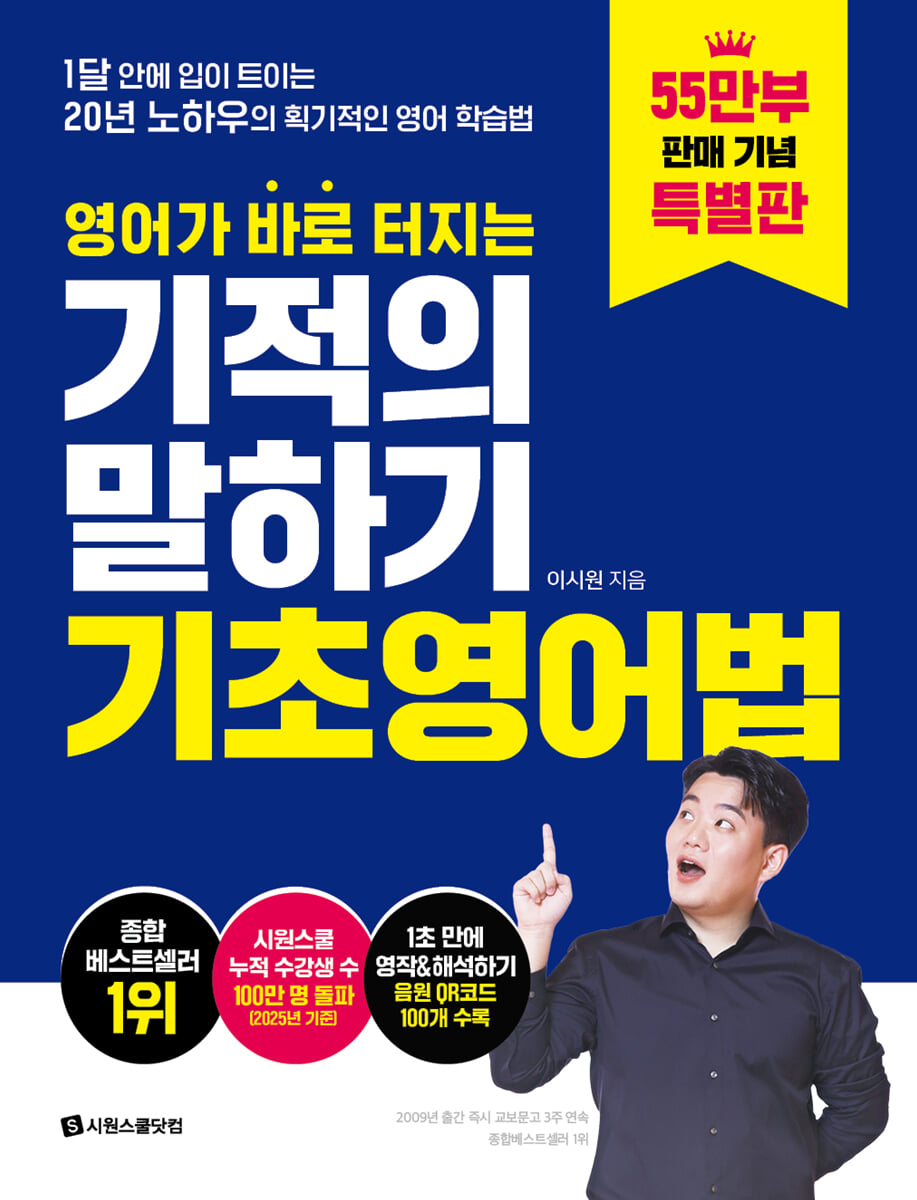
The Miraculous Basics of Speaking English That Will Make You Speak English Right Away
 |
Description
Book Introduction
Special edition commemorating the sale of 550,000 copies of Siwon School's "Basic English Grammar"
Siwon School celebrates reaching 1 million cumulative students
A groundbreaking English learning method based on 20 years of expertise that will have you speaking fluently in just one month.
The amazing miracle of learning English right away with the word linking method of "who + what"
A three-week bestseller immediately after its release! With over 550,000 copies sold to date, Siwon School's "Basic English Grammar" is back with a special, upgraded edition.
In Korean, we have particles (eun/neun/i/ga/eul/reul) so that the meaning is conveyed even if the word order is changed, such as 'I drink coffee = I drink coffee', but in English, there are no particles, so it is important to keep the 'word order = word connection method' that connects words.
English word linking is simple. Just follow the "who (subject) + what (verb)" rule and you're done! With 20 years of expertise from Siwon School, with over 1 million students, this "word linking" method has been honed. Embark on a fun journey to overcome your English beginner level in just one month with "Miracle Speaking Basics."
Siwon School celebrates reaching 1 million cumulative students
A groundbreaking English learning method based on 20 years of expertise that will have you speaking fluently in just one month.
The amazing miracle of learning English right away with the word linking method of "who + what"
A three-week bestseller immediately after its release! With over 550,000 copies sold to date, Siwon School's "Basic English Grammar" is back with a special, upgraded edition.
In Korean, we have particles (eun/neun/i/ga/eul/reul) so that the meaning is conveyed even if the word order is changed, such as 'I drink coffee = I drink coffee', but in English, there are no particles, so it is important to keep the 'word order = word connection method' that connects words.
English word linking is simple. Just follow the "who (subject) + what (verb)" rule and you're done! With 20 years of expertise from Siwon School, with over 1 million students, this "word linking" method has been honed. Embark on a fun journey to overcome your English beginner level in just one month with "Miracle Speaking Basics."
- You can preview some of the book's contents.
Preview
index
[Study Journal] Daily Study Check Log
[Lecture 1] I drink.
I drink.
Speaking with the basic sentence structure of 'subject + verb'
[Lecture 2] I don't drink.
I don't drink.
Speaking in negative sentences using 'subject + don't/doesn't + verb'
[Lecture 3] I drink coffee.
I drink coffee.
Speaking in sentences of 'subject + verb + object'
[Lecture 4] I will drink coffee.
I'm going to drink coffee.
Speaking in sentences of 'subject + will + verb + object'
[Lecture 5] I can drink coffee.
I can drink coffee.
Speaking in sentences with 'subject + can + verb + object'
[Lecture 6] I must drink coffee.
I have to drink coffee.
Speaking in sentences with 'subject + must/should/have to + verb + object'
[Lecture 7] I might drink coffee.
I might drink coffee.
Speaking in sentences with 'subject + might + verb + object'
[Lecture 8] I drank coffee.
I drank coffee.
Speaking in sentences of 'subject + past verb + object'
[Lecture 9] I am Siwon.
I am Siwon.
Speaking in sentences with 'subject + am/are/is + noun'
[Lecture 10] I am fine.
I'm fine.
Speaking in sentences with 'subject + am/are/is + adjective'
[Lecture 11] I am in Korea.
I'm in Korea.
Speak in sentences with 'subject + am/are/is + preposition + place'
[Lecture 12] I was in Korea.
I was in Korea.
Speaking in sentences with 'subject + was/were + noun, adjective, place'
[Lecture 13] I will be fine.
I'll be okay.
Speaking in sentences with 'subject + will/must/should be + noun, adjective, place'
[Lecture 14] Are you busy?
Speak with the sentence 'be verb + subject + noun, adjective, place?'
[Lecture 15] I am drinking coffee.
I'm drinking coffee.
Speaking in sentences with 'subject + am/are/is + verb-ing + object'
[Lecture 16] I was drinking coffee.
I was drinking coffee.
Speaking in sentences of 'subject + was/were + verb-ing + object'
[Lecture 17] I like drinking coffee.
I like drinking coffee.
Speaking in sentences of 'subject + like + verb-ing + object'
[Lecture 18] I want to drink coffee.
I want to drink coffee.
Speaking in sentences like 'subject+want+to-verb+object'
[Lecture 19] When do you drink coffee?
Making and speaking interrogative sentences using 'when, where, how'
[Lecture 20] What are you drinking?
Making and speaking interrogative sentences using 'what, who, why'
[Review] A Complete Summary of Word Association Methods for Lessons 1-20
[Lecture 1] I drink.
I drink.
Speaking with the basic sentence structure of 'subject + verb'
[Lecture 2] I don't drink.
I don't drink.
Speaking in negative sentences using 'subject + don't/doesn't + verb'
[Lecture 3] I drink coffee.
I drink coffee.
Speaking in sentences of 'subject + verb + object'
[Lecture 4] I will drink coffee.
I'm going to drink coffee.
Speaking in sentences of 'subject + will + verb + object'
[Lecture 5] I can drink coffee.
I can drink coffee.
Speaking in sentences with 'subject + can + verb + object'
[Lecture 6] I must drink coffee.
I have to drink coffee.
Speaking in sentences with 'subject + must/should/have to + verb + object'
[Lecture 7] I might drink coffee.
I might drink coffee.
Speaking in sentences with 'subject + might + verb + object'
[Lecture 8] I drank coffee.
I drank coffee.
Speaking in sentences of 'subject + past verb + object'
[Lecture 9] I am Siwon.
I am Siwon.
Speaking in sentences with 'subject + am/are/is + noun'
[Lecture 10] I am fine.
I'm fine.
Speaking in sentences with 'subject + am/are/is + adjective'
[Lecture 11] I am in Korea.
I'm in Korea.
Speak in sentences with 'subject + am/are/is + preposition + place'
[Lecture 12] I was in Korea.
I was in Korea.
Speaking in sentences with 'subject + was/were + noun, adjective, place'
[Lecture 13] I will be fine.
I'll be okay.
Speaking in sentences with 'subject + will/must/should be + noun, adjective, place'
[Lecture 14] Are you busy?
Speak with the sentence 'be verb + subject + noun, adjective, place?'
[Lecture 15] I am drinking coffee.
I'm drinking coffee.
Speaking in sentences with 'subject + am/are/is + verb-ing + object'
[Lecture 16] I was drinking coffee.
I was drinking coffee.
Speaking in sentences of 'subject + was/were + verb-ing + object'
[Lecture 17] I like drinking coffee.
I like drinking coffee.
Speaking in sentences of 'subject + like + verb-ing + object'
[Lecture 18] I want to drink coffee.
I want to drink coffee.
Speaking in sentences like 'subject+want+to-verb+object'
[Lecture 19] When do you drink coffee?
Making and speaking interrogative sentences using 'when, where, how'
[Lecture 20] What are you drinking?
Making and speaking interrogative sentences using 'what, who, why'
[Review] A Complete Summary of Word Association Methods for Lessons 1-20
Detailed image

Publisher's Review
1.
Siwon School's "Basic English Grammar," proven by 550,000 learners
Siwon School's "Basic English Grammar," which ranked #1 on the bestseller list for three consecutive weeks immediately after its release (based on Kyobo Bookstore) and has sold over 550,000 copies to date, has been reborn as a special edition with even more upgraded content.
The content has been further strengthened to enable more intensive training in the 'Word Connection Method', which is the result of Siwon School's 20 years of know-how, and 'Interpret in Korean in 1 Second' and 'Speak in English in 1 Second' based on this method, and additional content (100 QR codes for audio sources for speaking training) has been added.
2.
Create English sentences really easily using the 'Who + What' word linking method.
In Korean, we have particles (eun/neun/i/ga/eul/reul) so that the meaning is conveyed even if the word order is changed, such as 'I drink coffee = I drink coffee', but in English, there are no particles, so it is important to keep the 'word order = word connection method' that connects words.
English word linking is simple. Just follow the "who (subject) + what (verb)" rule and you're done! This textbook focuses on continuously creating, speaking, and expanding English sentences based on this "word linking" rule.
3.
Translate an English sentence into Korean in just 1 second.
After creating English sentences using the word association method, practice 'interpreting them into Korean in 1 second' by only looking at and listening to the English sentences without Korean translation.
When you scan the audio QR code included in the textbook, the English sentences will be played right away, so you can translate the English sentences into Korean within a second of hearing them, memorizing the meaning in your head.
4.
Translate a Korean sentence into English in just 1 second.
After completing the 'Interpret into Korean in 1 second' exercise, this time we will practice 'converting into English in 1 second' by only looking at and listening to Korean sentences.
When you scan the audio QR code included in the textbook, Korean sentences will be played right away, so you can build your 'English mouth muscles' by saying the Korean sentences in English within a second of hearing them.
5.
Includes 100 audio QR codes for interpretation and composition training in just 1 second.
When training to 'interpret in Korean in 1 second' or 'speak in English in 1 second', the effect is doubled if you 'listen' to the sentences as well as simply reading them.
Therefore, this textbook includes '100 audio QR codes' so that you can practice interpreting the sentences in Korean and speaking them in English while 'listening to them in real time' while reading them.
6.
Special appendix '[Review] Summary of Word Association Methods' included
After completing the entire textbook, we provide a special appendix titled '[Review] Word Connection Method Summary' that allows you to review and organize the word connection method formulas you have learned so far.
Since the word association formulas are organized into a ‘diagram (image)’, you can easily and intuitively understand the content just by looking at it.
7.
A 'Daily Study Check Log' is provided to match the one-month curriculum.
This textbook consists of a total of 20 lectures, and is designed as a curriculum to be completed over 4 weeks (1 month) by listening to 5 lectures per week, excluding weekends.
No matter what you study, it's important to develop the habit of managing your study routine.
Therefore, we provide a 'Daily Study Check Log' that allows you to systematically manage your one-month study.
Siwon School's "Basic English Grammar," proven by 550,000 learners
Siwon School's "Basic English Grammar," which ranked #1 on the bestseller list for three consecutive weeks immediately after its release (based on Kyobo Bookstore) and has sold over 550,000 copies to date, has been reborn as a special edition with even more upgraded content.
The content has been further strengthened to enable more intensive training in the 'Word Connection Method', which is the result of Siwon School's 20 years of know-how, and 'Interpret in Korean in 1 Second' and 'Speak in English in 1 Second' based on this method, and additional content (100 QR codes for audio sources for speaking training) has been added.
2.
Create English sentences really easily using the 'Who + What' word linking method.
In Korean, we have particles (eun/neun/i/ga/eul/reul) so that the meaning is conveyed even if the word order is changed, such as 'I drink coffee = I drink coffee', but in English, there are no particles, so it is important to keep the 'word order = word connection method' that connects words.
English word linking is simple. Just follow the "who (subject) + what (verb)" rule and you're done! This textbook focuses on continuously creating, speaking, and expanding English sentences based on this "word linking" rule.
3.
Translate an English sentence into Korean in just 1 second.
After creating English sentences using the word association method, practice 'interpreting them into Korean in 1 second' by only looking at and listening to the English sentences without Korean translation.
When you scan the audio QR code included in the textbook, the English sentences will be played right away, so you can translate the English sentences into Korean within a second of hearing them, memorizing the meaning in your head.
4.
Translate a Korean sentence into English in just 1 second.
After completing the 'Interpret into Korean in 1 second' exercise, this time we will practice 'converting into English in 1 second' by only looking at and listening to Korean sentences.
When you scan the audio QR code included in the textbook, Korean sentences will be played right away, so you can build your 'English mouth muscles' by saying the Korean sentences in English within a second of hearing them.
5.
Includes 100 audio QR codes for interpretation and composition training in just 1 second.
When training to 'interpret in Korean in 1 second' or 'speak in English in 1 second', the effect is doubled if you 'listen' to the sentences as well as simply reading them.
Therefore, this textbook includes '100 audio QR codes' so that you can practice interpreting the sentences in Korean and speaking them in English while 'listening to them in real time' while reading them.
6.
Special appendix '[Review] Summary of Word Association Methods' included
After completing the entire textbook, we provide a special appendix titled '[Review] Word Connection Method Summary' that allows you to review and organize the word connection method formulas you have learned so far.
Since the word association formulas are organized into a ‘diagram (image)’, you can easily and intuitively understand the content just by looking at it.
7.
A 'Daily Study Check Log' is provided to match the one-month curriculum.
This textbook consists of a total of 20 lectures, and is designed as a curriculum to be completed over 4 weeks (1 month) by listening to 5 lectures per week, excluding weekends.
No matter what you study, it's important to develop the habit of managing your study routine.
Therefore, we provide a 'Daily Study Check Log' that allows you to systematically manage your one-month study.
GOODS SPECIFICS
- Date of issue: November 28, 2025
- Page count, weight, size: 280 pages | 172*225*20mm
- ISBN13: 9791175500396
- ISBN10: 1175500399
You may also like
카테고리
korean


korean

![GQ KOREA Mark (Monthly): December [2025]](http://librairie.coreenne.fr/cdn/shop/files/8ef265dbbfbf186523ed75ba7319009d.jpg?v=1765340328&width=3840)


