

Almost all English punctuation
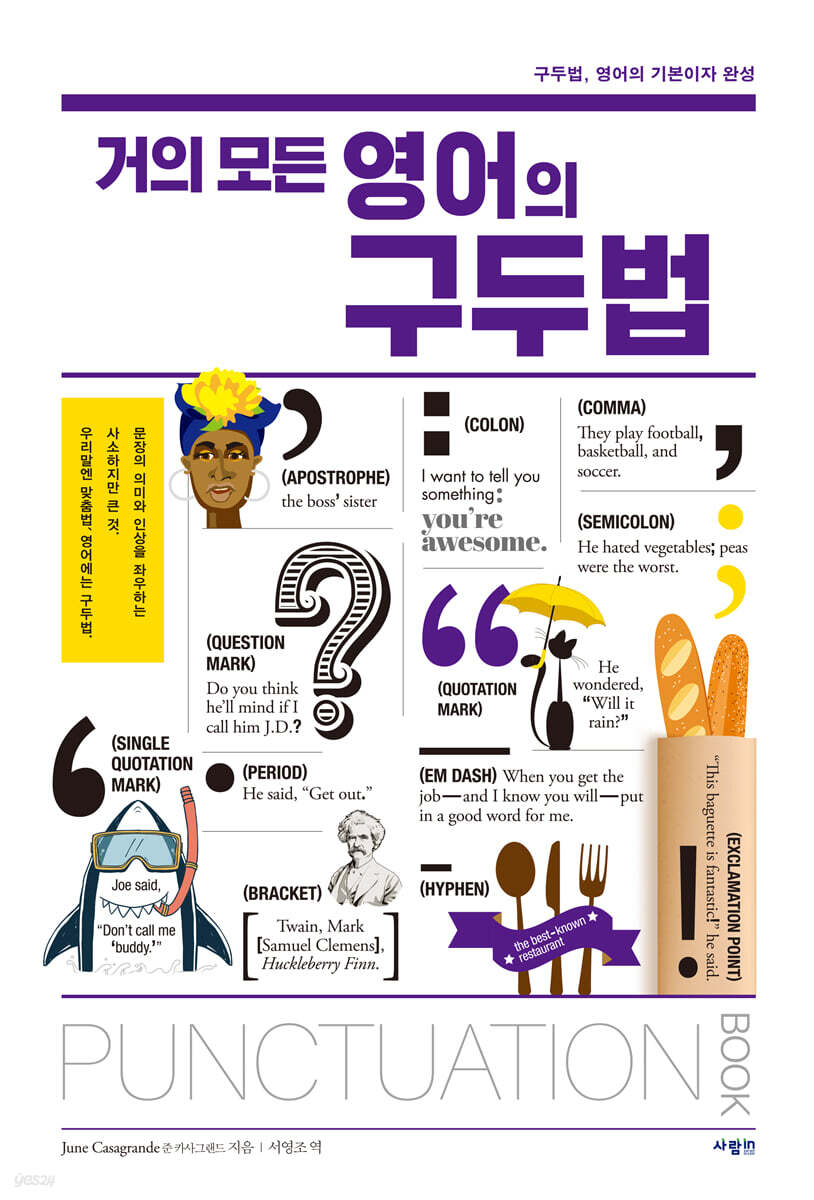 |
Description
Book Introduction
Punctuation, the foundation and perfection of English
In Korean, spacing and spelling are the foundation and completion of writing.
No matter how elegant the writing is, if the spacing is wrong or the spelling is wrong, the writer's character is questioned.
Would English be any different? A single comma can change the author's intent, and the presence or absence of a hyphen can alter the meaning of a sentence. Therefore, punctuation cannot be dismissed as simply the use of punctuation marks.
It seems like we all know this, but it's not as easy to actually use it.
Once you understand the hidden power of punctuation marks that you've been overlooking, you'll see the author's intentions and each sentence you encounter will feel new.
In Korean, spacing and spelling are the foundation and completion of writing.
No matter how elegant the writing is, if the spacing is wrong or the spelling is wrong, the writer's character is questioned.
Would English be any different? A single comma can change the author's intent, and the presence or absence of a hyphen can alter the meaning of a sentence. Therefore, punctuation cannot be dismissed as simply the use of punctuation marks.
It seems like we all know this, but it's not as easy to actually use it.
Once you understand the hidden power of punctuation marks that you've been overlooking, you'll see the author's intentions and each sentence you encounter will feel new.
- You can preview some of the book's contents.
Preview
index
PART 1 Basic Uses of Punctuation
Introduction: Punctuation is easy.
Except when things are difficult.
Basis and application of notation
Structure and features of this book
CHAPTER 1 Apostrophe
Most singular nouns possessive | Singular common nouns ending in s possessive
Singular possessive nouns ending in s | Plural possessive nouns ending in s
Plural possessive of nouns not ending in s | Plural possessive of surnames in given names
Apostrophe used in proper nouns | The possessive form of it, its, does not have an apostrophe.
An apostrophe is not used with the possessive pronouns his, hers, yours, ours, and theirs.
Exceptions to the Basic Rule of Creating Possessives | Joint vs.
Independent ownership
Quasi-possessives | Possessives in compounds
Possessive vs.
Adjective form | Possessive case of gerund
Double possessive | Apostrophes in contractions and other omitted letters
Contraction 's vs.
Possessive 's | Direction of the apostrophe
The first letter of a sentence that begins with an apostrophe is capitalized | Apostrophe that creates the plural of individual letters
No apostrophes are used in the plural of numbers | Plurals of proper nouns with possessive apostrophes
Singular possessive of proper nouns with apostrophes | Plural possessive of proper nouns with apostrophes
Abbreviations used as verbs | Apostrophes used with other punctuation marks
CHAPTER 2 Comma
The comma has little use depending on the notation | A comma that separates listed items
Commas in unequal adjectives before nouns | For enumerations and complex enumerations with their own commas: a semicolon instead of a comma | Commas when the & symbol is used instead of and
Commas separating multiple or repeated adverbs | Commas after the first word or phrase of a sentence
Commas that separate independent clauses | Commas that separate compound predicates, compound subjects, etc.
Commas when a subordinate clause comes before a main clause | Commas when a subordinate clause comes after a main clause
Commas before relative pronoun clauses in continuous use | Commas before appositives
Commas that separate adjectives, adverbs, and other inserted descriptive words
A comma before a parenthetical phrase expressing an opinion based on thoughts or observations | A comma separating titles
Commas that separate quotations | Commas that indicate omitted words in a repeating pattern
Commas between repeated words such as is is, in in, that that | Commas in English addresses
Commas after age, city of residence, and political party affiliation | Commas in units of measurement
Commas in too, also, either | Commas in however, therefore, indeed
Commas in including, such as, and other similar expressions | Commas in etc.
Comma in et al., and so forth, and the like | Comma in Yes and No
Commas in respectively | Commas in oh, um, ah, well, etc.
Comma in Inc., Ltd., and similar abbreviations | Comma in PhD, MD, MA, DDS, JD, and other academic titles
Comma in Jr., Sr., II, III, etc. | State, Country, Province, the District of Columbia (DC/D.
C.) Comma
Commas in dates and years | Organization names with commas in the middle
Titles with commas in the middle | Commas in noun phrases starting with not
Commas in phrases such as not only A but B | Commas in please
Commas in the more ~ the less, the more ~ the more, etc. | Commas when used with double quotation marks
Commas when used with single quotation marks | Commas when used with apostrophes
Commas when used with parentheses | Commas when used with ellipses
Commas when used with hyphens or en-dashes | Commas when used with prime or other measurement symbols
When to use a comma for clarity | A comma after a proper noun ending in an exclamation or question mark
When to Omit a Comma When There's Too Much Punctuation | Some Punctuation Advisory Board Rules on Comma Usage
CHAPTER 3 PERIOD
A period ending a sentence or sentence fragment | The space after a period
A period used in the initials of a person's name |
A period used in the initials of proper nouns other than people's names (excluding U.S. state and province names)
Periods in abbreviations for U.S. states, Canadian provinces, and the District of Columbia | Abbreviations and Periods
Acronyms and Periods | Periods at the End of URL Addresses
Period when used with double quotes | Period when used with single quotes
Period when used with an apostrophe | Period when used with parentheses ( ) or brackets [ ].
Period when used with prime and other measurement symbols | Period when used with dash
Periods when used with ellipses | Omission of periods to avoid double punctuation | Periods in rhetorical questions
CHAPTER 4 Colon
Colons that introduce content that explains or emphasizes the preceding content | Do not use colons after including, which introduces content that is listed
Colons introducing quotations, dialogue, and excerpts | Colons used with as follows, the following, etc.
Colons after greetings | Colons in ratio expressions
Colons in other number representations | Colons between titles and subtitles
Colons in citations | Space after colons
Whether to use uppercase or lowercase letters after a colon | Colons when used with parentheses
Colon when used with double quotation marks | Colon when a proper noun or title contains an exclamation or question mark
CHAPTER 5 Semicolon
Semicolon before conjunctive adverbs such as however, therefore, indeed | Semicolon before expressions such as that is, namely, for example
Semicolons between clauses with many punctuation marks | Semicolons separating listed items
Semicolons in indexes, text citations, etc.
CHAPTER 6 Double Quotation Marks
Double quotation marks to indicate direct quotes or dialogue | Another way to express long quotes
Quotation marks to indicate exceptional or ironic meaning | Quotation marks to highlight words discussed in a text
So-called is not quoted | In article notation, the title of the work is quoted
In scientific literature notation, double quotation marks are used instead of italics in the title of a work | Double quotation marks are used when used with a period
Double quotes when used with commas | Double quotes when used with question marks
Double quotes when used with exclamation marks | Double quotes when used with single quotes
Double quotes when used with a colon | Double quotes when used with a semicolon
Double quotes with ellipses | Creating plurals within double quotes | Creating possessives within double quotes
Direction of double quotes | Double primes and double quotes
CHAPTER 7 Single Quotation Marks
Quotes within a quote | Do not use single quotation marks around words discussed in the text.
Single quotation marks used in article titles | Single quotation marks used with other punctuation marks
Don't confuse the left single quote with the apostrophe | Don't confuse the single quote with the prime symbol
CHAPTER 8 Question Mark
Space after question mark | Question mark replacing comma
Question marks replacing periods | Question marks used with exclamation marks
A question mark that eliminates the need for a question mark at the end of a sentence | A question mark used in the middle of a sentence
Question marks after declarative sentences | Omission of question marks in rhetorical questions | Prefer not to use question marks in Guess what
CHAPTER 9 Exclamation Mark
Space after exclamation mark | Exclamation mark replacing comma
Exclamation marks that replace periods | Exclamation marks used with question marks | Exclamation marks that eliminate the need for exclamation marks at the end of sentences
CHAPTER 10 Ellipsis
Space between ellipsis dots | Space before and after ellipsis
Ellipses and line breaks | Ellipses are not required at the beginning or end of a quote.
Ellipsis after a complete sentence | Ellipsis indicating a stuttered word
CHAPTER 11 Hyphens
Hyphenation of compound modifiers in the dictionary | Hyphenation of compound modifiers not in the dictionary
Exceptions and Special Situations to the Basic Rules for Compound Modifiers | Hyphenation of Compound Adjectives Containing Certain Words
Hyphens in Compound Adjectives of Certain Types and Forms | Suspensive Hyphenation
Ambiguous Hyphenation in Compound Adjectives | Hyphenation in Compound Adverbs
Hyphenation Recommendations and Style Rules for Compound Nouns | Hyphenation of Compound Verbs
Hyphens in Prefixes | Exceptions to Hyphen Styles in Prefixes
Hyphens in Suffixes | Exceptions to Suffix Hyphen Styles
Hyphen in ratio | Hyphen in betting odds
Hyphens in ranges | Hyphens in words spelled out letter by letter | When to use hyphens in names
CHAPTER 12 Emdash
Insert emdash for insertion phrases | Insert emdash for additional information
Changes in sentence structure or thought Em dash | Em dash vs.
Parentheses and commas
Em dash in conversation | Em dash in dateline in news articles
Em dash in lists | Spaces on either side of an em dash
CHAPTER 13 Yen Dash
En dash meaning to, through, until | En dash used in complex compound adjectives
CHAPTER 14 Parentheses
Insert parentheses when inserting examples | Insert parentheses when inserting additional information
Parentheses when inserting reference information | Parentheses in phone area codes
Parentheses in grouping in mathematics | Parentheses in making numbers or letters stand out
Parentheses vs.
Dashes and commas | Parentheses when used with periods
Parentheses when used with question marks or exclamation marks | Parentheses when used with commas
Parentheses with semicolons | Parentheses with colons
Parentheses when used with dashes | Parentheses when used with hyphens
Parentheses when used with double quotation marks | Parentheses within parentheses
When there are two or more sentences in parentheses | Parentheses for the initials of the organization name
CHAPTER 15 Angle Brackets
CHAPTER 16 Slashes and Backslashes
Slashes meaning or, and, through, and per | Slashes in web addresses, dates, and phone numbers
CHAPTER 17 List of Enumerated Items
List within the text | List that is part of the previous sentence | List that is not part of the previous sentence
CHAPTER 18 Numbers and Addresses
Writing numbers in Arabic numerals vs.
Writing dates in words | Mixing letters and numbers vs.
Write in numbers only
Separate years with commas | Order of month and day
Abbreviating month names in dates vs.
Write your full name | Write in decades
Ordinal numbers are not preferred in dates | Time representations
Building Number | Abbreviations for Street, Avenue, Boulevard, etc.
Street names in numbers | Directions
State Name Abbreviation | PO Box Addresses
Hyphen in the word phone number | email itself
Line breaks in email addresses | How to write URLs
Line breaks in URLs | Punctuation marks after URLs
PART 2 Punctuation A to ZA~Z English Expressions
Korean expressions ㄱ~ㅎ
Appendix A Understanding Grammar Units: Phrases, Clauses, Sentences, and Sentence Fragments
Appendix B Identifying Parts of Speech for Better Punctuation
Acknowledgements
Introduction: Punctuation is easy.
Except when things are difficult.
Basis and application of notation
Structure and features of this book
CHAPTER 1 Apostrophe
Most singular nouns possessive | Singular common nouns ending in s possessive
Singular possessive nouns ending in s | Plural possessive nouns ending in s
Plural possessive of nouns not ending in s | Plural possessive of surnames in given names
Apostrophe used in proper nouns | The possessive form of it, its, does not have an apostrophe.
An apostrophe is not used with the possessive pronouns his, hers, yours, ours, and theirs.
Exceptions to the Basic Rule of Creating Possessives | Joint vs.
Independent ownership
Quasi-possessives | Possessives in compounds
Possessive vs.
Adjective form | Possessive case of gerund
Double possessive | Apostrophes in contractions and other omitted letters
Contraction 's vs.
Possessive 's | Direction of the apostrophe
The first letter of a sentence that begins with an apostrophe is capitalized | Apostrophe that creates the plural of individual letters
No apostrophes are used in the plural of numbers | Plurals of proper nouns with possessive apostrophes
Singular possessive of proper nouns with apostrophes | Plural possessive of proper nouns with apostrophes
Abbreviations used as verbs | Apostrophes used with other punctuation marks
CHAPTER 2 Comma
The comma has little use depending on the notation | A comma that separates listed items
Commas in unequal adjectives before nouns | For enumerations and complex enumerations with their own commas: a semicolon instead of a comma | Commas when the & symbol is used instead of and
Commas separating multiple or repeated adverbs | Commas after the first word or phrase of a sentence
Commas that separate independent clauses | Commas that separate compound predicates, compound subjects, etc.
Commas when a subordinate clause comes before a main clause | Commas when a subordinate clause comes after a main clause
Commas before relative pronoun clauses in continuous use | Commas before appositives
Commas that separate adjectives, adverbs, and other inserted descriptive words
A comma before a parenthetical phrase expressing an opinion based on thoughts or observations | A comma separating titles
Commas that separate quotations | Commas that indicate omitted words in a repeating pattern
Commas between repeated words such as is is, in in, that that | Commas in English addresses
Commas after age, city of residence, and political party affiliation | Commas in units of measurement
Commas in too, also, either | Commas in however, therefore, indeed
Commas in including, such as, and other similar expressions | Commas in etc.
Comma in et al., and so forth, and the like | Comma in Yes and No
Commas in respectively | Commas in oh, um, ah, well, etc.
Comma in Inc., Ltd., and similar abbreviations | Comma in PhD, MD, MA, DDS, JD, and other academic titles
Comma in Jr., Sr., II, III, etc. | State, Country, Province, the District of Columbia (DC/D.
C.) Comma
Commas in dates and years | Organization names with commas in the middle
Titles with commas in the middle | Commas in noun phrases starting with not
Commas in phrases such as not only A but B | Commas in please
Commas in the more ~ the less, the more ~ the more, etc. | Commas when used with double quotation marks
Commas when used with single quotation marks | Commas when used with apostrophes
Commas when used with parentheses | Commas when used with ellipses
Commas when used with hyphens or en-dashes | Commas when used with prime or other measurement symbols
When to use a comma for clarity | A comma after a proper noun ending in an exclamation or question mark
When to Omit a Comma When There's Too Much Punctuation | Some Punctuation Advisory Board Rules on Comma Usage
CHAPTER 3 PERIOD
A period ending a sentence or sentence fragment | The space after a period
A period used in the initials of a person's name |
A period used in the initials of proper nouns other than people's names (excluding U.S. state and province names)
Periods in abbreviations for U.S. states, Canadian provinces, and the District of Columbia | Abbreviations and Periods
Acronyms and Periods | Periods at the End of URL Addresses
Period when used with double quotes | Period when used with single quotes
Period when used with an apostrophe | Period when used with parentheses ( ) or brackets [ ].
Period when used with prime and other measurement symbols | Period when used with dash
Periods when used with ellipses | Omission of periods to avoid double punctuation | Periods in rhetorical questions
CHAPTER 4 Colon
Colons that introduce content that explains or emphasizes the preceding content | Do not use colons after including, which introduces content that is listed
Colons introducing quotations, dialogue, and excerpts | Colons used with as follows, the following, etc.
Colons after greetings | Colons in ratio expressions
Colons in other number representations | Colons between titles and subtitles
Colons in citations | Space after colons
Whether to use uppercase or lowercase letters after a colon | Colons when used with parentheses
Colon when used with double quotation marks | Colon when a proper noun or title contains an exclamation or question mark
CHAPTER 5 Semicolon
Semicolon before conjunctive adverbs such as however, therefore, indeed | Semicolon before expressions such as that is, namely, for example
Semicolons between clauses with many punctuation marks | Semicolons separating listed items
Semicolons in indexes, text citations, etc.
CHAPTER 6 Double Quotation Marks
Double quotation marks to indicate direct quotes or dialogue | Another way to express long quotes
Quotation marks to indicate exceptional or ironic meaning | Quotation marks to highlight words discussed in a text
So-called is not quoted | In article notation, the title of the work is quoted
In scientific literature notation, double quotation marks are used instead of italics in the title of a work | Double quotation marks are used when used with a period
Double quotes when used with commas | Double quotes when used with question marks
Double quotes when used with exclamation marks | Double quotes when used with single quotes
Double quotes when used with a colon | Double quotes when used with a semicolon
Double quotes with ellipses | Creating plurals within double quotes | Creating possessives within double quotes
Direction of double quotes | Double primes and double quotes
CHAPTER 7 Single Quotation Marks
Quotes within a quote | Do not use single quotation marks around words discussed in the text.
Single quotation marks used in article titles | Single quotation marks used with other punctuation marks
Don't confuse the left single quote with the apostrophe | Don't confuse the single quote with the prime symbol
CHAPTER 8 Question Mark
Space after question mark | Question mark replacing comma
Question marks replacing periods | Question marks used with exclamation marks
A question mark that eliminates the need for a question mark at the end of a sentence | A question mark used in the middle of a sentence
Question marks after declarative sentences | Omission of question marks in rhetorical questions | Prefer not to use question marks in Guess what
CHAPTER 9 Exclamation Mark
Space after exclamation mark | Exclamation mark replacing comma
Exclamation marks that replace periods | Exclamation marks used with question marks | Exclamation marks that eliminate the need for exclamation marks at the end of sentences
CHAPTER 10 Ellipsis
Space between ellipsis dots | Space before and after ellipsis
Ellipses and line breaks | Ellipses are not required at the beginning or end of a quote.
Ellipsis after a complete sentence | Ellipsis indicating a stuttered word
CHAPTER 11 Hyphens
Hyphenation of compound modifiers in the dictionary | Hyphenation of compound modifiers not in the dictionary
Exceptions and Special Situations to the Basic Rules for Compound Modifiers | Hyphenation of Compound Adjectives Containing Certain Words
Hyphens in Compound Adjectives of Certain Types and Forms | Suspensive Hyphenation
Ambiguous Hyphenation in Compound Adjectives | Hyphenation in Compound Adverbs
Hyphenation Recommendations and Style Rules for Compound Nouns | Hyphenation of Compound Verbs
Hyphens in Prefixes | Exceptions to Hyphen Styles in Prefixes
Hyphens in Suffixes | Exceptions to Suffix Hyphen Styles
Hyphen in ratio | Hyphen in betting odds
Hyphens in ranges | Hyphens in words spelled out letter by letter | When to use hyphens in names
CHAPTER 12 Emdash
Insert emdash for insertion phrases | Insert emdash for additional information
Changes in sentence structure or thought Em dash | Em dash vs.
Parentheses and commas
Em dash in conversation | Em dash in dateline in news articles
Em dash in lists | Spaces on either side of an em dash
CHAPTER 13 Yen Dash
En dash meaning to, through, until | En dash used in complex compound adjectives
CHAPTER 14 Parentheses
Insert parentheses when inserting examples | Insert parentheses when inserting additional information
Parentheses when inserting reference information | Parentheses in phone area codes
Parentheses in grouping in mathematics | Parentheses in making numbers or letters stand out
Parentheses vs.
Dashes and commas | Parentheses when used with periods
Parentheses when used with question marks or exclamation marks | Parentheses when used with commas
Parentheses with semicolons | Parentheses with colons
Parentheses when used with dashes | Parentheses when used with hyphens
Parentheses when used with double quotation marks | Parentheses within parentheses
When there are two or more sentences in parentheses | Parentheses for the initials of the organization name
CHAPTER 15 Angle Brackets
CHAPTER 16 Slashes and Backslashes
Slashes meaning or, and, through, and per | Slashes in web addresses, dates, and phone numbers
CHAPTER 17 List of Enumerated Items
List within the text | List that is part of the previous sentence | List that is not part of the previous sentence
CHAPTER 18 Numbers and Addresses
Writing numbers in Arabic numerals vs.
Writing dates in words | Mixing letters and numbers vs.
Write in numbers only
Separate years with commas | Order of month and day
Abbreviating month names in dates vs.
Write your full name | Write in decades
Ordinal numbers are not preferred in dates | Time representations
Building Number | Abbreviations for Street, Avenue, Boulevard, etc.
Street names in numbers | Directions
State Name Abbreviation | PO Box Addresses
Hyphen in the word phone number | email itself
Line breaks in email addresses | How to write URLs
Line breaks in URLs | Punctuation marks after URLs
PART 2 Punctuation A to ZA~Z English Expressions
Korean expressions ㄱ~ㅎ
Appendix A Understanding Grammar Units: Phrases, Clauses, Sentences, and Sentence Fragments
Appendix B Identifying Parts of Speech for Better Punctuation
Acknowledgements
Detailed image

Publisher's Review
The story behind English punctuation marks that we've been casually observing
Punctuation, which refers to the use of punctuation marks, is the foundation and completion of the English language.
Even if you use Go as a command, it is not a proper sentence if you do not use an exclamation point or a period.
Suddenly, a question like this arises:
'Is there a difference between using an exclamation mark and a period in a command statement?' The answer is 'yes.'
When using an exclamation point, the feeling of command conveyed to the reader is strong, and when using a period, the feeling is softer than when using an exclamation point.
And that's not all.
I talked to my brother Steve. and I talked to my brother, Steve. are separated by a comma, indicating that the first sentence indicates that the author has more than one male brother, while the second sentence indicates that the author has one male brother.
So I talked to my husband Tim.
If I don't use a comma in the sentence, I become a person who has had more than one husband.
In this way, the punctuation marks that we see without thinking contain many stories.
Because even a single punctuation mark can change the author's intention, punctuation should not be studied after mastering English, but rather studied as if it were grammar and vocabulary.
The punctuation study should be 『Almost All English Punctuation』.
Detailed items selected only for things you want to know and are curious about
Here's a detailed list of everything readers might want to know about punctuation: how to use parentheses in an entry, whether a period goes before or after quotation marks when used with them, how to hyphenate compound words, whether to use -s after an apostrophe to indicate the possessive case of a proper noun ending in -s, and the difference between a semicolon and a colon.
Readers can find and check it right there in the article.
A clear explanation from the world's leading authority on English punctuation.
The author, a renowned authority on punctuation, has opened a new chapter in punctuation reference books with concise explanations and a selection of topics that will interest learners.
It covers a wide range of topics, even those on which opinions are divided among experts, and includes the opinions of writing authorities in various fields, providing readers with a reference when faced with a choice between two options.
This is by far the best book on punctuation reference and application, so much so that even grammar and usage experts unanimously praise it.
Presenting examples of punctuation in specific writing fields
As you read, you will notice that some emails are written as email, while others are written as e-mail with a hyphen.
Also, in a list of three or more items, a comma may or may not be placed before the and before the last item.
Are they both wrong, or are they both right? The answer is "yes" depending on the field of writing.
Punctuation is necessary to get an accurate answer in these cases.
The reason why these different cases exist is because the usage of punctuation varies depending on the writing in a specific field.
For example, in book-related articles, email is written as email, but in news articles, it is written as e-mail with a hyphen.
When listing three or more items, whether or not to use a comma before and is also important. In book-related articles, a comma is used, but in article articles, it is not used.
"Almost All English Punctuation" is the only book that presents side-by-side examples of punctuation usage in specific writing fields.
Punctuation, which refers to the use of punctuation marks, is the foundation and completion of the English language.
Even if you use Go as a command, it is not a proper sentence if you do not use an exclamation point or a period.
Suddenly, a question like this arises:
'Is there a difference between using an exclamation mark and a period in a command statement?' The answer is 'yes.'
When using an exclamation point, the feeling of command conveyed to the reader is strong, and when using a period, the feeling is softer than when using an exclamation point.
And that's not all.
I talked to my brother Steve. and I talked to my brother, Steve. are separated by a comma, indicating that the first sentence indicates that the author has more than one male brother, while the second sentence indicates that the author has one male brother.
So I talked to my husband Tim.
If I don't use a comma in the sentence, I become a person who has had more than one husband.
In this way, the punctuation marks that we see without thinking contain many stories.
Because even a single punctuation mark can change the author's intention, punctuation should not be studied after mastering English, but rather studied as if it were grammar and vocabulary.
The punctuation study should be 『Almost All English Punctuation』.
Detailed items selected only for things you want to know and are curious about
Here's a detailed list of everything readers might want to know about punctuation: how to use parentheses in an entry, whether a period goes before or after quotation marks when used with them, how to hyphenate compound words, whether to use -s after an apostrophe to indicate the possessive case of a proper noun ending in -s, and the difference between a semicolon and a colon.
Readers can find and check it right there in the article.
A clear explanation from the world's leading authority on English punctuation.
The author, a renowned authority on punctuation, has opened a new chapter in punctuation reference books with concise explanations and a selection of topics that will interest learners.
It covers a wide range of topics, even those on which opinions are divided among experts, and includes the opinions of writing authorities in various fields, providing readers with a reference when faced with a choice between two options.
This is by far the best book on punctuation reference and application, so much so that even grammar and usage experts unanimously praise it.
Presenting examples of punctuation in specific writing fields
As you read, you will notice that some emails are written as email, while others are written as e-mail with a hyphen.
Also, in a list of three or more items, a comma may or may not be placed before the and before the last item.
Are they both wrong, or are they both right? The answer is "yes" depending on the field of writing.
Punctuation is necessary to get an accurate answer in these cases.
The reason why these different cases exist is because the usage of punctuation varies depending on the writing in a specific field.
For example, in book-related articles, email is written as email, but in news articles, it is written as e-mail with a hyphen.
When listing three or more items, whether or not to use a comma before and is also important. In book-related articles, a comma is used, but in article articles, it is not used.
"Almost All English Punctuation" is the only book that presents side-by-side examples of punctuation usage in specific writing fields.
GOODS SPECIFICS
- Date of issue: June 13, 2023
- Page count, weight, size: 380 pages | 866g | 170*250*20mm
- ISBN13: 9788960498051
- ISBN10: 896049805X
You may also like
카테고리
korean


korean

![GQ KOREA Mark (Monthly): December [2025]](http://librairie.coreenne.fr/cdn/shop/files/8ef265dbbfbf186523ed75ba7319009d.jpg?v=1765340328&width=3840)


