

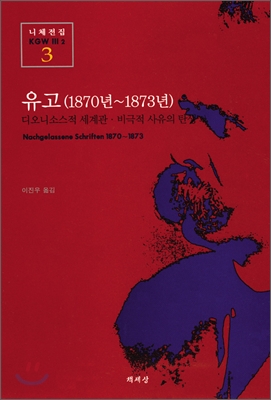
Yugoslavia (1870–1873)
 |
Description
Book Introduction
This is one of the complete works of Nietzsche published by Book World Publishing to commemorate the 100th anniversary of Nietzsche's death.
The complete Nietzsche works of the Book World are a translation of the remaining works, excluding the letters and commentaries, from the German publisher Walter de Gruyter's "Nietzsche Werke, Kritische Gesamtausgabe" (KGW), which is said to have provided a groundbreaking turning point in the history of Nietzsche studies. A total of 21 volumes are planned.
This complete collection embodies the pride and mission of translating the definitive version of Nietzsche's complete works, and commemorates the 100th anniversary of Nietzsche's death. It also embodies the intention to overcome the shortcomings of existing domestic Nietzsche complete works.
That is, it overcomes the problems of arbitrary translations by non-Nietzsche specialists without faithful commentary, or distortion of Nietzsche's interpretation by simply accepting concepts that came in mostly through Japan and adding haphazard annotations.
To this end, in the winter of 1998, a Nietzsche editorial committee was formed with four philosophy professors, and over the past three years, the Korean edition of the Nietzsche Complete Works has been prepared by correcting errors in Nietzsche's philosophical concepts and translations and establishing a unified plan.
By redefining translation terms and concepts that have been problematic in the domestic academic world, we will present a standard standard for Nietzsche translation, and by conveying the meaning of his metaphors and symbols to readers without the intervention of the translator, we will enable readers to fully experience Nietzsche.
In addition, we have added detailed explanations of basic explanations of Nietzsche's thought, the background of the text, and the relationships between each work to help readers easily understand the content.
Moreover, unlike books that remain stuck in archaic and outdated interpretations despite the new horizons opened up for Nietzsche studies by the discovery of his posthumous works, this collection includes Nietzsche's posthumous works.
Through this collection, readers will not only hear Nietzsche's voice vividly, but will also be able to understand the profound depth and charm of his thought, his human suffering, and the significance of his work in the history of philosophy.
The complete Nietzsche works of the Book World are a translation of the remaining works, excluding the letters and commentaries, from the German publisher Walter de Gruyter's "Nietzsche Werke, Kritische Gesamtausgabe" (KGW), which is said to have provided a groundbreaking turning point in the history of Nietzsche studies. A total of 21 volumes are planned.
This complete collection embodies the pride and mission of translating the definitive version of Nietzsche's complete works, and commemorates the 100th anniversary of Nietzsche's death. It also embodies the intention to overcome the shortcomings of existing domestic Nietzsche complete works.
That is, it overcomes the problems of arbitrary translations by non-Nietzsche specialists without faithful commentary, or distortion of Nietzsche's interpretation by simply accepting concepts that came in mostly through Japan and adding haphazard annotations.
To this end, in the winter of 1998, a Nietzsche editorial committee was formed with four philosophy professors, and over the past three years, the Korean edition of the Nietzsche Complete Works has been prepared by correcting errors in Nietzsche's philosophical concepts and translations and establishing a unified plan.
By redefining translation terms and concepts that have been problematic in the domestic academic world, we will present a standard standard for Nietzsche translation, and by conveying the meaning of his metaphors and symbols to readers without the intervention of the translator, we will enable readers to fully experience Nietzsche.
In addition, we have added detailed explanations of basic explanations of Nietzsche's thought, the background of the text, and the relationships between each work to help readers easily understand the content.
Moreover, unlike books that remain stuck in archaic and outdated interpretations despite the new horizons opened up for Nietzsche studies by the discovery of his posthumous works, this collection includes Nietzsche's posthumous works.
Through this collection, readers will not only hear Nietzsche's voice vividly, but will also be able to understand the profound depth and charm of his thought, his human suffering, and the significance of his work in the history of philosophy.
The posthumous writings from the summer of 1872 to the spring of 1873 contain clues that run through Nietzsche's life and thought.
The 'birth of tragic thought', which seeks to overcome modernity through thorough skepticism about modernity, allows us to grasp the spirit of our times, just as we understand Nietzsche and ourselves.
The lectures and essays that make up this book can be divided into three parts.
First, there are artistic philosophical writings related to the 'birth of tragedy'; second, cultural philosophical writings that seek to philosophically explain and understand the contemporary era; and third, rational critical writings that thoroughly question metaphysical reason.
Nietzsche, based on the tragic recognition that traditional metaphysical thinking is no longer possible, seeks new ideas, and through constant revision, defines life and thought and carries out self-criticism.
That is why, although he had numerous plans and drafts, he had only a few completed works, and his early writings reflect Nietzsche's tendency and attempts to achieve a complete work.
The posthumous writings from the summer of 1872 to the spring of 1873 contain clues that run through Nietzsche's life and thought.
The 'birth of tragic thought', which seeks to overcome modernity through thorough skepticism about modernity, allows us to grasp the spirit of our times, just as we understand Nietzsche and ourselves.
The lectures and essays that make up this book can be divided into three parts.
First, there are artistic philosophical writings related to the 'birth of tragedy'; second, cultural philosophical writings that seek to philosophically explain and understand the contemporary era; and third, rational critical writings that thoroughly question metaphysical reason.
Nietzsche, based on the tragic recognition that traditional metaphysical thinking is no longer possible, seeks new ideas, and through constant revision, defines life and thought and carries out self-criticism.
That is why, although he had numerous plans and drafts, he had only a few completed works, and his early writings reflect Nietzsche's tendency and attempts to achieve a complete work.
The 'birth of tragic thought', which seeks to overcome modernity through thorough skepticism about modernity, allows us to grasp the spirit of our times, just as we understand Nietzsche and ourselves.
The lectures and essays that make up this book can be divided into three parts.
First, there are artistic philosophical writings related to the 'birth of tragedy'; second, cultural philosophical writings that seek to philosophically explain and understand the contemporary era; and third, rational critical writings that thoroughly question metaphysical reason.
Nietzsche, based on the tragic recognition that traditional metaphysical thinking is no longer possible, seeks new ideas, and through constant revision, defines life and thought and carries out self-criticism.
That is why, although he had numerous plans and drafts, he had only a few completed works, and his early writings reflect Nietzsche's tendency and attempts to achieve a complete work.
The posthumous writings from the summer of 1872 to the spring of 1873 contain clues that run through Nietzsche's life and thought.
The 'birth of tragic thought', which seeks to overcome modernity through thorough skepticism about modernity, allows us to grasp the spirit of our times, just as we understand Nietzsche and ourselves.
The lectures and essays that make up this book can be divided into three parts.
First, there are artistic philosophical writings related to the 'birth of tragedy'; second, cultural philosophical writings that seek to philosophically explain and understand the contemporary era; and third, rational critical writings that thoroughly question metaphysical reason.
Nietzsche, based on the tragic recognition that traditional metaphysical thinking is no longer possible, seeks new ideas, and through constant revision, defines life and thought and carries out self-criticism.
That is why, although he had numerous plans and drafts, he had only a few completed works, and his early writings reflect Nietzsche's tendency and attempts to achieve a complete work.
index
1.
Two public lectures on Greek tragedy
2.
Dionysian worldview
3.
The Birth of a Tragic Thought
4.
Socrates and Greek tragedy
5.
About the future of our educational institutions
6.
Five Prefaces to Five Unwritten Books
7.
New Year's message to the editor of the weekly magazine
8.
Philosophy in the Age of Greek Tragedy
9.
On truth and falsehood in an immoral sense
10.
A warning to the Germans
Two public lectures on Greek tragedy
2.
Dionysian worldview
3.
The Birth of a Tragic Thought
4.
Socrates and Greek tragedy
5.
About the future of our educational institutions
6.
Five Prefaces to Five Unwritten Books
7.
New Year's message to the editor of the weekly magazine
8.
Philosophy in the Age of Greek Tragedy
9.
On truth and falsehood in an immoral sense
10.
A warning to the Germans
Into the book
Greek tragedy declined in a different way than all other similar artistic genres with a longer history.
It was because of an unresolvable conflict that he ended his life by suicide.
In other words, Greek tragedy, unlike other genres that had beautiful and peaceful deaths at an old age, had tragic deaths.
If it is a happy natural state to part ways with life without a desperate struggle to live, under the watchful eyes of worthy descendants, then the deaths of the artistic genres that emerged before tragedy can be said to show us this happy natural state.
They gradually disappeared.
Before their fading gazes stand descendants more beautiful than themselves, their heads held high and their postures impatient.
In contrast, death in Greek tragedy leaves behind only a desperate emptiness that is felt everywhere.
As in the days of Tiberius, Greek sailors heard the mournful cry from some remote island: "The great Pan is dead."
Now a wail of pain echoes through the Greek world.
"Tragedy is dead! Poetry itself is gone with it! Get out of here, you poor, insignificant epigones! Go to hell.
There you can feast on the crumbs left behind by the old masters!"
But when a new artistic genre blossomed, one that revered tragedy as its forerunner and master craftsman, it was recognized, with astonishment, that this genre somehow resembled its mother, and that it bore the very same features she had displayed in her long struggle for survival.
It was because of an unresolvable conflict that he ended his life by suicide.
In other words, Greek tragedy, unlike other genres that had beautiful and peaceful deaths at an old age, had tragic deaths.
If it is a happy natural state to part ways with life without a desperate struggle to live, under the watchful eyes of worthy descendants, then the deaths of the artistic genres that emerged before tragedy can be said to show us this happy natural state.
They gradually disappeared.
Before their fading gazes stand descendants more beautiful than themselves, their heads held high and their postures impatient.
In contrast, death in Greek tragedy leaves behind only a desperate emptiness that is felt everywhere.
As in the days of Tiberius, Greek sailors heard the mournful cry from some remote island: "The great Pan is dead."
Now a wail of pain echoes through the Greek world.
"Tragedy is dead! Poetry itself is gone with it! Get out of here, you poor, insignificant epigones! Go to hell.
There you can feast on the crumbs left behind by the old masters!"
But when a new artistic genre blossomed, one that revered tragedy as its forerunner and master craftsman, it was recognized, with astonishment, that this genre somehow resembled its mother, and that it bore the very same features she had displayed in her long struggle for survival.
---pp.117~118
GOODS SPECIFICS
- Date of issue: April 30, 2001
- Format: Paperback book binding method guide
- Page count, weight, size: 450 pages | 903g | 152*225*30mm
- ISBN13: 9788970132556
- ISBN10: 8970132554
You may also like
카테고리
korean


korean

![GQ KOREA Mark (Monthly): December [2025]](http://librairie.coreenne.fr/cdn/shop/files/8ef265dbbfbf186523ed75ba7319009d.jpg?v=1765340328&width=3840)


