

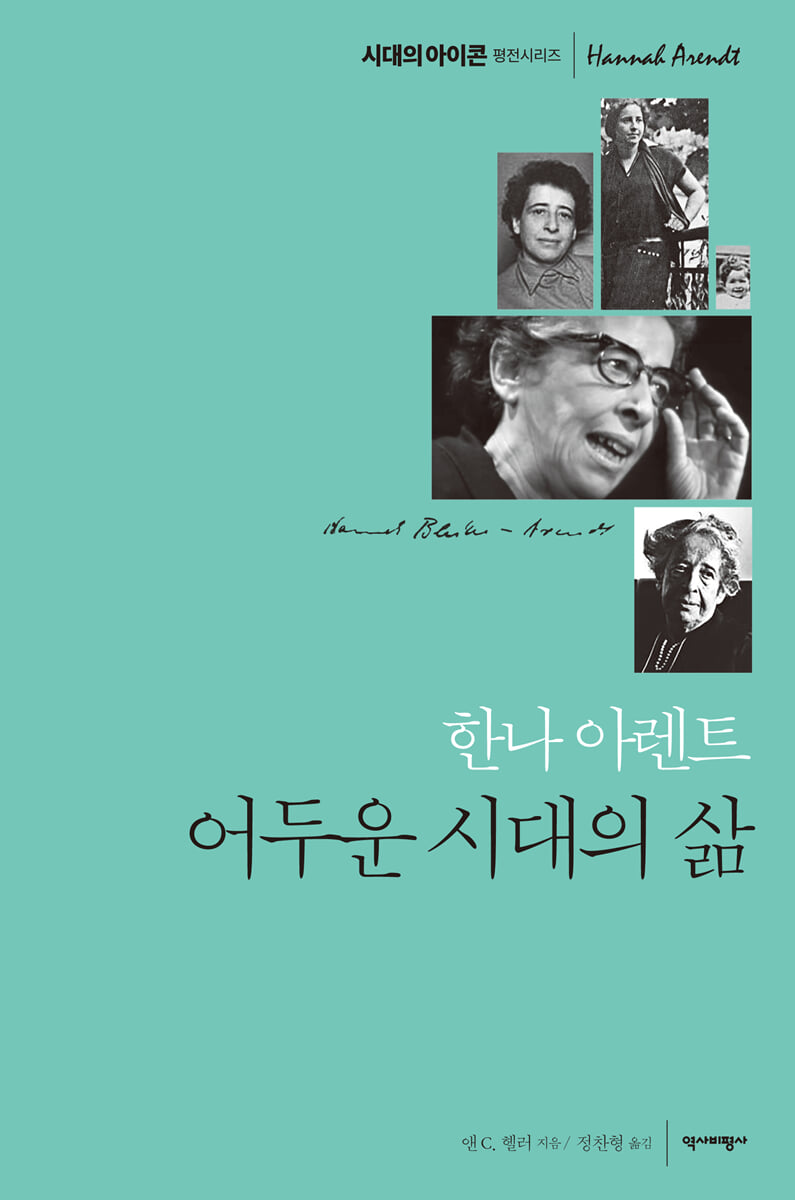
Hannah Arendt's Life in Dark Times
 |
Description
Book Introduction
A biographical series planned by Amazon,
A short biography with a thin volume but powerful message.
"Hannah Arendt: A Life in Dark Times" is one of the [Icons] series, a kind of "short biography series" planned by Amazon Publishing in the United States in 2013.
This project aimed to create “short biographies” that would be thin but powerfully conveyed in the mobile era, and the best writers in each field wrote about historical figures who had a profound impact on modern culture.
This book is the second publication in the first installment of the History Criticism Publishing Company's [Icons of the Era: Biography Series].
Hannah Arendt: Life in Dark Times, Anne C.
Heller (Anne C.
Written by Heller: Published in May 2021.
Edgar Allan Poe: The Fever Called Life, by Paul Collins, published in October 2020.
Jesus, God with a Human Face, by Jay Parini: Geungan.
Hannah Arendt was a Jewish political thinker who created a great stir in the intellectual history of the 20th century with her brilliant achievements.
In her 1950 book, The Origins of Totalitarianism, she delved into the details of the atrocities and massacres committed by fascism and Nazism, arguably the worst legacies of the 20th century.
Furthermore, in 『Eichmann in Jerusalem: A Report on the Banality of Evil』, while facing the horrific suffering experienced by Jews and Jewish society, he also harshly criticized the hidden meaning and structural background of the 'Eichmann Trial', which dealt with the issue of Nazi war criminals.
A short biography with a thin volume but powerful message.
"Hannah Arendt: A Life in Dark Times" is one of the [Icons] series, a kind of "short biography series" planned by Amazon Publishing in the United States in 2013.
This project aimed to create “short biographies” that would be thin but powerfully conveyed in the mobile era, and the best writers in each field wrote about historical figures who had a profound impact on modern culture.
This book is the second publication in the first installment of the History Criticism Publishing Company's [Icons of the Era: Biography Series].
Hannah Arendt: Life in Dark Times, Anne C.
Heller (Anne C.
Written by Heller: Published in May 2021.
Edgar Allan Poe: The Fever Called Life, by Paul Collins, published in October 2020.
Jesus, God with a Human Face, by Jay Parini: Geungan.
Hannah Arendt was a Jewish political thinker who created a great stir in the intellectual history of the 20th century with her brilliant achievements.
In her 1950 book, The Origins of Totalitarianism, she delved into the details of the atrocities and massacres committed by fascism and Nazism, arguably the worst legacies of the 20th century.
Furthermore, in 『Eichmann in Jerusalem: A Report on the Banality of Evil』, while facing the horrific suffering experienced by Jews and Jewish society, he also harshly criticized the hidden meaning and structural background of the 'Eichmann Trial', which dealt with the issue of Nazi war criminals.
- You can preview some of the book's contents.
Preview
index
Eichmann in Jerusalem, 1961–1963
The Death of the Father, Königsberg, 1906–1923
First Love, Heidegger in Marburg, 1924–1932
Our Exiles, Berlin and Paris in the 1930s
Security and Reputation, "The Origins of Totalitarianism" and New York's Intellectual Community, 1941–1961
After Eichmann, New York, 1963–1975
The Death of the Father, Königsberg, 1906–1923
First Love, Heidegger in Marburg, 1924–1932
Our Exiles, Berlin and Paris in the 1930s
Security and Reputation, "The Origins of Totalitarianism" and New York's Intellectual Community, 1941–1961
After Eichmann, New York, 1963–1975
Into the book
In her view, Eichmann's biggest problem was that he was "thoughtless" (i.e., he could not consider problems or events from other people's perspectives).
---p.34
Arendt elaborated her thoughts again in a remarkable analogy at a lecture a month later.
As Eichmann showed, evil is “hair-raisingly superficial,” and this makes it easily contagious.
“It has no roots anywhere, so it can spread like a fungus and devastate the world,” she declared to a packed auditorium of University of Chicago professors and students.
---p.36
Arendt proved that the person who can best protect herself is herself.
---p.53
She was already an outsider, standing alone, with no place to put down roots.
She did not mention that she was Jewish.
But she was willing to live without a “foundation” and without deceiving herself.
It was a life befitting of Hannah Arendt, a self-confident and proud vagabond.
---p.94
“A house that is not recognized and respected by its neighbors is not a house,” Arendt argued, still a stateless person.
“Palestinian independence can only be achieved through strong cooperation between Jews and Arabs.”
She criticized Zionists, who have traditionally been known for their belligerent tendencies, for not recognizing their differences with their opponents and for not agreeing with these views.
“(Massive) unanimity is not the result of consensus.
“It is nothing but an expression of fanaticism and hysteria.”
---p.159
“The principle that you must agree with yourself is a very old one.”
In her essay, “The Crisis of Culture,” included in “Between Past and Future,” Arendt wrote:
“In fact, such a principle was established by Socrates.
As Plato summarized, Socrates' central doctrine can be summarized in one sentence:
'I am one and only in this world.
Therefore, it is better not to agree with the whole world than not to agree with yourself.”
---p.187~188
The reason why all the thoughtful people of the world mourned the loss of Hannah Arendt was, at least in part, because in almost all of her writings, including her great works (The Origins of Totalitarianism, The Human Condition, Eichmann in Jerusalem), she was willing to look at the world from an outsider's perspective.
Even in the darkest and most dangerous times, she never stopped being an outsider.
---p.34
Arendt elaborated her thoughts again in a remarkable analogy at a lecture a month later.
As Eichmann showed, evil is “hair-raisingly superficial,” and this makes it easily contagious.
“It has no roots anywhere, so it can spread like a fungus and devastate the world,” she declared to a packed auditorium of University of Chicago professors and students.
---p.36
Arendt proved that the person who can best protect herself is herself.
---p.53
She was already an outsider, standing alone, with no place to put down roots.
She did not mention that she was Jewish.
But she was willing to live without a “foundation” and without deceiving herself.
It was a life befitting of Hannah Arendt, a self-confident and proud vagabond.
---p.94
“A house that is not recognized and respected by its neighbors is not a house,” Arendt argued, still a stateless person.
“Palestinian independence can only be achieved through strong cooperation between Jews and Arabs.”
She criticized Zionists, who have traditionally been known for their belligerent tendencies, for not recognizing their differences with their opponents and for not agreeing with these views.
“(Massive) unanimity is not the result of consensus.
“It is nothing but an expression of fanaticism and hysteria.”
---p.159
“The principle that you must agree with yourself is a very old one.”
In her essay, “The Crisis of Culture,” included in “Between Past and Future,” Arendt wrote:
“In fact, such a principle was established by Socrates.
As Plato summarized, Socrates' central doctrine can be summarized in one sentence:
'I am one and only in this world.
Therefore, it is better not to agree with the whole world than not to agree with yourself.”
---p.187~188
The reason why all the thoughtful people of the world mourned the loss of Hannah Arendt was, at least in part, because in almost all of her writings, including her great works (The Origins of Totalitarianism, The Human Condition, Eichmann in Jerusalem), she was willing to look at the world from an outsider's perspective.
Even in the darkest and most dangerous times, she never stopped being an outsider.
---p.199
Publisher's Review
He was a fiery free spirit and an eternal stranger.
A condensed biography of Hannah Arendt's tumultuous life
This book is a short biography that condenses the life and thought of Hannah Arendt into six aspects.
In particular, starting from the 'Eichmann trial' that sent shockwaves around the world with the concept of 'the banality of evil', the film dramatically captures each scene from his family history as a Jewish person, his intimate relationship with Martin Heidegger, a giant of German philosophy, his path of escape and exile toward a life of freedom, and his final days as a political thinker and philosopher.
Although this is a short biography, it accurately depicts the drama of Hannah Arendt's life and ideological turmoil through these six compressed aspects.
Author: Ann C.
Heller shows that the way of life that Hannah Arendt chose and practiced throughout her life—the power to speak truth freely and confidently while always facing her own identity as a free person and a stranger—is consistently evident in all six aspects.
Based on her self-reflective attitude toward Jews and Jewish society, she surprisingly captured the 'banality of evil' in the 'Eichmann trial', where everyone was angry and quick to condemn.
Although he was Jewish himself, he did not focus solely on the issue of Jewish persecution, but dissected the inhuman power and madness of fascism and Nazism as a form of 'totalitarianism.'
Hannah Arendt's loneliness and determination, as she lived as a "conscious vagabond" and an outsider, proving that "the person who can best protect himself is himself," are well expressed in this short biography.
A condensed biography of Hannah Arendt's tumultuous life
This book is a short biography that condenses the life and thought of Hannah Arendt into six aspects.
In particular, starting from the 'Eichmann trial' that sent shockwaves around the world with the concept of 'the banality of evil', the film dramatically captures each scene from his family history as a Jewish person, his intimate relationship with Martin Heidegger, a giant of German philosophy, his path of escape and exile toward a life of freedom, and his final days as a political thinker and philosopher.
Although this is a short biography, it accurately depicts the drama of Hannah Arendt's life and ideological turmoil through these six compressed aspects.
Author: Ann C.
Heller shows that the way of life that Hannah Arendt chose and practiced throughout her life—the power to speak truth freely and confidently while always facing her own identity as a free person and a stranger—is consistently evident in all six aspects.
Based on her self-reflective attitude toward Jews and Jewish society, she surprisingly captured the 'banality of evil' in the 'Eichmann trial', where everyone was angry and quick to condemn.
Although he was Jewish himself, he did not focus solely on the issue of Jewish persecution, but dissected the inhuman power and madness of fascism and Nazism as a form of 'totalitarianism.'
Hannah Arendt's loneliness and determination, as she lived as a "conscious vagabond" and an outsider, proving that "the person who can best protect himself is himself," are well expressed in this short biography.
GOODS SPECIFICS
- Publication date: April 28, 2021
- Format: Hardcover book binding method guide
- Page count, weight, size: 200 pages | 362g | 148*218*20mm
- ISBN13: 9788976966452
- ISBN10: 8976966457
You may also like
카테고리
korean


korean

![GQ KOREA Mark (Monthly): December [2025]](http://librairie.coreenne.fr/cdn/shop/files/8ef265dbbfbf186523ed75ba7319009d.jpg?v=1765340328&width=3840)


