

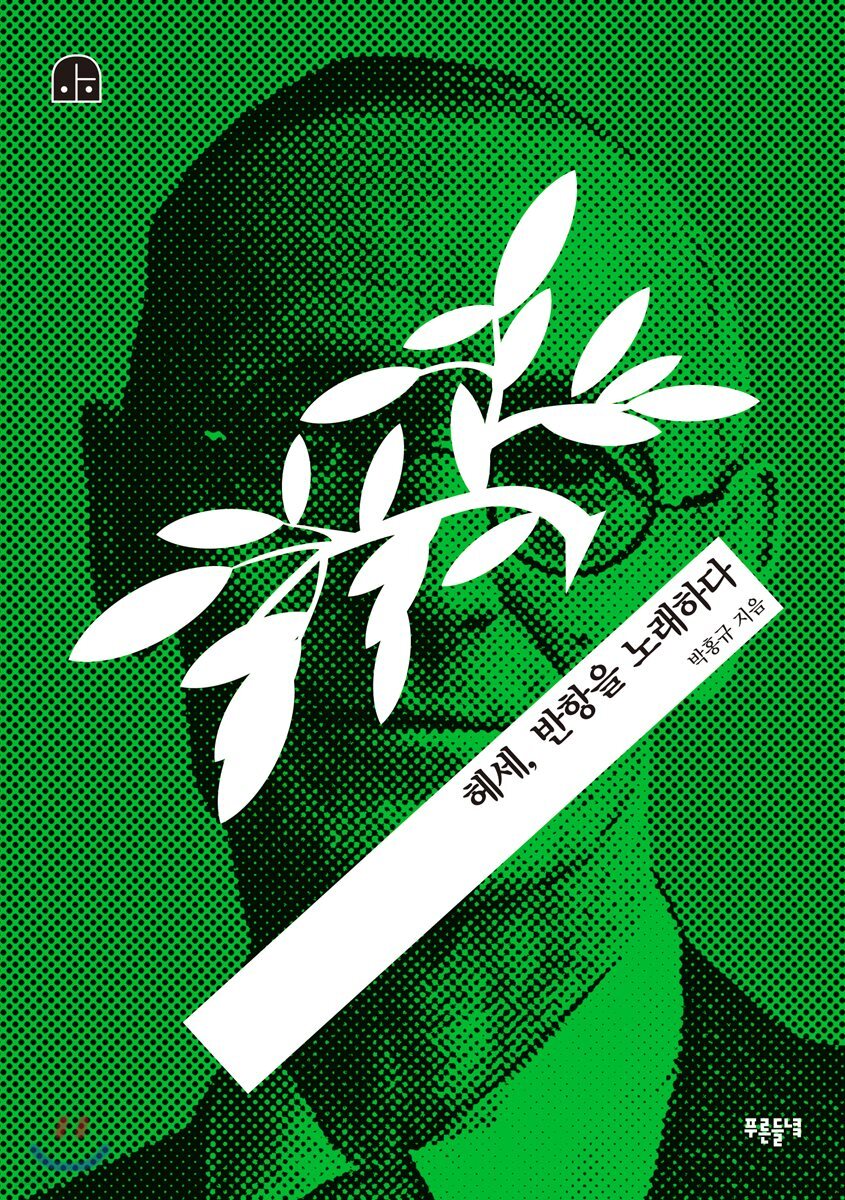
Hesse, Singing of Rebellion
 |
Description
Book Introduction
Hesse was not a genius novelist who spread the secrets of healing.
He was a rebel who stood up against the evil system that oppressed individuals and destroyed individuality!
A fresh look at the life and literature of Hermann Hesse, the author of 『Beneath the Wheel』, 『Demian』, and 『The Glass Bead Game』, whom we all love!
Few Western writers have achieved national fame and a wide fan base like Hermann Hesse.
Beneath the Wheel and Demian, along with Salinger's The Catcher in the Rye, have long been must-reads for adolescents, like a rite of passage, and Hesse's image of a simple farmer tending a vineyard has been imprinted on us as a naturalist writer through works like The Joy of Gardening.
Young people, in particular, were enthusiastic about Demian, considering Hesse a writer who focused on inner growth, along with the famous quote, “The bird breaks the egg and comes out.” This, along with Goethe’s words, “Man is destined to wander as long as he strives,” served as a meaningful stimulus that aroused awakening, challenge, and passion in young souls across the centuries.
Also, at some point in our country, Hesse established himself as a ‘writer of healing.’
This is because publishers and even readers have been promoting his books by saying things like, “If you read his books, pain, sorrow, and suffering will disappear,” or “Hesse’s writings are extremely effective in psychotherapy.”
However, this is the result of misreading the ‘self-discovery’ that Hesse emphasized.
The self-discovery Hesse speaks of is not to become part of the machine called the masses, but to resist the reality of that machine.
In fact, no writer in the world is obsessed with the inner self of an individual.
But all the books about Hesse published in our country say the same thing.
Hesse, a writer who dealt with the relationship between society and the individual, especially the situation in which the social system oppresses the individual, most acutely showed this. He viewed tragedies such as individual suicide as tragedies arising from the absurdity of society, not as conflicts of the inner mind.
He argued that to resolve such a tragedy, not only humans themselves but also society must be revolutionized.
In Korea, countless translations of Hesse's works have been published, and many commentaries on his life and works have been introduced.
However, there is no biography or systematic study of Hesse written by a Korean.
This book is the first Korean biography of Hesse, written to fill that intellectual gap, and is an attempt to read all of his works. It will be a refreshing work that explores the true nature of Hesse and his novels, which have been as misinterpreted as they have been loved.
He was a rebel who stood up against the evil system that oppressed individuals and destroyed individuality!
A fresh look at the life and literature of Hermann Hesse, the author of 『Beneath the Wheel』, 『Demian』, and 『The Glass Bead Game』, whom we all love!
Few Western writers have achieved national fame and a wide fan base like Hermann Hesse.
Beneath the Wheel and Demian, along with Salinger's The Catcher in the Rye, have long been must-reads for adolescents, like a rite of passage, and Hesse's image of a simple farmer tending a vineyard has been imprinted on us as a naturalist writer through works like The Joy of Gardening.
Young people, in particular, were enthusiastic about Demian, considering Hesse a writer who focused on inner growth, along with the famous quote, “The bird breaks the egg and comes out.” This, along with Goethe’s words, “Man is destined to wander as long as he strives,” served as a meaningful stimulus that aroused awakening, challenge, and passion in young souls across the centuries.
Also, at some point in our country, Hesse established himself as a ‘writer of healing.’
This is because publishers and even readers have been promoting his books by saying things like, “If you read his books, pain, sorrow, and suffering will disappear,” or “Hesse’s writings are extremely effective in psychotherapy.”
However, this is the result of misreading the ‘self-discovery’ that Hesse emphasized.
The self-discovery Hesse speaks of is not to become part of the machine called the masses, but to resist the reality of that machine.
In fact, no writer in the world is obsessed with the inner self of an individual.
But all the books about Hesse published in our country say the same thing.
Hesse, a writer who dealt with the relationship between society and the individual, especially the situation in which the social system oppresses the individual, most acutely showed this. He viewed tragedies such as individual suicide as tragedies arising from the absurdity of society, not as conflicts of the inner mind.
He argued that to resolve such a tragedy, not only humans themselves but also society must be revolutionized.
In Korea, countless translations of Hesse's works have been published, and many commentaries on his life and works have been introduced.
However, there is no biography or systematic study of Hesse written by a Korean.
This book is the first Korean biography of Hesse, written to fill that intellectual gap, and is an attempt to read all of his works. It will be a refreshing work that explores the true nature of Hesse and his novels, which have been as misinterpreted as they have been loved.
- You can preview some of the book's contents.
Preview
index
Author's Note: Resist everything!
1.
Hesse and Uri
Why did Hesse become a best-selling author in Korea? | The Hesse I read is a social writer | Hesse who fought for an anti-capitalist life | Hesse and the Fatherland | Hesse is an anarchist | Koreans misunderstood Hesse | Hesse and the wisdom of the East | The problems of the Hesse Renaissance | Why hippies in the late 1960s regarded Hesse's works as the Bible | Hesse and politics | A brief sketch of Hesse's life | A brief sketch of Hesse's literature
2.
Rebel to death
The Bismarck Era | Childhood in Calw and Basel | A Childhood Where Rebellion Began | Nurturing a Longing for the 'Other World' at the Theological Seminary | Becoming a Bookseller's Apprentice | The Hour After Midnight | Awakening from Illusion | First Marriage and First Success | Peter Camenzind | Peter Camenzind is a Textbook of Ecology | Beneath the Wheel | Beneath the Wheel is a Textbook of the Anti-School | German Literature and Hesse in the Early 20th Century
3.
Rebel by wandering
The Gaienhofen years, filled with the joys of gardening | Europe before World War I | Poetry in a time of upheaval | Meeting the Wanderer | What kind of person was Gusto Greser? | Hesse's Bern years | Gertrud and On the Road | From what perspective did Hesse understand India? | Loshalde | Knulp | Hesse's love of fairy tales
4.
Rebel with your conscience
Criticizing the Madness of the Age | War and Grezer | Beyond Morality and Reason | Demian | Encountering a New Inner World | Breaking the Egg of the World | Is Demian a Novel of Personality Perfection? | The Soul of a Child | Wanderings | Maria, Wife, Admitted to a Sanatorium Due to Depression | Germany after World War I | The Return of Zarathustra | Reflections on Dostoevsky
5.
Rebel with love
Montagnola, where Hesse lived for forty-four years | Klein and Wagner | Klingsor's Last Summer | Hesse and Greser in the early 1920s | Siddhartha, Part 1 | Siddhartha, Part 2 | After Siddhartha and the Sanatorium | Journey to Nuremberg | Steppenwolf | The Notebooks of Harry Haller | War | Music | Masquerade Ball | The Magic Theatre's Car | Between 1927 and 1929 | Narcissus and Goldmund | The Monastery Story | A Story of Wandering and Creation | A Story of Reunion and Death
6.
Rebel with service
Time Spent in the Garden | The Nazi Era | Pilgrimage to the East | The Nazis and Hesse | The Glass Bead Game | What is the Glass Bead Game? | The Age of Corrupt Miscellaneous Writing | What Kind of Place is Castalia? | Knecht | The Master of Games | Departure | Posthumous Poems | Three Resumes | Evaluation of The Glass Bead Game and Postwar Hesse | After World War II | The Cold War and the Later Years
Conclusion: Hesse's life and literature are a declaration of individual independence.
1.
Hesse and Uri
Why did Hesse become a best-selling author in Korea? | The Hesse I read is a social writer | Hesse who fought for an anti-capitalist life | Hesse and the Fatherland | Hesse is an anarchist | Koreans misunderstood Hesse | Hesse and the wisdom of the East | The problems of the Hesse Renaissance | Why hippies in the late 1960s regarded Hesse's works as the Bible | Hesse and politics | A brief sketch of Hesse's life | A brief sketch of Hesse's literature
2.
Rebel to death
The Bismarck Era | Childhood in Calw and Basel | A Childhood Where Rebellion Began | Nurturing a Longing for the 'Other World' at the Theological Seminary | Becoming a Bookseller's Apprentice | The Hour After Midnight | Awakening from Illusion | First Marriage and First Success | Peter Camenzind | Peter Camenzind is a Textbook of Ecology | Beneath the Wheel | Beneath the Wheel is a Textbook of the Anti-School | German Literature and Hesse in the Early 20th Century
3.
Rebel by wandering
The Gaienhofen years, filled with the joys of gardening | Europe before World War I | Poetry in a time of upheaval | Meeting the Wanderer | What kind of person was Gusto Greser? | Hesse's Bern years | Gertrud and On the Road | From what perspective did Hesse understand India? | Loshalde | Knulp | Hesse's love of fairy tales
4.
Rebel with your conscience
Criticizing the Madness of the Age | War and Grezer | Beyond Morality and Reason | Demian | Encountering a New Inner World | Breaking the Egg of the World | Is Demian a Novel of Personality Perfection? | The Soul of a Child | Wanderings | Maria, Wife, Admitted to a Sanatorium Due to Depression | Germany after World War I | The Return of Zarathustra | Reflections on Dostoevsky
5.
Rebel with love
Montagnola, where Hesse lived for forty-four years | Klein and Wagner | Klingsor's Last Summer | Hesse and Greser in the early 1920s | Siddhartha, Part 1 | Siddhartha, Part 2 | After Siddhartha and the Sanatorium | Journey to Nuremberg | Steppenwolf | The Notebooks of Harry Haller | War | Music | Masquerade Ball | The Magic Theatre's Car | Between 1927 and 1929 | Narcissus and Goldmund | The Monastery Story | A Story of Wandering and Creation | A Story of Reunion and Death
6.
Rebel with service
Time Spent in the Garden | The Nazi Era | Pilgrimage to the East | The Nazis and Hesse | The Glass Bead Game | What is the Glass Bead Game? | The Age of Corrupt Miscellaneous Writing | What Kind of Place is Castalia? | Knecht | The Master of Games | Departure | Posthumous Poems | Three Resumes | Evaluation of The Glass Bead Game and Postwar Hesse | After World War II | The Cold War and the Later Years
Conclusion: Hesse's life and literature are a declaration of individual independence.
Into the book
I read Hesse's works, including 'Demian', when I was in middle school.
I had already become tired of Jeon Hye-rin, the "genius" who was popular at the time, by the time I entered high school, but Hesse's works, including "Demian," which she translated in 1964, were friends of my adolescence.
It had nothing to do with the secrets of growth, such as the 'pain of breaking the shell' of an inner genius artist, which Jeon Hye-rin and her juniors often talked about in works like 'Demian'.
Rather, it was the message of freedom and independence—to be yourself, to be true to yourself, and to be responsible for yourself—that captivated me.
It meant a rejection of the state or capital.
As a thorough individual, I have my own amount
It was a teaching to live according to one's heart, take responsibility, love and serve others, and protect the peace of mankind.
It's such an obvious statement, isn't it? As Hesse said in "Demian," how difficult it is to maintain it. (...)
It is painful to look at Korea today and see that, although it has been said to have democratized, in reality, it has been collectivization, uniformity, atomization, power, violence, and selfishness centered on capitalization, monetization, commercialization, and materialization.
Hesse was the writer who most deeply pondered all such issues. --- From "The Hesse I Read is a Social Writer"
For example, Hesse stopped writing the novel after writing the story of the protagonist's study of Indian thought and Buddhism in Part 1 of Siddhartha, because he realized that he could only experience his own unique self after becoming angry against all order.
If one loses one's self by being influenced by the public and the opinions of others, there can be no experience of self.
So, Siddhartha leaves even the Buddha, and the story of his rebellious experience to stand up to the world is told in Part 2.
So, in no sense is this a story about compromising with the world.
Therefore, I cannot agree with the view that this book is “a peaceful book that brings harmony to this world,” or that the wisdom of India and China collided with and combined with Western experience to achieve harmony between the East and the West. --- From “Hesse and the Wisdom of the East”
What is interesting is that in Korea and Japan, Hesse's biographical works up to and including "Demian" are popular, while in the West, his later works after "Steppenwolf" are popular.
There is a view that this difference stems from the fact that while the early works deal with the fate of the individual, the later works examine the relationship between the individual and society.
There is a problem with this simple distinction.
Rather, the difference in popularity between the East and the West may be found in the fact that the early works excel in romantic depictions of nature, while the later works focus more on depictions of the inner world.
If there is one thing that the above views have in common, it is that Hesse's works were popular among youth in both the East and the West.
He says that this is both a strength and a weakness of Hesse's literature, and seeks the reason for this in non-literary factors.
And the first element is called the oriental element and the anthropological element, and this can stimulate Western youth's curiosity about "unfamiliar exoticism or very different cultures, and for Asian youth, it can feel very familiar because it is the spiritual soil that raised them."
However, it is difficult to accept the explanation that these same Oriental elements create curiosity in Westerners who do not know them, and a sense of familiarity in Easterners who do know them well.
So we need to find other factors.
In other words, Hesse's works, which depict the meaninglessness of war, appealed to the youth of Germany and Japan who experienced World War II and the United States who experienced the Vietnam War, and to youth who felt alienated from industrial society, despaired of the education system, and were pursuing their own paths.
This is more convincing.
Of course, the plainness of Hesse's works may also be a secret to their popularity. --- From "Problems of the Hesse Renaissance"
All the protagonists in Hesse's works die because of their suffering rather than overcoming it.
Most of them are not educated citizens, but rather anti-civil human beings who are faithful to their uneducated instincts.
And since suffering also arises from civic values, including morals, learned at home and at school during childhood, reading Hesse's works properly seems to be telling us to become anti-civil, anti-family, anti-educational, and anti-cultured people.
That is why his work was considered the bible of the hippies who emerged in the West in the late 1960s.
Therefore, Hesse's work is extremely dangerous to the eyes of a typical adult.
Hesse himself lived like a hippie.
On the other hand, in Korea, it is said that the formation of the inner world and self-realization are the essence of Hesse's literature.
For example, Jeon Hye-rin said, “The theme that appears throughout Hesse’s works was liberation from the self and the path to the true self, and he remained faithful to this motto until the end.”
What exactly is a self "liberated from the self," and what, then, is a "true self"? I believe that understanding the oppressive reality that inevitably emphasizes the individual self—individuality—resisting German reality is far more important than such abstruse theories of the self.
In fact, wasn't the German literary tradition of the Bildungsroman an effort to overcome the oppressive reality that hinders individual growth and establish individuality? As we will see later, this was a German intellectual tradition after Luther, and such an intellectual tradition was always focused on overcoming the oppression of reality.
But since overcoming reality is actually impossible, an unbridled tendency toward self-indulgence would have arisen, and where this is hindered, criticism would naturally arise, and wouldn't it have manifested as a mystical tendency, or perhaps, finally, as an extreme explosion, a romantic revolution? --- From "Why Hippies in the Late 1960s Treated Hesse's Works as the Bible"
The translator of Beneath the Wheel suggests that Hans's death may have been due to his mother's early death (267), but this is questionable.
Unlike Hans, Hesse had a mother, and while Hesse was able to sublimate his suffering and trials into writing, Hans is said to have died without finding such an outlet.
But the presence of his mother has nothing to do with Hans' death, let alone his suffering and trials.
In the final funeral scene of the novel, Hesse has Flick say that all the teachers and townspeople present killed Hans, but why does the translator emphasize the mother's absence so much? (...) In "Hesse's Literature and Ideal Politics," Hong Soon-gil says that Hans in "Under the Wheel" "endured and finally achieved inner maturity" (170). But is death really such maturity? Hong Soon-gil also says that "Under the Wheel" is "a product of happy times, like the hometown of his childhood and the embrace of his parents," and that Hesse "could have written successful works by continuing to hold on to the threads of memories, by reciting only inner confessions, and by pouring out only feelings mixed with nostalgia and melancholy," and that he was "a writer who rose to fame in that way." (185) Is that really so? "Under the Wheel" is not simply a youthful elegy.
It is a novel that criticizes the system.
This is the story of a teenager who died under the weight of the system of home, school, and work.
Although politics and economics do not appear as specific systems here, the authoritarian homes, schools, and workplaces that dominate the lives of teenagers already presuppose an authoritarian state.
Doesn't the principal's words quoted in Chapter 2 exemplify this? He's referring to the authoritarian society of late 19th-century Germany.
If Peter Camenzind is a textbook of ecology, Beneath the Wheel is a textbook of anti-school. --- From "Beneath the Wheel is a textbook of anti-school"
However, it is correct to view this novel as a work that “hit the mark so precisely that it could not possibly speak to the essence of the times,” as Thomas Mann said in the preface to the American edition of Demian in 1947 (Hwang Jin, 225).
This can be seen in the attitude of those who die while blaming themselves for the war rather than others.
Here Hesse never sees man as a “harmoniously complete unity,” as our scholars call it in the East.
The cause of the destructive war that brought about chaos and disorder rather than harmony is seen as the duality of human beings, that is, the opposition between mind and senses, good and evil.
By overcoming this kind of conflict, we once again pursue “harmoniously completed unity.” --- From “Is ‘Demian’ a novel about the perfection of personality?”
Published in 1930, 『Narcissus and Goldmund』 was introduced in Korea under the title 『Knowledge and Love』, and is said to have been loved by the most readers along with 『Demian』, but I find this difficult to understand.
This is because the opposition between pale intellect and unrestrained love, which is often said to be the theme of the novel, feels too idealistic.
In particular, it feels like a novel that contrasts Nietzsche's Apollonian and Dionysian human images.
However, if it is a copy of Nietzsche, Hesse's value may be damaged.
To me, this novel is seen as a satire of the problems of the system and the times caused by the discord between spirit and nature, rather than an ideological conflict.
(…) But the biggest difference is that the protagonists of ‘Narcissus and Goldmund’ are no longer the boys of ‘Beneath the Wheel’.
Narcissus is a monk who has spent his entire life in seclusion in a monastery, while Goldmund is a wanderer who has spent his entire life wandering outside the monastery.
Also, their personalities are different.
Narcissus is intellectual and calm, while Goldmund is romantic and passionate.
It is possible to distinguish between intellectual and emotional types.
But both are alike in their search for God.
If I had to pick just one protagonist out of the two, it would be Goldmund.
Therefore, considering the importance of the protagonist, it might have been more appropriate to title it 『Goldmund and Narcissus』. --- From 『Narcissus and Goldmund』
It is clear that 『The Glass Bead Game』 was written as a pursuit of utopia in rebellion against the reality that had become devastated after the rise of Nazism.
Hesse believed that fascism and communism were not very different.
They were considered similar in that they were trying to build an ideal society through violence and terrorism.
Hesse wrote the novel with the belief that it should represent a position that is nothing more than pure play, a basic human need and an expression of life, without pursuing any purpose, or even being conscious of such a purpose.
At first, Hesse intended to write a utopian novel.
However, from 1938 onwards, as his attitude changed to a more socially engaged one, he focused on novels that sought a dialectical synthesis of spirit and life.
(…) The biographical form of 『The Glass Bead Game』 shows that the novel is a ‘novel of growth’ (Entwicklungsroman).
However, the sentimentalism that recalls the agony of youth that Hesse had previously shown is excluded, and instead, a cool objectivity is shown.
To this end, Hesse put forward a biographer and an editor, a method he had already used in Demian and Steppenwolf.
But above all, the feature that should be noted in this novel is the depiction of an ideal society in which the individualization and individuation that Hesse pursued throughout his life are in harmony with the group to which he belonged.
(…) Therefore, 『Glass Bead Game』 is not a novel named after the main character.
Before that, the titles of Hesse's novels were mostly named after the protagonist.
Like Peter Camenzind, Demian, Siddhartha, and Narcissus and Goldmund.
This means that the protagonist Knecht's life is dissolved into a society called Castalia.
In other words, it is not only the individual who seeks harmony, but also the individual and the group. ---From “The Glass Bead Game”
Hesse says that whether we are parents, teachers, journalists, artists, or intellectuals, the most important thing we can do for children is to foster their individuality.
It is not a political slogan, but rather a teaching of how to live righteously and proudly on your own.
So to speak, it is a matter of fostering voluntary bullying.
Of course, individuality is ultimately discovered by the individual, and no one can replace them.
Therefore, no one can be a model for anyone.
So Hesse constantly warns us not to make ourselves or anyone else our role models.
In fact, this is the aspect of Hesse that I like the most.
There is no such thing as a great man.
There is only oneself.
(…) In the meantime, we have become much richer materially, but we have become very poor spiritually.
Hesse knew it in Germany a century ago.
Maybe we are in this situation now because we imitated Germany, the West.
It is time for both Germany and Korea to recover not only materially but also spiritually.
Hesse tells us that.
To do that, Hesse says, we must rebel against a world that is going wrong.
I warn you not to succumb to the easy and sweet whispers of healing.
Rebel.
It is human to rebel.
I had already become tired of Jeon Hye-rin, the "genius" who was popular at the time, by the time I entered high school, but Hesse's works, including "Demian," which she translated in 1964, were friends of my adolescence.
It had nothing to do with the secrets of growth, such as the 'pain of breaking the shell' of an inner genius artist, which Jeon Hye-rin and her juniors often talked about in works like 'Demian'.
Rather, it was the message of freedom and independence—to be yourself, to be true to yourself, and to be responsible for yourself—that captivated me.
It meant a rejection of the state or capital.
As a thorough individual, I have my own amount
It was a teaching to live according to one's heart, take responsibility, love and serve others, and protect the peace of mankind.
It's such an obvious statement, isn't it? As Hesse said in "Demian," how difficult it is to maintain it. (...)
It is painful to look at Korea today and see that, although it has been said to have democratized, in reality, it has been collectivization, uniformity, atomization, power, violence, and selfishness centered on capitalization, monetization, commercialization, and materialization.
Hesse was the writer who most deeply pondered all such issues. --- From "The Hesse I Read is a Social Writer"
For example, Hesse stopped writing the novel after writing the story of the protagonist's study of Indian thought and Buddhism in Part 1 of Siddhartha, because he realized that he could only experience his own unique self after becoming angry against all order.
If one loses one's self by being influenced by the public and the opinions of others, there can be no experience of self.
So, Siddhartha leaves even the Buddha, and the story of his rebellious experience to stand up to the world is told in Part 2.
So, in no sense is this a story about compromising with the world.
Therefore, I cannot agree with the view that this book is “a peaceful book that brings harmony to this world,” or that the wisdom of India and China collided with and combined with Western experience to achieve harmony between the East and the West. --- From “Hesse and the Wisdom of the East”
What is interesting is that in Korea and Japan, Hesse's biographical works up to and including "Demian" are popular, while in the West, his later works after "Steppenwolf" are popular.
There is a view that this difference stems from the fact that while the early works deal with the fate of the individual, the later works examine the relationship between the individual and society.
There is a problem with this simple distinction.
Rather, the difference in popularity between the East and the West may be found in the fact that the early works excel in romantic depictions of nature, while the later works focus more on depictions of the inner world.
If there is one thing that the above views have in common, it is that Hesse's works were popular among youth in both the East and the West.
He says that this is both a strength and a weakness of Hesse's literature, and seeks the reason for this in non-literary factors.
And the first element is called the oriental element and the anthropological element, and this can stimulate Western youth's curiosity about "unfamiliar exoticism or very different cultures, and for Asian youth, it can feel very familiar because it is the spiritual soil that raised them."
However, it is difficult to accept the explanation that these same Oriental elements create curiosity in Westerners who do not know them, and a sense of familiarity in Easterners who do know them well.
So we need to find other factors.
In other words, Hesse's works, which depict the meaninglessness of war, appealed to the youth of Germany and Japan who experienced World War II and the United States who experienced the Vietnam War, and to youth who felt alienated from industrial society, despaired of the education system, and were pursuing their own paths.
This is more convincing.
Of course, the plainness of Hesse's works may also be a secret to their popularity. --- From "Problems of the Hesse Renaissance"
All the protagonists in Hesse's works die because of their suffering rather than overcoming it.
Most of them are not educated citizens, but rather anti-civil human beings who are faithful to their uneducated instincts.
And since suffering also arises from civic values, including morals, learned at home and at school during childhood, reading Hesse's works properly seems to be telling us to become anti-civil, anti-family, anti-educational, and anti-cultured people.
That is why his work was considered the bible of the hippies who emerged in the West in the late 1960s.
Therefore, Hesse's work is extremely dangerous to the eyes of a typical adult.
Hesse himself lived like a hippie.
On the other hand, in Korea, it is said that the formation of the inner world and self-realization are the essence of Hesse's literature.
For example, Jeon Hye-rin said, “The theme that appears throughout Hesse’s works was liberation from the self and the path to the true self, and he remained faithful to this motto until the end.”
What exactly is a self "liberated from the self," and what, then, is a "true self"? I believe that understanding the oppressive reality that inevitably emphasizes the individual self—individuality—resisting German reality is far more important than such abstruse theories of the self.
In fact, wasn't the German literary tradition of the Bildungsroman an effort to overcome the oppressive reality that hinders individual growth and establish individuality? As we will see later, this was a German intellectual tradition after Luther, and such an intellectual tradition was always focused on overcoming the oppression of reality.
But since overcoming reality is actually impossible, an unbridled tendency toward self-indulgence would have arisen, and where this is hindered, criticism would naturally arise, and wouldn't it have manifested as a mystical tendency, or perhaps, finally, as an extreme explosion, a romantic revolution? --- From "Why Hippies in the Late 1960s Treated Hesse's Works as the Bible"
The translator of Beneath the Wheel suggests that Hans's death may have been due to his mother's early death (267), but this is questionable.
Unlike Hans, Hesse had a mother, and while Hesse was able to sublimate his suffering and trials into writing, Hans is said to have died without finding such an outlet.
But the presence of his mother has nothing to do with Hans' death, let alone his suffering and trials.
In the final funeral scene of the novel, Hesse has Flick say that all the teachers and townspeople present killed Hans, but why does the translator emphasize the mother's absence so much? (...) In "Hesse's Literature and Ideal Politics," Hong Soon-gil says that Hans in "Under the Wheel" "endured and finally achieved inner maturity" (170). But is death really such maturity? Hong Soon-gil also says that "Under the Wheel" is "a product of happy times, like the hometown of his childhood and the embrace of his parents," and that Hesse "could have written successful works by continuing to hold on to the threads of memories, by reciting only inner confessions, and by pouring out only feelings mixed with nostalgia and melancholy," and that he was "a writer who rose to fame in that way." (185) Is that really so? "Under the Wheel" is not simply a youthful elegy.
It is a novel that criticizes the system.
This is the story of a teenager who died under the weight of the system of home, school, and work.
Although politics and economics do not appear as specific systems here, the authoritarian homes, schools, and workplaces that dominate the lives of teenagers already presuppose an authoritarian state.
Doesn't the principal's words quoted in Chapter 2 exemplify this? He's referring to the authoritarian society of late 19th-century Germany.
If Peter Camenzind is a textbook of ecology, Beneath the Wheel is a textbook of anti-school. --- From "Beneath the Wheel is a textbook of anti-school"
However, it is correct to view this novel as a work that “hit the mark so precisely that it could not possibly speak to the essence of the times,” as Thomas Mann said in the preface to the American edition of Demian in 1947 (Hwang Jin, 225).
This can be seen in the attitude of those who die while blaming themselves for the war rather than others.
Here Hesse never sees man as a “harmoniously complete unity,” as our scholars call it in the East.
The cause of the destructive war that brought about chaos and disorder rather than harmony is seen as the duality of human beings, that is, the opposition between mind and senses, good and evil.
By overcoming this kind of conflict, we once again pursue “harmoniously completed unity.” --- From “Is ‘Demian’ a novel about the perfection of personality?”
Published in 1930, 『Narcissus and Goldmund』 was introduced in Korea under the title 『Knowledge and Love』, and is said to have been loved by the most readers along with 『Demian』, but I find this difficult to understand.
This is because the opposition between pale intellect and unrestrained love, which is often said to be the theme of the novel, feels too idealistic.
In particular, it feels like a novel that contrasts Nietzsche's Apollonian and Dionysian human images.
However, if it is a copy of Nietzsche, Hesse's value may be damaged.
To me, this novel is seen as a satire of the problems of the system and the times caused by the discord between spirit and nature, rather than an ideological conflict.
(…) But the biggest difference is that the protagonists of ‘Narcissus and Goldmund’ are no longer the boys of ‘Beneath the Wheel’.
Narcissus is a monk who has spent his entire life in seclusion in a monastery, while Goldmund is a wanderer who has spent his entire life wandering outside the monastery.
Also, their personalities are different.
Narcissus is intellectual and calm, while Goldmund is romantic and passionate.
It is possible to distinguish between intellectual and emotional types.
But both are alike in their search for God.
If I had to pick just one protagonist out of the two, it would be Goldmund.
Therefore, considering the importance of the protagonist, it might have been more appropriate to title it 『Goldmund and Narcissus』. --- From 『Narcissus and Goldmund』
It is clear that 『The Glass Bead Game』 was written as a pursuit of utopia in rebellion against the reality that had become devastated after the rise of Nazism.
Hesse believed that fascism and communism were not very different.
They were considered similar in that they were trying to build an ideal society through violence and terrorism.
Hesse wrote the novel with the belief that it should represent a position that is nothing more than pure play, a basic human need and an expression of life, without pursuing any purpose, or even being conscious of such a purpose.
At first, Hesse intended to write a utopian novel.
However, from 1938 onwards, as his attitude changed to a more socially engaged one, he focused on novels that sought a dialectical synthesis of spirit and life.
(…) The biographical form of 『The Glass Bead Game』 shows that the novel is a ‘novel of growth’ (Entwicklungsroman).
However, the sentimentalism that recalls the agony of youth that Hesse had previously shown is excluded, and instead, a cool objectivity is shown.
To this end, Hesse put forward a biographer and an editor, a method he had already used in Demian and Steppenwolf.
But above all, the feature that should be noted in this novel is the depiction of an ideal society in which the individualization and individuation that Hesse pursued throughout his life are in harmony with the group to which he belonged.
(…) Therefore, 『Glass Bead Game』 is not a novel named after the main character.
Before that, the titles of Hesse's novels were mostly named after the protagonist.
Like Peter Camenzind, Demian, Siddhartha, and Narcissus and Goldmund.
This means that the protagonist Knecht's life is dissolved into a society called Castalia.
In other words, it is not only the individual who seeks harmony, but also the individual and the group. ---From “The Glass Bead Game”
Hesse says that whether we are parents, teachers, journalists, artists, or intellectuals, the most important thing we can do for children is to foster their individuality.
It is not a political slogan, but rather a teaching of how to live righteously and proudly on your own.
So to speak, it is a matter of fostering voluntary bullying.
Of course, individuality is ultimately discovered by the individual, and no one can replace them.
Therefore, no one can be a model for anyone.
So Hesse constantly warns us not to make ourselves or anyone else our role models.
In fact, this is the aspect of Hesse that I like the most.
There is no such thing as a great man.
There is only oneself.
(…) In the meantime, we have become much richer materially, but we have become very poor spiritually.
Hesse knew it in Germany a century ago.
Maybe we are in this situation now because we imitated Germany, the West.
It is time for both Germany and Korea to recover not only materially but also spiritually.
Hesse tells us that.
To do that, Hesse says, we must rebel against a world that is going wrong.
I warn you not to succumb to the easy and sweet whispers of healing.
Rebel.
It is human to rebel.
---From "Hesse's life and literature are a declaration of individual independence"
Publisher's Review
[Park Hong-gyu's Homo Criticus]
It is not easy to say that you 'know' someone inside and out.
To truly understand a person, one must understand the times in which he lived, his life, actions, and even his thoughts, and must also possess a balanced perspective and critical awareness.
Unfortunately, however, we often rely on other people's perspectives, whether we're dealing with a person of the century or encountering a new idea.
Struggling in the midst of a deluge of information, they only accept information they believe to be correct and sometimes even develop extreme logic.
It is equally difficult to select information, make it your own, and incorporate it into your daily life.
[Park Hong-gyu's Homo Critique] was designed to provide readers, wandering amidst plausible information and one-sided claims, with the correct path to viewing the figures who had a profound impact on the development of intellectual history within the larger framework of the web of history.
This series, a collection of books by Professor Hong-gyu Park, a progressive legal scholar and a representative Renaissance man of South Korea, critically examines the lives and works of great thinkers, writers, and artists who left their mark on human history.
Hesse was not a genius novelist who spread the secrets of healing.
He was a rebel who stood up against the evil system that oppressed individuals and destroyed individuality!
A fresh look at the life and literature of Hermann Hesse, the author of 『Beneath the Wheel』, 『Demian』, and 『The Glass Bead Game』, whom we all love!
Few Western writers have achieved national fame and a wide fan base like Hermann Hesse.
Beneath the Wheel and Demian, along with Salinger's The Catcher in the Rye, have long been must-reads for adolescents, like a rite of passage, and Hesse's image of a simple farmer tending a vineyard has been imprinted on us as a naturalist writer through works like The Joy of Gardening.
Young people, in particular, were enthusiastic about Demian, considering Hesse a writer who focused on inner growth, along with the famous quote, “The bird breaks the egg and comes out.” This, along with Goethe’s words, “Man is destined to wander as long as he strives,” served as a meaningful stimulus that aroused awakening, challenge, and passion in young souls across the centuries.
Also, at some point in our country, Hesse established himself as a ‘writer of healing.’
This is because publishers and even readers have been promoting his books by saying things like, “If you read his books, pain, sorrow, and suffering will disappear,” or “Hesse’s writings are extremely effective in psychotherapy.”
However, this is the result of misreading the ‘self-discovery’ that Hesse emphasized.
The self-discovery Hesse speaks of is not to become part of the machine called the masses, but to resist the reality of that machine.
In fact, no writer in the world is obsessed with the inner self of an individual.
But all the books about Hesse published in our country say the same thing.
Hesse, a writer who dealt with the relationship between society and the individual, especially the situation in which the social system oppresses the individual, most acutely showed this. He viewed tragedies such as individual suicide as tragedies arising from the absurdity of society, not as conflicts of the inner mind.
He argued that to resolve such a tragedy, not only humans themselves but also society must be revolutionized.
In Korea, countless translations of Hesse's works have been published, and many commentaries on his life and works have been introduced.
However, there is no biography or systematic study of Hesse written by a Korean.
This book is the first Korean biography of Hesse, written to fill that intellectual gap, and is an attempt to read all of his works. It will be a refreshing work that explores the true nature of Hesse and his novels, which have been as misinterpreted as they have been loved.
Hesse, beloved by youth, Hesse, beloved by the Republic of Korea
Hesse is a popular writer.
He is imprinted on us with images such as a writer who sings of anxious and lonely youth, a writer who delves into the inner world, a writer who engages in a fierce internal struggle represented by self-discovery, a writer who sings of oriental mystery, a writer who returns to simple nature by cultivating a garden…
Hesse is also a representative writer that readers encounter passionately during their adolescence.
Even if you don't read books, there are probably few people who don't know "Beneath the Wheel" or "Demian."
Many famous quotes from his novels are also often circulated through the mass media.
And that's not all? Even our country's so-called "great" people commonly confess to being "greatly impressed by Hesse."
There is even a politician who said, “Before reading ‘Demian,’ I didn’t really know how to love my parents and country, and I was lazy in my studies. But after reading the phrase ‘the bird breaks the egg and comes out,’ I suddenly had a change of heart, studied hard, entered the Korea Military Academy, and was promoted to general at the earliest age. After that, I became a politician who supported President Park Chung-hee.”
Perhaps that's why Hesse's books are always included on the must-read lists for middle, high school, and college students.
The search for an extremely idealistic self, the loneliness that dominated the writer's entire life, and the search for individuality have become icons that symbolize Hesse.
Is Hesse really that kind of writer?
Was Hesse a writer who only focused on the inner self of individuals?
Hesse was a very weak man, who despised bourgeois life yet hovered on its fringes, opposed the war yet volunteered for the army, despised the collective yet always hovered around it.
He had been in and out of mental hospitals since childhood and attempted suicide when he was 50 years old.
Yet, in our country, he is recognized as a writer who has become a catalyst for success and awakening of the ranks, or as a writer who has provided an inaccessible method of healing.
But Hesse is not that kind of person.
The self-discovery Hesse spoke of was to resist the reality of the machine, rather than becoming corrupted by it.
In fact, no writer in the world is obsessed with the inner self of an individual.
Because no individual is independent of society.
Hesse is the writer who most keenly portrayed our situation in which the social system oppresses the individual.
He viewed tragedies such as individual suicides that arose as a result of the system as tragedies arising from the absurdity of society rather than from internal psychological conflicts, and argued that to resolve such tragedies, not only humans themselves but also society must be revolutionized.
He criticized the reality of the omnipotence of materialism, knowledge, and power, and insisted that the wheel that drives his young protagonist, Hans Giebenrath, to suicide must be broken.
Amidst the flood of stereotypical healing books overflowing with love for Hesse, this book highlights the true nature of Hesse, who so strongly advocated for social change.
Rebel, we are human to rebel.
The author introduces the true face of Hesse, not as a genius novelist wearing a fancy suit and preaching healing secrets, but as a laborer or farmer wearing shabby overalls and working hard in a mountain vineyard while painting simple watercolors.
Hesse recommended becoming a monk rather than becoming a successful person.
Hesse called for a return to pure nature, not to artificial organizations such as the military.
He said not to seek healing or comfort, but to wander, and not to seek stability, but to suffer endlessly.
He believed in rebellion, not obedience, in the individual, not the group, in individuality, not collectivity.
Furthermore, Hesse urged resistance to all power and authority that oppresses individuality and the individual.
Therefore, the author tells the readers of this book, borrowing Hesse's words, "Preserve your own individuality and believe in your own existence."
He especially emphasizes to youth, "Rebel! Rebel against everything that exists! We are human because we rebel."
Hesse, who thoroughly resisted capitalism and loved peace and nature, resembled Che Guevara.
This is because the essence of Hesse's life and work is the image of recognizing the truth for oneself, realizing responsibility, and standing firm as an independent individual during a long wandering.
This is why we must re-read Hesse in order to stand tall as individuals in the wasteland reality of Korea, where collective madness runs rampant.
It is not easy to say that you 'know' someone inside and out.
To truly understand a person, one must understand the times in which he lived, his life, actions, and even his thoughts, and must also possess a balanced perspective and critical awareness.
Unfortunately, however, we often rely on other people's perspectives, whether we're dealing with a person of the century or encountering a new idea.
Struggling in the midst of a deluge of information, they only accept information they believe to be correct and sometimes even develop extreme logic.
It is equally difficult to select information, make it your own, and incorporate it into your daily life.
[Park Hong-gyu's Homo Critique] was designed to provide readers, wandering amidst plausible information and one-sided claims, with the correct path to viewing the figures who had a profound impact on the development of intellectual history within the larger framework of the web of history.
This series, a collection of books by Professor Hong-gyu Park, a progressive legal scholar and a representative Renaissance man of South Korea, critically examines the lives and works of great thinkers, writers, and artists who left their mark on human history.
Hesse was not a genius novelist who spread the secrets of healing.
He was a rebel who stood up against the evil system that oppressed individuals and destroyed individuality!
A fresh look at the life and literature of Hermann Hesse, the author of 『Beneath the Wheel』, 『Demian』, and 『The Glass Bead Game』, whom we all love!
Few Western writers have achieved national fame and a wide fan base like Hermann Hesse.
Beneath the Wheel and Demian, along with Salinger's The Catcher in the Rye, have long been must-reads for adolescents, like a rite of passage, and Hesse's image of a simple farmer tending a vineyard has been imprinted on us as a naturalist writer through works like The Joy of Gardening.
Young people, in particular, were enthusiastic about Demian, considering Hesse a writer who focused on inner growth, along with the famous quote, “The bird breaks the egg and comes out.” This, along with Goethe’s words, “Man is destined to wander as long as he strives,” served as a meaningful stimulus that aroused awakening, challenge, and passion in young souls across the centuries.
Also, at some point in our country, Hesse established himself as a ‘writer of healing.’
This is because publishers and even readers have been promoting his books by saying things like, “If you read his books, pain, sorrow, and suffering will disappear,” or “Hesse’s writings are extremely effective in psychotherapy.”
However, this is the result of misreading the ‘self-discovery’ that Hesse emphasized.
The self-discovery Hesse speaks of is not to become part of the machine called the masses, but to resist the reality of that machine.
In fact, no writer in the world is obsessed with the inner self of an individual.
But all the books about Hesse published in our country say the same thing.
Hesse, a writer who dealt with the relationship between society and the individual, especially the situation in which the social system oppresses the individual, most acutely showed this. He viewed tragedies such as individual suicide as tragedies arising from the absurdity of society, not as conflicts of the inner mind.
He argued that to resolve such a tragedy, not only humans themselves but also society must be revolutionized.
In Korea, countless translations of Hesse's works have been published, and many commentaries on his life and works have been introduced.
However, there is no biography or systematic study of Hesse written by a Korean.
This book is the first Korean biography of Hesse, written to fill that intellectual gap, and is an attempt to read all of his works. It will be a refreshing work that explores the true nature of Hesse and his novels, which have been as misinterpreted as they have been loved.
Hesse, beloved by youth, Hesse, beloved by the Republic of Korea
Hesse is a popular writer.
He is imprinted on us with images such as a writer who sings of anxious and lonely youth, a writer who delves into the inner world, a writer who engages in a fierce internal struggle represented by self-discovery, a writer who sings of oriental mystery, a writer who returns to simple nature by cultivating a garden…
Hesse is also a representative writer that readers encounter passionately during their adolescence.
Even if you don't read books, there are probably few people who don't know "Beneath the Wheel" or "Demian."
Many famous quotes from his novels are also often circulated through the mass media.
And that's not all? Even our country's so-called "great" people commonly confess to being "greatly impressed by Hesse."
There is even a politician who said, “Before reading ‘Demian,’ I didn’t really know how to love my parents and country, and I was lazy in my studies. But after reading the phrase ‘the bird breaks the egg and comes out,’ I suddenly had a change of heart, studied hard, entered the Korea Military Academy, and was promoted to general at the earliest age. After that, I became a politician who supported President Park Chung-hee.”
Perhaps that's why Hesse's books are always included on the must-read lists for middle, high school, and college students.
The search for an extremely idealistic self, the loneliness that dominated the writer's entire life, and the search for individuality have become icons that symbolize Hesse.
Is Hesse really that kind of writer?
Was Hesse a writer who only focused on the inner self of individuals?
Hesse was a very weak man, who despised bourgeois life yet hovered on its fringes, opposed the war yet volunteered for the army, despised the collective yet always hovered around it.
He had been in and out of mental hospitals since childhood and attempted suicide when he was 50 years old.
Yet, in our country, he is recognized as a writer who has become a catalyst for success and awakening of the ranks, or as a writer who has provided an inaccessible method of healing.
But Hesse is not that kind of person.
The self-discovery Hesse spoke of was to resist the reality of the machine, rather than becoming corrupted by it.
In fact, no writer in the world is obsessed with the inner self of an individual.
Because no individual is independent of society.
Hesse is the writer who most keenly portrayed our situation in which the social system oppresses the individual.
He viewed tragedies such as individual suicides that arose as a result of the system as tragedies arising from the absurdity of society rather than from internal psychological conflicts, and argued that to resolve such tragedies, not only humans themselves but also society must be revolutionized.
He criticized the reality of the omnipotence of materialism, knowledge, and power, and insisted that the wheel that drives his young protagonist, Hans Giebenrath, to suicide must be broken.
Amidst the flood of stereotypical healing books overflowing with love for Hesse, this book highlights the true nature of Hesse, who so strongly advocated for social change.
Rebel, we are human to rebel.
The author introduces the true face of Hesse, not as a genius novelist wearing a fancy suit and preaching healing secrets, but as a laborer or farmer wearing shabby overalls and working hard in a mountain vineyard while painting simple watercolors.
Hesse recommended becoming a monk rather than becoming a successful person.
Hesse called for a return to pure nature, not to artificial organizations such as the military.
He said not to seek healing or comfort, but to wander, and not to seek stability, but to suffer endlessly.
He believed in rebellion, not obedience, in the individual, not the group, in individuality, not collectivity.
Furthermore, Hesse urged resistance to all power and authority that oppresses individuality and the individual.
Therefore, the author tells the readers of this book, borrowing Hesse's words, "Preserve your own individuality and believe in your own existence."
He especially emphasizes to youth, "Rebel! Rebel against everything that exists! We are human because we rebel."
Hesse, who thoroughly resisted capitalism and loved peace and nature, resembled Che Guevara.
This is because the essence of Hesse's life and work is the image of recognizing the truth for oneself, realizing responsibility, and standing firm as an independent individual during a long wandering.
This is why we must re-read Hesse in order to stand tall as individuals in the wasteland reality of Korea, where collective madness runs rampant.
GOODS SPECIFICS
- Date of publication: December 27, 2017
- Page count, weight, size: 320 pages | 442g | 148*210*30mm
- ISBN13: 9791159253010
- ISBN10: 1159253013
You may also like
카테고리
korean


korean

![GQ KOREA Mark (Monthly): December [2025]](http://librairie.coreenne.fr/cdn/shop/files/8ef265dbbfbf186523ed75ba7319009d.jpg?v=1765340328&width=3840)


