

Baek Seon-yeop
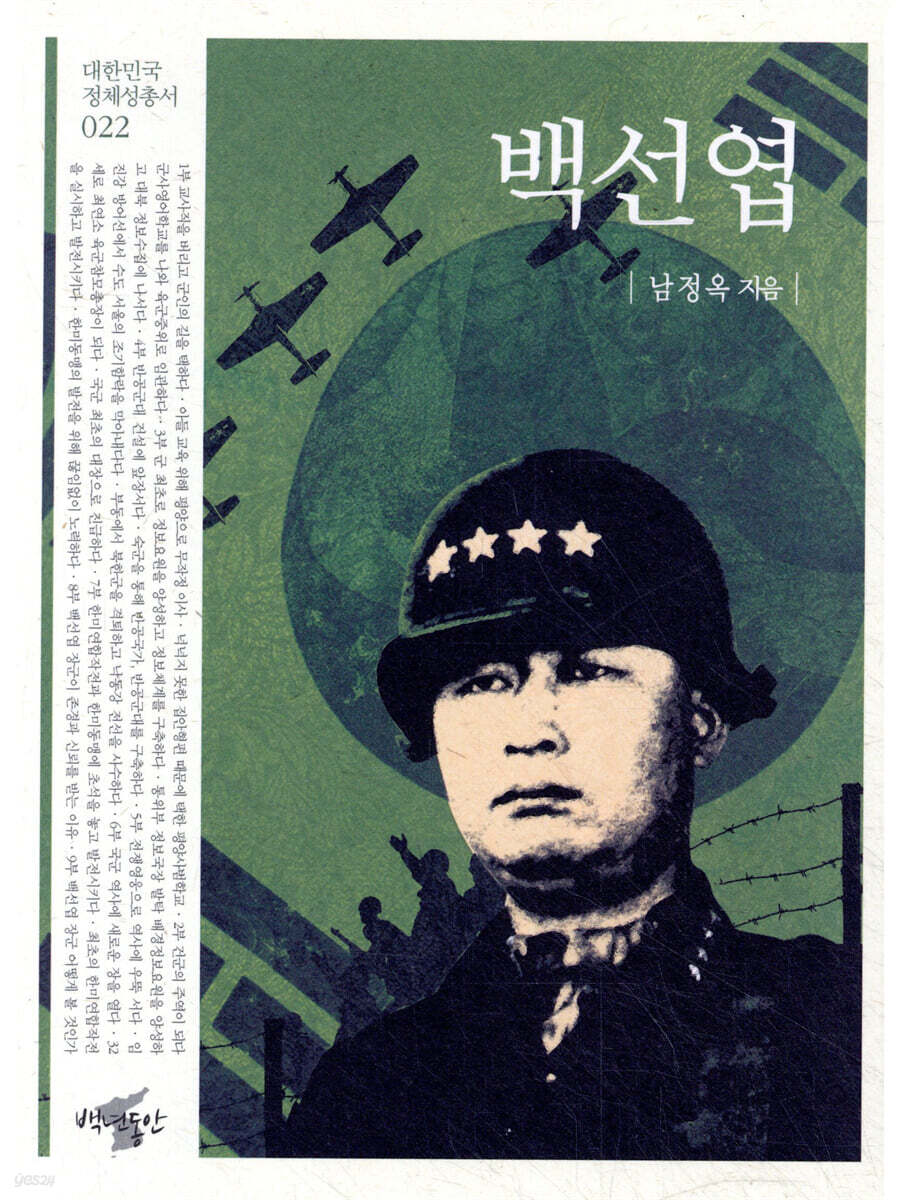 |
Description
Book Introduction
Baek Seon-yeop, the first general of the Republic of Korea: his life and struggles
A leading figure in the founding of the nation and a general who is respected and trusted by all
What is the secret behind all the first, youngest, and longest-lived records?
General Baek Seon-yeop (born 1920) is widely referred to as a “Korean War hero” or “living legendary war hero” by domestic and foreign media, academia, and U.S. military generals.
Baek Seon-yeop is a national hero who saved the Republic of Korea from the brink of collapse by defending Dabu-dong, the gateway to the temporary capital of Daegu, at the Nakdong River defense line during the most critical period of the Korean War; he is the leader of the Northward Advance Operation that won the competition against the US military with superior mobility for the North Korean capital of Pyongyang; and he is a famous general who recaptured the capital of Seoul, which had been taken from the communist army during the January 4th Retreat on March 15, 1951.
Baek Seon-yeop ended his 14-year military career as the Chairman of the Joint Chiefs of Staff (currently the Chairman of the Joint Chiefs of Staff) in 1960 and retired as an Army general.
He served as a general for 10 of his 14 years, and held the rank of general for 7 years, half of which.
Afterwards, he served as Ambassador to Free China, Ambassador to France and 13 European and African countries, Ambassador to Canada, Minister of Transportation, President of a state-owned enterprise, Chairman of the Sungwoo Association, Chairman of the Korea-US Security Research Association, Chairman of the 50th Anniversary of the Korean War Commemoration Association, and currently serves as Chairman of the Army Association.
This book seeks to capture the evaluation of General Baek Seon-yeop as a soldier.
This can be called the so-called biography of General Baek Seon-yeop.
The memoirs he has left behind are countless.
The memoir was published in Korean, Japanese, English, and Chinese versions one after another in Korea.
These memoirs provide a detailed account of Baek Seon-yeop's life.
There is nothing more detailed than these memoirs to trace Baek Seon-yeop's life.
Nevertheless, the purpose of publishing this book is not to tell Baek Seon-yeop's own story, but to objectively evaluate Baek Seon-yeop from a variety of perspectives.
Furthermore, by analyzing the limited influence Baek Seon-yeop had on the Republic of Korea and its military, we examine how much he contributed to the identity of the Republic of Korea.
In the process, we will naturally trace the footsteps of the Korean War, the ROK-US alliance, and our military.
In that respect, I recommend reading it to all military personnel, the general public, and students.
A leading figure in the founding of the nation and a general who is respected and trusted by all
What is the secret behind all the first, youngest, and longest-lived records?
General Baek Seon-yeop (born 1920) is widely referred to as a “Korean War hero” or “living legendary war hero” by domestic and foreign media, academia, and U.S. military generals.
Baek Seon-yeop is a national hero who saved the Republic of Korea from the brink of collapse by defending Dabu-dong, the gateway to the temporary capital of Daegu, at the Nakdong River defense line during the most critical period of the Korean War; he is the leader of the Northward Advance Operation that won the competition against the US military with superior mobility for the North Korean capital of Pyongyang; and he is a famous general who recaptured the capital of Seoul, which had been taken from the communist army during the January 4th Retreat on March 15, 1951.
Baek Seon-yeop ended his 14-year military career as the Chairman of the Joint Chiefs of Staff (currently the Chairman of the Joint Chiefs of Staff) in 1960 and retired as an Army general.
He served as a general for 10 of his 14 years, and held the rank of general for 7 years, half of which.
Afterwards, he served as Ambassador to Free China, Ambassador to France and 13 European and African countries, Ambassador to Canada, Minister of Transportation, President of a state-owned enterprise, Chairman of the Sungwoo Association, Chairman of the Korea-US Security Research Association, Chairman of the 50th Anniversary of the Korean War Commemoration Association, and currently serves as Chairman of the Army Association.
This book seeks to capture the evaluation of General Baek Seon-yeop as a soldier.
This can be called the so-called biography of General Baek Seon-yeop.
The memoirs he has left behind are countless.
The memoir was published in Korean, Japanese, English, and Chinese versions one after another in Korea.
These memoirs provide a detailed account of Baek Seon-yeop's life.
There is nothing more detailed than these memoirs to trace Baek Seon-yeop's life.
Nevertheless, the purpose of publishing this book is not to tell Baek Seon-yeop's own story, but to objectively evaluate Baek Seon-yeop from a variety of perspectives.
Furthermore, by analyzing the limited influence Baek Seon-yeop had on the Republic of Korea and its military, we examine how much he contributed to the identity of the Republic of Korea.
In the process, we will naturally trace the footsteps of the Korean War, the ROK-US alliance, and our military.
In that respect, I recommend reading it to all military personnel, the general public, and students.
- You can preview some of the book's contents.
Preview
index
Prologue: What Kind of Commander is Baek Seon-yeop? · 09
Part 1: Abandoning teaching and choosing the path of military service
Become a leading figure in the second part of the founding of the army
The 3rd Army was the first to train intelligence agents and establish an intelligence system.
Part 4: Leading the Construction of an Anti-Communist Army
Part 5: Standing tall in history as a war hero
Part 6: Opening a New Chapter in the History of the Korean Armed Forces
Part 7: Laying the Foundation for ROK-US Combined Operations and the ROK-US Alliance
Part 8: Why General Baek Seon-yeop is Trusted and Respected
Part 9: How should we view General Baek Seon-yeop?
Chronology · 195
References · 199
Search · 206
Part 1: Abandoning teaching and choosing the path of military service
Become a leading figure in the second part of the founding of the army
The 3rd Army was the first to train intelligence agents and establish an intelligence system.
Part 4: Leading the Construction of an Anti-Communist Army
Part 5: Standing tall in history as a war hero
Part 6: Opening a New Chapter in the History of the Korean Armed Forces
Part 7: Laying the Foundation for ROK-US Combined Operations and the ROK-US Alliance
Part 8: Why General Baek Seon-yeop is Trusted and Respected
Part 9: How should we view General Baek Seon-yeop?
Chronology · 195
References · 199
Search · 206
Into the book
General Baek Seon-yeop was one of the few combat commanders among the ROK military generals who received recognition from US military commanders.
Walton H. Walker
Walker) and Matthew B. Ridgway.
General Ridgway did, and General James A. Van Fleet did.
General Van Fleet and Maxwell D. Taylor
General Taylor cherished and respected General Baek Seon-yeop.
These were all commanders of the 8th US Army who were either Baek Seon-yeop's direct superiors or fought together in the Korean War.
These American generals unanimously praised Baek Seon-yeop's leadership as a general who had passed the harsh tests of American commanders on the battlefield.
--- p.10
The most important thing in suppressing the rebels was information.
To this end, Baek Seon-yeop looked down from the sky over Suncheon on an L-4 plane piloted by Lieutenant Jang Seong-hwan (former Chief of Staff of the Air Force) of the Army Aviation Corps, and saw that the friendly forces stationed in the suburbs showed no signs of advancing into the city.
There was nothing special about the movements of the communist rebels.
He decided that now was the right time to attack, so he loosened his tie, wrote “Launch the attack now” with a fountain pen, and threw it at the suppression forces operating on the ground.
--- p.67
Van Fleet's advice resonated deeply with Baek Seon-yeop, who would become president.
These were words that I had to keep in mind as I carried out the important task of being the president amidst the ongoing war, complex political realities, and turbulent society.
Baek Seon-yeop took these words as a golden rule and put them into practice.
His excellent performance as president was possible because of Van Fleet's advice.
In that way, Van Fleet served as a mentor to Baek Seon-yeop as a soldier and as a great senior in life.
--- p.125
Ultimately, this evaluation of Baek Sun-yup by US military commanders led to his selection as the 'Honorary Commander of the 8th US Army' in 2013.
In that respect, the Baek Seon-yeop Korea-US Alliance Award should also be viewed in that context.
It can be seen that even in the academic and media circles, they are not stingy in their evaluation of Baek Seon-yeop.
In 1995, Baek Seon-yeop was selected as one of the '100 People Who Changed Korea 50 Years After Liberation' by the academic and media circles.
Here, Baek Seon-yeop was selected as the first field commander of the Korean Army.
With this, Baek Seon-yeop solidified his position as Korea's best operational commander.
--- p.117
The purpose of this book is to provide an evaluation of General Baek Seon-yeop as a soldier.
The memoirs he has left behind are countless.
These memoirs provide a detailed account of Baek Seon-yeop's life.
Nevertheless, the reason for publishing this book is not to tell Baek Seon-yeop's own story, but to objectively evaluate Baek Seon-yeop from a variety of perspectives.
Furthermore, by examining the limited influence Baek Seon-yeop had on the Republic of Korea and its military, we aim to analyze how much he contributed to the identity of the Republic of Korea.
Walton H. Walker
Walker) and Matthew B. Ridgway.
General Ridgway did, and General James A. Van Fleet did.
General Van Fleet and Maxwell D. Taylor
General Taylor cherished and respected General Baek Seon-yeop.
These were all commanders of the 8th US Army who were either Baek Seon-yeop's direct superiors or fought together in the Korean War.
These American generals unanimously praised Baek Seon-yeop's leadership as a general who had passed the harsh tests of American commanders on the battlefield.
--- p.10
The most important thing in suppressing the rebels was information.
To this end, Baek Seon-yeop looked down from the sky over Suncheon on an L-4 plane piloted by Lieutenant Jang Seong-hwan (former Chief of Staff of the Air Force) of the Army Aviation Corps, and saw that the friendly forces stationed in the suburbs showed no signs of advancing into the city.
There was nothing special about the movements of the communist rebels.
He decided that now was the right time to attack, so he loosened his tie, wrote “Launch the attack now” with a fountain pen, and threw it at the suppression forces operating on the ground.
--- p.67
Van Fleet's advice resonated deeply with Baek Seon-yeop, who would become president.
These were words that I had to keep in mind as I carried out the important task of being the president amidst the ongoing war, complex political realities, and turbulent society.
Baek Seon-yeop took these words as a golden rule and put them into practice.
His excellent performance as president was possible because of Van Fleet's advice.
In that way, Van Fleet served as a mentor to Baek Seon-yeop as a soldier and as a great senior in life.
--- p.125
Ultimately, this evaluation of Baek Sun-yup by US military commanders led to his selection as the 'Honorary Commander of the 8th US Army' in 2013.
In that respect, the Baek Seon-yeop Korea-US Alliance Award should also be viewed in that context.
It can be seen that even in the academic and media circles, they are not stingy in their evaluation of Baek Seon-yeop.
In 1995, Baek Seon-yeop was selected as one of the '100 People Who Changed Korea 50 Years After Liberation' by the academic and media circles.
Here, Baek Seon-yeop was selected as the first field commander of the Korean Army.
With this, Baek Seon-yeop solidified his position as Korea's best operational commander.
--- p.117
The purpose of this book is to provide an evaluation of General Baek Seon-yeop as a soldier.
The memoirs he has left behind are countless.
These memoirs provide a detailed account of Baek Seon-yeop's life.
Nevertheless, the reason for publishing this book is not to tell Baek Seon-yeop's own story, but to objectively evaluate Baek Seon-yeop from a variety of perspectives.
Furthermore, by examining the limited influence Baek Seon-yeop had on the Republic of Korea and its military, we aim to analyze how much he contributed to the identity of the Republic of Korea.
--- From the text
GOODS SPECIFICS
- Date of issue: May 30, 2015
- Page count, weight, size: 212 pages | 296g | 150*198*20mm
- ISBN13: 9791186061299
- ISBN10: 1186061294
You may also like
카테고리
korean


korean

![GQ KOREA Mark (Monthly): December [2025]](http://librairie.coreenne.fr/cdn/shop/files/8ef265dbbfbf186523ed75ba7319009d.jpg?v=1765340328&width=3840)


