

Memories of Wittgenstein
 |
Description
Book Introduction
A classic memoir that most vividly reveals Wittgenstein's human side.
This is a memoir that humanizes the genius philosopher Wittgenstein, who had the greatest influence on modern philosophy.
Author Norman Malcolm vividly recalls his interactions with Wittgenstein over a dozen years.
It is structured around dialogues and anecdotes rather than philosophical discussions, allowing us to get one step closer to the inaccessible Wittgenstein.
In particular, this revised edition includes the full text of 57 letters that Wittgenstein sent to the author over a period of 11 years.
We can see not only Wittgenstein's genius, but also the gratitude, affection, jokes, and advice he showed to his acquaintances.
Also included is a biographical sketch of Wittgenstein by Wittgenstein's friend and distinguished philosopher, Jörg Henrik von Bricht.
This is a memoir that humanizes the genius philosopher Wittgenstein, who had the greatest influence on modern philosophy.
Author Norman Malcolm vividly recalls his interactions with Wittgenstein over a dozen years.
It is structured around dialogues and anecdotes rather than philosophical discussions, allowing us to get one step closer to the inaccessible Wittgenstein.
In particular, this revised edition includes the full text of 57 letters that Wittgenstein sent to the author over a period of 11 years.
We can see not only Wittgenstein's genius, but also the gratitude, affection, jokes, and advice he showed to his acquaintances.
Also included is a biographical sketch of Wittgenstein by Wittgenstein's friend and distinguished philosopher, Jörg Henrik von Bricht.
- You can preview some of the book's contents.
Preview
index
introduction
Part 1.
Electrical Sketch - Yeori Henryk von Brick
Part 2.
Wittgenstein's Memoirs - Norman Malcolm
Encounter with Wittgenstein (October 1938–February 1940)
Correspondence with Wittgenstein I (March 1940–April 1946)
Back in Cambridge (Autumn 1946 - Summer 1947)
Correspondence with Wittgenstein II (August 1947–June 1949)
Wittgenstein's visit to the United States (July 1949–October 1949)
Wittgenstein's Last Days (October 1949–April 1951)
bookkeeping
Part 3.
Wittgenstein's letters to Norman Malcolm
main
Search
Part 1.
Electrical Sketch - Yeori Henryk von Brick
Part 2.
Wittgenstein's Memoirs - Norman Malcolm
Encounter with Wittgenstein (October 1938–February 1940)
Correspondence with Wittgenstein I (March 1940–April 1946)
Back in Cambridge (Autumn 1946 - Summer 1947)
Correspondence with Wittgenstein II (August 1947–June 1949)
Wittgenstein's visit to the United States (July 1949–October 1949)
Wittgenstein's Last Days (October 1949–April 1951)
bookkeeping
Part 3.
Wittgenstein's letters to Norman Malcolm
main
Search
Detailed image
Into the book
Before he fell into a coma, he told Mrs. Bevan (who stayed by his side all night): "Tell them I had a wonderful life."
'They' undoubtedly referred to his close friends.
When I think of his profound pessimism, the intensity of his mental and moral suffering, the ruthless way in which he strained his intellectual powers, and the severity with which he refused love and the need for love, I am constantly led to believe that his life was a terrible misery.
But right at the end of his life, Wittgenstein himself exclaimed that it had been a 'wonderful' life.
I find this a mysterious and strangely moving statement. --- p.131
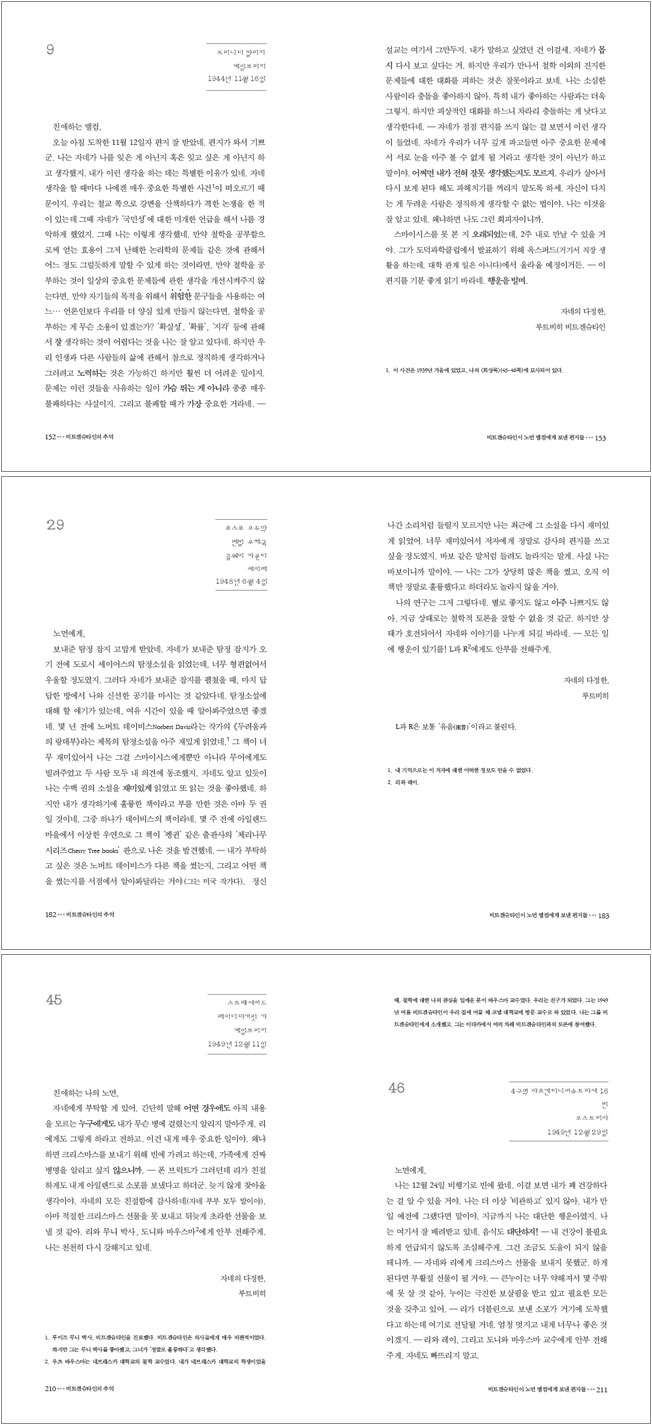
I think it would be wrong for us to avoid meeting and discussing serious issues other than philosophy.
I'm a timid person and I don't like conflict.
Especially not with someone I like.
But I think it's better to clash than to have a superficial conversation.
─ I've been thinking about this since I've been seeing you write less and less.
(…) Even if we live to see it again, let us not be afraid to dig it up.
People who are afraid of getting hurt cannot think honestly.
I know this very well.
Because I'm an avoider like that too. --- p.153
Wittgenstein sat on a plain wooden chair in the middle of the room.
Here he held his own reasons and struggled before the audience.
He often felt confused, and said so when he did.
He also frequently muttered things like, “I’m such an idiot,” “What a terrible teacher,” and “Why am I so stupid today?”
(…) Sometimes there were long silences in which no sound could be heard except Wittgenstein's occasional mutterings and the audience's breathless gazes.
In this silence, Wittgenstein thought actively in extreme tension.
His eyes were fixed on one point, his expression was lively, his hands made a conspicuous gesture, and his expression was solemn.
It was then that we realized that we were in the presence of extreme seriousness, immersion, and intellectual power. --- pp.37-38
A day or two later, I suddenly fell ill with a cold.
A young German friend named Tom Rosenmeier, concerned that I had no one to look after me, went to see Wittgenstein, knowing that we had been friends.
He was a man who had never met Wittgenstein.
When I knocked, Wittgenstein opened the door.
When Rosenmeier suddenly announced, “Malcolm is sick,” Wittgenstein immediately replied, “Wait.
“I’ll be there soon,” he replied.
The two appeared immediately.
Wittgenstein came to my bed and spoke in a rather serious tone.
“Smysis said that I misunderstood your intentions.
“If that’s the case, I’m sorry.” Then he started cleaning the room to make me more comfortable.
And he took on the task of bringing food and medicine.
'They' undoubtedly referred to his close friends.
When I think of his profound pessimism, the intensity of his mental and moral suffering, the ruthless way in which he strained his intellectual powers, and the severity with which he refused love and the need for love, I am constantly led to believe that his life was a terrible misery.
But right at the end of his life, Wittgenstein himself exclaimed that it had been a 'wonderful' life.
I find this a mysterious and strangely moving statement. --- p.131
I think it would be wrong for us to avoid meeting and discussing serious issues other than philosophy.
I'm a timid person and I don't like conflict.
Especially not with someone I like.
But I think it's better to clash than to have a superficial conversation.
─ I've been thinking about this since I've been seeing you write less and less.
(…) Even if we live to see it again, let us not be afraid to dig it up.
People who are afraid of getting hurt cannot think honestly.
I know this very well.
Because I'm an avoider like that too. --- p.153
Wittgenstein sat on a plain wooden chair in the middle of the room.
Here he held his own reasons and struggled before the audience.
He often felt confused, and said so when he did.
He also frequently muttered things like, “I’m such an idiot,” “What a terrible teacher,” and “Why am I so stupid today?”
(…) Sometimes there were long silences in which no sound could be heard except Wittgenstein's occasional mutterings and the audience's breathless gazes.
In this silence, Wittgenstein thought actively in extreme tension.
His eyes were fixed on one point, his expression was lively, his hands made a conspicuous gesture, and his expression was solemn.
It was then that we realized that we were in the presence of extreme seriousness, immersion, and intellectual power. --- pp.37-38
A day or two later, I suddenly fell ill with a cold.
A young German friend named Tom Rosenmeier, concerned that I had no one to look after me, went to see Wittgenstein, knowing that we had been friends.
He was a man who had never met Wittgenstein.
When I knocked, Wittgenstein opened the door.
When Rosenmeier suddenly announced, “Malcolm is sick,” Wittgenstein immediately replied, “Wait.
“I’ll be there soon,” he replied.
The two appeared immediately.
Wittgenstein came to my bed and spoke in a rather serious tone.
“Smysis said that I misunderstood your intentions.
“If that’s the case, I’m sorry.” Then he started cleaning the room to make me more comfortable.
And he took on the task of bringing food and medicine.
--- p.48
Publisher's Review
“Tell them, I had a wonderful life.”
Wittgenstein is the philosopher who had the greatest influence on modern philosophy, but he is famous for living a life of complete seclusion, avoiding exposure to the outside world.
His disciple and friend, Norman Malcolm, received widespread acclaim in 1958 for his vivid and moving memoir of the elusive philosopher.
Many books have been published about Wittgenstein, but none have come closer to him in a more human way than these memoirs.
The author vividly recalls his interactions with Wittgenstein over a dozen years.
It is structured around dialogues and anecdotes rather than philosophical discussions, allowing us to get one step closer to the inaccessible Wittgenstein.
By examining this human side, we can understand why Wittgenstein, despite suffering all his life from the "duties of genius," was able to say just before his death, "Tell them, I have had a wonderful life."
A classic memoir that most vividly reveals Wittgenstein's human side.
This Korean translation also has the significance of being the first to be introduced in Korea through an official contract, following the latest revision published in 2001.
The revised edition includes the full text of 57 letters Wittgenstein sent to the author over a period of 11 years.
The letters show how important friendship was to Wittgenstein.
In his letters, Wittgenstein jokes with his friends, gives them advice, scolds them, and expresses gratitude and affection.
I think it would be wrong for us to avoid meeting and discussing serious issues other than philosophy.
I'm a timid person and I don't like conflict.
Especially not with someone I like.
But I think it's better to clash than to have a superficial conversation.
(…) Even if we live to see it again, let us not be afraid to dig it up.
People who are afraid of getting hurt cannot think honestly.
I know this very well.
Because I'm an avoider like that too.
(Letter dated November 16, 1944)
His letters, which fully reveal his tireless work ethic and the consideration and affection he showed for his friends, acquaintances, and family, greatly contribute to a human understanding of this rigorous philosopher.
Finally, the book also includes a biographical sketch of Wittgenstein by Wittgenstein's friend and distinguished philosopher, Jörg Henrik von Bricht.
This is a concise yet accurate account of Wittgenstein's life.
Wittgenstein is the philosopher who had the greatest influence on modern philosophy, but he is famous for living a life of complete seclusion, avoiding exposure to the outside world.
His disciple and friend, Norman Malcolm, received widespread acclaim in 1958 for his vivid and moving memoir of the elusive philosopher.
Many books have been published about Wittgenstein, but none have come closer to him in a more human way than these memoirs.
The author vividly recalls his interactions with Wittgenstein over a dozen years.
It is structured around dialogues and anecdotes rather than philosophical discussions, allowing us to get one step closer to the inaccessible Wittgenstein.
By examining this human side, we can understand why Wittgenstein, despite suffering all his life from the "duties of genius," was able to say just before his death, "Tell them, I have had a wonderful life."
A classic memoir that most vividly reveals Wittgenstein's human side.
This Korean translation also has the significance of being the first to be introduced in Korea through an official contract, following the latest revision published in 2001.
The revised edition includes the full text of 57 letters Wittgenstein sent to the author over a period of 11 years.
The letters show how important friendship was to Wittgenstein.
In his letters, Wittgenstein jokes with his friends, gives them advice, scolds them, and expresses gratitude and affection.
I think it would be wrong for us to avoid meeting and discussing serious issues other than philosophy.
I'm a timid person and I don't like conflict.
Especially not with someone I like.
But I think it's better to clash than to have a superficial conversation.
(…) Even if we live to see it again, let us not be afraid to dig it up.
People who are afraid of getting hurt cannot think honestly.
I know this very well.
Because I'm an avoider like that too.
(Letter dated November 16, 1944)
His letters, which fully reveal his tireless work ethic and the consideration and affection he showed for his friends, acquaintances, and family, greatly contribute to a human understanding of this rigorous philosopher.
Finally, the book also includes a biographical sketch of Wittgenstein by Wittgenstein's friend and distinguished philosopher, Jörg Henrik von Bricht.
This is a concise yet accurate account of Wittgenstein's life.
GOODS SPECIFICS
- Date of publication: August 30, 2013
- Page count, weight, size: 240 pages | 328g | 143*208*20mm
- ISBN13: 9788998045265
- ISBN10: 8998045265
You may also like
카테고리
korean


korean

![GQ KOREA Mark (Monthly): December [2025]](http://librairie.coreenne.fr/cdn/shop/files/8ef265dbbfbf186523ed75ba7319009d.jpg?v=1765340328&width=3840)


