

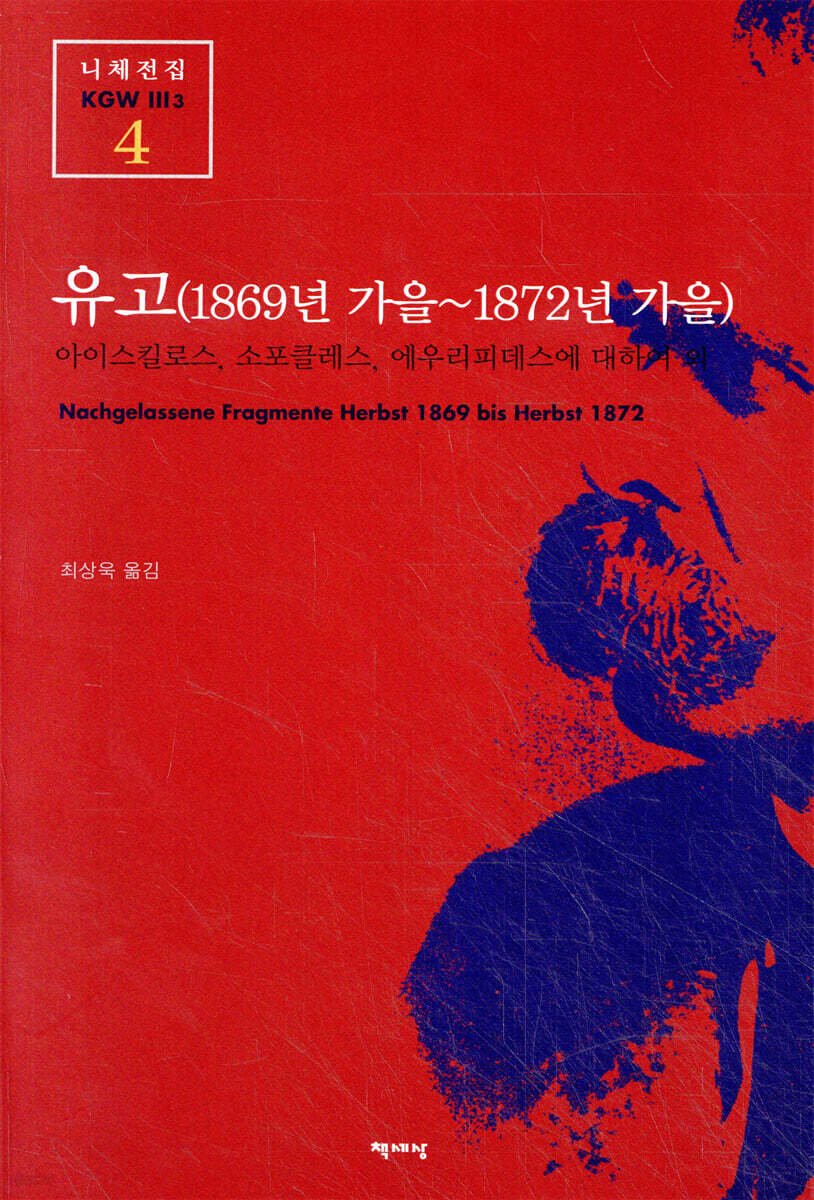
Yugoslavia (Autumn 1869 - Autumn 1872)
 |
Description
Book Introduction
This is a complete translation of Nietzsche's complete works published in Germany, and it is a compilation of Nietzsche's works from his lifetime as well as his posthumous works that served as the basis for his philosophical work or were in the process of being planned.
The contents of the anthology, which consists of a total of 18 parts, are divided into each part chronologically, and the contents are a mixture of notes on simple facts, interpretations of Nietzsche, artistic expressions, and philosophical analyses.
The contents of the anthology, which consists of a total of 18 parts, are divided into each part chronologically, and the contents are a mixture of notes on simple facts, interpretations of Nietzsche, artistic expressions, and philosophical analyses.
This is one of the complete works of Nietzsche published by Book World Publishing to commemorate the 100th anniversary of Nietzsche's death.
The complete Nietzsche works of the Book World are a translation of the remaining works, excluding the letters and commentaries, from the German publisher Walter de Gruyter's "Nietzsche Werke, Kritische Gesamtausgabe" (KGW), which is said to have provided a groundbreaking turning point in the history of Nietzsche studies. A total of 21 volumes are planned.
This complete collection embodies the pride and mission of translating the definitive version of Nietzsche's complete works, and commemorates the 100th anniversary of Nietzsche's death. It also embodies the intention to overcome the shortcomings of existing domestic Nietzsche complete works.
That is, it overcomes the problems of arbitrary translations by non-Nietzsche specialists without faithful commentary, or distortion of Nietzsche's interpretation by simply accepting concepts that came in mostly through Japan and adding haphazard annotations.
To this end, in the winter of 1998, a Nietzsche editorial committee was formed with four philosophy professors, and over the past three years, the Korean edition of the Nietzsche Complete Works has been prepared by correcting errors in Nietzsche's philosophical concepts and translations and establishing a unified plan.
By redefining translation terms and concepts that have been problematic in the domestic academic world, we will present a standard standard for Nietzsche translation, and by conveying the meaning of his metaphors and symbols to readers without the intervention of the translator, we will enable readers to fully experience Nietzsche.
In addition, we have added detailed explanations of basic explanations of Nietzsche's thought, the background of the text, and the relationships between each work to help readers easily understand the content.
Moreover, unlike books that remain stuck in archaic and outdated interpretations despite the new horizons opened up for Nietzsche studies by the discovery of his posthumous works, this collection includes Nietzsche's posthumous works.
Through this collection, readers will not only hear Nietzsche's voice vividly, but will also be able to understand the profound depth and charm of his thought, his human suffering, and the significance of his work in the history of philosophy.
This is one of the complete works of Nietzsche published by Book World Publishing to commemorate the 100th anniversary of Nietzsche's death.
The complete Nietzsche works of the Book World are a translation of the remaining works, excluding the letters and commentaries, from the German publisher Walter de Gruyter's "Nietzsche Werke, Kritische Gesamtausgabe" (KGW), which is said to have provided a groundbreaking turning point in the history of Nietzsche studies. A total of 21 volumes are planned.
This complete collection embodies the pride and mission of translating the definitive version of Nietzsche's complete works, and commemorates the 100th anniversary of Nietzsche's death. It also embodies the intention to overcome the shortcomings of existing domestic Nietzsche complete works.
That is, it overcomes the problems of arbitrary translations by non-Nietzsche specialists without faithful commentary, or distortion of Nietzsche's interpretation by simply accepting concepts that came in mostly through Japan and adding haphazard annotations.
To this end, in the winter of 1998, a Nietzsche editorial committee was formed with four philosophy professors, and over the past three years, the Korean edition of the Nietzsche Complete Works has been prepared by correcting errors in Nietzsche's philosophical concepts and translations and establishing a unified plan.
By redefining translation terms and concepts that have been problematic in the domestic academic world, we will present a standard standard for Nietzsche translation, and by conveying the meaning of his metaphors and symbols to readers without the intervention of the translator, we will enable readers to fully experience Nietzsche.
In addition, we have added detailed explanations of basic explanations of Nietzsche's thought, the background of the text, and the relationships between each work to help readers easily understand the content.
Moreover, unlike books that remain stuck in archaic and outdated interpretations despite the new horizons opened up for Nietzsche studies by the discovery of his posthumous works, this collection includes Nietzsche's posthumous works.
Through this collection, readers will not only hear Nietzsche's voice vividly, but will also be able to understand the profound depth and charm of his thought, his human agony, and the significance of his work in the history of philosophy.
The complete Nietzsche works of the Book World are a translation of the remaining works, excluding the letters and commentaries, from the German publisher Walter de Gruyter's "Nietzsche Werke, Kritische Gesamtausgabe" (KGW), which is said to have provided a groundbreaking turning point in the history of Nietzsche studies. A total of 21 volumes are planned.
This complete collection embodies the pride and mission of translating the definitive version of Nietzsche's complete works, and commemorates the 100th anniversary of Nietzsche's death. It also embodies the intention to overcome the shortcomings of existing domestic Nietzsche complete works.
That is, it overcomes the problems of arbitrary translations by non-Nietzsche specialists without faithful commentary, or distortion of Nietzsche's interpretation by simply accepting concepts that came in mostly through Japan and adding haphazard annotations.
To this end, in the winter of 1998, a Nietzsche editorial committee was formed with four philosophy professors, and over the past three years, the Korean edition of the Nietzsche Complete Works has been prepared by correcting errors in Nietzsche's philosophical concepts and translations and establishing a unified plan.
By redefining translation terms and concepts that have been problematic in the domestic academic world, we will present a standard standard for Nietzsche translation, and by conveying the meaning of his metaphors and symbols to readers without the intervention of the translator, we will enable readers to fully experience Nietzsche.
In addition, we have added detailed explanations of basic explanations of Nietzsche's thought, the background of the text, and the relationships between each work to help readers easily understand the content.
Moreover, unlike books that remain stuck in archaic and outdated interpretations despite the new horizons opened up for Nietzsche studies by the discovery of his posthumous works, this collection includes Nietzsche's posthumous works.
Through this collection, readers will not only hear Nietzsche's voice vividly, but will also be able to understand the profound depth and charm of his thought, his human suffering, and the significance of his work in the history of philosophy.
This is one of the complete works of Nietzsche published by Book World Publishing to commemorate the 100th anniversary of Nietzsche's death.
The complete Nietzsche works of the Book World are a translation of the remaining works, excluding the letters and commentaries, from the German publisher Walter de Gruyter's "Nietzsche Werke, Kritische Gesamtausgabe" (KGW), which is said to have provided a groundbreaking turning point in the history of Nietzsche studies. A total of 21 volumes are planned.
This complete collection embodies the pride and mission of translating the definitive version of Nietzsche's complete works, and commemorates the 100th anniversary of Nietzsche's death. It also embodies the intention to overcome the shortcomings of existing domestic Nietzsche complete works.
That is, it overcomes the problems of arbitrary translations by non-Nietzsche specialists without faithful commentary, or distortion of Nietzsche's interpretation by simply accepting concepts that came in mostly through Japan and adding haphazard annotations.
To this end, in the winter of 1998, a Nietzsche editorial committee was formed with four philosophy professors, and over the past three years, the Korean edition of the Nietzsche Complete Works has been prepared by correcting errors in Nietzsche's philosophical concepts and translations and establishing a unified plan.
By redefining translation terms and concepts that have been problematic in the domestic academic world, we will present a standard standard for Nietzsche translation, and by conveying the meaning of his metaphors and symbols to readers without the intervention of the translator, we will enable readers to fully experience Nietzsche.
In addition, we have added detailed explanations of basic explanations of Nietzsche's thought, the background of the text, and the relationships between each work to help readers easily understand the content.
Moreover, unlike books that remain stuck in archaic and outdated interpretations despite the new horizons opened up for Nietzsche studies by the discovery of his posthumous works, this collection includes Nietzsche's posthumous works.
Through this collection, readers will not only hear Nietzsche's voice vividly, but will also be able to understand the profound depth and charm of his thought, his human agony, and the significance of his work in the history of philosophy.
index
1 = P II 1b.
Fall 1869
2 = PI 14b.
Winter 1869/70 - Spring 1870
3 = PI 15a.
Winter 1869/70 - Spring 1870
4 = NI 1.
August–September 1870
5 = UI 3-3a.
September 1870 - January 1871
6 = UI 1.
Late 1870s
7 = UI 2b.
Late 1870–April 1871
8 = UI 5a.
Winter 1870/71 - Autumn 1872
9 = UI 4a.
1871
10 = Mp XII 1c.
Early 1871
11 = Mp XII 1b.
February 1871
12 = Mp XII 1d.
Spring 1871
13 = Mp XII 1a.
Spring-Autumn 1871
14 = PI 16b.
Spring 1871 - Early 1872
15 = UI 6a.
July 1871
16 = P II 8b.
Summer 1871 - Spring 1872
17 = NI 2.
September–October 1871
18 = Mp XII 2.
Late 1871–Spring 1872
Fall 1869
2 = PI 14b.
Winter 1869/70 - Spring 1870
3 = PI 15a.
Winter 1869/70 - Spring 1870
4 = NI 1.
August–September 1870
5 = UI 3-3a.
September 1870 - January 1871
6 = UI 1.
Late 1870s
7 = UI 2b.
Late 1870–April 1871
8 = UI 5a.
Winter 1870/71 - Autumn 1872
9 = UI 4a.
1871
10 = Mp XII 1c.
Early 1871
11 = Mp XII 1b.
February 1871
12 = Mp XII 1d.
Spring 1871
13 = Mp XII 1a.
Spring-Autumn 1871
14 = PI 16b.
Spring 1871 - Early 1872
15 = UI 6a.
July 1871
16 = P II 8b.
Summer 1871 - Spring 1872
17 = NI 2.
September–October 1871
18 = Mp XII 2.
Late 1871–Spring 1872
Into the book
The individual receives everything from the state in order to give everything back to the state.
According to this, what women mean to a nation is the same as sleep to men.
In the essence of sleep lies the healing power that replenishes what has been consumed, the beneficial rest in which all that is excessive is limited, and the eternal sameness by which the excessive and the superfluous are regulated.
In her, future generations dream.
Women are closer to nature than men, and remain equal in all essential things.
Here culture is always something superficial, something that does not touch the core that is eternally faithful to nature, and for that reason the culture of women appeared to the Athenians as something indifferent, that is to say, something ridiculous, if one were only to try to actualize it.
Anyone who would immediately infer from this fact that the position of women in Greece was necessarily inferior and too harsh should not base their guiding principle solely on the 'culture' of modern women and their demands for it.
According to this, what women mean to a nation is the same as sleep to men.
In the essence of sleep lies the healing power that replenishes what has been consumed, the beneficial rest in which all that is excessive is limited, and the eternal sameness by which the excessive and the superfluous are regulated.
In her, future generations dream.
Women are closer to nature than men, and remain equal in all essential things.
Here culture is always something superficial, something that does not touch the core that is eternally faithful to nature, and for that reason the culture of women appeared to the Athenians as something indifferent, that is to say, something ridiculous, if one were only to try to actualize it.
Anyone who would immediately infer from this fact that the position of women in Greece was necessarily inferior and too harsh should not base their guiding principle solely on the 'culture' of modern women and their demands for it.
---p.
225
225
Publisher's Review
This is the posthumous work that formed the basis of Nietzsche's famous work, The Birth of Tragedy. It is an important work that contains Nietzsche's early thoughts, showing the interests that flow throughout the posthumous collection and how those interests lead to his later thoughts.
Moreover, in this manuscript, all the important concepts that appear in his later works, such as 'will', 'art', 'genius', 'the relationship between cognition and action', and 'Socrates', appear, so readers will be able to escape to some extent the danger of schematic and chronological classification of Nietzsche's thought.
Moreover, in this manuscript, all the important concepts that appear in his later works, such as 'will', 'art', 'genius', 'the relationship between cognition and action', and 'Socrates', appear, so readers will be able to escape to some extent the danger of schematic and chronological classification of Nietzsche's thought.
GOODS SPECIFICS
- Date of issue: January 31, 2001
- Format: Paperback book binding method guide
- Page count, weight, size: 574 pages | 952g | 152*225*35mm
- ISBN13: 9788970132402
- ISBN10: 8970132406
You may also like
카테고리
korean


korean

![GQ KOREA Mark (Monthly): December [2025]](http://librairie.coreenne.fr/cdn/shop/files/8ef265dbbfbf186523ed75ba7319009d.jpg?v=1765340328&width=3840)


